What Does the U.S. Supreme Court Do? Roles, Responsibilities, and Why It Matters
Often called the “highest court in the land,” the U.S. Supreme Court sits at the top of the American justice system. But despite its influence, the Court hears only a tiny fraction of the cases sent its way.
Each year, the Supreme Court receives around 10,000 petitions, yet it only agrees to hear about 70 to 80 cases. When the Court declines a case, the lower court’s ruling usually stands, making the Supreme Court the final word in many legal disputes.
So, what does the Supreme Court actually do, and why does it matter?
The Role of the Supreme Court in the U.S. Justice System
At its core, the Supreme Court’s role is to interpret the U.S. Constitution and ensure that federal and state laws align with it. Its decisions affect how laws are applied nationwide, shaping issues like voting rights, criminal sentencing, and the balance of power between state and federal governments.
In simple terms, the Supreme Court:
Interprets the Constitution
Resolves disputes involving federal law
Reviews decisions from lower courts
Sets legal precedents that guide future cases
Because its rulings apply across the country, the Supreme Court plays a critical role in maintaining consistency within the justice system.
How Are the Federal Courts Structured?
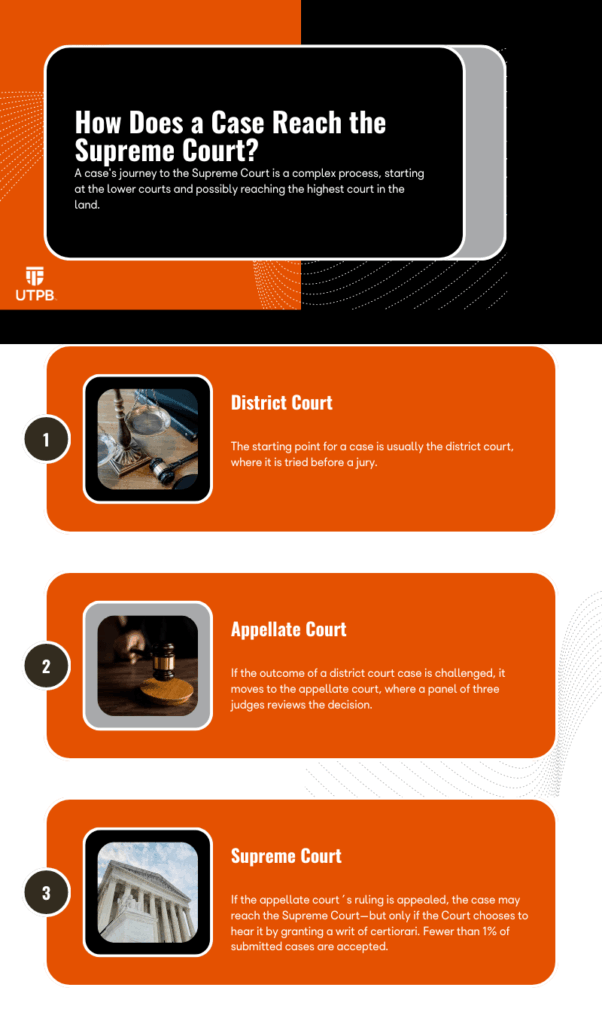
The Supreme Court sits at the top of a broader federal court system that includes two main levels below it: the U.S. District Courts and the U.S. Courts of Appeals.
U.S. District Courts
District courts are trial-level courts where federal cases begin. There are 94 district courts across the country, where judges hear cases involving federal law, often with juries present.
U.S. Courts of Appeals
Above the district courts are the U.S. Courts of Appeals, also known as circuit courts. These courts review district court decisions to determine whether the law was applied correctly.
Appellate courts don’t use juries. Rather, they employ panels of judges who evaluate legal arguments and issue rulings.
What Does the Supreme Court Do With Appeals?
After a case moves through lower courts, a party may ask the Supreme Court to review it by filing a writ of certiorari. The Court is not required to accept these requests—and in fact, it accepts fewer than 1% of them.
The justices use the “rule of four” to decide which cases to hear. If at least four of the nine justices agree that a case is significant, the Court will review it.
Once the Supreme Court issues a decision, that ruling is typically final unless:
A constitutional amendment overturns it, or
The Court later reverses itself in a future case
Why the Supreme Court Matters
The Supreme Court’s responsibilities extend far beyond individual cases. Its rulings influence civil rights, federal authority, voting laws, business regulations, and many other aspects of daily life.
Because of this reach, understanding the role of the Supreme Court is essential for anyone interested in:
Law and public policy
Criminal justice
Government and public service
Constitutional rights
Study the U.S. Justice System Online at UT Permian Basin
If you’re interested in how courts function—from trial courts to the Supreme Court—The University of Texas Permian Basin offers flexible online programs that explore the justice system in depth.
Social media has turned politics into a constant conversation. Not long ago, campaigns relied on TV ads, newspaper coverage, and door-knocking to reach voters. Now, candidates can post directly to millions of people before the evening news even airs. That access is powerful. It can help campaigns mobilize voters, respond quickly, and make political participation feel more…
Watch any televised trial and you’ll hear terms like “discovery,” “objection,” and “subpoena,” being thrown around, but what do they mean? That’s what we’re here to find out. Here are 10 of the most common criminal justice terms. We hope to provide some insight into the complex legal system and the essential roles performed by…
Ever wonder how elections actually work? The answer lies in electoral systems. Not to be confused with the Electoral College, an electoral system is a set of rules for casting and counting votes and determining who wins. Different countries use different methods to choose their leaders. Some systems can declare a winner with just 34%…