The Evolution of E-Commerce: A Timeline of Online Shopping
E-commerce has evolved from a niche online activity to a central part of everyday shopping and business. Since the 1990s, we’ve had major advancements in internet access, mobile technology, and digital marketing. These online upgrades have transformed how companies sell products and how consumers buy them.
One early milestone came on April 3, 1995, when Amazon recorded its first purchase from a non-employee customer. That was the beginning of Amazon’s journey to becoming the world’s largest e-commerce platform.
Let’s look back at the evolution of e-commerce and how it continues to shape our society.
What Is E-Commerce?
E-commerce, short for electronic commerce, is the buying and selling of goods or services online. It covers the full transaction, from finding a product and placing the order to paying for it and figuring out how it’ll make its way to your front door.
If you’ve ordered dinner through an app or bought something from your phone at 11 p.m., you’ve used e-commerce.
And these days, e-commerce can happen almost anywhere: a retailer’s website, a mobile app, an online marketplace, or even your social media feed. Businesses can sell directly to consumers, companies can sell to other companies, and individuals can sell to one another through platforms like eBay or Facebook Marketplace.
Online shopping feels completely normal now. Most of us barely think twice before pressing “buy now.” But getting here required decades of new technology, changing customer habits, and businesses willing to experiment with completely new ways to sell.
How Did E-Commerce Begin?
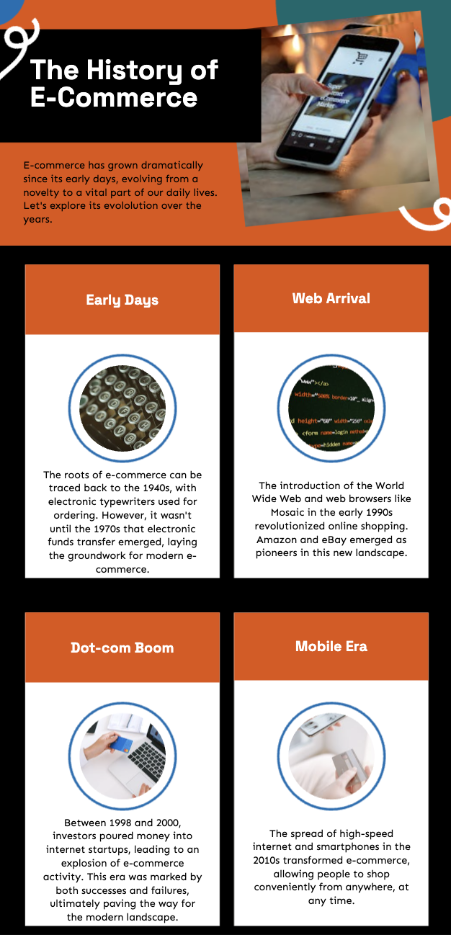
The origins of e-commerce can be traced back to the 1948-49 Berlin Blockade, which saw West Germany ordering supplies using a system of electronic typewriters called telex.
However, it wasn’t until the early 1970s that we began seeing innovations that would become staples of modern e-commerce, such as electronic funds transfer (EFT). At the time, e-commerce was little more than a convenient way to exchange documents within a company.
Everything changed with the introduction of the World Wide Web in 1991 and the web browser Mosaic, the precursor to Internet Explorer, two years later. These advancements provided the means for the public to search for and purchase products online. E-commerce transitioned to the internet soon after, and it wasn’t long before two of the world’s largest online retailers came on the scene: Amazon and eBay.
How Did the Dot-Com Boom Shape E-Commerce?
E-commerce exploded as internet service providers like AOL connected tens of millions of homes to the web. Excitement reached a fever pitch between 1998 and 2000 as investors poured money into internet startups.
This era is known as the dot-com bubble, a period marked by many promising but ultimately unprofitable online companies. Notoriously, online fashion retailer Boo.com burned through $185 million in 18 months before going bankrupt. The bubble burst in 2000 but left behind a robust digital infrastructure that paved the way for modern e-commerce.
What Does E-Commerce Look Like Today?
E-commerce sales worldwide reached an estimated 5.8 trillion in 2024. This explosive growth has been fueled by increased access to high-speed internet and the spread of smartphones, which are owned by over 5 billion people globally.
Online shoppers, once at the mercy of dial-up connections, can now shop anywhere. They can roll over in the middle of the night, fumble for their phone in the dark, and place an order with a single click.
E-commerce is now a part of everyday life.
Amazon, Walmart, and eBay remain the largest e-commerce companies, but the way they conduct business is far more refined than it was in the early days of e-commerce. Websites are clean and responsive. Search engines make finding deals easy and even make recommendations based on a person’s search history. And customizable orders give buyers more options and more control over their online shopping experience than ever before.
How Do Businesses Reach Online Buyers Today?
This evolving ecosystem also offers new ways for companies to reach customers. Email, text message, social media, and influencer marketing campaigns are all normal facets of online retail marketing.
Buyers are encouraged to leave reviews, opt into mailing lists, join loyalty programs, and post on social media, all to build an emotional connection between them and a brand. In this new ecosystem, there’s no right way but many possible ways to reach buyers, and they must all be accounted for if businesses are to thrive in this competitive environment.
What’s the Future of E-Commerce?
E-commerce will continue to become more personalized and easier to use. A few developments are already giving us a pretty good idea of where it’s heading:
AI-assisted shopping: AI tools can recommend products, answer questions, and help shoppers compare options without opening 27 different tabs.
Social commerce: People can discover a product in a creator’s video, read the comments, and buy it without leaving the app.
Connected shopping: Features like local pickup, real-time inventory, and virtual try-ons are making online and in-store shopping feel more connected.
Whatever comes next, customers will still expect the basics: an easy shopping experience, accurate delivery updates, and returns that don’t require a minor investigation.
Expand Your Knowledge of Digital Marketing
The evolution of e-commerce has led to an ecosystem where anyone can open an online shop and compete with leading retailers. Etsy is famous for its marketplace of one-of-a-kind items made by fledgling entrepreneurs. But, this diverse landscape of leading retailers and independent sellers means that your marketing strategy has to be louder, bolder, and smarter to make an impact.
Earn an Online Undergraduate Certificate in Digital Marketing
UT Permian Basin’s College of Business offers an online undergraduate certificate in digital marketing. Accredited by the prestigious Association to Advance Collegiate Schools of Business (AACSB International), our online undergraduate certificate in digital marketing program will provide you with the foundational knowledge you need to develop and implement brand, marketing, and social media campaigns.
In addition to exploring the many facets of e-commerce, our program looks at:
Digital branding
E-marketing
Digital advertising
Digital marketing analytics
Social media marketing
This 12-credit certificate program can be completed in tandem with any of our undergraduate bachelor’s degree programs, such as our Bachelor of Business Administration in Marketing. Attend UT Permian Basin online, and you’ll be able to enter the world of marketing with both a bachelor’s degree and an undergraduate certificate on your resume.
Growing a small business can feel like building the plane while flying it. You’re attracting customers, watching cash flow, fixing whatever broke that morning, and somehow also planning for next year. No pressure. Thankfully, a clear growth strategy can make things more manageable. By choosing the right goals, understanding what customers need, and building systems that can support expansion, you can…
Gen Z and younger millennials haven’t just entered the consumer marketplace. They’re reshaping it. According to a 2024 survey, 20% of U.S. consumers made purchases on a social media platform at least weekly. This means Gen Z and millennials are setting the tone for how future generations will discover and buy from brands. These digital…
Honoring and celebrating our mothers has been a global tradition throughout history. Although Mother’s Day was officially declared a U.S. holiday in 1914, its origins date back centuries. People have honored their mothers across cultures and time periods through festivals, religious observances, and communal gatherings. Understanding the historical significance of holidays like Mother’s Day provides…