British English vs. American English: Key Differences and Examples
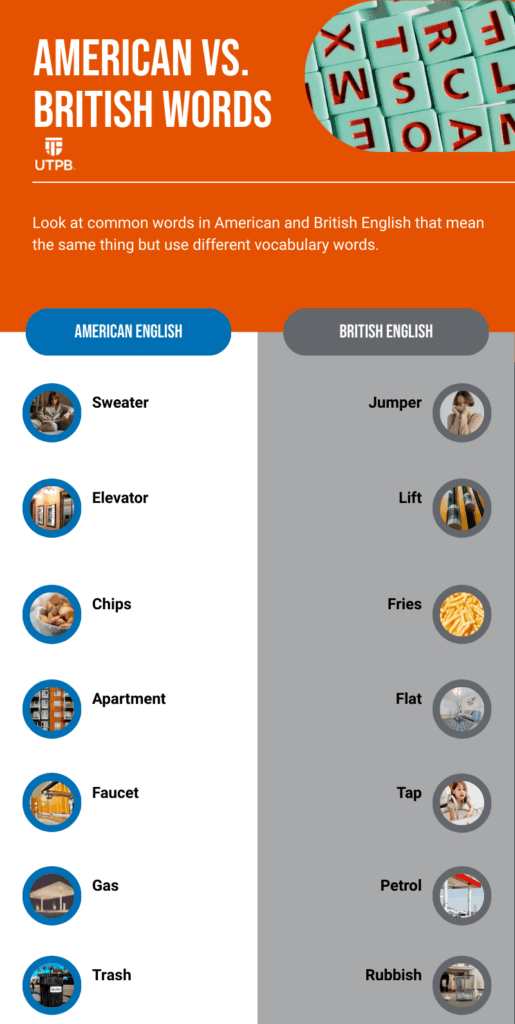
British and American English are two varieties of the same language, but they don’t always use the same words, spelling or grammar. They don’t always sound the same, either. A British speaker may take the lift to their flat, while an American takes the elevator to their apartment.
Most of these differences won’t stop people from understanding each other, but they can still cause confusion. Let’s look at why British and American English developed differently and compare some of the biggest differences between them.
British vs. American English at a Glance
Here are a few common differences you may notice:
Category
British English
American English
Vocabulary
lift
elevator
Vocabulary
flat
apartment
Vocabulary
boot
trunk
Spelling
colour
color
Spelling
centre
center
Recent action
I have just eaten.
I just ate.
Preposition
at the weekend
on the weekend
Collective noun
The team are winning.
The team is winning.
These are common patterns rather than strict rules. Usage can change depending on the speaker, region and context.How British and American English Developed Differently
British English originated from Old English, called Englisċ, with the arrival of the Anglo-Saxons in the 5th century. It developed further with influence from Latin, Norse, and Norman French. Modern English emerged around the 16th century and brought with it a standardization of grammar and spelling.
When British settlers brought English to America in the 17th century, it began to evolve separately due to cultural and environmental changes. Later, Americans pushing westward on the frontier in the 19th century often coined new words when needed, and the 20% of settlers who spoke a language other than English also influenced its early development.
Vocabulary Differences Between British and American English
One of the most noticeable differences between British and American English is their vocabulary. While “autumn” and “fall” are used in both variants, British English speakers prefer “autumn” — from the Latin “autumnus” — while Americans favor “fall,” derived from the 16th century British expression “fall of the leaf.”Some words people think of as distinctly American even began in Britain. “Soccer,” for example, was coined in Britain as a shortened form of “association football.” The word eventually fell out of favor there but remained common in the United States.
In some cases, words that are commonly used in one variant may be unfamiliar or have different meanings in the other. For example:
Spelling Differences Between British and American English
British English spelling was inconsistent before the invention of the printing press, as evidenced by Middle English classics like Geoffrey Chaucer’s “The Canterbury Tales,” published in the late 14th century.
British spelling became standardized after Samuel Johnson published “A Dictionary of the English Language” in 1755. In response, Americans created their own standard with Noah Webster’s “An American Dictionary of the English Language” in 1828. Webster aimed to simplify English spelling and reflect pronunciation more closely, likely influenced by the United States’ newfound independence from Great Britain. Grammar Differences Between British English and American English While the basic rules of English grammar remain consistent across both variants, there are subtle differences. British English speakers often use the present perfect tense to describe recent actions with present relevance, while American English speakers commonly use the simple past tense.
An example would be:
British English: “I have just eaten.”
American English: “I just ate.”
Prepositions and collective nouns also often differ slightly between the two dialects. A British speaker may say “at the weekend” while an American says “on the weekend.” In British English, “the team are winning,” while in American English, “the team is winning.”
How British and American English Pronunciation Differs British and American speakers are easily distinguishable by their pronunciation and enunciation. The most noticeable difference is the use of the letter “r.” Many British accents, especially Received Pronunciation (RP), do not pronounce the “r” at the end of words before consonants (e.g., “car” sounds like “cah”). Most American English accents are rhotic, pronouncing all instances of “r.”
Regional accents can vary, however, and some regions of England (such as Cornwall) use rhotic pronunciation, while some U.S. dialects like the Boston accent drop the “r” sound.
Confused yet? These differences extend to vowels, as well. American English speakers tend to emphasize vowels, while British speakers use different vowel sounds and enunciate the entire word more distinctly. For instance, in British English, “bath” is pronounced with a broad “a” (like in “ah”), while in American English, it has a short, elongated “a” sound.
Common Idioms in British and American English
Idioms reflect cultural differences and historical contexts, so it’s unsurprising that British and American English differ here as well. Some idioms like “break the ice,” which originated from ships breaking through frozen waters, are used in both variants. But most idioms have evolved to incorporate local culture and experiences.
For example:
British English: Tea is a cultural staple in the British Isles, and the idiom “t’s not my cup of tea” (it’s not to my taste) is very common.
American English: Baseball is a popular sport in the United States, and the idiom “ballpark figure” is commonly used to refer to an estimate of cost or quantity, similar to the term “ballpark” referring to a general area or range in baseball.
Explore the Rich Diversity of the English Language at The University of Texas Permian Basin
Are you fascinated by the contextual and historical differences between British and American English? Consider The University of Texas Permian Basin’s two English programs:
Both programs are taught entirely online and cover linguistic differences, literature, and cultural contexts, equipping students with a profound understanding of the English language. While our online MA in English requires a bachelor’s degree, it can lead to higher earnings and opportunities for doctoral studies or a career in law.
Graduates pursue careers in fields like:
Education
Publishing
Communication
Civil services
Advertising
An English degree is incredibly versatile, leading to many diverse opportunities based on your interests and goals. If you’re passionate about the English language and want to explore its rich diversity, take the next step in your educational journey and apply here.
We’re back with five more feminist writers who changed history. If you didn’t catch our first list, you can find it here. History is replete with authors and poets who turned pain into prose, giving voice to the women of their time. There are so many feminist writers worth mentioning (and reading); we couldn’t possibly…
Many of us have experienced misunderstandings due to miscommunication. For example, you might ask your partner to help with a chore around the house, shouting, “Can I get a hand?” They reply, “Be there in a minute!” But five minutes later, you’re frustrated—because to you, “a minute” means exactly 60 seconds, while to them, it…
The Age of Johnson was an eighteenth-century period of English literature named for Samuel Johnson (1709-1784), an acclaimed poet, essayist, literary critic, lexicographer, and biographer. Also referred to as the Age of Sensibility, the Age of Johnson was nestled between the Augustan Age—distinguished by writers such as Jonathan Swift and Alexander Pope—and the Romantic period,…