Undecided Major? How to Choose a College Path Without Spiraling
Choosing a college major can feel like you’re mapping out your entire adult life before you’ve even figured out how you like your coffee. (Some of us claimed we liked it black for a whole semester because it sounded like the cool answer.)
What if you choose incorrectly? What if you lose interest? What if the subject you love leads to a career you don’t actually want?
Take a breath. Your major matters, but you don’t need a perfectly detailed career plan to move forward. Start with your interests, strengths, and priorities, then narrow down your search from there.
In this article, we’ll cover how to narrow down your options, research careers, and choose a college path … without drafting your 40-year plan.
Is It Normal to Be Undecided About Your Major?
Yes, it’s normal to be undecided about your major. Some students arrive at college with a career in mind, while others need time and experience to figure out their best fit.
Even students who declare a major early sometimes change direction. According to the National Center for Education Statistics, about 30% of undergraduate students who declared a major changed it at least once within three years of enrolling. So if you’re not sure yet? Totally normal.
Some people have known they wanted to become veterinarians since they met their first, floppy-eared golden retriever. The rest of us may need more information—and that’s okay.
Use the time before you declare a major to research your options instead of waiting for the perfect answer to appear.
Do You Need to Choose a Career Before Choosing a Major?
No. You don’t need to choose one lifelong career before choosing a college major.
Some majors prepare students for a direct professional path. Nursing students, for example, usually plan to enter the nursing field.
But other majors can lead to several industries. A communication graduate might work in public relations, marketing, media, or fundraising. A psychology major could pursue human resources, social services, research, or counseling, although some roles require graduate education or licensure.
I was an English major, became a teacher, and later moved into marketing with exactly zero formal marketing experience. My writing, research, and communication skills came with me, even when the job title changed completely.
The takeaway: Your career may shift as you gain experience. For now, choose a direction that offers useful knowledge, transferable skills, and room to grow.
What Major Is Right for Me?
The right major should fit your interests, abilities, values, and career goals.
Start by asking yourself:
Which subjects or activities hold my attention?
Which skills come naturally to me?
What types of problems do I enjoy solving?
Do I prefer working with people, ideas, numbers, or technology?
What do I want my daily working life to look like?
Look for patterns rather than one dramatic lightbulb moment.
For example, a student who loves writing might initially consider English. But looking more closely at what they enjoy about writing could also lead them toward communication, marketing, public relations, or political science.
How Can You Narrow Down Your Major Options?
Start by choosing three to five reasonable possibilities. You only need enough interest in each one to look more closely.
For each major on your list:
Review the courses and skills involved.
Research careers connected to the degree, including any additional education they require.
Compare internship or experiential learning opportunities.
Pay attention to which options still interest you after the initial research.
And when in doubt, there’s usually a table to help you make a big life decision. Use this one to compare the factors that matter most to you:
Factor
Question to Ask
Required courses
Do the classes sound interesting and manageable?
Career options
What jobs could this major help me pursue?
Additional education
Will my preferred career require graduate school, certification, or licensure?
Time to graduate
Could choosing or changing this major add semesters or credits?
Personal priorities
How important are salary, flexibility, stability, location, or creativity to me?
As you compare programs, ask, “What can I do with my major?”
And look beyond the most recognizable job title. Many degrees lead to a wider variety of roles than students initially realize. An accounting major, for example, could pursue work in auditing, financial analysis, forensic accounting, tax consulting, compliance, or corporate finance. Becoming an accountant is only one possible path.
How Can Students Explore Career Paths Before Choosing a Major?
Students can research career paths through courses, conversations, and low-risk experiences.
Career planning for students doesn’t have to begin with a formal five-year plan. You could:
Take an introductory course in a subject you’re considering.
Attend a career panel, university event, or student organization meeting.
Talk with a professor in the department your potential major is in.
Interview or shadow someone who works in your target field.
Volunteer, try a related project, or apply for an internship.
If you’re more of a “take action from my phone” type of researcher, watch a few “day in the life” videos or browse Reddit discussions to hear honest firsthand experiences. But keep in mind that one person’s experience won’t represent an entire profession.
And if you’re wondering how to choose a career path, focus on what professionals do during an ordinary workday. The daily responsibilities, schedule, work environment, and education requirements will tell you a lot more than a job title alone.
Who Can Help You Choose a College Major?
Academic advisors, career counselors, faculty members, alumni, and working professionals can help you make an informed decision. I say this from experience: “What can I do with this degree?” will usually lead to a more useful conversation than “Please tell me what to do with my life.” (Even if both are completely valid questions.)
Instead, ask which courses offer the best introduction to the field, where graduates tend to work, and what would happen if you changed majors later.
What Happens If You Choose the Wrong Major?
If your first major doesn’t fit, an academic advisor can help you consider changing it.
A change may affect your course plan, graduation timeline, or financial aid, so ask questions early. Completed courses may still count toward general education requirements, electives, or another program.
Discovering that a subject isn’t right for you can still move you forward. Maybe you enjoy psychology but don’t want to pursue the required graduate education. Perhaps you like studying business but are finding that marketing interests you more than accounting. Now you have a clearer idea of what to try next.
Start Where You Are
You don’t need absolute certainty to choose a college path. You just need enough information to take the next reasonable step.
Choose a few majors, review their courses, research related careers, and talk with someone who can help. Each step can bring the bigger picture into focus.
The University of Texas Permian Basin offers 100% online undergraduate programs in fields like business, communication, criminal justice, English, healthcare, industrial technology, political science, psychology, sociology, and more. With flexible online learning, you can begin building a degree around your goals and your life—even if you’re still working out exactly where your path may lead.
Choosing a college major can feel like you’re mapping out your entire adult life before you’ve even figured out how you like your coffee. (Some of us claimed we liked it black for a whole semester because it sounded like the cool answer.) What if you choose incorrectly? What if you lose interest? What if the subject you love leads to a career you…
You only get one chance to make a first impression. Cover letters have long been one of the best ways to set yourself apart in a competitive market. But in the era of AI screeners, even the most polished resumes—and their accompanying cover letters—feel like they’re disappearing into the void. With the job market more…
Getting accepted to The University of Texas Permian Basin is a big milestone. If you’re a working professional, the next step—asking your employer about tuition reimbursement—can feel a little intimidating. But it doesn’t have to be. Most organizations want employees who grow, stay, and contribute at a higher level. And many companies offer tuition reimbursement,…
You only get one chance to make a first impression.
Cover letters have long been one of the best ways to set yourself apart in a competitive market. But in the era of AI screeners, even the most polished resumes—and their accompanying cover letters—feel like they’re disappearing into the void. With the job market more competitive than ever, job seekers need every advantage they can get.
Do I Need a Cover Letter?
Yes, you do need a cover letter. Cover letters can be a pain to put together and personalize, and there’s always the possibility that they go unread. But with a few exceptions (we’ll get to those) they remain the best way to tell hiring managers and recruiters who you are and where you see yourself in their company.
Let’s put it this way: A resume, no matter how polished, will never carry your voice like a cover letter. Hiring managers may not have the time (or motivation) to read every cover letter sent to their inbox, but you can be sure they’ll read those belonging to the strongest candidates.
Who is a hiring manager more likely to hire: someone who took time to personalize a cover letter for a specific company and role, or someone who uses the same template for every application?
Customization matters. Most hiring managers say a tailored cover letter is now non‑negotiable and routinely reject generic letters.
Here are three situations where you absolutely need a cover letter:
A cover letter is required or even just allowed. If a job application requires a cover letter, include one. If it’s optional, attach one anyway. In many fields, employers still use cover letters to gauge communication skills and motivation.
You need to provide context to your resume. Life happens. If you have an employment gap, you’re hoping to advance your career, or you’re pursuing a job in another city or industry, a cover letter can provide the context your resume can’t.
Someone in the company referred you. If someone referred you, give them a shout-out in your cover letter. It’ll help explain why you’re applying and remind the hiring manager that someone on their team has already vouched for you.
There are, however, a few rare occasions when a cover letter isn’t needed:
There isn’t an option to include it with your resume. Employers are looking for candidates who can follow directions. If there isn’t an option to include a cover letter or the job description instructs you not to include one, don’t.
You’re applying to high-volume, hourly, or frontline roles. In fast-paced fields like retail and hospitality, employers are more interested in your skills, availability, and track record than a letter. A cover letter still wouldn’t hurt, but you can usually skip it.
You don’t have time to personalize your cover letter. Sometimes, there isn’t enough time, energy, or motivation to write a meaningful letter. In that case, it’s better to skip the cover letter than send one that feels rushed, generic, or copy-and-pasted.
How to Write a Cover Letter (That Will Actually Be Read)
Templates are fine as a starting point, especially if you’re applying to many jobs. Just be sure to keep these tips in mind before submitting your next application.
Follow the instructions. Watch for outside-the-box directions meant to trip up inattentive applicants. Some employers test whether candidates actually read instructions—like asking you to mention a specific word in your opening paragraph. (The writer of this post was once instructed to attach a picture of a rubber duck to his cover letter.)
Keep it to one page. Half a page—roughly 200 to 400 words—is all you need to introduce yourself, explain why you’re a perfect fit for the role, and thank the hiring manager for their time and consideration. Short, focused letters are more likely to be read start to finish.
Tailor each letter to a specific role. When your dream position opens up, take the time to rewrite your letter based on the responsibilities and qualifications in the job posting. Emphasize the skills and experiences that match what they’ve asked for.
Inject some personality. Show off those communication skills. Avoid tired clichés like “I’m a team player” or “I thrive in a fast-paced environment.” Instead, use concrete examples and a professional but natural tone that lets your personality come through.
Proofread your cover letter. Nothing will sideline your cover letter faster than grammar or spelling mistakes. Your cover letter represents your work, so give it the same care you’d give an important email to your future boss: Proofread it, ask a friend or colleague to review it, and consider using an AI tool like ChatGPT for a final pass.
Happy Job Hunting
Job hunting can be incredibly discouraging at times, but stick with it. In a market where entry‑level roles have declined and competition is fierce, staying committed helps your chances of finding a company that values and rewards your talents.
Write Your Cover Letter With Confidence
If you’re halfway through your cover letter and can’t shake the feeling that something’s missing from your professional background, strengthening your education can help.
The University of Texas Permian Basin offers a diverse catalog of entirely online bachelor’s and master’s degrees and undergraduate and graduate certificate programs, so you can keep working or job hunting while you study.
Our programs are convenient, affordable, and career‑focused, so you can enhance your resume and write your next cover letter with confidence. As a student, you’ll also have access to our career services, including the resume builder SkillsFirst.
Choosing a college major can feel like you’re mapping out your entire adult life before you’ve even figured out how you like your coffee. (Some of us claimed we liked it black for a whole semester because it sounded like the cool answer.) What if you choose incorrectly? What if you lose interest? What if the subject you love leads to a career you…
You only get one chance to make a first impression. Cover letters have long been one of the best ways to set yourself apart in a competitive market. But in the era of AI screeners, even the most polished resumes—and their accompanying cover letters—feel like they’re disappearing into the void. With the job market more…
Getting accepted to The University of Texas Permian Basin is a big milestone. If you’re a working professional, the next step—asking your employer about tuition reimbursement—can feel a little intimidating. But it doesn’t have to be. Most organizations want employees who grow, stay, and contribute at a higher level. And many companies offer tuition reimbursement,…
Getting accepted to The University of Texas Permian Basin is a big milestone. If you’re a working professional, the next step—asking your employer about tuition reimbursement—can feel a little intimidating. But it doesn’t have to be.
Most organizations want employees who grow, stay, and contribute at a higher level. And many companies offer tuition reimbursement, tuition assistance, or educational assistance programs as part of their employee benefits.
With a clear, well-prepared approach, you can shift the tuition reimbursement conversation from asking for money to showing how your education aligns with company goals.
What Does Tuition Reimbursement Mean?
Tuition reimbursement, sometimes called employer tuition assistance, is an employee education benefit where your employer pays back some or all of your college tuition after you successfully complete your courses. Many organizations include tuition reimbursement programs as part of their professional development or employee retention strategies.
How To Get Tuition Reimbursement From Your Employer
To get tuition reimbursement, it’s important to present your program’s costs and benefits to your employer, then follow their reimbursement process.
Here are the steps to take when you’re ready to reach out.
Step 1: Research Your Company’s Tuition Reimbursement Policy
Always do your homework. Start by finding out whether your employer offers tuition reimbursement, tuition assistance, or educational assistance benefits. Look in your HR portal or employee handbook, since this information is often tucked away inside HR policies. Take note of:
Who’s eligible
How much they cover
What programs qualify
Required grades
Commitment requirements
Some companies reimburse after you complete your courses. Others offer support upfront. Requirements might vary based on your role or length of employment. For example, some employers expect three to 12 months of tenure or full-time status.
Getting familiar with these benefits helps you plan and shows your employer you take the opportunity seriously.
Pro tip: Print or save the policy and highlight the sections that apply to you. Bringing that copy to your meeting shows you’re organized and prepared.
Step 2: Choose a Program That Addresses a Business Need
A 2024 U.S. Chamber of Commerce Foundation brief found that 90% of surveyed business leaders viewed tuition assistance as a strategic investmentthat builds competitive edge. By choosing to continue your education, you’re already matching that mindset.
Now help your employer see this connection.
Ask yourself:
Where are the skill gaps on my team?
What new skills will upcoming projects require?
Could this degree help me take on work the company currently lacks expertise in?
If your program strengthens areas like leadership, analytics, SEO, finance, or health administration, say so. Try something like, “This program builds the exact skills our department needs, and I can use them right away.”
Fully online programs like those offered by UT Permian Basin are designed for working professionals, which means:
Flexible scheduling with minimal disruption
Skills that translate immediately to your role
Stronger return on investment for the employer
This frames the conversation around long-term value, not just cost.
Pro tip: Bring one concrete example of a current project where your new skills would save money, time, or outsourcing costs.
Step 3: Calculate and Present Program Costs
Before you walk into your meeting, have your numbers ready. (Seriously—nothing impresses an employer faster.) Gather the basics:
Total program cost
Per-credit tuition
Program length
Then suggest a funding plan that fits most tuition reimbursement or tuition assistance programs, like:
X dollars per year
Y courses per term
Reimbursement after each completed class
Make sure to mention whether you’re hoping for upfront assistance, post-completion reimbursement, or a mix of both. It’ll make your employer’s decision much easier.
Pro tip: Treat this like a business pitch: Be confident, organized, and straightforward. Your employer will appreciate that you’ve already done most of the work for them.
Step 4: Address Common Employer Concerns
Your employer will have questions. Try to anticipate them ahead of time and practice your responses. (This is a great time to get a friend into the mix for some practice rounds.)
Some questions to think about:
“Will this affect your work performance?”
Online classes make it easy to keep your workflow steady. Let them know you’ll plan ahead for busy weeks and stay on top of deadlines. You could even start with one course to show how smoothly the process works.
“What if you leave after we pay for it?”
Point out that education benefits increase retention—and you’re willing to show commitment, whether that’s maintaining a strong GPA or staying with the company for a set period after finishing.
Pro tip: Make the ask easy with a simple format. Using a “before and after” map to show how your role will grow makes you look prepared and forward-thinking … because you are.
What to Say When Asking for Tuition Reimbursement
Try customizing some of the scripts below to make your case for tuition assistance:
“This program strengthens skills that directly support our team’s goals.”
“I can apply the coursework immediately in my current role.”
“UT Permian Basin is accredited, and its online format ensures minimal interruption to my work schedule.”
“Here’s a cost breakdown and a funding model that fits our budget cycle.”
What We’ve Learned
Education is an investment for both you and your employer. When you connect your education to business needs and come prepared with costs and solutions, you turn a potentially awkward ask into a strategic partnership.
Key steps:
Choose a program that fills a real skill gap
Bring a clear, researched proposal
Anticipate concerns and offer solutions
Present your request in a structured, professional way
Why UTPB’s Online Programs Work for Working Professionals
Did you know that about 60% of employees using tuition reimbursement are enrolled in online programs? UT Permian Basin’s fully online, accredited programs are designed for working professionals balancing school, family, and career growth.
UTPB offers more than 40 online bachelor’s, master’s, and certificate programs. Students benefit from:
100% online coursework you can complete on your schedule
Eight-week and 16-week term options
Experienced, passionate faculty
Immediate real-world application of course material
Furthering your education shouldn’t interrupt your career—it should accelerate it. UTPB’s flexible online programs make it possible to advance professionally while earning a respected degree on your terms.
Choosing a college major can feel like you’re mapping out your entire adult life before you’ve even figured out how you like your coffee. (Some of us claimed we liked it black for a whole semester because it sounded like the cool answer.) What if you choose incorrectly? What if you lose interest? What if the subject you love leads to a career you…
You only get one chance to make a first impression. Cover letters have long been one of the best ways to set yourself apart in a competitive market. But in the era of AI screeners, even the most polished resumes—and their accompanying cover letters—feel like they’re disappearing into the void. With the job market more…
Getting accepted to The University of Texas Permian Basin is a big milestone. If you’re a working professional, the next step—asking your employer about tuition reimbursement—can feel a little intimidating. But it doesn’t have to be. Most organizations want employees who grow, stay, and contribute at a higher level. And many companies offer tuition reimbursement,…
The University of Texas Permian Basin is home to over 7,000 students. Whether on campus in West Texas or from a laptop hundreds of miles away, they’re part of a diverse community that values culture, connection, and progress.
Every member of our Falcon Family deserves some time in the spotlight. But with Hispanic Heritage Month in full swing, we’re shining a light on the contributions and culture of the largest ethnic group at UT Permian Basin.
Celebrating UT Permian Basin’s Hispanic Population
UT Permian Basin is recognized as a Hispanic-Serving Institution: a title given to colleges and universities where Hispanic and Latino students make up at least 25% of the student body. At UTPB, Hispanic and Latino students make up over half of our student population.
We’re proud of this designation, and even prouder that so many Hispanic and Latino students trust us with their education. But people are more than numbers, and culture can’t be captured in a percentage. So, let’s hear from one of our own faculty members about what celebrating Hispanic culture means.
“It’s a very close-knit community, it’s very—not that other cultures aren’t—but I feel that within our culture there [are] certain values that we’re raised with and instilled, and we just don’t stray away from those, and so for me it’s that unity that is created among the culture.”
Dr. Salgado has taught at our University for over 20 years. During that time, she’s watched the Permian Basin grow into a supportive, interconnected community—one that mirrors the cultural values she holds dear.
“To be able to see that now how we’re becoming a part of this bigger picture that connects the whole world makes me extremely proud of what we have done over the years,” she said. “To be able to see that diversity reflected in my community makes me very proud, because what I see is the little ones coming up can see opportunities.”
At UT Permian Basin, we’re working to expand those opportunities, for our students and community, every way we can.
Community in Action
What better way to support our local community than by welcoming them to campus? UT Permian Basin hosts summer camps and workshops that brings thousands of students to our campus. For example, the Project IDEA Summer Bridge Experience—a free, two-day event—offers academic, social, and financial preparation to Hispanic and low-income high school juniors and seniors.
UTPB’s Ballet Folklorico dance team performs on stage.
Culture also shows up in celebration. Each November, we host a Día de los Muertos Festival honoring loved ones who’ve passed. There’s also the Society of Hispanic Professional Engineers, which helps Hispanic and Latino students break new ground in STEM fields. And we can’t forget UTPB Folklorico. Their performances share Hispanic culture with campus and community audiences.
How UT Permian Basin Supports Hispanic Students
As a Hispanic-serving institution, UT Permian Basin can offer targeted financial resources and support systems to help Hispanic students succeed. Here’s how:
Grants and Scholarships
The HSI-STEM program puts a $4.9 million grant to work increasing the enrollment, retention, graduation, and career placement rate of Hispanic and Pell-eligible students.
Then there’s Falcon Free. While the HSI-STEM program caters to Hispanic and Latino students in STEM fields, Falcon Free helps most undergraduate students—many of them Hispanic—by covering tuition and fees for those with financial need.
Academic Programs
We also offer college programs attuned to the strengths and goals of Hispanic and Latino students. Our online MA in bilingual/ESL education—lead by Dr. Salgado— is perfect for Spanish speakers looking to share their language skills with English language learners.
The same goes for our Graduate Certificate, Bachelor of Arts, and Master of Arts in Spanish — ideal for Spanish speakers looking to achieve near-fluency and develop a deeper appreciation of Spanish-speaking cultures.
Together, these scholarships and programs help level the playing field, making it easier for Hispanic and Latino students to overcome barriers and pursue higher education. Because when everyone has access, everyone has the chance to give back and strengthen their community.
That’s what UT Permian Basin is all about.
Everyone Belongs at UT Permian Basin
UTPB is proud. Proud of our Hispanic and Latino students, proud to celebrate Hispanic Heritage Month, and proud to open doors to anyone who wants to learn, succeed, and grow along with us.
No matter your heritage, there’s a home for you here.
At UTPB, we offer entirely online undergraduate and graduate programs taught by expert faculty and backed by a community that values who you are and where you come from. Check out our online program offerings. And when you’re ready to become a part of this incredible community, apply to UTPB. We’ll be here to celebrate you.
You’ve decided to pursue a degree or certificate online from UT Permian Basin. You complete your application, hit “submit,” and cross your fingers. But what happens next? We spoke with two directors from the University’s admissions team to get an answer to that question. Along the way, we learned the differences between the undergraduate and…
Are you determined to make a difference in the world? If so, The University of Texas Permian Basin has an online program that can equip you to make your mark on countless lives. Our programs will prepare you to launch a career in a life-changing field, enable you to advance within an existing career, or…
If you have served in or are currently serving in the United States military, we thank you for your service! Over the years, our country has developed ways to show its appreciation to service members and help them excel outside the military with legislature that assists with education costs and other important aspects of life….
Jobs applications: Too many to count.
Resume tweaks: You’ve lost track.
Cover letters: You might as well be writing to Santa.
If you have a sinking feeling that your job applications are being sent to a black hole, you’re not imagining things. These days, many resumes never make it in front of human eyes. Why? Because AI’s sending them to the bottom of the stack.
How can you get your resume past the bots and into the hands of someone who can say, “You’re hired”? Let’s break it down.
1. Keep It Simple
When it comes to your resume, boring is better. AI can’t read visuals, so skip the headshot, graphics, and creative template you found on Canva. (You still have permission to go all out on your cover letter.)
Always follow the formatting instructions in the job posting. If they ask for a PDF, give them a PDF. If they want a .docx, send a .docx.
Shameless plug: UT Permian Basin students and alumni have access to a suite of free resources through Career Services, including resume builder SkillsFirst.
2. Use the Right Keywords
AI scanners search for keywords: words and phrases that describe the ideal candidate. Your goal is to give these AI models what they’re looking for. In your resume, include the skills, training, and experiences you (truthfully!) possess that match the job description.
Let’s say you’re applying for a management position. Your resume should mention things like:
Project management
Conflict resolution
Problem-solving
Not sure which keywords to include? Upload your resume to an AI chatbot like ChatGPT and ask it to suggest missing keywords or tailor your resume to the job posting. If AI is the gatekeeper, you might as well use it to your advantage.
3. Focus on Hard Skills
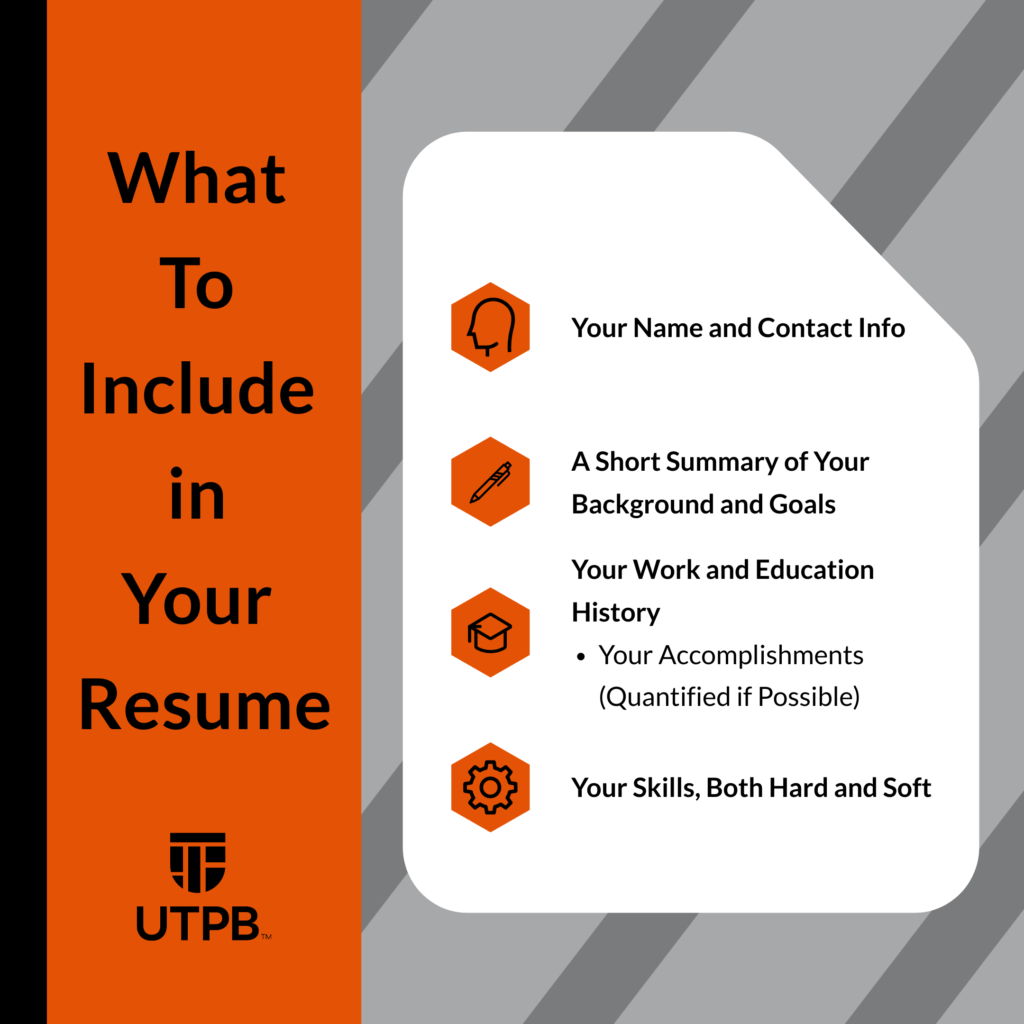
What skills should you put on your resume? Soft skills are nice, but hiring managers are instructing AI models to look for receipts. So, focus on hard skills: concrete evidence that you qualify for and can excel in the role.
For example:
Have experience with SWOT analysis? List it.
Know a programming language like Python or Java? Namedrop it.
Make decisions using Google Analytics? Put it in bold.
Quantify what you’ve accomplished in your current role. If you brought in $100,000 in revenue this year, include that in your professional history under your current role.
4. Keep It Human-Friendly
Your resume needs to be both bot- and human-friendly. Use clear, concise language. Work keywords in naturally; don’t stuff them in. Include a brief summary at the top—just two to three lines explaining to hiring managers why their search is over.
5. Keep It to One Page (For Now)
Your resume should fit on one page, especially if you’re applying to entry-level jobs. If it’s too long, hiring managers might not read it.
Later in your career, your resume might grow to two or three pages. But until then, less is more.
6. Fill the Gaps
The job market is not kind to “average.” Applicants, it seems, must be extraordinary—superhuman, even. A perfectly polished resume can go unnoticed if it’s missing something.
That “something” is often a credential.
A bachelor’s degree is the bare minimum for many jobs. A master’s degree is even better. These prestigious credentials show how skilled and serious a candidate is. Think about it: If you were a hiring manager, would you pick the candidate with or without years of education?
What’s Your Resume Missing?
Maybe your resume is *chef’s kiss* perfect. But most of us could use a little something extra.
UT Permian Basin offers over 40 online college programs that can help you fill the gaps in your resume. Keep working while earning your degree online. Or, if the job hunt’s a bust, consider pivoting and pursue a credential that will help you get past AI scanners, impress hiring managers, and land your dream job.
Not sure where to start? We put together a handy quiz that can point you in the right direction.
You Don’t Have to Do This Alone
UT Permian Basin is here to help you move forward, whether you’re updating your resume, switching careers, or starting fresh. Check out our online programs, and when you’re ready, apply to UTPB. Your resume will thank you.
Want a flexible way to earn your degree from The University of Texas Permian Basin? With UTPB’s online programs, you can live and work anywhere while getting a top-quality education.
When you study online with UTPB, you become part of the Falcon Family. We think it’s important to celebrate your achievements alongside them, too. Once you complete your online program, you can join your classmates at your graduation ceremony: an experience you don’t want to miss.
UTPB online students are transforming their lives, building their futures, and crossing the graduation stage with confidence, proving that you don’t have to choose between your dreams and your daily responsibilities.
Benefits of Online Learning at UTPB
Study From Anywhere
UTPB welcomes students from around the world. We have learners from more than 45 countries, with many living outside Texas. No matter where you live, you can benefit from the convenience of online learning. For many, earning a top-quality, affordable UTPB education remotely is the only way to make college work.
Online learning turns every home office, break room, café, and park bench into a classroom or study hall. Pick the spot that helps you focus best.
Set Your Own Schedule
Online learning has a flexible schedule: your schedule. Your online classroom is open 24/7 to accommodate your professional and personal commitments.
Do you work days? View course lectures at night. Work nights? Finish coursework in the daytime or on weekends. As long as you meet deadlines, you control your schedule and pace.
Graduate Here: One UTPB Online Student’s Story
Andrea Wang knows the benefits of online learning firsthand. She completed her online MBA from her Southern California home in 2023. When it came time to graduate, Wang—who’d grown up in Texas—wanted to walk across the stage in person.
Why?
“I’d never been to the campus,” Wang recalled. “Everything I learned about UTPB was from interacting with other students and faculty. And I thought, ‘Well, I’m going to get a degree from UTPB, so I should at least see it on graduation.’”
Wang was very eager to meet one of her professors. Although that almost didn’t happen, all turned out well in the end. “[My professor] went to California but came back in time for graduation. And so I got to see her on graduation day.”
“I think for me it was probably more fun than all my other graduations because it was something I chose to do in terms of earning the degree. This was completely my choice.”
What’s It Like for Online Students to Attend Graduation?
Wang believes that attending graduation in person can be a truly meaningful experience, even for online members of the Falcon Family.
“I think it’s worthwhile. It gives you a feel for what the university stands for. As I walked around the hallways, I could see professors’ names … what their interests were. It made me think about degrees that I didn’t know were there. It made me think, ‘Would I want to do another degree at UTPB or with another UT branch?’”
Wang also got a chance to show her school spirit by picking up some Falcons gear at our bookstore: t-shirts, sweatshirts, and a beanie. And she wasn’t finished: “We walked into the campus welcome center and got free T-shirts there!”
Six Reasons to Attend Graduation in Person
We understand that it’s not possible for every online student to attend graduation. But if you can make it to the Odessa, Texas area, we’d love to see you at the ceremony. That way you can:
Celebrate your accomplishments with loved ones.
Meet your classmates, professors, and campus-based counterparts.
Explore the UTPB campus.
More deeply appreciate an important milestone and rite of passage.
Choosing a college major can feel like you’re mapping out your entire adult life before you’ve even figured out how you like your coffee. (Some of us claimed we liked it black for a whole semester because it sounded like the cool answer.) What if you choose incorrectly? What if you lose interest? What if the subject you love leads to a career you…
You only get one chance to make a first impression. Cover letters have long been one of the best ways to set yourself apart in a competitive market. But in the era of AI screeners, even the most polished resumes—and their accompanying cover letters—feel like they’re disappearing into the void. With the job market more…
Getting accepted to The University of Texas Permian Basin is a big milestone. If you’re a working professional, the next step—asking your employer about tuition reimbursement—can feel a little intimidating. But it doesn’t have to be. Most organizations want employees who grow, stay, and contribute at a higher level. And many companies offer tuition reimbursement,…
Planning your next career move? Whether you’re entering the workforce for the first time or aiming for a more advanced role, having the right tools can make all the difference. Megan Baeza, UTPB’s executive director of career services, shares her expert advice on what your career toolkit should look like.
Must-Have Career Tools for Every Aspiring Professional
Your career toolkit should include both cutting-edge technology and practical skills. Here are the essentials every career-minded student needs.
Top Online Platforms for Job Hunting
Handshake
“The first thing to do is activate a Handshake account,” Baeza advised. “It’s like Indeed.com for college students.” According to Baeza, students logging on today would see “over 25,000 jobs and internships available. Many here in Texas, all over the United States, and some are even global.”
A job search platform tailored for college students, Handshake connects users with job and internship opportunities. Fortune 500 companies actively recruit on this platform, making it a must-have for students looking to stand out.
SkillsFirst
This AI-powered tool helps you tailor your resume to specific job descriptions. By highlighting the most relevant skills and keywords, you can ensure your application aligns with what employers are looking for, increasing your chances of getting noticed.
Crafting a Winning Resume and Cover Letter
Baeza estimates 99.9% of applications are now completed online, making it crucial to optimize your resume and cover letters for today’s technology. SkillsFirst’s resume builder identifies areas for improvement, helping you customize your application for each role.
“Customization is key,” Baeza explained. “If you don’t have the keywords, the customization, the correct format in your resume, those can all be problematic, [even if you] have the skills or qualifications.”
Mastering Interviewing Techniques
Strong interviewing skills require training, technology and people. Mastering the tried-and-true STAR method and “elevator pitch” are still helpful but are no longer enough.
“We want our candidates to start strong,” Baeza explained. “We want them to have thought about important questions that they want to ask the employer. Both of you are interviewing, right? It’s a two-way street.”
Tools like SkillsFirst allow you to practice responses, analyze body language, and refine your delivery.
“This is something you can do in privacy … then [the career services team] can help you refine those minor things that you still maybe need to work on through one-on-one coaching.”
Building a Professional Network
Networking is one of the most effective ways to find job opportunities. Building a network takes time, but there are many ways to do it. Start by connecting with:
Professors, classmates, and colleagues
LinkedIn connections
Alumni in your field
Professional organizations and networking events
Baeza urged students not to overlook contacts right in front of them: “You start in class, right? Who is your professor? Who are the other people in class with you? If you’re already working, who at your company can you connect with?”
She also strongly suggests those with a clear career path in mind connect with people already working in those fields. “Who are the leaders in your industry? You need to be following those companies [on social media] and connect with people within those organizations. Also, alumni working in that industry. They have advice you need. Don’t be fearful of reaching out.”
Polishing Your Professional Image
Your appearance matters during interviews. Or as Baeza put it, “When you look good, you feel good.” Dress professionally and ensure your virtual interview setup is distraction-free: no crying babies or barking dogs!
Baeza added that students near UTPB’s campus can borrow professional attire at no cost and have headshots taken right in the Career Services office.
Staying Organized During Your Job Search
Keep track of every application, including where you applied, whom you spoke with, and when. Follow-up promptly, especially with one gesture that can leave a big impression:
“A lot of students forget that follow-up is key. You know, sending that thank-you note honoring someone’s time,” Baeza explained.
Career Services: Your Partner in Success
Baeza and her Career Services team provide ongoing support for UTPB students and alumni, offering access to Handshake, SkillsFirst, one-on-one coaching, and more—virtually and in person.
Take advantage of these resources today to set yourself apart in the competitive job market and let UTPB Career Services help you land the job you want.
Ever wondered how to become president of the United States? It’s not as simple as giving great speeches or wearing a sharp suit. From meeting the constitutional requirements (like age and residency) to securing your party’s nomination and conquering the presidential election, the road to the White House is long—and often unpredictable.
In this guide, you’ll learn exactly what it takes to go from citizen to Commander in Chief. Whether you’re just curious about the process or seriously eyeing 1600 Pennsylvania Avenue, these 10 steps (plus 5 requirements) will walk you through how to run for president—and maybe even win.
Step 1: Be Born in the USA
One of the requirements to become president (per the U.S. Constitution) states that the president must be a natural born citizen of the United States. This is the one and only reason why Austrian-born actor and former California Governor Arnold Schwarzenegger can’t run for president. (Sorry, Arnold fans.)
Step 2: Turn 35
Your next step is to wait about 35 years. The Founding Fathers settled on this age requirement at the 1787 Constitutional Convention, believing it would ensure a leader of sound judgment, maturity, and wisdom.
Step 3: Live in the United States for 14 Years
The president is the only federal officer required to have lived in the United States for any amount of time. According to the Founding Fathers, 14 years is enough time for people to understand a presidential candidate and for that candidate, in turn, to appreciate the country’s values.
Step 4: Set the Foundation
You have decades to make a name for yourself in politics—plenty of time. Most candidates have advanced degrees, often in law or business. You can’t go wrong pursuing a degree in history,sociology, or political science.
Step 5: Choose Your Party
There are over 53 “third parties” in the U.S., but the country operates on a two-party system. If you want any shot at becoming president, you’ll likely have to register as a Democrat or Republican. Given today’s political polarization, choosing a party that aligns with your interests should be pretty straightforward.
Step 6: Start a Career in Politics
By now, you’ve earned degrees and accolades and are ready to pursue a career in politics. Though it’s not a requirement, running for and winning a race for mayor, governor, or senator in your state will bring you much-needed experience and exposure.
Step 7: Hit the Campaign Trail
Once you’re in the political spotlight, it’s time to announce your run for president. After registering with the Federal Election Commission in the spring a year before the presidential election, you’ll hit the campaign trail, rallying support around the country to win the favor of your political party.
Step 8: Secure the Nomination
Six to nine months before the election, primary voters in certain states choose their preferred candidate. Other states hold caucuses where a political party gathers and votes for a preferred candidate. Votes at primaries and caucuses award candidates with delegates, who represent their state at national conventions.
Get the majority of your party’s delegates and at the end of the national convention, your party will announce that you are the final presidential nominee. Then you’ll take the stage, give a rousing speech, and announce your running mate.
Step 9: Win the Debates
With the election months away, you and your opponent will go head-to-head in front of tens of millions of viewers. All eyes will be on you as you share your vision for the future of the nation. Stay calm, authentic, and above all, presidential.
Step 10: Win the Presidential Election
After years of planning, sacrifices, and nonstop campaigning, it all comes down to Election Day, held every four years on the Tuesday after the first Monday in November. All you can do now is cast your vote and wait for the results. The rest is up to the voters … technically.
When people cast their vote, they’re actually voting for electors from each state. Each state has its own group of electors, and whichever candidate wins a state’s popular vote wins all that state’s electors. The Electoral College consists of 538 electors, but you’ll need a majority (270) to win. That’s the magic number that’ll make you the leader of the free world.
Congratulations, Mister or Madam President
So, will you keep the drapes or give the Oval Office a complete makeover? The road to the White House was long and daunting, but here you are. Now, every choice you make will impact the nation’s future—at least, until your successor is elected.
FAQ About Running for President
You’ve got the steps down, but if you’re curious about the finer details, here are some of the most common questions people ask about running for president:
What are the five requirements to be president? You must be a natural-born U.S. citizen, at least 35 years old, and have lived in the U.S. for at least 14 years. You’ll also need leadership experience and a strong campaign platform.
How hard is it to become president? Extremely. The odds are about 1 in 10 million. But with the right education, experience, and campaign strategy, it’s not impossible.
How do you run for president? To run, you must file a statement of candidacy with the Federal Election Commission, fundraise, and campaign nationwide to win your party’s nomination.
Where to Begin?
Every U.S. president started exactly where you are now: reading a listicle on how to become president in 10 easy steps.
Okay, maybe not. But one thing’s for sure: Despite the unique paths that brought them to the presidency, they all prepared for the role—even if they didn’t have this convenient guide. If you want to be president, you’ll have to set yourself up for success, and you can start by earning an online degree from The University of Texas Permian Basin.
UT Permian Basin offers flexible online undergraduate and graduate programs that will look good on your resume and can set you up for a career in politics. Here are a few options we think are very presidential:
We can’t promise that you’ll become the next U.S. president, but we can promise that our online programs deliver an exceptional education that will help you in your pursuit of a fulfilling and worthwhile career, whether it’s in politics or another path.
If you’re studying accounting, there’s a decent chance you’ve heard some version of this advice: “Try to get into the Big 4.” Easy enough, right? Big 4 (or Big Four) accounting jobs can be competitive, especially for students and recent graduates trying to get their foot in the door. But to get hired at one of these elite companies, you don’t need a…
Are you a true-crime junkie? If so, you’re in good company. True crime is one of the most popular genres among podcast listeners in the United States and one of the fastest-growing genres in entertainment. Armchair detectives love the rush of having their suspicions confirmed: I knew it was the sketchy neighbor with the white pickup truck! But could that confidence—the unwavering belief in a suspect’s…
Growing a small business can feel like building the plane while flying it. You’re attracting customers, watching cash flow, fixing whatever broke that morning, and somehow also planning for next year. No pressure. Thankfully, a clear growth strategy can make things more manageable. By choosing the right goals, understanding what customers need, and building systems that can support expansion, you can…
There comes a time in most individuals’ careers when they decide, “You know what? I have career goals—and it’s time to achieve them.” While some have this epiphany early in their career, others might not make any long-term plans until they’ve gained a few years of experience or faced a significant career milestone. One thing is certain: There’s not always a straight path toward achieving those dreams.
That’s where a career development plan comes in. It’s a strategic tool that helps you determine and track your professional goals, allowing you to create a roadmap for achieving them in a timely and organized manner.
In this article, we’re divulging everything you need to know about how to write a career development plan that will help you make your professional ambitions a reality.
What is a Career Development Plan?
A career development plan, also known as a professional development plan, is a tool that allows you to map out your career goals. Once you’ve established your long-term goals, you can create a master plan that breaks them down into smaller, more manageable short-term goals. These incremental steps will guide you toward achieving your broader career objectives over time.
How To Write a Career Development Plan in 4 Steps
Creating a career development plan may seem straightforward at first: Simply outline your goals and devise a strategy to achieve them. However, with a few extra steps, you can assess your strengths and identify areas for improvement, helping you tailor your plan to your unique skills and long-term objectives.
Follow these four steps to craft a comprehensive and actionable career development plan that sets you up for success.
Step 1: Establish Your Long-Term Goal
Start by determining where you see yourself professionally in the long term, whether that’s five, ten, or even twenty years down the road. While you might envision yourself as a principal in your current school district, for example, it’s important to ask these questions to see if your original goal aligns with your aspirations:
What do I enjoy doing?
What skills come naturally to me?
Do I prefer working independently, collaborating with others, or leading a team?
What drains my energy in a work environment? What excites me?
By answering these questions, you can evaluate if your dream aligns with your passions and strengths.
Step 2: Give Your Skills a Self-Assessment
Before breaking down your objective into smaller goals, it’s important to assess your current skill set. Start by researching job listings related to your long-term career goal. Take note of the experience, responsibilities, and skills that are consistently mentioned across listings. Write those skills down and rank each one from one to five: one meaning you don’t yet have that ability, and five meaning you can already do it flawlessly.
With a clearer understanding of where your current skills stand and what’s needed to qualify for your future role, you can begin setting smaller goals to bridge the gap between your current resume and the one that will land you that position.
Step 3: Set Your Short-Term Goals
Once you’ve identified your long-term goals and researched the skills you need to improve or learn, you can create a roadmap with short-term goals that will help you reach your final destination.
For instance, you can work on soft skills like communication or time management, both at work and at home. Hard skills, such as data analysis or knowledge of federal and state education laws, however, require education and experience. To obtain these skills, you’ll need to consider professional development courses and additional education.
When setting your short-term goals, list them in a logical order, starting with foundational skills and knowledge and gradually progressing to more advanced objectives. Be sure to make SMART goals—specific, measurable, achievable, relevant, and time-bound—to keep you on track and help you achieve your goals within a specific timeframe.
Step 4: Monitor and Evaluate Your Progress
Completing your career development plan doesn’t mean you’ve reached the finish line. To get the most out of your hard work—and to stay on track toward your long-term goal—regularly review your plan at least twice a year to ensure you’re following the timeline you set for your short-term goals. It’s also important to reassess your goals to see if any adjustments are needed to better align with your overarching objective.
Your Path to Success Starts at UTPB
While career development plans are a great way to help you take actionable steps toward your larger goal, it’s not uncommon for career goals to shift during the process. A National Institutes of Health study found that 54% of participants who completed a career-planning course changed their career preferences afterward. While creating a career plan isn’t quite the same as taking a course, it provides a clear starting point to assess your skills and identify the steps needed to reach your ultimate goal.
For many, achieving that objective involves further education. At The University of Texas Permian Basin, we offer a variety of online undergraduate and graduate programs to help you gain the skills you need to succeed.
No matter where you are in life, our online programs make it easier to balance work, life, and education. With asynchronous courses, you can complete your studies on your schedule. Plus, our virtual students also enjoy these online benefits:
Start your education when you’re ready with year-round start dates.
Take advantage of affordable tuition rates.
Access coursework 24/7 from anywhere.
Learn from experienced instructors who also teach on campus.
Network with students worldwide, opening doors to future career opportunities.
Are you passionate about upholding ethical standards and advocating for others ? Do you thrive on the intellectual challenge of legal debates? If so, you’ve likely dreamt of the day that you can finally tell the world, “I’m an attorney.”
However, becoming a lawyer involves seven or more years of schooling after high school—not to mention passing the bar exam and meeting state-specific requirements. In the words of the iconic Elle Woods in the film “Legally Blonde”: “What, like it’s hard?”
With tenacity and passion, turning your dream of becoming a lawyer into reality is challenging but entirely achievable. Today, we’ll explore the role of a lawyer and the steps needed to embark on this career path.
What Does a Lawyer Do?
The better question is: What don’t lawyers do? Beyond prosecuting and defending criminals, many attorneys specialize in crucial areas that help us during important life events, such as buying houses, drafting wills, and handling divorce proceedings.
However, your role as a lawyer will vary based on your specialization. Before delving into some of your typical responsibilities, let’s outline some common types of lawyers:
Corporate lawyer
Family lawyer
Immigration lawyer
Intellectual property (IP) lawyer
Litigation lawyer
Personal injury lawyer
The specialty you choose will determine whether you spend most of your time preparing for and partaking in court proceedings and trials, but here’s a list of some typical responsibilities for most lawyers:
Advising and representing clients in legal matters.
Conducting research and offering counsel on legal rights and obligations.
Drafting contracts, deeds, wills, and other legal documents.
Negotiating settlements on behalf of clients.
Presenting arguments in court.
Upholding ethical standards as mandated by legal regulations.
Mediating between disputing parties and offering alternative resolutions outside of court.
How to Become a Lawyer
Below, we discuss the general steps involved in becoming a lawyer.
Step 1: Earn a Bachelor’s Degree
After graduating from high school, completing a four-year undergraduate program is the first step to earning your Juris Doctor (JD) degree. While there isn’t a specific major required for law school admission, certain majors can provide foundational skills necessary for your graduate studies, such as:
Political science
History
English
Sociology
Psychology
Finance
Step 2: Take the LSAT (Law School Admission Test)
After earning a bachelor’s degree, you’ll begin studying for the LSAT, which measures your knowledge and readiness in four areas:
Reading comprehension
Analytical reasoning
Logical reasoning
Writing
The first three sections are multiple choice, while the writing section (as you might expect) requires a written argument on behalf of one of two competing policy options.
We recommend preparing for the LSAT while earning your bachelor’s degree. You can tailor your courseload to include courses that will strengthen your ability to think critically, argue persuasively, and analyze precisely, such as UTPB’s Introduction to Philosophy or Psychology and Law, both offered through our online BA in psychology program.
Step 3: Apply to Law Schools
After taking the LSAT, you can begin applying to the law schools of your choice. Most law schools will accept students with an LSAT score of 150, while more prestigious schools require scores of 160 or higher. Other requirements may include your undergraduate transcripts, letters of recommendation, or a personal statement.
Step 4: Earn Your JD
It typically takes full-time students about three years to complete their JD coursework. Part-time students may extend this to four or five years.
According to U.S. News, the first year of law school is often the most demanding, as students are adapting to new and rigorous schedules. Justin Hansford, a law professor at Howard University’s School of Law, suggests that the second year offers more flexibility, allowing students to explore specialties and define their professional identity. In the third year, the focus shifts to preparing for the bar exam and entering the legal profession.
Step 5: Pass the Bar Exam
Most states offer the bar exam twice yearly, in the winter and summer. After graduating from your JD program, you’ll apply for admission to the bar and spend a few months intensely studying for the exam. The Multistate Bar Examination (MBE) consists of 200 multiple-choice questions, with 25 being unscored pretest questions.
Of the 175 scored questions, there are 25 randomized questions from seven subject areas, including:
Civil procedure
Constitutional law
Contracts
Criminal law and procedure
Evidence
Real property
Torts
Step 6: Complete Additional State Requirements
Depending on the state where you plan to practice, additional requirements may be necessary, such as state-specific law exams or participation in a mentorship program. Check your state’s guidelines to confirm any further requirements after passing the bar exam, and prepare for the exhilarating moment that you’re sworn in as a licensed attorney!
Start Your Journey Toward a Rewarding Legal Career
As you pursue a legal career, mastering essential skills like critical thinking, communication, negotiation, time management, and analysis is crucial. While law school refines these skills, you can build a strong foundation through one of the online bachelor’s programs offered by The University of Texas Permian Basin.
We offer several relevant online undergraduate programs that are ideal for aspiring lawyers, including:
With year-round start dates and a flexible online format, you can complete your studies at your own pace. Explore our offerings and choose the path that’s right for you.