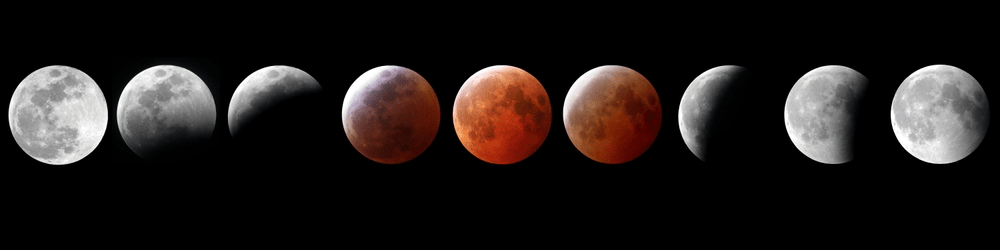
Lunar eclipses don’t happen often, but when they do, everything seems to slow down. People step outside. Neighborhoods get quieter, tuned in to the skies above. Suddenly, something outside of our control brings us all together for a shared moment of collective awe.
Eclipses remind us that we’re all living under the same moon, no matter where we call home. Below, we explore four ways lunar eclipses bring communities together around culture, curiosity, and shared experience.
#1 Supporting Community Curiosity and Learning
Lunar eclipses turn everyday spaces into informal classrooms. A few times a year, public places like libraries and parks will host viewing nights where people can ask questions, compare observations, and share what they know (or don’t) about what’s happening in the sky.
The basics are pretty simple: A lunar eclipse happens when Earth moves directly between the sun and the moon. That alignment casts a shadow over the lunar surface, and as the shadow shifts, you can see the different stages of a lunar eclipse, from the first dimming to the otherworldly reddish glow of totality.
But most people don’t learn this by reading a definition. They learn it by standing outside with others and pointing things out or asking the kinds of questions they might normally avoid in a classroom.
Moments like these highlight why lunar eclipses are important from a social perspective: They create opportunities for shared curiosity. Education becomes a community activity rather than a solo experience, and people feel more connected simply because they’re learning together.
#2 Creating Shared Wonder
One reason lunar eclipses continue to draw crowds around the world is that they’re easy to view. Unlike solar eclipses, you don’t need special equipment (thankfully, no cereal-box viewer required). Anyone can step outside and look up safely, assuming the weather cooperates. That simplicity alone makes the experience feel communal.
Whether you’re at home, out to dinner with friends, or walking across campus, you can pause whatever you’re doing to catch the moment. For many people, seeing that transformation in real time creates a shared sense of awe: a small moment when strangers feel a little less like strangers.
#3 Strengthening Community Bonds
In some cultures, eclipses were understood as moments to restore social harmony. Among the Batammaliba people of Togo and Benin, for instance, a lunar eclipse was seen as a disagreement between the sun and moon. The expectation was simple: People should resolve their own disputes so the sky could return to balance.
This exact practice isn’t common today, but the underlying idea makes sense—big, unusual events can give people a reason to pause and reconsider what feels worth holding onto.
Today, the “bonding” is usually more relaxed. Middle school nemeses might not be calling each other up to hash out their unresolved issues, but you might discover neighbors standing in the same spot to watch the sky. Friends might even organize a casual meetup to watch the eclipse, simply because they know everyone will be outside watching anyway.
When everyone is paying attention to the same rare event, it creates a brief sense of shared experience … even without words.
#4 Building Digital Communities
Not everyone watches a lunar eclipse from the same location, but that hasn’t stopped people from experiencing it together. Livestreams, group chats, and social media posts make it easy for friends (and plenty of strangers) to share the moment across time zones.
So how are people bonding over lunar eclipses and other natural phenomena online? A few patterns show up repeatedly:
Trading photos of the eclipse from a specific location
Sharing memories from past eclipses
Answering each other’s questions in real time
Digital platforms turn what used to be a place-bound experience into a global one. Instead of a single neighborhood stepping outside to watch the sky, millions of people end up participating in the same event, just from different corners of the world.
FAQ About Lunar Eclipses and Community
Looking for the TL;DR version? Here are answers to some common questions about lunar eclipses and the role they play in bringing communities together.
What does lunar eclipse mean? A lunar eclipse simply means that Earth has moved between the sun and the moon, blocking sunlight and casting a shadow across the lunar surface. Different cultures interpret this moment in their own ways, which is part of what makes eclipses so socially meaningful.
How often do lunar eclipses occur? Lunar eclipses typically occur two to four times a year, but visibility depends on where you are in the world. Even when the timing works out, weather and location determine whether you’ll catch it or miss it.
Why do lunar eclipses bring people together? Lunar eclipses bring people together because they’re widely visible, easy to watch, and culturally meaningful, creating shared moments of curiosity and connection.
Are lunar eclipses safe to view? Yes — lunar eclipses are completely safe to view with the naked eye because you’re looking at the moon, not the sun.
How does social media change the way we experience lunar eclipses? Social media expands eclipse experiences by allowing global sharing, livestreaming, and cross-cultural connections that extend far beyond local gatherings.
Explore Community Through Sociology With UT Permian Basin
Events like lunar eclipses remind us that community can form in unexpected ways—through shared curiosity, cultural meaning, and the simple act of looking up at the same sky. These moments reveal the social patterns that shape connection: tradition, storytelling, and collective learning, to name a few.
Understanding these patterns is at the heart of sociology. At The University of Texas Permian Basin, our online Bachelor of Arts in Sociology helps students explore how communities form, adapt, and thrive, whether that’s through celestial events or everyday interactions.
With flexible, fully online coursework, you can deepen your understanding of social behavior and prepare for careers that rely on cultural insight, community engagement, and analytical thinking.
When someone struggles with depression, homelessness, or discrimination, who steps in to help? A psychologist? A social worker? A sociologist? These three fields all address human challenges, but they explore humanity from very different angles: one from society, one from the mind, and one from the front lines. So what are the similarities and differences between sociology, psychology, and social work? This guide clears up…
How many times a day do you unlock your phone to scroll through your favorite feed? Ten? Twenty? Lost count after breakfast? You’re not alone. The average American checks their phone 205 times a day and spends about two and a half hours of that time on social media. Whether you’re catching up on family…
Weddings hold profound significance, no matter where you are in the world. Snag an invite to an Indian wedding and you’ll be partying for three days. Attend a Hungarian wedding and you’ll notice the bride slip into a red dress, called a menyecske ruha, at midnight. And at a Congolese wedding, don’t be shocked if…