The Cold War between the U.S. and the Soviet Union lasted nearly 45 years. This period of global tension was fueled by political differences, expansionism, a nuclear arms race, and constant propaganda. But these factors were symptoms of a deeper, underlying psychological force: group polarization. Both sides steadily grew more entrenched in their opposing views, pushing them farther apart—and to the brink of nuclear war.
Here’s how this tense chapter of human history connects to group polarization: a psychological phenomenon that still divides people today.
What’s the Definition of Group Polarization?
Group polarization in psychology is a group dynamic where people with similar views adopt more extreme versions of those views after group discussion. Each person reinforces the others’ beliefs, pushing the group’s stance further than the starting point of any one person in it.
How Does Group Polarization Happen?
Group polarization unfolds through a predictable pattern:
People with similar views gather together.
They discuss their shared perspective.
Each person’s opinion becomes more extreme through the conversation.
The group ends up more unified and more extreme than when they started.
Here’s a practical example: You’re on an online gaming team facing another squad. Before the match, everyone’s cautiously optimistic: “We can probably win this.” But as your teammates hype each other up, that turns into “We can’t lose!” Each person’s confidence feeds the group’s, and suddenly you’re all far more certain than anyone was individually.
Between-Group Polarization Two groups drift further apart over time as each one doubles down on its own views and pushes back harder against the other’s.
Within-Group Polarization A group ends up taking on an even stronger version of what they believed at the start.
Attitude Polarization After weighing different evidence, one group member becomes even more sure of what they already believed in.
Group polarization shows up in many contexts, including sports, religion, politics, and international affairs. And that brings us back to the Cold War.
What Was the Cold War?
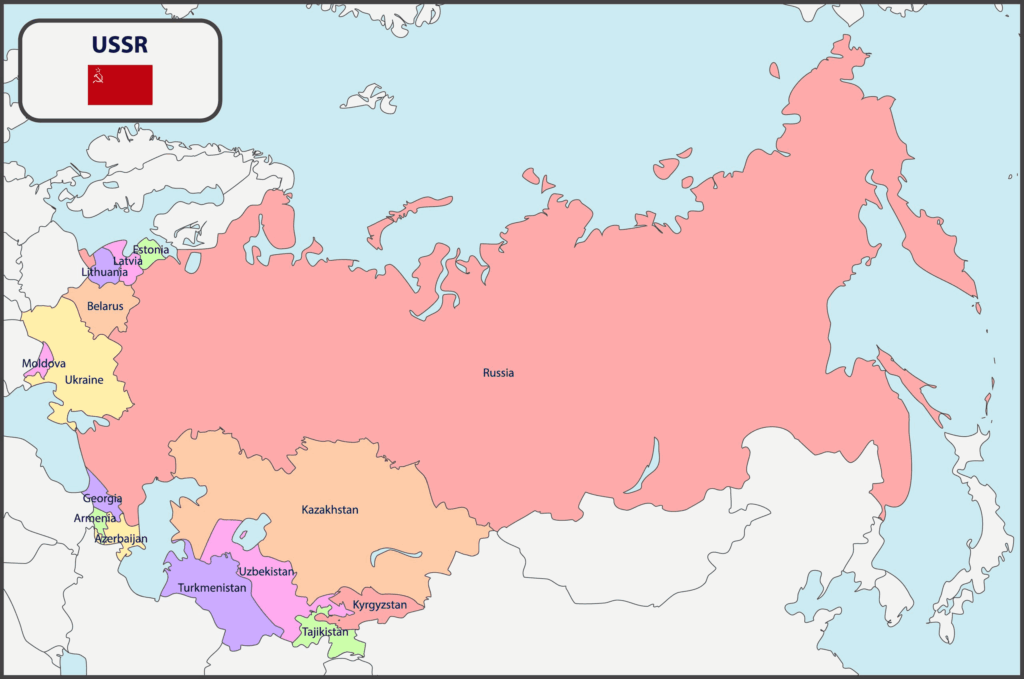
After World War II, Europe could’ve enjoyed some well-earned peace and security. Instead, it became ground zero for a 45-year conflict between two superpowers: the United States and the Soviet Union (USSR).
The Cold War earned its name because the two sides never directly fought each other. Instead, they engaged in constant indirect battles, through proxy wars, espionage, propaganda, and a nuclear arms race that threatened global destruction.
The conflict was rooted in opposing ideologies. The U.S. championed capitalism and democracy. The Soviet Union promoted communism and state control. After losing millions to Nazi Germany in World War II, the USSR sought to create a buffer zone of friendly communist nations in Eastern Europe. The U.S. viewed this expansion as a threat to democratic nations worldwide.
What started as a territorial dispute quickly escalated into a global standoff. Both sides became convinced the other posed an existential threat.
Group Polarization in the Cold War
The Cold War was a textbook case of group polarization on a global scale. You can see the psychological phenomenon at work in nearly every aspect of the conflict.
Each of these factors triggered or prolonged the 45-year standoff:
Deep ideological divisions (capitalism/democracy versus communism/socialism)
Echo chambers on both sides
“Us vs. them” mentalities
Expansionism to boost influence
Nuclear arms race for protection and intimidation
One-upmanship (space program, etc.)
Military alliances (NATO and the Warsaw Pact)
Propaganda campaigns
Reciprocal escalations (tit-for-tat)
How Group Polarization Escalated the Cold War
Once the Cold War began, group polarization took over through a pattern of action and reaction:
The U.S. saw this as aggression and countered by establishing military bases in the Pacific. Each side’s expansion fueled the other’s fear and justified further expansion—a classic polarization spiral.
The Nuclear Arms Race: Action and Reaction
The nuclear arms race followed the same pattern. After the U.S. detonated atomic bombs in 1945, the USSR rushed to develop its own by 1949. The U.S. responded with thermonuclear weapons. Neither side could back down without seeming weak to their own allies.
Military Alliances Formalize the Divide
By 1949, this us-versus-them mentality became formalized. North American and Western European countries formed the North Atlantic Treaty Organization (NATO) to counter Soviet expansion and provide mutual security. The USSR answered with the Warsaw Pact in 1955. The tipping point? West Germany joined NATO that year, putting the organization at the doorstep of Soviet-backed East Germany.
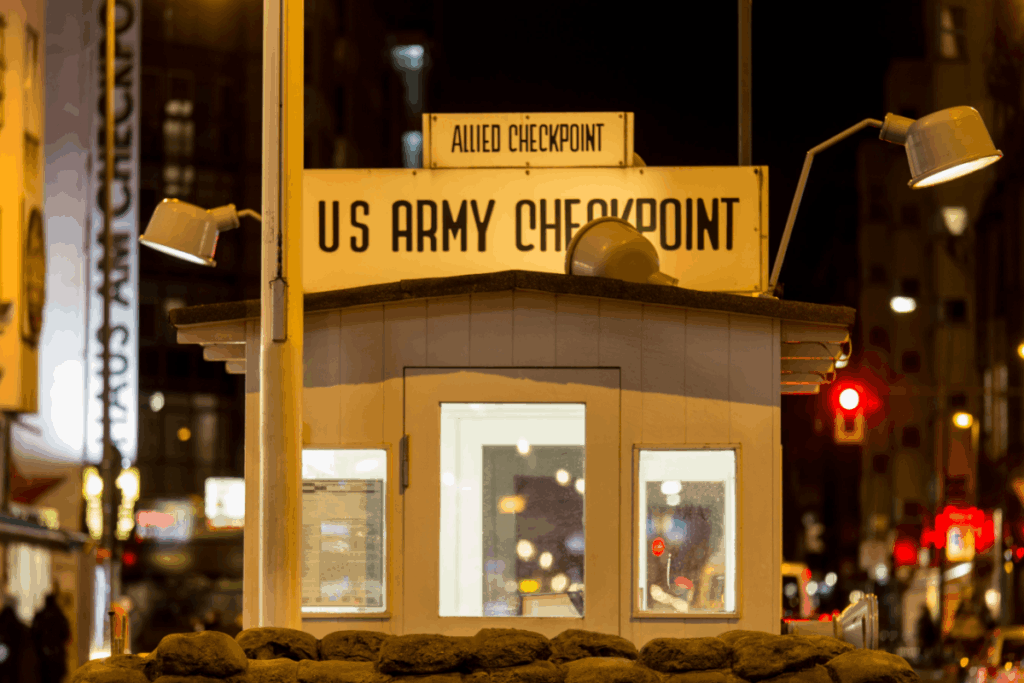
Germany had divided in 1949. The Allies controlled the West, and the Soviet Union controlled the East. The Checkpoint Charlie border crossing and nearby Berlin Wall became enduring symbols of Cold War division.
Think of NATO and the Warsaw Pact like two opposing teams, each convinced they’re right—and willing to go to extremes. During the Cold War, those divisions were so deep that diplomacy barely moved the needle for generations. And the stakes were much higher.
This nonstop game of oneupmanship lasted until 1991.
Propaganda and Echo Chambers
Propaganda reinforced group polarization during the Cold War too, with each side smearing the other while elevating its own image. Each superpower created echo chambers where citizens only heard their own government’s perspective—a perfect environment for extreme views to flourish.
Radio Free Europe and Voice of America beamed music, news, and proWestern commentary into Sovietcontrolled countries in multiple languages. The USSR hit back with broadcasts and papers like “Pravda,” framing Western capitalism as decadent, exploitative, and imperialistic.
Misinformation was a key tactic, and fake news stories were everywhere. Each side’s propaganda made the other seem more threatening, deepening the distrust that kept the Cold War going.
How Group Polarization Drove the Cold War: A Breakdown
Why did the U.S. and the Soviet Union keep escalating and hardening their positions for decades? Group polarization.
Here’s a recap of the cycle in simple terms:
Each side talked mainly to itself, not to each other. These echo chambers reinforced existing beliefs and fears.
Every action triggered an equal reaction. The U.S. built a bomb, so the USSR did too. Then the U.S. built a bigger one. The U.S. formed NATO, so the USSR created the Warsaw Pact.
Both groups became more extreme over time. What started as political disagreement hardened into absolute conviction that the other side was evil.
The cycle fed itself for 45 years. Each generation of leaders inherited these hardened positions and passed them on even stronger.
Understanding Psychology Can Build Bridges
Individuals and groups can shift their views. But sometimes it takes an open mind, learning, or an outside perspective to make that happen. The University of Texas Permian Basin can support you on all three fronts.
Create Greater Understanding With an Online BA in Psychology
Conflicting goals drive people apart. Understanding psychological concepts like group polarization and other social phenomena can strengthen connections and open doors to meaningful careers.
UTPB’s online Bachelor of Arts in Psychologycan help you understand human behavior and help others navigate conflict. You’ll find the program online exclusively at this UT System institution.
Thinking about a helping profession? This BA also sets you up for UTPB’s online Master of Social Work* and other licensure-focused programs.
Gain insight that helps reduce conflict and build bonds. Apply today!
Psychology is one of the broadest academic fields, and one of the most versatile. It spans everything from courtrooms to corporate offices, from childhood development to competitive sports. With so many specialties (and subspecialties), it can be tough to know where to even start. So exactly how many branches of psychology are there? The field is…
Ever reach for your phone and instantly face a barrage of messages, notifications, subscription reminders, and social media updates? You’re not alone. Scientists have estimated that the average person processes about 74 gigabytes of information daily: equivalent to watching 16 high-definition movies back-to-back in a single day. Cognitive overload is real. And over time, constant stimulation quietly changes how we think, focus, and feel. In this article, we’ll explore: What Does Cognitive Overload Mean? Cognitive overload happens when your brain receives more information than…
When someone struggles with depression, homelessness, or discrimination, who steps in to help? A psychologist? A social worker? A sociologist? These three fields all address human challenges, but they explore humanity from very different angles: one from society, one from the mind, and one from the front lines. So what are the similarities and differences between sociology, psychology, and social work? This guide clears up…