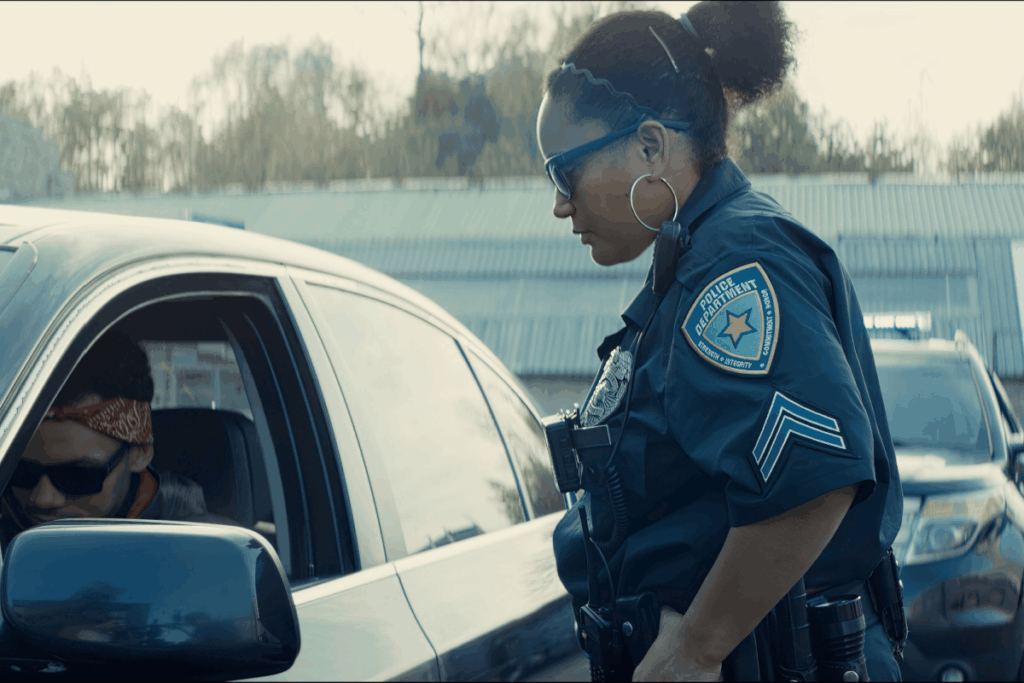
Women represent about half of the U.S. population, but women in law enforcement make up only 13%: around 96,000 nationwide. This gap matters, especially given the impact women have on policing.
Research into gender in policing shows that women officers are viewed by communities as more honest, compassionate, and trustworthy.
When it comes to public safety outcomes, women officers (compared to male officers) are less likely to:
Draw their firearms
Receive complaints
Use excessive force
In other words, their presence changes how policing works in everyday life.
Let’s take a closer look at four fearless women officers who helped lead us here.
Four Barrier-Breaking Women in Law Enforcement
#1 Alice Stebbins Wells
Alice Stebbins Wells wasn’t the first female police officer. (That distinction belongs to Marie Owens.) But her tireless advocacy led to initiatives that appointed female police officers in 16 U.S. cities by 1916—and inspired countless future generations.
In 1910, Wells was a pastor, but she’d always wanted to work in law enforcement. She used her oratory skills to petition the city council and mayor of Los Angeles to join the Los Angeles Police Department (LAPD). She succeeded and received full arresting powers. Wells even sewed her own uniform and attached Badge #1 to it after experiencing prejudice from a trolley conductor.
In 1912, another female trailblazer became New York City’s first female detective. Her name was Isabella Goodwin.
As a young woman, the quiet and intelligent Goodwin wanted to become an opera singer. But when her husband (a police officer) passed away, she decided to join the force. She passed the civil service exam, became a matron in 1896, and then rose to sergeant.
Known for her hard work and exceptional intuition, she caught the attention of a police captain who asked her to go undercover. She later led the NYPD’s first Women’s Bureau and helped solve complex crimes until her retirement.
In 1916, it wasn’t common to see a policewoman on duty—much less a Black officer. Georgia Ann Robinson was a hard-working community servant when an LAPD recruiter approached her in 1916. She began as a volunteer in the department before joining the force full-time in 1919, becoming one of the first Black women hired as a police officer in the U.S.
Robinson started as a jail matron. While she cared for the needs of female inmates and delinquent children, she also co-founded a women’s shelter called the Sojourner Truth Home, which was much needed at the time in Los Angeles.
#4 Susan Roley Malone
Susan Roley Malone was a math teacher and a Marine before joining law enforcement. Malone lived in the suburbs of Washington, D.C., and always knew she wanted to be an FBI agent. When the position opened to women in 1972, she applied immediately and was hired alongside Joanne Pierce Misko: the first two female agents in the FBI. Her first cases? Investigating cattle rustling and train wrecking.
When an FBI agent asked her why she wanted to serve, she responded, “I want to be here for the same reasons you want to be here.” And like the brave female law enforcement officers who came before and after, she persisted.
Key Takeaways
From the earliest days of policing, determined women in criminal justice found a way into a profession that underestimated them. Their impact reshaped public safety.
Together, these stories remind us:
Women remain underrepresented in policing. They make up just 13% of the force, despite making up half of the U.S. population.
Women officers consistently improve public safety outcomes. They receive fewer complaints, use less force, and are less likely to reach for firearms.
Progress came from persistence—not permission. Many early women officers created their own paths (and even their own uniforms) when institutional doors were still firmly closed.
Nontraditional backgrounds strengthened their leadership. Skills gained throughteaching, caregiving, military service, and community work translated directly into effective policing and success.
Women reshaped policing. They expanded the focus to prevention, community trust, and vulnerable populations. These women also laid the groundwork for today’s female law enforcement executives and leaders.
Today’s opportunities in law enforcement exist because women refused exclusion. Their legacy continues to shape modern law enforcement and criminal justice leadership.
Be Part of What Comes Next
Women still make up a relatively small percentage of law enforcement, but as these four pioneers showed, representation matters. Their legacy proved that diverse perspectives make policing more effective, more compassionate, and more connected to the communities it serves.
If learning about women breaking barriers sparked something in you—curiosity, purpose, maybe even a calling—there are clear pathways into criminal justice waiting for you.
The University of Texas Permian Basin’s fully online criminology programs are built for people who want to understand the law enforcement system and help shape its future from the inside:
Whether you’re just starting out or ready to move into leadership, these programs prepare you to bring the skills today’s communities need: critical thinking, empathy, and a commitment to justice that actually works.
Over 6,900 cyberattacks happen every second against Microsoft users alone. While it’s clear from that staggering number that criminals have gone digital, law enforcement is fighting back with new tools, training, and tactics. The challenge? Digital crimes don’t happen in plain sight. They’re hidden in code, encrypted networks, and anonymous online spaces. For National Cybersecurity…
We all want safer communities, right? Crime prevention can benefit our communities in countless ways, and stopping recidivism—repeat offenses—is a crucial part of that. But how do we get there? Restorative justice programs are helping people and neighborhoods heal while easing the strain on our overburdened criminal justice system. Let’s look at what these programs…
June is National Internet Safety Month in the United States: a time to spotlight online risks, particularly for children and teens. These efforts are especially crucial considering human trafficking—a modern form of slavery—continues to rise globally, with traffickers increasingly exploiting the internet to recruit victims. In this article, we’ll explore the extent of this humanitarian…
Apollidon Content TeamContent Team
The Apollidon Content Team combines expertise in marketing, content strategy, SEO/GEO/AEO, and student engagement to create content that helps colleges and universities reach prospective students. Through research-driven insights, data-informed strategy, and compelling storytelling, the team develops resources that increase visibility, strengthen institutional brands, and support enrollment growth.