ESL vs. Bilingual Education: What’s the Difference?
ESL and bilingual education both help students build English language skills, but they take different approaches in the classroom. ESL instruction is taught in English and focuses on language immersion, while bilingual education uses both English and a student’s native language to support learning.
Watch this quick breakdown of ESL vs. bilingual education
What Is ESL Education?
ESL education teaches students English through instruction delivered in English, with a strong focus on language immersion, meaning English is the primary language used when teaching.
So, do ESL teachers have to be bilingual?
No, English is the only language an educator needs to know to excel as an ESL teacher. The principle driving ESL education is that students will learn English faster if they’re immersed in the language.
Although they’re supported every step of the way, it’s sink or swim for ESL learners as they’re taught to read, write, and speak English. The use of other languages may be even be prohibited in an ESL classroom to encourage the use of English.
There are several types of ESL programs, but pull-out is one of the most popular forms. In this model, students are pulled out of their general education classes and instructed by ESL teachers either in groups or one on one.
This is where some confusion arises between ESL vs. ELL students. English language learners (ELL) is a broad term that applies to any student learning English. In what’s known as the push-in model, English language learners are usually kept in general classes and instructed by visiting ESL teachers.
ESL education can produce exceptional English speakers. However, students in ESL education who are unable to fall back on their native language may struggle to grasp complex concepts in English, and students’ proficiency in their native language may suffer as they focus solely on learning English. As an ESL teacher, it would be your job to help your ELLs overcome these challenges.
What Is Bilingual Education?
Bilingual education teaches students in both English and their native language so they can build academic skills while developing English proficiency.
For example, a bilingual education classroom may be entirely filled with Spanish-, Chinese-, or Arabic-speaking students. Because their native language is used as part of instruction, students may feel more supported as they transition into English.
In bilingual classrooms, students are instructed in math, geography, history, and other traditional subjects. Unlike a traditional classroom, however, students are taught in both English and their native language. With the aid of a teacher who can engage in discussions, debates, and presentations in their first language, students in bilingual classes have a better chance of becoming fluent in both languages.
Dual language education, also known as two-way immersion, is a type of bilingual education that is steadily growing in popularity. As opposed to other programs that immerse students in a target language as quickly as possible, dual language education teaches ESL learners and native English speakers together with the goal of functional bilingualism and biliteracy for both groups.
In an article published by NPR, George Mason University professors emeriti Wayne Thomas and Virginia Collier looked at eight million student records and found that dual language students had higher test scores, higher parent involvement, better attendance, and fewer behavioral problems than students in English-only classrooms.
What Do ESL and Bilingual Education Have in Common?
ESL and bilingual education teachers both nurture and cultivate English language skills. Teachers in either role can enjoy fulfilling careers teaching students a language that will better connect them to the world and people around them. Permanently enriching the lives of students is the goal of every educator, but that’s not the only thing these two career options have in common.
According to the National Center for Education Statistics, there were five million ESL learners enrolled in the United States public school system in 2017, up from 3.8 million students in 2000. Texas, in particular, has a high need for ESL and bilingual education teachers, with 20% of the state’s total student population identified as ESL learners.
As the number of ESL learners continues to rise, school districts will be in greater need of ESL and bilingual education teachers. Once you’ve earned your degree and are looking at ESL vs. bilingual certification in Texas, know that either option leads to a growing career field.
Bilingual education teachers often earn annual median salaries of about $62,000. Although they may not speak a second language, ESL teachers possess a highly sought-after skill set and earn about $56,000 annually. While a career as an ESL or bilingual ESL teacher is both financially and emotionally rewarding, you’ll first need to enter a master’s degree program that builds upon your strengths.
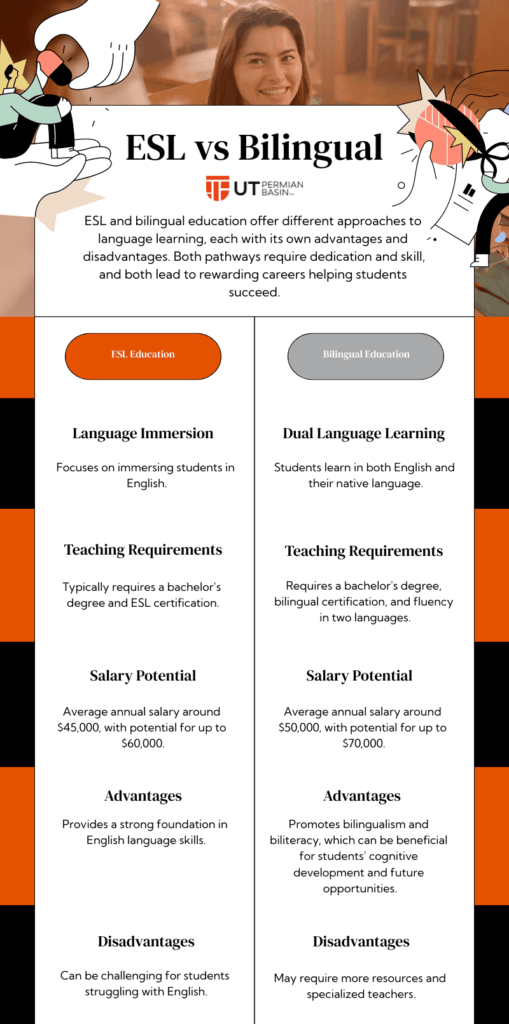
You’ve seen the commonalities these careers share; now let’s break down what sets them apart. Explore the chart below to compare key differences between ESL and bilingual education:
Upon completion of the program, students enrolled in UT Permian Basin’s MA in bilingual education program have the option of sitting for the Texas Bilingual Supplemental Exam, as long as they meet the other eligibility requirements.
Whether you immerse your students in a new language or act as a bridge between two languages, our online program will empower you with the skills needed to teach any ESL learner who enters your classroom.
Texas teachers, here’s the reality: More than half of all K-12 students in the state are Hispanic, and nearly a quarter are enrolled in bilingual/ESL programs. That translates to over a million students who needed specialized language support throughout the 2023-2024 school year. Districts are struggling to find enough certified bilingual and ESL teachers. A critical shortage for schools? Absolutely. But…
While many skills are crucial to us as human beings, mastering a language is perhaps the most fundamental. It provides a framework for the communication skills that students will use throughout their lives. Learning a second language has also been proven beneficial, and bilingual individuals enjoy some unique opportunities and advantages. Whether you’re currently a…
The English language is nobody’s special property. It is the property of the imagination: it is the property of the language itself. — Derek Walcott The United States has no official language, but English is the de facto language spoken by millions of native speakers. For both citizens and noncitizen residents, many of whom speak…