Social media has turned politics into a constant conversation.
Not long ago, campaigns relied on TV ads, newspaper coverage, and door-knocking to reach voters. Now, candidates can post directly to millions of people before the evening news even airs.
That access is powerful. It can help campaigns mobilize voters, respond quickly, and make political participation feel more immediate. But it can also spread misinformation, fuel outrage, and push people deeper into political echo chambers.
Let’s look at the benefits, drawbacks, and growing influence of social media in politics.
The Rise of Social Media in Political Campaigns
Just two decades ago, politicians had to rely on press conferences and news outlets to get their message out. These traditional methods are quickly becoming relics of the past. Today, social media offers candidates a direct line to voters through tools like:
- Tweeting campaign updates and hot takes
- Livestreaming rallies or casual Q&As
- Sharing behind-the-scenes moments via Instagram reels or Facebook stories
With social media platforms, candidates can respond to criticism instantly, post unfiltered thoughts (for better or worse), and build a personal brand that resonates with supporters—something that static newspaper ads simply can’t do.
Take President Donald Trump, for example. During the 2016 presidential primaries, he used Twitter (now X) to share controversial views and policy stances, often bypassing traditional media entirely. His tweets dominated news cycles, increased his media visibility, helped energize a loyal base, and drew public attention on his terms.
Benefits of Social Media in Politics
The upsides of using social media on the campaign trail are hard to ignore, from immediate access to voters to outreach strategies that don’t break the bank.
Here’s a closer look at the key advantages:
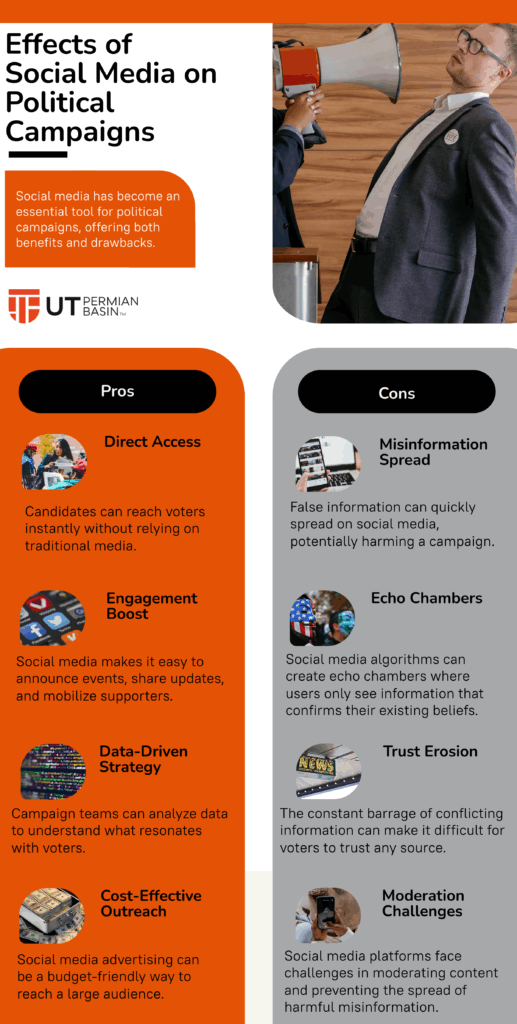
- Unfiltered access to voters
Candidates can post directly to their feeds, controlling their own narrative and image without the spin of traditional media.
- Higher engagement and voter mobilization
Social platforms make it easy to announce rallies, share key dates, or rally supporters to the polls. For example, Stacey Abrams’ 2022 gubernatorial campaign used Instagram to drive turnout among Gen Z and Black voters in Georgia: two groups historically underrepresented at the ballot box.
- Real-time data to guide strategy
With built-in analytics, campaign teams can see what’s working (and what’s not) in real time. If a video flops or a post goes viral, they can adjust on the fly based on clicks, comments, and shares.
- Cost-effective outreach
Compared to pricey TV spots, social ads are a budget-friendly way to get the word out. And if a post gains traction organically? Even better. A viral tweet or trending hashtag can go further than a million-dollar commercial ever could.
Drawbacks of Social Media in Politics
Of course, social media isn’t all rainbows and butterflies. Like any tool with perks, there are bound to be pitfalls, and social media is no exception. Below, we explore some of the most pressing drawbacks.
Social Media, Misinformation, and Political Trust
Misinformation can spread like wildfire, often faster than factual content. While social media can be wielded for good (think: educating voters, mobilizing communities), it can just as easily be used to mislead and manipulate.
Here are some core misinformation concerns that campaign teams should watch for:
- The speed of false information
From false claims of election fraud to doctored headlines designed to stoke outrage, misinformation thrives on platforms engineered for engagement over accuracy. By the time fact-checkers catch up, the damage is often done.
- Bots and fake accounts
Remember the Russian troll farms from the 2016 election? They used fake Facebook profiles to stir division, inflaming tensions around hot-button topics like race, gun control, and immigration. These coordinated disinformation campaigns flooded voters’ feeds, warping perceptions during a crucial election cycle.
- Moderation and accountability challenges
Platforms like Meta and X have tried implementing fact-checking programs, but many users viewed them as inconsistent or politically biased.
In 2025, Meta officially retired its fact-checking initiative, placing the responsibility for flagging misinformation on users. CEO Mark Zuckerberg admitted the change could let “more bad stuff” slip through the cracks, but he argued it was a necessary trade-off to reduce censorship and rebuild public trust.
- Eroding trust in truth
When voters see nonstop conflicting claims, it becomes harder to discern what’s true. That confusion can lead to skepticism, apathy, or worse: accepting misinformation as fact.
Algorithms, Echo Chambers, and Political Polarization
Your social media algorithm knows you a little too well. Cat lovers are flooded with silly feline videos, while health-food enthusiasts are served endless reels of vegan meal prep inspiration. The same goes for political content.
Your feed reflects your past likes, shares, and clicks, reinforcing your existing views. Over time, this can lead to echo chambers: online spaces where people mostly encounter opinions that mirror their own. When that happens, meaningful political discourse can take a hit.
Here’s how:
- Personalized feeds reinforce biases
To keep you engaged, algorithms serve up more of what you’ve interacted with before. If you regularly engage with left- or right-leaning posts, your feed will be shaped accordingly, making it harder to see opposing views.
- Polarization gets amplified
Echo chambers deepen divides. When you only see one side of an issue, it’s easy to view the other side as misinformed or malicious, fueling mistrust between political groups.
How Social Media Shapes Public Opinion
Social media does more than spread campaign messages. It can shape which issues people notice, which stories gain traction, and which voices get heard.
A viral video can make an issue feel urgent overnight, and a meme can simplify a political argument. That doesn’t mean one post changes every voter’s mind. But repeated exposure matters. The more often people see certain messages, the more those messages can influence what they pay attention to and who they trust.
For voters, this makes media literacy more important than ever. For political professionals, it shows why digital communication, public opinion, and political behavior are so closely connected.
Want to Understand the Bigger Picture? Study Political Science at UTPB
If you’re fascinated by how social media is reshaping politics—and you’re ready to dive into the forces that influence public opinion, policy, and power—UT Permian Basin’s online Bachelor of Arts in Political Science is a wise next step.
Whether you see yourself as a future policy analyst, campaign staffer, lawyer, political scientist, or diplomat, this program gives you the foundation to succeed in a wide range of roles. And with 100% online courses, you’ll have the flexibility to complete your degree on your own time—without putting your work or personal life on hold.
Ready to explore where a poli sci degree can take you? Reach out today—or take the leap and apply now.
Sources:
https://uclpress.co.uk/trumps-ascent-via-twitter/
https://georgiarecorder.com/2022/06/06/georgias-high-dollar-election-campaign-battles-now-waged-in-your-social-media-feeds/
-
From Congress to the White House to the Supreme Court, America’s political institutions shape every part of our lives. They decide how much you pay in taxes, whether your vote counts, and what rights you have. But are they working the way they’re supposed to? What Is a Political Institution? Political institutions are the organizations…
-
When people picture women who reshaped American politics, Ruth Bader Ginsburg often comes to mind first—and for good reason. RBG changed how the law sees gender equality from the inside of the Supreme Court. But here’s the thing: she wasn’t in Congress. Long before women were reliably winning elections—long before it was even legal for…
-
Ever wonder how elections actually work? The answer lies in electoral systems. Not to be confused with the Electoral College, an electoral system is a set of rules for casting and counting votes and determining who wins. Different countries use different methods to choose their leaders. Some systems can declare a winner with just 34%…
Chelsea is a Content and SEO Growth Specialist at Apollidon Learning, where she helps create, optimize, and refine educational marketing content for university partners. She holds a bachelor’s degree in literature from Florida State University and has spent the past six years working in marketing, including the past three at Apollidon.