Elevate Your Leadership with UTPB’s Online Superintendent Certification Program
The Unique Challenge of Superintendency
Being a superintendent/CEO, much like any chief executive position, can be inherently isolating. As the designated leader of the organization, a chief executive bridges the gap between board and staff. As a natural conduit between both groups, a superintendent wields unique access and information that must be leveraged to satisfy both groups’ needs and advance the organization’s overall mission.
To excel in this role, the chief executive must understand the interplay between people andsystems: namely how the character of the individuals within the enterprise impacts its systemic function. Through this understanding, they not only make decisions but often determine how those decisions will be made.
Lessons From the Field
When I worked in a central office role, directly supporting the superintendent/CEO during a period of government-mandated consolidation, one of my assignments was to develop a report on potential organizational charts for the newly expanded district. To compile this report, I met with each assistant superintendent to get their thoughts. One assistant superintendent, nearing retirement after more than twenty years in the district office and prior service as a principal, told me very plainly:
“You can come up with whatever structure you like, and one may have certain advantages over the other, but ultimately it’s the people in the roles who are going to make it or break it.”
To excel in their position, a school district chief executive must see board members as critical assets in the pursuit of the district’s goals and work to develop their leadership skills. This investment will greatly strengthen the board’s capacity for high-impact governance.
What Is High-Impact Governance?
“High-impact” governance boils down obtaining clear, accurate, and meaningful answers to three critical questions about your district:
Where is the district heading in the future? (vision, strategic direction, long-range goals)
What is the district now? (mission, operational goals, resource allocation)
How is the district performing? (educationally, administratively, financially)
Source: Houston, P., & Eadie, D. (2002). The Board Savvy Superintendent. The Scarecrow Press, Inc.
A superintendent/CEO that collaborates with board members to answer these questions truly understands that shared understanding and strong relationships are at the heart of effective solutions.
Beyond Soft Skills: Strategic Leadership
Getting to know people, listening to their concerns, and building consensual solutions are essential “soft skill” for today’s chief executives. However, these skills have limited value if a leader lacks the ability to:
drill down on critical governance questions.
facilitate discussions with the board.
assess the landscape and consider options.
ask the right questions to guide the organization forward.
Take the Next Step in Your Career
If you’re a leader on a school campus or already working at the district level and want to learn how to guide a board in making decisions that will bring quality educational opportunities to all students, preparing them for a meaningful life after school, your next step might be just a credential away. The University of Texas Permian Basin’s online Superintendent Certification programhelps yougain the expertise needed tobecome an effective superintendent in the state of Texas, as well as Alaska and Washington.*
We’ve tailored this 16-credit online program for working professionals. Aside from your practicum experience, you can complete the courses completely online and earn your certificate in as little as two semesters—or on a timeline that suits your needs. With year-round start dates, affordable tuition, and relevant courses taught by esteemedprofessors, what’s stopping you from starting the next chapter in your career? Contact us with any questions, and when you’re ready, your application is only a click away.
*Candidates from other states should contact Dr. Rod Uzat to determine if UTPB’s online Superintendent Certification program will meet the requirements of their state.
Many of us have experienced misunderstandings due to miscommunication. For example, you might ask your partner to help with a chore around the house, shouting, “Can I get a hand?”
They reply, “Be there in a minute!”
But five minutes later, you’re frustrated—because to you, “a minute” means exactly 60 seconds, while to them, it might mean “soon-ish.”
Now, imagine these kinds of misunderstandings happening in a courtroom, where the stakes are much higher. The discrepancy between “to-may-to” and “to-mah-to” could mean the difference between a lengthy prison sentence or millions of dollars in damages.
In this article, we explore two notable cases where semantics—the study of how words and phrases convey meaning and how that meaning shifts depending on context—played a critical role in shaping legal outcomes.
#1 The Definition of Loitering: City of Chicago v. Morales (1999)
In the 1990s, Chicago faced a significant rise in homicides due to gang violence. In 1992, the city recorded 920 homicides—the highest number since 1973—and many were linked to gang-related activities. To reduce these violent crimes, the city passed the Gang Congregation Ordinance. According to the law, law enforcement officers were authorized to make people leave a public area if they were suspected of “loitering” and met the following criteria:
More than one person was gathered in a public place.
They appeared to be gang members.
What Was Wrong With This Law?
The main issue with this law was its vagueness. It didn’t clearly define “loitering”: Did it mean standing in one place for a long time or simply gathering in a group? Nor did it specify how to determine gang affiliation, leaving too much discretion to law enforcement. This ambiguity gave police broad authority to question and remove individuals based on suspicion alone, increasing the risk of racial profiling and arbitrary arrests.
The Legal Case
In one notable incident, Jesus Morales was arrested under this law. He contested the charge in court, arguing that the law was unconstitutional. His case eventually reached the United States Supreme Court in 1999. The Court ruled 6-3 that the law was too vague and violated the 14th Amendment, which guarantees due process and equal protection under the law.
The Supreme Court’s reasoning included:
Vagueness The law didn’t clearly define what actions or behaviors were illegal, making it impossible for people to know when they were breaking the law.
Discretionary Power The law gave police officers the authority to decide who appeared to be a gang member based on personal judgment, which led to the risk of racial profiling.
Unfair Arrests The law allowed people to be arrested simply for standing in a public space, even if they weren’t engaged in any suspicious activity.
Why This Case Matters
City of Chicago v. Morales reinforced an important legal principle: Laws must be clear and specific so that citizens and law enforcement understand what is permissible and what isn’t. Vague laws can grant too much power to authorities, leading to unfair enforcement and potential violations of constitutional rights.
#2 What Is a Sandwich?: White City Shopping Center v. PR Restaurants, LLC (2006)
At first glance, the question “What is a sandwich?” seems straightforward. A sandwich typically consists of two pieces of bread with various fillings in between, right?
But what if that definition doesn’t align with everyone’s understanding of a sandwich? That’s precisely what happened to a Panera Bread location in Shrewsbury, Massachusetts.
The Problem: What Is a Sandwich?
This particular Panera had a lease agreement that included an exclusivity clause. To limit competition, the clause stipulated that no other restaurant in the White City Shopping Center could serve sandwiches. However, the lease didn’t specify what exactly constituted a sandwich.
When Qdoba opened in the same shopping mall and began selling burritos and tacos, Panera claimed that those items (since they were wrapped in a form of bread) qualified as sandwiches under their lease’s exclusivity clause. White City then filed a lawsuit seeking a court declaration that leasing to Qdoba did not violate the clause.
The Legal Case
The core issue in the case was simple: What defines a sandwich? Can a burrito or taco, with fillings wrapped inside a tortilla, be considered a sandwich?
When the case went to court, the judge ruled that tacos, burritos, and quesadillas are not sandwiches. As a result, Qdoba was not in violation of Panera’s exclusivity clause.
Why This Case Matters
This case highlights how an everyday word like “sandwich” can lead to a legal dispute when it isn’t clearly defined. The ruling stresses the importance of explicitly defining terms in legal documents to prevent ambiguity. It also shows how personal interpretations of common terms can cause misunderstandings and conflicts in legal settings.
FAQ
What does semantics mean? Semantics is the study of meaning in language: how words, phrases, and sentences convey meaning, and how those meanings can change based on context.
What are examples of semantics? Examples of semantics include how words like “loitering” can be interpreted differently depending on the context. You may use “loitering” in casual conversation to refer to simply hanging out, but in legal contexts, it could carry specific legal implications, such as being associated with gang activity.
When have semantics caused problems in the courtroom? Semantics has caused issues in several court cases where vague or ambiguous terms were at the heart of legal disputes. For example, in City of Chicago v. Morales (1999), the lack of a clear definition for “loitering” led to questions about racial profiling and constitutional rights. Similarly, Panera Bread’s lawsuit against Qdoba centered on the ambiguity of the term “sandwich,” showing how unclear definitions can lead to legal conflicts.
Find Clarity With a Degree From UTPB
Fortunately, extreme semantic miscommunications are rare compared to the small misunderstandings we experience daily. For example, when your partner says they’ll “clean” the kitchen, their version of “clean” might not align with yours—leading to frustration (or a kitchen that’s only halfway tidy). Understanding the nuances of language is key to avoiding misinterpretations, whether in personal conversations or professional settings.
The same principle applies to written communication. Words have power, and the ability to craft clear, compelling messages is a skill in high demand across industries. If you’re looking for a degree that opens doors in marketing, communication, education, writing, law, and beyond, The University of Texas Permian Basin (UTPB) offers online Bachelor of Arts (BA) and Master of Arts (MA) degrees in English to help you master the art of effective communication.
Each program explores the richness of the English language through literature, linguistics, and writing, examining works from Shakespeare to contemporary authors. In our undergraduate program, you can even take a course on semantics, where you’ll dive deep into how words shape meaning, logic, and interpretation.
With multiple start dates, affordable tuition, and fully online options, UTPB makes it easy to earn your degree on your schedule. Browse our programs today to find the best path for you.
Whether you’re a coach who’s overseeing an entire athletic team or a personal trainer developing a customized fitness program for your clients, one goal remains the same: preventing injuries before they happen. We all know the importance of rehabilitation, but the real victory lies in stopping those injuries from happening in the first place.
University athletes experience an average of more than two injuries each year, with the most common being ankle, knee, and shoulder injuries. But here’s the good news: Thanks to kinesiology, we can significantly reduce the risk of these career-threatening injuries and make strides toward better long-term health.
Join us as we explore kinesiology’s role in optimizing performance and ensuring athletes stay healthy and injury-free.
What Causes Common Sports Injuries?
Sports injuries are always lurking, waiting for an athlete to make a crucial mistake. Whether it’s throwing one too many passes without warming up properly or tackling someone at the wrong angle, the risk of injury is always present.
From strains and fractures to dislocations and twisted knees, sports injuries come in all shapes and sizes, and each sport carries its own set of risks. For example, football players commonly face ACL tears, shoulder injuries, and concussions, while baseball and softball players tend to suffer from shoulder or elbow injuries, as well as hand or finger fractures.
Even highly paid professional athletes aren’t immune to career-threatening injuries, which raises the question: What causes these injuries in the first place?
Several factors contribute to the occurrence of sports injuries, including:
Poor conditioning Athletes train year-round to maintain strength and stamina and reduce the likelihood of injury. However, when athletes fail to properly condition their bodies—whether that’s through strength training or stretching before and after exercise—their muscles, joints, and ligaments aren’t as strong or flexible. This makes them more vulnerable to strain and injury.
Overtraining When athletes repeatedly perform the same motions or train excessively without allowing their bodies the necessary time to recover, they increase their risk of overuse injuries. For example, stress fractures are common in sports like running or gymnastics, where the constant impact on bones leads to tiny cracks.
Trauma Trauma-related injuries are more prevalent in high-impact sports like football, hockey, and rugby. These injuries occur due to sudden, forceful impacts, such as colliding with another player, falling, or landing at an awkward angle. Common trauma injuries include concussions, fractures, dislocations, and sprains.
The Science Behind Kinesiology in Injury Prevention
Preventing sports injuries isn’t just about strengthening muscles or knowing anatomy; it also requires a scientific understanding of how the body moves under stress. Kinesiologists apply this knowledge to identify and address the physical demands placed on athletes, helping to reduce injury risks before they occur.
A key component of kinesiology is biomechanics, the study of how the body moves and responds to force. By analyzing an athlete’s movements, kinesiologists can detect imbalances, poor mechanics, or improper alignment that may predispose an individual to injuries like ACL tears, rotator cuff strains, or stress fractures.
How Kinesiologists Collaborate With Coaches
Integrating kinesiology into athletic training means developing evidence-based programs that prioritize not just peak performance but long-term health and injury prevention.
A crucial part of this integration is collaboration. Kinesiologists often work alongside coaches to design training routines that are both sport-specific and athlete-centered. While coaches focus on skill development and competition readiness, kinesiologists ensure the physical conditioning supports these goals safely. Together, they create balanced programs that boost athletic potential while minimizing injury risks.
How Do Kinesiologists Prevent Sports Injuries?
While not all sports injuries are preventable, kinesiologists play a crucial role in minimizing risk. By applying their expertise in biomechanics, human movement, and exercise science, they implement some of the following proactive strategies that help athletes stay on the field and out of the treatment room:
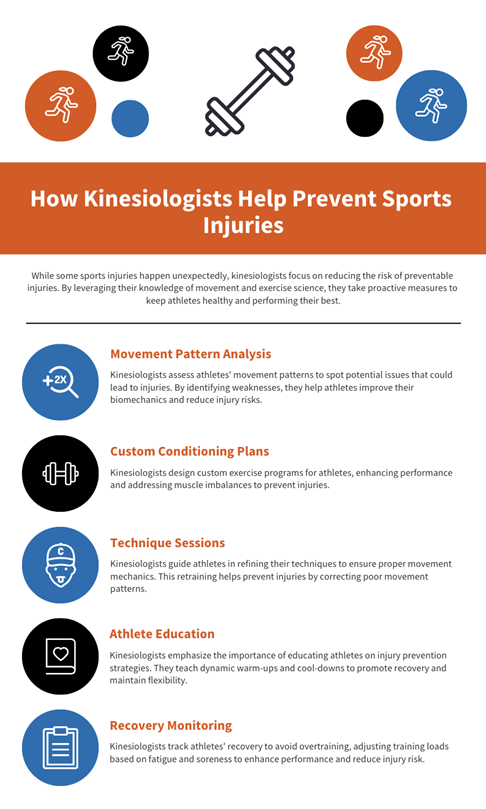
Biomechanical assessments Kinesiologists begin by analyzing an athlete’s movement patterns, including posture, gait, joint alignment, and overall biomechanics. These assessments help identify potential red flags, like poor knee tracking during squats, that could predispose someone to injuries such as ACL tears or patellar tendinitis.
Personalized exercise programs No two athletes are the same, which is why kinesiologists create individualized conditioning programs. They design them to enhance movement efficiency, improve joint stability, and correct muscle imbalances that could otherwise lead to strain or overuse injuries.
Movement retraining Once biomechanical assessments highlight inefficiencies, kinesiologists work with athletes to modify their movement mechanics. For example, if an athlete tends to let their knees cave inward during squats, a kinesiologist will teach proper technique and reinforce it through strength and neuromuscular training.
Educating athletes Injury prevention extends beyond the core workout itself. Kinesiologists educate athletes on the importance of dynamic warm-ups to prepare muscles and joints for physical activity and static or active cool-downs to promote recovery and reduce stiffness or soreness after exercise.
Monitoring recovery Overtraining is a common issue in both competitive and recreational sports. Kinesiologists help manage training loads by monitoring key recovery indicators such as muscle soreness, fatigue, heart rate variability, and sleep quality. By adjusting an athlete’s program as needed, they can strike the right balance between pushing for peak performance and preventing injury.
Make an Impact in Sports Medicine
Ready to elevate your expertise and make a difference in athletic performance and injury prevention? At The University of Texas Permian Basin, our online Master of Science in Kinesiology program prepares you for a career as a coach, exercise physiologist, or another exercise science role.
In just 30 credit hours, you’ll deepen your knowledge of human movement, applied research, and evidence-based practices. You’ll also take specialized courses like:
Training and Conditioning Methods
Analysis of Teaching and Coaching Behavior
Applied Sports Psychology
Our fully online program is designed for working professionals, offering affordable tuition and multiple start dates throughout the year.
This isn’t to say that women aren’t breaking barriers in traditionally male-dominated fields. Take Fortune 500 companies, for example. Though historical leadership in these elite businesses was overwhelmingly male, Fortune 500 companies have seen steady growth in female representation, with women holding 10.4% of their leadership positions as of 2023.
So, where do women stand today in leadership, from C-suite roles to entrepreneurial ventures? In this article, we’ll examine the challenges women often face on their path to leadership and explore strategies for overcoming these obstacles, empowering them to rise to the top.
Challenges Women in Leadership Face
While women have made great strides in workplace equity, they still face unique challenges in securing leadership roles. These hurdles often come from biases, social expectations, and systemic barriers that can make the journey more difficult.
Unconscious Gender Biases
Unconscious gender biases are stereotypes people hold about others based on their gender. These biases are often subliminal, shaped by cultural and societal norms that influence how we see the world—including our workplaces.
Common gender biases women experience in the workplace include:
Stereotypes Women in leadership roles sometimes face unfair assumptions about their abilities or decision-making. For example, when a female leader makes a strong decision in a high-pressure situation, some might question whether her choice was driven by emotions rather than logic. These stereotypes can cause people to doubt her leadership, even when her decisions are carefully thought out and support the goals of the organization.
Double standards In some workplaces, women in leadership positions may elicit different reactions than their male counterparts. For instance, employees may be more likely to openly challenge an email from a female supervisor than they would one from a male in the same position. This may stem from unconscious biases, where assertive or decisive women are judged more harshly than men exhibiting the same traits. These double standards can make leadership roles even harder for women to navigate.
Finding the Work-Life Balance
Achieving a work-life balance can be a challenge for anyone, but for women, it can be especially daunting due to societal expectations and additional responsibilities at home. Here are two key factors that contribute to this complexity:
Caregiving Expectations
Studies show that up to 81% of caregivers for both children and elderly family members are women. This caregiving burden stems from traditional societal norms that associate women with nurturing roles. For women striving to excel in leadership positions, managing these responsibilities alongside demanding professional roles can be overwhelming. The result is often a delicate juggling act that can make it difficult to progress in one’s professional and personal life.
Cultural Variations
Work-life balance challenges also vary significantly across cultures due to differences in societal norms, workplace policies, and government support systems. For instance, countries like Sweden provide extensive parental leave—up to 480 days shared between parents—making it easier for women to balance leadership roles and parenting responsibilities.
In contrast, countries with limited parental leave or minimal government support often place a heavier burden on women, who are frequently expected to manage a heavy share of household and caregiving duties. These contrasts highlight the critical need for equitable policies and support systems to create a more equal playing field for women in leadership.
Strategies for Overcoming Leadership Challenges
While it’s true that women face challenges as they work toward leadership roles, there are clear steps they can take to keep growing and moving forward in their careers.
Build Support Networks
Having a strong group of mentors, friends, and colleagues is important for anyone in leadership, but it’s especially helpful for women. This network can offer advice, feedback, and encouragement to help overcome challenges. Networking also provides a chance for women to share their own experiences and strategies, creating a sense of solidarity and helping them feel less alone when facing tough situations at work.
Advocate for Policy Change
Once women have reached leadership positions, they have the power to push for positive changes in the workplace. This can include advocating for better policies like paid maternity leave or more flexible working hours. By working to improve the system, they can help make the workplace more equal for everyone.
Continuing Education and Professional Development
Staying consistent with your education is a key way to stay competitive in any field. According to a recent McKinsey “Women in the Workplace” report, women often face barriers like limited access to career development programs.
By seeking out professional development opportunities like leadership workshops, certifications, or online courses, women can strengthen their expertise and stand out in their fields. Another option is advanced education, like online graduate programs or industry-specific certifications. These credentials help bridge gaps caused by unconscious biases or fewer opportunities in the workplace. They also equip women with the tools they need to confidently pursue leadership roles—and succeed—despite the challenges they may face.
Shape Your Future to Your Liking
Whether you’re just starting out in business or aiming to take your career to the next level as a future C-suite executive, The University of Texas Permian Basin is here to support you every step of the way. Our online Bachelor of Business Administration in Management gives you the skills and confidence needed to succeed in a variety of industries while building a strong foundation in leadership.
For experienced professionals, our online MBA program offers advanced training to help you achieve your leadership goals and stay competitive in today’s business world. Both programs feature affordable tuition and are delivered 100% online, so you can balance work, life, and education with ease.
If you asked a coworker, “What did you think of the meeting?”, a female colleague’s response might come across differently than a male colleague, even if they convey the same meaning.
Your female coworker might say, “I think the meeting went well, and it seemed like everyone had a chance to share their thoughts. What did you think?” Your male coworker, on the other hand, might offer a more concise reply, such as, “It was fine.”
Why Do Men and Women Communicate So Differently?
This isn’t about stereotypes. Plenty of men focus on forming emotional connections (“rapport talk”), and many women favor a straight-to-the-point communication style (“report talk”). But, in general, men and women do communicate differently, and understanding these subtle differences is often key to navigating around conversational landmines.
Men vs. Women: The Why Behind the What of Communication
As babies, regardless of gender, our primary goal is the same: to express our needs to caregivers through cries, coos, or smiles. As we grow and develop language skills, we begin conveying thoughts and emotions in more advanced ways, both verbally and nonverbally. Though communication styles vary significantly across individuals, here are some common patterns researchers have noted in male and female communication.
Women: Building Bonds
Women frequently use communication as a tool to deepen connections and nurture relationships, relying on empathy, understanding, and inclusivity when framing their thoughts. For example, hoping to connect with her partner, a woman might say, “Can we talk?” For her, talking for the sake of talking is part of being in a relationship. Relationship talk, to her, affirms their love for one another and reinforces the existence of their relationship.
Men: Solving Problems
When he hears that his partner wants to talk, a man might assume the worst. What’s wrong? I thought things were going well between us? Typically, when a relationship is progressing smoothly, men see no reason to talk about it. Men, for the most part, don’t want to “just talk.” It’s not that men are heartless; they just have a different approach to communication.
These varying communication approaches are a big reason why men and women don’t always see eye-to-eye. Women converse to sustain relationships, while men prefer to solve problems and realize goals. So, in a heterosexual relationship, when a man doesn’t want to discuss his relationship, his female partner may assume (understandably) that the relationship is in trouble.
Verbal Communication
According to researcher Albert Mehrabian, only 7% of communication relies on actual words, with the remaining 93% stemming from tone and nonverbal cues. Despite this small percentage, verbal language is crucial in shaping how people perceive our words. Men and women often approach this 7% with their own distinctive delivery, which reflects their different communication styles.
Women: Collaborative and Considerate Communication
Women frequently prioritize harmony when shaping their thoughts into words, softening their statements to avoid conflict or offending others. For example, in an email to a coworker, a woman might write, “I think this approach could work, but maybe we should consider other options too.” This hedging language is collaborative, encouraging dialogue without asserting dominance.
While effective in fostering positive relationships, women’s communication styles can also be direct and assertive when the situation calls for it. For instance, a woman leading a team project might say, “We need to meet the deadline by Friday. Let’s assign tasks today and reconvene tomorrow to check progress.”
Men: Direct and Decisive Communication
Men, on the other hand, are typically more straightforward and assertive when communicating verbally or in a written format. In the same email scenario, a man might write, “This approach works best. Let’s move forward with it.” This concise tone conveys confidence and decisiveness, prioritizing efficiency over relational considerations.
However, with a clear understanding of relational nuances, men can enhance the effectiveness of direct communication while still maintaining positive relationships. For example, in a team setting, a man might say, “This is the most practical solution. Let’s move forward with it, but I’m open to hearing other suggestions if anyone has concerns.”
Nonverbal Communication
Research highlights the importance of nonverbal cues like body language, facial expressions, and tone, allowing us to better convey our intentions and emotions. These silent signals often reveal what words do not.
Nonverbal Communication in Women
Many women tend to rely on nonverbal gestures to enhance what they’re feeling, including facial expressions, such as smiles or raised eyebrows that show excitement or surprise. Additionally, women are more inclined to maintain frequent eye contact, which exhibits attentiveness and an emotional connection to whomever they’re speaking. This expressiveness extends to their ability to decode nonverbal cues from others, making them generally better at interpreting subtle emotional undertones.
Nonverbal Communication in Men
In contrast, men often display a more reserved approach to nonverbal communication. Many men avoid prolonged eye contact, as it’s sometimes associated with emotional vulnerability. Instead, they may rely on physical gestures, which, while less frequent, are often more pronounced or expansive when used.
These larger gestures can convey authority or assertiveness but may lack the nuanced emotional detail often found in women’s nonverbal cues. However, nonverbal communication varies widely based on context and cultural upbringing.
Learn To Communicate Like a Pro With UT Permian Basin By Your Side
Communication may be a universal skill, but how we express ourselves varies from person to person. Today, men and women both adapt diverse communication styles that go beyond traditional stereotypes. Shared environments, such as workplaces or collaborative settings, influence and often blur these distinctions, fostering unique communication dynamics.
If you’re ready to elevate your communication skills, The University of Texas Permian Basin offers a Bachelor of Arts in Communication designed to fit your busy life. Delivered 100% online, this program empowers you to develop critical thinking and master essential techniques in areas like public relations, crisis communication, and small group collaboration.
We know every student’s goals are different, which is why we offer four specialty tracks to customize your degree:
Communication Studies
Strategic Messaging
Professional Communication
Sports Media
Take the next step toward advancing your career and personal growth. Explore the track that aligns with your future goals, and fill out an application when you’re ready to take the first step.
In our modern world, there are countless mediums through which we can document our emotions regarding the human experience: photos on Instagram and shorts on YouTube, to name a few. But nothing quite reflects our highs and lows like the written word, particularly in the form of poetry.
For centuries, poets have shaped the way we view the world around us, exploring themes that transcend time. Think about it: Shakespeare’s “Hamlet” with its iconic “To be, or not to be” soliloquy, or T.S. Eliot’s “The Waste Land,” with its fragmented yet powerful depiction of a post-war world struggling to find meaning.
These poets, along with countless others, have not only defined their eras but also left a lasting impact on how we express and interpret emotions today. In this article, we celebrate some of history’s most notable poets, whose works continue to resonate with and inspire new generations.
William Shakespeare (1564-1616)
William Shakespeare’s works have moved audiences for generations, connecting with readers and audiences across the globe. While he coined the famous phrase “To be, or not to be” centuries ago, it still holds profound relevance today, as do numerous other phrases in his works, like “break the ice,” “heart of gold,” and “wild-goose chase.”
Over his lifetime, Shakespeare penned 154 sonnets and numerous iconic plays, such as “Romeo and Juliet,” “Macbeth,” and “Much Ado About Nothing.” These plays are not only reenacted in theatres worldwide but have also been adapted into films with similar plots. The animated Disney film “The Lion King,” for instance, draws inspiration from “Hamlet.”Another ’90s classic,“Ten Things I Hate About You,”is based on his play“The Taming of the Shrew.”
Whether you’re reading a sonnet or a full-length play, Shakespeare’s themes are as timeless as they are universal. He did what many writers cannot: depict the complexities of human emotion, from the beauty of love to the depths of jealousy. His masterful manipulation of the English language and his knack for weaving intricate—and jaw-dropping—plots explain why his works have endured for centuries and remain central to educational curriculums today.
Edgar Allen Poe (1809-1849)
The Master of the Macabre, American poet Edgar Allan Poe is known for his uncanny ability to dig six feet deep into dark, gothic themes. Poems like “The Raven” were revolutionary in the 1800s, as Poe explored the human psyche and the darker side of existence.
The poem follows a man who is mourning the death of his beloved, Lenore. It expertly descends into the narrator’s spiral of madness, which is symbolized by a raven that repeatedly speaks the word “nevermore.” His use of symbolism, repetition, imagery, and melancholic rhythm throughout the poem are wonderful examples of literary devices that convey the narrator’s descent into despair.
His other works, both poetry and short stories, focused heavily on horror, mystery, and the “detective story,” paving the way for other famed writers like H.P. Lovecraft and Arthur Conan Doyle. Through his exploration of the dark side of the human mind, he helped create the genres of psychological horror and detective fiction, shaping the future of suspenseful literature.
Sylvia Plath (1932-1963)
Best known for her confessional style of poetry, Sylvia Plath explored themes of mental illness, death, and the female experience. Her work was especially groundbreaking during a time when mental health issues were rarely discussed openly. One of her most famous poems, “LadyLazarus,” portrays her own personal battle with suicidal thoughts, symbolizing both the pain and the power of survival. One excerpt from the poem reads:
Out of the ash
I rise with my red hair
And I eat men like air.
The imagery of “rising from the ash” alludes to the mythical phoenix, representing her resilience after feeling defeated in the face of self-destruction. In addition, the line “I eat men like air” conveys a strong sense of empowerment, as the speaker transforms her suffering into strength.
Plath’s work also explores the conflict between her self-identity and the societal expectations placed on women in the 1950s and ’60s. Her semi-autobiographical novel, “The Bell Jar,” delves into her struggles with mental illness, offering a candid look at the internal battles the narrator faced. In the final line of the book, she writes:
I took a deep breath and listened to the old brag of my heart. I am, I am, I am.
This line reflects the narrator’s ongoing attempt to find stability and meaning in an oppressive world. Through her candid writing style, Plath created a body of work that has resonated with readers for decades, particularly those grappling with their own experiences of mental health, gender roles, and the search for identity.
Discover the Power of Words With an Online BA in English
For centuries, poetry has had the power to shape our understanding of the human experience. If you’re passionate about exploring the depths of poetry, literary analysis, and storytelling, pursuing an online Bachelor of Arts in English from The University of Texas Permian Basin allows you to dive deeper than ever before into the world of literature.
With a core curriculum that emphasizes both classic and contemporary texts, you’ll refine your skills in writing, critical thinking, and communication, preparing you for careers in education, marketing, publishing, and more. Plus, with diverse American Literature, British Literature, and elective courses, you can customize your studies to align with your passions and professional goals.
At UT Permian Basin, we’re proud to offer competitive tuition rates, flexible 100% online learning, and year-round start dates, making it easier than ever to achieve your degree on your schedule.
“Sorry, I hated that. Sorry, I wish I hadn’t said that.” “Sorry, is this coffee? Sorry, this is my fault.”
Comedian Amy Schumer cast light on an all-too-common reality for many women with a 2015 sketch from her show “Inside Amy Schumer.” Entitled “I’m Sorry,” the sketch depicts female thought leaders on stage who apologized so profusely that they never got a chance to share their expertise.
The video addresses a troubling but persistent trend in our society: Studies show that women do indeed apologize more than men—but why?
Why Do Women Apologize More Than Men?
Over-apologizing happens for many reasons, including:
Seeking others’ approval
Feeling guilt for someone else’s behavior who doesn’t feel guilt
Feeling guilt for something you aren’t responsible for
Apologizing “too much” has also been linked to mental health conditions like social anxiety or post-traumatic stress disorder (PTSD). While the ability to make a genuine apology shows empathy and good social skills, over-apologizing can also reveal a lack of confidence and fear of confrontation.
A study by Psychological Science found that while women do apologize more than men, there’s an underlying disparity. Women reported offering more apologies than men but also committing more offenses.
Men, on the other hand, showed a higher threshold to what we perceive as offensive behavior. In fact, while women over-apologize, it has been found that men under-apologize, as they more often believe that society views apologetic behavior as a weakness.
As part of their study on gender bias in the workplace, the International Labor Organization (ILO) found that men’s assertiveness is often viewed more positively because it’s associated with leadership. Women’s assertiveness, on the other hand, is often interpreted as aggressive. As a result, women try to navigate these expectations to avoid backlash. Research has shown that 42% of working women in the United States have experienced gender discrimination at work.
How Gender Roles and Childhood Conditioning Affect Apologizing
Traditionally, girls are expected to grow up to become polite, communal, and nurturing. Boys, on the other hand, are expected to be grow into assertive, dominant, and unemotional men.
Gender-descriptive language is evident from the moment we’re born: If we hear the word “pretty,” we’ll usually assume it’s describing a girl. If we hear the word “strong,” we generally associate this with a boy.
These contradictory expectations can make women feel confused about the right actions and behavior, leading to feelings of insecurity. This is where, “Sorry, but…” comes in. Girls grow up hyper-aware of their actions and surroundings.
Cultural Perspectives on Apologies
While women’s tendency to over-apologize sheds light on gender biases within our society, apologizing differs significantly across cultures. Researchers found that while an individual-centered culture like the United States sees an apology as assessing a blame, a collectivist culture like Japan views an apology as an expression of remorse. This reveals intriguing insights into how social norms and values shape our behaviors.
Explore Society’s Complexities With a Sociology Degree
Imagine a world where individuals are free from limiting expectations, like the complex dynamics of why women feel the need to over-apologize. Sociology offers a lens through which we can analyze and critique societal norms, gender roles, and power structures that contribute to gender-based behaviors.
With the online Bachelor of Arts in Sociology from The University of Texas Permian Basin, you’ll gain a deeper understanding of how socialization, cultural expectations, and systemic discrimination shape our actions and perceptions. The program is entirely online, and classes are asynchronous, so you can study from anywhere in the world, on your own terms. Graduates can pursue a variety of roles in fields like:
Social research
Counseling
Advocacy
Policy analysis
Community development
Want to learn the skills needed to address gender bias head-on and help pave the way for an inclusive future for everyone? Visit our Apply page when you’re ready.
When someone struggles with depression, homelessness, or discrimination, who steps in to help? A psychologist? A social worker? A sociologist? These three fields all address human challenges, but they explore humanity from very different angles: one from society, one from the mind, and one from the front lines. So what are the similarities and differences between sociology, psychology, and social work? This guide clears up…
Lunar eclipses don’t happen often, but when they do, everything seems to slow down. People step outside. Neighborhoods get quieter, tuned in to the skies above. Suddenly, something outside of our control brings us all together for a shared moment of collective awe. Eclipses remind us that we’re all living under the same moon, no…
How many times a day do you unlock your phone to scroll through your favorite feed? Ten? Twenty? Lost count after breakfast? You’re not alone. The average American checks their phone 205 times a day and spends about two and a half hours of that time on social media. Whether you’re catching up on family…
“Access to basic quality healthcare is one of the most important domestic issues facing our nation.” –Former Congressman Ed Pastor
The COVID-19 pandemic exposed deep-seated issues in healthcare, particularly inequities in access and the challenges of serving uninsured populations. It also opened our eyes to the potential for a flexible healthcare system, as seen in the rise of telehealth services and the essential role of traveling nurses.
What’s Next for Healthcare?
As our world population grows and ages, there will be more patients and a greater need for an efficient, cost-effective healthcare system. Other key factors to watch out for in future healthcare settings include:
Digitalization and automation.
Big data management.
Patient-centric practices.
Let’s examine how the future of healthcare and how the industry may evolve in the coming decades.
Restructured Care Teams
While there are currently 297 physicians for every 100,000 patients in the United States, a new Association of American Medical Colleges (AAMC) report projects a shortage of up to 86,000 physicians by 2036. Stressful schedules fraught with challenges, like poor work-life balance and ongoing global healthcare crises, have contributed to lack of qualified care.
This means that in the absence of physicians, other healthcare providers will become increasingly essential, such as nurse practitioners (NPs), who can diagnose, treat, and manage patient care independently. Additionally, registered nurses (RNs) will become indispensable in areas lacking other providers.
Telemedicine and Virtual Wards
As technology advances, clinics will likely restructure into hybrid care teams, delivering services both virtually and on-site. For example, virtual hospital wards allow patients to be monitored from a central location. This will allow providers to effectively treat every patient, move them through the healthcare system efficiently and provide fully engaged care. Collaborative patient care systems, in which patients have more control over their health journey, will also become more prevalent.
Big Data and Smart Networks
Did you know that the healthcare industry generates about 30% of all global data? Because so much data is generated and captured, about 97% of healthcare data in hospitals goes unused. Artificial intelligence (AI)-powereddiagnostic tools, like image analysis software in radiology, are already improving early detection rates for conditions such as cancer. As these AI-aided systems advance, big data is helping us streamline information and revolutionize healthcare in areas such as:
Data-informed, personalized care.
Enhanced X-ray capabilities and precision.
Improved global collaboration.
Smart networksenable the access of patient files from anywhere in real-time, meaning patient data can be updated and viewed on the spot. However, these types of systems are often hindered by complex integration and their vulnerability to data breaches.
Predictive, Preventative, Personalized Medicine
With the onset of big data also comes the possibility of personalized healthcare. Personalized medicine means a patient’s personal data is used for customized treatment and prevention, which can help healthcare providers shift from a reactive approach to a more proactive one. While personalized healthcare creates long-term benefits for the patient, tailoring medical treatment based on your genome can be expensive. However, wearable devices are already used in fields like:
While promising cures are emerging, antibiotic resistance is also rising, along with mental health issues linked to digital device dependence. To ensure the benefits of healthcare advancements reach all communities, it’s essential to address barriers to access, particularly in underserved regions. While these innovations promise better healthcare outcomes, balancing the costs to make them accessible remains a pressing challenge.
The Rise of Robotic Assistants
The da Vinci robotic surgeon assistant is a good example of a growing number of automated systems implemented into our healthcare system. Robots are used to assist in complex and precise surgeries and can be built to provide robotic exoskeletons to help patients walk. This isn’t just limited to robots we can see: Nanobots (tiny robots injected into the body) can deliver medication directly to intended cells, instead of a broader area, which minimizes side effects and maximizes precision.
Shape Healthcare’s Next Generation
The evolving roles of healthcare professionals will require adaptability, making continuous learning and a patient-centered approach vital in the future. If you’re considering a career in nursing, it’s essential to have the right education and stay up-to-date on the latest trends and technology.
Hone Your Nursing Skills Online With a BSN
The University of Texas Permian Basin’s online RN to BSN program prepares you for these future challenges and innovations. You’ll gain leadership skills, learn evidence-based practices and focus on patient-centered care: all critical for modern healthcare environments.
Our program’s flexible format, which is entirely online except for two proctored courses, allows you to keep up with healthcare advancements while balancing your work and studies.
Take charge of your career growth on your own schedule, adapt to new healthcare demands, and help shape the future of patient care. Learn more and apply here.
Many of us feel the invigorating sense of fresh starts and second chances that New Year’s brings. On January 1st, we’re often eager to embrace a healthier, polished version of ourselves—and we’re not alone. According to a 2024 Forbes Health poll, 48% of participants said improving their fitness was their top priority, 36% cited improving their mental health as their resolution, and another 32% wanted to improve their eating habits.
New Year’s is like the Black Friday of holidays for wellness and health-related resolutions. Consequently, ramping up social media marketing strategies is a powerful way for brands to drive customer engagement and capitalize on this peak interest. Today, we’ll explore the influence of social media on wellness brands during the New Year and discuss effective marketing strategies to leverage this seasonal momentum.
The Role of Social Media Marketing in Wellness Resolutions
As the end of the year approaches, health and wellness brands often rejoice—especially if they have a strong digital marketing presence. Many notice an increase in traffic to their storefronts and websites.
This surge in purchases is often attributed to a business’s social media presence. With strategies including relatable content, community engagement, and interactive challenges, social media platforms become ideal channels for health and wellness brands to connect with consumers. For example, in 2016, WeightWatchers capitalized on the New Year’s momentum with their “Live Fully” campaign, which included a social media component encouraging users to share their resolutions online. During this campaign, users lost 15% more weight in the first two months after the program launched.
Timing is crucial. It’s important to start planning—and posting—your content well before New Year’s. This approach allows you to capture your audience’s attention, build anticipation, and inspire them to make physical or mental changes in their lives. Tools such as polls, testimonials, and user-generated content are excellent ways to boost engagement and foster community involvement.
Health and Wellness Brands’ Social Media Marketing Strategies
If you’re looking for the perfect opportunity to capitalize on the hype that the New Year brings to your industry, now’s your chance to flaunt your social media prowess with some of these social media marketing strategies:
Create engaging posts It might sound straightforward, but a little competitive research and some Google searches can go a long way in uncovering your customers’ pain points. Once you understand what they want to see, create content that aligns with their New Year’s resolutions. Think exercise reels, mouthwatering photos of healthy recipes, or practical tips for prioritizing mental health as they head into the new year.
Launch interactive challenges Starting an interactive challenge not only helps your audience become up to 95% more likely to achieve their goals, but it also motivates others to join. As participants share their wellness journeys and invite their friends to join, you may see a spike in users and engagement on your social platforms.
Incorporate user-generated content Whether it’s before-and-after transformation photos or testimonials from satisfied customers, user-generated content can persuade those on the fence that your products or services are exactly what they need to get their resolutions on the right track. Plus, when users share content like healthy recipes or meal prep ideas that use your products, it gives you even more material to work with.
Use polls and surveys Take advantage of the poll features on social platforms to ask your audience about their New Year’s resolutions or what topics they’d like to see more of. This allows you to tailor your content based on their feedback and ensures you’re focusing on what resonates most in the months ahead.
How to Drive Engagement Beyond January
Unfortunately, all good things—including the excitement around New Year’s resolutions—tend to fade. By February, approximately 80% of resolutions lose steam, often fizzling out entirely. Luckily, you can get ahead of this drop-off and keep your social media audience engaged well beyond January with a few smart strategies.
Here’s how to keep your users excited and motivated:
Offer periodic challenges Accountability shouldn’t stop at the end of January. Launch seasonal wellness programs or fitness challenges to help your audience stay motivated throughout the year. This fosters a sense of community and keeps them coming back to your platforms to check their progress and connect with others.
Schedule regular check-ins Use polls or open-ended questions in your content calendar to ask followers how their resolutions are going. Encourage them to share tips that have helped them stay on track. These small interactions not only build engagement but also keep your brand relevant to their interests and needs.
Create exclusive content When planning your content calendar, think about what types of content will inspire your audience year-round. Consider offering live Q&A sessions, creating in-depth guides that align with your brand, or even offering special insider content for loyal followers. This keeps your audience motivated and positions your brand as a go-to authority in the wellness space.
Find Your Niche in Digital Marketing with a BBA in Marketing From UTPB
Digital marketing is a fast-growing industry with numerous specialties, including social media, content strategy, SEO, email marketing, and affiliate marketing, just to name a few. Whether you’ve already found your niche or are still exploring which path aligns with your passions and strengths, The University of Texas Permian Basin offers an online BBA in marketing that equips you with the fundamentals of both business and marketing. By taking 12 credits of marketing electives—from Digital Branding to Social Media Marketing—you’ll gain the expertise to specialize in your desired area.
If you’re looking to sharpen your skills or explore the latest digital marketing trends, UTPB also offers an Undergraduate Certificate in Digital Marketing, which can be added to your bachelor’s degree program. In just 12 credit hours, you’ll have the opportunity to select from six courses, allowing you to tailor your education to your specific interests within the digital marketing field.
With affordable tuition, flexible, asynchronous classes, and year-round start dates, nothing is holding you back from taking the next step in your career. Apply to your program of choice today and begin your journey toward mastering digital marketing!
If you’ve ever wondered, “what can you do with a political science degree?”, you’re in the right place. We’re here to talk about seven influential people who majored in political science. While their success can’t be solely credited to their degrees, it’s fair to say that the knowledge and skills they gained through their education played a significant role in shaping their journeys.
1. Barack Obama
Barack Obama, the 44th president of the United States, began his political climb by graduating with a degree in political science in 1983. Afterward, he devoted himself to the people of Chicago, working as a community organizer to improve housing conditions and establish job-training programs for those in need.
He then earned a law degree, and soon after, joined a law firm that focused on civil rights. For Obama, the legal world was a stepping stone to a political career. In 1996, Obama was elected to the Illinois Senate. Eight years later, he was elected to the U.S. Senate. Then, in 2008, he made history by becoming the first Black U.S. president.
Obama’s presidency was defined by significant challenges, both at home and abroad. Yet his two terms were marked by incredible achievements: the American Recovery and Reinvestment Act of 2009, the Affordable Care Act of 2010, and the appointments of Elena Kagan and Sonia Sotomayor to the Supreme Court, to name a few.
2. Madeleine Albright
Madeleine Albright’s early years were shaped by upheaval. As a child, she fled to the U.S. from Czechoslovakia after the Soviet-backed communist coup in 1948. By 1957, she had become a U.S. citizen, and two years later, she graduated with honors from Wellesley College with a degree in political science.
In 1993, Albright became the U.S. ambassador to the United Nations. On January 23, 1997, she was sworn in as Secretary of State, becoming the first woman to ever hold the position. Albright was a formidable force in global diplomacy, championing the expansion of NATO, advocating for democracy in Eastern Europe, and working to normalize relations with countries like China and Vietnam.
Albright’s impact on democracy, diplomacy, and global affairs was profound. And as a unique footnote in her storied career, she appeared on the beloved show “Parks and Recreation” in 2015.
3. Anderson Cooper
Anderson Cooper’s early life was marked by tragedy. In 1978, his father died during open-heart surgery, and a decade later, his brother Carter committed suicide. Reflecting on these tragedies, Cooper said, “I became really focused on questions of survival … I came up with this idea: I’ll just go to places that are really dangerous and I’ll learn about survival and try to shoot some stories and maybe it’ll lead to something. Even if it doesn’t, I will learn a lot about how people survive.”
After earning a degree in political science in 1989, Cooper began his news career as a fact-checker for Channel One, but the job was mundane. So, Cooper did what any sensible person would do: He took a video camera to film strife in Myanmar and parts of Africa. Cooper subsequently took the job of chief international correspondent for Channel One.
Cooper’s career took off, from becoming an ABC News correspondent in 1995 to hosting the reality show “The Mole” in 2000. In 2003, Cooper got his own show: “Anderson Cooper 360,” where for nearly two decades he’s given his take on major news stories. Anderson Cooper became a household name, and to this day, fans can catch him getting merrily inebriated during CNN’s annual “New Year’s Live” special.
4. Pete Wentz
Pete Wentz, bassist for Fall Out Boy, majored in political science and was one semester from graduating before dropping out to chase the punk rock dream. No, Wentz didn’t end up in politics, but who’s to say those political science lessons didn’t find their way into the lyrics of “Sugar, We’re Goin Down,” “Dance, Dance,” or “This Ain’t a Scene, It’s an Arms Race.”
5. Aisha Tyler
Aisha Tyler stands out as the entry on this list with perhaps the most thrilling career. With a degree in political science and environmental studies, she boldly stepped off the beaten path, deciding to take a risk on her career. Her gamble paid off.
Today, Tyler is a celebrated director, actor, and comedian, whose career in television spans decades. Her accolades include hosting the hit show “Whose Line Is It Anyway?”, portraying Dr. Tara Lewis on “Criminal Minds,” and lending her voice to Lana Kane on “Archer.” Speaking with CNN, Tyler emphasized the importance of dedication: “I believe in hard work. I think that everything flows out of that … if you are doing something that you love and you put a lot of hard work into it, you will be rewarded, and that’s been the thing I’ve hewn to for my entire adult life.”
6. Rachel Maddow
Rachel Maddow was destined for a career in journalism. By the time she was seven, she was already reading the newspaper, bombarding her parents with questions about what she had read.
After completing her bachelor’s degree, Maddow turned her attention to activism, working with the San-Francisco-based AIDS organization ACT UP. Her dedication and impact earned her a Rhodes Scholarship, making her the first openly gay U.S. resident to receive the honor. With this scholarship, she pursued and completed a doctorate in political science.
Maddow’s broadcasting career began in 1999, and after a couple of hosting gigs, she landed own radio show on the Air America Radio network. “The Rachel Maddow Show” was a hit. By 2006, she leveraged her radio success to transition to cable television.
After stints on other shows, Maddow secured an exclusive contract to be MSNBC’s political analyst in January 2008. “The Rachel Maddow Show” made its television debut that year and was an immediate hit. Today, Maddow continues to offer her sharp insights on the day’s most pressing stories.
7. Cory Booker
We couldn’t leave you without mentioning one more influential politician. After earning degrees in political science, sociology, and history, Cory Booker earned a Juris Doctor — a sophisticated term for a law degree — in 1997. After law school, Booker made his way to Newark, New Jersey, and started a nonprofit dedicated to providing legal services for low-income families.
In a surprise upset, Booker won a seat on the Newark City Council in 1998. Although he lost his initial bid for mayor in 2002, he came back in 2006 and won. As mayor, Booker drew national attention for initiatives on gun control and violence reduction, among other reforms. He held the mayoral office until 2013.
In October 2013, Booker won a special election to represent New Jersey in the U.S. Senate. As New Jersey’s junior senator, Booker has been a staunch advocate for justice, co-sponsoring the First Step Act, which became law in 2018. In 2020, Booker launched a campaign for the Democratic presidential nomination. Although he suspended his campaign that same year, Senator Booker continues to serve the people of Newark and the state of New Jersey.
Turning Education Into Action
As demonstrated by the diverse career paths outlined above, a degree in political science opens doors to a wide array of opportunities in the public and private sectors. Regardless of the path they chose, the political science backgrounds of these notable figures allowed them to follow their passions and make a lasting impact on the world.
Change the World With a Political Science Degree
The University of Texas Permian Basin offers an online Bachelor of Arts in Political Science designed to help you reach your goals, whether you’re preparing for law school or looking at other career paths.
With courses like Political Theory, Congressional Politics, and Public Policy, you’ll gain foundational knowledge of how the American legal and political systems work. Plus, our courses are entirely online, meaning that you can pursue your degree on your schedule while balancing your personal and professional commitments.
You’ve seen how a political science degree has shaped the lives of successful graduates. Now it’s your turn. Apply to our online BA in political science program and start writing your own success story: one that could change your life and the lives of others.