Peace Officer Training: Where It’s Lacking and How It Can Be Improved
In recent years, law enforcement departments across the United States have come under increased scrutiny for the use of excessive force. While there are differing views about this highly sensitive topic, in most cases, a more measured, nonviolent approach will typically produce a more equitable response and can help increase public favor toward law enforcement. Such an approach starts with more extensive training for new recruits and updated training for experienced officers.
Revamping and Refocusing Peace Officer Training
The call for an updated approach to law enforcement training is coming from many directions, not just grassroots activist groups. In an op-ed piece for USA Today, retired NYPD officer and New York Law School professor Kirk Burkhalter called for “throwing out the book on police training and replacing it with a robust system of modern education.”
Some of the most passionate advocates for reform are those with experience inside the criminal justice system itself. Former police officer Randy Shrewsberry, for example, established the Institute for Criminal Justice Training Reform as a direct response to his own negative experiences as a police officer. His organization’s website states that “poor training … is a significant contributor to needless public deaths, mass incarceration, and ethical lapses within law enforcement.”
The call for reform is clear. But what specific changes to peace officer training are these law enforcement veterans and others advocating for?
“Police officers only receive about 60 hours of training in law,” Shrewsberry told NPR, noting that this includes a wide range of legal areas. “There’s just no way in the period of time that they’re given that they would be able to be trained adequately.” Burkhalter also elaborated on the need for a broader curriculum in his USA Today opinion piece: “Recruits should take classes that you might typically find in an undergraduate program—from criminal and constitutional law to sociology, psychology and conflict resolution.”
Use of De-Escalation Tactics
A report issued by the International Association of Chiefs of Police (IACP) defines de-escalation as a “process or collection of tactics used to prevent, reduce, or manage behaviors associated with conflict such as verbal or physical agitation, aggression, violence, or similar behaviors.” More concisely, it means an officer assessing a suspect’s behavior and calibrating their own behavior to avoid a conflict, brandishing a weapon, or the need for arrest. These tactics include:
Letting suspects know you’re really listening to them.
Relaxing your physical stance.
Using empathetic words and phrasing.
Avoiding raising your voice.
Looking for something you have in common.
Offering positive alternatives to their view and behavior.
Ability to Identify and Properly Handle Suspects With Mental Health Issues
According to the American Psychological Association (APA), an estimated 20% or more of calls to police involve mental health or drug-related crises. In some areas of the U.S., psychologists are now training law officers and/or accompanying them on calls to provide crisis intervention assistance. Some localities are even looking to mandate mental health training for peace officers.
More Anti-Bias Training
Law enforcement officers are increasingly being trained to be aware of implicit bias, defined by IACP’s Police Chief magazine as “the unconscious, unknowing differential treatment of another person based on a number of discriminatory factors.” The aim is to reduce or eliminate any bias in the identification, detention, or arrest of suspects based on their race or other traits.
Consistent Training Standards
Peace officer training standards vary from location to location and many of them aren’t evaluated for effectiveness. Proposals have been made over the years for more standardized training and sharing of updated tactics and policies across law enforcement agencies, though a cohesive set of regulations remains elusive.
Your Foundation for a Rewarding Law Enforcement Career
UT Permian Basin’s online criminal justice degrees were designed to help individuals catalyze positive change within the criminal justice system. If you’re a current or aspiring member of the law enforcement community or a related criminal justice field, our programs can help you fulfill your role more ethically and effectively:
Our bachelor’s degree provides an examination of various aspects of criminal justice in addition to a wide range of general education topics to broaden your knowledge. This is an ideal program for those looking to enter the criminal justice field.
If you’ve completed a criminal justice-related bachelor’s degree and are currently in a criminal justice career, our online master’s degree program offers the knowledge and credentials required by many agencies for advancement into leadership roles and higher pay. The U.S. Bureau of Labor Statistics states that master’s degree holders earn about 18% more than those with a bachelor’s degree alone. Students can graduate from our MS program in as little as one year.
Exceptional Quality and Convenience
When you become a student in either of our online criminal justice programs, you’ll learn directly from criminal justice experts with years of experience working in the field—the same distinguished faculty who teach the programs on campus. No campus visits are required, and with our asynchronous online format, you can complete coursework on your own schedule from practically anywhere in the world. Earn your degree while maintaining your professional and personal commitments!
Our criminal justice system relies on the efforts of numerous individuals to keep the wheels of justice turning. Peace officers have the power to enforce laws, cite offenders, and temporarily take suspects into custody. These suspects may then go before a judge, with or without a jury, to determine their guilt or innocence and any appropriate penalty. Upon conviction, correctional officers are then tasked with managing imprisonment, parole, and probation.
But what happens when there aren’t enough officers or judges to meet the demands of our society?
Understaffing in the U.S criminal justice system is on the rise, according to multiple sources. An alarming report issued by the International Association of Chiefs of Police (IACP) showed that 78% of law enforcement agencies had trouble finding qualified candidates and 65% did not have enough applicants to meet their needs. The consequences of the shortage are widespread and profound, and it appears to be on track to worsen soon.
The Impact of Officer Shortages
From Florida to Minnesota to Arizona, law enforcement academies are facing recruitment shortages, and agencies are seeing fewer applicants and greater attrition among their personnel. “Less officers translate into a less effective response time,” police science professor Maria Haberfeld told a Philadelphia news outlet. With fewer officers to respond to calls, valuable time can be lost during or following a crime.
Underserved areas, where existing law enforcement personnel may become overworked and demoralized, are even more vulnerable to crime. “If you are in your 13th, 14th, 15th hour of overtime, your effectiveness obviously goes down,” Haberfeld explained. These conditions are leading an increasing number of frustrated officers to retire or resign.
The staffing outlook isn’t looking any more encouraging in corrections, where, according to some reports, corrections officers are in short supply due to COVID-19 concerns, economic uncertainty, and other job opportunities. The U.S. Bureau of Labor Statistics (BLS) projects the loss of nearly 30,000 corrections officers—a 7% decline in employment—from 2020-2030, leaving prisons severely understaffed.
The Impact of Judge Shortages
To quantify recent judge shortages, take as an example federal courts, which had more than 715,000 cases on their docket in the summer of 2021. That’s an increase of nearly 20% over the number of cases just one year prior and a 36% increase over the number of cases from five years earlier. Yet the same number of judges presided over all these cases. No new federal judges are likely to be seated before 2025, and state and local courts coast to coast are similarly facing a shortage of judges.
Such shortages lead to a backlog of court cases, which can force complainants and defendants to wait longer for justice to be served. Judges may also be inclined to dismiss more cases to lighten their caseload or speed up individual cases, potentially denying the involved parties a full and fair hearing.
What’s to be done about these problematic staffing shortfalls? Unfortunately, there’s no fast or easy fix. Systemic issues such as police accountability, poor working conditions, and budgetary concerns will need to be addressed to attract skilled candidates. While our society progresses toward a more effective and equitable criminal justice system, the field needs additional qualified personnel, making the employment opportunities for those with the right skills and credentials plentiful.
Become Part of the Solution
You can help fill the need for more knowledgeable, credentialed personnel in our criminal justice system. Whether you aspire to enter a criminal justice career upon graduation, want a stepping-stone to law school, or hope to advance in your current career in the field, UT Permian Basin has online degrees that can help you achieve your goals. Choose the program that aligns with your education and career level:
Explore criminal justice from multiple perspectives and gain a broad foundation in general education topics to round out your education. If you want to go into public service, this is where you start.
If you have a bachelor’s degree in a criminal justice-related major and are active in a criminal justice career or recently completed your undergraduate studies and plan to enter the field, this online master’s degree program can provide the expertise and credentials you need. You’ll build advanced-level abilities that will prepare you for leadership positions with greater compensation potential. According to the Bureau of Labor Statistics, master’s degree holders earn about 18% more than bachelor’s degree holders. And you can finish this program in as little as one year!
Continuing your education in one of our online criminal justice programs is one of the most convenient and effective ways to start affecting positive change from within the criminal justice system. Research has consistently shown that officers with increased education levels are associated with fewer injuries, more positive supervisor evaluations, and decreased departmental use of force complaints. With your UTPB credentials, you can shape a stronger, more ethical criminal justice system.
Learn Directly From Criminal Justice Experts
Our online criminal justice degree programs feature the same robust curriculum used in their campus-based equivalents. Courses are taught by the same acclaimed faculty that teach on campus at UTPB— criminal justice experts with significant experience in both the field and the classroom. Who better to guide you through these career-enhancing programs than authorities who know the system from the inside?
Experience Unequalled Flexibility
Both our online criminal justice degree programs are presented in an asynchronous format that allows you to complete your studies anywhere, at your own pace, with no campus visits required. You can earn a respected university degree while continuing to meet your professional and personal commitments.
Want to be part of building a stronger criminal justice system? Apply now to gain the skills and credentials you need to succeed.
Television shows, films, and other sources of popular culture have all helped perpetuate widely held notions about the U.S. criminal justice system. Some of these notions may be true, but many are either patently false or do not reflect the “whole truth.” Let’s shine some light on five of the most common misconceptions about criminal justice in America.
Misconception #1: You Have a Right to One and Only One Phone Call
The freedom to place a single phone call after being arrested isn’t enshrined in the U.S. Constitution. Still, a suspect generally is permitted one or more phone calls to notify family members and secure the services of an attorney after being taken into custody. What can vary from jurisdiction to jurisdiction is at what point the suspect may place a call during the process. It may be before or after fingerprinting, mugshots, etc. A suspect may also be allowed to make more than one phone call, as they may need to notify multiple parties or make an alternate call if an individual doesn’t answer.
Misconception #2: Pleading Insanity Guarantees a “Slap on the Wrist”
The idea that a defendant can escape a lengthy (or any) prison sentence by pleading “not guilty by reason of insanity” is false. Courts hold a high threshold for proving insanity and may not accept the plea. In fact, defense attorneys deliver a successful case with an insanity plea less than 1% of the time. If found not guilty by reason of insanity, a defendant can expect to be confined to a psychiatric hospital, possibly for longer than they would a conventional prison.
Misconception #3: Giving Convicts Long Prison Sentences Make Us Safer
According to a report published by the National Institute of Justice, an office of the U.S. Department of Justice, “prison sentences (particularly long sentences) are unlikely to deter future crime” and can in fact have the opposite effect if inmates learn new criminal tactics from their fellow prisoners during incarceration. In addition, many convicts don’t emerge from prison reformed and ready to forsake their prior criminal behavior, leading to a pattern of recidivism that many criminologists believe calls for a change in U.S. sentencing policy.
Misconception #4: Reforming Criminal Justice Will Help the “Bad Guy”
While some types of criminal justice reform remain controversial and untested, others have been implemented and may offer benefits to law enforcement, suspects, or witnesses. Footage from police body cameras, a relatively recent example of criminal justice reform, can provide corroborating evidence for any involved party. The ultimate judgment of the court may then better serve justice.
Misconception #5: A Person Can Never Be Compelled to Testify Against Their Spouse
Marital privilege is not a right without limitations. There are various exceptions based on where the crime was committed (if a criminal case), the severity of the malfeasance, and other factors. It’s not a case of “never.”
Online Criminal Justice Degrees for Every Stage of Your Career
Common criminal justice misconceptions are dispelled in The University of Texas Permian Basin’s online criminology and criminal justice studies degree program. Guided by the same expert faculty who teach an identical curriculum on campus, you’ll learn the criminal justice system from people who have worked in the field. Let’s explore these degree programs so you can choose the best fit for your education level and current experience in the criminal justice field.
This program provides an ideal foundation for students who wish to pursue public service careers and want to transform the American criminal justice system from within. We examine a comprehensive range of topics, including ongoing challenges in the criminal justice system, approaches to conflict resolution, and methods for preventing crime.
Students who have completed a criminal justice-related bachelor’s degree and are already working in the field can prepare for leadership roles by earning a Master of Science in Criminal Justice Administration. Many students take as little as one year to complete our online program, which provides an advanced exploration of crucial criminal justice methods and concepts.
The Truth About Online Learning From UT Permian Basin
At UT Permian Basin, we believe education should propel you forward, not hinder you. Our criminal justice programs are delivered in an asynchronous, 100% online format that enables you to complete coursework on your own schedule, 24/7. What’s more, you can learn from any location in the world with internet access. You won’t find a more convenient, flexible way to earn a career-enhancing graduate credential while fulfilling your work and personal responsibilities.
Master criminal justice practices and principles with a degree from UT Permian Basin!
Criminal justice is a broad term that incorporates the various departments involved in our legal system and the processes that take place within them, from investigation through to apprehension, arrest, trial, incarceration, and paroling of criminals. There are many career paths one can take within criminal justice, from crime scene investigator, police officer, and probation officer to department administrator. No matter which role you might pursue, you’ll need a strong foundation in criminal justice education. The University of Texas Permian Basin offers online bachelor’s- or master’s-level criminal justice degree programs that can help you gain this foundation conveniently and affordably.
What is taught in criminal justice degree programs? Essential principles that help prepare you to begin a career in the criminal justice field or move into a leadership position within an existing criminal justice career. Here we present six things you’ll learn in a criminal justice program, followed by more specifics about each of our online degree programs:
The Structure of the American Judicial System Any study of criminal justice in the United States must provide a foundational knowledge of American judicial systems. Our bachelor’s degree program offers that introductory understanding of judicial systems at the local, state, and federal levels, paying particular attention to those courts with criminal jurisdiction.
Public Administration’s Connection to Criminal Justice Public administration and criminal justice are inextricably linked. Our master’s program will show you how to identify management issues that impact a government body’s ability to run criminal justice agencies, including the economic, political, social, and legal landscapes those agencies must navigate.
Theories About the Origin of Criminal Behavior What causes people to commit crimes? Our bachelor’s program examines many common theories and ways those theories can be harnessed to prevent and control crime.
Advanced Research Methods Our master’s program takes a deep dive into research methods used to determine the causal factors of criminal activity. Graduates are empowered with the ability to analyze and critique such methods, particularly with regard to human trafficking.
The Role of Police in a Democracy We cover a number of contemporary issues in our bachelor’s degree program, including use of force, minority relations, and overall community relations.
Policy Evaluation and Development In a time when law enforcement policies are under increasing scrutiny, the need to bring about positive change within the criminal justice system has reached a critical level. Our programs demonstrate how the evaluation of existing policies and development and implementation of new policies can create a better balance between the needs of law enforcement and the rights and dignity of suspects.
Professional Benefits of Our Criminal Justice Programs
Let’s take a more detailed look at our two online criminal justice degree programs, which we’ve designed to accommodate different levels of education and professional experience. One of these programs may be just what your career needs.
We designed our online Bachelor of Science in Criminology and Criminal Justice Studies program for those who want to protect and serve the public and who wish to help transform the criminal justice system from the inside out. This program explores all facets of the criminal justice system, including present-day challenges and controversies, conflict resolution approaches, and crime prevention tactics, providing an essential foundation for those interested in pursuing a job in criminal justice. All criminal justice courses within this program are taught by highly experienced professionals who have worked within or alongside the criminal justice field.
If you’ve already earned an undergraduate-level degree in criminal justice or a related discipline and are currently working within the criminal justice field, you may be ready to take a major step forward by embarking on graduate studies. Our online Master of Science in Criminal Justice Administration program can give you the respected graduate-level credential required for advancement within many criminal justice agencies. During this program, you’ll build proficiency in the criminal justice concepts and practices needed to become a leader in the field. All courses for this UT Permian Basin criminal justice program last just eight weeks, and you can collect your degree in as little as one year.
The Benefits of Learning Online With UT Permian Basin
All courses for both of these degree programs are presented in an asynchronous, 100% online format, which offers you some considerable advantages. You can complete coursework at your own pace, 24/7, from virtually anywhere in the world. If you have professional and/or family responsibilities, as many of us do, you’ll find this flexibility invaluable. Pursuing an education shouldn’t interfere with you living your life—especially since it’s intended to enhance it! Our online programs feature the same curriculum and instructors as their on-campus counterparts and provide a great way to earn a credential that can launch or transform a career in criminal justice.
Discover what our online degree programs in criminal justice have to offer you and your professional future!
Miami police officers responding to a 911 call found two men sitting in the street. One was holding an unknown shiny object. The other man put his hands up, but the man holding the object ignored police commands. An officer fired a gun at him, but the shot missed its intended target and hit the other man in the leg.
The shiny object turned out to be a silver toy truck. The man holding it was autistic, and the man with him—the one who was shot—was a behavioral therapist who was trying to calm him down. Individuals on the autism spectrum, which includes a range of developmental disabilities, are at high risk for mental health crises.
The officer who fired the shot, and who was probably not adequately trained to understand what was happening, was ultimately convicted of culpable negligence. The shooting victim was hospitalized and recovered from his wound.
This was an unfortunate incident, but it could’ve been far worse.
How Does Law Enforcement Handle Mental Health Issues? Salt Lake City police officers responding to a call that a juvenile had been threatening people with a weapon encountered a 13-year-old boy. When the boy ran, he was shot multiple times by police. No weapon was found on him. The boy’s mother said she had called for emergency assistance in taking her son, who had Asperger’s syndrome, to a hospital during a mental health crisis. The boy survived the shooting but has lasting health issues.
The incident led a former Salt Lake City police chief to state, “If we cannot respond, as a police agency, to a 13-year-old child who has autism, without shooting him, I don’t know if we should be in this business.”
A Killeen, Texas, family called police requesting a mental health professional when a member of the family, Patrick Warren Sr., was experiencing a mental health crisis. No officer with mental health training was available, and a police officer responded to the family’s call. When the officer arrived, Warren emerged from his house, and when he failed to comply with the officer’s order to “sit down,” the officer fatally shot him. Warren was unarmed.
According to one report, nearly 25% of all suspects killed by police in 2020 were diagnosed as having a serious mental illness. A look back to five years prior shows similar results, with one quarter of people shot dead by police in the first half of the year alone having been “in the throes of mental or emotional crisis.” Another report stated that people suffering from mental illness are “16 times more likely” to be killed by law enforcement than suspects who don’t have mental health issues.
Mental illness isn’t the only root cause of mental health crises, however. People with developmental disabilities and individuals going through a tough time, even without any underlying conditions, may also have mental health episodes. These cases need to be treated with great sensitivity. Too often, however, law enforcement handles mental health issues with potentially deadly force. Outcomes for these incidents could improve drastically if officers understood that they were dealing with a person who was experiencing a mental health crisis.
There’s no question that law enforcement is a dangerous profession, with police officers forced to make life-or-death decisions quickly and in hazardous circumstances. There have been numerous documented cases of police officers being injured or killed by mentally ill suspects. However, the number of suspects killed by police could be significantly decreased if some key changes are made to law enforcement protocols.
What’s Needed for Change Deadly incidents have prompted a widespread call for increased mental health training for police officers, most of whom aren’t currently qualified to handle suspects with mental health problems. Some believe that law enforcement shouldn’t be dealing with such individuals at all. This underscores the need for a twofold approach to the problem:
More Training Some reports show police receive only eight hours of crisis intervention training. Those publicly calling for expanded training include police chiefs, chiefs of staff to police commissioners, and high-profile public policy organizations. Yet, as of June 2020, an average of only 16% of police departments nationwide were using Crisis Intervention Teams (CITs), which utilize mental health professionals. Still, CIT is becoming a “model for police interactions in crisis situations involving persons in the community with mental, emotional, or developmental challenges.”
More Alternatives Not everyone agrees police should be the first responders to emergency calls. The city of Eugene, Oregon has begun to handle non-criminal calls that come into 911 in a different way. Instead of sending police, the city sends mental health workers as part of a program it calls CAHOOTS (Crisis Assistance Helping Out On The Streets). During 2019, the CAHOOTS team requested law enforcement assistance on less than 1% of the calls to which it responded.
Our Online Degree Programs Can Help The University of Texas Permian Basin offers online bachelor’s degree programs that can help you perform to your potential in a criminal justice career. By developing a better understanding of the behavior and motivations of the people you interact with, you’ll gain a critical tool in avoiding unnecessary use of force.
Bachelor of Science in Criminology and Criminal Justice Studies Our program prepares you toprotect and serve your community as youwork towardpositive changes to the criminal justice system from the inside.You’ll examine topics including the use of force by police and the control of police behavior.
Bachelor of Arts in Psychology Build a broad foundation of psychological science knowledge through an emphasis on crucial written communication and research skills beneficial in helping professions and beyond. You’ll explore topics such as abnormal psychology, social psychology, and positive psychology.
Online Learning Convenience We offer all of the courses for these programs in an asynchronous, 100% online format that enables you to earn a valuable credential on your own schedule, practically anywhere, while keeping up with your professional and personal duties. Many courses last just eight weeks, and you’ll learn from the same respected faculty who teach these courses on the UT Permian Basin campus.
Individuals with mental health issues continue to be killed by police in tragic misunderstandings. The right training can help prevent such incidents. An online Bachelor of Science in Criminology and Criminal Justice Studies or Bachelor of Arts in Psychology from UT Permian Basin is a good place to start.
Stories related to the U.S. criminal justice system often make headlines. However, many of the complex and controversial issues covered in these stories don’t lend themselves to simple, clear-cut solutions and news-ready synopses. Here, we examine five current issues in criminal justice and explore the degree programs that can help make sense of these complex subjects:
Body Cameras Increased attention on fatal incidents involving alleged police misconduct has spurred a push to make body cameras standard equipment for police, alongside handcuffs and pepper spray. The intent is to achieve greater accountability and transparency regarding police actions through recorded evidence. This is potentially beneficial because video footage may exonerate the officer or the suspect involved.
The use of body cameras has broad support—90% of American voters, according to one survey—and is expanding, with the Department of Justice announcing it will permit officers nationwide to use body cameras under certain conditions. Body cameras do have their critics and downsides, however. In some jurisdictions, officers are not permitted to turn their cameras off while on duty. This creates privacy issues for police, who often take restroom breaks or take personal calls while on duty, and for bystanders who may be inadvertently recorded during an investigation.
Human Trafficking Human trafficking, the act of smuggling a person for the purpose of forced labor, is a $150 billion business. The case of Jeffrey Epstein, an American financier with personal ties to royalty, world leaders, and major celebrities, is perhaps the highest profile sex trafficking story in recent memory. While all 50 states have anti-human-trafficking laws on the books and increasing focus is being directed toward helping survivors, addressing and preventing human trafficking still presents many challenges.
According to the Center for American Progress, these challenges include a lack of solid data about sex trafficking involving minors, the tendency of society to see trafficked individuals as criminals rather than as victims, and the justice system and social services failing to recognize victims and potential victims of human trafficking. Further, business owners and the public may unwittingly support human trafficking through companies that are ostensibly legitimate, e.g., hotels and other hospitality businesses, banks, and transportation companies.
Marijuana Legalization A growing number of states are legalizing marijuana for recreational use, which has created some new concerns for law enforcement. There has been an increase in burglaries of marijuana dispensaries and violence toward their employees, as well as increased criminal activity in the surrounding neighborhoods. Further, determining how impaired a driver might be by cannabis during a traffic stop is a more complex process than testing for alcohol intoxication. The Breathalyzer has been used to detect alcohol in a driver’s system since the 1950s, but an equivalent and accurate device for detecting cannabis is still under development.
Genealogy Database Use The Golden State Killer, who murdered at least 13 people and raped dozens more during the 1970s and 1980s, was apprehended in 2018 using a method relatively new to law enforcement. Police involved in the case uploaded DNA evidence from a crime scene to GEDmatch, a public genealogy website, and found a DNA match from one of the killer’s distant relatives. This eventually led them to Joseph James DeAngelo Jr., who was convicted as the Golden State Killer in 2020.
DNA evidence is possibly the most definitive type of evidence in crime investigation, but the use of data from genealogy websites by police is controversial. People tracing their family history through a genealogy website may not want to have their information used by law enforcement. There are also concerns that this use of data by police violates the Fourth Amendment, which prohibits unreasonable search and seizure. These concerns notwithstanding, in 2019 a Florida judge ordered GEDmatch to give police full access to its database.
Sentencing Disparities The expression “justice is blind” is intended to suggest that the justice systems “sees” and treats all people equally. This ideal is often not reflected in criminal sentencing, however, as a federal government report has shown. For instance, Black men receive longer prison sentences—an average of 19.1% longer—than white men under similar circumstances. The same report shows that women of any race receive shorter prison sentences than white men. Advocacy groups such as The Sentencing Project are actively working to end such sentencing disparities.
A Career-Enhancing Online Education in Criminal Justice The University of Texas Permian Basin offers online degree programs in criminal justice that can prepare you to enter into or advance within this dynamic field. Both programs are presented in an asynchronous, 100% online format that enables you to learn at your own pace, anywhere, around your personal and professional responsibilities.
If you’ve already completed a bachelor’s degree in criminal justice or another field, you may want to consider the professional benefits that a graduate-level criminal justice credential can bring to you.
Master of Science in Criminal Justice Administration This onlineprogram is designed for professionals working within the criminal justice system who wish to advance into leadership positions, anditcan also benefit undergraduate degree holders lookingto develop a mastery of criminal justice concepts. You can earn an online master’s degree in criminal justice administration from UT Permian in as little as one year.
Explore criminal justice online with UT Permian Basin and earn a respected degree that can expand your expertise and bring greater employment opportunities.
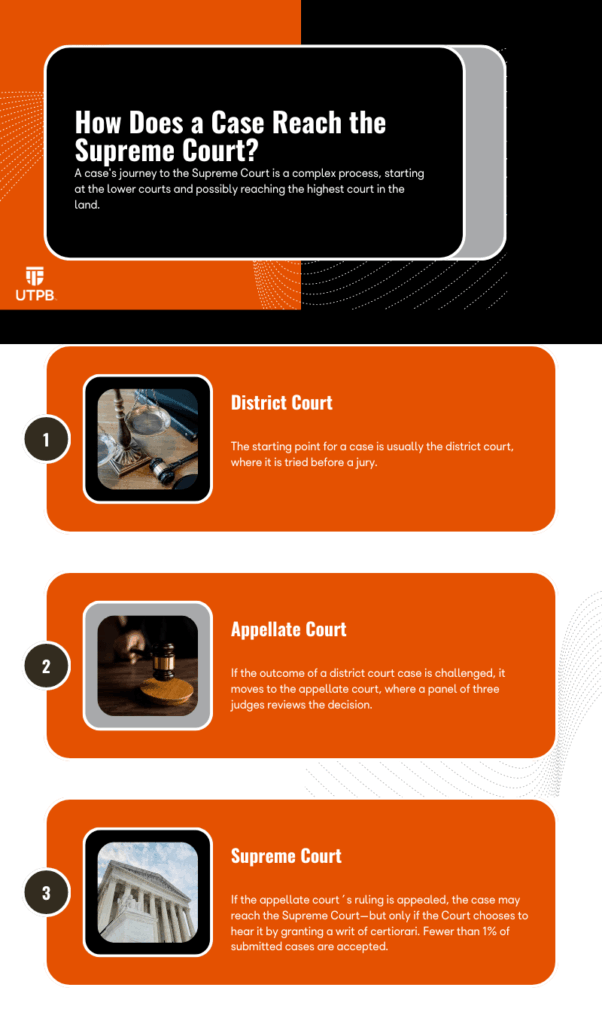
Often called the “highest court in the land,” the U.S. Supreme Court sits at the top of the American justice system. But despite its influence, the Court hears only a tiny fraction of the cases sent its way.
Each year, the Supreme Court receives around 10,000 petitions, yet it only agrees to hear about 70 to 80 cases. When the Court declines a case, the lower court’s ruling usually stands, making the Supreme Court the final word in many legal disputes.
So, what does the Supreme Court actually do, and why does it matter?
The Role of the Supreme Court in the U.S. Justice System
At its core, the Supreme Court’s role is to interpret the U.S. Constitution and ensure that federal and state laws align with it. Its decisions affect how laws are applied nationwide, shaping issues like voting rights, criminal sentencing, and the balance of power between state and federal governments.
In simple terms, the Supreme Court:
Interprets the Constitution
Resolves disputes involving federal law
Reviews decisions from lower courts
Sets legal precedents that guide future cases
Because its rulings apply across the country, the Supreme Court plays a critical role in maintaining consistency within the justice system.
How Are the Federal Courts Structured?
The Supreme Court sits at the top of a broader federal court system that includes two main levels below it: the U.S. District Courts and the U.S. Courts of Appeals.
U.S. District Courts
District courts are trial-level courts where federal cases begin. There are 94 district courts across the country, where judges hear cases involving federal law, often with juries present.
U.S. Courts of Appeals
Above the district courts are the U.S. Courts of Appeals, also known as circuit courts. These courts review district court decisions to determine whether the law was applied correctly.
Appellate courts don’t use juries. Rather, they employ panels of judges who evaluate legal arguments and issue rulings.
What Does the Supreme Court Do With Appeals?
After a case moves through lower courts, a party may ask the Supreme Court to review it by filing a writ of certiorari. The Court is not required to accept these requests—and in fact, it accepts fewer than 1% of them.
The justices use the “rule of four” to decide which cases to hear. If at least four of the nine justices agree that a case is significant, the Court will review it.
Once the Supreme Court issues a decision, that ruling is typically final unless:
A constitutional amendment overturns it, or
The Court later reverses itself in a future case
Why the Supreme Court Matters
The Supreme Court’s responsibilities extend far beyond individual cases. Its rulings influence civil rights, federal authority, voting laws, business regulations, and many other aspects of daily life.
Because of this reach, understanding the role of the Supreme Court is essential for anyone interested in:
Law and public policy
Criminal justice
Government and public service
Constitutional rights
Study the U.S. Justice System Online at UT Permian Basin
If you’re interested in how courts function—from trial courts to the Supreme Court—The University of Texas Permian Basin offers flexible online programs that explore the justice system in depth.
Technology drives progress in every field, and it’s helping criminal justice professionals make significant strides in identifying and apprehending suspects, keeping tabs on offenders, and more. Here we’ll look at how technology is transforming all sectors of the criminal justice system, including some controversies and issues related to its use. Investigation Forensic Algorithms Working in…
From firefighters and teachers to city planners and social workers, public servants play a quiet but essential role in keeping communities safe, healthy, and functioning. If you’ve ever ridden public transportation or even checked out a library book, you’ve benefited from public services. But what exactly are public services—and what kinds of careers exist in…
“Fight for the things that you care about. But do it in a way that will lead others to join you.” -Ruth Bader Ginsburg Becoming a judge takes grit, intelligence, and years of legal work. For women, the path is often even steeper. Despite the barriers, though, trailblazing women have risen to the highest courts…