Online Second Bachelor’s vs. Master’s: Which to Choose
Thinking about going back to school? If you’re considering an online second bachelor’s degree or a master’s degree, you’re not alone. Many working professionals explore these options when changing careers, boosting skills, or meeting grad school requirements.
So—should you get a second bachelor’s degree online, or is a master’s a better fit?
We’ll break down the pros and cons, answer your biggest questions, and help you explore flexible degree programs at The University of Texas Permian Basin.
Why Get a Second Bachelor’s Degree Online?
You may want to consider earning another bachelor’s degree if you’re looking to:
Change careers.
Refresh your skills
Reenter the workforce after a long absence
Complete a degree that’s more relevant to your current or intended field
Advance into a new role that requires a bachelor’s degree in a specific discipline
Learn broadly marketable and applicable skills
Improve your GPA for graduate school admission
Second Bachelor’s vs. Master’s: Which Degree is Better?
A master’s degree may be a better choice for you if you’re looking to:
Deepen your expertise in a specific subject area
Position yourself as a leader or specialist in your field
Complete your degree in less time than a second bachelor’s
Boost your earning potential
Qualify for advanced or specialized roles
Reduce overall education costs
Access more financial aid opportunities in select programs
While some master’s degree programs allow you to apply after completing any bachelor’s program, others require you to have a related bachelor’s degree and/or relevant work experience before you can be admitted.
Can You Transfer Credits to a Second Bachelor’s Degree?
If you’ve already earned a bachelor’s degree, you likely completed 120 credits. When earning a second bachelor’s degree, you are not expected to earn another 120 undergraduate credits.
You can generally transfer up to 60 credits from your previous bachelor’s degree, which means you can start your program already halfway to earning that second degree. You will need to complete the remaining 60 credits, which cover core, major, and related elective courses. You may also need to complete any relevant prerequisite courses.
Let’s say you have a bachelor’s degree in education and are looking to make a career change into accounting. You’re torn between pursuing a Bachelor of Business Administration in Accounting or an MBA in Accounting. We can look at both programs to compare the cost, number of credits, time to complete, and job and salary outlook.
Tuition and Credit Hours
BBA in Accounting
Requirements*
Credit Hours
Lower-level business core
18
Business core
24
Major courses
27
Business electives
9
Prerequisites (estimated)
9
TotalCredit Hours
87
Total Tuition
$31,523.58
*Assuming you are able to transfer 42 general education requirements. Please note that up to 60 credits may transfer, but it is largely dependent on your undergraduate degree major and the courses you took. If 60 credits do transfer, your total tuition for the remaining 60 credits would be $21,720.
MBA in Accounting
Requirements
Credit Hours
Prep course
3
Core courses
12
Courses beyond core
21
Specialty: accounting elective courses
9
Total Credits Hours
45
Total Tuition
$17,594.55
Time to Completion
Using the total credit hour information from above, we can calculate an estimated time to completion based on whether you plan on taking your courses part-time or full-time. At UTPB, most of our online programs are accelerated. Each semester has two 8-week terms (summer terms are 7 weeks long).
BBA in Accounting
Part-Time (at least 6 credit hours per semester)
Full-Time (at least 12 credit hours per semester)
2-1/2 years (15 terms)
1-1/2 years (8 terms)
Assuming you are able to transfer 42 general education requirements and will need to take 87 credits as shown in the Tuition and Credit Hours section. The also assumes you are taking courses during fall, spring, and summer semesters. Time to completion may vary based on course load in any given semester.
MBA in Accounting
Part-Time (at least 6 credit hours per semester)
Full-Time (at least 12 credit hours per semester)
1-1/2 years (8 terms)
1 year (4 terms)
The assumes you are taking courses during fall, spring, and summer semesters. Time to completion may vary based on course load in any given semester.
Salary Comparison
Next, let’s look at job posting analytics from Lightcast to compare the minimum education level required and median advertised salaries posted for accountants and auditors between September 2023 and March September 2025.
BBA in Accounting
Unique Job Postings Requiring Bachelor’s Degree as Minimum Education
Median Advertised Salary
362,055
$83,300
MBA in Accounting
Unique Job Postings Requiring Master’s Degree as Minimum Education
Median Advertised Salary
80,368
$105,900
Explore Online Programs for Your Second Degree at UTPB
The University of Texas Permian Basin is proud to offer nearly 40 online degree programs representing some of today’s most in-demand fields. All our online programs provide the same opportunity to experience flexible, self-paced learning from practically any location. You don’t have to choose between your career, your personal commitments, and your education!
Online Bachelor’s Degrees for Second-Degree Students
If you’re considering that second bachelor’s degree, our online undergraduate programs focus on a variety of rewarding fields, including business, social sciences, humanities, and nursing. Choose a specialized major in one the following degree programs:
Decided a master’s degree is best for you? We offer graduate programs in business (including the energy sector), public administration, language, education (including special education), and more. Program types include:
FAQs About Getting a Second Bachelor’s Degree Online
Thinking about going back to school but still have questions? Below are answers to common concerns about earning a second bachelor’s degree online—and how it compares to pursuing a master’s degree. Whether you’re changing careers, upgrading your skills, or returning to the workforce, these answers can help clarify your next step.
Is getting a second bachelor’s degree worth it? It depends on your goals. A second bachelor’s degree is worth considering if you’re making a major career shift, need a specific credential for a job, or want to improve your GPA before applying to grad school. It’s also a great option if a master’s program requires a related undergraduate background you don’t yet have.
How long does it take to finish a second bachelor’s degree online? Most students can complete a second bachelor’s degree online in about two years—sometimes less—thanks to transferable credits from their first degree. Time to completion depends on your pace, prior coursework, and program requirements.
What’s the difference between a second bachelor’s and a master’s degree? A second bachelor’s degree provides foundational knowledge in a new field, while a master’s offers advanced expertise and typically focuses on a narrower area of study. Master’s degrees can often lead to higher earning potential and more specialized roles, but they may require a related undergraduate degree or work experience.
Ready To Take the Next Step? Contact Us Today
Still weighing your options? Our student engagement and outreach team can help you compare programs, review your transfer credits, and decide whether a second bachelor’s or a master’s degree is the right move.
Get in touch now and take the first step toward your next degree.
You only get one chance to make a first impression. Cover letters have long been one of the best ways to set yourself apart in a competitive market. But in the era of AI screeners, even the most polished resumes—and their accompanying cover letters—feel like they’re disappearing into the void. With the job market more…
Getting accepted to The University of Texas Permian Basin is a big milestone. If you’re a working professional, the next step—asking your employer about tuition reimbursement—can feel a little intimidating. But it doesn’t have to be. Most organizations want employees who grow, stay, and contribute at a higher level. And many companies offer tuition reimbursement,…
The University of Texas Permian Basin is home to over 7,000 students. Whether on campus in West Texas or from a laptop hundreds of miles away, they’re part of a diverse community that values culture, connection, and progress. Every member of our Falcon Family deserves some time in the spotlight. But with Hispanic Heritage Month…
“Education is education and it’s the right of every human being.” – Malala Yousafzai
At age 15, Malala Yousafzai became an international symbol for all girls who wish to receive an education. Outspoken on the topic since childhood, Malala was shot in the head while walking home from school by a member of the Pakistani Taliban, which had banned education for girls. Malala survived the attack, recovered, and became revered worldwide as an activist and author. She was awarded the Nobel Prize for her efforts at 17 and is still the youngest person to receive that recognition.
Malala’s story may not be typical, but it illustrates how immense the barriers to equal access to education are and what girls can achieve despite these challenges. It also reminds us that education is essential if girls are to enjoy healthy, independent, confident, and rewarding lives.
Here we’ll explore initiatives that seek to empower girls within the United States and beyond through educational access and support.
Initiatives Promoting Gender Equality in Education
Governmental organizations, nongovernmental organizations (NGOs), nonprofits, and other types of groups have taken steps toward advancing gender equality in education. Perhaps unsurprisingly, Malala herself is leading the charge with the Malala Fund. Below are some of the ways organizations and individuals are currently supporting or can support these efforts.
Legislating Against Gender-Based Discrimination
Signed into law in the U.S. in 1972, Title IX prohibits gender-based exclusion or discrimination against anyone who participates in a federally funded educational program or activity. It also gives girls access to school-related athletic and sports programs.
More targeted federal legislative efforts—including the Keeping Girls in School Act, which would see the U.S. leading international efforts at expanding educational access for girls—have been proposed in recent years but have yet to become law.
Making Education Safer
Organizations from the World Bank to the United Nations Girls’ Education Initiative (UNGEI) are providing advocacy and resources to help reduce gender-based violence: a social norm that inhibits girls’ school participation in many Sub-Saharan African countries and elsewhere.
Improving Teacher Training
The Gender-Responsive Pedagogy for Early Childhood Education Toolkit, issued by UNGEI, centers on helping teachers integrate gender equality into their pedagogy to overcome cultural and gender biases and norms and ensure girls and boys are treated and supported equally in the classroom.
Designating Scholarships
While the U.S. provides free primary and secondary education for all, the same is not true worldwide. In Nigeria, where poverty is rampant and school comes at a cost beyond the means of many, some parents are prioritizing the education of their sons at the expense of their daughters. To combat this, the Nigerian government has introduced the Adolescent Girls Initiative for Learning and Empowerment (AGILE), which provides scholarships to offset financial barriers and other obstacles.
Leading Community Outreach and Awareness Efforts
In rural African communities, the Campaign for Female Education (CAMFED) works with community leaders, educators, and families to identify girls in need of education and mentorship. The organization then provides monetary and social support for both. Other outreach efforts help girls in rural areas by assessing their needs through interviews, surveys, and focus groups; offering access to resources; helping connect girls through clubs and support groups; and involving the broader community, including boys and men, to help them understand the value of educating girls.
Meeting Girls’ Personal Needs
Studies have shown that providing feminine care products at school can improve girls’ attendance. In some cases, cost, stigma, and/or unpredictable menstrual cycles prevent girls and young women from having these products when needed. As of this writing, 25 states and the District of Columbia have enshrined free access to period products in schools in their lawbooks.
Offering Programs Online
Distance learning programs enable girls living in rural, remote, and underserved areas to access the same high-quality education programs as other children while removing travel and associated cost burdens.
UTPB Specializes in Making Education Accessible
The University of Texas Permian Basin is doing its part to make higher education accessible to all. Our 40+ online degree and certificate programs empower students to earn an educational credential at their own pace from virtually any corner of the globe. We designed our programs to accommodate professional and personal obligations, because we understand that our students have lives outside of school.
Greater than 60% of current UTPB students are women, and we’re honored to be able to help them and all our students achieve their higher education goals. Elevate your own potential as a teacher or education leader, renewable energy champion, business or government leader, nurse, or other essential profession, and inspire girls to do the same. These programs can provide the foundation:
We welcome the opportunity to discuss any of our online programs with you! Just click on any program link above and look for “Request More Information.”
At The University of Texas Permian Basin, we’re proud of our online programs, and we love to talk about them. But we believe the best way to share their benefits is to allow actual program graduates to speak for themselves. We hope you find the words of these UTPB alumni as inspiring as we do!
“I got promoted while I was getting the degree. I was able to put on my resume that I was pursuing a degree, and I was currently in the program. So, it helped me get the position I’m in now, which is a team lead position.”
“I think I learned at least as much as I would have if I had been in a classroom, if not more.”
“I was able to get a lot of industry information from the student base as well. There were some networking opportunities.”
“[A]ll of the content always had an end in mind, and it was connected to our certification exam in some way.”
“As soon as I graduated, I had an assistant principal position. And then, as soon as five years came up, I was able to get my job as an actual principal. And I would most definitely say that the program prepared me for it.”
“I can’t thank the professors there enough, and I think that they have really made an impact on my life.”
“[I]f you’re interested in landing a leadership role, improving your entrepreneurial skills, or transforming your current career path, UTPB’s MBA program will help you get there.”
“I think studying online gave me an opportunity to be more disciplined.”
“I know I can think a lot clearer now and more objectively and I’m able to sort of take a step back and look at the big picture in a lot of things.”
“I chose the right path because [the program’s] helping me grow and I should not have an issue with the certification exam because of how relevant the topics are.”
“It was difficult before COVID being all online. There wasn’t much interaction. It was just a lot of submissions. But this [UTPB] program is not that way.”
“I’ve been able to interact with educators in other districts and hear their perspective. [This program] has also allowed me to network with Dr. Uzat, who’s been very supportive. He helped me write a scholarship letter for TASA to try to get some scholarship funds.”
“I looked around online and that’s how I found UTPB. It’s more affordable versus what the other colleges were telling me. The fees were maybe less than half the cost of the [other] university fees.”
“I did really enjoy my peer support. We all had the same goals, the same mindset, and we all were there to support each other.”
“One thing I really liked about UTPB is [when] I ended up running out of financial aid, [UTPB] paid my tuition. That meant so much to me!”
“I started looking into the program, and I was like, this is something that will work for me. The programs they have. The tuition. The length of the classes. [The eight-week session length] was the most important one … because I thought, well, I can take more classes if they’re shorter.
“You save on the parking, you save on the gas, you save on the insurance, you save on the food. There’s a lot of convenience.”
“I got really good when it comes to time management and also setting up my priorities. Now I know how to work my time and use it wisely.”
“I would recommend this online program because the advisors and professors are knowledgeable, professional, supportive, and caring.”
“I had the chance to work in groups, make friends in my field, gather ideas and feedback, and maintain these relationships even after graduation.”
“Working online allowed me to be at home while I worked, stopping for family dinners and scheduling my work around important family events when necessary.”
“[W]ith the structure of an online program, I get to set my hours, I get to set where I work, [and] I get to set how long I work.”
“Dr. Wilson helped me get back on track to where I gained the confidence and the knowledge that I needed to become that real teacher that I already was.”
“Being online doesn’t mean disconnected. I still felt just as close to my fellow classmates as I do in a classroom in person.”
Here we’ll explore some reasons why students are pursuing their undergraduate degrees online, and why you should consider doing so as well—through The University of Texas Permian Basin.
Being Digital Natives
Though some will say anyone born in 1980 or after is a digital native, the “real” digital natives (those who have never known a world without the internet), are arguably Gen Z—born somewhere in the range of 1996-2012. As digital natives, they’re accustomed to conducting as many of their daily activities online as possible, as tends to be their preference. If one is communicating, shopping, banking, and possibly working online, earning a degree online may be a foregone conclusion.
Appreciating Convenience
Data contemporary with the federal government report cited above shows that 91% of full-time undergraduate students at four-year public institutions are under the age of 25, potentially supporting the digital native connection. That’s not to say online degree programs are only for students of any specific age, however. Recent high school graduates and non-degreed, established working professionals alike are realizing the tremendous advantages that online undergraduate programs provide:
24/7, worldwide classroom access
Self-paced learning
Flexibility in coursework completion that accommodates professional and personal commitments
Wanting to Save Money
In a time of alarming inflation, being able to forego the costs associated with a college commute—parking permits, gasoline, tolls, and even vehicle wear and tear—is a plus some first-time students can’t pass up. Depending on their chosen institution, they may also be able to save on tuition.
Seeking Expanded Networking Opportunities
Because of their international reach, online degree programs give undergraduate students, especially those who may not be very far along in a career, the opportunity to make some professional contacts from the global workplace. These are the people they’ll want to stay connected with and reach out to for career advice and tips about job openings when approaching graduation.
16 In-Demand Online Programs, Unlimited Career Potential
The student body of UT Permian Basin is composed of greater than 80% undergraduates. At UTPB, we understand your goals, and we’re here to help you achieve them! We offer online degree programs for undergraduates who know exactly where they want to go and for those who want the flexibility to pursue a variety of rewarding career paths with their college credentials. All UTPB’s online programs:
Welcome eligible students of all ages and from all corners of the U.S. and around the globe.
Offer the conveniences unique to the online learning format.
Are available at a tuition rate that is among the most affordable of any accredited university.
We’ve sorted our online undergraduate degrees by UTPB college or school below. Click on any link to view each program’s overview, requirements, courses, and potential careers and salaries:
*Programs available online exclusively at this UT System institution.
A degree can open new doors for you. Online programs make it easier to reach those doors. Consider earning one of our undergraduate degrees online and apply to your chosen program today!
It’s been a primary source of financial aid for college degree seekers in the United States since President Johnson signed the 1965 Higher Education Act (HEA). Receiving its current name with the 1992 HEA reauthorization, the Free Application for Federal Student Aid (FAFSA) has been issued in a new, improved format for 2024-2025, thanks to the FAFSA Simplification Act. This is welcome news for all Americans who plan to request federal aid for a college degree program. Details are below, but the tl;dr version is this:
More people are now eligible for federal financial aid through the new FAFSA, and they can complete the 2024-2025 application in considerably less time.
Features of the New FAFSA
Here are some of the changes FAFSA applicants can expect to see:
The application has been streamlined from 108 questions to a maximum of 36—a reduction of two-thirds. Some applicants will now be able to finish the application in under 10 minutes.
610,000 new students from low-income backgrounds will now qualify for Federal Pell Grants, which, unlike loans, do not need to be repaid.
Applicants are no longer required to enter in their federal tax information; it will automatically be added to the form.
Previously available in just two languages, the new FAFSA will offer 11 language choices.
The Expected Family Contribution (EFC) from the previous application has been replaced with the Student Aid Index (SAI), which helps institutions determine the amount of federal aid a student will receive.
Our Financial Aid Experts Are Ready to Help With FAFSA
Wondering how the new FAFSA will specifically benefit UT Permian Basin and its students? Due to a change in how the Department of Education calculates eligibility, “there’s going to be a lot more students here at UTPB that are going to be eligible for a Pell Grant,” explained Dr. Scott Lapinski, Director of Financial Aid for The University of Texas Permian Basin. “So, it’s going to help us stretch our Falcon Free dollars further to help more students because it’s going to be less money that we have to use from Falcon Free.” Exclusive to UTPB, Falcon Free is a scholarship that enables qualifying Texas residents to earn a bachelor’s degree with no out-of-pocket tuition costs or mandatory fees.
Led by Dr. Lapinski, UT Permian Basin’s Office of Financial Aid and Scholarships is dedicated to helping students understand the funding options available to them, including the new FAFSA. “I ensure that my staff attends conferences and webinars so that they know of all the changes that are coming out,” Lapinski explained. “We get the students started [on the FAFSA], let them work through it, and then if they have any questions we’re there to help them.”
Choose From Dozens of Online Undergraduate and Graduate Degree Programs
UT Permian Basin offers 36 online degree programs at the time of this writing, and there are more to come. Upon qualification, you can use funds obtained through FAFSA to earn your MBA in one of several in-demand specializations, get started on a bachelor’s degree in a variety of rewarding disciplines, prepare for new roles as an educator, education leader, or nursing leader, and more, all online. Browse our current online degree programs now:
Are you determined to make a difference in the world? If so, The University of Texas Permian Basin has an online program that can equip you to make your mark on countless lives. Our programs will prepare you to launch a career in a life-changing field, enable you to advance within an existing career, or lay the groundwork for further education and commensurate career opportunities.
For some, making a difference in the world means becoming a more impactful educator or nurse. It can also mean serving the public in a variety of roles, including:
Strengthening our democracy and criminal justice system.
Helping steer offenders away from a life of crime and in more productive directions.
Raising awareness and funds for important issues and the organizations that represent them.
Let’s look at a few online UT Permian Basin programs and some careers in which you can make a genuine difference.
Online Bachelor of Arts in Political Science (Exclusively at This UT System Institution)
As with all bachelor’s degrees, this program begins with a diverse selection of general education courses, providing you with foundational knowledge that will benefit you throughout your life. As you progress through our program, you’ll explore American politics at all levels, judicial politics, and the independent and interdependent functioning of government agencies.
How you can make a difference with this degree:
If you use your political science degree as a foundation for law school, as many students do, you can help ensure criminals are no longer able to threaten society and innocent victims receive the restitution they’re due. Continue with an education master’s degree after completing this program and you can cultivate the basic skills needed to excel in generations of students, including those who may have differing needs.
Online Bachelor of Arts in Psychology (Exclusively at This UT System Institution)
Providing perspective on both theoretical and applied aspects of psychology, this bachelor’s degree program will help you develop highly valued professional skills, including written and verbal communication, research, analytical thinking, collaboration, and problem-solving.
How you can make a difference with this degree:
If you want to give extra support and guidance to those who need it most, this degree can provide a catalyst for careers in counseling, social work, and psychology. Minimum degree requirements may vary.
Online Bachelor of Science in Criminology and Criminal Justice Studies
Get an introduction to our criminal justice system that can lead to careers in the field. You’ll delve into all topics related to law enforcement, courts, and corrections, including criminal behavior, juvenile delinquency, terrorism, drugs, and the role of police in society. We use a multi-disciplinary approach that includes classes from other departments closely linked with the criminal justice profession.
How you can make a difference with this degree:
As a police officer, you can protect the public from criminal acts and establish strong relationships between law enforcement and the community. As a parole officer, you have the equally important job of making sure that parolees find gainful employment, avoid drugs and reoffences, and otherwise stay on the straight and narrow.
Online Master of Science in Criminal Justice Administration
Built on a research-based curriculum, this program is ideal for experienced criminal justice professionals who aspire to lead an agency. With the advanced knowledge of a graduate degree, you can also experience greater advancement and earning potential. Many students finish this program in as little as 12 months. A bachelor’s degree is required.
How you can make a difference with this degree:
As a first-line supervisor in law enforcement, corrections, or other areas of criminal justice, you can ensure your agency operates ethically, lead the charge for criminal justice reform from within the system, and safeguard your agency and its personnel.
This degree can empower you to launch a career or advance within an existing role in the nonprofit or public sector. Through our flexible program, you’ll discover how to contend with the complexities of nonprofit and public sector organizations while keeping them mission-focused. Many students finish this program in as little as 12 months. A bachelor’s degree is required.
How you can make a difference with this degree:
Working in public sector management jobs, you can advocate for the needs of the people you serve, ensuring they have access to resources like cleaner water, wider roads, or safer schools. As a nonprofit professional, you can bring greater awareness and support to a variety of social causes, charities, the arts, and other organizations and activities that enrich our lives.
There are countless ways to make a difference in the world. With 40+ online degrees and certificates, UTPB is here to help you. Consider these programs, the difference they can make in your professional prospects, and the difference you can make in the lives of others. Then take the next step!
Many college students prefer online learning because, with the exception of weekly deadlines, they’re free to complete coursework at their own pace.
Want to visit a future module and complete coursework ahead of time, or rewatch last week’s lecture to gain a deeper understanding of the subject matter? With remote learning, you can.
Self-paced online learning is a blessing for students with the motivation to stay on track, but motivation can wax and wane, especially when deadlines loom. That’s why we’re here to share some tips to help college students—and in particular online students—manage their time.
Turn on a study music mix and brew your favorite caffeine-infused beverage because we’ve got work to do!
Time Management for College Students
Time management comes down to one simple problem: There’re 168 hours in a week. Let’s say you work 40 hours a week and sleep eight hours a night. That leaves 72 hours.
Full-time students take at least four classes (12 credit hours) each semester. (Students in our accelerated graduate programs are considered full-time if they’re enrolled in 6 or more credit hours.) One credit hour typically translates to about three hours of work per week.
Students taking 3 credit hours will spend about 9 hours a week studying and completing assignments, while students taking 12 credit hours will spend as much as 36 hours on coursework. Any remaining time is devoted to family, friends, and hobbies.
Making the most of this limited amount of time can be challenging for even the most detail-oriented among us, but it’s possible. More importantly, it’s worth it.
Make a Schedule
The most important thing you can do to manage your time in college is to make a weekly schedule. You can buy a planner, maybe one with an assortment of tabs and artwork on the front, but there are plenty of free online templates that will do nicely. Once you have your weekly planner, fill it with all your planned daily activities. Try to account for every hour. Then block out time for coursework.
Spread the Love
Many online students wait until the weekend to dive into their studies and coursework, but we don’t recommend it. Students are prone to burnout, especially if they work full time, unless they devote at least one day a week to rest and relaxation.
Try to spend one or two hours on coursework every weeknight. That way, when Sunday night rolls around, you won’t be hunched over your keyboard, frantically trying to finish an assignment before the clock strikes 12.
Download Some Helpful Apps
Technology has revolutionized learning, and our online programs are only one example. Here are some apps we recommend to help you better manage your time.
Manage Your Class Schedule
Many online courses, including ours, are delivered through Canvas. The Canvas Student app includes everything you need to know about your courses, including a calendar. If, however, you need a little more help keeping track of your schedule, apps like Any.do, Remember the Milk, and 2Do can be lifesavers.
To-Do List Apps
Schedules are critical for time management, but nothing’s as satisfying as knocking items off a to-do list. Evernote, TikTik, and Todoist are just a few of the task-managing apps available that can help you stay on top of assignments and their due dates.
Productivity Apps
Tuning out the world and getting down to studying isn’t always easy, especially when that cell phone looks so much more appealing than reading about mitosis. Fortunately, there are productivity apps and extensions available like Stayfocused, Forest, and RescueTime that can help keep you on course.
Prioritize Your Tasks
Sometimes there just aren’t enough hours in the day to get to everything you want, and that’s okay. There’s always tomorrow! What’s important is to prioritize your assignments by importance and deadlines.
Start small. Complete one task, then another. Soon, what seemed like an impossible undertaking will be broken down into a series of doable tasks. Before you know it, you’ll be wondering why you were so stressed in the first place.
Study Online at The University of Texas Permian Basin
The University of Texas Permian Basin offers numerous online undergraduate and graduate programs—over 40 in total—for students interested in an alternative to traditional learning.
Modern and flexible, our online programs are designed with students’ needs in mind. Students have the freedom to complete coursework on their own schedule and the support of our expert faculty and attentive advisors, who are considerate of the challenges students face when they’re up against the clock.
If you’re interested in learning more about online learning at UT Permian Basin online, check out our Program and Course catalog. Among our programs, you’re sure to find the one that meets your academic, personal, and professional needs.
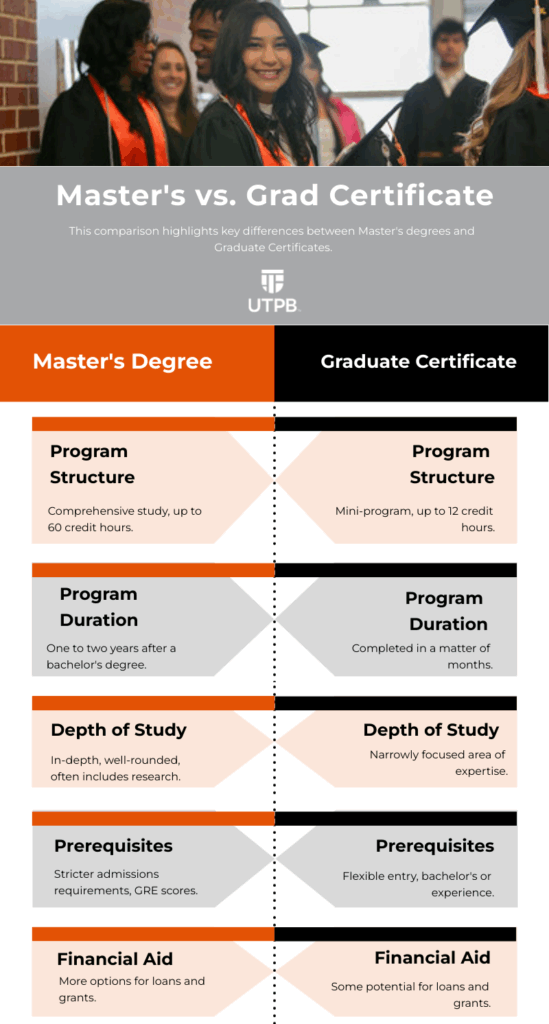
Trying to decide between a graduate certificate and a master’s degree? You’re not the only one. Both can help you grow your skills, strengthen your resume, and move your career forward, but they’re built for slightly different goals.
A master’s degree is usually the better fit if you want a broader graduate education or qualifications for higher-level roles. A graduate certificate makes more sense if you want to build a specific skill set in a shorter timeframe.
Here’s a closer look at how they compare.
Graduate Certificate vs. Master’s Degree: What’s the Difference?
A master’s degree is a full graduate program in a broader field of study. These programs often require 30 to 60 credit hours and may include research, internships, or thesis work, depending on the field.
A graduate certificate is shorter and more focused. Most require about 9 to 15 credit hours and are designed to help students or working professionals build skills in a specific area.
Program Length
For many students, a master’s degree takes one to two years to complete. A graduate certificate can often be finished in a matter of months, which makes it appealing if you’re looking to upskill without committing to a full degree program.
Depth of Study
Master’s degree programs cover a specific discipline in depth, typically including research and thesis components, and more coursework overall.
Graduate certificate programs help aspiring professionals build expertise in a focused area without the extensive coursework of a full master’s degree.
Career Options
Depending on the field and profession you’ll pursue, a master’s degree can qualify you for specialized roles and lead to higher earning potential.
A graduate certificate can still add value, especially if you want to sharpen a certain skill, meet licensing requirements, or transition into a new area without starting from scratch.
Prerequisites
Master’s degree programs often have stricter admission requirements. This can sometimes include letters of recommendation or passing scores from standardized tests like the GRE.
Graduate certificates usually have a more flexible admission requirements and are accessible to professionals with a bachelor’s degree or relevant experience.
Financial Aid
Students pursuing a master’s degree often qualify for federal financial aid, including loans and grants.
Those pursuing a graduate certificate may also qualify for financial aid, depending on the school’s policies.
A master’s degree may be the better choice if you:
Want a broader graduate education
Are aiming for leadership or specialized roles
May pursue a doctorate later
Need a graduate degree for your field
A graduate certificate may be a better fit if you:
Want to build a specific skill set quickly
Are changing careers or testing a new field
Need a shorter, more flexible program
May want to stack credits into a master’s later
Frequently Asked Questions: Graduate Certificate vs. Master’s Degree
Still deciding between a graduate certificate and a master’s degree? These common questions can help clarify your options and guide you toward the right next step.
Is a graduate certificate worth it? Yes, especially if you want to build specialized skills quickly, boost your resume, or explore a new field without committing to a full degree. It’s also a great way to test the waters before pursuing a master’s degree.
Can I use a graduate certificate toward a master’s degree later? In many cases, yes. Some programs allow you to transfer certificate credits into a related master’s degree, which can save time and money. Be sure to check with the specific program you’re considering.
Which option leads to better career opportunities? A master’s degree typically qualifies you for higher-level roles and increased earning potential, especially in leadership or research-based careers. A graduate certificate can still enhance your qualifications but is best suited for more targeted career moves.
Explore Your Flexible Learning Options at UT Permian Basin
UTPB offers the flexibility to start with a graduate certificate and later transition to a master’s degree program—or vice versa. Whether you’re a prospective student or mid-career professional, you’ve got the opportunity to customize your educational path to align with your goals.
You only get one chance to make a first impression. Cover letters have long been one of the best ways to set yourself apart in a competitive market. But in the era of AI screeners, even the most polished resumes—and their accompanying cover letters—feel like they’re disappearing into the void. With the job market more…
Getting accepted to The University of Texas Permian Basin is a big milestone. If you’re a working professional, the next step—asking your employer about tuition reimbursement—can feel a little intimidating. But it doesn’t have to be. Most organizations want employees who grow, stay, and contribute at a higher level. And many companies offer tuition reimbursement,…
The University of Texas Permian Basin is home to over 7,000 students. Whether on campus in West Texas or from a laptop hundreds of miles away, they’re part of a diverse community that values culture, connection, and progress. Every member of our Falcon Family deserves some time in the spotlight. But with Hispanic Heritage Month…
After narrowing down your top university contenders and completing your applications, it’s time to consider what comes after you’ve been accepted. From choosing your classes for your first semester to purchasing every book on each course syllabus, there are so many items to add to your educational to-do list ahead of your first day of classes.
However, have you considered how you’ll be paying for those courses and textbooks? That’s why prioritizing your FAFSA application should be at the top of your to-do list. This simple application is your gateway to accessing multiple forms of financial aid, from grants to loans (and plenty in between).
Today, we’re discussing all things FAFSA, including what it is and why it’s important to fill out—the sooner the better!
The FAFSA 411: Everything You Need to Know
The Free Application for Federal Student Aid, better known as FAFSA, is a form that most students are eligible—and encouraged—to complete. The application collects the following information to determine the amount of financial aid you may be qualified to receive from the college you’re attending:
Your social security number (or alien registration number if you’re not a U.S. citizen)
Your federal income tax returns and W-2s*
Bank statements*
*Please note that if you’re a dependent student, you’ll need the above information from your parents to apply.
After submitting your FAFSA, your information will be reviewed and sent to the universities listed on your application. The colleges will then use that information to determine your eligibility for financial aid. You may qualify for a variety of different types of financial aid, including but not limited to:
Federal grants Grants are mostly given on the basis of need and don’t require repayment.
Scholarships Like grants, scholarships don’t need to be repaid once you’ve earned your degree. However, unlike grants, they’re usually awarded based on merit, such as academic achievements or extracurricular activities.
Federal student loans Funded by the U.S. Department of Education, federal loans are based on financial need and must be paid back with interest.
Work-study This is a federal work program that allows undergraduate and graduate students at participating schools to earn money while working to pay for tuition.
Why Is Filling Out the FAFSA Essential?
Some students receive financial assistance through scholarships or their parents’ college savings funds. However, those avenues may not always fully cover tuition and other expenses. Whether you believe you can afford college independently or feel you won’t qualify for aid, consider the following reasons you should run, not walk to your keyboard and fill out the online application before the deadline.
The FAFSA Is Your Window Into Financial Assistance
True to its name, the Free Application for Federal Student Aid costs nothing. It takes just an hour to complete, and within a few weeks, you’ll know whether you qualify for one or more of the various forms of financial aid.
If you find out you’re eligible for funds, you can rest assured that you have a guaranteed means to pay for your education. In addition, if you learn that you don’t need the financial aid offered to you, you’re not legally bound to take it. You can say “No, thank you,” and happily move on with your to-do list.
The FAFSA Can Help You Budget Effectively
Have you broken down the costs for all the items you’ll need for your courses? From laptops and lab equipment to textbooks and everything in between, there are a few additional expenses you may not have accounted for—and that’s okay! The FAFSA is here to help.
Your application results can give you a clear understanding of the general costs associated with attending college, whether you need the assistance or not. It also shines a light on the financial resources available to you, so you can make informed decisions about budgeting and financing for the future.
The FAFSA Can Present Work-Study Opportunities
Looking for ways to pay for your education, sharpen your skills, and give your resume a boost? After completing your FAFSA, you might find that you’re eligible for a federal work-study program. These programs offer part-time job opportunities that help you earn money for educational expenses while allowing you to gain valuable work experience that you can proudly add to your resume.
Secure Your Future (and Your Funds) by Filling Out Your FAFSA Today
At The University of Texas Permian Basin, we strongly encourage all students, regardless of their program, to submit a FAFSA. Whether you’re an incoming freshman, transfer student, or graduate student, all you need to do is fill out the application. The Department of Education and UTPB will handle the rest.
If you’re worried that you missed your window for the 2024 school year, worry not. The FAFSA deadline isn’t until June 30, 2024, with the application window likely to begin in December 2023. Since schools often allot and distribute funding on a first-come, first-served basis, it’s in your best interest to submit your application as early as possible to ensure you’re able to secure your funds.
Take the next step in financing your future by making sure you’ve got your expenses covered. Explore our FAFSA page today.
For some recent grads, the concept of getting a job is simple. They browse listings, submit their applications, and wait for responses from hiring managers. However, if that process doesn’t result in a shiny new job after a few weeks, they begin to wonder why they haven’t heard back from more employers.
One factor to consider is when they’re applying for jobs. That’s right—the time of year you’re job hunting may play a role in determining not only how many employers are hiring but also how actively they’re pursuing applicants for open positions. Below, we dive into the most (and least) ideal times of year to apply for jobs and offer some tips to help you get hired no matter the season.
When Is the Best Time to Apply for Jobs?
While you should feel motivated to submit applications any time of year, certain months may prove more fruitful than others. Some of the best times of year to apply for positions include:
January and February
The first two months of the year are known by many as the best months to get hired. Why, you ask? There are several possible reasons:
The start of the year often provides the push some people need to switch roles or quit their current positions in favor of finding employment elsewhere. This frees up roles for other job seekers.
In the fall, many companies review their budget for the following year. Ahead of the holidays, hiring managers use that information to post job openings in December to fill those positions in January and February.
By the end of January, most employees have returned from vacation and work resumes its usual pace. This gives HR the chance to finally post vacant positions.
September and October
The arrival of fall brings more than just cooler temperatures and autumn-scented candles. September and October also carry the possibility of more open job vacancies. This could be due to a few different factors:
Like January and February, employers and hiring managers are often returning from vacations around this time. They then begin to focus on what’s ahead for the business, such as filling roles that opened up over the summer.
These months create urgency to fill open positions as hiring managers anticipate the upcoming holiday season, which tends to see fewer job applications due to people’s focus on holiday-related activities.
Do Employers Have “Lull” Months in Hiring Activity?
In December, the work environment tends to be more relaxed, with employees operating at a more leisurely pace. This is typically a result of the exciting and festive celebrations that occur during this time of year. Many employees use their paid time off for traveling and spending time with family, which in turn makes December one of the slower hiring periods for employers.
The summer months of June, July, and August may also prove slightly more challenging for job seekers. Like November and December, children are often out of school on vacation, making family vacations a high priority for many of the managers hiring new employees.
Tips for Getting Hired Year-Round
While employers might have their “preferred” hiring times throughout the year, there’s no one-size-fits-all guidebook to abide by. That said, if you feel qualified for a role (or even if you don’t), there’s no harm in applying no matter the time of year. Plus, with the following pointers, you’ll be ready to apply when the role you’ve been waiting for unexpectedly appears in your job search one day:
Tailor Your Resume
While it may feel like a lot of up-front work, tailoring your resume to each job you apply for can showcase the specific qualities and experience you possess that align with what each employer is currently seeking. To target your resume for each application, carefully read the job listing to locate the skills they’re looking for, determine which of those you possess, and add those abilities to your resume.
Think Outside the Box for Relevant Skills and Experience
If you’re a recent grad or are changing careers, you might not have much experience related to the jobs you’re applying for—and that’s okay. Instead, you can include abilities that are most relevant for the job.
For example, if you’re applying for a job in marketing but have no prior experience, you can highlight other relevant skills or responsibilities you’ve had in past jobs, like proofreading, collaborating with colleagues, or helping a local business manage their social media accounts.
Apply, Apply, and Apply Some More
We get it. Sometimes, you read the experience required for a position and scroll right past because you don’t feel qualified. According to the Harvard Business Review, you’re not alone. 41% of women and 46% of men avoid applying to certain positions because they don’t feel they meet the qualifications. However, we strongly urge you to consider applying regardless. It could show the hiring manager you’re proactive and driven. They may even reach out regarding the role you applied for or suggest a different job for which they think you’d be a perfect fit.
Earn the Skills You Need to Get a Job Any Time of the Year
To become one of the top candidates for your dream job, there are a few aspects that can increase your chances of receiving a call from the hiring manager:
Come equipped with the skills listed on the job posting.
List a degree from a reputable university on your resume.
Have the tenacity and confidence to apply to the jobs you’re qualified for—and some of the ones you’re not.