How Everyday Uses for Psychology Can Impact Your Life
Psychology has a number of interesting applications. It can be used to alter perceptions, turn enemies into friends, and even make people ignore a man in a gorilla suit. Many individuals are first attracted to the field of psychology by the impact these incredible phenomena have on themselves and those around them. Let’s explore some of the most significant studies and findings in the field of psychology and see how they fit into everyday life.
If you’re intrigued by how these scientific studies, hypotheses, and effects can improve your daily life, you can apply this passion to a career studying and improving the lives of others. The University of Texas Permian Basin offers an online program that allows students to earn a bachelor’s degree in psychology on their own time, at their own pace. The study of the mind is an incredible pursuit, and it begins with a Bachelor of Arts in Psychology.
The Ben Franklin Effect
Ben Franklin was using psychology to turn political opponents into trusted allies back in the 1700s. In his autobiography, Ben Franklin tells the story of winning over an adversary who had delivered an impassioned speech against him. Knowing that this gentleman could one day hold substantial political power, Franklin responded in an unconventional manner: He asked to borrow a book. Specifically, he asked to borrow a rare book in a way that both flattered and inconvenienced his adversary. The adversary promptly sent the book, and Franklin returned it with a thank-you note. From that day forward, the “adversary” was far more willing to help Franklin, and the two become lifelong friends.
According to Ben Franklin, “He that has once done you a kindness will be more ready to do you another, than he whom you yourself have obliged.” Another name for this phenomenon? Cognitive dissonance. Essentially, someone who dislikes you can’t mentally process why they would allow themselves to be inconvenienced by you. To avoid discomfort, they will change their opinion of you rather than their opinion of themselves. When employing the Ben Franklin Effect in real life, remember to always use this superpower for good.
The Somatic Marker Hypothesis
“Elliot” had it all: a good job, a happy marriage, and the respect of his peers—until one day he started having headaches. The headaches became more severe, and it was later discovered that Elliot had a brain tumor. The tumor was removed, but not before it damaged the frontal lobe of his brain. Elliot began to look at every situation in his life through a purely logical lens devoid of all emotion—the dream of every procrastinator. The problem is that Elliot had effectively undergone a lobotomy, and his life crumbled soon after.
What can be learned from Elliot’s tragedy? The study of Elliot led to the somatic marker hypothesis, which proposes that emotions, not logic, are the driving force behind decision-making. When making decisions, you filter out choices based on how you feel about the imagined outcome. The next time you’re unable to find the motivation to work, clean, or create, consider why you imagine those possibilities being unpleasant. If you can be honest with yourself, you may arrive at the right decision.
The Halo Effect
In one of the most famous examples of how psychology relates to everyday life, Richard Nisbett and Timothy Wilson set out to study the halo effect, a cognitive bias that occurs when first impressions cloud a person’s perception of others. Over one hundred college students were asked to review footage of a psychology instructor. In some videos, the instructor was friendly and encouraging, while in others the instructor was cold and unlikable. Students were then asked to rate the instructor’s appearance, mannerisms, and accent. The results showed that even when participants had enough information to make an independent assessment, they were influenced by the instructor’s attributes. Students who saw the “likable” instructor rated his appearance, mannerisms, and even his accent higher. Furthermore, students were unaware that their perception of the instructor had any effect on their ratings.
The halo effect can be summed up as judging a book by its cover. When we meet others, we unconsciously allow their attractive features to influence our overall opinion of them. This presents a prime opportunity to use psychology in your daily life. When meeting new people, always try to make a good first impression by displaying confidence, being well-groomed, and not mentioning negative details about yourself. Being aware of the halo effect can also allow you to take a step back from situations and consider if your opinions are being influenced by anything other than logic.
The Invisible Gorilla
How well do you multitask? To put your multitasking skills to the test, watch this video and count how many times the players wearing white pass the ball. The answer is 16, but that’s not what the video is testing. Did you notice the gorilla? If you did, it might have been because you were expecting it, as the original selection attention test involving a gorilla is world-famous.
Did you notice the curtain change or the player on the black team leave the game?
Don’t feel bad if you didn’t. When Christopher Chabris and Daniel Simons expanded on their original experiment, the majority of participants failed to notice one or both of the unexpected events. What this study shows is that people can focus so hard on one task that they fail to notice other important details. According to Simons, “Although people do still try to rationalize why they missed the gorilla, it’s hard to explain such a failure of awareness without confronting the possibility that we are aware of far less of our world than we think.”
Similar to the halo effect, our expectations can alter our perception of reality. The lesson here isn’t that people don’t pay enough attention or that we shouldn’t multitask; it’s that people can be led astray when relying solely on their intuition. How can you use this in your everyday life? Intuition is great for things like deciding what to order for dinner, but for decisions that require an analytical approach, you’re better off giving yourself enough time to react and consider the things that matter rather than relying exclusively on your gut.
Psychology is far more than the study of the mind. As a social science, it’s the study of people, their behaviors, and their relationships with each other. Earning a bachelor’s degree in psychology means gaining insight into the mental processes that shape not only your own experiences but the world around you.
If you’re interested in entering an exciting field that rewards curiosity and compassion with high-paying careers, UTPB’s 100% online psychology program offers the flexibility, affordability, and academic excellence you need to take the next step in your education and career.
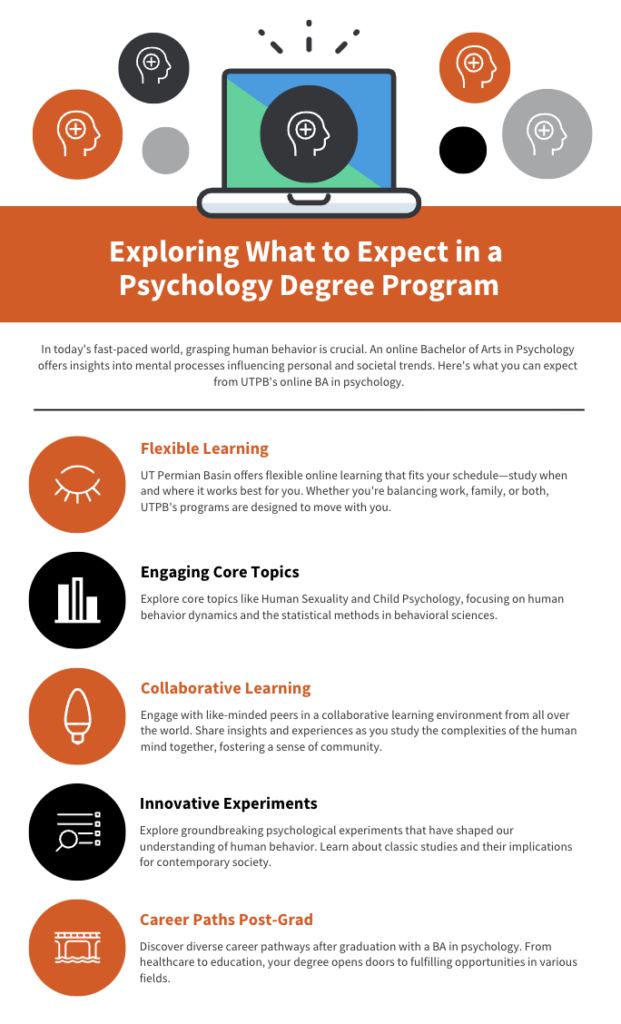
How Is UT Permian Basin’s Online BA in Psychology Program Structured?
With our program, you can study psychology from anywhere with a Wi-Fi connection. Down the street from campus? Sure. Across the globe at a cozy cafe? Absolutely.
Our program is presented in an eight-week course model with six start dates a year, meaning you can earn a bachelor’s degree in psychology without having to block out months of your time or sacrifice your personal and professional commitments. At UT Permian Basin, you can continue working while working toward a psychology degree.
What Are the Degree Requirements for UTPB’s Online BA in Psychology Program?
In order to earn a BA in psychology, students at UT Permian Basin must complete 120 credit hours composed of:
42 hours of general education courses
36 hours of core courses in psychology
24 hours of electives, and 18 hours of minor courses
Students can choose the minor that interests them most and create a customized learning experience. All core courses are worth 3 credit hours and delve into engaging topics such as Social Psychology, Abnormal Psychology, and Lifespan Psychology. Students can expect to explore:
The social influences that affect motivation, perception, and behavior
The application of statistical methods to behavioral sciences research
The development, maintenance, and treatment of behavioral disorders
The psychological processes that affect people across their lifespan
What Is the Online Learning Experience Like?
When enrolled in our online program, you’ll receive a first-rate education from the same faculty members who teach students on campus. Learn with virtual classmates who have also devoted themselves to the study of the human mind.
Learn About the World’s Most Influential Psychological Experiments
As a psychology major, you’ll be following in the footsteps of some of the world’s greatest intellectual pioneers and learning about the most famous psychological experiments to ever be conducted.
Take the Asch conformity experiments. Solomon E. Asch set out to discover if, when presented with a problem with an obvious answer, a participant would agree with their incorrect peers. In what is now a classic social experiment, unsuspecting participants were placed in a room with several “confederates” and asked to compare the length of drawn lines. Answers were shared out loud, and the confederates always gave the incorrect answer. Although the answer was obvious, about one-third of participants agreed with the confederates after hearing their responses.
In our online program, you’ll learn that while psychological experiments like this one were first conducted decades ago, they still hold profound implications today. You’ll even be able to conduct your own research in our capstone course while being supervised by a psychology faculty member. If you dream of one day publishing your own research paper, our program offers real-world experience.
What Are the Tuition Costs and Admission Requirements?
Our online BA in psychology program is affordable, with tuition costing less than $400 per credit hour. We offer flexible payment options, and financial aid is available for qualifying students.
Applying to UT Permian Basin’s online BA in psychology program is a straightforward process designed to make quality education accessible to more students:
All first-year and transfer students can apply by mailing their high school and/or college transcripts to the Admissions Office.
A minimum 2.0 cumulative GPA is required for admission.
Students who don’t meet the GPA requirement may be conditionally admitted if they maintain a 2.0 GPA or higher during their first 30 credit hours at UTPB.
Once You’ve Graduated: Careers and Beyond
A BA in psychology is an incredibly versatile degree that can lead to success in a number of exciting fields, including:
Healthcare
Education
Business
Social work
Although a bachelor’s degree alone can lead to a rewarding career, many students enrolled in our program go on to pursue a doctoral degree and become clinical, counseling, research, school, or industrial-organizational psychologists.
According to the Bureau of Labor Statistics, psychologists made an average annual salary of $94,310 in 2024, with some earning well over six figures. If you’re interested in helping individuals overcome psychological, emotional, and behavioral challenges, a BA in psychology can be the next stepping-stone in your career path.
If you’re ready to explore the growing field of one of the world’s youngest sciences, learn more about UT Permian Basin’s online BA in psychology program.
The Cold War between the U.S. and the Soviet Union lasted nearly 45 years. This period of global tension was fueled by political differences, expansionism, a nuclear arms race, and constant propaganda. But these factors were symptoms of a deeper, underlying psychological force: group polarization. Both sides steadily grew more entrenched in their opposing views,…
When the final “ber” months roll around, the world wraps itself in holiday cheer. Families make travel plans, calendars fill with festive gatherings, and store shelves overflow with stocking stuffers and seasonal treats. But behind the twinkle lights and snow-covered commercials, the holidays can be a stressful time. According to the American Psychological Association, 41%…
Does your pulse race at the thought of glancing out of a plane window at 30,000 feet? How about swimming through shark-infested waters? Or delivering a speech to a roaring crowd? While a fear of heights, sharks, or public speaking is normal, most people won’t be diagnosed with a phobia of these common fears. To…