Nature vs. Nurture: The Debate Over Our Personalities
Are we born with our personalities, or are we shaped by the world around us?
That question sits at the center of the nature vs. nurture debate. “Nature” refers to the traits we inherit through biology and genetics. “Nurture” refers to the influence of our environment, including family, culture, education, relationships, and life experiences.
For centuries, philosophers, scientists, and psychologists have debated which force matters more. Today, the answer is less “either/or” and more “both/and.” Put simply, our personalities are shaped by the interaction between our genes and our experiences.
Let’s take a closer look at the nature vs. nurture debate and what it can teach us about personality, behavior, and human development.
Quick Answer: Nature vs. Nurture
Nature and nurture both influence personality. Genetics can shape traits like temperament, intelligence, and mental health risk, while environment can affect behavior, emotional development, values, and coping skills. Most psychologists today see personality as the result of both forces working together.
What Does “Nature” Mean in Psychology?
When people talk about heredity, they almost exclusively refer to their physical traits. They might say, “I have my mother’s eyes” or “my father’s nose,” but the characteristics we inherit from our parents are more than skin deep.
Your chromosomes, composed of segments of DNA called genes, shape many of your traits. You have 23 pairs—one chromosome per pair from each parent.
Think of genes as blueprints, carrying instructions that determine your every biological trait, including the color of your hair, eyes, and skin. Moreover, your personality, intelligence, and mental health can also be attributed, at least in part, to your genetic makeup.
What Does “Nurture” Mean in Psychology?
English philosopher John Locke compared the mind at birth to a tabula rasa, or blank slate, upon which our experiences imbue reason and knowledge. This is “nurture,” the idea that a child’s environment determines whom they turn out to be.
A report published by the National Academies of Sciences, Engineering, and Medicine (NASEM) affirms that informed parents are more likely to have positive interactions with their children in ways that support healthy development. By showing warmth, being responsive, and promoting other evidence-based practices, parents can improve outcomes relating to their child’s emotional, behavioral, cognitive, and social skills.
A person’s environment is most impactful during their early years, when their brain has yet to fully develop and their experiences are shaped entirely by their home life. There’s no doubt that nature plays a critical role in deciding the trajectory of our lives. The question is, how much of our behavior is inherited?
Examples of Nature vs. Nurture
Nature and nurture often work together in everyday life. For example:
A child may inherit a naturally cautious temperament, but their environment can influence whether that caution develops into confidence, anxiety, or careful decision-making.
Someone may have a genetic risk for a mental health condition, but support, treatment, stress levels, and life experiences can all affect how that risk develops over time.
A person may be born with certain athletic traits, but coaching, practice, nutrition, and access to opportunities can shape how far those abilities go.
A student may have a natural strength in language or problem-solving, but encouragement, education, and practice can help that ability grow.
These examples show why many psychologists no longer see nature and nurture as opposing forces. Instead, they work together to shape personality, behavior, and development.
What Twin Studies Reveal About Nature vs. Nurture
Scientists have taken a novel approach to testing the effects of heredity on personality: studying twins. Identical twins share the same genes, whereas fraternal twins share half of their genes, like other siblings.
By contrasting the traits of identical and fraternal twins, scientists have been able to separate the influences of nature and nurture on human behavior. In a meta-analysis of the heritability of human traits, researchers looked at over 50 years of twin studies, compiling evidence from over 2,000 publications reporting on a combined 17,804 traits and 14,558,903 twins.
They found that the heritability of human traits, including temperament and personality functions, is about 50%. To put it simply, half of our unique personalities can be attributed to heredity, or nature.
Why the Nature vs. Nurture Debate Isn’t Either/Or
Has the revelation that genetics accounts for half of our mental and physical traits—and that both sides hold equal sway over our personalities—put an end to the nature versus nurture debate? Not quite.
This debate has proven more nuanced than previously thought, particularly with the revelation that genetically driven behaviors shape our environments in the same way our environments shape us.
For example, parents responding negatively to their child’s antisocial behaviors may end up reinforcing those same behaviors. Complicating matters further are epigenetic changes that switch genes on and off. Traumatic experiences, in particular, can be passed on from one generation to the next. Complex factors like these continue to stoke the flames of this age-old debate.
More than opposing ideas, nature and nurture describe entwined influences that alter and build upon one another. While some argue that nature carries more weight because our genes, as opposed to our experiences, are set in stone, this is exactly why nurture is such an important concept.
The family, society, and culture we’re born into are random, but not all environmental factors are beyond influence, and something as simple as reading bedtime stories to a child could make a world of difference in who they grow up to be.
Study Human Behavior With UTPB’s Online Psychology Program
If you’re interested in how genetics, environment, personality, and behavior shape who we become, UT Permian Basin’s online Bachelor of Arts in Psychology can help you explore those questions in greater depth.
The program provides foundational psychology knowledge in areas such as research methods, mental disorders, and the application of psychological principles in real-world settings. Courses are fully online and asynchronous, giving you the flexibility to study on your schedule while earning the same respected degree as on-campus students.
Ready to pursue your interest in psychology? Learn more about UTPB’s online BA in psychology program.
Psychology is one of the broadest academic fields, and one of the most versatile. It spans everything from courtrooms to corporate offices, from childhood development to competitive sports. With so many specialties (and subspecialties), it can be tough to know where to even start. So exactly how many branches of psychology are there? The field is…
Ever reach for your phone and instantly face a barrage of messages, notifications, subscription reminders, and social media updates? You’re not alone. Scientists have estimated that the average person processes about 74 gigabytes of information daily: equivalent to watching 16 high-definition movies back-to-back in a single day. Cognitive overload is real. And over time, constant stimulation quietly changes how we think, focus, and feel. In this article, we’ll explore: What Does Cognitive Overload Mean? Cognitive overload happens when your brain receives more information than…
When someone struggles with depression, homelessness, or discrimination, who steps in to help? A psychologist? A social worker? A sociologist? These three fields all address human challenges, but they explore humanity from very different angles: one from society, one from the mind, and one from the front lines. So what are the similarities and differences between sociology, psychology, and social work? This guide clears up…
Psychologists devote themselves to analyzing the complex relationship between our minds, behaviors, and environments. This study of mental processes provides psychologists with insights into everyday life and, sometimes, revelations on the human condition. They are bearers of knowledge: professionals who share their understanding with others to improve their lives, especially with regard to mental health. The expertise that makes psychologists so valued in clinical and research settings, however, makes them valued across a range of professional fields, one of which is sure to pique your interest.
Practical in its design, The University of Texas Permian Basin’s online Bachelor of Arts in Psychology program helps students qualify for careers adjacent to the field of psychology or prepare for graduate studies and ultimately careers as psychologists. This versatile degree can open the door to numerous opportunities, which begs the question: What would you do with a BA in psychology?
Choose Your Path
Divided in two—like the left and right cerebral hemispheres of the brain—the field of psychology is comprised of applied and experimental psychology. To practice psychology or conduct research, aspiring professionals must earn an undergraduate degree, and they often continue their educational journey in graduate school.
Applied Psychology
The image of a psychiatrist sitting in an oversized leather chair with a pen and notebook in hand is hard to shake. There are certainly therapists and counselors who work in clinical settings, helping patients organize their thoughts and manage mental health disorders. However, clinical psychology is one of many branches in the field of psychology.
Practitioners of psychology use their expansive knowledge of cognitive, emotional, and social processes to solve problems and promote healthy human development. A forensic psychologist could be an expert witness in a court case; a health psychologist could advise healthcare professionals on the best ways to promote health and wellness; and a sports psychologist could help an athlete regain their focus while recovering from injury. A psychologist’s area of focus really depends on their background and interests.
Experimental Psychology
Experimental psychologists are the minds behind some of the greatest insights into human behavior. The Grant Study, for example, sought to answer life’s ultimate question: What is the secret to a happy, fulfilling life? In one of the longest-running longitudinal studies, 268 undergraduate men from the classes of 1938-1940 were followed for 75 years, having everything from alcohol consumption to family relationships measured. Researchers found that love—love and using coping mechanisms that don’t push it away—is the secret to long-term happiness.
Far from mad scientists, experimental psychologists are highly trained professionals who, by collecting data and conducting research, answer theoretical questions pertaining to a wide range of behavioral topics, including attention, emotion, and memory. Armchair psychologists may have all the answers, but experimental psychologists were the ones to provide them.
Explore Other Career Options
A BA in psychology, while a must-have for students pursuing a career in the field of psychology, can help graduates secure a rewarding, fulfilling profession in many fields. The National Center for Education Statistics reported that employment rates were higher in 2019 for individuals with higher levels of educational attainment, with 87% of 25- to 34-year-olds employed. By obtaining a BA in psychology, graduates can qualify for a number of careers requiring applicants with undergraduate degrees. Notable careers for psychology graduates include:
Caseworker
Disability case manager
Human resource advisor
Preschool teacher
Psychiatric technician
Psychosocial rehabilitation specialist
Public relations representative
Research assistant
Veterans counselor
Victim advocate
Obtain a Sought-After Skill Set
Not only does a BA in psychology qualify graduates for careers requiring a degree, it also empowers graduates with a unique skill set highly sought after by employers. Professionals holding psychology degrees have in-depth knowledge pertaining to human motivation, communication, and perception—the invisible forces that determine the outcome of every meeting and dealing. This acute awareness of people’s thoughts and feelings is an invaluable asset for organizations. In fact, according to Deloitte, “soft skill-intensive occupations will account for two-thirds of all jobs by 2030.”
Throughout UT Permian Basin’s online psychology program, students develop empathy and emotional intelligence. Our online course Social Psychology, for example, explores the interrelationships between individuals and their social environment. Industrial and Organizational Psychology looks at employee motivation and satisfaction, while Positive Psychology focuses on areas of personal growth among individuals, including love, optimism, and self-efficacy. Students in our online program have the added benefit of collaborating with their professors and fellow students on online discussion boards. These discussions offer the chance for students to apply what they’ve learned in a supportive online environment—a preview of the social situations psychology graduates must adeptly navigate in the workplace.
Study the Mind at UT Permian Basin
Have you chosen your psychology career path? Don’t be discouraged if you haven’t. There are numerous opportunities in and adjacent to the field of psychology that can provide you with a rewarding career. However, no matter where your career takes you, no matter whom you assist with your expertise, the first step on your career path will be to earn a BA in psychology.
UT Permian Basin’s online psychology program will empower you with a broad understanding of mental processes and human behavior, emphasizing written communication and research skills that can assist you in psychology-related professions and beyond. Entirely online, our program can be completed at your convenience and from anywhere with a Wi-Fi connection. Upon graduating, you’ll earn the same prestigious degree awarded to graduates of our on-campus program.
It may be considered a soft skill by many, but being able to get along with others is perhaps the most important trait any person can have, regardless of their profession or other factors. The ability to understand others is key to interacting in positive, constructive ways in any social setting.
Psychology is a word often used to describe the way people think and the motivations behind their actions. In terms of understanding others, why is psychology important? Let’s begin with a definition of what it is and then continue on with an exploration of the benefits of studying psychology.
What Is Psychology?
According to the American Psychological Association (APA), “Psychology is the study of the mind and behavior. The discipline embraces all aspects of the human experience—from the functions of the brain to the actions of nations, from child development to care for the aged. In every conceivable setting from scientific research centers to mental healthcare services, ‘the understanding of behavior’ is the enterprise of psychologists.”
How Can Studying Psychology Help You Understand Others and Yourself?
The benefits of studying psychology are consequential and numerous when it comes to understanding one’s self and other people. You’ll gain insight into why people think and act the way they do and into your own behavior and motivations. You’ll learn about the internal impulses and desires that drive us all. And you’ll develop a greater sense of empathy for others based on that understanding, enabling you to limit your biases against people who act differently than you do. Knowing what motivates people goes a long way toward creating a harmonious relationship with those around you, whether they are a major part of your life or someone with whom you’re interacting only briefly, such as a cashier.
Studying psychology can give you a better understanding of your children, helping you become a better parent as you learn to nurture their developing psyches. This, in turn, can make them well-balanced, psychologically healthy children destined to grow into well-balanced, psychologically healthy adults.
An education in psychology can also help you become a better communicator. Communication involves not only how you speak to others but how you interpret others’ word choices, body language, tone, facial expressions, and eye contact and use that understanding to formulate appropriate responses. Understanding someone doesn’t merely mean comprehending the words they’re speaking, but the intended meaning beneath them, or subtext. All the characteristics above provide added clarity.
If your ultimate intention in studying psychology is to pursue a career in the field, there are two routes you can take. One is going into practice, which is clinically based and focuses on helping people. As the APA states, psychologists “identify and help people overcome the obstacles that inhibit them from making better choices … Psychologists use psychological science to help people tap into their potential and help them perform at an optimal level.”
The other path is basic research and the science of psychology. The majority of academic psychologists focus on this path, which emphasizes research methods, critical thinking, data collection and analysis, statistical modeling, and scale development.
Are There Other Personal Benefits ofStudying Psychology?
Beyond understanding others, an education in psychology can help you live a more fulfilling life by fostering critical thinking and confidence. You’ll also gain a deeper understanding of the science of psychology.
As Ronald E. Riggio, PhD, explains in an article in Psychology Today, studying psychology can also help you:
Understand basic psychological and scientific principles affecting human behavior.
Become a better critical thinker.
Gain a better understanding of relationships.
Be more effective in your profession.
Become more likely to be hired.
What Type of Program Is Best for Studying Psychology?
The University of Texas Permian Basin’s online Bachelor of Arts in Psychology offers a broad foundation of psychological science with an emphasis on critical written communication and research skills that are invaluable in helping professions and other careers. This intensive online program will help you cultivate important abilities, including reasoning about empirical research, writing persuasive, cohesive arguments, and thinking critically on applied and theoretical aspects of psychology. Finally, the knowledge and insight our affordable program provides can make you more competitive in your pursuit of a diverse selection of professional roles.
Why Learn Online?
We offer our BA in psychology program 100% online through asynchronous class sessions. This advantage enables you to complete your coursework anywhere, at your own pace. If you have work and/or family responsibilities, you’ll find that a flexible program format like ours best suits your busy schedule. You can begin the program at any of six start dates per year. All program courses last eight weeks and are taught by the same acclaimed faculty who teach them on campus. When you successfully complete your BA in psychology program, you’ll receive the same respected degree that campus-based UT Permian Basin graduates receive.
Psychology has a number of interesting applications. It can be used to alter perceptions, turn enemies into friends, and even make people ignore a man in a gorilla suit. Many individuals are first attracted to the field of psychology by the impact these incredible phenomena have on themselves and those around them. Let’s explore some of the most significant studies and findings in the field of psychology and see how they fit into everyday life.
If you’re intrigued by how these scientific studies, hypotheses, and effects can improve your daily life, you can apply this passion to a career studying and improving the lives of others. The University of Texas Permian Basin offers an online program that allows students to earn a bachelor’s degree in psychology on their own time, at their own pace. The study of the mind is an incredible pursuit, and it begins with a Bachelor of Arts in Psychology.
The Ben Franklin Effect
Ben Franklin was using psychology to turn political opponents into trusted allies back in the 1700s. In his autobiography, Ben Franklin tells the story of winning over an adversary who had delivered an impassioned speech against him. Knowing that this gentleman could one day hold substantial political power, Franklin responded in an unconventional manner: He asked to borrow a book. Specifically, he asked to borrow a rare book in a way that both flattered and inconvenienced his adversary. The adversary promptly sent the book, and Franklin returned it with a thank-you note. From that day forward, the “adversary” was far more willing to help Franklin, and the two become lifelong friends.
According to Ben Franklin, “He that has once done you a kindness will be more ready to do you another, than he whom you yourself have obliged.” Another name for this phenomenon? Cognitive dissonance. Essentially, someone who dislikes you can’t mentally process why they would allow themselves to be inconvenienced by you. To avoid discomfort, they will change their opinion of you rather than their opinion of themselves. When employing the Ben Franklin Effect in real life, remember to always use this superpower for good.
The Somatic Marker Hypothesis
“Elliot” had it all: a good job, a happy marriage, and the respect of his peers—until one day he started having headaches. The headaches became more severe, and it was later discovered that Elliot had a brain tumor. The tumor was removed, but not before it damaged the frontal lobe of his brain. Elliot began to look at every situation in his life through a purely logical lens devoid of all emotion—the dream of every procrastinator. The problem is that Elliot had effectively undergone a lobotomy, and his life crumbled soon after.
What can be learned from Elliot’s tragedy? The study of Elliot led to the somatic marker hypothesis, which proposes that emotions, not logic, are the driving force behind decision-making. When making decisions, you filter out choices based on how you feel about the imagined outcome. The next time you’re unable to find the motivation to work, clean, or create, consider why you imagine those possibilities being unpleasant. If you can be honest with yourself, you may arrive at the right decision.
The Halo Effect
In one of the most famous examples of how psychology relates to everyday life, Richard Nisbett and Timothy Wilson set out to study the halo effect, a cognitive bias that occurs when first impressions cloud a person’s perception of others. Over one hundred college students were asked to review footage of a psychology instructor. In some videos, the instructor was friendly and encouraging, while in others the instructor was cold and unlikable. Students were then asked to rate the instructor’s appearance, mannerisms, and accent. The results showed that even when participants had enough information to make an independent assessment, they were influenced by the instructor’s attributes. Students who saw the “likable” instructor rated his appearance, mannerisms, and even his accent higher. Furthermore, students were unaware that their perception of the instructor had any effect on their ratings.
The halo effect can be summed up as judging a book by its cover. When we meet others, we unconsciously allow their attractive features to influence our overall opinion of them. This presents a prime opportunity to use psychology in your daily life. When meeting new people, always try to make a good first impression by displaying confidence, being well-groomed, and not mentioning negative details about yourself. Being aware of the halo effect can also allow you to take a step back from situations and consider if your opinions are being influenced by anything other than logic.
The Invisible Gorilla
How well do you multitask? To put your multitasking skills to the test, watch this video and count how many times the players wearing white pass the ball. The answer is 16, but that’s not what the video is testing. Did you notice the gorilla? If you did, it might have been because you were expecting it, as the original selection attention test involving a gorilla is world-famous.
Did you notice the curtain change or the player on the black team leave the game?
Don’t feel bad if you didn’t. When Christopher Chabris and Daniel Simons expanded on their original experiment, the majority of participants failed to notice one or both of the unexpected events. What this study shows is that people can focus so hard on one task that they fail to notice other important details. According to Simons, “Although people do still try to rationalize why they missed the gorilla, it’s hard to explain such a failure of awareness without confronting the possibility that we are aware of far less of our world than we think.”
Similar to the halo effect, our expectations can alter our perception of reality. The lesson here isn’t that people don’t pay enough attention or that we shouldn’t multitask; it’s that people can be led astray when relying solely on their intuition. How can you use this in your everyday life? Intuition is great for things like deciding what to order for dinner, but for decisions that require an analytical approach, you’re better off giving yourself enough time to react and consider the things that matter rather than relying exclusively on your gut.
Psychology is far more than the study of the mind. As a social science, it’s the study of people, their behaviors, and their relationships with each other. Earning a bachelor’s degree in psychology means gaining insight into the mental processes that shape not only your own experiences but the world around you.
If you’re interested in entering an exciting field that rewards curiosity and compassion with high-paying careers, UTPB’s 100% online psychology program offers the flexibility, affordability, and academic excellence you need to take the next step in your education and career.
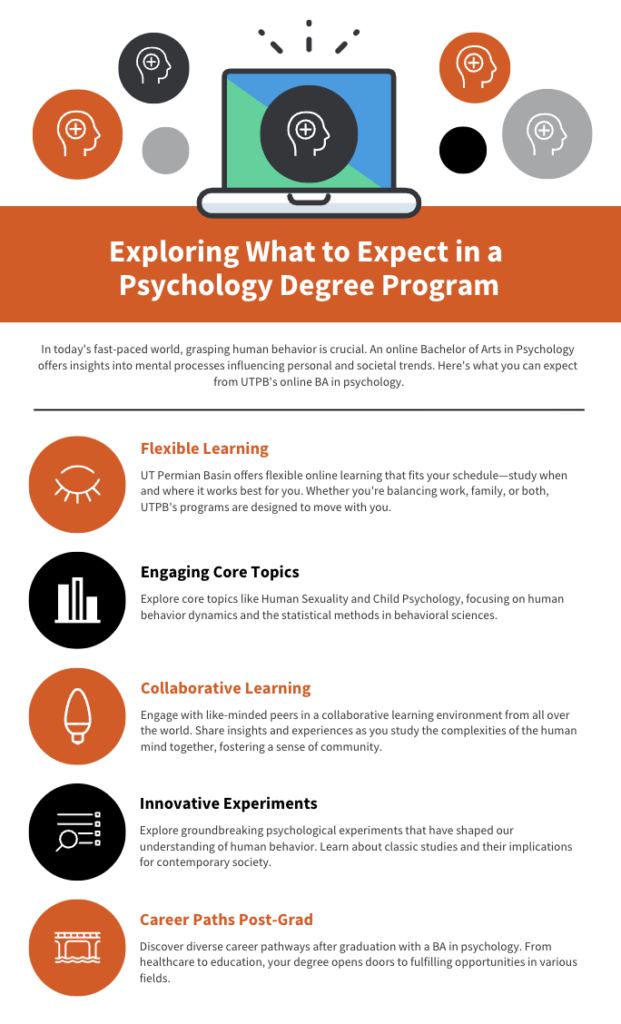
How Is UT Permian Basin’s Online BA in Psychology Program Structured?
With our program, you can study psychology from anywhere with a Wi-Fi connection. Down the street from campus? Sure. Across the globe at a cozy cafe? Absolutely.
Our program is presented in an eight-week course model with six start dates a year, meaning you can earn a bachelor’s degree in psychology without having to block out months of your time or sacrifice your personal and professional commitments. At UT Permian Basin, you can continue working while working toward a psychology degree.
What Are the Degree Requirements for UTPB’s Online BA in Psychology Program?
In order to earn a BA in psychology, students at UT Permian Basin must complete 120 credit hours composed of:
42 hours of general education courses
36 hours of core courses in psychology
24 hours of electives, and 18 hours of minor courses
Students can choose the minor that interests them most and create a customized learning experience. All core courses are worth 3 credit hours and delve into engaging topics such as Social Psychology, Abnormal Psychology, and Lifespan Psychology. Students can expect to explore:
The social influences that affect motivation, perception, and behavior
The application of statistical methods to behavioral sciences research
The development, maintenance, and treatment of behavioral disorders
The psychological processes that affect people across their lifespan
What Is the Online Learning Experience Like?
When enrolled in our online program, you’ll receive a first-rate education from the same faculty members who teach students on campus. Learn with virtual classmates who have also devoted themselves to the study of the human mind.
Learn About the World’s Most Influential Psychological Experiments
As a psychology major, you’ll be following in the footsteps of some of the world’s greatest intellectual pioneers and learning about the most famous psychological experiments to ever be conducted.
Take the Asch conformity experiments. Solomon E. Asch set out to discover if, when presented with a problem with an obvious answer, a participant would agree with their incorrect peers. In what is now a classic social experiment, unsuspecting participants were placed in a room with several “confederates” and asked to compare the length of drawn lines. Answers were shared out loud, and the confederates always gave the incorrect answer. Although the answer was obvious, about one-third of participants agreed with the confederates after hearing their responses.
In our online program, you’ll learn that while psychological experiments like this one were first conducted decades ago, they still hold profound implications today. You’ll even be able to conduct your own research in our capstone course while being supervised by a psychology faculty member. If you dream of one day publishing your own research paper, our program offers real-world experience.
What Are the Tuition Costs and Admission Requirements?
Our online BA in psychology program is affordable, with tuition costing less than $400 per credit hour. We offer flexible payment options, and financial aid is available for qualifying students.
Applying to UT Permian Basin’s online BA in psychology program is a straightforward process designed to make quality education accessible to more students:
All first-year and transfer students can apply by mailing their high school and/or college transcripts to the Admissions Office.
A minimum 2.0 cumulative GPA is required for admission.
Students who don’t meet the GPA requirement may be conditionally admitted if they maintain a 2.0 GPA or higher during their first 30 credit hours at UTPB.
Once You’ve Graduated: Careers and Beyond
A BA in psychology is an incredibly versatile degree that can lead to success in a number of exciting fields, including:
Healthcare
Education
Business
Social work
Although a bachelor’s degree alone can lead to a rewarding career, many students enrolled in our program go on to pursue a doctoral degree and become clinical, counseling, research, school, or industrial-organizational psychologists.
According to the Bureau of Labor Statistics, psychologists made an average annual salary of $94,310 in 2024, with some earning well over six figures. If you’re interested in helping individuals overcome psychological, emotional, and behavioral challenges, a BA in psychology can be the next stepping-stone in your career path.
If you’re ready to explore the growing field of one of the world’s youngest sciences, learn more about UT Permian Basin’s online BA in psychology program.
Psychology is one of the broadest academic fields, and one of the most versatile. It spans everything from courtrooms to corporate offices, from childhood development to competitive sports. With so many specialties (and subspecialties), it can be tough to know where to even start. So exactly how many branches of psychology are there? The field is…
Ever reach for your phone and instantly face a barrage of messages, notifications, subscription reminders, and social media updates? You’re not alone. Scientists have estimated that the average person processes about 74 gigabytes of information daily: equivalent to watching 16 high-definition movies back-to-back in a single day. Cognitive overload is real. And over time, constant stimulation quietly changes how we think, focus, and feel. In this article, we’ll explore: What Does Cognitive Overload Mean? Cognitive overload happens when your brain receives more information than…
When someone struggles with depression, homelessness, or discrimination, who steps in to help? A psychologist? A social worker? A sociologist? These three fields all address human challenges, but they explore humanity from very different angles: one from society, one from the mind, and one from the front lines. So what are the similarities and differences between sociology, psychology, and social work? This guide clears up…