Gamification in education uses game-like elements such as points, badges, challenges, and leaderboards to make learning more engaging and motivating for students. By bringing familiar features from games into the classroom, educators can encourage participation and support stronger student buy-in.
From elementary school to college classrooms, you can use gamification in different ways depending on students’ needs and learning goals. In this article, we’ll look at:
What Is Gamification in Education?
Gamification in education refers to integrating game mechanics into the learning environment. By incorporating elements like badges, points, leaderboards, challenges, and progress bars, gamification taps into students’ familiarity with gaming to boost classroom engagement and motivation.
Here’s a deeper dive into these key components:
- Badges
As they complete tasks, students earn badges, giving them a sense of achievement and progress. For example, a student could earn a “Math Master” badge for mastering a set of problems.
- Points
A simple yet powerful motivator, teachers can award points for participation, completing assignments, or achieving specific milestones.
- Leaderboards
Displaying a class’s progress and ranking allows students to tap into their competitive drive, encouraging them to strive for top positions.
- Challenges
Challenges transform assignments into exciting quests or missions, like turning a research project into a “mystery-solving” adventure.
- Progress Bars
These provide a visual representation of students’ progress, making their achievements clear and motivating them to reach their goals.
These elements of gamification help create an interactive and dynamic learning experience. By tapping into students’ natural desire for achievement and competition, gamification fosters both motivation and accountability.
What Are the Benefits of Gamification in Education?
Gamification can lead to a range of benefits in the classroom. According to one study, gamification can lead to an 89% increase in student performance. But that’s just the start.
Here are a few more ways it can transform learning:
- Boosting motivation
When learning feels like play, students are more likely to show up and give their best effort. Gamification taps into intrinsic and extrinsic motivation by making lessons feel rewarding, encouraging even hesitant learners to give new concepts a try.
- Increasing engagement
Student buy-in is one of the biggest hurdles in education. But when students are motivated, they’re more engaged. For example, earning points for listening attentively, participating in discussions, or completing worksheets adds layers of interactivity that make the lesson feel less like a chore and more like a challenge.
- Promoting a growth mindset
Many gamified systems allow students to try again when they don’t succeed the first time. Think of it like reattempting a level in a game. This helps students reframe setbacks as opportunities to learn and improve, reinforcing the message: “I haven’t mastered this yet, but I will.”
- Making progress visible
In traditional classrooms, it’s not always easy for students to track their growth. Gamification tools like progress bars or journey maps let students see what they’ve accomplished and what still lies ahead, making progress tangible and goal-setting more intuitive.
Potential Drawbacks of Gamification
While gamification can offer a range of benefits, it’s not without its challenges. Here are a few potential drawbacks to keep in mind:
- Overreliance on extrinsic motivation
Visible rewards like points, badges, or class rankings can definitely boost engagement. But if students come to rely solely on these external motivators, their intrinsic drive to learn may suffer. Without consistent gamified rewards—or when transitioning to a classroom that doesn’t use them—some students might struggle to stay motivated or perform at their best.
- Increased pressure and competition
Tools like leaderboards can inspire some students, but they may have the opposite effect on others. Seeing their name near the bottom of the list, especially in front of peers, can lead to anxiety, embarrassment, or disengagement. Not all students thrive in competitive environments, and some may feel discouraged rather than driven.
Examples of Gamification in the Classroom
The type of gamification that works for first graders might not entice, say, 11th graders. Below, we explore some real-world examples of how educators can bring game elements into their classrooms at every level:
- Elementary School
Students earn badges and points for completing reading logs, participating in class discussions, or mastering multiplication tables. A classroom “treasure map” shows their collective progress toward a group goal, like a pizza party or a special theme day.
- Middle School
A science teacher turns a unit on ecosystems into a “mission” game where students complete challenges (like building a food web) to earn points and unlock new “levels” of the game. Leaderboards encourage friendly competition and collaboration.
- High School
In an English class, students engage in a debate tournament, earning points for preparation, participation, and rebuttals. Badges are awarded for creativity, teamwork, and research skills. A progress bar shows how close each student is to completing a full “debate mastery” achievement.
- College
A business course uses a simulated startup challenge. Students work in teams to “launch” a product, completing weekly quests like budget planning, marketing pitches, and risk analysis. Points and feedback fuel continuous improvement, and a final leaderboard highlights top teams based on performance and creativity.
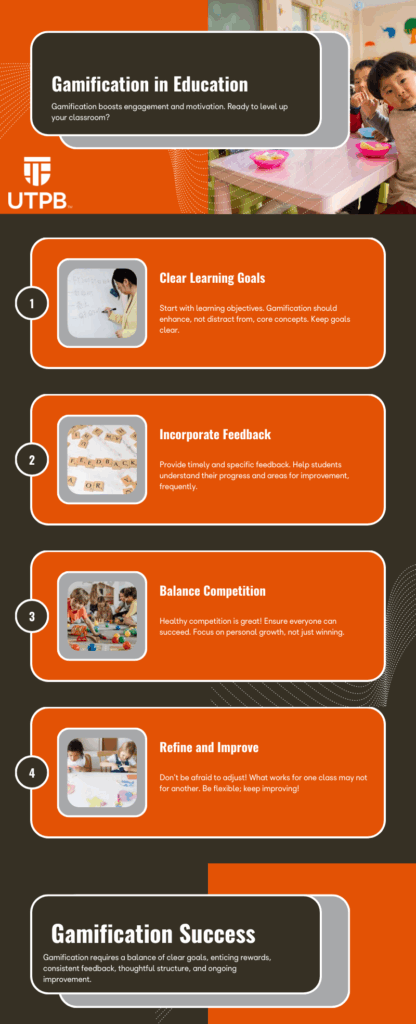
4 Best Practices for Gamification in Education
There are countless ways to bring gamification into your classroom. You don’t have to reinvent the wheel—just a few gamified tweaks to your existing lesson plans can make a big difference in student participation and learning outcomes.
Here are a few best practices to get started:
4 Best Practices for Gamification in Education
You don’t have to overhaul your teaching strategy to use gamification in your classroom. In fact, just a few gamified tweaks to your existing lesson plans can make a big difference in student participation and learning outcomes.
Here are a few best practices to get started:
#1 Create a Clear Objective
You likely already have objectives aligned to your state standards. The key is to make those goals understandable and attainable for students.
When students know what they’re working toward, each step of the learning process feels purposeful, and every small milestone gives them a reason to celebrate.
#2 Determine Your Point System
Points can be awarded for just about anything, depending on your goals. If classroom management is the focus, give points for raising hands, staying on task, or helping others.
In addition, if you’re targeting mastery of a specific concept, award points for correct answers, insightful questions, or completing extension activities. The point system should reflect the behaviors and outcomes you want to reinforce.
#3 Set Time Limits
Adding a time element keeps students focused and adds a subtle sense of urgency. Whether it’s cleaning up or completing an activity, use a visible timer to let students know how much time they have left. This works especially well with challenges, encouraging students to work efficiently and stay on task.
#4 Offer Meaningful Rewards
The reward doesn’t always have to be tangible. It could be earning a new avatar accessory, choosing the next class activity, or unlocking a bonus challenge. The key is to make rewards feel exciting and age-appropriate while reinforcing learning goals.
DTake Your Career to the Next Level with a Graduate Credential From UTPB
Whether you’re ready to bring gamification into your own classroom or you’re working at the district level to boost student engagement across schools, deepening your expertise through advanced education can make a lasting impact.
At UT Permian Basin, we offer several education-focused graduate programs tailored to help you meet your career goals:
As a virtual Falcon, you’ll benefit from:
- 100% online coursework
- Flexible scheduling that fits your busy lifestyle
- Competitive tuition rates no matter where you’re located
Take the next step toward becoming a more dynamic, effective educator. Explore your graduate options at UTPB on our education programs overview page.
Sources:
https://www.sciencedirect.com/science/article/pii/S1071581920300987
Other articles you may be interested in:
-
Texas teachers, here’s the reality: More than half of all K-12 students in the state are Hispanic, and nearly a quarter are enrolled in bilingual/ESL programs. That translates to over a million students who needed specialized language support throughout the 2023-2024 school year. Districts are struggling to find enough certified bilingual and ESL teachers. A critical shortage for schools? Absolutely. But…
-
Can speaking multiple languages boost your salary? Make travel easier? Even help prevent dementia? The answer is yes. But multilingual societies also face real challenges, from schools struggling with resources to entire languages disappearing. Whether you’re considering learning a second language or wondering how multilingual communities work, this guide covers what you need to know….
-
Bilingualism can come in handy for travel, work, and personal conversations. But did you know bilingual brains function better and longer? Bilingual people: Impressed yet? Let’s explore the cognitive advantages of a bilingual brain. How Does Being Bilingual Benefit Your Brain? Delayed Cognitive Decline People can stay sharp as they age by reading, playing word…
Chelsea is a Content and SEO Growth Specialist at Apollidon Learning, where she helps create, optimize, and refine educational marketing content for university partners. She holds a bachelor’s degree in literature from Florida State University and has spent the past six years working in marketing, including the past three at Apollidon.