The Boston Tea Party Explained: More Than Just Spilled Tea
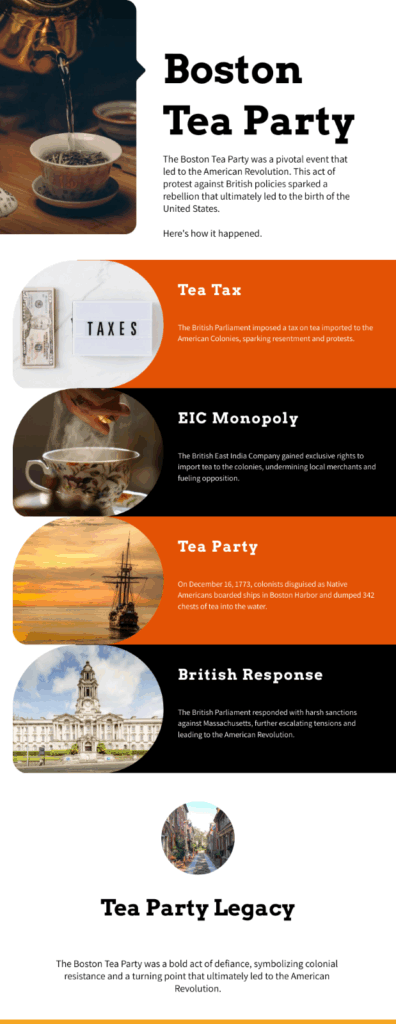
The Boston Tea Party was a political protest against British taxation and trade control in the American Colonies. In 1773, colonists in Boston dumped tea from British ships into the harbor to protest the Tea Act and Parliament’s growing control over colonial trade.
More than an act of destruction, the Boston Tea Party became a powerful symbol of resistance that helped deepen tensions between Britain and the Colonies. And spoiler alert: It wasn’t a party, and no tea was consumed, sadly.
Join us as we explore what led to the Boston Tea Party, what happened that night, and the aftermath that followed.
What Led to the Boston Tea Party?
The Boston Tea Party was caused by growing colonial frustration over British taxes and trade restrictions, especially the Tea Act of 1773. When British subjects crossed the Atlantic Ocean and settled as colonists in the Americas, they brought their noted fondness for tea with them and weren’t about to let geography deprive them of their homeland habit. At that time, most tea was imported to the Colonies; even today, tea is still not widely grown in the United States.
In the 1770s, the British East India Company (EIC)—which transported tea but was also closely associated with trafficking African slaves to the Colonies—was experiencing financial problems. To bolster the struggling company, the British Parliament passed the Tea Act, which made the EIC the exclusive importer of tea to the American Colonies, among other stipulations.
A tea tax had been levied in the Colonies since 1767, though some tea merchants had sidestepped this by purchasing tea from Dutch smugglers. This latest exertion of control by the government back home did not sit well with the independent tea sellers that were edged out by EIC’s monopoly and low-price advantage, essentially creating long before the term was officially coined 233 years later.
What Happened During the Boston Tea Party?
During the Boston Tea Party, colonists boarded British ships in Boston Harbor and dumped imported tea into the water to protest British rule.
But to paint a more colorful picture, here’s how it went down: About 60 white men diguised as Native Americans descended on Boston Harbor one crisp December night in 1773, boarded EIC ships, and dumped about £18,000 worth of tea (about $1.7 million today) overboard.
Some accounts have participants breaking open the heavy chests before pouring the tea directly into the water, while others have them heaving the chests into the water. The incident was famously immortalized in a 1970s educational cartoon.
Samuel Adams—influential writer, politician, signatory to the Declaration of Independence, and inspiration for the beer brand that’s sold today—was a colonial-rights supporter who opposed the Tea Act and “taxation without representation.”
The night of the Boston Tea Party, Adams spoke at a large meeting of likeminded individuals at Boston’s Old South Meeting House. Some attendees later took part in dumping tea into Boston Harbor, though Adams’s role in planning that act of protest and whereabouts during the act itself remain unclear.
What Happened After the Boston Tea Party?
Parliament responded to the Boston Tea Party with wide-ranging sanctions against Massachusetts in particular. While this may have been predictable, it served as yet another point of contention in an escalating feud between the Colonies and their mother country.
About 16 months later, the American Revolutionary War broke out. That conflict lasted more than eight years and, in combination with a small outbreak that ran concurrently, resulted in hundreds of thousands of deaths. But it also gave birth to an independent nation that showed Britain its control over its growing global footprint could be successfully challenged.
Revisit History and Enrich Your Future
One of the most fascinating aspects of studying history is gaining a more nuanced perspective on some eras and events and a more accurate understanding of those that may be commonly misunderstood.
Delivered in a 100% online, asynchronous format, The University of Texas Permian Basin’s Master of Arts in History program features in-depth 16-week courses that illuminate the American Revolution and other pivotal epochs of American and world history. View all program courses here.
Ready to go back in time so that you can move forward? Apply here.
As store aisles fill with skeletons, ghouls, and endless bags of candy, children begin the great debate over whether to be witches or firefighters for Halloween. Meanwhile, adults across the country start adding gargantuan bags of candy to their normal grocery lists in preparation for trick-or-treaters. This raises the question: Has trick-or-treating always been a…
Thousands of years ago, as flowers bloomed and the weather warmed, villagers in what is now Europe gathered to celebrate the vernal equinox. Communities gathered in open clearings, the air filled with the rich scent of burning herbs and fresh, damp earth. They placed eggs—symbols of renewal—on altars, and the sight of a hare darting…
More than 21 million dead, most of them civilians. The map of Europe redrawn. World War I—a conflict associated with the introduction of tanks, bombers, advanced artillery, chemical weapons, and trench warfare—left an indelible mark on civilization and the collective human psyche. History might’ve played out very differently, however, had a driver not made a…
Apollidon Content TeamContent Team
The Apollidon Content Team combines expertise in marketing, content strategy, SEO/GEO/AEO, and student engagement to create content that helps colleges and universities reach prospective students. Through research-driven insights, data-informed strategy, and compelling storytelling, the team develops resources that increase visibility, strengthen institutional brands, and support enrollment growth.