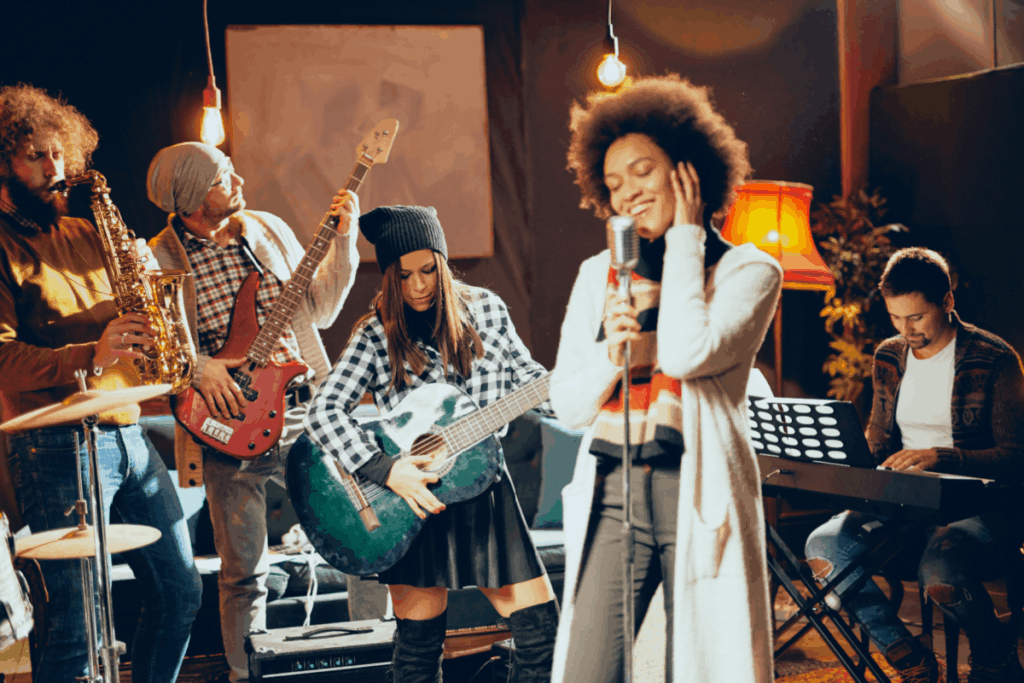
Women in the Arts: Musically Inclined and Unstoppable
Ever found yourself humming an earworm and suddenly wondering, “Where did this come from—and who created it?”
Music is a universal language. It conveys memory, rebellion, grief, joy, and identity. Across centuries, women have used the language of sound in a world where they’ve been told, repeatedly, to stay invisible.
Here are some of the famous women in music who refused to stay quiet and challenged what it means to be heard.
Early Women Composers: Creating Music Before Permission Existed
Long before concert halls and recording studios—even before women were expected to sign their own work—women were already composing music. Let’s look at a few women who defined music long before the modern era.
Saint Hildegard von Bingen
When people think of musical geniuses, a medieval abbess rarely comes to mind. Yet Hildegard von Bingen was a composer, mystic, Doctor of the Church, and philosopher. She was also the earliest Western composer whose complete body of work survives. She wrote more than 70 sacred pieces, including “Ordo Virtutum,” composed around 1151. This morality play focused on the inner struggle of the soul rather than conventional visions of heaven or hell: a radical concept at the time.
Strozzi was a 17th-century Venetian soprano, composer of cantatas, and single mother who had more secular music in print than any other composer of her time—male or female. She explored themes like love and heartbreak and published eight collections under her own name: a rare achievement for women of her era.
In the 19th century, Clara Schumann forged a career despite strict social limits placed on women performers. The virtuoso pianist and composer’s compositions—especially her chamber works—quietly explored grief, intimacy, and resilience. They reflected both personal struggles and broader constraints of the Romantic Era.
In the early 20th century, Florence Price faced systemic racism and oppression. Still, her blend of European classical music and African American folk music in works like “Symphony in E Minor” caught the attention of the Chicago Symphony Orchestra. In 1933, she became the first Black woman to have a symphony performed by a major U.S. orchestra.
Voices of Power: Famous Women in Jazz, Soul, and Rock
In the mid-20th century, jazz and soul gave women something society often denied them: a public voice with authority. Female musicians could use improvisation and emotional precision to assert independence and lead cultural expression.
Ella Fitzgerald
The “First Lady of Song,” whose career exploded in the 1960s, possessed a three-octave range, impeccable phrasing, and revolutionary scat-singing (jazz vocal improvisation) ability. The winner of 13 Grammy Awards, she demonstrated that technical precision and improvisation could be turned into art.
The “Queen of Soul” sang in her father’s choir at age 12 and taught herself piano. Her four-octave range and gospel-driven power propelled her career in 1967. Aretha Franklin earned 18 Grammys, had over 100 Billboard R&B hits, and became the first woman inducted into The Rock & Roll Hall of Fame. No wonder her number one civil rights and feminist anthem called for a little more R-E-S-P-E-C-T.
Janis Joplin’s raw, soulful vocals and electric stage presence made her a defining icon of the 1960s and 1970s counterculture. Although she tragically lost her life at 27, she opened the doors for women in rock—back when it was a largely male-dominated industry—earning the nickname “Queen of Rock ‘n’ Roll.”
With her crystal-clear soprano and technical precision, Joan Baez’s tunes elevated folk music into political power in the 1970s. By blending political anthems with rich storytelling, she quickly became an icon for the era’s anti-war and civil rights movements.
Modern Women in Music: Reinvention, Ownership, and Legacy
By the late 20th century, the game had changed. Influence was no longer just about sound but about ownership, reinvention, and lasting power. Women saw this shift coming—and seized it.
Madonna
Some critics argue that pop had a pre-Madonna and post-Madonna era. The “Queen of Pop” redefined pop stardom through constant reinvention for over 40 years. Using music videos, fashion, and provocation, she challenged norms around gender, sexuality, religion, and power.
Dubbed “The Queen of Country Pop,” 90s star Shania Twain’s “Come On Over” is still the best-selling album of all time by a solo female artist and the original template for the country/pop fusion that was to come. In the 90s, the country pop song “Man! I Feel Like a Woman!” became a symbol of female empowerment.
Singer and producer Beyoncé Knowles-Carter has received a record-breaking 32 Grammy Awards and has become one of the most influential artists of the early 21st century. Her vocal precision and genre-blending music reshaped pop’s sound. Her songs explore Black identity, womanhood, power, and artistic control. Her album “Lemonade,”for example,explores romantic betrayal and overcoming.
Taylor Swift reshaped industry norms by reclaiming ownership of her work through album re-recordings. Her narrative-driven songwriting (revenge songs, anyone?), genre-crossing from country to pop to indie folk, and advocacy for artists’ rights reframed conversations around authorship in the digital age. Her 2022 hit single “Anti-Hero”is an example of her songwriting prowess, using satire to confront insecurity and public pressure.
From Hildegard von Bingen to Aretha Franklin to Taylor Swift, famous women in music have continuously led cultural change and artistic revolution.
Here’s what we learned:
From sacred chants to pop anthems: Women composers and performers consistently pushed musical boundaries while navigating cultural and institutional barriers.
Pioneers in artistic independence: These artists published under their own names, composed despite restrictions, or reclaimed ownership of their work, showing others how it’s done.
Identity, power, justice, and social change: Women in music have used their voices not only for artistic expression but to address taboo subjects and normalize them.
Legacy: History isn’t fixed. It expands when overlooked voices are heard, remembered, and celebrated.
Music moves faster than history books and knows no cultural barriers. And throughout time, unstoppable women challenged who gets to be heard.
Create Your Own Path With a BA in Humanities
Do you find yourself looking up the lyrics to a favorite song—or pausing to reflect on a quote from a classic novel?
Studying classics helps us understand where many of our biggest modern questions came from, including who gets power, how societies define justice, and why humans keep telling the same stories in new outfits. A single, harmless question comes up a lot in humanities courses (usually from someone trying very hard not to care): Why does any of this matter? And…
Monsters have been with us since the beginning of storytelling. Before novels, there were myths. Before myths, there were campfire stories about things lurking just outside the firelight. Something about the human brain is wired to conjure creatures (and compelled to write entire books about them). But literary monsters have never just been about scaring people. The…
“I took the road less traveled by, And that has made all the difference.” Even if you don’t know the entire poem, you may recognize the closing words from Robert Frost’s “The Road Not Taken.” They’re quoted at graduations, shared during moments of change, and used to describe the quiet courage of choosing your own path. So why have these simple words endured across generations? The power of…