Spanish in the Digital Age: Technology and Language Learning
If you’re like most people, when you decide to learn Spanish to advance your career, you might reach for your phone. In 2023 alone, there were 231 million language learning app downloads. Social media, websites, and AI offer instant translations. But how good are these quick fixes? Is their content accurate? And can they actually land you a job?
Let’s explore your options for learning Spanish in the digital age and how to choose the right path for your goals.
Spanish Language Learning Apps and Tools
Language learning has changed. No more flipping through a Spanish phrase book at Barcelona’s Sagrada Familia church then forgetting it in a taxi. Today, digital tools make learning a second language more accessible than ever.
So, where are people turning to learn Spanish? Here are six popular tools:
#1. Language Learning Apps
Popular Spanish-speaking apps are just a download away. Some are free, and others require a monthly or annual subscription. You’ve probably heard of:
Duolingo
Babbel
Lingutown
Rosetta Stone
These apps allow virtually anyone to learn Spanish at their own pace, anywhere. Many offer adaptive feedback, tracking your progress, correcting your mistakes, and adapting to your pace and skill level. Some apps even use gamified lessons that “reward” you as you learn.
#2. Translation Apps
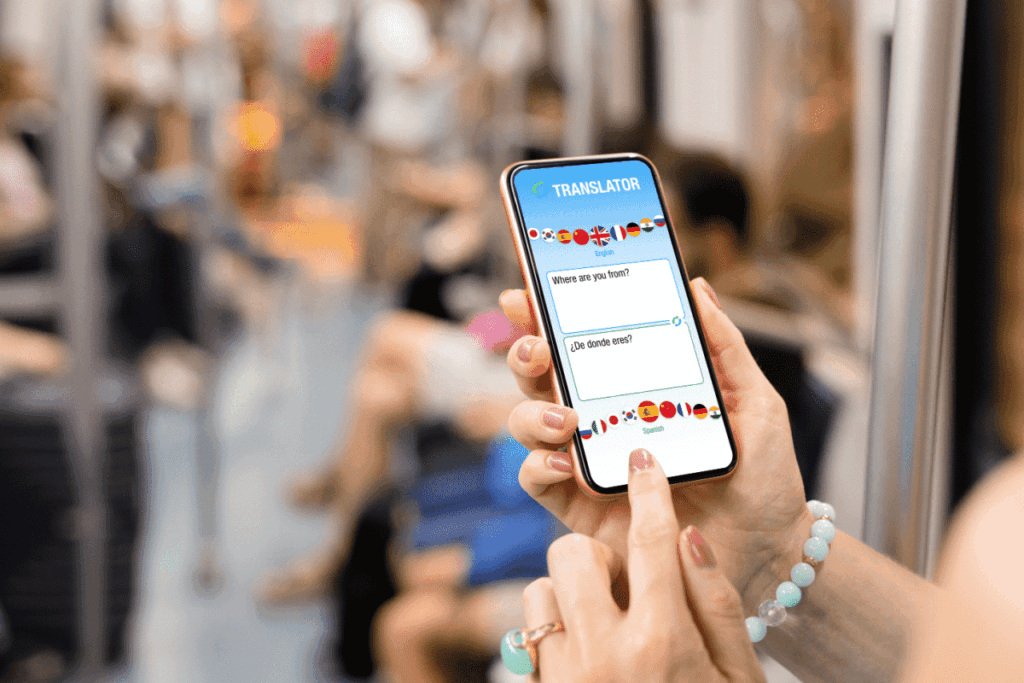
Google Translate and Microsoft Translator are popular apps you can download to your phone. They translate words, phrases, and entire documents on the go.
#3. Real-Time Conversation Translation Apps
Some translation apps, coupled with earpiece devices, can translate conversations on the spot. They “hear” the other language, translate it for you, and tell you how to respond. You can have basic Spanish conversations instantly.
#4. Social Media Translation
Someone just posted a comment on Facebook, Instagram, or TikTok … but it’s in Spanish. Click “See Translation” and — ¡Mira! — it’s in English. These translations get better over time through user feedback.
#5. AI Tools
AI tools like ChatGPT and Copilot can help you practice your Spanish, but they shouldn’t be your only source for Spanish language learning. As the apps point out, the technology is experimental and can make mistakes.
#6. Online Videos
There are plenty of DIY YouTube videos that provide quick help with pronouncing Spanish words. But as a primary language teaching tool? Not recommended.
What Apps Can’t Teach You About Spanish
Convenience? Speed? Learning and translation apps and devices are useful tools that offer some advantages. But are they enough to help you reach your professional or personal goals?
Think about your career plans. Do you want international opportunities? (Spanish is the primary language in 21 countries and territories across four continents.) If so, you’ll need a strong vocabulary and credentials to match.
Many Spanish-language apps don’t provide important cultural and historical context or teach dialect and regional differences. These skills matter in professional settings, when you’ll need to do more than chat with a Spanish-speaking waiter or hotel receptionist.
The casual, informal Spanish you might pick up from apps and social media—think internet slang and code-switching—won’t prepare you for formal business settings or professional translation work. Do you want to:
Teach?
Work in diplomacy, publishing, travel, or hospitality?
Take on translation or interpretation roles?
If so, you’ll need formal, expert-driven, in-depth language education for these careers.
When Apps Aren’t Enough: Building a Career With Spanish
Language apps are great for basics. But if you’re learning Spanish to change the course of your career, you’ll need more.
If you want to work internationally, teach, translate, or use Spanish professionally, you need deep cultural knowledge. You need to understand regional dialects. You need credentials employers recognize.
The simplest, most effective way to gain all of these? Joining a Spanish program from an accredited university.
Why Choose UT Permian Basin’s Online Spanish Programs?
When you earn your online Spanish credential with The University of Texas Permian Basin, you’ll get the flexibility of learning online with the rigor of a university education. Our doctoral-level faculty teach the cultural context, historical background, and regional variations that apps skip. You’ll graduate with real credentials—not just a completion badge.
Whether you’re starting your education or advancing your career, we have a program that fits:
About 41 million people speak Spanish in the United States. Worldwide, that number jumps to 595 million. It’s the official language of 21 countries and territories across four continents. How Can a Spanish Major Help Your Career? Spanish language skills are certainly handy for social situations and travel. But more importantly, Spanish fluency and cultural…
Did you know that Spanish is the second-most spoken language in the world? It comes in as a close second only to Mandarin Chinese. In the United States alone, about 42 million people speak Spanish as their first language, and it’s one of very few languages that can help you communicate across multiple continents. It…
If you have a passion for learning languages and are fascinated by other cultures, have you considered turning those interests into a career? As a Spanish major at UTPB, you’ll not only dramatically improve your Spanish-speaking abilities but also sharpen other must-have language skills that are highly sought-after in today’s job market. Join us as…