While all students have distinct learning styles, those with autism spectrum disorders have a demonstrable need for additional support in the classroom. ASD students require greater understanding and patience from teachers, as well as specific tools, techniques, and autism-friendly environments to help them learn and thrive. Let’s briefly review some of the evidence-based interventions that educators, often in cooperation with parents, are implementing today.
Antecedent-Based Interventions (ABI)
Proactive strategies that modify an environment before a target behavior occurs and can include a wide variety of treatments.
Example: Develop a series of pictures depicting each step of a common task such as brushing teeth, post them where they’re easy for the ASD individual to see, and regularly check their progress in following the visual schedule.
Ayres Sensory Integration (ASI)
Drawn from occupational therapy, these strategies seek to identify and rectify sensory issues that may prevent participation in daily activities.
Example: Use a swing such as a hammock to stimulate the vestibular system—responsible for balance, coordination, and spatial orientation—in an ASD individual with sensory processing difficulties.
Extinction (EXT)
Interventions that disconnect a behavior from a consequence that may be reinforcing it.
Example: Ignore disruptive attention-seeking behavior by refraining from responding to it while reinforcing positive alternatives, such as raising one’s hand.
Modeling (MD)
Performing a target behavior that encourages the learner to use that behavior, resulting in the adoption of the target behavior.
Example: Have a peer of an ASD individual demonstrate a particular social skill, such as introducing themself to others, and have the individual observe and practice that skill.
Music-Mediated Interventions (MMI)
This intervention utilizes songs, melodic intonation, rhythm, or a combination of these to aid in the comprehension and/or accomplishment of desired skills and behaviors.
Example: Give an ASD individual an instrument and have them take turns with others in playing it to reinforce cooperation skills.
Prompting (PP)
Prompting strategies include verbal, visual, and gestural prompts that help a person with an ASD carry out a task or follow rules or instructions.
Example: Use verbal and gestural prompts to guide an ASD person through the steps of an everyday action such as tying shoes, and gradually reduce the prompts through subsequent instances of the activity.
Reinforcement (R)
Reinforcement involves presenting a stimulus contingent on a response, which increases the likelihood of that response occurring again.
Example: Select a positive behavior that must be reinforced (such as waiting one’s turn), make the ASD person aware of rewards for that behavior, and reinforce with a reward when they exhibit the target behavior.
Social Narratives (SN)
These strategies describe social scenarios to emphasize key aspects of a target behavior or skill and provide examples of appropriate responses.
Example: Write a detailed first-person story that describes an experience from an ASD individual’s perspective, such as going to the dentist, including each step of the process, to prepare the individual for what to expect and how to behave.
Degrees for Aspiring ASD-Focused Educators
Hone your teaching craft to better serve ASD students in one of The University of Texas Permian Basin’s CAEP-accredited, online special education graduate programs. Each online program equips you to empower students with developmental and learning disabilities and enable them to live more fulfilling and independent lives.
A practicum component of select UTPB special education programs enables you to get hands-on professional experience, while the online format affords you the flexibility to complete a master’s degree while simultaneously keeping your professional and personal commitments. Access your chosen program anytime, 24/7, from any location to complete assignments, quizzes, and exams.
Online Master of Arts in Special Education, Autism Spectrum Disorders Track
UT Permian Basin’s 30-credit MA in special education is ideal for those passionate about supporting students on the autism spectrum. It offers a specialized track devoted to autism spectrum disorders, covering the physical and cognitive development of individuals on the spectrum throughout their lives. The curriculum highlights the importance of technology, innovation, and inclusion in contemporary special education, in addition to evidence-based interventions for ASD students.
- Apply with no GRE requirement.
- Build valuable professional experience through a practicum course.
- Finish our program in as little as one year.
- Receive a TEACH Grant of up to $4,000 to apply toward this program, pending eligibility.
See career options, projected job growth, and median salaries associated with this degree.
Online Master of Arts in Special Education
Our 30-credit special education master’s degree emphasizes technology and innovation in inclusive classrooms, equipping educators with essential tools to address challenges like working with limited resources, fostering diversity, creating inclusive environments, and identifying individual student needs.
- Apply with no GRE requirement.
- Finish our program in as little as one year.
- Receive a TEACH Grant of up to $4,000 to apply toward this program, pending eligibility.
See career options, projected job growth, and median salaries associated with this degree.
Online Master of Arts in Special Education, Educational Diagnostician Track
Our 36-credit MA in special education with an educational diagnostician track is designed for those seeking expertise in identifying and assessing unique student learning needs. This track provides thorough instruction in standardized and curriculum-based assessment methods to effectively address learning or developmental barriers in students.
- Apply with no GRE requirement.
- Build valuable professional experience through a practicum course.
- Finish our program in as little as two years.
- Receive a TEACH Grant of up to $4,000 to apply toward this program, pending eligibility.
- Secure eligibility for Texas Educational Diagnostician Certification.
See career options, projected job growth, and median salaries associated with this degree.
Get started on your special education master’s degree! Apply today.
Sources:
https://tipsheets.vkcsites.org/evidence-based-practices-for-autistic-students-for-educators/
https://www.autismsociety-nc.org/treatment/
https://docs.autismspeaks.org/evidence-based-practices/
https://www.txautism.net/interventions/modeling
https://www.ice-asi.org/home/about-ayres-si/
https://www.autismspeaks.org/blog/how-general-education-teachers-can-support-students-asd
https://www.ncbi.nlm.nih.gov/pmc/articles/PMC5152684/
https://www.autismspeaks.org/blog/support-child-autism-classroom
Efficient use of the planet’s resources is a way that individuals and industry can contribute to a sustainable future. By focusing our efforts on energy efficiency, we can reduce pollution, preserve our finite natural resources, and save money. Myriad technologies and practices are fueling more responsible energy use for businesses and consumers alike. Let’s review some of these modern energy-saving innovations and introduce career-enhancing programs that can help students hone their energy business expertise.
Modern Advancements in Energy Efficiency
Smart Thermostats
Many modern thermostat systems can be programmed to deliver warmer or cooler air during peak usage times. Units equipped with an “eco” mode automatically adjust the thermostat during hours when homes or businesses are unoccupied, and smart thermostat apps allow control from anywhere in the world.
LED Lighting
From streetlights to household lamps, LED lighting is becoming the norm. Though not without controversy, LED lightbulbs are far more energy efficient than incandescent bulbs and have been in wide use since before the U.S. banned the latter. Light from LED streetlamps often has a telltale bluish or purplish hue.
Motors
Cutting-edge electric motors consume less energy yet deliver the same output in industrial settings thanks to technologies like permanent magnets and variable frequency drives.
Energy-Efficient Windows
Windows featuring a low-emissivity coating do a better job of maintaining the indoor temperature—regardless of the outside temperature—than older models.
Insulation
Traditionally made of fiberglass or other materials, insulation today is available in a more thermal resistant aerogel that is sprayed onto the inside of the structure’s outer surface. Some buildings have smart insulation that uses sensors to automatically adjust efficiency with fluctuations in the weather.
Climate Control
Some HVAC systems have a variable refrigerant flow function that provides different levels of refrigerant to discrete areas of a building, allowing energy savings where less cooling or heating is needed.
Solar Panels
Solar photovoltaic (PV) panels efficiently convert sunlight to electricity, reducing the need for electricity from outside sources, though homes and businesses that generate 100% of their own electricity from solar power are still few.
Energy Star Appliances
Appliances that adhere to the stringent energy efficiency requirements of the Environmental Protection Agency are common today and prominently feature the Energy Star sticker.
Smart Grids
Meters used in smart grids offer instantaneous data on energy use, enabling better management of energy resources.
Energy Storage
Long-lasting, high-capacity lithium-ion batteries store renewable energy during low generation periods, balancing supply and demand.
Electric Vehicles (EVs)
Electric-powered cars convert a higher proportion of energy to propulsion in comparison to vehicles running on traditional fuel sources.
Stoves
Induction cooking surfaces use electromagnetic fields to heat cookware directly, providing higher energy efficiency than gas or electric stoves.
Conventional Energy-Saving Methods
Modern innovations aside, these are timeless energy-saving practices that benefit us all:
- Turning off lights and appliances when not in use
- Closing doors to maintain the indoor temperature
- Opening drapes or curtains to use natural light instead of electric light sources
- Closing curtains during the day to cool off the inside of the home or business
- Opening windows to allow cool air in
- Using ceiling fans instead of an HVAC system to cool off
Invest Your Energy Into Respected Credentials
Located in the heart of America’s energy industry, The University of Texas Permian Basin leverages local expertise and partnerships to offer top-tier energy programs online. Our AACSB-accredited online graduate degrees and certificates are designed to help you master the latest skills and techniques, distinguishing you from other job candidates and preparing you for leadership roles.
Online Master of Business Administration with Certificate in Energy Business
- Build a broad, strong foundation in the major business disciplines.
- Become an “MBA.”
- Earn an energy business certificate simultaneously, without adding extra time to your degree.
- Finish in as little as four semesters.
- Elevate your earning potential by 16%.
See careers and salaries associated with this degree.
Online Master of Science in Energy Business
- Study energy business with a special emphasis on financial principles.
- Experience an online program like few others available in the U.S.
- Finish in as little as four semesters.
- Elevate your earning potential by 16%.
See careers and salaries associated with this degree.
Online Graduate Certificate in Energy Business
- Gain highly applicable energy business expertise quickly.
- Get a preview of our master’s-level energy curriculum before applying to a degree program.
- Finish in as little as two semesters.
See careers and salaries associated with this certificate.
Make Learning More Efficient
When you earn a UTPB credential online, there’s no commute, no tolls, no parking fees, and no gas needed: a significant savings of energy and money. Our online graduate programs enable you to better manage your time and arrange coursework on your own schedule, around your personal and professional commitments. View lectures and complete assignments on your lunch hour or at night, after the house gets quiet. Our online programs put the power in your hands.
Apply to the UTPB online energy business program of your choice!
Sources:
https://www.usaid.gov/energy/efficiency/basics/technologies
https://www.energystar.gov/about/how-energy-star-protects-environment/energy-efficiency
https://www.weforum.org/agenda/2023/01/energy-efficiency-projects-innovations/
https://www.energy.gov/eere/iedo/energy-efficiency-technologies
https://www.architecturaldigest.com/story/incandescent-light-bulb-ban-what-you-need-to-know
https://www.utilitydive.com/news/doe-finalizes-new-light-bulb-efficiency-standard/713149/
As a nurse, HIPAA isn’t just background noise or a form you ask patients to sign. It’s the law that governs how you communicate, where you store patient info, what you can share—and with whom. It’s not just about doing the right thing. It’s about keeping your license, protecting your patients, and staying employed.
In this guide, we break down what nurses absolutely need to know about HIPAA — in plain English. Whether you’re new to nursing or need a refresher, this guide is for you.
HIPAA for Nurses: What It Is and Why It Matters
What is HIPAA? An acronym for the Health Insurance Portability and Accountability Act of 1996, HIPAA is designed to protect sensitive patient health information. For nurses, this means understanding what information is protected, how to keep it secure, and what not to do.
Imagine this: You accidentally mention a patient’s condition in the hallway or snap a photo in the break room where patient charts are visible. These simple acts can violate HIPAA and result in serious consequences for you and your employer.
6 Critical Things Nurses Need to Know About HIPAA
The HIPAA Privacy Rule also gives an individual the right to access their own health records, including test results, labs, etc., from their physicians. In addition, it allows a personal representative authorized by the individual to access their health records.
With this background in mind, let’s examine some of the important aspects of HIPAA that nurses need to know.
#1 What Counts as Protected Health Information?
Nurses should have a thorough understanding of what is deemed Protected Health Information (PHI) under HIPAA. According to The HIPAA Journal, insufficient knowledge about what constitutes PHI is a major driver of HIPAA-related complaints to the Department of Health & Human Services’ Office of Civil Rights.
Healthcare providers may share PHI about a patient with each other, provided all parties have an established relationship with the patient and the discloser reveals only the minimum amount of information needed by the recipient. This can be done without the patient’s consent.
#2 HIPAA Security Measures Nurses Must Follow
Covered entities—medical facilities, nursing homes, and pharmacies—are required to put security measures in place to protect private information. These include:
- Policies for access control
- Locked filing cabinets and rooms
- Passwords and other security credentials for digital systems
As a nurse, you’re responsible for following these policies to protect your patients and yourself.
#3 Common HIPAA Violations
Nurses Might Not RealizeMany healthcare professionals may violate HIPAA without even realizing it. Examples of infractions include:
- Taking selfies or other photos in the workplace.
- Discussing a patient’s condition with coworkers who are not treating the same patient.
- Discussing a patient’s condition in front of visitors.
- Talking about a patient with their own significant other.
Bottom line? If someone doesn’t have a clinical need to know, refrain from sharing.
#4 State Laws May Be Stricter than Federal HIPAA Guidelines
State and local laws protecting patient privacy may be more stringent than HIPAA requirements. In these cases, nurses must follow the stricter requirements.
#5 Repercussions of Violating HIPAA
When nurses violates HIPAA, the consequences may include:
- Receiving a warning or remedial HIPAA training
- Losing their job and/or nursing license
- Fines or legal penalties for the employer
- In more severe cases, criminal penalties
#6 Why HIPAA Training Is an Ongoing Process
HIPAA rules have been updated multiple times since 1996, most recently in 2024. To stay compliant, updated training on an annual basis is generally recommended. Employers will arrange this training for their nursing staff and other employees subject to HIPAA.
Prepare for a Leadership Role With Expanded Expertise and Credentials
In addition to being fully versed in HIPAA, you’ll need to know much more if you aspire to make the transition from RN to nursing leader. The University of Texas Permian Basin’s CCNE-accredited online RN to BSN program was designed for busy nurses like you who want to provide a higher quality of care and have the opportunity to compete for advanced roles in the profession.
Our world-class, flexible program enables you to:
- Learn from master’s- or doctorally prepared nurses, many of whom have been working in the field for decades.
- Complete your degree online from any location that suits you, on your own schedule, around your shift hours and personal commitments.
- Meet your clinical requirements at a local facility with a qualified preceptor of your choice.
- Earn an optional Nurse Manager Certificate from Sigma Theta Tau International Honor Society of Nursing at the completion of your degree.
Give your nursing career the boost it needs. Find out more and apply to our online RN to BSN program today!
Sources:
https://www.hipaajournal.com/hipaa-compliance-for-nurses
https://www.healthit.gov/topic/hipaa-versus-state-laws
https://www.ama-assn.org/practice-management/hipaa/hipaa-violations-enforcement
https://www.hipaajournal.com/what-happens-nurse-violates-hipaa
Other articles you may be interested in:
-
Picture this: You’re in a hospital room, and a nurse walks in—flustered, but still smiling—with a chart in hand. This expert provider is checking your vitals, catching early warning signs, coordinating with doctors, reassuring your anxious family outside, and solving small healthcare crises in the hallway … all before lunch. Today, nurses are no longer…
-
Of the growing number of fields actively using artificial intelligence (AI) technology—including finance, manufacturing, marketing, and customer service—the field that arguably makes the most significant impact in our lives is healthcare. AI is supporting all healthcare sectors, simultaneously making nurses more efficient, elevating their level of care, and improving patient outcomes. Here we’ll examine some…
-
Every year, over 150,000 registered nurses (RNs) graduate from nursing school, ready and eager to make a difference in the lives of patients. They’ve spent up to four years preparing for this moment, poring over textbooks, completing clinicals, and mastering skills. But when it comes time to face the challenges on the hospital floor or…
Cooking the books. Creative accounting. Embezzlement. These are phrases commonly used to describe accounting fraud. But what exactly does that phrase mean?
Accounting fraud is the deliberate misrepresentation of financial statements to conceal corporate transactions or fabricate a misleading picture of financial stability. A study shared by Thomson Reuters showed that each year, about 41% of companies commit accounting violations, while about 10% of major public companies commit the more serious offense of securities fraud. That amounts to a lot of lost money—more than $1 million for one quarter of companies in 2023 alone.
What’s Being Done About Accounting Fraud?
Accountants have many tools and tactics at their disposal for detecting and preventing fraud, though like company executives, employees, customers, competitors, and hackers, accountants themselves can also be fraudsters. Here are some of the practices that prudent, ethical companies and individuals are implementing to thwart accounting fraud:
Analyzing Data
Accounting systems are analyzing large volumes of data more efficiently than ever before. Data analytics tools can detect patterns and anomalies that might indicate fraudulent activities, such as duplicate payments, unusual vendor relationships, or suspicious transactions.
Assessing Fraud Risk
Accountants are conducting fraud risk assessments to identify areas of vulnerability within an organization, enabling them to establish preventive measures to mitigate the likelihood of fraud occurring.
Auditing
Ongoing internal and external audits are fundamental in fraud detection. Auditors are examining financial records, transactions, and internal controls to identify any irregularities or signs of fraudulent behavior.
Documenting and Keeping Records
Accounting systems are ensuring that all transactions are recorded accurately and transparently, making it easier to identify discrepancies or unauthorized activities that could suggest fraud.
Monitoring Transactions
Transactions are being scrutinized regularly throughout accounting processes to pinpoint discrepancies, anomalies, or irregular patterns that may indicate potentially fraudulent activities.
Supporting Whistleblowers
Accounting departments are implementing whistleblower programs that empower employees to report suspected fraudulent activities confidentially.
Using Controls
Accounting systems are incorporating internal controls that prevent and detect fraudulent activities through segregation of duties and authorization procedures that ensure no individual has full control over financial transactions.
Training and Educating
Accounting professionals are being regularly trained in the latest fraud detection techniques and can educate their fellow employees about the signs of fraud.
Credentials That Add Up to Tremendous Career Potential
No matter what aspects of accounting interest you, The University of Texas Permian Basin offers an online, AACSB-accredited accounting degree to match. Our programs equip you with the expertise needed for a variety of related career opportunities. Choose a program based on your education level and professional ambitions:
Online Bachelor of Business Administration in Accounting
A bachelor’s degree is typically a prerequisite for entering the field of accounting professionally. UTPB’s BBA in accounting—available online exclusively at this UT System institution—aims to provide you with the necessary skills and knowledge to pursue accounting and related positions in governmental, public, private, and non-profit organizations.
Suggested course for more information on accounting fraud: ACCT 4320 – Forensic Accounting/Fraud Examination
See where graduates of this UTPB program are working.
Online Master of Business Administration With Accounting Track
Broaden your business understanding while enhancing your proficiency in both traditional and contemporary accounting concepts, strategic analysis, and decision-making skills through our online MBA program with accounting track. Benefits of our 33- to 42-credit program include:
- An optional CPA track for those wishing to pursue CPA certification.
- A non-CPA track for those who desire broader accounting studies.
- A completion time of as little as four semesters.
Suggested course for more information on accounting fraud: ACCT 6320 – Fraud Examination and Forensic Accounting
See where graduates of this UTPB program are working.
Online Master of Professional Accountancy
Refine your expertise in historical and contemporary accounting methodologies and enhance your decision-making and strategic thinking abilities with an eye toward becoming a CPA in our online Master of Professional Accountancy program. This 36-credit online program:
Suggested course for more information on accounting fraud: ACCT 6320 – Fraud Examination and Forensic Accounting
See where graduates of this UTPB program are working.
Ready to get started? Apply now!
Sources:
https://www.investopedia.com/ask/answers/032715/what-accounting-fraud.asp
“Knowledge itself is power.” –Francis Bacon, British philosopher and author
Reading and writing are foundational skills with which everyone, regardless of their socioeconomic background or future ambitions, must be equipped. Here we’ll look at how literacy is linked to an individual’s socioeconomic status and potential, as well as statistics that support these connections.
These Literacy Statistics Are Startling
A concerning 21% of U.S. adults are unable to read and write. With a population of 258.3 million adults, that leaves greater than 54 million illiterate U.S. adults. Statistics from the Urban Institute’s National Assessment of Educational Progress (NAEP) reveal that a staggering two thirds of U.S. schoolchildren lack reading proficiency. Overall, the U.S. ranks 36th worldwide in literacy. These startling numbers equate to less opportunity for many Americans to get ahead.
Obviously, much more work is needed on the literacy front.
Illiteracy as a Barrier to Socioeconomic Advancement
Literacy is crucial to securing college admission and any job resulting from earning a higher education degree.
College Admissions
High school students must have good grades to graduate and apply to college, and to pass tests such as the SAT and ACT where required. Performance in any pre-admission interviews, as well as the quality of the application itself, may also indicate one’s literacy level. Illiteracy creates a barrier not only to admission but to success in higher education because college students must be able to read and write at a more advanced levels than were ever previously required of them.
College is the bridge to better socioeconomic status for many Americans. According to data published by the Association of Public & Land-Grant Universities, college graduates are 24% more likely to secure employment than those who only finish high school.
Career Potential
Literate individuals can pursue a broader range of career paths, including many well-paid and highly skilled positions. Those lacking literacy skills face limited options, often encountering challenges in securing even entry-level jobs with basic skill requirements, including positions that may or may not require a college education.
Despite the need for literacy skills in the professional setting, an estimated 36 million U.S. adults are unable to read and write well enough to qualify for jobs that will enable them to support a family. Individuals in this situation are often unable to improve their socioeconomic status.
The Proven Earning Potential of Education
U.S. government data confirms a clear correlation between education and employment, professional advancement, and earning potential: the higher the academic credential an individual acquires, the greater the employment and earning potential they are likely to experience. Education—the core of which is literacy—has a direct impact on socioeconomic potential, if not status.
Master’s degree holders, for example, earn ~16% higher median wages than bachelor’s degree holders and ~93% more than those with a high school diploma alone. High school graduates earn ~27% more than those who never finish high school. Education also enables individuals to manage their finances effectively, invest in their future, and escape the cycle of poverty.
Help foster greater literacy among Americans of all ages! Start by equipping educators with the expertise to empower their students with the reading and writing skills necessary to flourish in all aspects of their lives. You can do so as a certified reading specialist or in many related education roles.
Elevate Educators and Your Own Professional Potential
At 30 credits, The University of Texas Permian Basin’s CAEP-accredited online Master of Arts in Literacy translates to a career-defining, life-changing credential you can earn in under two years. As a student in our program, you’ll:
- Receive up to $4,000 a year toward your UTPB MA in literacy with a TEACH grant, if eligible.
- Complete studies at your own pace from practically any location in the world while meeting your professional and personal responsibilities.
- Learn from faculty widely acknowledged for their extensive experience in and enthusiasm for literacy education.
- Graduate better prepared for the Texas Education Agency (TEA)’s reading specialist certification. (Consult your state’s certification agency or email Dr. Tara Wilson for requirements outside Texas.)
See more details about our MA in literacy program and apply today!
Paperless paychecks have been around since the 1970s, allowing employers to electronically transfer wages into employees’ accounts on payday. Direct deposit, or ACH (Automated Clearing House), saves the time and effort of rushing to a brick-and-mortar bank location and waiting in line to deposit a check before the bank closes. It’s an early example of fintech we take for granted today.
Many more advances have emerged in recent decades, providing us with unprecedented financial autonomy and transforming the finance industry. Though we still need to keep our money somewhere secure, these innovations enable us to perform a wide range of financial transactions from a cell phone—and some sidestep traditional financial institutions altogether.
Fintech, short for “financial technology,” encompasses innovative technologies that enhance and automate the provision and use of financial services. It assists companies, business owners, and consumers in optimizing their financial operations and processes through software and algorithms deployed on mobile devices and computers. Let’s look at a few fintech examples now.
Online Banking
Financial institutions enable customers to access their account 24/7 from the convenience of a secure website or app. These accounts are the same ones that they can access via an ATM or a local bank branch. In fact, customers can perform most banking transactions online, from deposits to transfers, making most bank visits redundant.
Digital Wallets
A digital wallet is a financial transaction app compatible with any connected device. It securely stores payment details and passwords in the cloud. While accessible from a computer, mobile wallets, a subset of digital wallets, are predominantly utilized on mobile devices. In addition to credit cards, digital wallets can store concert or travel tickets, car keys, ID cards, and coupons.
Cryptocurrency
A relatively recent addition to the world of finance, cryptocurrency gets a lot of attention, but not always for the right reasons. Criticisms of this virtual currency include slow transactions, inadequate regulation, a lack of inherent value, and potential use in criminal activities. Though controversial, cryptocurrency may be with us to stay.
Peer-to-Peer Lending
Also known as P2P lending, these platforms facilitate direct connections between borrowers and lenders, establishing their own rates and terms for transactions and allowing individuals to obtain loans directly from other individuals. P2P eliminates the need for a financial institution as an intermediary.
Robo-Advisors
A robo-advisor is a digital platform that delivers automated, algorithm-based financial planning and investment services, often with minimal human oversight. In a common scenario, a robo-advisor will collect information about your financial status and future objectives through an online questionnaire, enabling it to provide recommendations and execute investments autonomously on your behalf.
Rungs in the Ladder to a Finance Career
The University of Texas Permian Basin’s AACSB-accredited online finance programs equip you with financial management skills that can result in rewarding occupations, including leadership roles. All three highly marketable degrees are led by esteemed PhD-level faculty members boasting extensive experience within the finance industry. Explore the fintech, terminology, and trends you’ll need to know with us, online.
Online Bachelor of Business Administration in Finance
Develop essential financial management abilities applicable across diverse career paths with a BBA in finance—available online exclusively at this UT System institution. Many students use this program as a foundation for valuable Chartered Financial Analyst (CFA) and Certified Financial Planner (CFP) professional credentials.
See where graduates of this UTPB program are working now, potential future jobs, and corresponding salaries.
Online Master of Business Administration in Finance
Once you’ve completed a bachelor’s degree, continue your studies with an MBA—highly prized in the business world for its prestige. Build broad business acumen with a special emphasis on finance by completing 33-42 credits. Graduate in as little as four semesters.
See where graduates of this UTPB program are working now, potential future jobs, and corresponding salaries.
Online Master of Science in Finance
If you seek a graduate degree sharply focused on finance, consider this 30-credit program—one of select few university programs of its type in Texas to boast STEM certification. Graduate in as little as four semesters.
See potential future jobs and corresponding salaries for this degree.
Stick to Your Own Schedule
Delivered in an asynchronous online format, our finance degree programs provide you with the flexibility to pursue your studies at your own pace, irrespective of your location. There’s no need to visit campus. Whether you’re balancing work, personal commitments, or both, our programs empower you to fulfill those responsibilities while earning a highly regarded, career-advancing degree.
Join the field of finance prepared to take on its changes and challenges. Apply to one of our online finance degree programs today!
Sources:
https://www.mckinsey.com/featured-insights/mckinsey-explainers/what-is-fintech
https://www.investopedia.com/terms/f/fintech.asp
https://www.investopedia.com/terms/r/roboadvisor-roboadviser.asp
https://www.investopedia.com/terms/d/digital-wallet.asp
https://www.investopedia.com/terms/p/peer-to-peer-lending.asp
https://www.investopedia.com/terms/c/cryptocurrency.asp
When we consider a healthcare professional’s role in the patient experience, we might be inclined to picture a patient-facing individual such as a nurse or a patient care technician. These professionals have an incalculably beneficial effect on patients’ health and well-being. But apart from having the proper skills and disposition required to do their jobs effectively, they need strong, compassionate leadership to guide them and set them up for success.
Here we’ll discuss the vital role healthcare managers and leaders play in ensuring their facility’s patients receive the best of care.
Rethinking the Patient’s Role
The phrase “patient-centered care” comes up often today because of a significant mindset shift in healthcare. While physicians and other healthcare professionals may be exceptionally skilled and experienced, patient-centered care dispenses with the view that these professionals alone know what’s best for a patient in favor of a more inclusive, personalized approach.
Patient-centered care puts an emphasis on treating the patient as an individual and learning their specific healthcare needs. It seeks to engage patients and their families by providing them with the information to understand a health condition and make their own decisions regarding the course of care. This requires healthcare professionals to be excellent communicators and advocates for their patients.
The Driver of Patient-Centered Care
Healthcare manager is not a specific role but rather a general title for a variety of different professions including clinical manager, nursing home administrator, and health information manager. While managing the day-to-day operations of their department or facility is front and center for these professionals, better healthcare outcomes and a first-rate patient experience are always at the core of their mission.
Healthcare managers drive the personalized, patient-centered care that can result in a positive patient experience by:
- Establishing a mission and ensuring all employees understand and adhere to it.
- Setting the tone for care within their facility.
- Hiring skilled professionals to support their efforts.
- Ensuring patients have everything they need.
- Equipping employees with the resources to do their jobs well, from medical equipment and supplies to adequate mental health breaks.
The Rewards of Leadership
As a healthcare manager or leader, you’ll have the potential to improve the lives of countless patients and employees throughout your career—a challenging but ultimately rewarding endeavor. While positive patient outcomes may be their own reward, healthcare management roles can also lead to more job opportunities and higher compensation. Data shows median earnings in the six figures and an astonishing growth rate of 28%—much faster than the average for all occupations—for related careers in the coming years. The University of Texas Permian Basin can put you on a path to these leadership roles in healthcare.
Redefine the Patient Experience as a Healthcare Leader
UT Permian Basin’s online degrees in healthcare management and leadership lay the groundwork for fulfilling careers at the helm of a patient-centered organization.
Online Bachelor of Business Administration in Healthcare Management
Explore the application of core business principles from the AACSB-accredited BBA program within a healthcare context, including topics such as financial management in healthcare organizations, patient service strategies, and understanding legal and regulatory frameworks. See where graduates of this UTPB program are working!
Online Bachelor of Applied Arts and Sciences in Healthcare Leadership
Enhance your expertise in meeting the requirements of employees and patients while also refining your skills in financial management and quantitative decision-making. This program is designated for students who hold an AAS degree in nursing, emergency medical services, radiology, or other healthcare-related disciplines.
One Choice for Convenience and Quality
Choose either healthcare-focused online UTPB bachelor’s degree to experience the benefits of our asynchronous, 100% online format. Enjoy the flexibility of finishing your coursework according to your own timetable, regardless of your location, all while maintaining your professional and personal obligations. You’ll still receive guidance from our esteemed faculty, as both programs are overseen by the same distinguished educators who teach at our Odessa, Texas, campus.
Apply to your preferred program today!
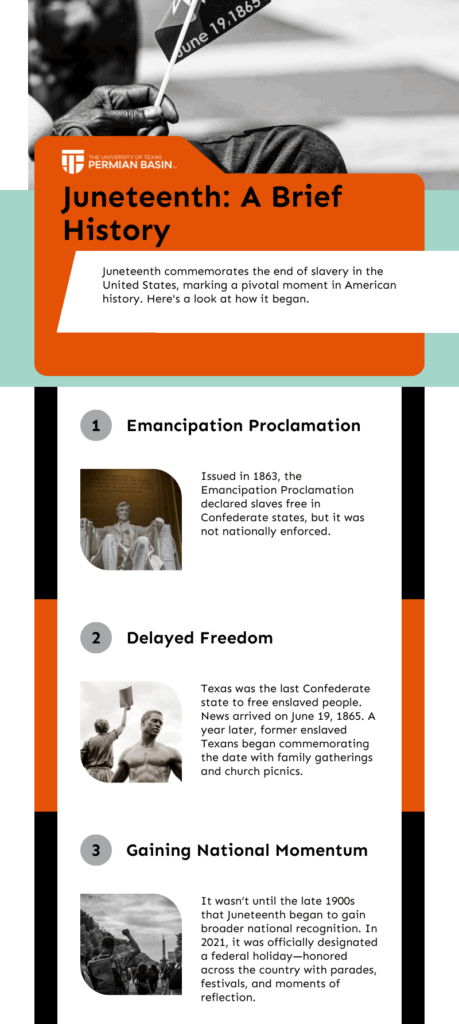
Most Americans celebrate July 4th as the day the U.S. won its independence from Britain. But millions also recognize a second Independence Day, Juneteenth, which marks the day in 1865 when the last enslaved Americans in Texas finally learned they were free.
In this article, we explore the powerful history behind Juneteenth and how it has become a national symbol of delayed justice and the lasting freedom for all.
What Is Juneteenth and Why Is It Important?
On January 1, 1863, President Abraham Lincoln freed many American slaves when he issued the Emancipation Proclamation. However, it would be nearly three years before all slaves were freed nationwide.
The Civil War raged until April 1865, delaying the full impact of emancipation, as many slaveholding states resisted Lincoln’s directive. In addition, Lincoln’s proclamation didn’t apply to certain border states and regions under Union control, a gap later closed by the 13th Amendment—Abolition of Slavery—in December 1865.
Six months before that amendment was ratified, Union troops arrived in Galveston, Texas, and freed a quarter of a million slaves on June 19th, 1865. That day became a milestone as the broader promise of emancipation was finally realized. One year later on June 19th, 1866, former enslaved Texans began commemorating the date. The celebration became known as Juneteenth: a blend of “June” and “nineteenth.”
Also called Juneteenth Independence Day or Freedom Day, the holiday has a rich history. Initially marked by church picnics and speeches, Juneteenth gained momentum as Black Texans relocated to other states and took the tradition with them, spreading its observance nationwide and even internationally. Today, typical festivities include Emancipation Proclamation readings, parades, and concerts.
How Juneteenth Became a National Holiday
Juneteenth is an enduring reminder of the struggle for equality that Black Americans and their ancestors have faced, though awareness and acknowledgement of its significance were slow to come for the nation as a whole.
It’s perhaps fitting that in 1980, Texas became the first state to make Juneteenth an official holiday. Other states followed suit beginning in the 1990s, and by 2023 it was an official holiday or observance in all 50 states and the District of Columbia. Juneteenth became a federal holiday in 2021.
Study the Past to Impact Your Future: Earn Your MA in History
If you’re interested in the history of North America and its role in international events, The University of Texas Permian Basin’s online Master of Arts in History will help you master durable, highly marketable skills, and deliver a credential applicable to many careers. Our program offers an exploration of the Civil War, Reconstruction, and other key areas of our history through comprehensive 16-week courses. See the complete list here.
We offer this program in a 100% online, asynchronous format that empowers you to earn an MA in history on your own schedule from any location. You’ll find this flexibility invaluable while managing professional and personal responsibilities and finishing a master’s degree at the same time. And that’s just the beginning of our program’s benefits:
- Thesis and non-thesis options are available.
- Completion is possible in as little as two years.
See where graduates of this UTPB program are working now, potential future jobs, and corresponding salaries.
Ready to get started? Apply today.
Sources:
https://www.archives.gov/exhibits/featured-documents/emancipation-proclamation
https://jackmillercenter.org/emancipation-proclamation-juneteenth-holiday
https://constitutioncenter.org/the-constitution/amendments
https://www.pbs.org/newshour/politics/juneteenth-is-now-a-national-holiday-how-did-it-come-to-pass
https://sgp.fas.org/crs/misc/R44865.pdf
Other articles you may be interested in:
-
Studying classics helps us understand where many of our biggest modern questions came from, including who gets power, how societies define justice, and why humans keep telling the same stories in new outfits. A single, harmless question comes up a lot in humanities courses (usually from someone trying very hard not to care): Why does any of this matter? And…
-
Monsters have been with us since the beginning of storytelling. Before novels, there were myths. Before myths, there were campfire stories about things lurking just outside the firelight. Something about the human brain is wired to conjure creatures (and compelled to write entire books about them). But literary monsters have never just been about scaring people. The…
-
“I took the road less traveled by, And that has made all the difference.” Even if you don’t know the entire poem, you may recognize the closing words from Robert Frost’s “The Road Not Taken.” They’re quoted at graduations, shared during moments of change, and used to describe the quiet courage of choosing your own path. So why have these simple words endured across generations? The power of…
The English language has been the foundation of countless works of art and literature throughout the ages and across the world. Often a work of literature will inspire the creation of a work in another art form, be it sculpture, painting, theater, music, film, architecture, dance, or photography—just one of the fascinating ways art and literature intersect. Let’s look at a few specific examples here and then discuss how you can learn more about both subjects.
Where Art and Literature Meet
The history of art and literature is rich with examples of works influencing one another. Some paintings have inspired books, such as Johannes Vermeer’s “Girl With a Pearl Earring.” Books are also often adapted into films, including one named for Vermeer’s famous painting and, more recently, several 2024 Oscar nominees. Many operas are based around mythology and others, such as “The Merchant of Venice,” on the works of William Shakespeare. Some of the world’s most admired sculptures and paintings are also based on mythology. Works of literature are often adapted to be performed as plays or musicals. Victor Hugo’s 19th century novel “Les Misérables” is an immensely popular example of a work that has successfully been adapted for stage and screen.
Want to explore the intersection of art and literature in greater depth? The University of Texas Permian Basin invites you to consider one of our illuminating online English degree programs.
English Degrees for Where You Are and Where You Want to Be
The University of Texas Permian Basin’s online English degree programs cast a light on art and literature through dedicated courses throughout their curricula. Whether you’re an aspiring undergraduate or you’re ready to pursue graduate studies, we have an online program for you. Use either highly marketable degree below for an array of rewarding career options.
Build a Foundation in Our BA in English Program
Our online Bachelor of Arts in English delves into the intricacies of the English language and culture, encompassing a wide range of creative works from Shakespeare to Spielberg.
- Available online exclusively at this UT System institution.
- Offers median earning potential ~68% higher than a high school diploma.
Take these BA courses for greater insight:
Literature and Art (ENGL3332)
Offered as an option in our BA in English program, this course investigates the intricate connection between literature and visual arts as depicted in Victorian and modern novels. It aims to impart fresh perspectives, encouraging a shift from mere reading to active observation. Through the examination of renowned literary figures, you’ll unravel how they seamlessly intertwine literature and art, revealing that the comprehension and appreciation of one often relies on understanding the other.
Film As Literature (ENGL3330)
This course is an exploration into critical and theoretical frameworks and terminology used to analyze films as both cultural artifacts and literary creations. In addition, the course examines significant film movements from various countries throughout the history of cinema.
Literature and Mythology (ENGL3333)
This course aims to familiarize students with the depth, intrigue, and importance of classical (Greek and Roman) mythology in the context of British, American, or comparative literature. It delves deeply into the interplay of literature with mythological references and the diverse interpretations of mythological entities across artistic media such as painting and sculpture.
See potential careers and salaries related to this BA degree and learn where UTPB program graduates are working.
Reach Higher With an MA in English
Already earned a bachelor’s degree? Our online Master of Arts in English delves deeper into the English language and culture, forging connections between aesthetic, cultural, historical, psychological, and social themes found in literature from both past and present. You’ll relate these literary themes to contemporary cultural, psychological, and sociopolitical landscapes.
- Small class sizes provide the opportunity for personalized attention.
- Complete your degree in as little as a year and a half.
- Gain access to a greater variety of career choices, including leadership roles.
- Your graduate degree offers median earning potential ~16% higher than a bachelor’s degree alone.
Take these MA courses for greater insight:
Literature and the Visual Arts (ENGL6332)
One of the core courses in our online MA in English program and available with either a British or American focus, this course delves into the nonverbal aspects of literature, exploring how works extend beyond verbal expression to evoke art and music. It aims to uncover what verbal discourse may hide or silence by simultaneously communicating these hidden dimensions.
Literature and Mythology (ENGL6330)
This course investigates the influence of myths on the human psyche and their role in shaping cultural and sociopolitical viewpoints. Additionally, it underscores the significance of mythology in understanding literature, art, and music.
See potential careers and salaries related to this MA degree and learn where UTPB program graduates are working.
Convenient, Accessible, Affordable Programs
No matter which program you apply to or where you live, you can count on enjoying the online convenience that allows you to complete your studies on your own schedule. You needn’t compromise on your personal or professional responsibilities to earn a degree!
UTPB also offers some of the lowest tuition rates among accredited universities, translating to an education that’s both affordable and esteemed. These are some of the reasons U.S. News & World Report has named us among:
- Best Regional Universities West
- Top Public Schools
- Best Value Schools
- Top Performers on Social Mobility
Choose your English degree program and apply today!
Steam, electricity, and automated machines have underpinned fundamental shifts in how people live and work, and each has been the driver behind its own industrial revolution. But while their lasting impact has been substantial, none of these revolutions have been “smart.” That changed with Industry 4.0.
As the “Fourth Industrial Revolution,” Industry 4.0 has introduced intelligent, data-driven, adaptive technologies that have retooled factories for unprecedented efficiency and accuracy in manufacturing and transformed many of our everyday activities.
Below we’ll consider some of the most impactful Industry 4.0 innovations and demonstrate how these translate directly to tools that are making our lives easier. In addition, we’ll introduce two online industrial technology programs specifically designed for those wishing to pursue careers fueled by this bleeding-edge technology.
Industry 4.0 Comes Home From the Factory
The cloud, the internet, artificial intelligence (AI), 3-D printing, virtual reality, and advanced analytics. These complex tools and technologies have become household words in recent years. You may not know what they’re doing—or soon will be doing—“under the hood” for you daily, but their reach and impact is significant. Consider this scenario:
You’re 30 miles from home when your phone buzzes with two alerts: one informing you that your window has been broken and another announcing that your doorbell has rung. You also realize you forgot to turn the oven off before you left. You answer the door on your phone to see and converse with your neighbor—who has come to apologize that his child’s baseball went through your window—via your doorbell camera app. You thank him and then, relieved that no one has broken into your home, switch that oven off.
You enjoy peace of mind behind the wheel as you deal with these potential emergencies on your phone because you’re in an autonomously driving car that’s doing most of the work. Once you arrive home, you verbally command your oven to turn back on so you can prepare dinner and then ask Alexa to play your favorite music. A voice confirms your playlist will begin.
As you sit down to relax, your phone reminds you that you have a dentist appointment the next morning to receive a crown on one of your teeth. You’re relieved to know that the process won’t require multiple visits and weeks of waiting, the way it did for your father back in the day, who himself recently had a successful hip replacement via robotic surgery. Your dentist will create a new crown on the spot for you with an advanced 3-D printer.
What You Have to Look Forward To
Your home may already have some smart features, and smart technologies may begin to appear more often in other parts of your life. Like most people, you may not yet have a self-driving vehicle. If you have a late model car, however, there’s a good chance it may already be parking itself or steering you back into your lane when you inadvertently cross onto the shoulder of the road.
You’re experiencing these and countless other innovations in mobile apps and home-based technologies because you’re fortunate enough to live during the Industry 4.0 era! Get ready to witness more amazing strides in your personal and professional life that were not possible before Industry 4.0. (Industry 5.0, with an anticipated focus on ecology, sustainability, and people, is on the horizon and will provide even more career options.) Make sure you’re ready for new opportunities with the required expertise.
Credentials for Your Industry 4.0 Career and Beyond
If your interest in Industry 4.0 technology is connected to your career goals, The University of Texas Permian Basin has two online, AACSB-accredited degree programs that can help you. Let’s look at what they’re about and how they can benefit you professionally:
Online Bachelor of Science in Industrial Technology (BSIT)
Created to be your first college degree program or a second bachelor’s degree, our BSIT equips you with a practical understanding of core principles and skills crucial for managing industrial operations across any enterprise. Through our curriculum, you’ll develop the proficiency to overcome complex engineering, design, and technical complications effectively.
Get more details, including career paths and salaries related to this degree.
Online Bachelor of Applied Arts and Sciences in Industrial Technology (BAAS-IT)
Already earned an Associate of Applied Science? Advance your education by pursuing a BAAS-IT with us. Our curriculum delivers vital management principles, optimization theory, and supply chain management, equipping you with the skills necessary to tackle industrial and technical obstacles within your organization. Elevate your expertise and resume with an optional 12-credit online undergraduate certificate in petroleum technology.
Get more details, including career paths and salaries related to this degree.
UTPB Program Benefits—Including One Exclusive
We understand that life doesn’t slow down for a university education. These industrial technology programs are available online exclusively at this UT System institution. Our flexible learning platform enables you to balance your professional and personal obligations while completing your degree. With access to our asynchronous lectures, you can complete coursework at your convenience from virtually anywhere worldwide. There are no mandatory campus visits. And our tuition rates are among the most competitive of any accredited university.
Apply here to get started!
Sources:
https://www.mckinsey.com/featured-insights/mckinsey-explainers/what-are-industry-4-0-the-fourth-industrial-revolution-and-4ir
https://www.linkedin.com/pulse/revolutionizing-road-safety-how-ai
https://www.forbes.com/sites/technology/article/self-driving-cars/?sh=284c10355e07
https://medlineplus.gov/ency/article/007339.htm
https://online.utpb.edu/about-us/articles/industrial-technology/smart-factories-how-iot-and-big-data-are-revolutionizing-industrial-operations/