All About Engagement: Top 5 Digital Marketing Trends for 2023
Every year, new trends and technologies emerge to influence how we develop strategies, deliver content, and connect with audiences, and 2023 looks to be no different. Marketers with their finger on the pulse of culture and society will have a distinct advantage over the competition. As for those who don’t, they probably aren’t going to be around long enough to be concerned with next year’s trends.
Here are five digital marketing trends to watch out for in the coming year. Who knows, you may even find one that would be perfect for your current marketing strategy.
1. Content Is (Still) King
“Content is where I expect much of the real money will be made on the internet,” Bill Gates wrote in a 1996 essay titled “Content is King.” He saw the internet as a level playing field where anyone with a computer could publish content. His words ring true to this day.
Google recently rolled out its “helpful content update,” which will prioritize content created by and for people. Similarly, Facebook’s News Feed is now called “Feed,” and users are more likely to see meaningful and informative content from people they engage with.
Google and Facebook’s algorithm updates make it harder for businesses to reach target audiences—so what can marketers do? Don’t try to game a search engine or algorithm. Instead, create authentic, satisfying content. The emphasis is on engagement, which will be a running theme in 2023.
2. (Short) Videos Are Taking Over
What would you say is the most popular social media app? Not Facebook. Not Instagram. Since its 2016 launch, TikTok has reigned supreme, with its ads reaching over one billion users each month. TikTok offers a way to reach millennials and members of Gen Z, but the trend to focus on is the rise of videos that have made this platform so popular.
85% of marketers say that short-form videos (videos under 60 seconds) are the most effective format on social media. Maybe it’s because of diminishing attention spans or social media burnout, but people are bored with posts that consist of nothing more than a picture and caption. Audiences want to engage with brands; they want to be wined and dined. Brands that post videos, live demonstrations, and interactive content like online quizzes will have an easier time engaging with their audiences and nurturing a loyal following.
3. Influencers (Big and Small) Are Becoming Brand Ambassadors
Millennials and Gen Z avoid ads like the plague—Gen Z is particularly adept at using ad blockers—and are far more receptive to influencer recommendations. Influencers are like gatekeepers who hold the key to reaching hundreds, thousands, or millions of people who would otherwise never interact with a brand. Influencer marketing isn’t new, but brands are now forming long-term partnerships with influencers who go on to represent their interests as brand ambassadors.
4. Artificial Intelligence Is Taking Over (Boring) Tasks
Artificial intelligence (AI) has changed the face of marketing. Google and Facebook’s AI-driven advertising tools can target audiences with increasingly effective advertisements. Getting into inboxes is easier with tools that optimize email send times and automate the creation of subject lines. As if that’s not enough, ageless “virtual dolls” (AI-generated influencers) are working with brands like Tesla to advertise to tens of thousands of their followers in China.
Most marketing departments already use some AI-driven advertising tools, but as AI continues to disrupt the industry, businesses will be pressured to foster an AI-ready culture. While marketers may not need to become data science experts, businesses will be looking for professionals willing to upskill to leverage the power of AI for their marketing strategies.
5. Old (High-Traffic) Content Needs Attention
Virtually every business is relying on digital marketing to grow, as evidenced by the internet’s over 500 million blogs. Publishing blog posts is a tried-and-true way to rank higher on search engine results pages. (Google loves fresh content.) Over time, however, even the most well-written blog content becomes stale, resulting in diminishing returns for marketing teams.
Want to increase traffic and conversion rates? Update your old blog posts. HubSpot has more than doubled the number of monthly leads generated by old posts through what they call “historical optimization.” Be on the lookout for high-traffic, low-converting blog posts and improve content throughout. Not the flashiest trend, we admit, but it can generate tremendous results with minimal investment: Marketing is all about working smarter, not harder.
Keep Up or Risk Being Left Behind
We’ve presented you with an, ahem, stellar article on upcoming digital marketing trends, but it in no way compares to the formal instruction in marketing you’ll receive at The University of Texas Permian Basin.
UT Permian Basin offers an online undergraduate certificate in digital marketing that can be completed in tandem with any of our bachelor’s degree programs, including our online BBA in marketing. Supplement your undergraduate degree with specialized knowledge of digital branding, marketing analytics, and social media marketing, among other foundational topics.
If you already have a bachelor’s degree, we also offer an online Master of Business Administration with emphasis in marketing for professionals interested in gaining leadership and marketing skills essential for achieving organizational goals. Led by the same doctoral-level business professors who teach on campus, this program can help you advance your career or transition into a marketing role, such as a marketing analyst, manager, or strategist.
“Painting is silent poetry, and poetry painting that speaks.” This phrase, first attributed to Simonides from Plutarch’s “Moralia” and later reiterated by the Roman poet Horace in “ut pictura poesis,”holds true even today. Writers have shaped—and simultaneously been influenced by—great works of art throughout history, and sociopolitical and cultural movements started by impactful literary works often develop in parallel with artistic movements.
Impressionism The art movement known as impressionism initially developed in 19th-century France as a form of rebellion against the rigid rules of classicism.
Classical painters used historical elements and mythology containing literary overtones in their work. In contrast, impressionist painters strove for more personal and accurate depictions of reality and, unlike classical artists, painted outside to take advantage of natural lighting. French artist Claude Monet’s 1872 painting “Impression, soleil levant,” which translates to “Impression, Sunrise,” is credited as the movement’s namesake, arguably also giving rise to impressionist literature and impressionist music.
Modernist writers like Katherine Mansfield and Virginia Woolf were greatly influenced by impressionistic art. Virginia Woolf’s short stories and novels frequently used imagery and stream of consciousness to show an emotional world rather than a factual one. Similarly, composers of this time used impressionism as an antithesis to the rigid Romantic and Classical musical styles of the age, instead opting for more suggestive harmonies and timbres. Pianist Claude Debussy created a series of books with his opera “Broillards,” which is structured like a musical poem.
The Pre-Raphaelites of Mid-19th-Century England Pre-Raphaelitism was a countercultural movement formed in response to the restrictive rules of Victorian art and writing, impressionism, and the negative sociopolitical impacts of the industrial revolution. The Pre-Raphaelite style revived Medieval and Renaissance elements of religion, the supernatural, and fairy tales. Painters were deeply impacted by prominent writers of the time and sought to emphasize the interconnections between art and literature. For example, “Lady Lilith” (1866-1868) by painter-poet Dante Gabriel Rossetti explored sexual oppression. He was influenced by Johann Wolfgang von Goethe’s biblically themed play “Faust.” Elements of Pre-Raphaelitism are evident in the work of important authors like Alfred Lord Tennyson, William Morris, and Walter Pater. Composers of the mid-19th-century were similarly influenced by the Pre-Raphaelite love of medieval themes to challenge the rapidly changing times. Interestingly, the movement’s longevity seems to have endured far past initial expectations: Pre-Raphaelitism saw resurging popularity in the print and media as recently as the 1980s.
Modern Media The movie industry that rose up around Hollywood in the early 20th century was a new form of visual art dependent on the literary material provided by scriptwriters and authors. Breakthrough novels of the time—such as Margaret Mitchell’s “Gone with the Wind” or Jules Verne’s “Around the World in Eighty Days”—have been adapted into timeless, defining, Oscar-winning films.
Likewise, many great modern operas have been repeatedly adapted from classical works of literature, like William Shakespeare’s “Romeo and Juliet.” Other classics like “Carol,” “Room,” and “Dracula”are operas adapted from their literary counterparts that have become Oscar-nominated hits.
Explore Literature’s Influence on the Visual Arts Throughout the Ages If you’re eager to explore this subject in more detail, consider our course “Literature and the Visual Arts” (ENGL 6332), part of The University of Texas Permian Basin’s MA in English program. Students taking this course will develop an in-depth understanding of British and American literature as it’s represented in art and music throughout history, focusing especially on impressionism, Pre-Raphaelitism, and major operas.
There are no formal prerequisites: only 24 English undergraduate credits or admission into our master’s degree program.
Your Degree at Your Pace
Our MA in English program is entirely online and can prepare you for a lucrative career in teaching, writing, communication, advertising, civil service, or education—and even lay the foundation for a doctorate degree. According to the U.S. Bureau of Labor Statistics, students graduating with master’s degrees make about 20% more than a working professional holding only a bachelor’s degree.
Our program is affordable, convenient, and flexible—and motivated students may accelerate their studies and finish in as little as one year! Join The University of Texas Permian Basin online and see why our program is unlike any other. Apply for our Master of Arts in English today.
A traditional MBA path often means finishing your bachelor’s degree, entering the workforce, then returning to school years later for your MBA: an expensive and time-consuming journey that can take six or more years in total.
At The University of Texas Permian Basin, we offer a smarter, faster option: our online 4+1 MBA program. In just five years, you can earn both your Bachelor of Business Administration (BBA) and your Master of Business Administration (MBA), saving you time, money, and the hassle of a second admissions process.
Here’s a closer look at the key benefits of UTPB’s accelerated 4+1 MBA and how it can jumpstart your business career.
What Makes UTPB’s Online MBA Stand Out?
There are so many good things to say about our 4+1 MBA program, we can’t break them down into just six specific benefits. Instead, we’ve expanded them to six benefit categories:
1: Streamline Your Path from Undergraduate to Graduate Business Degrees
With our 4+1 MBA program, you’ll enjoy a smooth transition from our BBA to MBA program. No additional application—or corresponding application fee—is required.
2: Save More with One of the Most Affordable Online MBA Programs in Texas
U.S. News & World Report ranked our MBA program the second most affordable online MBA in the nation for the 2024–2025 school year—an honor we don’t take lightly. In general, UTPB has lower tuition rates than many accredited universities of our standing.
3: Increase Your Earning Power and Career Opportunities with an Advanced Degree
According to the U.S. Bureau of Labor Statistics, individuals with a master’s degree earn significantly more than those with lower levels of education.
As of 2024, average median weekly earnings were:
High school diploma – $946
Bachelor’s degree – $1,533
Advanced degree (master’s or higher) – $1,864
These numbers highlight the earning power that comes with continuing your education—and why earning both your BBA and MBA through UTPB’s accelerated 4+1 program is a smart investment in your future.
So, how do those numbers translate into real salaries?
Here’s the median annual pay for key business roles, showcasing the earning potential that comes from completing your BBA and MBA:
The BBA portion of our 4+1 MBA program gives you a solid foundation in general education and core business principles. From there, the MBA builds on that knowledge with advanced coursework in management, finance, marketing, and accounting.
Together, these degrees prepare you to pursue a wide range of rewarding business roles, including many at the leadership level.
4: Earn Two Degrees in Just Five Years Through Our 4+1 MBA Format
An MBA is a leadership credential. Commit to gaining crucial professional experience alongside our 4+1 MBA program and you may be competing for business leadership positions when you finish your degree. Follow our recommended course plan and you can complete both programs in an accelerated five-year time span.
5: Study Anytime, Anywhere With a Fully Online, Flexible MBA Program
The asynchronous, 100% online format of our 4+1 MBA program offers tremendous convenience. You can learn on your own schedule, 24/7, from practically any location. No campus visits are required. This advantage lets you continue giving your professional and personal commitments the attention they need while completing your degree. Our rolling admissions policy and six start times per year provide further flexibility.
6: Gain Credibility With an AACSB-Accredited Business Education
Offered through our College of Business, our 4+1 MBA program has its own kind of “business credentials.” The University boasts AACSB accreditation, a distinction that only 5% of business programs worldwide hold. This designation is your assurance that the UTPB’s programs have undergone a meticulous peer-review process to ensure they uphold “the highest standards of excellence in teaching, research, curriculum, and learner success.”
Program faculty members also have their own impressive credentials.Our team is made up of top researchers with extensive experience working in the business world. The bottom line: Our business credentials equate to a top-quality business education respected by employers.
Frequently Asked Questions About the UTPB 4+1 MBA
Still curious about how the 4+1 MBA works? Here are a few quick answers to help you better understand what makes this program such a smart choice.
What is a 4+1 MBA program? A 4+1 MBA allows you to earn both your Bachelor of Business Administration (BBA) and Master of Business Administration (MBA) in just five years. This accelerated format helps you save time and money while gaining advanced business knowledge early in your career.
Is the UTPB 4+1 MBA program fully online? Yes. UTPB’s entire 4+1 MBA program is delivered 100% online in an asynchronous format, so you can complete coursework on your schedule from anywhere—no campus visits required.
Who is eligible for the 4+1 MBA program? This program is designed for current UTPB undergraduate business students (excluding those in the BBA in accounting program). Students apply during their undergraduate studies to transition seamlessly into the MBA track without a separate application process.
Are you authoritative? Intuitive? Experienced? A natural-born leader whose direct reports would follow off a cliff? That’s a phenomenal start, but these days, it’s only half the equation. Modern business leaders need a seamless blend of high-level human skills and data analytics skills. In competitive markets, professionals with both are known as dual-threats. Data skills…
According to the World Health Organization, 99% of the global population breathes polluted air. Yet we’re surrounded by clean, sustainable energy sources. Despite coal and natural gas being the most widely used energy sources, the urgency of climate change and resource depletion is making the shift to clean energy increasingly essential. In 2023, about 23%…
Some of the best career growth strategies for BBA graduates are building experience intentionally, developing leadership habits early, and expanding your skills before you need them. That’s the blueprint. But here’s how it usually plays out. Most graduates start in roles like “marketing coordinator” or “financial analyst trainee.” That’s normal (and honestly, a good thing). Those early roles are where you…
While it may seem a majority of Americans rarely agree on anything, nearly all surveyed adults—a surprising 95%—believe that our criminal justice system and law enforcement need some degree of reform.
Criminal justice reform, encompassing law enforcement, the courts, and corrections, touches upon several hot-button issues in the United States. Approaching this type of restructuring presents a tricky balancing act for all involved, since it’s a divisive topic that, on one hand, can make our criminal justice system more just, and on the other, risks polarizing an already ideologically divided population.
Let’s look at some proposed or implemented changes and consider how these might impact our country and then discuss some barriers to criminal justice reform.
Criminal Justice Reform Issues and Potential Benefits to Society
Treatment Over Jailtime for Drug Addicts
Efforts are being made to reframe drug addiction as an illness deserving of treatment (therapy, counseling, etc.) rather than a crime warranting incarceration. Jail time is unlikely to significantly change a drug addict’s mindset or behavior, and some may use while incarcerated and simply continue their habit once released. Treating drug addiction as a disease will reduce drug-related illnesses and deaths, lower the $600 billion annual price tag our country currently pays for substance abuse-related expenses, and allow us to have a smaller taxpayer-funded prison system.
Rehabilitation During Incarceration
While prison is a necessity, especially for violent criminals, its purpose is being reconsidered as recidivism rates rise. By some reports, up to 77% of convicts leaving prison are rearrested within the first five years. Dangerous people must be kept away from society. However, what should or could be done before incarcerated individuals’ release to decrease their chances of future violent or delinquent behaviors?
Former inmates often return to the life they know best. Using prison time for rehabilitation—which may include education, job training, and mental health programs—can make recidivism less likely and reduce crime’s financial burden on society.
Law Enforcement Policing Itself
High-profile stories of violent deaths during encounters between police and suspects have stoked calls for greater accountability among law enforcement. In some places, new recruits and longtime peace officers are being trained in de-escalation tactics to help prevent interactions with suspects and members of the public from turning violent. Some states and smaller jurisdictions are enacting “duty to intervene” laws that compel officers to intercede when fellow officers may be using excessive force. Such practices can minimize deaths and injuries, broaden community support for law enforcement, increase officer retention, and attract more individuals to the profession.
Barriers to Reform
Even with a high percentage of Americans agreeing that criminal justice reform is needed, there are some strong voices in the argument that may slow or thwart reforms.
Public Attitudes
As previously noted, public attitudes largely align on the need for criminal justice reform, but not necessarily the type or extent. Regarding excessive force, some share a view that a suspect won’t be manhandled, injured, or killed if they complied with law enforcement commands. It’s possible that de-escalation techniques could also prevent this violence, however. Some also assert that resources such as vocational training should be denied to convicted criminals and be directed toward more deserving individuals. It’s important to understand that the alternative can be more costly to society: higher crime rates, recidivism, a loss of public trust in the police (and vice versa), and increased legal costs.
Police Unions
Representing the interests of law enforcement, police unions hold significant sway in the criminal justice system and, by and large, oppose reforms connected with their policies or the actions of their officers. Some of these unions are closely aligned with district attorneys that decline to indict union members.
Prepare to Lead Criminal Justice Reform Efforts
The University of Texas Permian Basin offers undergraduate and graduate-level online degree programs designed for students who want to catalyze positive change in our criminal justice system from within. Our program faculty is composed of criminal justice experts who’ve worked extensively in the field and bring that vital experience to the virtual classroom. Offered 100% online, our programs allow you to complete courses practically anywhere in the world on your own schedule: invaluable advantages for anyone juggling work and personal commitments while earning a degree.
Let’s review some key benefits of each program, including promising earnings data from the U.S. Bureau of Labor Statistics.
Built on a robust foundation of general education courses, our online BS in criminology and criminal justice studies program introduces you to a broad range of core criminal justice concepts, including the components and structure of our system, theoretical perspectives on crime, and related subjects that you need to start a career in public service.
Select program benefits:
Arrange your studies around shift work, if needed.
Enjoy earning potential ~38% higher than those with an associate degree alone.
Already have a bachelor’s degree in criminal justice or a related field? Consider our online MS in criminal justice administration. Take a deeper dive into today’s controversial topics as you develop the expertise to recognize areas that need to be addressed and take action to protect your agency and the public.
Our program has been ranked #5 in the nation for Best Law Enforcement Administration Graduate Programs and is also shown as the most affordable among competing schools on the same list.
Select program benefits:
Get started with no GRE or thesis requirements.
Develop advanced-level proficiency.
Finish in as little as one year.
Compete for leadership roles.
Enjoy potential earnings ~18% higher than with a bachelor’s degree alone.
Both programs prepare you to take on greater professional responsibilities and seek criminal justice leadership roles that give you the authority to make a real difference.
“Imposter syndrome” is a popular term on the internet lately, though it has been around since the late 1970s. Georgia State University psychologists Pauline Rose Clance and Suzanne Imes coined the term “imposter phenomenon” in their 1978 study on high-achieving women who felt as though their success was not attributed to their own abilities.
What Is Imposter Syndrome?
Imposter syndrome is experienced by people “who believe that they are undeserving of their achievements and the high esteem in which they are, in fact, generally held.” While it is normal to occasionally feel self-doubt, individuals experiencing imposter syndrome constantly feel undeserving of their job, their position, education or experience—despite having success. It occurs most prevalently among high-achieving women holding positions of authority, especially women of racial and ethnic minority and those of the LGBTQ+ community. However, it can occur for anyone no matter their gender, intelligence or performance. About 70% of people experience this condition at some point in their life, and become anxious, depressed and demotivated as a result.
Imposter syndrome exacerbates existing mental health conditions. It has been linked to perfectionistic and self-effacing character traits, having a lack of role models in the workplace, as well as strained relationships and high expectations—often learned during childhood. Sexism, classism, prejudice and racism also play major parts.
Imposter Syndrome and Gender Bias
Since most reported cases of imposter syndrome are women, how does gender factor in? While social norms vary across cultures, women’s roles have largely been domestic throughout time. This dynamic changed slowly during the Second World War, when women staffed the factories while men were away on the front. In the 1960s, the US saw a surge of women entering the workforce, but traditional gender roles remained and were slow to adapt to the change. Pay inequality and lack of flexibility caused great stirs among women organizations and the union, resulting in several bills that made unequal pay unlawful.
Traditionally masculine fields like engineering and computer science are still mostly dominated by men—only 21% of engineering majors and 19% of computer science majors today are women. Those that do defy the stereotypes often feel as if they don’t fit in and are singled out.
Women holding positions of authority especially also report feeling more likely to be perceived as aggressive in situations where men would be perceived as being assertive and showing leadership. Lean In, a US organization that focuses on gender bias in the workplace, reports that men hold 62 percent of manager-level positions while women hold about 38 percent.
Safer, More Inclusive Spaces
The American Psychological Association and several other leading non-profit organizations formed the Mental Health in the Workplace initiative in 2022, which includes more than 150 groups—including nonprofit companies, governmental organizations and universities that have joined the effort in reshaping how employers approach mental wellness and equality at work.
This initiative tackles data derived from psychological research and insight to provide safer communities and well-being in the workplace—including training management in providing safe spaces and offering flexible schedules, listening to the needs of employees to improve the workflow, and reshaping policies to reflect diversity, a sense of inclusion and equity.
The University of Texas Permian Basin is committed to the emotional well-being of its students, faculty and staff and offers a mental wellness program to provide a safe and supportive environment for everyone on campus and online.
Explore Mental Wellness With our BA in Psychology
Study with our dedicated faculty at The University of Texas Permian Basin and earn an industry-recognized, accredited degree online. Our BA in Psychology helps prepare you with the knowledge you need to help build supportive environments in the workplace and beyond—and will help you develop key skills in psychological science that you can apply in all aspects of life. Our program is entirely online, asynchronous, affordable and flexible. You will never have to step on campus—study from anywhere in the world!
With a BA in Psychology, you can expect to develop the knowledge, communication skills and research skills necessary to pursue a multitude of careers, some of which include:
Group Therapy Facilitator
Public Health Professional
Data Scientist
Management Professional
Marketing Professional
Human Resources Professional
Mental Health Worker
Gain the knowledge and credentials needed to become a force for change in tomorrow’s workplaces. Apply to join our online BA in Psychology program today!
Looking to grow your career without committing to another full-time degree? You’re not alone. More and more students and working professionals are turning to online certificate programs to sharpen their skills, stand out to employers, and stay competitive in a fast-changing job market.
In fact, a Pew Research Center study found that 54 percent of working adults felt that learning new, transferable skills in niche areas was essential to keeping up with an ever-changing economy. That’s where stackable certificates come in, offering a flexible way to build specialized knowledge without the rising tuition costs of full-time degree programs.
What Are Stackable Certificates?
Stackable certificates are short, focused academic programs that can be completed individually or “stacked” over time to build toward a degree or career advancement. Unlike traditional degree programs, online certificate programs are designed to deliver specific, job-ready skills in less time and at a lower cost. Each certificate adds a layer of expertise, helping you customize your education path based on your goals or industry demands.
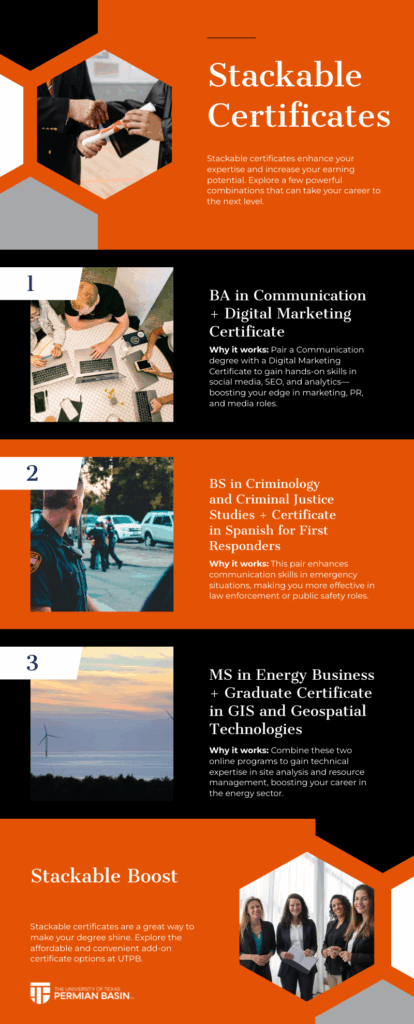
Stackable certificates allow you to build specialized skills quickly and affordably. Check out these examples of how combining certificates with your degree can open up new career opportunities and boost your earning potential.
How Do Certificates Differ from Degrees?
Certificates differ from degrees in that they require less time, cost significantly less, and focus on specialized skills rather than broad academic study. Here’s how they compare:
Undergraduate and Master’s Degrees
Undergraduate degrees typically require up to 120 credits or four to five years of full-time study. In 2023, the average tuition ranged from $9,600 to $34,000 depending on factors like whether you were attending a public or private institution and whether you lived on or off campus.
If you want to pursue further education after earning a bachelor’s degree, a master’s degree often requires at least two more years of study—and an additional $20,000. While master’s degree grads earn an average of about 20% more than those with only a bachelor’s degree, there’s another option: online certificate programs (aka stackable certificates).
Online Certificates
At UTPB, we offer highly specialized, industry-recognized credentials in just 8 to 12 months at a fraction of the cost—around $5,000. These stackable certificates allow you to gain skills quickly and apply them immediately in the workforce, all while adding valuable expertise to your degree.
What Do Stackable Certificates Offer?
Stackable certificates offer a flexible, affordable way to gain specialized skills, boost your resume, and increase your earning potential—without committing to another full degree. Depending on the employer, a graduate certificate can be even more powerful than a master’s degree during the hiring process. That’s because certificate programs shape expertise in a very specific area, while a master’s degree tends to offer more generalized knowledge.
Students with an undergraduate degree in marketing, for example, may want to earn an additional digital marketing certificate or to re-skill and expand their career options without the hassle of earning a second degree. Working professionals can train in new specializations without needing to abandon their position to return to school.
In addition, prospective students may earn more than one certificate at a time, building one credential on top of another. This allows them to gain specific career skills and head into the workforce before deciding on a degree. Courses taken toward a certificate can count towards an undergraduate or graduate degree. This short-term online training model is ideal for upskilling quickly and affordably.
Looking for more benefits? Choosing add-on certificates also:
Boosts transferable and variable skills, which are highly desired by employers
Adds specialization to your degree, helping you stand out in a competitive job market
Results in a higher salary potential
Helps you gain expertise in specialized fields that can increase your chances of promotion
Offers flexible, short-term options that are less expensive than starting a second or third full-time program
These programs are effective career advancement certifications that support lifelong learning and real-world readiness.
UT Permian Basin’s Undergraduate and Graduate Certificates
The University of Texas Permian Basin makes it easier than ever to earn stackable certificates that can strengthen your degree, with online certificate programs requiring just 9 to 14 credit hours.
If you’re an online undergraduate or graduate student currently enrolled at UT Permian Basin, you can apply for a certificate program through the Office of Continuing and Professional Education. Depending on the program, you may have additional admission requirements.
If you’re an undergraduate student looking to boost your liberal arts or business degree, you may be interested in the following UT Permian Basin certificates:
Going back to school is a big decision that can greatly impact your career. Luckily, there are several options for students wanting to further their education. UT Permian Basin is committed to helping students develop lifelong skills and knowledge they can use personally and professionally. Our undergraduate and graduate certificate programs are entirely online and accessible from anywhere in the world.
Maximize your skills at your own pace and convenience. Choose an online UT Permian Basin certificate program and pursue the career of your dreams!
You only get one chance to make a first impression. Cover letters have long been one of the best ways to set yourself apart in a competitive market. But in the era of AI screeners, even the most polished resumes—and their accompanying cover letters—feel like they’re disappearing into the void. With the job market more…
Getting accepted to The University of Texas Permian Basin is a big milestone. If you’re a working professional, the next step—asking your employer about tuition reimbursement—can feel a little intimidating. But it doesn’t have to be. Most organizations want employees who grow, stay, and contribute at a higher level. And many companies offer tuition reimbursement,…
The University of Texas Permian Basin is home to over 7,000 students. Whether on campus in West Texas or from a laptop hundreds of miles away, they’re part of a diverse community that values culture, connection, and progress. Every member of our Falcon Family deserves some time in the spotlight. But with Hispanic Heritage Month…
2021 school year was in full swing. Students had settled into a routine of taking notes, waiting for the bell, and meeting friends between classes—that is, until the COVID-19 pandemic sent them home.
The pandemic forced virtually all U.S. public and private schools to shut down for the remainder of the school year, disrupting the lives of over 55 million students. Despite transitioning to remote learning, students were left without the safety, stability, and relationships that are critical for their development.
Schools have since reopened and most students have returned to the classroom, but the COVID-19 pandemic continues to have a profound impact on students, especially those with disabilities.
Millions of Students Rely on Special Education Services
The Individuals with Disabilities Education Act (IDEA) requires that schools provide a “free appropriate public education” and, to that end, special education and related services to students with disabilities. As “uncertain” as times may be, schools are no less legally or morally obligated to accommodate students’ unique needs.
Schools Struggle to Support Remote Special Education Students
After shutting their doors in March 2020, many schools scrambled to transition to remote learning and struggled to follow each student’s individual education program (IEP): an outline of their required special education services. Many of these services disappeared overnight, and those that were deployed online were of little use to students without a computer or internet access. A vulnerable and at-risk population, students with disabilities were left without the support they were entitled to and desperately needed.
Special Education Students Slip Through the Cracks
As weeks turned to months, parents watched in dismay as their children regressed despite the strides they’d made in general and special education classrooms. “I just watched my child not learning and going backwards,” said Rachael Berg of her 6-year-old daughter, who has an intellectual disability and attention deficit disorder. “I’m just sad for her.”
As schools began reopening in August 2020, administrators and educators faced a backlog of referrals for special education evaluations and requests to add additional services to students’ IEPs. Determining eligibility is already an involved, challenging process, but special educators must now deal with a new problem: Are a student’s difficulties the result of a disability or the lack of support they received during the pandemic? Misdiagnose students and schools run the risk of withholding the support students need, whether or not they have a disability.
Looking to the Future of Special Education
School closures were necessary to protect students, teachers, and their families from COVID-19, and by all accounts, educators did everything in their power to deliver high-quality education. Still, students with disabilities were left without the support and services they needed. Going forward, schools will be responsible for delivering compensatory special education services, helping students reach the level of achievement they would’ve obtained had their education not been interrupted.
Special educators, already in high demand before the pandemic, will be called upon to help students make up for the skills they’ve lost. To address this growing need, The University of Texas Permian Basin offers an online Master of Arts in Special Education program for teachers interested in enriching the lives of students with disabilities.
Earn a Master of Arts in Special Education
Our online MA in special education program provides the training needed to overcome the unique challenges encountered in today’s classroom. Graduate students explore the use of technology to minimize learning challenges, characteristics of developmental disorders, and strategies for teaching exceptional learners, among other foundational topics. In as little as one year, teachers can graduate from our program with the knowledge and skills needed to help students with special needs catch up to their non-disabled peers.
We also offer an educational diagnostician track and an autism spectrum disorders track if you’re interested in gaining specialized knowledge in these areas. All three of our MA in special education programs are online, allowing you to complete assignments and explore course topics on your schedule. Plus, you could qualify for a Teacher Education Assistance for College and Higher Education (TEACH) Grant, which awards up to $4,000 per year to students completing coursework needed to begin a teaching career.
As a classroom teacher, you already have a profound impact on your students’ lives. By pursuing a career in special education, you can address the needs of students who are at the greatest risk of falling behind. We encourage you to explore our MA in special education programs and apply to your program of choice. At UT Permian Basin, you’ll learn how to help all your students achieve their full potential—even those who’ve fallen behind during the pandemic.
The effects of COVID-19 continue to reverberate throughout the healthcare sector, even as infection rates across the United States have fallen since the height of the pandemic. Getting those numbers under control remains a high priority, alongside tackling major issues that in some cases grew out of the pandemic. Let’s look at three of the most pressing issues those working in healthcare leadership are facing now and examine how they’re addressing them.
1. Revamping Hiring and Retention Strategies
Many healthcare professionals, including those at the leadership level, are reaching retirement age and leaving the workforce. At the same time, the “great resignation” spurred in part by the COVID-19 pandemic has created further shortfalls in healthcare staffing. Healthcare leaders must now adjust the traditional workplace experience to attract new, younger candidates. This includes offering more benefits, greater flexibility, and access to additional resources to better cope with the inherent stress of medical careers and balance work and personal responsibilities.
The upside of these staffing challenges is more employment opportunities for professionals with the necessary qualifications. According to the U.S. Bureau of Labor Statistics (BLS), the need for medical and health services managers will increase by 28% between 2021 and 2031—much faster than the average growth rate for all occupations. During the same time span, the BLS projects employment in healthcare professions overall to grow by 13%, a rate also much faster than the average for all occupations.
2. Keeping More Patients at Home
The pandemic compelled healthcare leaders to take a fresh look at traditional healthcare delivery methods, and many of them are now considering expanding home care options as a permanent solution, where possible. Home care includes a combination of virtual office visits, device-driven remote monitoring of patients, skilled nursing home visits, and home modifications such as the addition of ramps and rails. With many physicians confident that home care can be delivered at the same level of quality as facility-based care, home care could become the norm, especially for older adults with chronic conditions, as early as 2025.
3. Fortifying Cyber Security Capabilities
Cyberattacks are an ongoing threat to healthcare institutions and the patients they serve. The advent of smart medical devices—the Internet of Medical Things (IoMT)—makes a hospital’s internal networks, cloud storage, and equipment only part of the equation. The IoMT technology used in remote monitoring equipment can also be hacked, interrupting care and potentially endangering the patient, in addition to raising the cost for their care.
Cyberattacks on the healthcare sector are on the rise. During 2021, more than 600 breaches were reported in the U.S. healthcare sector and more than 22 million patients had their private data compromised. Small- and medium-sized institutions are the most common targets. Under such threats, healthcare institutions are fortifying their cyber security capabilities. Market research shows that the cyber security market for the global healthcare industry reached nearly $13 billion in 2020, and that number is expected to more than quadruple by 2030.
Complex, Interconnected Issues
Home care can help alleviate issues caused by staffing shortages, but it also requires a greater investment in cyber security, since remote care technology is highly susceptible to cyberattacks. Understanding these connections, it’s easy to see why these issues are so front-and-center for healthcare leaders—and how they underscore the need for skilled professionals who can become healthcare leaders and tackle the problems that might emerge in the coming years. Through our AACSB-accredited College of Business, UT Permian Basin offers an online degree program that helps you build these healthcare leadership qualities.
Become a Healthcare Trendsetter
As a healthcare leader, you must foresee potential issues and make the right decisions to address those issues effectively. We can help you develop the required expertise with our online Bachelor of Applied Arts and Sciences in Healthcare Leadership, an affordable program designed for students who hold an AAS-degree in a healthcare-related field.
Built on a general education foundation that incorporates courses in the humanities, mathematics, history, languages, and sciences, our program explores key leadership subjects both within and outside the context of healthcare organizations, including:
Occupational health and safety
Project management
Principles of management and marketing
Human resource management
Quantitative decision-making tools
Hone Your Healthcare Leadership Expertise Online
Our BAAS in healthcare leadership is delivered in an asynchronous, 100% online format that enables you to complete coursework at your own pace from practically any location on the planet. There are no required campus visits. You can earn your bachelor’s degree while giving professional or personal commitments the attention they deserve. All courses are led by the same renowned faculty who teach at our campus.
Become the healthcare leader you were meant to be! Apply now.
From firefighters and teachers to city planners and social workers, public servants play a quiet but essential role in keeping communities safe, healthy, and functioning.
If you’ve ever ridden public transportation or even checked out a library book, you’ve benefited from public services. But what exactly are public services—and what kinds of careers exist in this field?
Here’s a clear, straightforward breakdown.
What Are Public Services?
Public services—also known as government services—are programs and resources provided by local, state, and federal governments to support the well-being of communities.
These services are designed to meet public needs—not generate profit—and are available to everyone. Common examples include:
Emergency services (police, fire, EMS)
Public education
Environmental protection
Transportation and infrastructure
Water supply and waste management
Urban planning and community development
A well-known example is the National Park System, which preserves millions of acres of public land for recreation, conservation, and education.
While governments sometimes partner with private organizations, public services remain focused on access, equity, and long-term community impact.
What Careers Exist in Public Service?
Careers in public service offer meaningful work across many industries, from education and public safety to policy and administration. Whether you prefer hands-on work, leadership roles, or behind-the-scenes planning, public service offers meaningful career options with real-world impact.
Some common public service careers include:
Law enforcement officer
Firefighter
Teacher or school administrator
Social worker
City or public administrator
Human resources manager
Inspector or compliance officer
Animal control officer
Policy analyst or lobbyist
Many of these roles also fall under public administration careers, which focus on managing programs and serving communities at the local and national level.
Why Choose a Career in Public Service?
Working in public service isn’t just about giving back. It also comes with practical benefits.
Job Stability
Government agencies are among the most stable employers in the U.S., offering consistent employment, competitive wages, and strong benefits packages.
Student Loan Forgiveness
Many public servants qualify for Public Service Loan Forgiveness (PSLF), which forgives remaining student loan debt after 10 years of qualifying payments while working in public or nonprofit roles.
Purpose-Driven Work
Perhaps the biggest benefit is knowing your work matters. Public servants help protect communities, improve access to resources, and support vulnerable populations every day.
Advance Your Public Service Career With UT Permian Basin
If you’re interested in building or advancing a career in public service, UT Permian Basin (UTPB) offers flexible, fully online programs designed for working professionals.
Women represent about half of the U.S. population, but women in law enforcement make up only 13%: around 96,000 nationwide. This gap matters, especially given the impact women have on policing. Research into gender in policing shows that women officers are viewed by communities as more honest, compassionate, and trustworthy. When it comes to public…
The Civil Rights Act of 1964 changed the lives of millions of Americans. It guaranteed the right to vote, ended segregated public spaces, and made employment discrimination illegal. Historians rank it alongside the Constitution and the Emancipation Proclamation as one of the most important documents in U.S. history. Five months after the act passed, Martin…
If you hop on a Citi Bike in New York City, you’re doing more than just getting across town. You’re helping create real-time data that city planners use to design new bus routes and bike lanes where they’re needed most. Convenient and essential, right? Big data is reshaping our cities—and the future of public administration….
Most of today’s employers are looking for a particular set of skills in job candidates, and certain college degrees are better oriented toward helping you develop them than others.
You’ve probably heard of “soft skills,” but what are they? Verbal and written communication, teamwork, critical thinking, and problem-solving are the among the most important skills, and with their broad applicability, it’s easy to see why employers would desire them. A higher education degree in communication helps you sharpen these vital abilities.
As beneficial as soft skills are, having highly focused knowledge in a specific discipline can also help you land and excel in your desired professional role. The University of Texas Permian Basin’s online Bachelor of Arts in Communication empowers you to build both types of expertise simultaneously.
One Communications Degree Offers Countless Course Path and Career Options
Our online BA in communication program is built on a foundation of general education courses in which you’ll acquire knowledge that will serve you well in your career and beyond. From there, you’ll move on to core communication courses that help you develop public speaking and interpersonal communication skills and gain an understanding of modern media, communication theories, and the origins of rhetorical thought. Taken alongside these core courses, our communication electives enable you to:
Explore the dark side of communication.
Become more effective at argument and persuasion.
Learn media writing.
Choose Your Own Communication Track
Perhaps the most exciting aspect of our program, career-wise, is the inclusion of specialty tracks that allow you to gear your studies toward your areas of interest and acquire added expertise that will help you in related professional roles. Which communication track should you choose? That depends largely upon what you want to do with your life. Let’s examine each track in our BA in communication program and its potential professional benefits.
If you have your eye on a career in advertising, marketing, publication relations, the nonprofit sector, or a similar field, this track may align most closely with your goals. Our Strategic Messaging track helps you understand how to communicate and promote an organization’s products, services, and/or cause to the public. You’ll master crisis communication, corporate messaging and branding, and government and investor relations during this program.
If you plan to pursue a career in human resources or aspire to a managerial/supervisorial position, being able to communicate clearly and effectively with others in a professional setting is crucial. Our Professional Communication track explores small group communication, interpersonal communication, conflict negotiation, and other topics that will help you hone communication capabilities essential to your success in such roles.
If a career in the dynamic world of sports marketing, public relations, or social media marketing is calling you, we recommend our Sports Media track. This track trains you to fashion the public image of professional sports teams and leagues, with instruction in media writing and a review of sports media production. It should be noted that this track does not cover the technical side of media production.
If you want to acquire a comprehensive knowledge of communication that will be invaluable to you in practically any career, our Communication Studies track is your most advantageous option. You can still learn about the topics that interest you by selecting five electives from a pool of more than 20 courses.
Experience the Flexibility of Our Online Classroom
No matter which track you choose for your BA in communication, you’ll enjoy the unequalled convenience of our 100% online, asynchronous format. Our program allows you to complete your coursework on your own schedule practically anywhere in the world, from New England to New South Wales. You can continue meeting your professional and personal commitments as you complete a potentially life-changing bachelor’s degree. Along the way, you’ll stay closely connected to classmates and faculty through multiple online collaboration and communication tools.
Set your own course as a communication major with UT Permian Basin! Apply now.