How Online Certificate Programs Can Advance Your Career
Looking to grow your career without committing to another full-time degree? You’re not alone. More and more students and working professionals are turning to online certificate programs to sharpen their skills, stand out to employers, and stay competitive in a fast-changing job market.
In fact, a Pew Research Center study found that 54 percent of working adults felt that learning new, transferable skills in niche areas was essential to keeping up with an ever-changing economy. That’s where stackable certificates come in, offering a flexible way to build specialized knowledge without the rising tuition costs of full-time degree programs.
What Are Stackable Certificates?
Stackable certificates are short, focused academic programs that can be completed individually or “stacked” over time to build toward a degree or career advancement. Unlike traditional degree programs, online certificate programs are designed to deliver specific, job-ready skills in less time and at a lower cost. Each certificate adds a layer of expertise, helping you customize your education path based on your goals or industry demands.
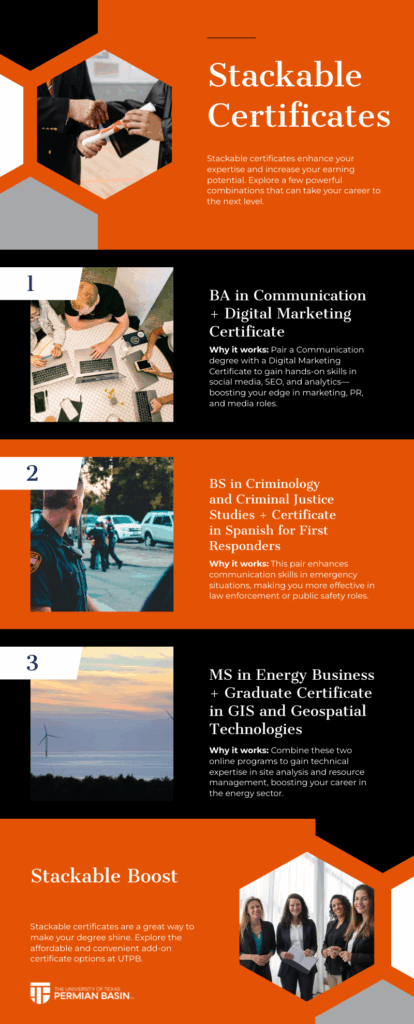
Stackable certificates allow you to build specialized skills quickly and affordably. Check out these examples of how combining certificates with your degree can open up new career opportunities and boost your earning potential.
How Do Certificates Differ from Degrees?
Certificates differ from degrees in that they require less time, cost significantly less, and focus on specialized skills rather than broad academic study. Here’s how they compare:
Undergraduate and Master’s Degrees
Undergraduate degrees typically require up to 120 credits or four to five years of full-time study. In 2023, the average tuition ranged from $9,600 to $34,000 depending on factors like whether you were attending a public or private institution and whether you lived on or off campus.
If you want to pursue further education after earning a bachelor’s degree, a master’s degree often requires at least two more years of study—and an additional $20,000. While master’s degree grads earn an average of about 20% more than those with only a bachelor’s degree, there’s another option: online certificate programs (aka stackable certificates).
Online Certificates
At UTPB, we offer highly specialized, industry-recognized credentials in just 8 to 12 months at a fraction of the cost—around $5,000. These stackable certificates allow you to gain skills quickly and apply them immediately in the workforce, all while adding valuable expertise to your degree.
What Do Stackable Certificates Offer?
Stackable certificates offer a flexible, affordable way to gain specialized skills, boost your resume, and increase your earning potential—without committing to another full degree. Depending on the employer, a graduate certificate can be even more powerful than a master’s degree during the hiring process. That’s because certificate programs shape expertise in a very specific area, while a master’s degree tends to offer more generalized knowledge.
Students with an undergraduate degree in marketing, for example, may want to earn an additional digital marketing certificate or to re-skill and expand their career options without the hassle of earning a second degree. Working professionals can train in new specializations without needing to abandon their position to return to school.
In addition, prospective students may earn more than one certificate at a time, building one credential on top of another. This allows them to gain specific career skills and head into the workforce before deciding on a degree. Courses taken toward a certificate can count towards an undergraduate or graduate degree. This short-term online training model is ideal for upskilling quickly and affordably.
Looking for more benefits? Choosing add-on certificates also:
Boosts transferable and variable skills, which are highly desired by employers
Adds specialization to your degree, helping you stand out in a competitive job market
Results in a higher salary potential
Helps you gain expertise in specialized fields that can increase your chances of promotion
Offers flexible, short-term options that are less expensive than starting a second or third full-time program
These programs are effective career advancement certifications that support lifelong learning and real-world readiness.
UT Permian Basin’s Undergraduate and Graduate Certificates
The University of Texas Permian Basin makes it easier than ever to earn stackable certificates that can strengthen your degree, with online certificate programs requiring just 9 to 14 credit hours.
If you’re an online undergraduate or graduate student currently enrolled at UT Permian Basin, you can apply for a certificate program through the Office of Continuing and Professional Education. Depending on the program, you may have additional admission requirements.
If you’re an undergraduate student looking to boost your liberal arts or business degree, you may be interested in the following UT Permian Basin certificates:
Going back to school is a big decision that can greatly impact your career. Luckily, there are several options for students wanting to further their education. UT Permian Basin is committed to helping students develop lifelong skills and knowledge they can use personally and professionally. Our undergraduate and graduate certificate programs are entirely online and accessible from anywhere in the world.
Maximize your skills at your own pace and convenience. Choose an online UT Permian Basin certificate program and pursue the career of your dreams!
You only get one chance to make a first impression. Cover letters have long been one of the best ways to set yourself apart in a competitive market. But in the era of AI screeners, even the most polished resumes—and their accompanying cover letters—feel like they’re disappearing into the void. With the job market more…
Getting accepted to The University of Texas Permian Basin is a big milestone. If you’re a working professional, the next step—asking your employer about tuition reimbursement—can feel a little intimidating. But it doesn’t have to be. Most organizations want employees who grow, stay, and contribute at a higher level. And many companies offer tuition reimbursement,…
The University of Texas Permian Basin is home to over 7,000 students. Whether on campus in West Texas or from a laptop hundreds of miles away, they’re part of a diverse community that values culture, connection, and progress. Every member of our Falcon Family deserves some time in the spotlight. But with Hispanic Heritage Month…
Welcome to The University of Texas Permian Basin! Now that you’re part of the Falcon Family, let’s go over what you need to do to prepare for your first semester as an online student and what you need to know to get the most out of your time at UT Permian Basin. We’re excited for you to experience everything our University has to offer, and we hope you are too!
Visit the Student Portal
The MyUTPB portal is a one-stop-shop for almost all the services you’ll rely on as a student. Here you’ll be able to register for classes, update your student information, and access library services, Office 365, and your university email. You’ll also access your courses through the student portal, or you can visit utpb.instructure.com to be taken directly to Canvas.
To access the student portal, you’ll need to claim your FalconID and create a password. Claim your FalconID by visiting this page and entering in your 10-digit StudentID, which you should have received when you applied. Your FalconID will be your username for logging into online resources at UT Permian Basin, so commit it to memory or keep it somewhere secure. With it, you’ll be able to log into the student portal and register for classes.
Connect With Your Academic Advisor
Consider your academic advisor your point of contact with the University. From enrollment to graduation, they’ll be here to answer your questions and help you make academic decisions. You can email advising@utpb.edu (or gradstudies@utpb.edu if you’re a graduate student) for assistance or schedule an academic advising appointment on our Online Academic Advising page.
UT Permian Basin’s advisors are here to support you throughout your academic journey, and we encourage you to reach out to them whenever you need help with:
Accessing tutoring services.
Adjusting your class schedule.
Changing your major/minor.
Submitting an academic appeal.
Taking time off from your program.
Register for Classes
Generally, you won’t be self-enrolling in courses; your advisor will do that for you. But we’ll give you a quick rundown of the process in case you do need to register for courses in a given semester.
After attending the online student orientation and signing the Student Financial Responsibility Agreement in the student portal, review current and upcoming semester schedules to learn more about your desired courses and gather their course numbers, as you’ll need these to register. Next, log into the MyUTPB portal and click Manage Classes. From here, you’ll be able to search for and enroll in your desired courses. Detailed instructions on how to register for courses can be found here.
Prepare for the First Day of Class
Now that you’ve registered for classes, got yourself some UT Permian Basin apparel, and set up a cozy at-home workspace, it’s time to prepare for your first day in our virtual classrooms.
Explore Canvas
Canvas is the learning management system (LMS) for all courses offered at UT Permian Basin. Courses you’re enrolled in will appear on the Canvas Dashboard, where you can access course syllabi, materials, assignments, quizzes, and tests—everything you need for a successful semester. Chances are you’ll be a pro at navigating Canvas by the end of your first semester, but you can always visit the Canvas Student Tutorial if you need help getting around.
Read the Syllabus
It’s imperative that you read the syllabus for each of your classes. Look for syllabi in the Start Here section under each class in Canvas. The syllabus will provide an overview of academic policies, instructions for completing assignments, and required materials, among other useful information. As you progress through a course, you’ll want to consult the syllabus first if you’re confused about an assignment. For now, make sure you have all required course materials and textbooks, which you should receive by the first week of class at the latest. Also check out the course calendar in Canvas to see assignment due dates and plan out your first week.
Welcome to the Falcon Family
UT Permian Basin may serve a diverse community of students from 47 countries around the world, but we still cater to the unique needs of every student.
Our mission is to help you achieve academic and professional success, but our hope is that you’ll come to truly see yourself as a part of the Falcon Family. Connect with your professors, reach out to your fellow students, and appreciate the college experience. Graduation day will come, but for now, you have your entire academic journey to look forward to.
The notion that education is the key to a successful career is as true today as it was when school libraries were using the Dewey Decimal System. What has changed, however, is how students are attending—or should we say logging into—college classes.
Watching a recorded lecture while on lunch break, stirring a simmering risotto, or keeping an eye on a toddler is increasingly becoming students’ preferred method for earning an academic credential. Over one-third of college students were enrolled in at least one online college course in 2019, and this was before the COVID-19 pandemic. Yet the convenience and growing popularity of online degree and certificate programs have left many wondering how valuable online credentials actually are, especially employers.
Career Benefits of Earning an Online Credential
There’s no question that employers favor college-educated professionals, with many requiring a four-year degree at a minimum. If someone performs their role well, does it matter how they earned their academic credential?
Employers are more interested in the competencies a credential denotes than where it originated. By enrolling in online courses, professionals can gain access to resources that may otherwise be unavailable based on their schedule, location, or finances (e.g., expert instruction, up-to-date course content, and a supportive learning environment). In addition, traditional and online programs are often led by the same faculty members who teach the same course content, giving employers even more reason to embrace graduates of online programs. This convenient, cost-effective platform produces more qualified candidates in a tight labor market. All in all, it’s a net gain for employers.
Identical Instruction and Credentials
Graduates of online programs often receive the exact same credentials awarded to their on-campus counterparts. Since these credentials make no mention of being “online,” employers tend to initially overlook where they originated (39% of HR managers spend less than a minute on their first look at a resume), and there’s no need for applicants to distinguish between an online and traditional credential on their resume. “The education, knowledge and experience you have in a field of study is what you want to showcase on your resume,” confirmed PrincetonOne President and CEO Dave Campeas. “The true test of your expertise and knowledge will come during the interview.”
If an employer asks during an interview why you pursued an online credential, be honest. When they hear how you deftly balanced online education and personal and professional responsibilities, they’ll likely be supportive and that much more impressed. However, as is becoming the case with all academic credentials, employers will double-check that your online degree or certificate came from a legitimate institution.
The Importance of Accreditation
The credential marketplace has been inundated with badges, licenses, apprenticeships, and micro-credentials in recent years, with nearly one million unique credentials offered in the U.S. alone—967,734, to be exact. Don’t get us wrong; employers are bullish on online education, but now they’re faced with determining the legitimacy of all academic credentials, and they’re not alone.
Aspiring students must be on the lookout for the rising number of bad actors backed by fake college accreditation agencies. Julie Uranis, vice president of online and strategic initiatives for the University Professional and Continuing Education Association, perfectly sums up the problem. “I could have a credential in cybersecurity,” said Uranis, “but if I got it from an entity that previously was focused on food handling, you have to worry about whether they’re qualified to teach that subject matter.”
The goal of accreditation is to ensure that the quality of education and training offered by institutions of higher education is acceptable in quality, and it remains the most reliable way to ensure a credential didn’t come from the online equivalent of a mall kiosk. A list of reliable institutional accrediting agencies can be found on the U.S. Department of Education website. Among this list, you’ll find the Southern Association of Colleges and Schools Commission on Colleges (SACSCOC), the educational accreditor that awarded UT Permian Basin its accreditation. This institutional recognition by SACSCOC confirms our commitment to quality and integrity and to providing effective programs, both online and on-campus, that meet the Commission’s rigorous standards. Rest assured, an academic credential from UT Permian Basin is the real deal.
Impress Employers With an Online Credential From UT Permian Basin
Will employers notice your online credential? That depends. Did you earn it from UT Permian Basin?
UT Permian Basin is one of the top-ranked online colleges in Texas, empowering students through accredited online programs, affordable tuition rates, and a collaborative online learning environment. Over five thousand students from all over the world entrust us with helping them prepare for fulfilling careers, and we’re not about to let them down. We offer numerous online undergraduate and graduate programs, all of which offer instruction of the highest quality and many of which are accredited by specialized accrediting organizations.
Each of our online programs is designed to provide everything you need to accelerate your career. Whether you’re studying microeconomics in our online BBA in management program or democratization in our online MA in history program, you’ll be working toward a prestigious credential. More importantly, you’ll gain invaluable skills that will serve you long after a stellar interview. When an employer looks over your resume and sees that you’ve earned an academic credential from UT Permian Basin, you can relax knowing that your education has prepared you for every question they could ask.
Browse our catalog to find the bachelor’s degree, master’s degree, or graduate certificate that’ll be the highlight of your resume. When you’re ready, we look forward to welcoming you as UT Permian Basin’s latest Falcon.
When senior year of high school rolls around, all anyone can talk about is where they’ll be attending college. One friend was accepted here, another was rejected there. As admissions decisions are being made in colleges across the country, how many seniors are rushing home to check their mailbox for the letter?
We don’t blame them. Every academic decision they’ve made has led to this moment, when they finally find out which college colors they’ll be wearing. And although college hopefuls understand that attending college is a rewarding experience, not all of them fully understand why.
College develops students into well-rounded individuals, capable of critical thinking and clear communication, and prepares them to succeed in all aspects of their lives, including their careers. As part of a core curriculum, general education is essential for helping students become enlightened, engaged citizens. Yet many wonder why general education courses are required—and you may be wondering the same. Rest assured, the real-world benefits of general education courses are well worth the credit hours.
Building the Foundation for Your Success
Critics of general education believe that the purpose of higher education is to instill students with exclusively work-related skills. However, focusing on one area of study to the detriment of others is not a practical approach. According to the U.S. Bureau of Labor Statistics (BLS), the average baby boomer holds about 12 jobs throughout their lifetime. COVID-19 and the Great Resignation are sure to increase this number for younger generations. Given the number of hats students are likely to wear throughout their careers, colleges and universities focus on providing a diverse set of foundational skills students can apply to any career.
Despite the diversity of roles most individuals take on throughout our professional lives, there remains immense pressure for students to declare their major and career intentions from now until the end of time. Considering that one-third of undergraduates switch their major within three years of enrollment, providing students with a narrow set of work-related skills may not prove beneficial in the long run. A Gallup survey of over 2,000 college graduates found that those who aligned their work with their interests, values, and strengths were three times more likely to find purposeful work, and those who did find purpose in their work were ten times more likely to prosper.
General education ensures you have the fundamental skills needed to succeed in college and life, regardless of your intended area of study. Even if you’re certain of your academic goals, these basics are the foundation upon which you’ll build specific work-related skills. They could even spark an interest in a new career path—one where you do what you love.
General Education at UT Permian Basin
Most colleges require a certain number of general education courses as part of the core curriculum, and The University of Texas Permian Basin is no different. Consisting of 42-47 semester credit hours, our General Education Core Curriculum covers the following foundational areas:
Communication
A sterling resume can only take you so far if you’re unable to articulate your knowledge and experiences. Communication courses will help you develop your oral, written, and visual literacy skills and express your ideas clearly regardless of the subject matter or setting.
History
By studying the past, you’ll learn about the complex interactions between individuals, communities, states, and nations that make the U.S. what it is today, and you’ll gain a new perspective on your role in society.
Language, Philosophy, and Culture
Culture has a tremendous impact on the human condition. Understanding and appreciating how people are shaped by their customs and beliefs is key to becoming a well-rounded individual who excels in any work or social situation.
Mathematics
Deepen your understanding of logic, patterns, and quantitative relationships in courses like College Algebra. Although you may have a supercomputer in your pocket, these skills are irreplaceable in countless careers, especially those in the STEM fields.
Life and Physical Sciences
There’s a universe of natural phenomena that seems impossible to explain — that is, until you dive into the science. Biology and geology courses explore Earth and its diverse lifeforms, down to the microscopic cells that sustain everyday life.
Political Science
Political science courses, like our history courses, instill a deep sense of civic responsibility by exploring issues affecting the world around us. Take an in-depth look at U.S. politics, exploring political institutions and parties as well as their philosophical foundations.
Creative Arts
Artistic expression is human creativity given form. By looking at works of art through a critical lens, and by learning how music, paintings, and sculptures uniquely convey ideas, you’ll develop new ways to engage with different forms of expression. Who knows? You could even find your next creative passion.
Social and Behavioral Sciences
Courses like psychology and sociology look at how scientific methods can be used to shed light on what makes us human, exploring the root causes of our behaviors and their effect on society and culture. When you notice the obscure mechanisms influencing life, you’ll be better able to navigate its twists and turns.
Become a Well-Rounded Professional at UT Permian Basin
General education ensures that UT Permian Basin graduates can communicate effectively, think critically, and reach informed conclusions, among other skills essential for learning and thriving in any field. Given its importance, core instruction is provided to all UT Permian Basin students, whether they’re online or on campus.
At UT Permian Basin, you can satisfy the general education requirements by enrolling in one of our many online undergraduate programs. We also accept transfer credits from accredited institutions. Designed to be convenient and affordable, our online courses can help you gain essential skills, meet degree requirements, and become a more well-rounded individual without burdening you as you prepare for the next stage of your life.
Ready to become a Falcon? Browse through our course and program catalog, and when you’re ready, apply to become UT Permian Basin’s latest undergraduate student.
If you’re pursuing an online program at The University of Texas Permian Basin, you know that studying online has its perks and conveniences, including the ability to complete coursework at any time from the comfort of your own home. However, an online format can also pose unique challenges. Some students may feel isolated, which can impact their motivation to engage in courses. For other students, faulty or out-of-date technology may pose an issue. Fortunately, there are a variety of ways that online students can overcome these challenges, manage their time and resources successfully, and find their place in the UTPB Falcon Family.
Stay Up to Date with Technology
Online education can trace its origins to the mid-1800s, when the U.S. Postal Service developed “correspondence colleges”: a new educational format in which professors sent materials by mail to students who couldn’t be on campus. Over a century later, in 1982, the first online courses were offered by Western Behavioral Sciences Institute in La Jolla, California. Since then, virtual education has become mainstream. About one in four college students are currently enrolled online across the United States, a number that has increased since the COVID-19 pandemic, and technology has been keeping up with the changing times.
If you’re a prospective or current online student wondering what kind of technology you’ll use in your online classes, you’ll find it helpful to become acquainted with Zoom, Skype, WhatsApp, and your school’s apps and online platforms. Set up your computer’s camera and microphone ahead of time and check your connections. If you have spotty access to the internet, don’t be afraid to inform your advisor or professors. Some teachers will even record class sessions for students to watch later.
Connect with Students and Faculty
If you’ve ever felt tired or down when faced with long days studying at the computer, know you’re not alone. “Zoom Fatigue” isn’t just a pandemic-spurred catchphrase —it’s a real psychological phenomenon. Communication and peer interaction are just as important as your academic efforts when earning your degree. These social elements are sometimes missing when you study online, and virtual education may worsen existing mental health issues. Therefore, it is important to attend every class, introduce yourself, connect with peers, and participate in group discussions online.
Ask Questions
Since you don’t have your professor and fellow classmates in the room with you, it’s important to ask questions if you have trouble understanding something. Participating online will help you relate and engage with your peers. It will also help you meet minimum participation requirements.
Attend Virtual Events and Join Groups
Join online clubs, forums, and groups (or create them if they don’t yet exist online for your school). Students can also seek out a virtual advisor or tutor, or attend online events. It’s also important that online students know that they’re not always limited to virtual coursework. Some programs may offer in-person field trips, internships, or practicums that allow them to connect with other professionals, especially if you live close to the university.
Pursue Your Online Education at UT Permian Basin
UT Permian Basin is accredited by the Southern Association of Colleges and Schools Commission on Colleges and is ranked nationally by U.S. News & World Report as one of the top public schools, best regional universities, and a top performer on social mobility. At UT Permian Basin, we’ve made it easy to earn an online degree, and we’re committed to providing accessible, affordable education for our students.
Stay Connected
UT Permian Basin offers over 40 online programs with six annual start dates, so you choose the program of study that interests you most and pursue it at the time that suits your life best. Meet with an academic advisor or schedule time online with a student outreach and engagement specialist as a prospective or current student to sort out any questions, comments, or issues you may have.
You can find more information on an immersive online management system called Falcon Online, which offers all the resources that online students need. Online students attend orientation virtually and attend classes using Canvas. Any UTPB student can use the university’s online library, which offers extensive online databases and chat options.
General education courses are required for every bachelor’s degree because they help students build a strong foundation before focusing on a major. No matter what field you choose, these courses teach skills that support college learning and everyday problem-solving.
General education classes also give students the chance to explore different subjects, such as communication, math, science, and the humanities, while improving communication skills and critical thinking. This broad foundation helps prepare students for their major and for life beyond college. In this article, we explain:
What general education courses are
How general education courses differ from a general education degree
Why general education is required for bachelor’s programs
How these courses support academic and career success
General Education Courses vs. General Education Degree: What’s the Difference?
While they sound similar, a general education degree and general education courses refer to two very different things. General education courses are the foundational classes that every student must complete as part of a bachelor’s degree program, regardless of their major. These courses cover a wide range of subjects to help students build critical thinking and problem-solving skills.
On the other hand, a general education degree typically refers to an associate degree or a broad, multidisciplinary bachelor’s program that doesn’t focus on one specialized field. If you’re pursuing a traditional bachelor’s degree, general education courses are just one component of your overall curriculum—not a separate degree in themselves.
What Are General Education Courses?
General education courses span a wide range of academic subjects and are a required part of nearly every bachelor’s degree program. These courses typically include:
Communication
Creative arts
History
Language, philosophy, and culture
Life and physical sciences
Mathematics
Political science
Social and behavioral sciences
This interdisciplinary curriculum helps students build essential skills in communication, critical thinking, and problem-solving—skills that are in high demand across virtually every field. According to the American Association of Colleges and Universities, general education empowers students to approach complex issues from multiple perspectives and participate effectively in a diverse, democratic society.
Why Does Every Bachelor’s Degree Program Require Gen Ed Courses?
No matter what career path you follow, general education courses explore the fundamental subject matter that you will need to function and thrive within society. Advanced degrees, such as a master’s degree, require the completion of a bachelor’s degree; hence, they assume students already have this foundation and are ready for fully specialized learning. But bachelor’s degree students need more advanced instruction in these essentials than a high school education can provide.
Not everyone enters college at the bachelor’s level already knowing what they want to do with their life. General education courses introduce students to a broad variety of subjects that can help them determine where their interests and natural talents lie.
While completing a bachelor’s degree program’s general education requirements, students also develop important communication, critical thinking, and problem-solving skills that will serve them well throughout every aspect of their lives. These so-called “soft” skills are in high demand among employers, according to studies of major employers and the U.S. Department of Labor, and can therefore increase a graduate’s career opportunities.
FAQ: General Education
General education courses are essential to every bachelor’s degree, but many students still have questions about them. Here are some quick answers to the most common ones:
General education courses are required classes that all undergraduate students take. They cover subjects like math, science, communication, and the humanities to build important skills.
They help students develop critical thinking, problem-solving, and communication skills that are valuable in any career.
General education courses are part of a degree program, while a general education degree usually refers to an associate degree or a broad program with no specialized focus.
Most bachelor’s programs require 40 to 60 credits in general education courses before you focus on your major.
Yes, you can usually transfer general education credits from other accredited institutions, but check with your school to confirm.
UT Permian Basin Online Bachelor’s Degree Program
UT Permian Basin’s online undergraduate programs provide the flexibility to complete coursework at your own pace from anywhere in the world. If professional and personal obligations currently keep you busy, you’ll find this flexibility makes all the difference.
All our online programs are based around the same rigorous curriculum taught by the same renowned faculty who teach at our Odessa, Texas campus. Each program offers exceptionally high quality and value, with affordable tuition rates that most accredited universities of our stature can’t match.
Expand your horizons with general education courses as part of an online bachelor’s degree program from UT Permian Basin! Browse your options now.
You only get one chance to make a first impression. Cover letters have long been one of the best ways to set yourself apart in a competitive market. But in the era of AI screeners, even the most polished resumes—and their accompanying cover letters—feel like they’re disappearing into the void. With the job market more…
Getting accepted to The University of Texas Permian Basin is a big milestone. If you’re a working professional, the next step—asking your employer about tuition reimbursement—can feel a little intimidating. But it doesn’t have to be. Most organizations want employees who grow, stay, and contribute at a higher level. And many companies offer tuition reimbursement,…
The University of Texas Permian Basin is home to over 7,000 students. Whether on campus in West Texas or from a laptop hundreds of miles away, they’re part of a diverse community that values culture, connection, and progress. Every member of our Falcon Family deserves some time in the spotlight. But with Hispanic Heritage Month…
If you have served in or are currently serving in the United States military, we thank you for your service! Over the years, our country has developed ways to show its appreciation to service members and help them excel outside the military with legislature that assists with education costs and other important aspects of life. We wanted to let you know about some of these assistance options to show you that, as a military veteran, you can afford to pursue the university education you want and deserve.
The most common type of modern veteran assistance—the GI Bill—stems from the Servicemen’s Readjustment Act of 1944, passed toward the end of World War II. This act gave service members returning from the war financial assistance with home loans and education expenses in addition to funding veterans hospitals. Today, the GI Bill focuses on funding education and training programs. You may see the GI Bill referred to in several ways, including:
Post 9/11 GI Bill
Montgomery GI Bill
Montgomery GI Bill Selective Reserve
Other Military Education Funding Options
In addition to the GI Bill, UT Permian Basin participates in:
Dependents’ Educational Assistance (Chapter 35)
Vocational Rehabilitation and Employment (Chapter 31)
Hazlewood Act (Texas Veterans)
The Hazlewood Act is a significant source of education funding assistance designated for Texas military veterans. Let’s take an in-depth look at this option now.
Hazlewood Act Origins, Purpose, and Benefits
The Hazlewood Act originated in the Texas Legislature in 1923 and is named after Sen. Grady Hazlewood,a University of Texas graduate who later helped revise the act to benefit World War II veterans. Exclusive to the state of Texas, the Hazlewood Act “provides qualified Veterans, spouses, and dependent children with an education benefit of up to 150 hours of tuition exemption, including most fee charges, at public institutions of higher education in Texas.” If you’re a military veteran who was a Texas resident when you entered active duty, or a spouse or dependent of a veteran who was killed or permanently disabled while in service, you may qualify for this significant benefit.
When you consider the 120 credit hours needed to complete a bachelor’s degree program and 30 credit hours required to complete some of our master’s degrees, the full value of the Hazlewood Act becomes clear: At up to 150 hours, it can cover your undergraduate tuition and most fees as well as most or all of your graduate tuition and fees. Depending on the program you choose, you can earn not one but two valuable degrees to enrich your resume and gain an advantage with potential employers.
The Hazlewood Act can provide a complete education, helping you thrive in your professional life and beyond at relatively little personal expense. While you’ll pay for any books and supplies and cover your own living expenses while enrolled, when you choose an online education program, you can save on these expenses by earning your credentials from home.
Using the Hazlewood Act to Pay for Our Programs
The Hazlewood Act can help you pay for UT Permian Basin’s bachelor’s degree and master’s degree programs, our professional certificate programs, or a combination of these credentials up to 150 credit hours. You gained valuable life and career skills while serving in the military. Why not choose one or more of our 40+ online programs—in diverse disciplines including business administration, communication, nursing, and cyber security—to further boost your career prospects? When you enroll in one of our online programs, you’ll experience considerable benefits practically from day one.
Online Benefits of Our Education Programs
Presented almost entirely in an asynchronous format, our online degree and certificate programs offer unmatched flexibility and convenience. You can complete coursework at your own pace from practically anywhere in the world with no campus visits required. If you currently have professional and personal responsibilities, you’ll immediately discover how advantageous online education can be. For many students, it’s what makes earning a degree possible while continuing to meet their existing commitments. During your program, you’ll also have online access to faculty and classmates as well as extensive student services, all of which add up to a huge support network that will make online learning an enriching and smooth experience.
Professional Benefits of Our Online Degrees
A bachelor’s degree equips you with critical thinking, problem-solving, and other skills that will benefit you daily in your personal and professional life. These “soft” skills are highly sought after by employers, according to the U.S. Department of Labor and surveys of major employers. Having a master’s degree on your resume can also significantly increase your compensation and professional opportunities. Data provided by the U.S. Bureau of Labor Statistics (BLS) shows that master’s degree holders earn about 20% more than those who hold a bachelor’s degree alone.
We encourage you to take advantage of the education benefits you’ve earned! For more information about your military funding options, please contact UT Permian Basin Military and Veteran Student Services.
Texas veterans: For complete Hazlewood Act eligibility requirements and application instructions, visit this site. From there, you’ll also be able to initiate an application for UT Permian Basin. We look forward to hearing from you!
Have you reached the point in your college career where you’re ready to move to the next level? Maybe you’re ready to transfer out of your two-year program, or your experience at another school isn’t what you expected it to be, and you want to finish your degree in a program that better suits you. We’d be honored to welcome you over to The University of Texas Permian Basin, where you can enjoy the considerable advantages of online learning as you earn a valuable online degree. Before we go any further, let’s first see if you fit into one of our transfer student categories:
You’ve completed at least 24 semester hours of college credit but have not yet completed a bachelor’s degree.
You’ve completed an associate degree and are ready to pursue a bachelor’s degree.
You’ve completed a bachelor’s degree and wish to pursue a second bachelor’s degree.
You are a degree- or non-degree seeking student or transient student.
Do any of those scenarios describe you? If so, let’s see if you meet UT Permian Basin’s transfer admission requirements.
Admission Requirements for Transfer Students
To transfer to a UT Permian Basin online program, you must:
Have completed a minimum of 24 semester hours at another regionally accredited college or university.
Have a grade point average (GPA) of 2.0 (equivalent to a “C”) or higher out of a possible 4.0.
Be eligible to re-enroll at other college-level institutions you have attended prior to UT Permian Basin.
If you meet all of the admission requirements above, you’re most likely eligible to transfer to an online program at UT Permian Basin! But first, we’ll need a few additional things:
Application Materials
When you seek admission to one of our online programs, you must submit:
Official transcripts from every college or university you have attended.
Verification that you have met Texas Success Initiative (TSI) requirements.
What You Should Do Next
If you haven’t already applied to an online UT Permian Basin program and you meet the requirements, apply now! This is where your journey to new educational horizons and a more fulfilling life begins. If you need assistance with the application process, please contact Student Outreach and Engagement at studentinquiries@online.utpb.edu.
What If …
If you don’t meet certain admission requirements, you may still be admitted to the University, with some caveats:
If you don’t have the required GPA, you may still receive provisional admission, a status which requires you to earn at least a “C” in all of your classes during your first 12 semester hours. After that, you will be permitted to enroll for additional terms.
If you’re applying with credits from a non-accredited college or university, you may be admitted conditionally. For this, you must achieve and maintain a minimum GPA of 2.0 during your first 30 semester hours.
What to Do If You Need Financial Aid
There are numerous forms of financial aid available, and many of our students qualify for one or more of them. Additional details and contact information for our financial aid office are here.
Haven’t Picked a Program?
UT Permian Basin offers a broad spectrum of online bachelor’s degree programs representing in-demand fields including multiple business specializations, criminal justice, healthcare management, communication, industrial technology, the social sciences, and humanities. All of our programs help prepare you for success in a current or future career by providing essential expertise. Browse our online bachelor’s degree programs now. We also have master’s degree programs and undergraduate and graduate certificates you can pursue in the future.
Advantages of Online Learning
Most of the courses in our online bachelor’s programs are delivered in a 100% online, asynchronous format that allows you to set your own class schedule. Complete coursework at any hour, any day, from virtually any location in the world. You’ll find this flexibility particularly beneficial if you have professional and/or personal obligations to keep. And you don’t have to sacrifice quality for convenience: Our online degree programs feature identical curricula to their on-campus counterparts and are taught by the same acclaimed faculty.
While we’ve outlined most of the transfer and admissions processes here, we have dedicated student representatives who are eager to give you personalized and detailed assistance. Contact us today!
Earning a higher education credential from an accredited institution is a crucial milestone. It’s the gateway to career opportunities, a feeling of well-deserved pride, and personal and professional fulfillment. The University of Texas Permian Basin, the federal government, private lenders, and many other organizations offer various types of payment assistance so you can pursue higher education and enjoy all these benefits.
Let’s take a look at what the financial commitment of earning an educational credential online from UT Permian Basin is like and review some of the financial aid and scholarship options that may be available to you.
Save Money by Paying Less
UT Permian Basin’s tuition and fee structure is among the most affordable you’ll find in higher education, due in part to the fact that we don’t charge online students out-of-state tuition rates. (In some cases, out-of-state rates can more than double the amount a student pays for their education.) Online students benefit from other savings as well, as they don’t need to pay for the parking permits, gas, tolls, and other expenses related to commuting to campus. You’re already saving money just by choosing online learning!
Look to Uncle Sam
All Americans share a common interest in helping cultivate educated and productive members of society. For this reason, the federal government offers various student loans to eligible individuals for qualifying programs. Some of these, such as Direct Subsidized Loans, are awarded due to financial need, while others, such as Direct Unsubsidized Loans, don’t require demonstration of financial need.
For undergraduate students, federal loans generally range between $5,500 and $12,500 per year. This could potentially cover 100% of a qualified student’s annual cost for some bachelor’s degrees. Graduate students may borrow as much as $20,500 each year for their education. The total tuition for UT Permian Basin’s graduate programs starts at about $10,000, and many programs range from approximately $13,000 to $16,000. Considering that some online graduate programs last one year, a federal loan may cover all or most of the tuition costs for qualified students. In addition to these loans, Direct PLUS Loans help graduate students, professional students, and parents of dependent undergraduates cover related expenses that financial aid does not.
If you’re interested in applying for federal student aid, you should first apply to a UT Permian Basin online program. Once you’ve been accepted and have registered for classes in that program, visit this website to complete a Free Application for Federal Student Aid (FAFSA). When filling out a FAFSA, be sure to use the UT Permian Basin school code, 009930.
Apply for a Grant
Various federal, state, and private agencies offer grants to students with demonstrable financial need. Grants do not have to be repaid. Notable examples include Federal Pell Grants and Teacher Education Assistance for College and Higher Education (TEACH) Grants, but many others are available, and students are encouraged to do their own research.
Take Out a Private Loan
Individuals apply for private loans through banks, credit unions, and other financial institutions to help them cover the cost of a new home, a new car, and even their college education. Private loans must be repaid.
Get a Scholarship
Scholarships are awarded based on need, academic achievement, or other criteria and do not have to be repaid.r the cost of a new home, a new car, and even their college education. Private loans must be repaid.
Pay in Installments
UT Permian Basin enables you to split your total tuition cost into four separate payments, with the first due at enrollment and the rest during subsequent months. Get more details on our payment plans here.
Take Advantage of Your Employer’s Education Benefits
Many employers will help cover a portion of the cost of educational programs that are relevant to their industry. Speak with your company’s human resources department to see if such benefits might be available.
Use Your Veteran and Military Benefits
UT Permian Basin proudly participates in several VA education programs, including:
Post 9/11 GI Bill® (Chapter 33)
Montgomery GI Bill® (Chapter 30)
Montgomery GI Bill® Selective Reserve (Chapter 1606)
Dependents’ Educational Assistance (Chapter 35)
Vocational Rehabilitation and Employment (Chapter 31)
Hazlewood Act (Texas Veterans)
For more information about your eligibility for these programs, please contact Military and Veteran Student Services at veterans@utpb.edu.
Reach Out to Us
We’ve touched on several ways to ease your financial responsibility for online UT Permian Basin programs. The above list is not exhaustive, however, and there are other options available. Some students qualify for several types of financial aid, and the combined funds cover most or all of their annual education expenses, though this varies by individual. We’d be happy to help you sort through these options and determine which will work best for you. Reach out to our financial aid office for assistance at any time.
See how affordable our online degree and certificate programs can be with financial aid!
When you think about going to college, a degree is often the first thing that comes to mind. But if you’ve already earned a bachelor’s degree, going back for another degree isn’t the only option. Undergraduate certificate programs offer a faster, more focused way to gain in-demand skills.
Whether you want to boost your resume, pivot your career, or specialize in a specific area, a certificate can help you get there faster and more affordably. In this article, we’ll break down what undergraduate certificates are, how they compare to degrees, and what options are available online at UT Permian Basin.
Certificate vs. Degree: Key Differences Explained
Certificate and degree programs share the same aim—to educate and provide valuable credentials. In terms of tuition, per-credit-hour rates for undergraduate certificate programs generally track with undergraduate degree tuition. Certificate courses are also frequently included as part of related degree programs and are often taught by the same renowned faculty. But a certificate program differs from a degree program in several key ways:
Focus: Specialization vs. General Education
A certificate program provides focused skills in a specific discipline, helping you improve your performance in a related job and add a valued credential to your resume. An undergraduate degree provides a broad, interdisciplinary education through a general education component.
Time to Completion
Certificate programs are usually far shorter than degree programs, requiring fewer credits and less time to complete. Some certificate programs take as little as one semester to complete, while bachelor’s degree programs generally take around four years. Certificate programs are designed to equip you with valuable professional skills and knowledge in a condensed timeframe.
Cost Comparison
Undergraduate certificate programs may cost as little as a few thousand dollars, while a bachelor’s degree may cost tens of thousands of dollars.
Financial Aid Availability
Only select certificate programs are eligible for federal financial aid, while most degree programs qualify. There are other types of financial aid available for either kind of program as well. For more information on financial aid options, contact our financial aid office.
Undergraduate and Graduate Options
Certificate programs are available at both the undergraduate and graduate levels. Undergraduate certificates offer foundational skills, while graduate certificates provide more advanced, specialized knowledge. Admission requirements are often similar to degree programs, but some certificate options may allow you to enroll without pursuing a full degree.While certificate and degree programs can complement each other, they aren’t the same. Many careers still require at least a bachelor’s degree as a baseline qualification, and some employers only offer promotions or leadership roles to those with advanced degrees.
While a certificate won’t replace a degree, it can improve the likelihood of advancing your career by:
Enhancing your resume
Building relevant skills
Making you more competitive in your field
You’ll get the most value from a certificate when you pursue it after, alongside, or in preparation for a degree program.
Explore UT Permian Basin’s Undergraduate Certificates
UT Permian Basin has introduced online undergraduate certificate programs in several in-demand fields, and we plan to continue adding more. As a university, we identify professional needs and skill gaps and develop new programs to address them. Our current programs include:
Our 9-credit online program addresses the pressing need for Spanish-speaking first responders in the United States through an exploration of topics such as:
Our 12-to-18 credit online program can be added to any of our online BBA programs and helps students grasp the rising importance of the digital space in sales and marketing through an exploration of topics such as:
Advertising
Branding
Analytics
Social media
Frequently Asked Questions About Undergraduate Certificates
Curious whether an undergraduate certificate is right for you? Here are answers to some of the most common questions about certificate programs and how they compare to traditional degrees.
What is an undergraduate certificate program? An undergraduate certificate is a short, focused academic program designed to help you build specific skills in a particular subject area. It typically requires fewer credits than a degree and can often be completed in less than a year. Many certificates are offered online and can be stacked with a degree or pursued on their own.
How does a certificate differ from a degree? While both certificates and degrees offer valuable credentials, certificates are more specialized and take less time to complete. Degrees offer a broader, more comprehensive education and are often required for long-term career advancement. Certificates are ideal for skill-building, career shifts, or enhancing your current qualifications.
Can I use a certificate to start or advance my career? Yes! Certificate programs are designed to help you gain job-ready skills that can improve your resume and make you more competitive in the workforce. They’re especially useful if you’re looking to enter a new field, gain a promotion, or build additional expertise in your current career path.
Enjoy The Unmatched Convenience of Online Learning at UTPB
All of our undergraduate certificate programs are delivered in an online, asynchronous format that offers you unparalleled flexibility and convenience. These programs put you in charge of your own schedule, empowering you to complete your coursework at your own pace from practically any location on the planet. This is especially beneficial if you have ongoing professional and/or personal commitments.
We don’t require campus visits for any of these programs. What’s more, you have access to an extensive network of online support services. We do everything we can to ensure your online certificate experience is as hassle-free as possible.
Experience the many advantages of an online undergraduate certificate from UT Permian Basin!
You only get one chance to make a first impression. Cover letters have long been one of the best ways to set yourself apart in a competitive market. But in the era of AI screeners, even the most polished resumes—and their accompanying cover letters—feel like they’re disappearing into the void. With the job market more…
Getting accepted to The University of Texas Permian Basin is a big milestone. If you’re a working professional, the next step—asking your employer about tuition reimbursement—can feel a little intimidating. But it doesn’t have to be. Most organizations want employees who grow, stay, and contribute at a higher level. And many companies offer tuition reimbursement,…
The University of Texas Permian Basin is home to over 7,000 students. Whether on campus in West Texas or from a laptop hundreds of miles away, they’re part of a diverse community that values culture, connection, and progress. Every member of our Falcon Family deserves some time in the spotlight. But with Hispanic Heritage Month…