What’s Valentine’s Day without a bouquet of roses, heartfelt greeting card, or heart-shaped box of chocolates? At least, that’s what it feels like for anyone shopping for their significant other, if only to outdo the previous year.
No wonder so many people believe that this commercial holiday started as a marketing ploy. In actuality, the origins of Valentine’s Day are steeped in history. (The same can’t be said about Singles Awareness Day, which follows on the 15th.)
How Did Valentine’s Day Start? The Real History
Valentine’s Day is named after St. Valentine, the patron saint of lovers, beekeepers, and epileptics. Little is known of St. Valentine, and there’s dispute as to whether he was one person. Multiple historical figures were named Valentine or Valentinus, the two most likely candidates being martyrs beheaded on February 14 around 270 A.D. for performing miracles.
According to legend, St. Valentine was a bishop of Terni put to death for healing a blind child. Another legend tells how, after being imprisoned for helping Christians escape Roman persecution, he signed a letter to his jailor’s daughter “from your Valentine.” Separating fact from fiction in these romantic backstories is challenging, however, as most originated after the time of St. Valentine.
How exactly did a Christian martyr become the patron saint of lovers? No one knows. Nonetheless, St. Valentine became a religious and romantic figure, and by the Middle Ages he was one of the most popular saints throughout Europe.
Ancient Origins of Valentine’s Day Traditions
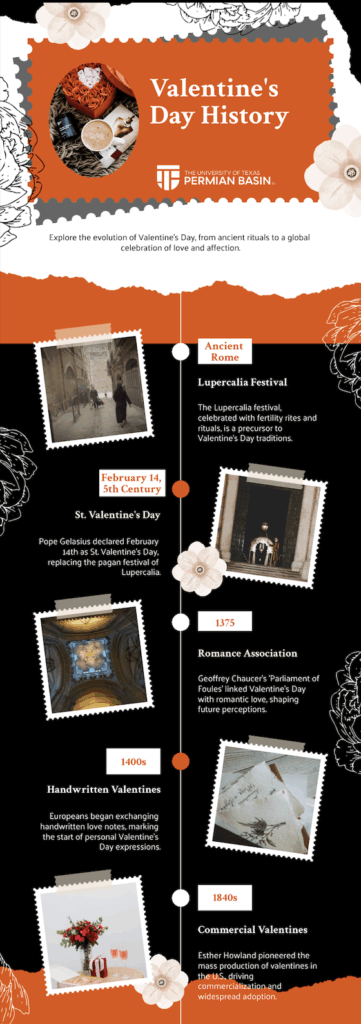
We’ll get back to St. Valentine. Now, our look at the origins of Valentine’s Day takes us to Ancient Rome and the pagan holiday Lupercalia. Celebrated on the ides of February, Lupercalia saw Roman men drink to excess, remove their clothes, and sacrifice a goat. (When in Rome!) They then took to the streets, slapping women with strips of goat hide. Roman women—if history is to be believed—lined up to take part, hoping it would lead to a healthy pregnancy.
Pope Gelasius was not a fan of Lupercalia, to say the least. Condemning the superstitious holiday in the late fifth century, Gelasius and the Catholic Church declared February 14 to be St. Valentine’s Day. Certainly, Gelasius picked the date to commemorate the death of St. Valentine, but we can’t help but wonder if he saw an opportunity to replace a pagan holiday.
When Did Valentine’s Day Become Romantic?
English poet Geoffrey Chaucer was the first to associate Valentine’s Day with romance. In his 1375 poem “Parliament of Foules,” Chaucer pointed out that Valentine’s Day coincided with the start of bird nesting season, lending credence to the idea that the day should be a celebration of love.
The idea caught on, especially after poets and playwrights further romanticized the holiday. “Tomorrow is Saint Valentine’s Day. / All in the morning betime, / and I a maid at your window, / to be your Valentine,” says Ophelia in Shakespeare’s “Hamlet.”
When Did Valentine’s Day Become Commercialized?
By the 1400s, friends and couples throughout Europe were exchanging handwritten poems: a precursor to today’s greeting cards. The practice came to the New World in the 1700s, about the time commercially printed cards were gaining popularity.
When Esther Howland of Massachusetts came across an imported card in the 1840s, she was inspired to improve on its beautiful but expensive design. Her creation of gilded lace, wafer paper, and cupid ornaments led to the first mass-produced valentines in America. “No other producer of commercial valentines understood so well their potential for the tactile communication of complex feeling,” wrote author Barry Shank.
A Brief History of Valentine’s Day and It’s Commercial Rise
Over the centuries, Valentine’s Day has transformed from a blend of Roman rituals and Christian martyrdom into one of the most celebrated and commercial holidays worldwide. Here’s a quick look at how it all unfolded, from ancient rites to record-breaking spending:
How Valentine’s Became a Commercialized Holiday
Today, Valentine’s Day is celebrated the world over. According to Hallmark, about 145 million Valentine’s Day cards are exchanged every year. Americans spent approximately $24 billion on Valentine’s Day in 2022.
Love it or hate it, Valentine’s Day has grown into one of the largest commercial holidays, with people everywhere shopping online and in person for the perfect gift for that special someone.
No, Valentine’s Day didn’t start as a marketing ploy. However, that hasn’t stopped marketers from using the holiday to boost sales or tailor their messaging to lovestruck audiences. (We’re guessing this isn’t what Pope Gelasius had in mind.)
Still, marketers must be capable of leveraging holidays like Valentine’s Day if they’re to help businesses, particularly e-commerce sites, rise above the competition.
Frequently Asked Questions About the Commercialization of Valentine’s Day
Curious how a holiday rooted in ancient Rome and Christian martyrdom evolved into one of the biggest spending events of the year? These commonly asked questions unpack the history, myths, and marketing behind Valentine’s Day.
When did Valentine’s Day become commercialized? The commercialization of Valentine’s Day began in the 19th century with the mass production of valentines. Esther Howland is credited with creating the first commercially successful Valentine’s Day cards in the U.S. By the 20th century, candy, flower, and jewelry companies joined in, transforming the holiday into a full-blown retail event.
Was Valentine’s Day invented by greeting card companies? No. Valentine’s Day has deep historical roots going back to both Roman and Christian traditions. While card companies like Hallmark helped popularize Valentine’s Day in the 1900s, the holiday predates them by centuries.
Why is Valentine’s Day considered a commercial holiday? Valentine’s Day is considered commercial because it heavily revolves around gift-giving, dining out, and spending on loved ones. In 2022 alone, Americans spent roughly $24 billion on Valentine’s Day gifts and celebrations.
How did Valentine’s Day become a holiday? The Catholic Church officially declared February 14th as St. Valentine’s Day in the late fifth century, possibly to replace the pagan festival Lupercalia. Over time, the day became associated with romance, especially after medieval poets linked it to love and courtship.
What role does marketing play in modern Valentine’s Day? Modern marketing plays a major role in shaping Valentine’s Day spending habits. From limited-edition product lines to email campaigns and influencer promotions, brands use targeted strategies to encourage consumer purchases leading up to February 14th.
Explore Marketing and E-Commerce at UT Permian Basin
The University of Texas Permian Basin offers an online undergraduate certificate in digital marketing. Accredited by the prestigious Association to Advance Collegiate Schools of Business (AACSB International), our certificate program provides foundational knowledge of advertising, marketing analytics, social media marketing, and other tools and strategies essential for careers in marketing.
We think you’ll be particularly interested in our online course E-Commerce, which covers such topics as content management, mobile commerce, and online auctions. Upon completion, you’ll be capable of implementing an e-commerce plan of your own.
Our certificate program can be completed in tandem with any of UT Permian Basin’s bachelor’s degree programs. Visit our Programs and Courses page to discover what UT Permian Basin online has to offer.
Ready to get started? Apply now to our online undergraduate certificate in digital marketing. We can’t offer you a Valentine’s Day card, but we think an undergraduate certificate is a worthy substitute.
Marketing is often seen as a fast-paced, exciting world that requires a highly competitive—or even cutthroat—sensibility. In reality, those who enter the marketing industry find a welcoming field that rewards individuals willing to learn and grow as leaders and communicators. At The University of Texas Permian Basin, students who earn an online Bachelor of Business…
Not even a week has passed since you stored away your Christmas decorations, and signs of the next big holiday are already on the rise. Pink and red heart-shaped boxes and a plethora of lovestruck stuffed animals line the shelves in every store. It’s official: Valentine’s Day is approaching. Thanks to several well-planned marketing strategies,…
A small candle business with a limited budget once relied solely on word of mouth to attract customers. But with a few well-placed social posts, some glowing customer reviews, and a simple video tutorial, their reach started to grow—and so did their sales. Stories like this aren’t rare. Small businesses everywhere are learning that with…