What Is Industrial Technology and What Can You Do With It?
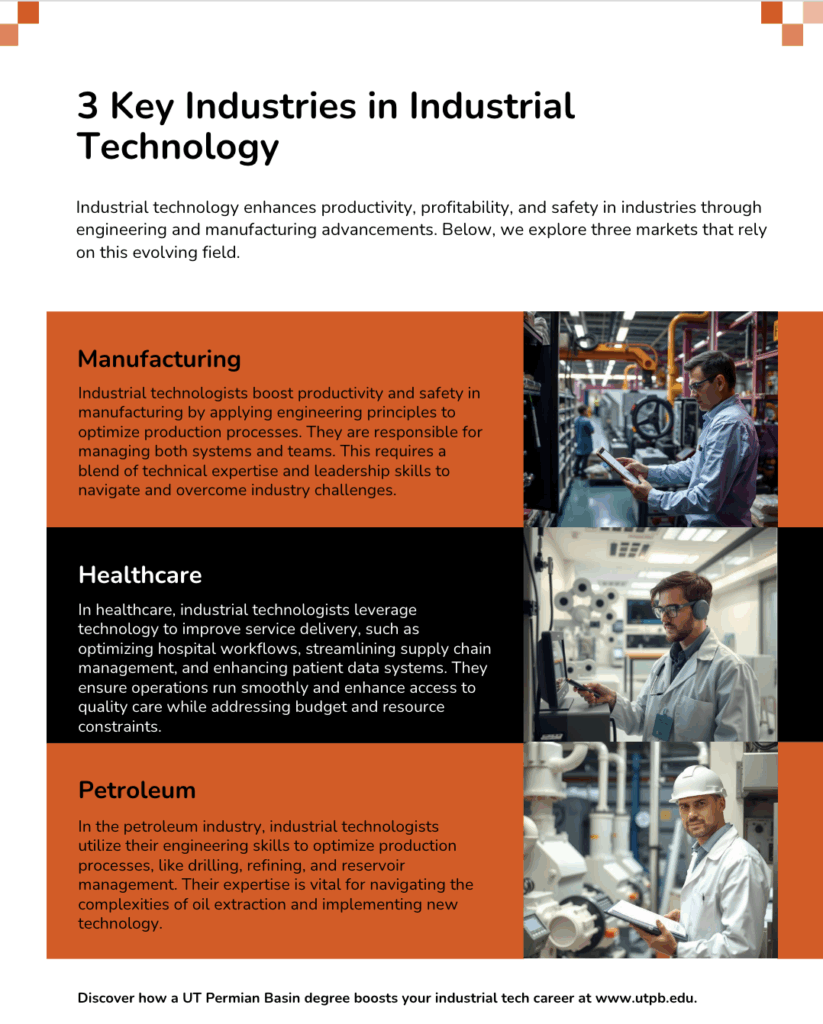
Industrial technology is the use of tools, systems, and technical knowledge to improve how industrial work gets done. It draws from areas like engineering, manufacturing, and management to make processes safer and more productive.
Professionals in this field help organizations work more efficiently across industries such as manufacturing, healthcare, and petroleum. Because industrial technologists can apply their skills in many settings, industrial technology can lead to a wide range of career paths, which we explore below.
What Does Industrial Technology Do in Manufacturing?
Industrial technology supports manufacturing by helping organizations improve production processes and manage teams. In this industry, industrial technologists often need both technical knowledge and leadership skills to keep operations running smoothly while working through constraints, like:
Budget limitations, which canaffect staffing, equipment, and production decisions
Time pressures, which can make it harder to meet production schedules and deadlines
Resource constraints, which can impact access to materials, tools, and workforce support
UT Permian Basin’s BSIT is designed with aspiring and current professionals in mind. In contrast, our BAAS-IT program provides individuals with an Associate of Applied Science degree with a direct path to a bachelor’s degree and can be tailored for professionals looking to advance their careers in the energy industry. Foundational manufacturing technologies covered in both programs include processes for fabricating metals, separating plastics, and conditioning composite materials.
How Is Industrial Technology Used in Healthcare?Industrial technology is used in healthcare to improve operations, streamline services, and support the effective delivery of patient care. As healthcare organizations adopt tools like electronic health records and other advanced systems, they need professionals who can help:
Designed for working professionals with an Associate of Applied Science, our online program prepares students for leadership roles, where their decision-making and problem-solving abilities will be frequently called upon.
Potential careers include:
Industrial engineer
Quality supervisor
Supply chain manager
How Is Industrial Technology Used in the Petroleum Industry?
Industrial technology plays an important role in the petroleum industry by supporting drilling, production, and other technical operations. In a field that depends on strong STEM skills, industrial technologists help organizations improve processes and support efficient, safe operations.
The Permian Basin is one of the world’s top-producing oil fields. Production, which declined in 2020 due to COVID-19, is now ramping up, and the number of hydraulic fracturing jobs now exceeds those from March of 2020.
The math, science, and engineering skills that make industrial technologists so valued in other fields make them indispensable in the petroleum industry, which is why UT Permian Basin developed a graduate certificate to help individuals capitalize on the oil boom.
Our online undergraduate certificate in petroleum technology provides professionals with a deeper understanding of the technology used in the petroleum industry. For example, our online course Drilling Technology covers the principles and technologies of mud, air, and gas drilling, among other topics. This certificate can be added to a student’s BAAS-IT, further distinguishing graduates from their peers.
Open the Door to New Possibilities at UT Permian Basin
What is industrial technology? It’s the improvement of industrial processes, but it’s more than that. It’s a way for you to open the door to new career possibilities. Rather than remain tied to one career or one industry, you can become a more well-rounded professional capable of thriving in a variety of fields.
UT Permian Basin offers several online degree options designed with professionals like you in mind. Courses are 100% online and asynchronous, which will allow you to progress through the program at your own pace. Virtual classrooms are led by industry experts with years of experience, who will help you expand your creativity and problem solving, improve your oral and written communication, and master engineering and manufacturing principles.
Ever check the tag on a t-shirt or appliance and see “Made in China” or “Made in Mexico”? Soon, you may be seeing more tags labeled “Made in the USA.” Today, there’s a reshoring trend that’s reopening factories, strengthening American manufacturing, and creating new opportunities for businesses and workers. As more companies move toward domestic…
Ransomware, phishing, viruses: If it’s connected to the internet, someone’s probably trying to hack it. Threats are everywhere in today’s digital world, and now that factories run on smart technology, it’s not just laptops at risk. Industry 4.0 has moved manufacturing from traditional methods to smart, automated systems (think robots and sensors on the factory…
Imagine a factory where machines, robots, and sensors are all talking to each other, like nerves sending signals to a brain. Before a human notices anything, the system’s already flagged a motor that’s starting to lag and adjusted a product’s assembly in seconds. This is connected manufacturing in action. Today’s smart factories run on connected…
“The most dangerous leadership myth is that leaders are born—that there is a genetic factor to leadership. That’s nonsense; in fact, the opposite is true. Leaders are made rather than born.” — Warren Bennis
Do you dream of making a real impact in the healthcare field—not just treating patients, but shaping the systems that care for them? Becoming a healthcare leader gives you the power to influence policies, drive innovation, and improve lives on a broader scale.
Whether you see yourself managing a hospital department or overseeing vital healthcare projects, this step-by-step guide will show you how to turn your passion into a purpose-driven leadership career.
What Is a Healthcare Leader?
A healthcare leader is someone who oversees key services that directly or indirectly impact patient care and organizational outcomes. This includes:
Administrators
Department directors
Project managers
Other decision-makers who guide healthcare operations
What Does It Take to Become a Healthcare Leader?
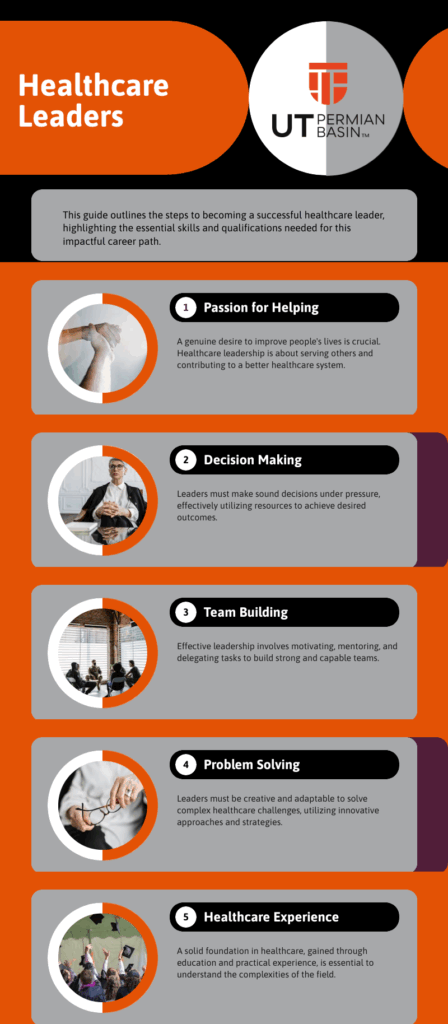
To succeed in a healthcare leadership role, you’ll need a combination of personal drive, practical skills, and real-world experience. Here are some key qualities and steps to help you get there:Be driven by a genuine passion for helping others.
Make sound decisions—even under pressure—and turn them into effective actions.
Use available resources strategically and efficiently.
Delegate responsibilities and mentor team members.
Think creatively to solve complex problems.
Gain prior work experience in healthcare, as most leaders work their way up in the field.
Becoming a healthcare leader takes more than ambition. t requires a unique mix of skills, experience, and education. Whether you’re just starting out or looking to move up, this infographic breaks down the essential steps to help you rise to the top and make a lasting impact in the healthcare industry.
Top Skills of an Effective Healthcare Leader
As you work toward a leadership position in healthcare, you’ll need to develop the skills required of a leader in practically any profession, including:
Determination
Integrity
Confidence
Charisma
Communication
Creativity
Patience
Flexibility
Quality focus
If you already possess some of these, you’re ahead of the game. But leadership is about lifelong learning, and even natural leaders benefit from refining their skills.Do You Need a Degree to Become a Healthcare Leader?
In addition to personal development, you also need to have formal credentials in healthcare leadership that show you’ve been educated by a credible source. This typically means earning a bachelor’s degree from an accredited institution.Why Now Is a Great Time to Enter Healthcare Leadership
The healthcare industry is growing rapidly due to an aging population, technological advancements, and policy changes. This growth has created demand for professionals who can lead teams, manage systems, and improve outcomes.
Here are in-demand leadership roles and their average salaries and job outlooks:
Medical and Health Services Managers According to the U.S. Bureau of Labor Statistics (BLS), the predicted job outlook for medical and health services managers through 2032 boasts a tremendous 29% growth rate—much faster than the average for all occupations. Median annual pay, as of 2020, is $117,960.
Project Management Specialists O*NET (Occupational Information Network) reports that jobs for project management specialists between 2022 and 2032 will grow by 7%—faster than average for all occupations. Median yearly pay, as of 2025, is $100,750.
Administrative Services and Facilities Managers BLS projections show that employment for administrative services and facilities managers will grow by 6%—faster than the average rate for all occupations—through 2032. Median pay, as of 2025, is $106,880 per year.
We Can Help Make You a Leader
The University of Texas Permian Basin is doing its part to nurture tomorrow’s healthcare leaders. Our AACSB-accredited College of Business offers two online bachelor’s degree programs that will help you develop effective healthcare leadership skills:
Learn demonstrated ways to implement BBA business fundamentals in a healthcare context through courses focused on financial management among healthcare providers, patient services, and the legal and regulatory environments of the healthcare industry.
In this program, you’ll learn proven strategies for complex problem-solving, project management and forecasting, and overcoming common limitations in the workplace regarding budget, time, and resources that every healthcare leader needs to know.
The Advantages of Online Learning at UT Permian Basin
Most courses for both of our healthcare management/leadership degree programs last just eight weeks, and all are delivered in an asynchronous, 100% online format. You can complete coursework on your own schedule, 24/7, from anywhere in the world while tending to ongoing work and family responsibilities. You’ll learn the same curriculum from the same renowned faculty who teach the programs on campus at UT Permian Basin, with added flexibility.
Hone your leadership skills for a rewarding career in healthcare. You’ll find the foundation you need in one of UT Permian Basin’s online healthcare management and healthcare leadership bachelor’s degree programs.
During the remainder of this decade, the U.S. healthcare industry is expected to undergo a tremendous expansion, with an anticipated growth rate of 16%. That translates to roughly 2.6 million new jobs in the U.S. alone. Globally, the healthcare market will have an estimated value of more than $300 billion by 2027 and exceed $665…
Future healthcare leaders are made here at The University of Texas Permian Basin, where we proudly offer an online Bachelor of Applied Arts and Sciences in Healthcare Leadership and an online Bachelor of Business Administration in Healthcare Management. Without question, both programs confer skills and credentials that are invaluable for anyone aspiring to a leadership…
A safe blood supply, steady heartbeats, and early breast cancer detection: Black Americans helped make these and other medical breakthroughs possible. This Black History Month, we’re shining a spotlight on healthcare heroes who changed patient care forever. Black Medical Heroes: Yesterday and Today How many medical heroes can you name? People like nurse and hygiene…
The terms mainstreaming (integration) and inclusion are often used interchangeably. The careful implementation of these contrasting teaching approaches, however, can have a profound impact on the academic outcomes of students with disabilities. Knowing the difference between inclusion and mainstreaming can help you better reach students with and without disabilities, so we encourage you to join us on this exploration.
What is mainstreaming in education? Essentially, mainstreaming requires that exceptional learners adapt to the rigors of the general education classroom, whereas an inclusive classroom adapts to the needs of individual students, including those with disabilities.
As we discuss the purpose of mainstreaming, consider how students’ lives are shaped by the efforts of general and special educators. Their dedication, compassion, and knowledge help ensure that there will always be a place for exceptional learners in the classroom, regardless of setbacks or limitations.
Mainstreaming
Mainstreaming consists of integrating students with disabilities into general education classrooms during specific times of the day. Students study subjects like reading, writing, or math with their nondisabled peers if their skills indicate that they can benefit from the lesson. Otherwise, they are taught by a special educator in a separate classroom. Detractors assert that mainstreaming assumes a child’s limitations must be addressed before they can be integrated into a general education classroom.
Inclusion
Inclusion involves systemic reform and altering teaching methods to ensure that all students are able to engage with learning materials. Rather than remove students with disabilities from the general classroom, special and general educators work collaboratively to provide them with individualized instruction. Research has shown that students with disabilities experience substantial short- and long-term cognitive and social development when taught in a general education classroom.
Determining Whether a Student Is Included or Integrated
7.1 million public school students received special education services during the 2018-2019 school year, according to the National Center for Education Statistics (NCES). During the same school year, 64% of students with disabilities spent the vast majority of their school day in general education classrooms. Unfortunately, that leaves millions of students who are unable to take full advantage of an inclusive classroom, which brings us to the topic of the Individuals with Disabilities Education Act (IDEA).
Least Restrictive Environment
Enacted in 1975, IDEA entitles students with disabilities—regardless of their severity—to speech-language pathology, physical therapy, psychological services, and other special education and related services. Under section 300.224 of IDEA, students with disabilities have a right to be educated in the least restrictive environment (LRE) available. The LRE for a student with disabilities is the environment that will, to the maximum extent appropriate, allow them to interact with and learn alongside nondisabled students. Students are to be removed from the traditional classroom if and only if their disability is severe enough to warrant special schooling or placement in a special education classroom.
Who determines whether a student is mainstreamed or placed in an inclusive classroom? A team comprised of parents, general education teachers, special education teachers, and other parties with an understanding of the services the child needs. Along with the student (when appropriate), this team will develop an Individual Education Plan (IEP): a unique document that, among other determinations, outlines to what extent a child can participate in a regular classroom.
Deciding What’s Best for Students
In an inclusive learning environment, students with disabilities experience improved academic outcomes, have fewer absences, and receive better instruction. Furthermore, they are more likely to complete secondary school, enroll in post-secondary education, obtain employment, and live independently. Individualized instruction provided in an inclusive classroom also benefits nondisabled students, and exposure to their disabled peers can help them grow more accepting of others.
The benefits of an inclusive classroom are manifold. However, students with severe disabilities may spend far less time in general education classrooms, where they are integrated only when appropriate. The purpose of mainstreaming students isn’t to isolate students from their peers. Rather, it’s to help ensure that they are receiving the individualized attention they deserve. The extent to which a child is mainstreamed is dependent on their IEP team, including their special education teachers.
Enrich the Lives of Students With Disabilities
One of the few criticisms of an inclusive classroom is that it requires general education teachers to possess the necessary skills and qualifications to effectively teach students with disabilities. To foster inclusivity, teachers must be able to meet the challenges presented by diversity, inadequate support, and barriers to learning opportunities as well as students’ emotional, behavioral, and learning disorders. At UT Permian Basin, teachers can learn how to overcome these challenges and cater to the needs of students with and without disabilities.
Entirely online and featuring asynchronous elements, our master’s degree programs can help you expand your teaching skill set without having to leave your current teaching position. As a graduate student, you’ll learn to diagnose learning difficulties, provide classroom interventions, and prescribe IEP plans, among other learning outcomes. Lessons taught in our online classrooms are immediately applicable to your career, helping you become a more effective, well-rounded educator.
UT Permian Basin’s College of Education offers the following online special education programs:
Earning a master’s degree in special education can help you not only reach a broader range of students but also transition into a career as a special educator, if you so desire. Moreover, a master’s degree in special education will empower you to take a more active role in deciding to what extent an exceptional learner can be taught alongside their nondisabled peers.
Before GPS came built into our phones and cars, many of us relied on printed directions from MapQuest. You’d enter your destination, print out a list of step-by-step instructions, and hope you didn’t miss a turn—because if you did, rerouting wasn’t an option.
If you happened to miss an exit or take a wrong turn, you had to rely on your own (sometimes questionable) sense of direction to get back on track. But even MapQuest was just a moment in time in the broader evolution of geospatial technology.
Today, we’re diving into the roots and remarkable growth of geospatial technologies—exploring everything from ancient navigation tools to satellites, drones, and AI.
What Is Geospatial Technology?
If you’ve ever used GPS to get around, you’re not alone—93% of people have. That everyday convenience is just one example of geospatial technology in action. But its uses go far beyond road trips.
Geospatial technology refers to the tools and methods used to collect, analyze, and interpret data about the Earth’s surface. This includes information from satellites, drones, remote sensors, and mapping systems, used in everything from city planning to climate research.
As high-speed data networks and computing power have advanced, so has the complexity and precision of geospatial tools. Today, these technologies support global efforts in fields like environmental conservation, military intelligence, disease tracking, and infrastructure development.
Geospatial Technology: The Early Era
Let’s take a brief look at geospatial-related tools and technologies of centuries past.
Hand-Drawn Map
Cartography, or mapmaking, dates back to the B.C. era. Early maps were often based on explorers’ accounts and typically depicted the world as a flat disc, showing only the continents now known as Europe, Asia, and Africa. The Americas, Australia, and Antarctica had yet to be discovered.
The magnetic compass was developed in China around the time of the transition from the B.C. era to the A.D. era. It enabled more accurate navigation, especially at sea, and became essential for global exploration.
Atlases, or collections of maps, were first published in the 16th century. They helped standardize geographic knowledge and made it more accessible to scholars and explorers alike.
The first fully functional telescope is believed to have been invented in 1608. It allowed astronomers and navigators to observe distant objects, improving both celestial mapping and navigation accuracy.
The sextant, invented in the mid 1700s, is a tool used to measure the angle between the horizon and a celestial object like the sun or stars. It helped sailors figure out their exact position at sea and was a major breakthrough in navigation long before GPS existed.
Geospatial Technology in the Modern Era and Beyond
The development of photography in the 19th century paved the way for more detailed and precise ways of gathering geospatial information.
As early as the 1860s, balloons, kites, and even birds were fitted with cameras, enabling people to capture views of cities and topographical features from the air. Planes were used for this purpose beginning in the early 1900s.
The first manmade satellite was launched into space by the Soviet Union in 1957. Satellites have since been used for military surveillance, cartography, and communications.
If you’ve ever seen a person standing on the side of the road, wearing a bright safety vest, looking through an instrument on a tripod, that may not have been a camera or a telescope they were using.
The total station has been around since 1971 and is used to measure distance and vertical and horizontal angles. It’s commonly used in civil engineering, construction, and surveying and can assist in making maps, identifying property lines, and determining precisely where a new road or building should be located.
According to the U.S. Department of Defense (DOD), GPS is “a satellite-based navigation system that helps people find their precise location on Earth.” GPS technology as we know it today began as a DOD project in 1973. It was initially reserved for military use, but in 2000 it became available to anyone with the necessary equipment after President Clinton issued an executive order.
21st Century Total Station
The contemporary total station integrates technological advances such as robotics, GPS, and remote-control capabilities. Data from these total stations can be downloaded and used with software to render vivid 3D images.
Unmanned, remote-controlled aircraft, sometimes called Unmanned Aerial Vehicles (UAV), have been used for military purposes and surveying/mapmaking for many years. 2006 marked the first use of drones for other commercial and personal purposes, such as delivery and photography.
As with many industries, artificial intelligence (AI) revolutionized the GIS and geospatial sectors. Identifying topographic features in satellite images is just one of many current AI applications, and its future potential in the geospatial field is tremendous.
Advance Your Career with a Graduate Certificate in GIS
The University of Texas Permian Basin has served the GIS and geospatial industries for more than 20 years. Our close association has given UT Permian Basin an up-to-date, insider’s perspective of the industry that we’ve drawn upon in creating the curriculum for our online GIS and Geospatial Certificate.
This 12-credit graduate certificate program helps you develop practical skills that can benefit individuals in the oil and gas industry, the geospatial industry, and environmentally oriented careers. In just four courses, you’ll explore the technology, practices, and principles at work in the geospatial industry today.
The Convenient Way to Earn Career-Enhancing Credentials
Delivered through asynchronous, 100% online courses, our graduate program provides you with exceptional convenience and flexibility. You can complete coursework on your own schedule, practically anywhere, enabling you to learn around any job or family responsibilities you might have. Each course lasts eight weeks and is taught by the same acclaimed educators who teach the courses at the UT Permian Basin campus.
Explore today’s GIS and geospatial technology and trends as you gain a career-enhancing credential in our online GIS and Geospatial Certificate program!
Modern video games can recreate the real world with stunning precision, and GIS technology is what makes that possible. In fact, when fire ravaged Notre-Dame Cathedral in Paris in 2019, a detailed digital model built for the video game “Assassin’s Creed Unity” surfaced as a potential reconstruction reference. GIS is rapidly reshaping what it means to play video games today. This article examines: What Is GIS? …
On December 26, 2004, a massive earthquake struck beneath the Indian Ocean and sent a wall of water nearly 100 feet high outward. It barreled into South Asia at 30 miles an hour, wiping out communities before most people even knew what was coming. By the time the waves crossed the ocean, nearly 230,000 lives had…
Imagine you’re commuting to work and your Google Maps loses signal. Suddenly, the little blue dot stops moving and you don’t know where you are. Panic ensues (for some of us). Modern devices constantly broadcast our location through GPS, Wi-Fi, cell towers, and apps. We’re basically walking beacons of sensitive data. But here’s the flip side:…
Miami police officers responding to a 911 call found two men sitting in the street. One was holding an unknown shiny object. The other man put his hands up, but the man holding the object ignored police commands. An officer fired a gun at him, but the shot missed its intended target and hit the other man in the leg.
The shiny object turned out to be a silver toy truck. The man holding it was autistic, and the man with him—the one who was shot—was a behavioral therapist who was trying to calm him down. Individuals on the autism spectrum, which includes a range of developmental disabilities, are at high risk for mental health crises.
The officer who fired the shot, and who was probably not adequately trained to understand what was happening, was ultimately convicted of culpable negligence. The shooting victim was hospitalized and recovered from his wound.
This was an unfortunate incident, but it could’ve been far worse.
How Does Law Enforcement Handle Mental Health Issues? Salt Lake City police officers responding to a call that a juvenile had been threatening people with a weapon encountered a 13-year-old boy. When the boy ran, he was shot multiple times by police. No weapon was found on him. The boy’s mother said she had called for emergency assistance in taking her son, who had Asperger’s syndrome, to a hospital during a mental health crisis. The boy survived the shooting but has lasting health issues.
The incident led a former Salt Lake City police chief to state, “If we cannot respond, as a police agency, to a 13-year-old child who has autism, without shooting him, I don’t know if we should be in this business.”
A Killeen, Texas, family called police requesting a mental health professional when a member of the family, Patrick Warren Sr., was experiencing a mental health crisis. No officer with mental health training was available, and a police officer responded to the family’s call. When the officer arrived, Warren emerged from his house, and when he failed to comply with the officer’s order to “sit down,” the officer fatally shot him. Warren was unarmed.
According to one report, nearly 25% of all suspects killed by police in 2020 were diagnosed as having a serious mental illness. A look back to five years prior shows similar results, with one quarter of people shot dead by police in the first half of the year alone having been “in the throes of mental or emotional crisis.” Another report stated that people suffering from mental illness are “16 times more likely” to be killed by law enforcement than suspects who don’t have mental health issues.
Mental illness isn’t the only root cause of mental health crises, however. People with developmental disabilities and individuals going through a tough time, even without any underlying conditions, may also have mental health episodes. These cases need to be treated with great sensitivity. Too often, however, law enforcement handles mental health issues with potentially deadly force. Outcomes for these incidents could improve drastically if officers understood that they were dealing with a person who was experiencing a mental health crisis.
There’s no question that law enforcement is a dangerous profession, with police officers forced to make life-or-death decisions quickly and in hazardous circumstances. There have been numerous documented cases of police officers being injured or killed by mentally ill suspects. However, the number of suspects killed by police could be significantly decreased if some key changes are made to law enforcement protocols.
What’s Needed for Change Deadly incidents have prompted a widespread call for increased mental health training for police officers, most of whom aren’t currently qualified to handle suspects with mental health problems. Some believe that law enforcement shouldn’t be dealing with such individuals at all. This underscores the need for a twofold approach to the problem:
More Training Some reports show police receive only eight hours of crisis intervention training. Those publicly calling for expanded training include police chiefs, chiefs of staff to police commissioners, and high-profile public policy organizations. Yet, as of June 2020, an average of only 16% of police departments nationwide were using Crisis Intervention Teams (CITs), which utilize mental health professionals. Still, CIT is becoming a “model for police interactions in crisis situations involving persons in the community with mental, emotional, or developmental challenges.”
More Alternatives Not everyone agrees police should be the first responders to emergency calls. The city of Eugene, Oregon has begun to handle non-criminal calls that come into 911 in a different way. Instead of sending police, the city sends mental health workers as part of a program it calls CAHOOTS (Crisis Assistance Helping Out On The Streets). During 2019, the CAHOOTS team requested law enforcement assistance on less than 1% of the calls to which it responded.
Our Online Degree Programs Can Help The University of Texas Permian Basin offers online bachelor’s degree programs that can help you perform to your potential in a criminal justice career. By developing a better understanding of the behavior and motivations of the people you interact with, you’ll gain a critical tool in avoiding unnecessary use of force.
Bachelor of Science in Criminology and Criminal Justice Studies Our program prepares you toprotect and serve your community as youwork towardpositive changes to the criminal justice system from the inside.You’ll examine topics including the use of force by police and the control of police behavior.
Bachelor of Arts in Psychology Build a broad foundation of psychological science knowledge through an emphasis on crucial written communication and research skills beneficial in helping professions and beyond. You’ll explore topics such as abnormal psychology, social psychology, and positive psychology.
Online Learning Convenience We offer all of the courses for these programs in an asynchronous, 100% online format that enables you to earn a valuable credential on your own schedule, practically anywhere, while keeping up with your professional and personal duties. Many courses last just eight weeks, and you’ll learn from the same respected faculty who teach these courses on the UT Permian Basin campus.
Individuals with mental health issues continue to be killed by police in tragic misunderstandings. The right training can help prevent such incidents. An online Bachelor of Science in Criminology and Criminal Justice Studies or Bachelor of Arts in Psychology from UT Permian Basin is a good place to start.
Earning a university degree can equip you with skills and credentials that will be a tremendous asset in your professional life. As Abigail Johnson Hess reports on CNBC.com, the long-held notion that a college degree “can be a clear path to stronger job opportunities and higher earnings” still holds true. College graduates take home about $30,000 more each year than those whose highest level of education completed is high school.
When choosing a college degree, it’s important to follow your passion, but you should also consider whether the field you’ve chosen has growth potential. Once you’ve found a promising professional area, having an educational credential that employers value can help you compete for emerging positions.
With these facts in mind, let’s look at the added benefits of a degree in business. According to the U.S. Bureau of Labor Statistics, employment in business and financial operations occupations is expected to grow by 5% by 2029, which is faster than the average growth rate for all occupations. That amounts to nearly half a million new jobs for which a bachelor’s degree is the minimum educational requirement. If you’re a business-oriented job seeker, or plan to be one, earning a Bachelor of Business Administration can be the differentiator that gets you in on the ground floor.
A four-year degree is not your only option for professional advancement, however. You can add an undergraduate certificate in digital marketing to any online bachelor’s degree program at The University of Texas Permian Basin. If you have a passion for business, mastering digital commerce is a shrewd career move. Commerce in the digital realm is growing and is expected to continue doing so, creating more job opportunities in this innovative field. Let’s look at digital commerce a little more closely and see why a BBA degree combined with an undergraduate certificate can benefit you.
What Is Digital Commerce? According to one definition, digital commerce “enables customers to purchase goods and services through an interactive and self-service experience. It includes the people, processes and technologies to execute the offering of development content, analytics, promotion, pricing, customer acquisition and retention, and customer experience at all touchpoints throughout the customer buying journey.” Some of the most popular digital marketing channels include social media, paid search, search engine optimization (SEO), affiliate marketing, and email.
The Future of Digital Commerce Digital commerce, also referred to as e-commerce, has been growing steadily for some time. What’s more, COVID-19 has hastened a digital-first strategy among retailers in a market where brick and mortar commerce was already on the decline, according to an Entrepreneur.com article. In parts of the world where the coronavirus was particularly prevalent, Facebook marketing jumped 50%. The increase in digital commerce is expected to spur a corresponding increase in job growth in roles as diverse as sales, operations, software and app development, and content creation. As of 2020, purchases through digital commerce channels made up 10% of all retail sales, a number that’s predicted to increase by 15% annually.
Our Online Bachelor of Business Administration Programs UT Permian Basin offers four AACSB-accredited BBA programs online, each in a vital and dynamic business field:
Bachelor of Business Administration in Accounting Build awide-ranging skillset in analyzing and solving financial problems as you receive expert guidance for accounting careers in nonprofit, government, public, or private organizations, or as a CPA.
Bachelor of Business Administration in Marketing Prepare to expertly promote an organization through both traditional and digital marketing efforts based on effective analyses of demographics and consumer behavior.
Our Online Undergraduate Certificate in Digital Marketing You’ll compound the skills and credentials gained from our BBA programs with a specialized undergraduate certificate. Certificates will expand your expertise and help position you for a broader choice of professional roles.
Our online undergraduate certificate in digital marketing is a 12-credit certificate program comprised of your choice of four eligible courses, all of which are offered as electives in our BBA programs. By choosing these applicable electives, you’ll earn an additional credential while completing the same number of total credits in the same amount of time—with no delay in graduation.
Our digital marketing certificate program will help you understand and succeed within the rapidly evolving digital landscape. You’ll gain a foundational understanding of the differences between traditional and digital marketing, build proficiency in Google Analytics and other search engine optimization tools, and master social media’s unique marketing tactics.
Advantages of Earning College Credentials Online Our Bachelor of Business Administration degrees and undergraduate certificate in digital marketing are presented in a 100% online asynchronous format. This allows you to complete your coursework anywhere with internet access, 24/7, at your own pace. If you have professional or family responsibilities to attend to, or both, our flexible program is just what you need. Most of our program courses last just eight weeks, and all are taught by the same acclaimed faculty who teach them on campus. When you’re done with your degree program, you’ll graduate with two respected, career-enhancing credentials that can help you in many business roles.
Expand your business acumen and career potential by adding our undergraduate certificate in digital marketing to your UT Permian Basin BBA program!
The energy sector is growing steadily, and that means that there will be many jobs available to those with the right qualifications for years to come. If you’re already in one of these roles, an advanced degree or certificate can position you for management-level roles within your organization. However, at any stage of your career, you may be able to directly benefit from: A credential from an accredited, renowned business school on your resume.
A credential from an accredited, renowned business school on your resume.
Faster-than-average job growth.
Six-figure income potential.
Let’s examine what types of energy business roles are available and the educational credentials that can help keep you competitive for them at hiring time.
Rewarding Career Paths Here are three vital business roles that you can pursuewithin an energy organization:
Financial Manager Financial managers develop financial documents, guide organizations’ investments, and map out future financial objectives. Financial management is experiencing an employmentboom, and with that boom comes highly competitive compensation rates. The U.S. Bureau of Labor Statistics(BLS) projects that financial manager jobs will grow by 15%—much faster than the average growth rate for all jobs—from 2019 to 2029. Perhaps even more notably, median annual pay for financial managers in 2019 was$129,890.
The BLS also reports that many businesses favor candidates who have a master’s degree in business administration or a related field, making our Master of Business Administration degree, which includes financial management as a core part of its curriculum,a sound professional investment.
Marketing Manager Marketing managers are in charge of promoting a business’ brand, and their field is also a growing and highly lucrative one. According to the BLS, there will be a 6% increase in the number of marketing management jobs in the United States between 2019 and 2029. That’sfaster than the average growthratefor all jobs, which is 4%. Further, median pay for marketing managers is $135,900 per year. Marketing management is also included as a core part of ourMaster of Business Administration degree program.
Financial Analyst Financial analysts guide organizations and individuals in their investment choices. Right now, there’s a strong need for financial analysts in the U.S., and that trend will continue. The BLS forecasts a 5% increase in financial analyst jobs from 2019 through 2029, representing a growth rate faster than the national average. Median annual pay for financial analysts is estimated at $81,590, but some sources suggest those who work as financial analysts in the renewable energy sector can earn even more per year. In addition, the BLS states that a Master of Business Administration can boost a financial analyst’s potential for career advancement.
Online Programs to Accelerate Your EnergyBusiness Career The University of Texas Permian Basin offers online graduate degree and graduate certificate programs that can help youlaunch or advance within a career in the energy industry or an energy-related field.Both of these programs are delivered 100% online through our AACSB-accredited College of Business.
Graduate Certificate in Energy Business This graduate certificate program is offered as a 12-credit stand–alone credential and translates yourexpertisein accounting, business law, finance, management, and marketing to the rapidlyexpanding energy industry.
Career-Friendly Online Convenience All program courses are presented in an asynchronous online format that allows you to earn a respected credential on your own schedule while upholdingyour professional and personal responsibilities. Our program courses are taught by the same celebrated faculty who teach them here on campus, and most of the courses last only eight weeks!
Build the expertise needed to excel as a leader in an energy-related careerwith a UT Permian Basin online MBA or Graduate Certificate in Energy Business.
Stories related to the U.S. criminal justice system often make headlines. However, many of the complex and controversial issues covered in these stories don’t lend themselves to simple, clear-cut solutions and news-ready synopses. Here, we examine five current issues in criminal justice and explore the degree programs that can help make sense of these complex subjects:
Body Cameras Increased attention on fatal incidents involving alleged police misconduct has spurred a push to make body cameras standard equipment for police, alongside handcuffs and pepper spray. The intent is to achieve greater accountability and transparency regarding police actions through recorded evidence. This is potentially beneficial because video footage may exonerate the officer or the suspect involved.
The use of body cameras has broad support—90% of American voters, according to one survey—and is expanding, with the Department of Justice announcing it will permit officers nationwide to use body cameras under certain conditions. Body cameras do have their critics and downsides, however. In some jurisdictions, officers are not permitted to turn their cameras off while on duty. This creates privacy issues for police, who often take restroom breaks or take personal calls while on duty, and for bystanders who may be inadvertently recorded during an investigation.
Human Trafficking Human trafficking, the act of smuggling a person for the purpose of forced labor, is a $150 billion business. The case of Jeffrey Epstein, an American financier with personal ties to royalty, world leaders, and major celebrities, is perhaps the highest profile sex trafficking story in recent memory. While all 50 states have anti-human-trafficking laws on the books and increasing focus is being directed toward helping survivors, addressing and preventing human trafficking still presents many challenges.
According to the Center for American Progress, these challenges include a lack of solid data about sex trafficking involving minors, the tendency of society to see trafficked individuals as criminals rather than as victims, and the justice system and social services failing to recognize victims and potential victims of human trafficking. Further, business owners and the public may unwittingly support human trafficking through companies that are ostensibly legitimate, e.g., hotels and other hospitality businesses, banks, and transportation companies.
Marijuana Legalization A growing number of states are legalizing marijuana for recreational use, which has created some new concerns for law enforcement. There has been an increase in burglaries of marijuana dispensaries and violence toward their employees, as well as increased criminal activity in the surrounding neighborhoods. Further, determining how impaired a driver might be by cannabis during a traffic stop is a more complex process than testing for alcohol intoxication. The Breathalyzer has been used to detect alcohol in a driver’s system since the 1950s, but an equivalent and accurate device for detecting cannabis is still under development.
Genealogy Database Use The Golden State Killer, who murdered at least 13 people and raped dozens more during the 1970s and 1980s, was apprehended in 2018 using a method relatively new to law enforcement. Police involved in the case uploaded DNA evidence from a crime scene to GEDmatch, a public genealogy website, and found a DNA match from one of the killer’s distant relatives. This eventually led them to Joseph James DeAngelo Jr., who was convicted as the Golden State Killer in 2020.
DNA evidence is possibly the most definitive type of evidence in crime investigation, but the use of data from genealogy websites by police is controversial. People tracing their family history through a genealogy website may not want to have their information used by law enforcement. There are also concerns that this use of data by police violates the Fourth Amendment, which prohibits unreasonable search and seizure. These concerns notwithstanding, in 2019 a Florida judge ordered GEDmatch to give police full access to its database.
Sentencing Disparities The expression “justice is blind” is intended to suggest that the justice systems “sees” and treats all people equally. This ideal is often not reflected in criminal sentencing, however, as a federal government report has shown. For instance, Black men receive longer prison sentences—an average of 19.1% longer—than white men under similar circumstances. The same report shows that women of any race receive shorter prison sentences than white men. Advocacy groups such as The Sentencing Project are actively working to end such sentencing disparities.
A Career-Enhancing Online Education in Criminal Justice The University of Texas Permian Basin offers online degree programs in criminal justice that can prepare you to enter into or advance within this dynamic field. Both programs are presented in an asynchronous, 100% online format that enables you to learn at your own pace, anywhere, around your personal and professional responsibilities.
If you’ve already completed a bachelor’s degree in criminal justice or another field, you may want to consider the professional benefits that a graduate-level criminal justice credential can bring to you.
Master of Science in Criminal Justice Administration This onlineprogram is designed for professionals working within the criminal justice system who wish to advance into leadership positions, anditcan also benefit undergraduate degree holders lookingto develop a mastery of criminal justice concepts. You can earn an online master’s degree in criminal justice administration from UT Permian in as little as one year.
Explore criminal justice online with UT Permian Basin and earn a respected degree that can expand your expertise and bring greater employment opportunities.
How an organization communicates during a crisis can significantly impact its reputation. In some cases, it can even determine whether the organization survives the fallout. That’s why crisis communication strategies are so important; they’re the methods organizations use to communicate clearly, quickly, and empathetically during challenging situations.
Take Airbnb’s reaction to the COVID-19 pandemic, for instance. When the start of the pandemic seemingly shut down the world (including everyone’s vacation and travel plans), Airbnb lost around 80% of its bookings.
However, thanks to maintaining open lines of communication and showing empathy to all stakeholders involved, the company wrote its own narrative. This effectively saved Airbnb from going under while also garnering renewed loyalty and respect from hosts and travelers alike.
In this article, we’ll use Airbnb’s example to explain three of the most effective ways to handle crisis communication: social media, press conferences, and empathy.
#1 Social Media: Quick, Cost-Effective, and Engaging
Social media is often the fastest and easiest way for organizations to respond during a crisis. It gives them a chance to:
Communicate quickly
Keep people informed
Stay visible when it matters most
In 2020, as Airbnb’s bookings rapidly declined amid the uncertainty of the COVID-19 pandemic, the company used digital platforms to deliver fast, empathetic messaging. This helped the public understand what was happening and why. The use of social media also made it clear that Airbnb wasn’t hiding from the problem.
Here are a few ways Airbnb used social media effectively:
Sharing Timely Updates
Platforms like X (formerly Twitter) and Facebook allow companies to respond quickly. In a fast-moving situation, that speed matters—especially when people are looking for answers.
As hosts began losing bookings and guests wondered whether they’d be eligible for refunds, Airbnb shared updates on its evolving policies. This gave all stakeholders peace of mind and showed that Airbnb had a plan in place—instilling confidence in how the company was handling the situation.
Striking the Right Tone
Tone can make or break a message, and CEO Brian Chesky’s communication leaned toward comfort and honesty. With a human, empathetic tone, his letters and emails openly expressed regret for the pain caused by mass cancellations—even while explaining why they were necessary.
Engaging the Community
Social media gives organizations the chance to respond to questions and clarify concerns in real time. With both hosts and guests worried about losing money, Airbnb announced it would spend $250 million to partially reimburse hosts for canceled bookings. That strategy was shared across social media, blog posts, and through Chesky himself—keeping the messaging consistent and personal.
#2 Press Conferences: Open and Transparent
For more serious or complex situations, like impending host refunds and companywide layoffs, Airbnb needed to communicate directly and clearly to everyone affected. CEO Brian Chesky did just that.
Here are a few ways he effectively used virtual press-style communication during a time when in-person meetings weren’t possible:
Creating a Personal Connection
When times were hard, Chesky made the difficult decision to let 25% of his company go. But he didn’t do so quietly or impersonally. Rather, he sent open letters to employees, letting them know the why behind the what and making sure to outline how the company would support them both financially and emotionally.
Seeing a CEO like Chesky address the issue head-on in a public statement, rather than hiding behind a stale press release, helped the message feel more sincere. It also showed that the company was taking the matter seriously.
Answering Public Questions
In the midst of COVID-19, Chesky wasn’t able to host in-person press conferences, but he gave the public the next best thing: virtual briefings. He invited questions and shared regular video messages to clarify policy changes and the company’s latest strategies.
He also appeared on podcasts, news broadcasts, and livestreams to explain Airbnb’s decisions in real time, making space for transparency and public dialogue when it mattered most.
#3 Empathy: The Common Thread
What tied Airbnb’s crisis communication together wasn’t just speed or transparency: It was heart. Across social media, blog posts, and executive statements, the company communicated with real emotional intelligence.
CEO Brian Chesky summed it up best in the closing lines of one of his open letters:
“Our mission is not merely about travel. When we started Airbnb, our original tagline was, ‘Travel like a human.’ The human part was always more important than the travel part. What we are about is belonging, and at the center of belonging is love.”
That mindset shaped how Airbnb handled the pandemic: with compassion for employees, understanding toward guests, and meaningful support for hosts. It’s a reminder that when a company leads with kindness, people remember not just what happened but how they were treated.
Want to Master Crisis Communication?
Crisis communication isn’t just about damage control. It’s a valuable professional skill that can make a real difference across industries. If you want to sharpen your communication skills and learn how to respond with clarity and confidence, consider the online Bachelor of Arts in Communication from The University of Texas Permian Basin.
Courses are asynchronous and delivered in eight-week sessions, so you can work at your own pace. With six start dates a year, it’s easy to find a time that fits your schedule.
Picture Martin Luther King Jr. standing on the steps of the Lincoln Memorial, delivering his “I Have a Dream” speech to over 250,000 people gathered for the March on Washington. Could he have known, in that moment, that his words would terrify some, inspire many more, and echo across decades of social movements? King and…
You can speak the same language as someone and still completely miss each other’s meaning. That’s part of what makes intercultural communication so important. Whether you’re working with international teams, studying abroad, or connecting with people from different backgrounds, communication involves more than just choosing the right words. Intercultural communication is how people from different cultures share ideas and make sense of one…
AI is now an inseparable part of our classrooms, homes, and offices. Capable of performing trillions of calculations in a second, AI-powered machines dredge the depths of the internet to find and convey information in any style, language, or difficulty level. But don’t worry, AI is only here to lend a hand. At least, that’s…
If you’ve ever Googled “How hard is the CPA exam?” you know the answer: very. The full exam runs 16 hours and is divided into four sections, each one focused on a core area of accounting:
Auditing and Attestation (AUD)
Business Environment and Concepts (BEC)
Financial Accounting and Reporting (FAR)
Regulation (REG)
If you asked a student preparing for the CPA, they’d probably tell you it feels like a part-time job.
The good news? The University of Texas Permian Basin’s online Master of Professional Accountancy (MPA) is built to support that journey. Our coursework aligns with all four CPA exam areas and helps you meet key eligibility requirements—especially if you’re planning to become a CPA in Texas.
The takeaway: You don’t have to navigate this process alone. The right program can make all the difference.
How UTPB’s Online Master of Professional Accountancy Helps You Become a CPA in Texas
UT Permian Basin’s 100% online, AACSB-accredited Master of Professional Accountancy gives you the flexibility and structure you need to move toward CPA eligibility—without pressing pause on your career or personal life.
This program helps you build a strong foundation in both traditional accounting principles and the modern, tech-forward practices today’s organizations rely on. As you progress, you’ll learn to think critically, communicate clearly, and apply accounting concepts in real business settings.
And because the entire program is delivered online and asynchronously, you can learn:
Anywhere (your couch, a coffee shop, even a late-night study session after work)
Anytime (early mornings, lunch breaks, weekends)
At a pace that works for you
Additional program benefits include:
Courses designed for busy schedules—most run just eight weeks
Instruction from the same respected PhD-level faculty who teach on campus
The option to finish your degree in 2 to 4 years
Once you graduate, you’ll have completed key educational requirements needed to sit for the CPA exam, and you’ll hold a graduate degree that helps you stand out in a competitive field. For many employers, that combination—MPA + CPA eligibility—signals readiness, commitment, and advanced training.
6 Great Reasons to Become a Certified Public Accountant
Accounting is already a stable, respected career. But earning your CPA license takes things one step further. Here’s why so many professionals decide the extra effort is worth it:
Professional respect: The “CPA” credential carries serious weight. Clients and colleagues see CPAs as experts at the top of their field.
Higher earning potential: On average, CPAs earn up to 15% more than non-CPA accountants.
Career advantage: That three-letter credential on your résumé instantly helps you stand out during hiring.
Strong job demand: Changes in regulations, demographics, and student pipelines mean CPAs remain in high demand across industries.
More variety in your work: Today’s CPAs aren’t limited to one type of accounting job. Many work in consulting, analytics, technology, or even travel-based roles.
Industry flexibility: CPAs are needed everywhere—from healthcare and finance to nonprofits, energy, government, and tech.
Put simply: Earning your CPA opens doors you may not even know exist yet.
How Long Do You Have to Pass the CPA Exam?
Once you start the CPA exam, the clock begins ticking. You’ll have 18 months to pass all four sections, in any order you choose. Pass rates typically fall between 50 to 66%, so many candidates retake at least one section. It’s normal—and it’s exactly why strong academic preparation matters.
The CPA exam isn’t just a test; it’s a journey. Programs like UTPB’s online Master of Professional Accountancy are designed to help you start that journey with confidence.
Prepare for the CPA Exam With UTPB
If earning your CPA is part of your long-term plan, now is the perfect time to take the next step. Our online Master of Professional Accountancy can help you meet educational requirements, sharpen your accounting expertise, and prepare to sit for the exam, all while fitting school around your life—not the other way around.
Your future as a CPA starts with a program designed for where you’re headed.
When you hear the word “accountant,” who comes to mind? Someone balancing spreadsheets and filing taxes? If so, you’re on the right track. But there’s more to it. Within the field of accounting, one credential stands apart: the Certified Public Accountant (CPA). While both accountants and CPAs manage finances, advise clients, and ensure the accuracy…
Picture this: You’re a junior accountant, and your manager asks you to tweak a report to make the numbers look better. The request sounds harmless enough—just a small tweak—but you know it’s not above board. Now you’re stuck. Do you follow orders and risk crossing an ethical line, or do you push back and risk…
You’ve always been an analytical thinker. A problem solver. Maybe a math whiz, too. There’s a career that matches your strengths. Certified Public Accountants—or CPAs—excel in these qualities. Let’s explore why a CPA is no ordinary accountant and what it takes to become one. Want to Be a CPA? Here’s What You Need to Know …