4 Reasons to Get an MBA With a Concentration in Finance
Many students pursue an MBA to gain a strong foundation in business fundamentals and to open up career opportunities. In 2025, MBA graduates are predicted to earn an average starting salary that’s $30,000 higher than projections for experienced, direct-from-industry hires.
An MBA with a concentration in finance offers the best of both worlds: a solid grounding in business and a specialized focus on financial management. With an education that spans investment, economics, and accounting, graduates with a finance concentration are highly employable, often securing jobs within three months of graduation.
If you’re passionate about finance, The University of Texas Permian Basin can help you on the path to a rewarding career. Not convinced? Below, we break down four reasons why you should consider pursuing an MBA with a concentration in finance with us.
#1 Gain Expertise in Financial Management
Why choose a finance specialization when an MBA alone can already lead to a rewarding career? It’s true that UT Permian Basin’s online MBA program prepares students for leadership roles in several fields, including:
Business
Sales
Marketing
Information technology
In addition to being affordable, 100% online, and AACSB-accredited, an MBA with a finance focus can help ease—and often accelerate—your transition into a career in finance. Whether you’re aiming to become a financial manager, chief financial officer, or analyst, this specialization opens the door to numerous opportunities.
Think of it as the difference between a general practitioner and a surgeon. A general practitioner can help in a wide variety of medical areas, but only a surgeon can wield a scalpel with expert precision. Both enjoy rewarding careers, but surgeons will ultimately earn a higher salary.
So, how do you become a surgeon of finance?
UT Permian Basin’s online MBA program with a concentration in finance empowers students with the skill set needed for a career in the world of budgeting, investments, and financial systems. Core courses are paired with concentration courses—e.g., Management of Financial Institutions, Options & Futures, International Finance—to teach the financial skills needed to thrive in virtually any industry. It’s no wonder that graduates of our online MBA program with a concentration in finance are so employable.
#2 Enhance Job Market Competitiveness
Students enrolled in our program are often already gainfully employed and are looking to advance their careers. However, students looking for a career change may join our program to make themselves more employable. Either way, graduates who have earned an MBA with an emphasis in finance will be in demand regardless of where they end up.
Employers are looking for MBA graduates, but that won’t make your career search any less competitive. Professionals stand out from the crowd when their resume mentions a specialty, especially an MBA with an emphasis in finance.
#3 Unlock High-Paying Career Opportunities
U.S. News also reports that the average salary for 2019 graduates of full-time MBA programs in the financial services industry was an impressive $128,997. Monster similarly reports that finance is among the best-paying MBA majors. Graduates of MBA programs with a finance focus often earn six-figure salaries because of the in-demand knowledge and skills that only they possess.
Let’s take a look at the median annual salaries for several finance careers as reported by the U.S. Bureau of Labor Statistics (BLS):
Financial Manager
Financial managers are responsible for an organization’s finances, including development and strategies for achieving long-term financial goals. On average, financial managers made $156,100 a year in 2023. In addition, the projected job outlook is 17% through 2033, much higher than the national average.
Financial Analyst
Financial analysts look at financial data to guide organizations in their investment decisions. Financial analysts earned an average annual salary of $99,890 in 2023, but the highest 10% earned over $175,840.
Budget Analyst
Similar to financial analysts, budget analysts look at financial data to make recommendations, but their focus is on helping organizations budget and track spending. Budget analysts made an average annual salary of $84,940 in 2023, but the highest 10% earned over $131,630.
#4 Join a Network of Career-Driven Professionals
Networking is essential in a financial career, and it begins long before applying for a new position. As a student of our online MBA program with a concentration in finance, you’ll (virtually) learn and engage with other aspiring professionals who have made it their priority to succeed in the world of finance.
Long-lasting relationships born of this program will serve you well in the years to come, as your colleagues inform you of new opportunities, industry trends, and career advice. At UT Permian Basin, ensuring your future success begins the moment classes start.
Frequently Asked Questions
1. What can I do with an MBA with a concentration in finance? Graduates can pursue roles such as financial manager, chief financial officer (CFO), financial analyst, or investment banker. The degree also opens doors to consulting and leadership positions in a variety of industries.
2. Is an MBA with a concentration in finance worth it? Yes! Specializing in finance can lead to higher salaries and stronger job prospects. Finance-related roles consistently rank among the top-paying MBA careers.
3. How long does it take to earn an MBA with a finance concentration? At UT Permian Basin, students can complete their degree in as few as 15 months, depending on their course load and prior business education.
4. Is an online MBA with a finance concentration as valuable as an in-person degree? Yes. Accredited online MBA programs, like the one at UT Permian Basin, provide the same rigorous curriculum as in-person programs while offering greater flexibility for working professionals.
Why Choose UT Permian Basin?
Students with a mind for finance are often interested in pursuing degrees with the highest return on investment (ROI). At UT Permian Basin, our AACSB-accredited online MBA program with a concentration in finance costs less than $15,000 to complete (about $11,000 for students who already have undergraduate business degrees). For less than $15,000, students gain access to a first-rate education and one of the most financially rewarding career fields for MBA graduates.
Although an MBA with a finance focus can be earned in as few as 15 months, our program is also entirely online and can be completed at your own pace, meaning there’s no need to forgo personal or professional responsibilities. Continue your education and your current career without needing to prioritize one over the other.
UT Permian Basin’s online MBA program with a concentration in finance will expand your competencies in financial management, empower you with an in-demand skillset, and connect you with a network of like-minded students. If you have a clear career goal in mind, invest in a degree with a concentration that aligns with that goal. For an affordable, flexible, and first-rate financial education, apply to UT Permian Basin’s online MBA program with a concentration in finance.
Are you authoritative? Intuitive? Experienced? A natural-born leader whose direct reports would follow off a cliff? That’s a phenomenal start, but these days, it’s only half the equation. Modern business leaders need a seamless blend of high-level human skills and data analytics skills. In competitive markets, professionals with both are known as dual-threats. Data skills…
According to the World Health Organization, 99% of the global population breathes polluted air. Yet we’re surrounded by clean, sustainable energy sources. Despite coal and natural gas being the most widely used energy sources, the urgency of climate change and resource depletion is making the shift to clean energy increasingly essential. In 2023, about 23%…
Some of the best career growth strategies for BBA graduates are building experience intentionally, developing leadership habits early, and expanding your skills before you need them. That’s the blueprint. But here’s how it usually plays out. Most graduates start in roles like “marketing coordinator” or “financial analyst trainee.” That’s normal (and honestly, a good thing). Those early roles are where you…
An industrial technology degree prepares graduates for careers in manufacturing, construction, healthcare, and government (to name a few). These roles focus on improving how systems and processes work across organizations.
While career paths vary by specialization and experience, many industrial technology graduates move into roles centered on process improvement. Below are five common career paths for industrial technology majors.
1. Industrial Production Manager
Industrial production managers typically oversee the daily operations of manufacturing plants while evaluating processes to make them faster, simpler, and more efficient. As the job title implies, industrial production managers are in charge of hiring, training, and overseeing team members, each with their own unique perspective and experience level. Industrial production managers may also be tasked with:
Finding the best way to meet production goals.
Keeping workers safe and productive.
Staying on schedule and on budget.
In order to manage people and processes, industrial project managers must be trained in project management, managing technology, and human resource management—all areas covered in UT Permian Basin’s online Bachelor of Science in Industrial Technology program.
According to the U.S. Bureau of Labor Statistics (BLS), the valuable soft and hard skills industrial project managers bring to their organizations nets them an average annual salary of $121,000, which means the only thing standing between you and a six-figure salary is a bachelor’s degree.
2. Industrial Engineer
Industrial engineers are also agents of change who reduce waste and make processes more efficient. However, industrial engineers take a more direct approach than their managerial counterparts.
From development to delivery, they are involved in all stages of production. An industrial engineer might be behind a desk one day and on the production floor observing plant operations the next. As an industrial engineer, your job duties might include:
Developing management control systems.
Devising ways to make processes more efficient.
Ensuring that quality standards are met.
In order to excel in this role, industrial engineers must have a working knowledge of engineering principles as well as a familiarity with computer-aided drafting (CAD) software. In our online Bachelor of Science in Industrial Technology program, you’ll receive ample training in both areas.
Our course in supply chain management will teach you how to reduce the time required to design, process, and deliver products, and our course in engineering graphics provides an essential introduction to CAD software.
Due to their value and versatility, industrial engineers make an average annual salary of about $100,000, and the projected growth rate for this position is higher than the average for all U.S. occupations. However, a high salary and favorable job outlook aren’t the only things to look forward to.
Engineers have been found to have the happiest job in the world. Few other careers offer individuals the chance to learn new skills daily, exert creative freedom, and help shape the future of their industry. If you live to see the fruits of your mathematically precise labor, this may be the career for you.
3. Quality Engineer
Being an engineer doesn’t mean you’ll be alone in your pursuit of perfection. Quality engineers work in tandem with a quality team to ensure that tools, materials, products, and processes meet quality standards. You must also be able to communicate with suppliers, customers, and employees to identify and mitigate issues with manufactured products. Additional work duties include:
Creating and implementing quality standards.
Ensuring all processes comply with safety regulations.
Inspecting and testing products.
Monitoring and improving production processes.
At UT Permian Basin, our online Bachelor of Science in Industrial Technology program provides students with the precise skillset needed to thrive in this position. Courses like Total Quality Management cover the principles of quality management, and our capstone course (ITEC 4392–Internship) provides the field experience you’ll need to stand out in this competitive market. If you’re someone who takes pride in their work, consider this high-paying career.
4. Health and Safety Engineer
The designs and processes perfected by engineers help change people’s lives for the better. This is abundantly apparent in the work performed by health and safety engineers. These engineers use their education and experience to design systems that protect workers from injury and illness. As a health and safety engineer, you may one day:
Conduct inspections for safety hazards.
Ensure compliance with safety regulations.
Ensure correct installation and use of safety devices.
Investigate industrial accidents.
In our online Bachelor of Science in Industrial Technology program, classes like Safety, Health, and the Environment prepare students for this indispensable profession by teaching them safe work practices, recognition and elimination of health hazards, emergency treatment for industrial accidents, and other vital safety subjects.
All of the industrial technology jobs on this list offer the chance to improve individual workplaces, but consulting engineers are also given the unique opportunity to benefit society at large. As a consulting engineer, you’ll maintain your independence while providing expertise on civil, environmental, industrial, mechanical, electrical, and structural projects—all vital parts of our nation’s infrastructure.
As a consulting engineer, you’ll be the requisite problem solver who helps oversee a project from its earliest stages or who swoops in at the final phase to save the day. Where others see a great expanse, you see a bridge. Additional job duties may include:
Coordinating project efforts across multiple teams.
Designing within a specified budget.
Outlining material requirements and system functions.
Depending on the career path you take, you can either specialize in a single area of industrial technology or provide a wide range of technical, scientific, and managerial expertise. For their in-demand contributions, consulting engineers make an average annual salary of $101,000.
Earn a Bachelor’s Degree in Industrial Technology
If you’re interested in any of the careers on this list, we encourage you to consider earning a degree in industrial technology at UT Permian Basin. With our program’s 100% online format and six start dates a year, the path to becoming an industrial technology professional has never been clearer.
Ever check the tag on a t-shirt or appliance and see “Made in China” or “Made in Mexico”? Soon, you may be seeing more tags labeled “Made in the USA.” Today, there’s a reshoring trend that’s reopening factories, strengthening American manufacturing, and creating new opportunities for businesses and workers. As more companies move toward domestic…
Ransomware, phishing, viruses: If it’s connected to the internet, someone’s probably trying to hack it. Threats are everywhere in today’s digital world, and now that factories run on smart technology, it’s not just laptops at risk. Industry 4.0 has moved manufacturing from traditional methods to smart, automated systems (think robots and sensors on the factory…
Imagine a factory where machines, robots, and sensors are all talking to each other, like nerves sending signals to a brain. Before a human notices anything, the system’s already flagged a motor that’s starting to lag and adjusted a product’s assembly in seconds. This is connected manufacturing in action. Today’s smart factories run on connected…
For over half a century, our nation has committed to closing achievement gaps by providing all students with equal access to high-quality education. The Every Student Succeeds Act (ESSA) was signed into law in 2015, reauthorizing the 50-year-old Elementary and Secondary Education Act (ESEA). The ESSA includes provisions to uphold “critical protections for America’s disadvantaged and high-need students,” including students with developmental and learning needs. Although many impassioned educators and administrators have done their best to push this issue to the forefront, the measurable progress in the last half-century towards closing the achievement gap for students with disabilities has been modest.
There are a variety of developmental and learning disabilities that can affect student achievement, including dyslexia, autism spectrum disorder (ASD), and ADHD. Some students with disabilities are able to excel in general education classrooms, while those with severe disabilities may best achieve their potential in special education classrooms. As we’ll see below, a one-size-fits-all approach is ineffective at closing the achievement gap for special education students. Let’s take a look at the achievement gap affecting students with disabilities and the role that individuals with a Master of Arts (MA) in Special Education play in closing the gap.
How Large Is the Achievement Gap?
In an article published in the academic journal Exceptional Children in 2018, researchers noted a significant achievement gap in American students in grades K-12. This meta-analysis of 23 studies found that on average, students with disabilities performed more than three years below their nondisabled peers. This achievement gap suggests that students with disabilities still have limited access to the instruction needed to succeed in school.
The researchers also explored why a reading gap still exists despite federal policies aimed at improving the reading skills of students with disabilities. Their meta-analysis concluded that accountability-based policies focused on reporting achievement gaps are not enough to strengthen academic outcomes. As the article states, “the goal of access to the general education curriculum for [students with disabilities] is commendable, but this access will only be achieved when special education is actually special, that is, individualized and intensive for the many who require it.”
Students With Disabilities are Unable to “Catch Up” Without Intervention
Once an achievement gap is present, it’s nearly impossible to overcome. One research study published by the American Psychological Association in 2016 looked at the reading comprehension growth trajectories of nearly 100,000 students in grades three through seven. The study found that “achievement gaps for [students with disabilities] changed very little across grades, and group rankings for the exceptionality groups also remained stable. After four years, none of the groups [of students with disabilities] had “caught up” with the students in [general education] in their reading comprehension achievement.” Expecting all students to reach the same reading level ignores how serious and complex achievement gaps are by the third grade.
The study also notes that, by the third grade, there is already a significant achievement gap in reading comprehension that naturally and gradually increases over time. This is especially concerning because reading comprehension is so crucial for children’s development and is considered a critical outcome of early education. Without early, aggressive intervention, students with disabilities will continue to lag behind their nondisabled peers, which is why special education plays such a vital role in leveling the academic playing field.
Closing the Achievement Gap for Special Education Students
Implementing effective special education programs does not come without its own challenges, however. In an op-ed piece published by The Washington Post, former superintendent of the Arlington, Mass., school system Nathan Levenson writes that special education can sometimes hurt students if implemented poorly. He writes that students with special needs can be pulled out of core classes and not given the instructional time they need. Alternatively, they are sometimes placed in the care of paraprofessionals without the expertise or experience needed to assist them. As Levenson states, “Achievement of students with disabilities is low, the achievement gap is high, and despite heroic efforts by schools and teachers, the gap isn’t closing.” When students with developmental and learning disabilities are given access to a strong, adaptable curriculum and highly skilled teachers, particularly those who are capable of giving them individualized education, they learn more and the achievement gap closes.
Measuring the achievement gap between students with and without disabilities can help identify the problem. However, it’s important to take a holistic approach that considers the whole child in all of his or her complexity and not just look at a test score; otherwise, students in need of help may be left behind. There is perhaps no one in a better position to help these students than special education teachers. By intervening early, special education teachers can make a real difference in the lives of students with disabilities.
Enriching the Lives of Students
If you’re interested in closing the achievement gap for special needs students and working in the special education field as a special education teacher, educational diagnostician, or director of special education, you’ll first need to earn a master’s degree in special education. At The University of Texas Permian Basin, our online MA in special education program will empower you with the skills needed to enrich the lives of students with developmental and learning disabilities. In special education courses like Characteristics of ASD and Developmental Disorders, you will learn:
The characteristics of developmental disorders.
Procedures for identifying developmental disorders.
Appropriate intervention programs.
You don’t need a teaching certificate to apply for our program, and GRE requirements are waived for candidates with a 3.0 grade point average. Our program is affordable, 100% online, and can be completed in as few as 12 months, which means that in as little as one year, you could be entering the growing field of special education. UT Permian Basin also offers an MA in special education with an emphasis on autism for individuals interested in a career serving students on the autism spectrum.
Equipped with the lessons learned in UT Permian Basin’s online MA in special education program, you’ll be able to identify learning and developmental disorders and intervene before a student is left behind. There are few things in life more rewarding than playing an instrumental role in a child’s academic success. Before you lead your own class, enroll in ours and earn your master’s degree in special education.
Marketing is often seen as a fast-paced, exciting world that requires a highly competitive—or even cutthroat—sensibility. In reality, those who enter the marketing industry find a welcoming field that rewards individuals willing to learn and grow as leaders and communicators. At The University of Texas Permian Basin, students who earn an online Bachelor of Business Administration in Marketing go on to enjoy long-term careers in a rapidly growing field.
Thinking about a career after a BBA in marketing? Let’s take a look at some of the most in-demand marketing jobs.
1. Marketing Manager
We’ll start with one of the roles that most frequently comes to mind when picturing a typical marketing career. As a marketing manager, you’ll develop and execute marketing campaigns for a wide range of mediums, including digital media and print media—or alternatively, you could specialize in just one marketing medium within your company. You might be evaluating campaign performance one day while brainstorming new marketing strategies with your team the next.
Through upper-level courses, such as Principles of Marketing and Marketing Management, students in our online BBA in marketing program are taught how to anticipate and thrive within tomorrow’s marketing landscape and excel within their roles, including marketing management. Marketing managers made a median annual wage of $136,850 in 2019, and with an 8 percent projected growth rate through 2028, demand for this role doesn’t show signs of waning.
2. Account Manager
Although most, if not all, marketing jobs entail working with an internal team, there are also those that require client interaction. Account managers act as liaisons between marketing agencies and their clients—but don’t confuse this for a simple middleman role. Account managers are tasked with:
Anticipating and providing for client needs.
Fostering client-agency relationships.
Handling and relaying client communications.
Upselling agency products and services.
Working with sales and marketing teams.
As you can see, many marketing roles will require you to wear multiple hats. This is one of the main draws of the marketing industry: you never know what tomorrow will bring. An online BBA in marketing from UT Permian Basin can help prepare you for the multifaceted field of account management by teaching you how to analyze markets, competitors, and buyer behaviors to develop and propose marketing strategies. Account managers have an average base pay of $62,263 per year.
3. Social Media Manager
Posting, tweeting, sharing—this is how people communicate today, and these are the same avenues social media managers use to market to them. Many students who enter UT Permian Basin’s online BBA in marketing program are already familiar with social media platforms, but there’s so much more to this role than just updating Facebook profiles. Social media managers are in charge of curating a company’s online presence by publishing eye-catching media and clear, concise, and informative content. In many ways, they are the voice of their company, as they engage directly with audiences. Like the two previous entries on this list, social media managers work with talented teams, use data to inform their decisions, and execute marketing strategies. This is the perfect job for those who want to take on a leadership role while maintaining their creativity.
The median base salary for a social media manager is $50,000 per year, but many graduates go on to find even more lucrative positions by putting their natural communication skills and creative impulses to good use. UT Permian Basin’s online BBA in marketing program can foster these natural talents while providing an essential foundation in business fundamentals and best practices.
4. Market Research Analyst
If you live to see your hard work turn into quantifiable results, market research analyst may be the career for you. Like marketing managers, market research analysts help their companies figure out how to reach their target audience and promote their products or services. However, market research analysts take a more direct approach when making these decisions. As the job title implies, market research analysts analyze data they obtain through surveys, questionnaires, polls, and other sources to:
Deliver results, insights, and recommendations to clients.
Determine an organization’s position in the marketplace.
Measure the effectiveness of marketing strategies.
Predict marketing trends.
Although this job may seem like primarily crunching numbers, market research analysts must also possess soft skills in order to translate complicated findings into easy-to-understand summaries. Courses like Marketing Research can prepare you for the research aspect of this position, while the entire BBA in marketing program can equip you with the soft skills you’ll need to excel in this role. Market research analysts can expect to earn a median salary of $63,790 per year, or $30.67 per hour.
5. Public Relations Specialist
Much like social media managers, public relations specialists carefully craft their organization’s voice. However, public relations specialists are also in charge of curating an organization’s entire public image across any and all platforms. Public relations specialists may also communicate with multiple audiences, including consumers, news outlets, and investors. Every encounter is an opportunity to present your company in the best light. The job duties of a public relations specialist, also known as media specialist or communications specialist, may entail:
Analyzing public opinion of an organization and its actions.
Curating and protecting an organization’s public image.
Ensuring an organization’s brand is consistent across all platforms.
Ensuring marketing strategies align with a company’s public image.
Preparing press releases and speeches.
For public relations specialists considering a career in politics, a BBA in marketing can also lead to a rewarding career as a press secretary. Perhaps more than any other career on this list, this role requires professionals to have outstanding problem-solving skills. At UT Permian Basin, our online BBA in marketing program prepares students for public relations by teaching them the skills needed to overcome challenging situations with grace and poise. Public relations specialists made a median annual wage of $61,150 in 2019, and that’s just one possible career out of numerous others in the marketing field.
Aspiring special education teachers often pursue a master’s degree in special education to expand their skill sets and make a difference in the lives of students with disabilities. However, this only scratches the surface of what can be done with this prestigious degree. Graduates of The University of Texas Permian Basin’s online Master of Arts (MA) in Special Education program join a growing field of advocates, behavior intervention specialists, and educational diagnosticians. An MA in special education can also be a stepping stone to a career as a school counselor, instructional coordinator, or principal. No matter what you do with your master’s degree, you’ll be making real change in an in-demand field.
As we discuss why you should get a master’s in special education, consider how your life and the lives of your students can benefit from the lessons taught in UT Permian Basin’s online MA in special education program. Whether you’re interested in starting a career in special education or want to advance in your current position, an MA in special education can help you achieve your goals.
Gain the Skills Needed to Assist Students With Disabilities
Students in special education classes are affected by a wide variety of disabilities, including learning disabilities, speech or language impairment, and autism spectrum disorder (ASD). In order to address each student’s unique needs, special education professionals must provide high-quality, individualized education. This flexible, tailored approach is a crucial part of overcoming the achievement gaps that cause vulnerable students to fall behind their nondisabled peers.
By the end of UT Permian Basin’s online MA in special education program, you’ll be able to identify the specific characteristics of developmental disorders and intervene at a crucial time in a student’s education. Our course Programs and Practices for Exceptional Learners will instruct you on the unique needs of students with cognitive-behavioral needs, while program courses like Behavioral Management and Social Skills, Methods for Teaching Exceptional Learners, and Technology and School Change will teach you how to address a variety of other special needs.
With your help, students can go on to have improved academic outcomes that would otherwise be unobtainable. This is one of the chief motivating factors for students pursuing a master’s in special education: to help students who are unable to help themselves.
Make Every Day a Victory for You and Your Students
In addition to the life-altering services you’ll provide to students, there are the everyday benefits of having an MA in special education to think about. For example, a typical day in the life of a special education teacher entails:
checking in on students during their morning routine;
working and sharing resources with general education teachers to assist students; and
meeting with students for one-on-one or group instruction.
Every day is spent building relationships with students and fellow teachers and watching students grow and overcome challenges that seemed impossible the day before. If you’d like to transition into a rewarding teaching position, an MA in special education can help you achieve this goal.
Advance Your Career in a High-Paying Field
Many students who enter our online MA in special education program already have established careers in special education, whereas others have yet to take their first steps into this rewarding field. Graduates of our program, no matter their motivation, are entering a field where their in-demand skills are rewarded with high salaries.
According to the U.S. Bureau of Labor Statistics (BLS), special education teachers earn annual salaries of about $61,000—as much if not more than kindergarten, middle school, and high school teachers—while still enjoying summer and winter break. Special education teachers in the highest 10% earned nearly $100,000 a year, and this is only one possible career path for professionals with an MA in special education.
Educational diagnosticians, also known as learning consultants, work with a multidisciplinary team to diagnose learning disabilities. Remember, early diagnoses are critical for closing achievement gaps and helping students with disabilities realize their academic potential. Once a student’s development and abilities have been assessed, educational diagnosticians take on the role of case manager and work with special education teachers to monitor their progress and ensure proper implementation of educational processes. According to PayScale, educational diagnosticians earn annual salaries of about $60,000, with top earners making over $70,000 per year.
Transition Into a Career Where You Can Make Lasting Change
Graduates of UT Permian Basin’s online MA in special education can also transition into a supervisory or administrative role if desired. Although this role has less one-on-one interaction with students, special education administrators are able to enact lasting change on a larger scale. Special education directors, for example, oversee special education programs, providing assistance to principals, teachers, and students. These professionals must possess extensive knowledge of special education programs, best practices, and laws—all topics covered in our online MA in special education program. As administrators, special education directors make an average annual salary of $104,000. If you’re interested in setting the standards for special education programs, this may be the career for you.
Earn Your MA in Special Education Completely Online
Why get a master’s in special education? You can expand your teaching skills, improve your employability, and advance your career in a program tailored to your needs. Our online MA in special education program is 100% online, so you can continue your education while attending to personal and professional responsibilities. A master’s degree can be earned in as little as 12 months; however, our program’s flexible 8-week courses allow you to complete the program at your own pace. This convenient online program is also affordable, with a total tuition cost of about $12,000. Financial aid is also available for those who qualify, and qualified applicants in certain programs may qualify for the TEACH Grant.
If you’re interested in a degree that will benefit not only you but the students under your care, enroll in UT Permian Basin’s online MA in special education program.
Every teacher has their own tried-and-true methods for managing a classroom. Common strategies include commending a student’s good behavior in front of their classmates or speaking to a disruptive student in private. Spoken praise or a stern warning can go a long way towards communicating with students of any age, but how do you connect with students who have mental or physical limitations inhibiting their ability to communicate?
Nonverbal cues are used to communicate with and ultimately educate students with disabilities. Although the classroom cues discussed throughout this article can be helpful for communicating with students of any age, grade level, or academic ability, they are most often used to reach students with disabilities, allowing these students to engage with teachers and peers in a way that would otherwise be out of reach due to cognitive, hearing, speech, or other impairments.
How Are Nonverbal Cues Helpful?
Nonverbal communication is symbolic. It allows teachers to convey entire concepts with a single gesture, and these simplified cues are easily understood by students with disabilities. When a teacher raises their hand, it can tell students that now is the time to remain silent and pay attention—all without a single word passing between them. A student may use cues, such as sign language, to quietly request a bathroom break or communicate with a fellow student without disrupting the class. Nonverbal cues bridge the gap between students with disabilities and the world around them.
The benefits of using nonverbal communication are explored in a review article published in the Journal of Advances in Medical Education and Professionalism in 2017. This article revealed that students’ academic progress improved with increased use of verbal and nonverbal communication by their teachers and that nonverbal communication had a “positive and profound effect on the students’ mood.” By incorporating classroom cues into their lessons, teachers can not only boost classroom productivity but also make a positive change in the lives of students with developmental disabilities.
Examples of Nonverbal Cues
If you’re a teacher, you already use nonverbal cues in the classroom. Eye contact, facial expressions, and posture are types of nonverbal cues that students pick up on whether you intend them to or not. However, there are nonverbal cues you can use intentionally to tip the scales in your favor. What are visual cues in education? Here are some common nonverbal cues you can use in your classroom.
Hand Gestures
With practice, a hand gesture can be all it takes to get students to quiet down, line up, or pay attention. For example, when you raise your hand for attention and several of your students raise their hands in response, the rest will quickly follow suit. You can even turn nonverbal communication into a game by rewarding students if they are able to remain productive for a certain amount of time.
Printed Pictures
Many special educators hold up printed pictures when they want to convey a concept to their entire class. A red stop sign may indicate that the class is too loud, while a pencil can remind students that their peers are still working on a task. Another advantage of using printed pictures for nonverbal communication is that the images can be substituted if students become disinterested with frequently used pictures.
American Sign Language
When you teach American Sign Language, not only will your students be learning cues, they’ll be learning a second language. Simple words you can teach your class in ASL include bathroom, help, play, sit, and stop. Don’t be surprised when parents report back that their son or daughter has started signing at the dinner table.
Using Cues in the Classroom
There are a number of things to consider before formally implementing nonverbal communication in your classroom, not the least of which is how to convey cues to students with special needs. First, it’s important to carefully explain nonverbal cues as if you were teaching a lesson. You’ll also need to discuss the benefits of following classroom cues and slowly demonstrate every cue until students are able to follow with ease. Finally, it’s important to review nonverbal cues regularly to ensure that they’re fresh in students’ minds, perhaps by rewarding your class for quickly responding when they see a cue.
As with any rule, you’ll want to ensure that cues, whether used to encourage or discourage behavior, are administered fairly. No one has a more emphatic sense of fairness than a grade-schooler. If students begin thinking that cues are biased toward certain students, they’ll be less likely to follow along. You must be consistent and even-handed in all aspects of teaching, including the use of nonverbal cues.
Considering the Needs of Individual Students
Nonverbal classroom cues help teachers effectively manage large groups of students, but they can also be tailored to the needs of individual students. Students with disabilities, in particular, may have difficulty maintaining focus or controlling their emotions. These students can benefit from nonverbal cues that are personalized for them. For example, if a student is known to have outbursts, you can develop a nonverbal cue that will inform them that their behavior is unacceptable without the need to reprimand them in front of their peers.
Other students may have physical limitations that prevent them from participating with the rest of their classmates. For example, not every student is going to have the fine motor skills needed to form signs when learning American Sign Language. Teachers in this situation may accept an approximation of the sign or explore a different nonverbal cue.
Expand Your Skills as a Special Educator
Nonverbal communication is just one of the many skills you’ll need as a special educator. In addition to utilizing nonverbal cues, you’ll need to be able to recognize developmental disorders, provide for students’ unique needs, and help students with disabilities reach their full academic potential. These are all fundamentals covered in our online Master of Arts (MA) in Special Education program. If you’re interested in learning more about the techniques employed by special education professionals, consider enrolling in the online MA in special education program at The University of Texas Permian Basin.
Differentiated instruction, also known as differentiated learning, supports diversity in the classroom by providing multiple avenues for learning. Have you ever accounted for students’ strengths and weaknesses when developing lesson plans? Or helped a struggling student grasp a new concept by switching up your teaching method? If so, you may already be familiar with the benefits of this teaching approach.
The underlying principle that defines differentiation is that not everyone learns the same way or has the same skillset, but everyone has the right to an education that takes into account—and celebrates—their diverse needs. If you’re interested in a career as an English as a second language (ESL) teacher, this approach may one day play a pivotal role in your classroom.
The Evolution of Teaching: Abilities Over Styles
Let’s first look at why students’ learning outcomes have improved with this teaching approach. In years past, it was widely thought that the optimal teaching method could be found by discovering a student’s preferred learning style. The most popular model for determining learning styles is VARK, which stands for:
Visual
Aural
Read/write
Kinesthetic (tactile)
At the end of a simple questionnaire, a student could discover if they learned by seeing, hearing, reading, or performing activities. However, as The Atlantic reports, research has shown that there is no correlation between academic performance and a student’s learning style. This is because students have a range of learning styles, not just one.
Rather than focusing on learning styles, teachers should focus on abilities. Some students excel at reading, while others excel at writing. This differentiation is crucial in ESL classes, where the disparities in students’ language skills may be challenging to overcome.
As University of Virginia psychologist Daniel Willingham explains, “Everyone is able to think in words; everyone is able to think in mental images. It’s much better to think of everyone having a toolbox of ways to think, and think to yourself, which tool is best?”
What is differentiated instruction? For Willingham and an increasing number of educational professionals, differentiated instruction is about using multiple tools (teaching methods) so that each and every student can benefit.
Benefits of Differentiated Instruction
When it comes down to it, most educators want to know: What are the benefits of differentiated instruction in the classroom? The advantages of this teaching approach are so impactful that many teachers are eager to adopt it from the outset:
Addressing Learning Gaps Some students grasp new concepts in minutes, while others may need more time and extra support. Differentiated instruction accounts for these differences by tailoring lesson plans to meet the unique needs of each student, whether through extra small-group work, one-on-one time, or adapted materials.
Catering to Each Student’s Strengths Every student has their own strengths and weaknesses when it comes to learning. Differentiated instruction gives all students the chance to thrive by offering multiple ways to engage with the material. Whether through visual aids, hands-on activities, or interactive exercises, students have opportunities to learn in ways that best suit their individual abilities.
Encouraging Group Learning While differentiated instruction focuses on the individual, it also incorporates group learning to foster collaboration. Activities like center time and peer-assisted learning help students connect with their classmates, reinforcing their understanding of concepts through shared experiences.
The benefits don’t stop there. Differentiated instruction also leads to:
Increased Participation Students feel more engaged when learning is tailored to their needs, which boosts classroom participation.
Flexibility for Teachers This approach allows teachers to adapt lessons to the diverse learning paces and styles in their classroom, leading to more effective teaching.
Inclusivity for All Students Differentiated instruction ensures that all students, regardless of their background or ability, have access to a meaningful and effective education.
Ongoing Assessments Regular formative assessments, both formal and informal, allow teachers to gauge students’ progress and adjust their methods to keep them on track.
Key Differentiated Instruction Strategies Every Teacher Should Know
Classrooms are mosaics built from students with different cultures, behaviors, and experiences. By acknowledging these differences and responding positively to student needs, an ESL teacher can foster an inclusive learning environment where students are better able to learn new language skills.
Let’s explore some of the main principles of differentiated learning.
Flexibility
Time, materials, and student groupings are teaching elements that are there to serve students, not the other way around. These elements should be flexible and adjusted as student needs are assessed and provided for. This is especially crucial in ESL classes, where some students may need more attention than their peers.
Ongoing Assessment
Differentiated instruction means continuously assessing students’ progress, ability, needs, and interests to inform instruction. By making assessment an ongoing process, teachers can determine where students are in relation to academic goals and adjust their teaching approach as needed. An ESL teacher should always be willing to approach a student regarding the challenges they’re facing in learning a second language.
Group Work
Differentiation is all about mixing it up. Students should receive individual, small-group, and whole-class instruction. Groups should be similarly varied, with students working with peers of similar academic ability one week and peers with similar interests the next. Sometimes, all a struggling student needs is the assistance of a peer who’s a little farther along.
Challenging Learning Environment
Every teacher hopes that students will find their lessons engaging, but the true difficulty lies in challenging students of varying skill levels. Teachers who regularly assess student progress can alter tasks so that students are only engaging with content they are able to learn. Rather than provide different tasks for every student, teachers can incorporate flexible tasks, such as having students study alone for a set amount of time.
Collaboration
Students know their academic strengths and weaknesses better than anyone. They know which lessons they find engaging, uninteresting, or downright painful to get through. Although teachers should always be strong sources of leadership in the classroom, student input is crucial for providing for their needs and maximizing learning.
What Differentiated Instruction Looks Like in the Classroom
Curious to see what differentiated instruction looks like in practice? Using an ESL classroom as an example, students have constant access to learning materials of varying levels of difficulty, and study times are set aside so that students can advance at their own pace.
Whether in small groups or with the whole class, students apply what they’ve learned to regular discussions, deepening their comprehension and retention of the English language. In addition to teaching by the book, teachers build lesson plans around their students’ individual skills, assessing abilities by reviewing assignments, listening to discussions, or engaging with students one-on-one. Everyone is learning in a differentiated classroom, including the teacher.
Frequently Asked Questions About Differentiated Instruction
What are the benefits of differentiated instruction? Differentiated instruction supports all learners by adapting to students’ unique needs, helping them stay engaged, learn more effectively, and build confidence.
Why is differentiated instruction important in today’s classrooms? Today’s classrooms are diverse, and one-size-fits-all teaching doesn’t work for everyone. Differentiated instruction ensures all students, including ESL learners, get the support they need.
What are some strategies for using differentiated instruction? Effective strategies include flexible grouping, ongoing assessment, student choice, and adapting tasks based on ability—not just learning style.
How can teachers apply differentiated instruction in real classrooms? Teachers can offer materials at different levels, let students work at their own pace, assess learning regularly, and tailor lessons to students’ strengths.
Why Is Differentiated Instruction Important for Bilingual Education?
Differentiation is a crucial concept for teachers interested in bilingual career growth. ESL teachers instruct students with diverse backgrounds, experiences, and preferences that heavily influence their ability to learn a second language. ESL teachers must be able to account for, support, and celebrate what makes students unique learners. A Master of Arts in Bilingual/English as a Second Language Education can prepare aspiring professionals for this exciting role as a champion for student success.
The University of Texas Permian Basin’s online MA in bilingual/ESL education program covers theoretical and practical methods of teaching, including strategies for teaching science, social studies, math, and language arts to Spanish speakers. Differentiated instruction is just one of the teaching methods we cover in this online program. In as little as 12 months, our online MA in bilingual/ESL education program can prepare you for an exciting career as a leader in the bilingual education field and, more importantly, a champion of student diversity.
Texas teachers, here’s the reality: More than half of all K-12 students in the state are Hispanic, and nearly a quarter are enrolled in bilingual/ESL programs. That translates to over a million students who needed specialized language support throughout the 2023-2024 school year. Districts are struggling to find enough certified bilingual and ESL teachers. A critical shortage for schools? Absolutely. But…
Can speaking multiple languages boost your salary? Make travel easier? Even help prevent dementia? The answer is yes. But multilingual societies also face real challenges, from schools struggling with resources to entire languages disappearing. Whether you’re considering learning a second language or wondering how multilingual communities work, this guide covers what you need to know….
Bilingualism can come in handy for travel, work, and personal conversations. But did you know bilingual brains function better and longer? Bilingual people: Impressed yet? Let’s explore the cognitive advantages of a bilingual brain. How Does Being Bilingual Benefit Your Brain? Delayed Cognitive Decline People can stay sharp as they age by reading, playing word…
The first three years of a child’s life play a crucial role in his or her development. By the time healthy toddlers are ready to enter preschool, they will have reached a number of developmental milestones, including being able to dress themselves, say their first name, and play make-believe. Infants and toddlers who are having trouble reaching developmental milestones can catch up to their peers with the help of early intervention, a system of support services that help children with developmental delays. Early intervention is especially important in minimizing potential developmental delays for the one in six children in the United States diagnosed with developmental disabilities.
Early intervention can enhance the development of infants and toddlers and help individuals with disabilities reach their full potential. As we explore the importance of intervention programs, consider the active role you could take to help children overcome developmental delays. If you’re interested a career as a special education teacher or early intervention specialist, earning a master’s degree in special education can help you achieve your goal.
The Impact of Early Intervention on Children With Special Needs
Although it’s best to mitigate a developmental issue before a child reaches the age of three, early intervention remains important during the subsequent school years. For example, a teacher who notices a student struggling with reading comprehension can help that student secure the individualized attention they need before they’re “left behind” by their peers. Despite the attention of caring parents and teachers, a struggling student may be suffering from an underlying developmental disability, such as autism spectrum disorder (ASD), hearing loss, or a learning disability.
The Earlier the Better
Early intervention in special education can improve developmental trajectories for children with disabilities and improve outcomes with regard to health; language; and cognitive, social, and emotional development. It can also help families care for their children, advocate for services, and gain access to systems of support. However, intervention is more likely to be effective if it is done earlier in life. According to the Centers for Disease Control and Prevention (CDC), “the connections in a child’s brain are most adaptable during the first three years of life. These connections, also called neural circuits, are the foundation for learning, behavior, and health. Over time, these connections become harder to change.” The earlier intervention is implemented, the better a child’s chances of achieving their full potential.
A Growing Need
The need for early intervention in education is further supported by the CDC and Health Resources and Services Administration’s findings that the prevalence of developmental disabilities is increasing among children in the United States. Their study found that about 17% of children aged 3-17 had a developmental disability. Specifically, the number of children with developmental disabilities rose from 16.2% between 2009 and 2011 to 17.8% between 2015 and 2017; however, this is likely due in part to increased awareness, screening, and diagnosis of developmental disabilities. With one in six children in the United States being diagnosed with a developmental disability, this study shows that the actual number of children with developmental disabilities remains unknown and could point to an even greater need for early intervention in education.
The Foundations of Early Intervention
The Individuals with Disabilities Act (IDEA) was passed with the goal of making public education and related services free and accessible to students with disabilities. The Infants and Toddlers with Disabilities Program (Part C) of IDEA was passed in 1986 to provide early intervention to infants and toddlers aged three and under. Together, IDEA and Part C govern how states and public agencies provide early intervention services to children with disabilities and their families.
Under Part C, every infant or toddler with a disability is entitled to receive an individualized family service plan (IFSP) developed by parents and a multidisciplinary team. Not to be confused with an IEP (individualized education program developed for public school children who need special education), an IFSP focuses on a child’s unique needs and how services and family members can meet those needs. An IFSP also focuses on easing a young learner’s transition to preschool. Examples of early intervention services include:
Family training and counseling
Speech-language pathology
Vision and audiology services
Occupational and physical therapy
Early identification services
Services like these are essential for assisting children with their physical, cognitive, communication, social, emotional, and adaptive development. The special educators, social workers, and other qualified professionals who provide early intervention services all play a crucial role in helping boys and girls with special needs overcome developmental delays. If you’re interested in taking an active role in early intervention and prevention in special education, earning a master’s degree in special education is a good start.
Take an Active Role in Early Intervention
The University of Texas Permian Basin offers a Master of Arts in Special Education that can help education professionals transition into a career helping students with disabilities. Whether you’d like to be a special education teacher and assist at a crucial time in a young learner’s life or an early intervention specialist and take a hands-on approach addressing developmental delays, our program can provide you with the skillset to do so.
Our online program is accredited by the Council for the Accreditation of Educator Preparation (CAEP). Courses like Characteristics of ASD and Developmental Disorders will help you identify characteristics of developmental disorders, while our course Transition Programming for Exceptional Learners will empower you to help students with special needs transition to life after secondary school.
UT Permian Basin’s online MA in special education program is affordable, 100% online, and can be completed in as little as 12 months. If you already have a career educating young children, you can earn your master’s degree in special education while continuing to foster their education. Advance your career at your own pace, from your own home. For a master’s degree that can open doors in a field in need of your experience, expertise, and empathy, enroll in UT Permian Basin’s online MA in special education program.
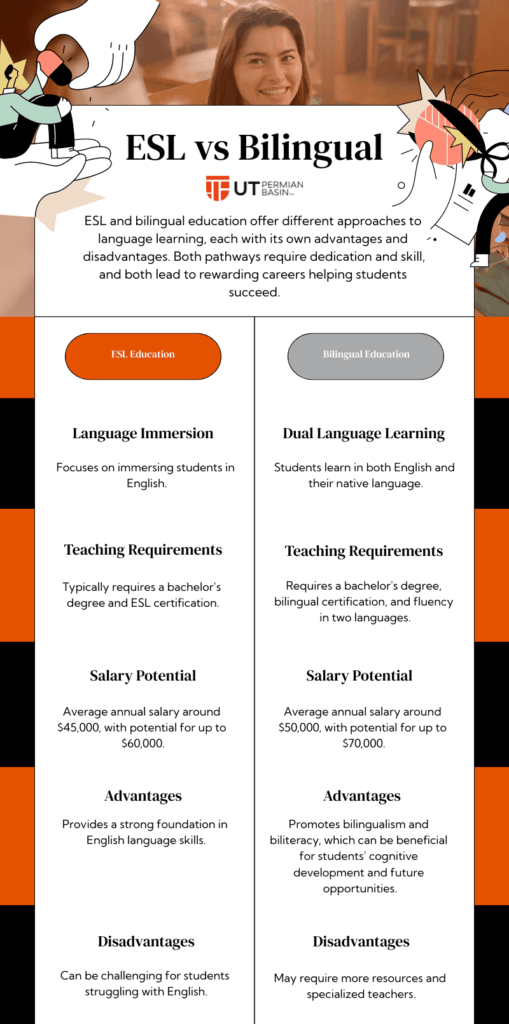
ESL and bilingual education both help students build English language skills, but they take different approaches in the classroom. ESL instruction is taught in English and focuses on language immersion, while bilingual education uses both English and a student’s native language to support learning.
Watch this quick breakdown of ESL vs. bilingual education
What Is ESL Education?
ESL education teaches students English through instruction delivered in English, with a strong focus on language immersion, meaning English is the primary language used when teaching.
So, do ESL teachers have to be bilingual?
No, English is the only language an educator needs to know to excel as an ESL teacher. The principle driving ESL education is that students will learn English faster if they’re immersed in the language.
Although they’re supported every step of the way, it’s sink or swim for ESL learners as they’re taught to read, write, and speak English. The use of other languages may be even be prohibited in an ESL classroom to encourage the use of English.
There are several types of ESL programs, but pull-out is one of the most popular forms. In this model, students are pulled out of their general education classes and instructed by ESL teachers either in groups or one on one.
This is where some confusion arises between ESL vs. ELL students. English language learners (ELL) is a broad term that applies to any student learning English. In what’s known as the push-in model, English language learners are usually kept in general classes and instructed by visiting ESL teachers.
ESL education can produce exceptional English speakers. However, students in ESL education who are unable to fall back on their native language may struggle to grasp complex concepts in English, and students’ proficiency in their native language may suffer as they focus solely on learning English. As an ESL teacher, it would be your job to help your ELLs overcome these challenges.
What Is Bilingual Education?
Bilingual education teaches students in both English and their native language so they can build academic skills while developing English proficiency.
For example, a bilingual education classroom may be entirely filled with Spanish-, Chinese-, or Arabic-speaking students. Because their native language is used as part of instruction, students may feel more supported as they transition into English.
In bilingual classrooms, students are instructed in math, geography, history, and other traditional subjects. Unlike a traditional classroom, however, students are taught in both English and their native language. With the aid of a teacher who can engage in discussions, debates, and presentations in their first language, students in bilingual classes have a better chance of becoming fluent in both languages.
Dual language education, also known as two-way immersion, is a type of bilingual education that is steadily growing in popularity. As opposed to other programs that immerse students in a target language as quickly as possible, dual language education teaches ESL learners and native English speakers together with the goal of functional bilingualism and biliteracy for both groups.
In an article published by NPR, George Mason University professors emeriti Wayne Thomas and Virginia Collier looked at eight million student records and found that dual language students had higher test scores, higher parent involvement, better attendance, and fewer behavioral problems than students in English-only classrooms.
What Do ESL and Bilingual Education Have in Common?
ESL and bilingual education teachers both nurture and cultivate English language skills. Teachers in either role can enjoy fulfilling careers teaching students a language that will better connect them to the world and people around them. Permanently enriching the lives of students is the goal of every educator, but that’s not the only thing these two career options have in common.
According to the National Center for Education Statistics, there were five million ESL learners enrolled in the United States public school system in 2017, up from 3.8 million students in 2000. Texas, in particular, has a high need for ESL and bilingual education teachers, with 20% of the state’s total student population identified as ESL learners.
As the number of ESL learners continues to rise, school districts will be in greater need of ESL and bilingual education teachers. Once you’ve earned your degree and are looking at ESL vs. bilingual certification in Texas, know that either option leads to a growing career field.
Bilingual education teachers often earn annual median salaries of about $62,000. Although they may not speak a second language, ESL teachers possess a highly sought-after skill set and earn about $56,000 annually. While a career as an ESL or bilingual ESL teacher is both financially and emotionally rewarding, you’ll first need to enter a master’s degree program that builds upon your strengths.
You’ve seen the commonalities these careers share; now let’s break down what sets them apart. Explore the chart below to compare key differences between ESL and bilingual education:
Upon completion of the program, students enrolled in UT Permian Basin’s MA in bilingual education program have the option of sitting for the Texas Bilingual Supplemental Exam, as long as they meet the other eligibility requirements.
Whether you immerse your students in a new language or act as a bridge between two languages, our online program will empower you with the skills needed to teach any ESL learner who enters your classroom.
The United States is in desperate need of qualified teachers—so much so that schools have started hiring teachers from half a world away. School districts are searching for fully certified professionals, preferably those who are certified to teach two subjects, but what’s the purpose of dual certification if schools are going to such extremes to hire…
The English language is nobody’s special property. It is the property of the imagination: it is the property of the language itself. — Derek Walcott The United States has no official language, but English is the de facto language spoken by millions of native speakers. For both citizens and noncitizen residents, many of whom speak…
Differentiated instruction, also known as differentiated learning, supports diversity in the classroom by providing multiple avenues for learning. Have you ever accounted for students’ strengths and weaknesses when developing lesson plans? Or helped a struggling student grasp a new concept by switching up your teaching method? If so, you may already be familiar with the…
If you’ve ever imagined leading a school community—supporting students, guiding teachers, and making big-picture decisions that shape the future—becoming a principal might be your next step.
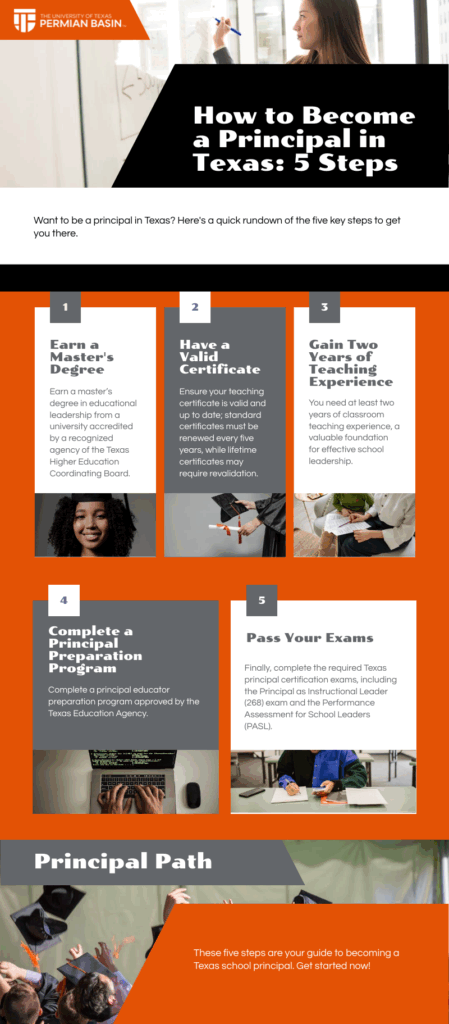
In Texas, the path to principal certification includes a mix of education, experience, and exams. Whether you’re currently teaching or just starting to explore leadership roles, this guide will walk you through the five key requirements set by the Texas Education Agency (TEA). It all starts with earning your master’s degree in educational leadership—and we’ll show you how to get there.
Step 1: Earn a Master’s Degree in Educational Leadership
Finding a university accredited by one of the agencies recognized by the Texas Higher Education Coordinating Board (THECB) is the first stop on your way to becoming a Texas principal. The U.S. Department of Education provides an accredited database you can use to research qualifying universities, but we can save you some time.
Since 1975, The University of Texas Permian Basin has been accredited by the Southern Association of Colleges and Schools Commission on Colleges (SACSCOC), the recognized regional accrediting body for degree-granting higher education institutions in the Southern United States.
When you earn a Master of Arts in Educational Leadership from UT Permian Basin, you’re earning a prestigious degree that meets the first requirement for becoming a principal in Texas. Our program will also prepare you for this role by covering such topics as instructional leadership, school public relations, cultural diversity in education, and school law.
Step 2: Maintain a Valid Teaching Certificate
If you’re reading this, there’s a good chance you already hold a valid classroom teaching certificate. As stipulated by TEA, standard education certificates must be renewed every five years (continuing professional education requirements and application instructions can be found here). Educators with a lifetime certificate (certificates issued prior to Sept. 1, 1999) must still have them revalidated by taking the Texas Higher Education Assessment (THEA).
Step 3: Gain 2 Years of Teaching Experience
Completing two years as a classroom teacher is one of the requirements for principal certification in Texas. Many of the skills you’ve acquired as an educator—active listening, conflict resolution, time management—will prove invaluable in a career as a principal.
UT Permian Basin’s online MA in educational leadership program is a meaningful, rigorous program that will build upon these skills by engaging you in real-world experiences that administrators encounter on a day-to-day basis.
Furthermore, because our program is 100% online, you can continue your education while working toward that two-year teaching requirement. If you’re an educator with a busy personal and professional schedule, our flexible online program and its multiple annual start dates can accommodate your needs.
Step 4: Complete a Principal Preparation Program
Prior to taking the final exam to receive a Texas principal certification, candidates must complete a principal educator preparation program. What is a principal educator preparation program? Essentially, it’s a graduate certificate program offered by universities to students who have already earned a master’s degree.
UT Permian Basin offers an online principal certification program that prepares professionals for not only the certification exams but also a career as an advocate for the students, teachers, and staff that may one day be under their administration. Advanced candidates in our online MA in educational leadership program may also become eligible for a principal certification.
Step 5: Pass the Texas Principal Certification Exams
As of Sept. 1, 2019, candidates must also complete the Performance Assessment for School Leaders (PASL) to obtain a standard principal certification. The PASL includes three tasks that must be completed during the candidate’s internship, including a video submission of themselves facilitating a collaborative team.
As part of UT Permian Basin’s online MA in educational leadership program, students complete an eight-week supervised practicum in a school setting during which students can complete the video submission requirements for the PASL.
From Classroom to Leadership: Start Your Principal Journey with UT Permian Basin
Like UT Permian Basin’s online MA in educational leadership program, a career as a principal is rigorous and rewarding. No two days are the same, as principals attend school assemblies, meet with parents, and stop by classrooms. At every turn, they’re interacting with students, listening to their successes and failures, and watching them grow into more mature and well-rounded learners.
If life as a principal appeals to you, there’s a clear path to becoming a principal in Texas, and it begins with earning an MA in educational leadership.
Gamification in education uses game-like elements such as points, badges, challenges, and leaderboards to make learning more engaging and motivating for students. By bringing familiar features from games into the classroom, educators can encourage participation and support stronger student buy-in. From elementary school to college classrooms, you can use gamification in different ways depending on students’ needs and learning…
“Education is the most powerful weapon which you can use to change the world.” — Nelson Mandela Shaping Education: From Pioneers to Advocates Education has long been a cornerstone of human civilization, shaping the course of society across generations. Educational pioneers like Horace Mann, who championed free public education, and Maria Montessori, who revolutionized individualized learning,…
Robots in the classroom. Three-dimensional online education. 2025 is well underway, and the potential for big developments in education is on the horizon this year. Perhaps unsurprisingly, many of these educational trends are centered around technology-facilitated digital learning. Some may be familiar, while others may be new to you. All are expected to become more…