The humanities encompass the full range of human thought and creativity, including languages, religion, philosophy, and the broad spectrum of the arts (including the performing arts and the visual arts). Humanities education explores the commonalities and differences in self-expression that humans have exhibited through the ages and continue to demonstrate today. The humanities have always been and will continue to be the basis of human cultures and source of our perceptions of different cultures.
In the academic realm, a student may study any or all of the humanities as part of a formal degree program such as a Bachelor of Arts in Humanities. These programs expose students to diverse ideas from around the world, broadening their knowledge and developing their critical thinking abilities.
Are the Humanities Important?
People from all walks of life, across philosophical and political perspectives, agree on the importance of the humanities. Famed “Star Wars” director George Lucas said this of the humanities: “The sciences are the ‘how,’ and the humanities are the ‘why’—why are we here, why do we believe in the things we believe in. I don’t think you can have the ‘how’ without the ‘why.’”
Former President Ronald Reagan believed that, “The arts and humanities teach us who we are and what we can be. They lie at the very core of the culture of which we’re a part.” J. Irwin Miller, famed industrialist and civil rights proponent, also spoke to the transformative nature of the humanities when he stated, “The calling of the humanities is to make us truly human in the best sense of the word.”
The broadly applicable skills that the humanities offer also directly benefit individuals in their personal and professional lives. As American philosopher and law professor Martha Nussbaum notes, “Business leaders love the humanities because they know that to innovate you need more than rote knowledge. You need a trained imagination.”
What Skills Can You Gain by Studying Humanities?
Humanities expand our knowledge of human cultures and help us understand what binds us together and what differentiates us from one another. In addition to these high-level insights, however, they also provide practical applications that can enhance your professional skillset and give you a competitive edge. By studying humanities in a formal university-level program, you can acquire transferrable, marketable skills and qualities that will be an asset to you in your professional pursuits. What will you learn in a humanities program? Examples include:
Critical Thinking—The ability to receive and analyze knowledge and to use your creativity to develop innovative solutions to problems.
Communication—The ability to form unique viewpoints and to express yourself clearly and persuasively in both written and spoken forms.
Empirical and Quantitative Reasoning—The ability to comprehend and use numerical data to formulate and deliver educated decisions.
Teamwork—The ability to understand and accept the viewpoints of others and to work collaboratively with them to achieve common goals.
Personal Responsibility—The ability to see the consequences for your actions and take responsibility for and justify the choices you make.
Social Responsibility—The ability to see what’s best for society and the world as a whole and to act accordingly.
Employers want professionals who can come up with fresh approaches to solving problems, express themselves clearly, collaborate with others, and act in a responsible, ethical manner. These abilities are the foundation for nearly every career path, as well as many graduate-level programs. Equipped with these skills, you’ll be prepared to take on a diverse range of career paths, including:
Teacher
Writer
Public relations manager
Advertising sales agent
Travel agent
Counselor
Event organizer
Artist
Lawyer
Minister
Military service member
Why Earn Your Degree in Humanities From The University of Texas Permian Basin?
The University of Texas Permian Basin’s online Bachelor of Arts in Humanities program goes beyond discussions of the world’s great works of art and philosophies. This immersive, affordable program empowers you with the key skills today’s employers value most.
Our BA in humanities program is unique in that, as a student, you’re not given a preset path to follow; the program enables you to choose concentrations based on your personal areas of interest. Our faculty advisors work with you to develop an individualized plan of study with an interdisciplinary theme, period, set of problems, specialization, or perspective that you can’t get by combining a major and minor in the traditional way. You’ll choose a minimum of two concentration areas in art, communication, English, history, or music, totaling 24 credits of specialized coursework in these areas.
Our program is flexible not only in terms of what topics you may study but in how you complete your degree. The 100% online format allows you to complete coursework anytime, at any location with internet access. You can choose from six start dates a year and enjoy condensed eight-week courses and an accelerated completion time. All courses are taught by the same esteemed faculty who teach on campus at UT Permian Basin. When you’re ready to graduate, you’ll receive the same valued degree that campus-based students receive.
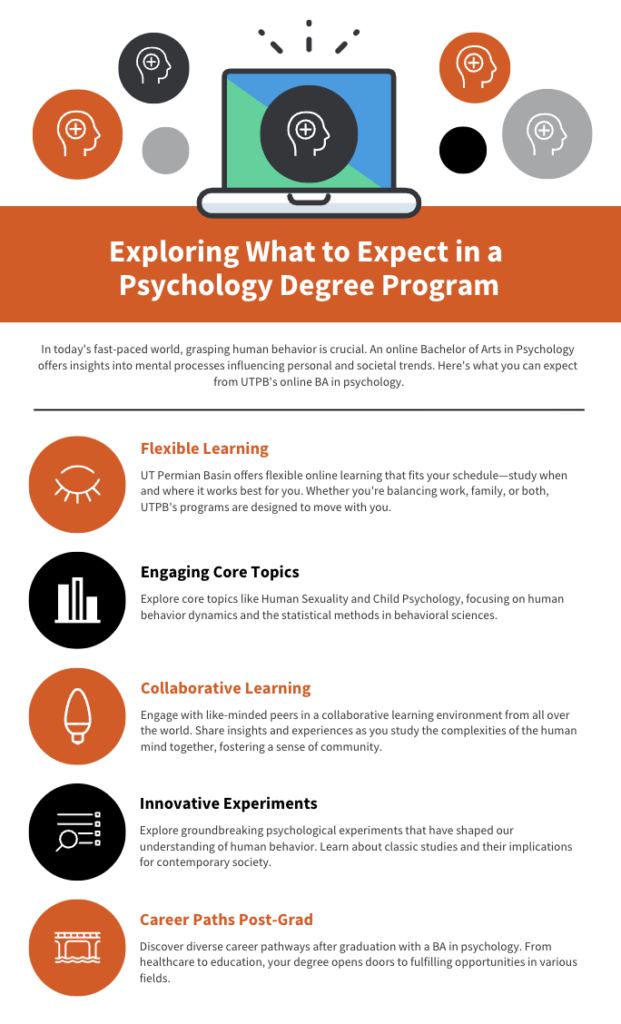
Psychology is far more than the study of the mind. As a social science, it’s the study of people, their behaviors, and their relationships with each other. Earning a bachelor’s degree in psychology means gaining insight into the mental processes that shape not only your own experiences but the world around you.
If you’re interested in entering an exciting field that rewards curiosity and compassion with high-paying careers, UTPB’s 100% online psychology program offers the flexibility, affordability, and academic excellence you need to take the next step in your education and career.
How Is UT Permian Basin’s Online BA in Psychology Program Structured?
With our program, you can study psychology from anywhere with a Wi-Fi connection. Down the street from campus? Sure. Across the globe at a cozy cafe? Absolutely.
Our program is presented in an eight-week course model with six start dates a year, meaning you can earn a bachelor’s degree in psychology without having to block out months of your time or sacrifice your personal and professional commitments. At UT Permian Basin, you can continue working while working toward a psychology degree.
What Are the Degree Requirements for UTPB’s Online BA in Psychology Program?
In order to earn a BA in psychology, students at UT Permian Basin must complete 120 credit hours composed of:
42 hours of general education courses
36 hours of core courses in psychology
24 hours of electives, and 18 hours of minor courses
Students can choose the minor that interests them most and create a customized learning experience. All core courses are worth 3 credit hours and delve into engaging topics such as Social Psychology, Abnormal Psychology, and Lifespan Psychology. Students can expect to explore:
The social influences that affect motivation, perception, and behavior
The application of statistical methods to behavioral sciences research
The development, maintenance, and treatment of behavioral disorders
The psychological processes that affect people across their lifespan
What Is the Online Learning Experience Like?
When enrolled in our online program, you’ll receive a first-rate education from the same faculty members who teach students on campus. Learn with virtual classmates who have also devoted themselves to the study of the human mind.
Learn About the World’s Most Influential Psychological Experiments
As a psychology major, you’ll be following in the footsteps of some of the world’s greatest intellectual pioneers and learning about the most famous psychological experiments to ever be conducted.
Take the Asch conformity experiments. Solomon E. Asch set out to discover if, when presented with a problem with an obvious answer, a participant would agree with their incorrect peers. In what is now a classic social experiment, unsuspecting participants were placed in a room with several “confederates” and asked to compare the length of drawn lines. Answers were shared out loud, and the confederates always gave the incorrect answer. Although the answer was obvious, about one-third of participants agreed with the confederates after hearing their responses.
In our online program, you’ll learn that while psychological experiments like this one were first conducted decades ago, they still hold profound implications today. You’ll even be able to conduct your own research in our capstone course while being supervised by a psychology faculty member. If you dream of one day publishing your own research paper, our program offers real-world experience.
What Are the Tuition Costs and Admission Requirements?
Our online BA in psychology program is affordable, with tuition costing less than $400 per credit hour. We offer flexible payment options, and financial aid is available for qualifying students.
Applying to UT Permian Basin’s online BA in psychology program is a straightforward process designed to make quality education accessible to more students:
All first-year and transfer students can apply by mailing their high school and/or college transcripts to the Admissions Office.
A minimum 2.0 cumulative GPA is required for admission.
Students who don’t meet the GPA requirement may be conditionally admitted if they maintain a 2.0 GPA or higher during their first 30 credit hours at UTPB.
Once You’ve Graduated: Careers and Beyond
A BA in psychology is an incredibly versatile degree that can lead to success in a number of exciting fields, including:
Healthcare
Education
Business
Social work
Although a bachelor’s degree alone can lead to a rewarding career, many students enrolled in our program go on to pursue a doctoral degree and become clinical, counseling, research, school, or industrial-organizational psychologists.
According to the Bureau of Labor Statistics, psychologists made an average annual salary of $94,310 in 2024, with some earning well over six figures. If you’re interested in helping individuals overcome psychological, emotional, and behavioral challenges, a BA in psychology can be the next stepping-stone in your career path.
If you’re ready to explore the growing field of one of the world’s youngest sciences, learn more about UT Permian Basin’s online BA in psychology program.
Psychology is one of the broadest academic fields, and one of the most versatile. It spans everything from courtrooms to corporate offices, from childhood development to competitive sports. With so many specialties (and subspecialties), it can be tough to know where to even start. So exactly how many branches of psychology are there? The field is…
Ever reach for your phone and instantly face a barrage of messages, notifications, subscription reminders, and social media updates? You’re not alone. Scientists have estimated that the average person processes about 74 gigabytes of information daily: equivalent to watching 16 high-definition movies back-to-back in a single day. Cognitive overload is real. And over time, constant stimulation quietly changes how we think, focus, and feel. In this article, we’ll explore: What Does Cognitive Overload Mean? Cognitive overload happens when your brain receives more information than…
When someone struggles with depression, homelessness, or discrimination, who steps in to help? A psychologist? A social worker? A sociologist? These three fields all address human challenges, but they explore humanity from very different angles: one from society, one from the mind, and one from the front lines. So what are the similarities and differences between sociology, psychology, and social work? This guide clears up…
Every nursing shift brings surprises—patients with unexpected symptoms, emergencies that demand split-second decisions, and the challenge of juggling it all. That’s where critical thinking comes in.
It’s more than a buzzword: It’s the difference between reacting and leading. In this article, we’ll break down why critical thinking is essential for nurses and how you can strengthen this skill to level up your career.
What Is Critical Thinking in Nursing?
Critical thinking is the process of “actively and skillfully conceptualizing, applying, analyzing, synthesizing, and/or evaluating information gathered from, or generated by, observation, experience, reflection, reasoning, or communication, as a guide to belief and action.” It’s based on accuracy, sound evidence, fairness, and other universally accepted intellectual values. Put simply, it’s the ability to be objective. Rather than allow emotions or opinions to guide their beliefs and actions, critical thinkers are driven by facts.
As a nurse, your overall goal is to improve patient outcomes. Critical thinking is important in nursing because if all healthcare providers can think critically and utilize evidence-based decision-making, there’s a better chance of improving patient outcomes. In fact, the Bureau of Labor Statistics (BLS) lists critical thinking as one of the most important qualities a nurse can have, alongside qualities like communication and organizational skills and emotional stability.
Why Critical Thinking Is Essential in Healthcare Settings
The fight-or-flight response is a physiological reaction that occurs when there is a perceived threat to survival. When our brain registers this threat, our bodies are flooded with stress hormones, such as adrenaline and norepinephrine. Heart rates increase, pupils dilate, and muscles tense up.
The fight-or-flight response may have helped our distant ancestors take down mammoths, but it’s far less helpful when rushing to make an important decision regarding a patient’s care plan. Worse still is when a patient is in a life-or-death situation and their survival depends on poise under pressure.
If your goal is to work in a hospital, especially in an intensive care unit (ICU), you must be able to think critically in all manner of situations. By cultivating your critical thinking skills, you can respond appropriately even when your heart is pounding and your thoughts are racing.
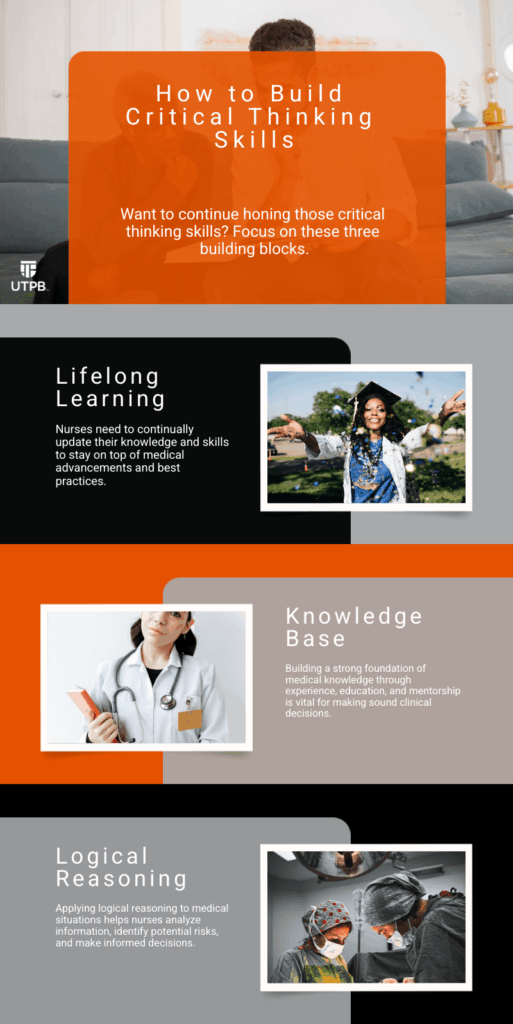
How to Build Critical Thinking Skills as a Nurse
In order to think critically, it’s not enough to be able to recite medical information verbatim. Critical thinkers are always logical and unbiased in their assessments, challenging the accuracy of information and beliefs when they have cause to doubt them. Although some are naturally inquisitive, all nurses can develop their innate curiosity, medical knowledge, and ability to think on their feet.
Step 1: Become a Lifelong Learner
Looking at the three components of critical thinking, your first step in developing your skill set is to develop a wise, problem-solving attitude. Nurses are no longer the untrained caregivers of the past. Today, nurses play a vital role in patient-centered care, often assisting doctors by contributing to care plans, analyzing diagnostic tests, administering medicine, and monitoring vital signs. As the duties of a nurse continue to evolve and expand, nurses can excel by remaining open-minded and becoming lifelong learners.
Step 2: Build a Repository of Experience
The second component of critical thinking is the knowledge of methods of logical investigation. Essentially, your goal is to develop a repository of medical knowledge to draw upon when making decisions. Medical knowledge can be obtained from years of experience, guidance from colleagues, and academic programs like those offered by The University of Texas Permian Basin. As a registered nurse (RN), it’s likely that your academic and working experiences already shape your decision-making. If that’s the case, you’re already employing one of the tenets of critical thinking.
Step 3: Allow Logic to Guide Your Behavior
The ability to not only understand medical knowledge but effectively apply it to your decision-making may be the most difficult component of critical thinking to adopt. Fortunately, you’re not alone. In addition to staying up-to-date on best practices, you can draw upon the experience of doctors, educators, and fellow nurses. No one knows more about critical thinking than the professionals who’ve spent years in your role. Over time, you’ll be able to calmly and effectively apply your skills to help patients regardless of the medical, cultural, or linguistic challenges facing you.
Gain Critical Thinking Skills While Advancing Your Career
Critical thinking is absolutely a skill set that can be developed with the help of an online Registered Nurse to Bachelor of Science in Nursing program. At UT Permian Basin, we can empower you with the critical thinking skills needed to excel in your current position and the leadership skills needed to advance your career.
With the exception of leadership clinical experiences, our program is asynchronous and 100% online, and there’s no travel required. Remain in your current nursing role while continuing your education on your own time and at your own pace. In as little as eight months, you can complete our online RN to BSN program and receive a Nurse Management Certificate from Sigma Theta Tau Nursing Honor Society. During those eight months, you’ll gain first-rate instruction accredited by the Commission on Collegiate Nursing Education (CCNE).
UT Permian Basin’s online RN to BSN program offers the education and experiences needed to prosper in a leadership role. The critical thinking, management, and transcultural nursing skills taught in our virtual classrooms will prove indispensable in your nursing career. By enrolling in our online RN to BSN program, you’ll not only be more capable of stepping into a leadership role but also better able to assist the patients under your care.
As a nurse, HIPAA isn’t just background noise or a form you ask patients to sign. It’s the law that governs how you communicate, where you store patient info, what you can share—and with whom. It’s not just about doing the right thing. It’s about keeping your license, protecting your patients, and staying employed. In…
Picture this: You’re in a hospital room, and a nurse walks in—flustered, but still smiling—with a chart in hand. This expert provider is checking your vitals, catching early warning signs, coordinating with doctors, reassuring your anxious family outside, and solving small healthcare crises in the hallway … all before lunch. Today, nurses are no longer…
As the United States becomes increasingly multicultural, education must address the topic of multiculturalism so that degree holders will be properly prepared to serve the needs of our diverse society. Nurses interact with a diverse range of people on any given day. With an awareness of multicultural populations, nurses will be able to provide more…
Community health nurses care for more than one patient at a time. Their focus is the health of whole populations, whether that means educating families, supporting underserved groups, or helping prevent illness before it spreads.
Also called public health nurses in some settings, community health nurses work directly with individuals and families while also looking at the bigger picture. They pay attention to the social, economic, and environmental factors that affect health and work to improve health outcomes across entire communities, not just for individual patients.
Community health nursing focuses on promoting health at the community level. That means looking beyond one patient at a time and focusing on the health needs of groups of people who live in the same area, attend the same schools, work in the same environments, or face similar health risks.
Instead of treating illness after it happens, community health nurses work proactively to help people stay healthier in the first place. They look at the factors that shape health across a community, including access to care, transportation, housing, nutrition, education, and other everyday conditions that can affect long-term well-being.
Because health is shaped by more than medical treatment alone, community health nurses also pay attention to issues like food access, housing, insurance coverage, and transportation.
What Do Community Health Nurses Do?
Community health nurses often serve people who have limited access to care. Depending on the role, the responsibilities of community health nurses include:
Providing screenings, education, or follow-up care
Supporting maternal and child health
Managing chronic disease in community settings
Developing outreach programs for at-risk populations
Advocating for policies that improve community health
Educating the public about issues like nutrition, substance use, or sexually transmitted diseases
These nurses work across a variety of settings, including government agencies, schools, nonprofit organizations, clinics, and academic institutions.
How Can You Reduce Barriers to Care as a Community Health Nurse?
One of the most important parts of community health nursing is helping reduce barriers that keep people from getting care.
That may mean:
Connecting patients with insurance or transportation resources
Supporting prevention programs in underserved areas
Helping communities respond to broader public health concerns
Community health nurses can’t solve every systemic problem on their own, but they can help people access screenings, education, and preventative care they might not otherwise receive.
How Do Community Health Nurses Help Individuals and Families?
Community health nurses promote prevention by educating at-risk groups on public health challenges, including:
Alcohol and tobacco use
Nutrition and physical activity
Prescription drug overdose
Sexually transmitted diseases
Teen pregnancy
How to Become a Community Health Nurse
To become a community health nurse, you first need to become a registered nurse. From there, earning a BSN can help you build the broader knowledge and leadership skills often needed in community-based roles.
The University of Texas Permian Basin’s online RN to BSN program helps nurses strengthen their skills in leadership and evidence-based practice. The program is fully online and designed for working nurses who want to maximize their impact.
“Access to basic quality healthcare is one of the most important domestic issues facing our nation.” –Former Congressman Ed Pastor The COVID-19 pandemic exposed deep-seated issues in healthcare, particularly inequities in access and the challenges of serving uninsured populations. It also opened our eyes to the potential for a flexible healthcare system, as seen in the…
As a nurse, HIPAA isn’t just background noise or a form you ask patients to sign. It’s the law that governs how you communicate, where you store patient info, what you can share—and with whom. It’s not just about doing the right thing. It’s about keeping your license, protecting your patients, and staying employed. In…
Any sufficiently advanced technology is indistinguishable from magic. —Arthur C. Clarke Imagine a 19th-century nurse stepping foot in a modern-day hospital. Although knowledgeable for her time, this nurse would be at a loss for what to do with commonplace technologies like defibrillators, ventilators, and vital signs monitors. Medical culture would perhaps feel familiar, but every…
Kindness plays an underappreciated role in healthcare. Nurses who are able to show compassion can better connect with and provide for patients. There’s just one problem: Kindness can be in short supply in the medical field, where stress and burnout are very real problems for nurses and other healthcare providers. As a registered nurse (RN), you must be able to show your patients kindness even when you’re nearing the end of a 12-hour shift, your feet are killing you, and you’re on your fifth cup of coffee.
The University of Texas Permian Basin offers an online RN to BSN program designed to empower nurses with the skills needed to thrive in leadership roles. In addition to patient-centered care, interprofessional collaboration, and transcultural nursing, our program covers the important role kindness plays in healthcare. Although kindness can’t suture a wound or cure a disease, it can be a powerful tool in medicine if administered properly.
What Do We Mean When We Talk About Kindness in Nursing?
A two-way relationship between a patient and healthcare provider.
A genuine interest in patients’ concerns and feelings.
Considering what it would be like in a patient’s situation.
Respecting patients’ dignity.
Using what’s been learned about a patient to assist them.
Empathy in healthcare means more than just being friendly. It requires conscious effort to step back and respect a patient’s feelings, needs, and predicament. This process requires a skill set that can be developed with time, practice, and instruction. By accepting your emotions, you can better care for your patients and avoid and mitigate stress that leads to burnout. We’ll continue to use “kindness” throughout this article, but what we’re referring to is a multi-step process requiring empathy.
The Importance of Showing Kindness to Patients
Kindness is more than just window dressing on medical care. It’s an integral part of the patient experience. Research has shown that patients who receive compassionate, patient-centered care are more satisfied and willing to comply with their medical treatment, which leads to positive patient outcomes. Kindness, as perceived by patients, may even reduce the severity and duration of the common cold. When healthcare providers take the time to consider a patient’s needs, they are better able to provide for those needs. If you’ve ever struggled to convince a patient to take their regularly scheduled medicine, you may already know the important role kindness plays in improving patient outcomes.
Conversely, unkind behavior can have just as much of an impact on patient experiences and outcomes. 64% of Americans report experiencing unkind behavior in healthcare settings. In addition to staff rudeness and poor listening skills, survey takers reported a failure on behalf of their healthcare provider to develop a two-way relationship. Poor experiences like these encourage patients to switch to other healthcare providers or forgo seeking healthcare altogether. Kindness is so valued by patients, in fact, that the majority of Americans surveyed ranked kindness as one of the most important factors in choosing a healthcare provider, above the cost of care, wait times, and travel distance.
Entering a patient’s room with a warm smile and a willingness to listen may seem trivial when compared to objective medical outcomes, but how patients perceive kindness can strongly color their experience and impact the quality of care they receive. Unfortunately, kindness may be the last thing on your mind during a clinical encounter, especially when a patient is being less than cooperative. How can you build a two-way relationship with patients who aren’t willing to be kind to nurses?
Building a Rapport With Patients
It’s important to understand that when patients are acting out, they are only reacting to situations they feel they have little or no control over. Nancy Whitt, a nurse of 45 years, sums it up perfectly: “It’s easy to blame the nurse who’s right there. Most of the time, [patients] are just reacting to the circumstances they’ve found themself in with anger, fear, or a bit of both. You just need to let it all wash over you and carry on with your job.”
“Let it wash over you” may be easier said than done, but it’s the key to fighting burnout and showing kindness. By being kind even when your impulse is to do otherwise, you will eventually form a habit. Kindness can become second nature with time, instruction, and practice. The Buddhist practice of mindfulness-based meditation, such as loving-kindness meditation, can help in this regard. One study shows that by taking just 10 minutes to meditate and wish patients health, happiness, and well-being, healthcare providers can prevent burnout and improve the quality of care.
As a nurse, you may not have 10 minutes to spare when administering care. However, it’s important to at least see your patients as living, thinking individuals who experience joy, sorrow, and everything in between as vividly as you do. What patients feel when they have a broken leg or an infected wound is exactly what you would feel if the tables were turned. That’s kindness: being able to see things from another perspective and using that insight to build a rapport with patients.
Adding Kindness to Your Nursing Repertoire
You can develop the skill set needed to employ kindness in your profession, and it begins by making a conscious choice to consider the needs of others. At UT Permian Basin, our online RN to BSN program can guide you as you become a more compassionate, capable leader.
Our program empowers students with the leadership skills needed to consider patients’ medical and emotional needs when making decisions. Our course Population Public Health Clinical empowers students to perform assessments of formal and informal community systems and health care delivery systems with an emphasis on cultural diversity and the needs of individuals, families, communities, and populations, while courses like Social Determinants of Health teach students how to evaluate the way sociocultural factors impact health disparities, outcomes, and patient satisfaction, strengthening patient-nurse rapport and empathy. Moreover, our program is flexible and 100% online, meaning that you can earn your degree while continuing to work and care for your patients.
If you’re interested in becoming a kinder, more compassionate nurse, enroll in UT Permian Basin’s online RN to BSN program. In less than eight months after enrolling, you can graduate having gained an entirely new perspective on nursing.
As the United States becomes increasingly multicultural, education must address the topic of multiculturalism so that degree holders will be properly prepared to serve the needs of our diverse society. Nurses interact with a diverse range of people on any given day. With an awareness of multicultural populations, nurses will be able to provide more effective and compassionate care.
While no nurse can be fully educated on all the intricacies of every culture she or he will encounter, it’s important to at least be aware that there are differences between cultures in a healthcare context. One can no longer take a one-size-fits-all approach. It is imperative to provide multicultural nursing care.
What Do Transcultural and Multicultural Mean?
The Cambridge Dictionary defines “multicultural” as “including people who have many different customs and beliefs,” while Merriam-Webster defines “transcultural” as “involving, encompassing, or extending across two or more cultures.”
In the nursing context, RegisteredNursing.org defines transcultural nursing as a “nursing specialty which focuses on global cultures and comparative cultural caring, health, and nursing phenomena” with the aim of providing “culturally congruent nursing care.” The uniting theme between transcultural and multicultural nursing is that patients may be different kinds of people from diverse backgrounds, and the nursing profession must acknowledge and respond to their unique needs.
Why Transcultural and Multicultural Nursing Are Important
While the concept of transcultural nursing dates back to at least the 1950s, population growth and immigration have made it more important now than ever. A variety of factors, including ethnicity, culture, religious beliefs, and gender identity, influence a patient’s choices regarding healthcare. A nurse must consider these when administering care or when trying to help a patient make decisions about their own care.
A culturally competent nurse is one who understands the concerns, sensitivities, and risk factors inherent in various cultures. With proper instruction in a university-level program such as RN to BSN, you can become a culturally competent nurse with the ability to identify possible barriers and find effective ways to avoid or overcome them. These skills are critical to being a nurse today, both in terms of the quality of patient care you provide and for your employment potential.
Overview of UT Permian Basin’s Online RN to BSN Program
The University of Texas Permian Basin’s online RN to BSN program was designed with transcultural and multicultural nursing in mind. This CCNE-accredited program prepares nurses for leadership and decision-making roles in patient care. As you progress through the program, you’ll achieve a deep understanding of evidence-based practice, patient-centered care, and—as we’re discussing here—methods for meeting the diverse needs of multicultural patients.
BSN Courses That Focus on Culture
Our online RN to BSN program has three core courses that directly address multicultural and transcultural nursing. Those courses, and their official catalog descriptions, are:
Transcultural Nursing
Knowledge of the basic nursing practices and specialized medical and nursing terminology needed to communicate effectively concerning health status and health/illness management of Spanish-speaking patients and families. Evaluate nursing decisions and nursing actions needed to perform patient history, patient teaching, medication administration, discharge planning, and explanation of procedures and therapy congruent with the needs of Spanish speaking patients. Identify when to use a medical interpreter.
Multicultural Public Health Nursing
Analysis of formal and informal community systems/resources and healthcare delivery systems in public health; emphasis on cultural influences on health of individuals, families, communities, and populations. Community partnerships, interprofessional communication to help families modify lifestyle and community resources to promote health. Roles, strategies, and resources for emergency management in the community.
Multicultural Public Health Nursing: Clinical
Application of evidence-based nursing practice skills to community/public health situations addressing cultural diversity, at-risk families, and vulnerable populations; nursing collaboration and interprofessional communication to explore public health systems to promote health in communities. Community assessment and planning in non-emergent and emergent situations. Advocacy for access to the healthcare system.
The Advantages of Completing Your BSN Online
Earning your BSN online from UT Permian Basin has benefits beyond building your nursing proficiency and increasing your ability to provide multicultural nursing care. Our program features asynchronous, 100% online classes that enable you to finish your coursework at your own pace, from any location where you have internet access, at any time of the day. No campus visits are required for this program—including the three required clinical courses. If you’re currently working and/or trying to manage family responsibilities, you’ll find this the most flexible way to earn your BSN degree.
Our clinical courses enable you to work closely with an established professional to develop vital experience, acquire knowledge and skills, and put theories you’ve learned into practice within different professional settings. Clinical courses are conducted in-person with a preceptor that you choose, the primary requirement being that they’ve completed a BSN and are already working in a position of nursing leadership. All the details and requirements for preceptors will be provided to you during your first seminar course.
Our online RN to BSN program features an accelerated format that allows you to complete some courses in as little as seven weeks. You may also choose from six program start times per year to suit your schedule and program completion goals. All courses within the program are taught by the very same acclaimed faculty who teach them in physical classrooms here on the UT Permian Basin campus. Upon graduating from the program, you will receive an identical degree to the one that students who have attended class in-person on our campus receive. Degrees do not specify whether the program was completed on campus or online.
Successful modern nurses are skilled in transcultural and multicultural nursing. Develop your own expertise in an online RN to BSN program from UT Permian Basin.
Technology is transforming the way nurses learn, study, and deliver care. From NCLEX prep tools to clinical communication apps, today’s nurses and nursing students rely on a wide range of digital resources to stay sharp and efficient. Whether you’re preparing for exams or managing patient care, mobile apps and education platforms can help you work smarter, not harder.
Below, we highlight some of the top-rated apps and tech tools that support nursing education and practice, including study aids, drug references, and learning management systems like Canvas.
5 Technology Tools for Nurses
#1 Doximity
The creators of this app state that it “helps over 1 million healthcare professionals take the friction out of everyday challenges that are unique to clinicians.” Doximity combines many tools that nurses and other medical workers use on a daily basis.
The app enables users to make one-click audio and video calls to patients for telemedicine visits, which are becoming increasingly popular. Users can also fax medical records and lab results securely in compliance with HIPAA, search nationwide physician directories, and browse the latest news by medical field or specialty.
Doximity is also a networking tool that allows users to share their curriculum vitae (CV) and reconnect with former colleagues and classmates. In addition, the app enables the user to earn a continuing medical education (CME) credit, which most healthcare professionals are required to complete annually.
#2 Picmonic: Nursing, NP, NCLEX
This app is designed to help nursing school students pass their exams (including the NCLEX-RN or NCLEX-PN), classes, and boards. According to its creators, Picmonic is used by more than a half million students and is “the world’s best mnemonic video and spaced repetition quizzing study tool that’s research-proven to increase memory retention 331%.” The app includes more than 10,000 quiz questions—including daily practice quizzes—and 1,000 mnemonic videos that cover a variety of major subjects.
#3 Davis’s Drug Guide for Nurses
This app provides the critical information nurses need to safely administer medications to patients. It’s a comprehensive nursing drug guide containing monographs for more than 5,000 FDA-approved generic and trade name drugs. Included are drug interaction information; cautions for geriatric, pediatric, and lactating mother use; pharmacogenomic content; Canadian-specific content; details of herbal drug content; and proper drug name pronunciations.
#4 Nursing Dictionary by Farlex
Nursing Dictionary by Farlex is a medical dictionary app that was designed specifically for use by nurses. It provides access to more than 56,000 medical terms, including 4,000 entries on medications, as well as 9,000 images. All information comes from authoritative sources such as Houghton Mifflin, McGraw-Hill, Gale, and Elsevier.
Nurses and nursing students alike can benefit from Nursing Dictionary by Farlex, which offers voice search capabilities, a definition sharing function, unlimited bookmarks, and advanced search functions. Users can search across multiple disciplines in more than a dozen medical dictionaries and encyclopedic sources.
#5 Study Tools to Support Your Nursing Journey
Whether you’re just starting your nursing journey or returning to school to earn your BSN, mobile study tools can help you learn on your schedule. While apps like Picmonic and UWorld NCLEX-RN are popular among nursing students preparing for licensure, RNs pursuing their BSN often use tools like:
Nursing.com: Not just for NCLEX prep, this app offers clinical cheat sheets, care plan templates, and video explanations that can reinforce your coursework.
SimpleNursing: A quick, visual way to brush up on clinical concepts, pharmacology, and lab values while balancing work and study.
These tools are especially helpful if you’re returning to academics after time in the field and want concise, flexible refreshers.
Learn Smarter with Our Online RN to BSN Program
At The University of Texas Permian Basin, our CCNE-accredited RN to BSN program is built to fit your busy life. We know that as a working nurse or student, you’re juggling personal and professional responsibilities. That’s why we’ve created a flexible online format that lets you earn your degree on your schedule without putting the rest of your life on hold.
What makes this online flexibility possible? Technology tools. Specifically, Canvas, our learning management system (LMS). Canvas makes it easy to:
Access lectures and assignments 24/7
Participate in discussion boards and group chats
Submit work and track your grades from any device
Communicate with instructors and classmates through built-in messaging tools
Whether you’re reviewing clinical case studies or preparing for exams, Canvas supports your learning every step of the way. It’s one of the key tech tools that enables our students to thrive in an online environment.
You can share information, join discussions, and pose questions to your experienced instructors—most of whom are former online students—and classmates using email, chat, and discussion boards. You can even set up virtual study groups. Canvas makes all of these advantages possible on your journey to an RN to BSN degree at UT Permian Basin.
Technology tools for nurses have forever changed the way we learn about and practice this critical profession. Experience the benefits of tech tools for yourself starting with our online RN to BSN program.
Picture this: You’re in a hospital room, and a nurse walks in—flustered, but still smiling—with a chart in hand. This expert provider is checking your vitals, catching early warning signs, coordinating with doctors, reassuring your anxious family outside, and solving small healthcare crises in the hallway … all before lunch. Today, nurses are no longer…
Of the growing number of fields actively using artificial intelligence (AI) technology—including finance, manufacturing, marketing, and customer service—the field that arguably makes the most significant impact in our lives is healthcare. AI is supporting all healthcare sectors, simultaneously making nurses more efficient, elevating their level of care, and improving patient outcomes. Here we’ll examine some…
Every year, over 150,000 registered nurses (RNs) graduate from nursing school, ready and eager to make a difference in the lives of patients. They’ve spent up to four years preparing for this moment, poring over textbooks, completing clinicals, and mastering skills. But when it comes time to face the challenges on the hospital floor or…
As a registered nurse (RN), you provide invaluable care and compassion to patients in their most vulnerable moments. You administer medications and treatments, advocate for your patients, and often serve as the steady hand that keeps things running. You are, arguably, the backbone of the healthcare system.
But you’re more than that. You’re a caregiver, a problem solver, a team leader, and someone who deserves the opportunity to grow. For many RNs, that next opportunity comes in the form of a Bachelor of Science in Nursing (BSN).
While an Associate Degree in Nursing (ADN) is the minimum requirement to become an RN, earning a BSN can open doors to leadership roles and higher pay, all while strengthening the care you already provide.
How an RN to BSN Program Compares to an ADN
A BSN, or RN to BSN, has a number of similarities to an ADN:
Both prepare you to take the National Council Licensure Examination (NCLEX), which you must pass in order to receive your nursing license.
Both programs teach many of the same hands-on skills in both programs.
The BSN provides a greater range of skills, including critical thinking, research, and leadership.
While both an ADN and a BSN will equip you with the essential skills to begin your nursing career, there are some notable differences—particularly in terms of time commitment, salary potential, and long-term career opportunities. For example, you can complete an ADN in two or more years, while a BSN degree requires a minimum of four years to complete.
The time invested pays off, however. Nurses that have earned their BSN average higher annual salaries than their ADN-holding colleagues. According to the U.S. Bureau of Labor Statistics (BLS), the median annual wage for registered nurses in 2024 was $93,600.
While the BLS does not break down salaries specifically for ADN vs. BSN holders, it reports that registered nurses in outpatient care centers earn a mean wage of $102,640, while those in federal government positions earn an average of $114,860—roles that often prefer or require a BSN.
Top 4 Reasons to Pursue an RN to BSN Degree
Not sure if now’s the right time to earn your BSN? You’re not the only one. Many nurses start with a diploma or associate degree and return to school later once they’ve gained experience, weighed their options, or solidified their goals.
Whether you’re early in your career or planning ahead for graduate school, a BSN can open new doors. Here are four key reasons to consider advancing your nursing education:
If you’re considering going the BSN route, here are four reasons to do so:
#1 Improve your job prospects If you’re a new RN who’s having difficulty finding your first job out of nursing school, a BSN degree might give you an edge over other candidates. Many employers give BSN holders greater consideration than ADN holders, and some may only hire BSNs.
#2 Increase your earning potential Many employers offer higher base pay to RNs with a BSN versus those with an ADN alone.
#3 Prepare for leadership roles While upper-management positions generally require a graduate-level degree, a BSN is the path to greater responsibilities and compensation and can provide the necessary foundation for in-demand upper-management roles.
#4 Lay the groundwork for advanced practice or teaching If you wish to become an advanced practice registered nurse (APRN) or a nurse educator, you’ll need a BSN degree before continuing on to graduate school.
What You’ll Learn in an RN to BSN Program: Curriculum Overview
As a BSN student, you’ll study subjects including theories and issues in professional nursing and healthcare, nursing research, and clinical leadership. Modern nursing also puts a strong emphasis on addressing the needs of multicultural patients as our society becomes more diverse and interconnected with the outside world.
This means you’ll take one or more courses with a multicultural or global focus. In addition, you may take some electives with a business and/or management focus.
Why Choose UTPB’s Online RN to BSN Program?
The University of Texas Permian Basin’s CCNE-accredited online Bachelor of Science in Nursing program prepares you to take on leadership and decision-making roles in patient care. As you progress through the program, you’ll develop a deeper understanding of the following skills:
Evidence-based practice
Patient-centered care
Ways of meeting the varied needs of multicultural patients
Advantages of Earning Your RN to BSN Online: Flexibility & Convenience
Earning a Bachelor of Science in Nursing online from UT Permian Basin provides many advantages:
Asynchronous, 100% online classes allow you to complete your coursework on your own schedule, from any location with internet access..
No campus visits required for class sessions or tests—ideal for students who may also be trying to fit in work and family responsibilities.
Six start times a year provide extra flexibility for whenever you’re ready to begin.
Accelerated online course format lets you complete courses in seven or eight weeks.
Courses are taught by the same accomplished faculty who teach on campus at UT Permian Basin.
Your diploma will be identical to an in-person degree, with no indication that the degree was earned online or on campus.
Clinical Requirements for the UTPB Online RN to BSN Program
UT Permian Basin’s online RN to BSN program has three required clinical courses. These courses let you work closely with an established professional to acquire invaluable experience, develop new knowledge and skills, and apply theory into actual practice within a variety of professional settings.
Clinical courses are conducted in-person with a preceptor of your choosing, provided they’ve already earned a BSN and are currently working in a leadership position. You do not need to make campus visits for the clinical courses, and you’ll receive all of the details and requirements for preceptors while enrolled in your first seminar course.
Picture this: You’re in a hospital room, and a nurse walks in—flustered, but still smiling—with a chart in hand. This expert provider is checking your vitals, catching early warning signs, coordinating with doctors, reassuring your anxious family outside, and solving small healthcare crises in the hallway … all before lunch. Today, nurses are no longer…
Of the growing number of fields actively using artificial intelligence (AI) technology—including finance, manufacturing, marketing, and customer service—the field that arguably makes the most significant impact in our lives is healthcare. AI is supporting all healthcare sectors, simultaneously making nurses more efficient, elevating their level of care, and improving patient outcomes. Here we’ll examine some…
Every year, over 150,000 registered nurses (RNs) graduate from nursing school, ready and eager to make a difference in the lives of patients. They’ve spent up to four years preparing for this moment, poring over textbooks, completing clinicals, and mastering skills. But when it comes time to face the challenges on the hospital floor or…
No two patients are exactly alike. Different symptoms, different diagnoses, different treatment plans. Another key difference? Their cultural background. In the U.S.’s increasingly diverse healthcare landscape, nurses regularly care for patients from all over the world, and their values, beliefs, and expectations aren’t always the same.
Just like a treatment plan should be tailored to the individual, nursing care must also be adapted to respect and reflect each patient’s unique cultural identity. That’s where transcultural nursing comes in.
To truly connect with patients and offer the highest quality of care, nurses must develop cultural awareness and strong communication skills. These skills build trust, reduce misunderstandings, and improve outcomes, especially in today’s multicultural communities.
Whether you’re an experienced RN or just beginning your BSN journey, gaining transcultural nursing skills can help you become a more compassionate, effective caregiver.
What Is Transcultural Nursing?
Transcultural nursing is a specialty that focuses on delivering culturally sensitive and respectful care to people of diverse backgrounds. In practice, this means learning how culture influences communication, health behaviors, and expectations so that nurses can tailor their care to each patient’s unique needs.
Key Cultural Factors in Transcultural Nursing Care
In a multicultural society, there are multiple factors to consider in patient care that haven’t always been top of mind for healthcare professionals, such as how body language, eye contact, touch, and proximity affect patients. These elements, often second nature in nursing, can vary greatly across cultures.
What feels respectful in one culture may feel invasive or dismissive in another. That’s why nurses must treat each of these aspects as culturally influenced and potentially sensitive.
Avoiding Assumptions and Stereotypes in Patient Care
While it’s helpful to be able to identify the culture and religion of a patient you’re treating, it’s also important not to make assumptions about them or stereotype them. As the peer-reviewed journal Nursing2020 states, failing to understand or respect a patient’s preferences may come across as indifference—or worse, incompetence.
Instead of relying on generalizations, it’s important to remember that all patients are individuals. A cultural assessment tool, such as a short questionnaire, can be a helpful way to learn about preferences and build trust.
Key practices to keep in mind include:
Asking open-ended questions to understand patient beliefs and customs
Avoiding making assumptions based on race, ethnicity, or language alone
Respecting religious or cultural practices, especially regarding modesty, diet, or gender roles
Practicing active listening to help patients feel heard and respected
Building Cultural Competency Through Education
Formal instruction is another way to become what the Transcultural Nursing Society calls a “culturally competent nurse.” A baccalaureate-level program such as a Bachelor of Science in Nursing can help you gain the skills to identify and overcome challenges arising from cultural differences with patients. These skills help you perform your daily nursing responsibilities more effectively whilehelping you advance your career.
Earn Your BSN Online with a Focus on Transcultural Nursing
Created with a transcultural-nursing-infused curriculum, The University of Texas Permian Basin’s CCNE-accredited online Bachelor of Science in Nursing (RN to BSN) program can help you prepare to take on leadership and decision-making roles.
As you move through our program, you’ll learn effective ways to meet the diverse needs of multicultural patients as well as gain a deeper understanding of evidence-based practice and patient-centered care.
Transcultural Nursing Courses in Our Online BSN Program
The UT Permian Basin online RN to BSN program includes three core courses that directly address the question, “What is transcultural nursing?”:
Transcultural Nursing
In this course, you’ll gain a foundation in the nursing practices and specialized medical and nursing terminology you need to communicate effectively with Spanish-speaking patients and families. This includes:
Evaluating the nursing decisions and actions required to perform patient history
Patient teaching
Administering medication
Discharge planning
Explaining procedures and therapy
Corresponding with Spanish-speaking patients via a medical interpreter
Multicultural Public Health Nursing
This course includes an analysis of formal and informal community systems/resources and healthcare delivery systems in public health and emphasizes cultural influences’ effect on the health of individuals, families, communities, and populations. In the course, you’ll:
Explore community partnerships
Strengthen interprofessional communication to promote health
Understand roles, strategies, and resources for emergency management in the community
Multicultural Public Health Nursing: Clinical
In this course, you’ll discover how to:
Apply evidence-based nursing skills to community and public health settings
Address the needs of culturally diverse populations
Support at-risk families and vulnerable communities
You’ll also learn the importance of collaboration and interprofessional communication in promoting healthy communities through public health systems. The course also examines community assessment and planning in non-emergent and emergent situations in addition to advocacy for access to the healthcare system.
Build Transcultural Nursing Skills in an Online RN to BSN Program
Earning your BSN online from UT Permian Basin means benefits you can enjoy immediately, not just after graduation. Our program features asynchronous, fully online classes that you can complete at any time of day from any location with internet access.
There are no required campus visits, and you can choose from six program start times to fit your schedule and program completion goals. If you’ll be juggling professional and personal responsibilities while you’re enrolled, you’ll find this flexibility invaluable.
The UT Permian Basin online RN to BSN program is delivered in an accelerated format that enables you to finish some courses in just seven weeks.Courses are taught by the same acclaimed faculty who teach them in-person on the UT Permian Basin campus. When you graduate from the program, you’ll receive a BSN degree that’s identical to the one that campus-based students receive.
To provide the most effective care to patients, every nurse should be educated in transcultural nursing. UT Permian Basin’s online RN to BSN program can help you excel in the modern multicultural environment.
Picture this: You’re in a hospital room, and a nurse walks in—flustered, but still smiling—with a chart in hand. This expert provider is checking your vitals, catching early warning signs, coordinating with doctors, reassuring your anxious family outside, and solving small healthcare crises in the hallway … all before lunch. Today, nurses are no longer…
Of the growing number of fields actively using artificial intelligence (AI) technology—including finance, manufacturing, marketing, and customer service—the field that arguably makes the most significant impact in our lives is healthcare. AI is supporting all healthcare sectors, simultaneously making nurses more efficient, elevating their level of care, and improving patient outcomes. Here we’ll examine some…
Every year, over 150,000 registered nurses (RNs) graduate from nursing school, ready and eager to make a difference in the lives of patients. They’ve spent up to four years preparing for this moment, poring over textbooks, completing clinicals, and mastering skills. But when it comes time to face the challenges on the hospital floor or…
Work-life balance is important for nurses because the demands of the job don’t stop when a shift ends. Nurses spend their days caring for others, often under intense physical and emotional pressure, which can make it difficult to protect time for rest, relationships, and personal goals.
When work begins to crowd out everything else, nurses may experience chronic stress, exhaustion, and burnout. Finding balance isn’t about splitting time evenly between work and life, but about creating a routine that supports both professional responsibilities and personal well-being.
In this article, we explore why work-life balance matters for nurses and practical ways to improve it over time.
What Is Work-Life Balance in Nursing?
For nurses, work-life balance doesn’t mean bisecting your time into 50% work and 50% leisure, nor does it mean completely separating these two halves.
According to management professor Marcus Butts, “Busy people who see work and nonwork as two separate spheres tend to get angry when one bleeds into the other.” Rather than looking at your work and personal life as two competing halves, he suggests looking at life as “one big pie.”
Another way is to imagine life as a wheel. The “Wheel of Life” is a tool that can help you visualize the varying areas of your life. In addition to work and leisure, the wheel of life generally contains:
Family and friends
Finances
Health
Personal growth
Physical health
Romance
There will be days when one area of your life takes priority, like when you’re asked to work overtime, and that’s okay, so long as the other areas of your life aren’t neglected for too long. What is work-life balance as a nurse? It’s being satisfied with all aspects of your life, including work and leisure, even when one aspect takes priority over the others, and it’s absolutely achievable.
What’s So Important About Balancing Work and Leisure?
When not at work, nurses try to squeeze as much out of their free time as possible, including spending time with their family, furthering their education, and finding time for a little rest and relaxation. No one wants to choose between work and personal commitments like these. However, nurses who are unable to improve work-life balance risk falling short in both their personal and professional lives.
Work-life imbalance can also result in burnout, a state of physical and mental exhaustion that causes nurses to feel disconnected from work and home. Nurses experiencing burnout are more likely to make mistakes, which can be costly and dangerous in the medical field. According to the Mayo Clinic, nurses with poor life-balance put their own health at risk as a result of chronic stress, which can cause anxiety, depression, digestive problems, headaches, and heart disease.
How to Achieve Work-Life Balance
Your first step in achieving work-life balance is to use your skills as a nurse to evaluate your own priorities. What would you tell a patient if they were experiencing stress from work-life imbalance? What dimension of your wheel of life have you been neglecting?
Even if your priority is to advance your career, another aspect of your life, such as your physical or mental health, might be throwing the rest of your life out of balance.
Create Your Personalized Plan
Your next step is to create a personalized plan for improving work-life balance. Start with small, achievable goals. For example, if your goal is to spend more time with your family, you can start by planning meals around the dinner table instead of having everyone eat separately. You’re likely setting yourself up for failure if you expect to achieve work-life balance all at once. Instead, try using evidence-based strategies to create an individualized change process where small successes are built upon to achieve an overall goal.
Manage Your Time
Time management is one of the most important aspects of work-life balance as a nurse. When creating your personalized plan, take a look at how you currently spend your time.
If you’re spending an inordinate amount of time browsing through social media, unplugging for a few hours a day can relieve stress and free up time for your lifestyle goals. Track how you spend your time to spot activities that are eating up your free time. There’s no shortage of time management apps that can help you do so.
Optimize Your Work Schedule
Work schedules are one of the most important influences on work-life balance. Many nurses elect to work three 12-hour shifts a week to try to tip the work-life balance scales, thinking that four days off will allow them to make the most of their personal time.
A four-day weekend is appealing, but it’s important to consider how exhausting this schedule can be. After a 12-, 14-, or even 16-hour workday followed by a long commute home, many nurses can barely muster the energy to eat a meal, let alone make time for personal commitments. A four-day weekend might very well allow for more personal time, but if a nurse is spending that time recovering, it might not be worth it.
Night shifts, especially rotating shifts, are particularly detrimental to nurse work-life balance. Nurses working overnight shifts can experience disrupted circadian rhythms, leading to insomnia, illnesses, and accidents. They can also experience psychological issues as a result of being isolated from their loved ones. If you’re having trouble finding your work-life balance, speaking with your supervisor regarding your schedule and personal needs may help.
Develop Your Support System
Nurses are better able to care for patients when they have the guidance, encouragement, and support of a team. It’s no different when improving work-life balance. Lifestyle coaches, trusted friends, and experienced coworkers are all sources of support who can help you achieve your career and lifestyle goals.
There will always be caring mentors willing to help people who genuinely want to create positive change in their lives. At The University of Texas Permian Basin, you’ll find them in our RN to BSN program, passing on their experience and supporting nurses as they learn to balance their personal and professional lives.
Picture this: You’re in a hospital room, and a nurse walks in—flustered, but still smiling—with a chart in hand. This expert provider is checking your vitals, catching early warning signs, coordinating with doctors, reassuring your anxious family outside, and solving small healthcare crises in the hallway … all before lunch. Today, nurses are no longer…
Of the growing number of fields actively using artificial intelligence (AI) technology—including finance, manufacturing, marketing, and customer service—the field that arguably makes the most significant impact in our lives is healthcare. AI is supporting all healthcare sectors, simultaneously making nurses more efficient, elevating their level of care, and improving patient outcomes. Here we’ll examine some…
Every year, over 150,000 registered nurses (RNs) graduate from nursing school, ready and eager to make a difference in the lives of patients. They’ve spent up to four years preparing for this moment, poring over textbooks, completing clinicals, and mastering skills. But when it comes time to face the challenges on the hospital floor or…