The Role of Assistive Technology in Special Education
Educators in the special education classroom use a range of strategies to ensure their students have the tools they need for success. From tried-and-true techniques like differentiated instruction to providing information in multiple modes—such as visual and auditory—teachers are constantly finding creative new ways to meet the diverse needs of their students.
As technology continues to advance, many educators are embracing more sophisticated forms of support and enhancement, particularly through assistive technology.
Today’s article explores the pivotal role of assistive technology in special education, along with some common types of technology that teachers and students are incorporating into the classroom to make learning more effective for all.
What Is Assistive Technology, and What Is Its Role in the Classroom?
At its core, assistive technology refers to tools, devices, equipment, and software designed to support students with disabilities. Contrary to the assumption that assistive technology involves complicated devices that require significant training, the equipment used can range widely in complexity. Both more basic forms, such as audiobooks and closed-caption videos, and more advanced modalities can enhance the learning experiences for students with disabilities.
Assistive technology plays a major role in the special education classroom. From providing a personalized learning experience to offering differentiated ways to read and write, here are some of the ways it helps teachers and students:
Increasing accessibility and inclusion Whether a student is hearing impaired or has difficulty speaking, assistive technology devices make educational materials more accessible to all students. This promotes an inclusive classroom that allows students to feel comfortable and more capable of participating and learning.
Promoting engagement Before having assistive technology in the classroom, some students struggled to participate in the entirety of the day’s lessons. For example, non-verbal students might have been less likely to engage in an activity that involved speaking with their peers. With the help of a speech-generating device, however, they’re free to express themselves and participate in class discussions.
Preparing for future careers From operating the cash register at the checkout counter to utilizing GPS systems for deliveries, most modern professions rely heavily on technology. Assistive technology equips students for a future where technology plays a crucial role in diverse careers.
Types of Assistive Technology and How They’re Used in the Classroom
There are numerous types of assistive technology, each tailored to meet the specific needs of students with disabilities. Devices to help students communicate? Yep. Tools to improve their motor skills? Those exist, too.
Below, we explore some of the different types of assistive technology commonly used in special education classrooms today:
Text-to-speech software Often used on computers, laptops, tablets, and cell phones, text-to-speech software helps students convert written text into spoken words. This auditory tool is especially useful for those with reading difficulties or visual impairments.
Speech-to-text software On the other hand, some students encounter writing challenges due to issues related to motor skills. This is where speech-to-text software comes into play—a straightforward yet effective tool that enables them to articulate their thoughts verbally, converting them into written words on the screen.
Augmentative and Alternative Communication (AAC) Devices Nonverbal students often take advantage of AAC devices, which allow them to express their thoughts, needs, and emotions through symbols and pictures with the assistance of an app.
Interactive Whiteboards An interactive whiteboard connects to a computer and projector, functioning as a touchscreen device. It lets users interact with projected content by using a stylus, finger, or other tool. In a special education setting, it provides students with multiple benefits, including:
Multisensory learning: It engages students both visually and tactilely.
Differentiated instruction: Teachers can tailor the lessons to each student’s needs.
Collaborative learning: Students can work together on the board, fostering teamwork and collaboration.
Make a Difference in the Special Education Classroom
Whether you currently work with students with disabilities or you’re making a pivot in your career, The University of Texas Permian Basin’s online Master of Arts in Special Education can equip you with the knowledge and skills needed to make a meaningful impact in the lives of diverse learners.
Our CAEP-accredited online program consists of 30 credits and can be completed in as little as one year if you’re taking classes full-time. In addition, UTPB participates in the Teacher Education Assistance for College and Higher Education (TEACH) Grant program, which provides up to $4,000 per year to students completing coursework that will help them begin a career in a high-need teaching field.
If you’re passionate about making a difference in the lives of diverse learners and contributing to the inclusive education landscape, consider taking the next step in your journey. Apply to The University of Texas Permian Basin’s online Master of Arts in Special Education program.
Did you know you experience cognitive bias daily? For example, what’s your favorite color? Let’s pretend it’s purple. Without even hesitating, you tell me as much. It’s been purple for as long as you can remember (even if you don’t recall exactly why).
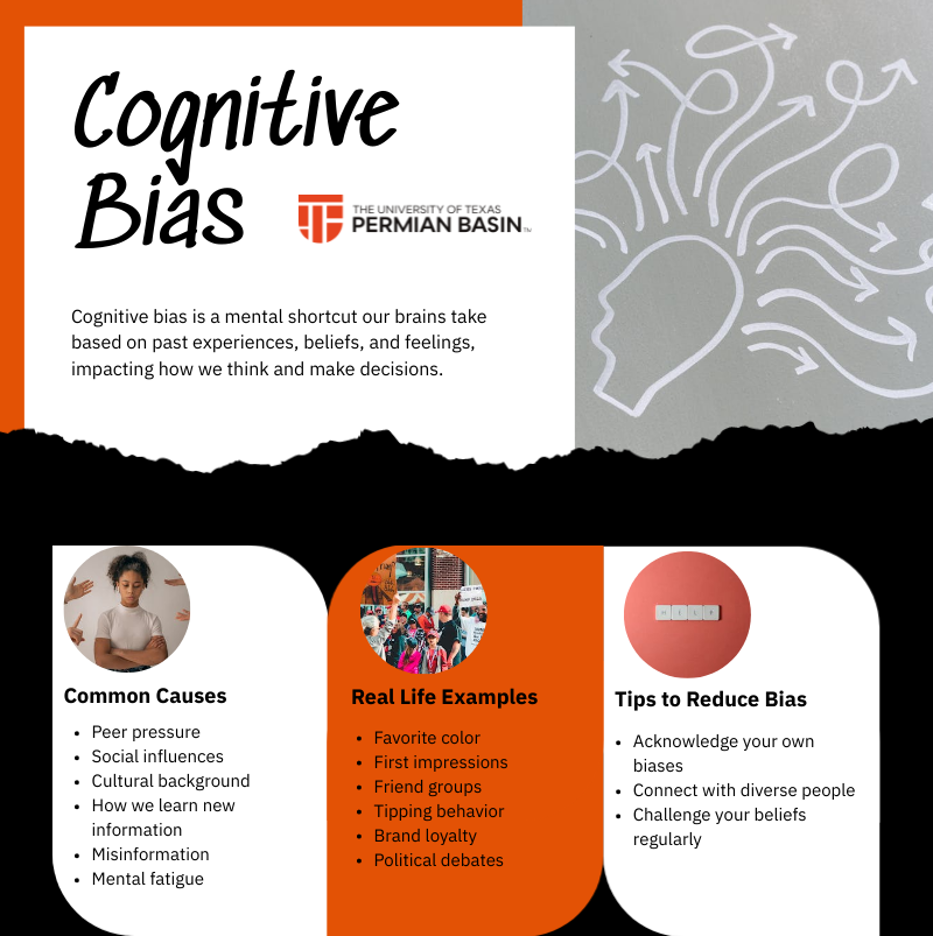
That’s an example of cognitive bias, a pattern of thinking that occurs when your brain takes a shortcut based on a past experience, belief, or feeling. Because purple felt familiar to you, you chose that color—even if you’ve recently found yourself enamored with teal or navy.
Aside from helping us come up with quick and easy conclusions about our favorite color, how else does cognitive bias affect our lives? Let’s immerse ourselves in the realm of cognitive bias, from what it is to how it impacts us and how we can make a conscious effort to reduce it in our daily lives.
What Is Cognitive Bias?
Cognitive bias refers to the systematic errors in thinking that occur when the brain processes vast amounts of information. The human brain is a powerful anomaly. It can process 11 million bits of information every second. Our conscious minds, however, can only keep up with 40 to 50 pieces of information each second. Though significantly less than 11 million, that’s still an impressive amount of information to juggle at any given moment.
To help us keep up with all the bits and pieces, our brains occasionally take cognitive shortcuts to simplify information processing. The result? Cognitive biases, which serve as a quick way for your mind to make judgments based on your past experiences. So, instead of contemplating what your favorite color may be based on how you’ve decorated your home recently or the color you can’t seem to get enough of in your wardrobe, you go with the easy answer—the cognitive bias.
What Causes Cognitive Bias?
Cognitive bias refers to the systematic errors in thinking that occur when the brain processes vast amounts of information. Since your brain is consciously computing 40 to 50 items per second, it’s challenging to contemplate every single option 100% of the time, even when asked the simplest of questions. Even with an endless supply of information available to you at the swipe of a finger, sometimes it’s easier to take advantage of mental shortcuts.
Some of the most common causes of cognitive bias include:
Emotions Your emotions and beliefs can affect your decision-making and thinking.
Social influences Many of your judgments and beliefs are formed by your friends and family.
Cultural conditioning Our upbringing and cultural background often shape our thinking and contribute to our biases.
Availability of information As we age, we learn new bits of information through our social circles, books, or deep dives on the internet. Sometimes, rather than learning more about a topic we’re familiar with, we rely on our memories to relay what we know and overestimate our understanding of that topic, denying ourselves a new viewpoint on a particular topic.
How Does It Affect Our Lives?
Cognitive bias affects more than just our go-to responses for our favorite color. Below, we highlight some of the typical effects that cognitive biases can have on our lives:
Distorted perception Biases can lead you to create your own perceptions of reality. For example, let’s say you’re at a social gathering with your friends. You meet a woman named Suzie, who tells you she’s a librarian. Based on your prior stereotypes of librarians, you assume she’s reserved and enjoys speaking about her latest reads. When she brings up a popular book, she confirms part of your stereotype. As you focus on this, you miss out on the other qualities Suzie has to offer, like her quick wit, sarcasm, and love for college football.
Closed-mindedness When you’ve developed a set of beliefs via social, familial, or societal norms, cognitive biases can lead to close-mindedness on a variety of topics, from the education system to religion, politics, and more. Rather than hearing out another person’s perspective on a specific topic, you may be more likely to immediately shut their ideas down or simply not listen to their side of an argument.
Communication issues Cognitive biases can make it more challenging to have effective communication with others. Sometimes one or both parties can misinterpret or misconstrue what the other is saying due to their own personal biases.
Tips for Reducing Cognitive Bias in Our Daily Lives
While not all cognitive biases have negative consequences, it’s helpful to be aware of any biases you have so you can overcome them with these tips:
Accept that everyone has cognitive biases The first step to surpassing cognitive biases is to acknowledge that you (and everyone else) have biases. This will help you become more open to understanding others’ perspectives.
Experience life with a variety of people When you’re at a work function or family gathering, the comfortable choice is to remain close to your friends. Instead, try branching out from your usual group and speaking with individuals from diverse backgrounds and who have different ways of viewing the world.
FAQ About Cognitive Bias
Curious how cognitive bias shows up in everyday life or how to keep it in check? Let’s recap the core concepts.
What is cognitive bias? Cognitive bias is a mental shortcut your brain uses to make quick judgments based on past experiences, beliefs, or emotions.
Why do we experience cognitive bias? Our brains are constantly processing vast amounts of information. To keep up, they rely on shortcuts influenced by emotion, memory, culture, and social context.
How does cognitive bias affect daily life? Cognitive biascan distort perception, limit open-mindedness, and lead to miscommunication in everyday situations.
Can cognitive bias be reduced? Yes—by acknowledging your biases, engaging with diverse perspectives, and actively questioning your assumptions.
Earn a Bachelor of Arts in Psychology at The University of Texas Permian Basin
Your interest in the human mind and behavior doesn’t have to end with cognitive bias. With a BA in psychology, you can take your fascination (and career) to the next level. With UTPB’s online Bachelor of Arts in Psychology, you’ll gain a broad foundation of psychological science knowledge and written communication and research skills that can jump-start your career in a variety of industries.
Our program is ranked among the Most Affordable Online Psychology Degree by STEPS and as one of the Top Online Bachelor of Psychology Degree Programs by TopCounselingSchools.org. If you’re ready to start your next chapter, apply today!
Psychology is one of the broadest academic fields, and one of the most versatile. It spans everything from courtrooms to corporate offices, from childhood development to competitive sports. With so many specialties (and subspecialties), it can be tough to know where to even start. So exactly how many branches of psychology are there? The field is…
Ever reach for your phone and instantly face a barrage of messages, notifications, subscription reminders, and social media updates? You’re not alone. Scientists have estimated that the average person processes about 74 gigabytes of information daily: equivalent to watching 16 high-definition movies back-to-back in a single day. Cognitive overload is real. And over time, constant stimulation quietly changes how we think, focus, and feel. In this article, we’ll explore: What Does Cognitive Overload Mean? Cognitive overload happens when your brain receives more information than…
When someone struggles with depression, homelessness, or discrimination, who steps in to help? A psychologist? A social worker? A sociologist? These three fields all address human challenges, but they explore humanity from very different angles: one from society, one from the mind, and one from the front lines. So what are the similarities and differences between sociology, psychology, and social work? This guide clears up…
The History of Spanish Language: From Latin Roots to a Global Reach
But where did this widely spoken language originate, and how did it grow into the global phenomenon it is today? In this article, we’ll explore the history of Spanish language, including its history, evolution, and cultural significance—along with where you can sharpen your own Spanish fluency and appreciation for Spanish-speaking cultures.
Everything Began With the Romans
The Spanish language emerged from the Iberian Peninsula, the section of the European continent occupied by modern day Spain, Portugal, and the southernmost part of France. Like other Romance languages, Spanish traces its roots to Rome—not for its “romantic” qualities, but because it evolved from Latin.
Specifically, it developed from Vulgar Latin, the spoken form used by common people, rather than Classical Latin, the formal version seen in the works of Virgil, Ovid, and Cicero. The modern form of Spanish can be traced to the northern coastal region of Spain in the ninth century.
Spanish Becomes an International Language
In the centuries after the modern Spanish language developed, it spread to the Americas and elsewhere through exploration, colonization, immigration, and religious missions. It continued to develop into different dialects, with Castilian being the variety most spoken today.
Spanish is now spoken in at least 20 countries on four continents, listed here by largest number of speakers to smallest:
North America
South America
Europe
Africa
As of 2023, the world is home to an estimated 360 million Spanish speakers, with more than a third of native speakers living in Mexico and only about 12% living in Spain.
Key Takeaways
Where did the Spanish language originate? The Spanish language originated in the Iberian Peninsula, which is modern-day Spain, Portugal, and the southernmost part of France. It developed from Vulgar Latin, the spoken form of Latin used by common people, and its modern form can be traced to the northern coastal region of Spain in the ninth century.
How did Spanish become an international language? In the centuries after its development, Spanish spread to the Americas and other parts of the world through exploration, colonization, immigration, and religious missions.
How many countries speak Spanish today? Spanish is spoken in at least 20 countries across four continents: North America, South America, Europe, and Africa.
How many Spanish speakers are there in the world? As of 2023, there are an estimated 360 million Spanish speakers worldwide.
Why are Romance languages called ‘Romance languages’? Romance languages are named for their connection to Rome, not for their ‘romantic’ qualities, as they evolved from Latin.
Explore Where Spanish Can Take You
If Spanish is already part of your life, work, or future goals, UTPB’s online graduate programs can help you build on it.
If you’re like most people, when you decide to learn Spanish to advance your career, you might reach for your phone. In 2023 alone, there were 231 million language learning app downloads. Social media, websites, and AI offer instant translations. But how good are these quick fixes? Is their content accurate? And can they actually…
About 41 million people speak Spanish in the United States. Worldwide, that number jumps to 595 million. It’s the official language of 21 countries and territories across four continents. How Can a Spanish Major Help Your Career? Spanish language skills are certainly handy for social situations and travel. But more importantly, Spanish fluency and cultural…
Did you know that Spanish is the second-most spoken language in the world? It comes in as a close second only to Mandarin Chinese. In the United States alone, about 42 million people speak Spanish as their first language, and it’s one of very few languages that can help you communicate across multiple continents. It…
Are we born with our personalities, or are we shaped by the world around us?
That question sits at the center of the nature vs. nurture debate. “Nature” refers to the traits we inherit through biology and genetics. “Nurture” refers to the influence of our environment, including family, culture, education, relationships, and life experiences.
For centuries, philosophers, scientists, and psychologists have debated which force matters more. Today, the answer is less “either/or” and more “both/and.” Put simply, our personalities are shaped by the interaction between our genes and our experiences.
Let’s take a closer look at the nature vs. nurture debate and what it can teach us about personality, behavior, and human development.
Quick Answer: Nature vs. Nurture
Nature and nurture both influence personality. Genetics can shape traits like temperament, intelligence, and mental health risk, while environment can affect behavior, emotional development, values, and coping skills. Most psychologists today see personality as the result of both forces working together.
What Does “Nature” Mean in Psychology?
When people talk about heredity, they almost exclusively refer to their physical traits. They might say, “I have my mother’s eyes” or “my father’s nose,” but the characteristics we inherit from our parents are more than skin deep.
Your chromosomes, composed of segments of DNA called genes, shape many of your traits. You have 23 pairs—one chromosome per pair from each parent.
Think of genes as blueprints, carrying instructions that determine your every biological trait, including the color of your hair, eyes, and skin. Moreover, your personality, intelligence, and mental health can also be attributed, at least in part, to your genetic makeup.
What Does “Nurture” Mean in Psychology?
English philosopher John Locke compared the mind at birth to a tabula rasa, or blank slate, upon which our experiences imbue reason and knowledge. This is “nurture,” the idea that a child’s environment determines whom they turn out to be.
A report published by the National Academies of Sciences, Engineering, and Medicine (NASEM) affirms that informed parents are more likely to have positive interactions with their children in ways that support healthy development. By showing warmth, being responsive, and promoting other evidence-based practices, parents can improve outcomes relating to their child’s emotional, behavioral, cognitive, and social skills.
A person’s environment is most impactful during their early years, when their brain has yet to fully develop and their experiences are shaped entirely by their home life. There’s no doubt that nature plays a critical role in deciding the trajectory of our lives. The question is, how much of our behavior is inherited?
Examples of Nature vs. Nurture
Nature and nurture often work together in everyday life. For example:
A child may inherit a naturally cautious temperament, but their environment can influence whether that caution develops into confidence, anxiety, or careful decision-making.
Someone may have a genetic risk for a mental health condition, but support, treatment, stress levels, and life experiences can all affect how that risk develops over time.
A person may be born with certain athletic traits, but coaching, practice, nutrition, and access to opportunities can shape how far those abilities go.
A student may have a natural strength in language or problem-solving, but encouragement, education, and practice can help that ability grow.
These examples show why many psychologists no longer see nature and nurture as opposing forces. Instead, they work together to shape personality, behavior, and development.
What Twin Studies Reveal About Nature vs. Nurture
Scientists have taken a novel approach to testing the effects of heredity on personality: studying twins. Identical twins share the same genes, whereas fraternal twins share half of their genes, like other siblings.
By contrasting the traits of identical and fraternal twins, scientists have been able to separate the influences of nature and nurture on human behavior. In a meta-analysis of the heritability of human traits, researchers looked at over 50 years of twin studies, compiling evidence from over 2,000 publications reporting on a combined 17,804 traits and 14,558,903 twins.
They found that the heritability of human traits, including temperament and personality functions, is about 50%. To put it simply, half of our unique personalities can be attributed to heredity, or nature.
Why the Nature vs. Nurture Debate Isn’t Either/Or
Has the revelation that genetics accounts for half of our mental and physical traits—and that both sides hold equal sway over our personalities—put an end to the nature versus nurture debate? Not quite.
This debate has proven more nuanced than previously thought, particularly with the revelation that genetically driven behaviors shape our environments in the same way our environments shape us.
For example, parents responding negatively to their child’s antisocial behaviors may end up reinforcing those same behaviors. Complicating matters further are epigenetic changes that switch genes on and off. Traumatic experiences, in particular, can be passed on from one generation to the next. Complex factors like these continue to stoke the flames of this age-old debate.
More than opposing ideas, nature and nurture describe entwined influences that alter and build upon one another. While some argue that nature carries more weight because our genes, as opposed to our experiences, are set in stone, this is exactly why nurture is such an important concept.
The family, society, and culture we’re born into are random, but not all environmental factors are beyond influence, and something as simple as reading bedtime stories to a child could make a world of difference in who they grow up to be.
Study Human Behavior With UTPB’s Online Psychology Program
If you’re interested in how genetics, environment, personality, and behavior shape who we become, UT Permian Basin’s online Bachelor of Arts in Psychology can help you explore those questions in greater depth.
The program provides foundational psychology knowledge in areas such as research methods, mental disorders, and the application of psychological principles in real-world settings. Courses are fully online and asynchronous, giving you the flexibility to study on your schedule while earning the same respected degree as on-campus students.
Ready to pursue your interest in psychology? Learn more about UTPB’s online BA in psychology program.
Psychology is one of the broadest academic fields, and one of the most versatile. It spans everything from courtrooms to corporate offices, from childhood development to competitive sports. With so many specialties (and subspecialties), it can be tough to know where to even start. So exactly how many branches of psychology are there? The field is…
Ever reach for your phone and instantly face a barrage of messages, notifications, subscription reminders, and social media updates? You’re not alone. Scientists have estimated that the average person processes about 74 gigabytes of information daily: equivalent to watching 16 high-definition movies back-to-back in a single day. Cognitive overload is real. And over time, constant stimulation quietly changes how we think, focus, and feel. In this article, we’ll explore: What Does Cognitive Overload Mean? Cognitive overload happens when your brain receives more information than…
When someone struggles with depression, homelessness, or discrimination, who steps in to help? A psychologist? A social worker? A sociologist? These three fields all address human challenges, but they explore humanity from very different angles: one from society, one from the mind, and one from the front lines. So what are the similarities and differences between sociology, psychology, and social work? This guide clears up…
When people think of history class, they might picture dusty textbooks, memorized dates, or a recurring nightmare of a multiple-choice question about the date of the Great Molasses Flood. (1919, for what it’s worth.)
But here’s what that reputation misses: History is one of the most practical subjects you can study. The skills it builds—critical thinking, research, writing, argumentation—are exactly what some employers say they can’t find enough of. And at the graduate level, a history degree can invite opportunities that might surprise you.
Why Is History Important?
History is important because it explains how our society arrived at our current moment. Every political system, social norm, economic structure, and cultural tension playing out today has roots somewhere in the past. Understanding those roots gives you scope, context, and a serious advantage over people who don’t. You’re better equipped to make sense of the present and think clearly about what comes next.
Historians and historically trained thinkers have shaped public policy, legal arguments, journalism, education, and leadership at every level. The ability to look at a complex situation, trace how it developed, and form a clear perspective is rare and valuable. It’s also exactly what a history education teaches you.
History degrees have launched some pretty varied careers (and we’re not afraid to name names):
JFK, FDR, and George W. Bush – all history majors before they became president
Elena Kagan – history degree from Princeton, first female dean of Harvard Law, Supreme Court justice
Susan Wojcicki – history and literature major at Harvard, former CEO of YouTube
Steve Carell – history and theatre degree from Denison University, beloved actor and comedian (proof that this degree is nothing if not versatile)
Why Study History at the Graduate Level?
Graduate-level history study goes much deeper than the survey courses most people remember from undergrad. Instead of covering centuries in a semester, you’ll spend careful, considered time on historic moments and topics of consequence.
One week you’ll be reading primary sources and wrestling with competing interpretations. The next, you’ll build your own arguments from the evidence. It’s less “here’s what happened” and more “here’s why it matters—and what we still don’t fully understand.”
At UTPB, the online MA in history covers topics including:
The American Revolution
The Civil War and Reconstruction
The Third Reich and Holocaust
World War I
That kind of focused, rigorous study builds skills that transfer directly to a wide range of careers. And that’s the question most prospective students want answered—what can you do with a history degree?
What Can You Do With a History Degree?
History degree jobs span a wider range than most people expect. Sure, a classic role as a history professor probably springs to mind first, but a master’s in history can take graduates down many different paths.
That’s because the degree signals a key message to employers: This person can read carefully, write clearly, think critically, and make a coherent argument. Those abilities show up again and again on the lists of skills employers are struggling to find.
Some common career paths for history graduates include:
Education: Teaching at the secondary or post-secondary level, curriculum development, and instructional design
Government and public policy: Research, analysis, communications, and advisory roles at local, state, and federal levels
Management and leadership: Operations, project management, and organizational leadership
Research and writing: Journalism, archival work, museum curation, and professional historian roles
Law enforcement and intelligence: Analytical and investigative roles that rely heavily on research skills
A master’s degree also carries a real earnings advantage. According to the U.S. Bureau of Labor Statistics, workers with master’s degrees had median weekly earnings of $1,840 in 2024, compared to $1,543 for bachelor’s degree holders. That’s a gap of about $300 a week, adding up to roughly $15,000 more per year.
Why Get a Master’s Degree in History Online With UTPB?
If the careers, skills, and famous alumni above haven’t sold you yet, here’s the practical part: UTPB makes it genuinely easy to earn your graduate degree in history. The program is fully online and asynchronous, which means you complete coursework on your own schedule. No commuting, no rigid class times, and no choosing between your degree and your job.
A few things worth knowing about our online MA in history:
There’s no GRE required for admission.
Thesis and non-thesis options are available.
Many students complete the program in as little as two years.
Courses are taught by the same distinguished faculty who teach the on-campus program.
If you’ve already completed a bachelor’s degree from an accredited institution, you may be closer to earning your master’s than you think. Explore UTPB’s online MA in history to learn more about the program and how to apply.
Imagine being told you can’t do something—by law, by tradition, by those close to you—and doing it anyway. Even today, women face greater barriers to recognition and authority than men. Yet throughout history, countless women stepped beyond traditional domestic roles, often at great personal risk. This article highlights nine of the countless important women who…
“Our country has deliberately undertaken a great social and economic experiment, noble in motive and far-reaching in purpose.” -Herbert Hoover Today, speakeasies are stylish bars hidden away behind bodegas, coffee shops, and laundromats. Ordering a cocktail is as easy as walking up to the bar, and while some places still require a password, you can…
At the iron gates of Auschwitz-Birkenau, one of the most infamous extermination camps of Nazi Germany, the chilling phrase “Arbeit macht frei” (“Work sets you free”) still casts a haunting shadow. These deceptive words led into one of history’s darkest chapters. Beyond that gate, more than a million lives were brutally ended. Auschwitz-Birkenau was just…
If you want to earn a degree faster without putting your life on pause, an accelerated online degree program may be worth a closer look.
An accelerated degree program is designed to help students complete coursework in a shorter time frame than a traditional program. Instead of longer semesters, you’ll move through condensed sessions that cover the same material in less time. At The University of Texas Permian Basin, you can complete some programs in as little as eight months, depending on the program and course load.
So, what does that actually look like for students?
How Accelerated Online Programs Work
Traditional college semesters often run about 15 weeks. Accelerated programs break that schedule into shorter sessions, which allows students to finish courses more quickly and keep moving toward graduation.
At UTPB, many fall, spring, and summer sessions include shorter course terms, with some lasting just eight weeks. That means students can make steady progress throughout the year while learning on a schedule that works for them.
For motivated students, that flexibility can make a major difference.
What Is an Online Accelerated Degree Program Like?
An accelerated online degree program is a real college experience that’s built for efficiency and flexibility.
Online students learn from experienced faculty, complete coursework remotely and move through class materials in a way that fits around work, family, and other responsibilities. Because many online courses are asynchronous, students can log in when it works best for them instead of rearranging everything around a fixed class time.
What Support Do Online Students Receive?
Online students at UTPB have access to many of the same support services available to on-campus students. That includes academic advising, tutoring, and writing assistance.
Students can also connect with classmates and instructors through discussion boards, assignments, and group work. And even though you’re using an online setting, there are still opportunities to ask questions, collaborate, and build connections.
In other words, accelerated doesn’t mean unsupported.
Ask yourself: If I can receive the same guidance, education, and degree from an accelerated online program, why anchor myself to a college campus?
Frequently Asked Questions
You asked and we answered. Here are some of the most common inquiries about our accelerated online degree programs:
What is an accelerated degree program? An accelerated degree program allows students to complete their degree in a shorter time frame by offering condensed course formats and flexible scheduling.
How long does it take to earn an accelerated online degree? At UT Permian Basin, students can complete some programs in as little as eight months, depending on the program and course load.
Are accelerated online degrees the same as on-campus degrees? Yes! Graduates receive the same UT Permian Basin diploma as on-campus students, with identical coursework and faculty instruction.
What resources are available to online students? Online students have access to advisors, tutoring services, writing assistance, and 24-hour discussion boards for academic support.
What accelerated degree programs does UT Permian Basin offer? UTPB offers accelerated degrees in business, education, arts and sciences, health sciences, and engineering at both undergraduate and graduate levels.
Find Your Online Accelerated Program at UTPB
UTPB offers accelerated online programs across a variety of fields, including business, education, arts and sciences, health sciences, and engineering.
If you’re looking for a way to earn your degree faster while still receiving academic support and a respected credential, an accelerated online program could be the right next step.
You only get one chance to make a first impression. Cover letters have long been one of the best ways to set yourself apart in a competitive market. But in the era of AI screeners, even the most polished resumes—and their accompanying cover letters—feel like they’re disappearing into the void. With the job market more…
Getting accepted to The University of Texas Permian Basin is a big milestone. If you’re a working professional, the next step—asking your employer about tuition reimbursement—can feel a little intimidating. But it doesn’t have to be. Most organizations want employees who grow, stay, and contribute at a higher level. And many companies offer tuition reimbursement,…
The University of Texas Permian Basin is home to over 7,000 students. Whether on campus in West Texas or from a laptop hundreds of miles away, they’re part of a diverse community that values culture, connection, and progress. Every member of our Falcon Family deserves some time in the spotlight. But with Hispanic Heritage Month…