5 Jobs a Public Administration Degree Can Help You Land
If you’re working in the public or the nonprofit sector, you may be ready to move up in your career and become a leader in your field. If you aspire to work in one of those sectors, you may be looking for a way to boost your relevant qualifications. Either way, new credentials can lead to new opportunities. Some government agencies and organizations require a graduate-level degree for advancement. A degree such as a Master of Public Administration (MPA) can make all the difference, positioning you for coveted managerial and directorial roles or helping you transition into either of these rewarding sectors. In short, in addition to expanded knowledge, this degree can bring you greater responsibilities in a new role, greater respect from peers, colleagues, and superiors, and greater compensation prospects.
What Kind of Job Can I Get With a Public Administration Degree?
The public and nonprofit sectors both have a wide range of positions that require the expertise that an MPA degree can provide. That means there are many possibilities when it comes to taking a position commensurate with your degree. The U.S. Bureau of Labor Statistics (BLS) publishes valuable information about many of these roles. The BLS is considered the authority in salary and job growth statistics as well as standard job descriptions in the United States.
The information below has been collected from the BLS website and is current as of October 2020. As you will see, demand is growing for many of the roles listed. Most of these careers are projected to grow at a rate faster than the national average of 4% through 2029, and some offer six-figure salary potential. Public service can be rewarding both in terms of the work you do and what you get for it in return.
Social and Community Service Managers
Social and community service managers organize and oversee programs, departments, and organizations that work for the public good. They work for nonprofit entities, governmental agencies, and for-profit social services businesses. The field is expected to grow by 17% through 2029. Median annual pay is $67,150.
Financial Managers
The duties of a financial manager include producing financial reports, formulating plans that lay out the future financial goals of their employer, and supervising investment activities. They may work in government or in a variety of industries, including investment firms, financial institutions, and insurance companies. The field is expected to grow by 15% through 2029. Median annual pay is $129,890.
Public Relations and Fundraising Managers
Public relations managers are in charge of maintaining and improving a company’s or organization’s public image, while fundraising managers lead efforts to bring financial donations into their organization. The majority of people employed in one of these positions in the United States work in religious, civic, grantmaking, or professional organizations or in educational services in state, local, or private organizations. The field is expected to grow by 9% through 2029. Median annual pay is $116,180.
Human Resources Managers
Needed in nearly every industry, human resources managers are in charge of planning, managing, and guiding all administrative duties with regard to the acquisition, compensation, retention, and dismissal of employees. The field is expected to grow by 6% through 2029. Median annual pay is $116,720.
Emergency Management Directors
Emergency management directors create and direct emergency plans for assisting populations in the aftermath of natural disasters or other emergency situations. They may work for governments at the local, state, or federal level or for medical facilities, educational institutions, or private companies. The field is expected to grow by 4% through 2029. Median annual pay is $74,590.
Where Can I Earn an MPA Degree?
The University of Texas Permian Basin offers an online Master of Public Administration program that can help you enter into a new career or advance within your existing career in the public or nonprofit sector.
Throughout the program, you’ll learn proven ways to become an effective leader. You’ll discover practical, competent, ethical, and legal ways to address organizational issues and policy questions, with the ultimate aim of upholding the public interest. Graduates from our program have gone on to use their degree and accompanying skills in a variety of fields including economic development, public safety, healthcare, human services, transportation, criminal justice, fine arts, and parks and recreation.
The Benefits of Our Online MPA Program
With its 100% online, asynchronous course format, our Master of Public Administration program enables you to complete studies anywhere, on your own schedule. You’ll find this especially advantageous if you’re juggling work and/or family responsibilities while earning your degree. Tremendous flexibility is just one benefit in a program that enables you to:
Earn your degree in as little as 12 months.
Choose from six convenient start dates per year.
Complete courses in just eight weeks.
Learn from faculty members with extensive experience in relevant fields.
Gear your studies toward a specific area of interest.
Gain a top-quality education delivered by supportive faculty.
The United States is in desperate need of qualified teachers—so much so that schools have started hiring teachers from half a world away. School districts are searching for fully certified professionals, preferably those who are certified to teach two subjects, but what’s the purpose of dual certification if schools are going to such extremes to hire teachers?
Why would an educator need to earn a dual certification to advance their career?
By earning a dual certification, educators prove that they have the skills, knowledge, and experience to lead a classroom. Once certified in their particular areas of study, an educator can advance their career, and one day they may find themselves leading an entire school. Let’s explore how earning a master’s degree and certificate can help emerging and established teachers advance their careers.
Advance Your Career Through Certification
How does certification help in career advancement? For many teachers, being able to guide young learners through essential life lessons is one of the most rewarding aspects of their career. Thus, the problem: how can educators advance their career without abandoning the classes and students they adore? Certification allows teachers to do just that. Through dual certification, educators can expand their responsibilities and earn higher salaries, and they can complete the certification process while continuing to teach.
Reading and Language Roles
For example, teachers who want to strengthen their understanding of literacy can earn a Master of Arts in Literacy from The University of Texas Permian Basin. Educators who join our online program understand just how important reading is for young children. More than a third of American fourth graders can’t complete their schoolwork successfully due to their poor reading ability. By earning an MA in literacy, teachers can earn a higher salary while ensuring at-risk students aren’t left behind. Moreover, with the addition of two courses, Texas candidates may qualify for the English as a Second Language (ESL) supplemental teacher certification, further increasing career mobility.
Administrative Roles
If an administrator is interested in advancing their career by becoming a principal, certification allows them to work toward state requirements while remaining in their current position and gaining necessary leadership experience. Principals take an active role in shaping the academic lives of students; however, candidates must obtain the proper certification as well as a master’s degree.
UT Permian Basin offers Texas administrators an affordable, flexible path to principal certification through our online Master of Arts in Educational Leadership program. Program participants learn to become 21st-century educational leaders while taking courses aligned with the State Board for Educator Certification (SBEC) for Principal and Superintendent Competencies and the standards set by the Educational Leadership Constituent Council. Obtaining a principal certificate in Texas often leads to a six-figure salary, but principals aren’t the only certified professionals who can maximize their earning potential.
Earn a Higher Salary
Dual certification is especially important in Texas, where teacher salaries lag behind those in states with similar employment levels like California and New York. Like many states, Texas uses a “step and lane” salary schedule for teachers. Depending on the district, teachers can earn a higher starting salary, but it can take well over a decade for a Texas teacher’s salary to peak.
Why get certified? By earning a master’s degree and certifications in specific academic areas, Texas teachers can be paid premiums in some school districts and outearn their peers. A prime example of this is the new initiative to reward Texas’ highest-rated educators. Although the initiative, which is enabling top teachers to earn six-figure salaries, is currently only in effect in select school districts in the Houston area, the push for a modern pay-for-performance system is in full swing.
Provide High-Quality Education
The purpose of certification goes beyond increasing salaries and career options. The more high-quality a teacher’s education, the better education they’re able to provide to students. Multiple studies have explored the relationship between teacher education and teacher effectiveness. In one study, researchers looked at a data set consisting of information from Houston Independent School District (HISD) teachers and fourth- and fifth-grade students and found that certified teachers who graduated from an approved teacher education program were more effective at stimulating student achievement gains in both reading and mathematics.
Researchers cautioned, however, that “certification is only a proxy for the real variables of interest that pertain to teachers’ knowledge and skills.” In addition to subject matter knowledge, this includes the ability to teach and manage a classroom of unique learners, design and implement instruction, and work with students, teachers, and other professionals.
Advance Your Career at UT Permian Basin
Don’t be alarmed by this extensive list of teaching credentials. Like their students, every educator has to start somewhere. In Texas, it starts by earning a master’s degree and becoming certified in an area of interest. Even teachers with years of experience can earn dual certification, advance their career, earn a higher salary, and offer education of the highest quality. If you’re interested in seeing just how far your career path can take you, explore UT Permian Basin’s numerous online programs. Whether your career interests lie in bilingual/ESL education, educational leadership, literacy, or special education, UT Permian Basin has the online degree program for you.
It may be considered a soft skill by many, but being able to get along with others is perhaps the most important trait any person can have, regardless of their profession or other factors. The ability to understand others is key to interacting in positive, constructive ways in any social setting.
Psychology is a word often used to describe the way people think and the motivations behind their actions. In terms of understanding others, why is psychology important? Let’s begin with a definition of what it is and then continue on with an exploration of the benefits of studying psychology.
What Is Psychology?
According to the American Psychological Association (APA), “Psychology is the study of the mind and behavior. The discipline embraces all aspects of the human experience—from the functions of the brain to the actions of nations, from child development to care for the aged. In every conceivable setting from scientific research centers to mental healthcare services, ‘the understanding of behavior’ is the enterprise of psychologists.”
How Can Studying Psychology Help You Understand Others and Yourself?
The benefits of studying psychology are consequential and numerous when it comes to understanding one’s self and other people. You’ll gain insight into why people think and act the way they do and into your own behavior and motivations. You’ll learn about the internal impulses and desires that drive us all. And you’ll develop a greater sense of empathy for others based on that understanding, enabling you to limit your biases against people who act differently than you do. Knowing what motivates people goes a long way toward creating a harmonious relationship with those around you, whether they are a major part of your life or someone with whom you’re interacting only briefly, such as a cashier.
Studying psychology can give you a better understanding of your children, helping you become a better parent as you learn to nurture their developing psyches. This, in turn, can make them well-balanced, psychologically healthy children destined to grow into well-balanced, psychologically healthy adults.
An education in psychology can also help you become a better communicator. Communication involves not only how you speak to others but how you interpret others’ word choices, body language, tone, facial expressions, and eye contact and use that understanding to formulate appropriate responses. Understanding someone doesn’t merely mean comprehending the words they’re speaking, but the intended meaning beneath them, or subtext. All the characteristics above provide added clarity.
If your ultimate intention in studying psychology is to pursue a career in the field, there are two routes you can take. One is going into practice, which is clinically based and focuses on helping people. As the APA states, psychologists “identify and help people overcome the obstacles that inhibit them from making better choices … Psychologists use psychological science to help people tap into their potential and help them perform at an optimal level.”
The other path is basic research and the science of psychology. The majority of academic psychologists focus on this path, which emphasizes research methods, critical thinking, data collection and analysis, statistical modeling, and scale development.
Are There Other Personal Benefits ofStudying Psychology?
Beyond understanding others, an education in psychology can help you live a more fulfilling life by fostering critical thinking and confidence. You’ll also gain a deeper understanding of the science of psychology.
As Ronald E. Riggio, PhD, explains in an article in Psychology Today, studying psychology can also help you:
Understand basic psychological and scientific principles affecting human behavior.
Become a better critical thinker.
Gain a better understanding of relationships.
Be more effective in your profession.
Become more likely to be hired.
What Type of Program Is Best for Studying Psychology?
The University of Texas Permian Basin’s online Bachelor of Arts in Psychology offers a broad foundation of psychological science with an emphasis on critical written communication and research skills that are invaluable in helping professions and other careers. This intensive online program will help you cultivate important abilities, including reasoning about empirical research, writing persuasive, cohesive arguments, and thinking critically on applied and theoretical aspects of psychology. Finally, the knowledge and insight our affordable program provides can make you more competitive in your pursuit of a diverse selection of professional roles.
Why Learn Online?
We offer our BA in psychology program 100% online through asynchronous class sessions. This advantage enables you to complete your coursework anywhere, at your own pace. If you have work and/or family responsibilities, you’ll find that a flexible program format like ours best suits your busy schedule. You can begin the program at any of six start dates per year. All program courses last eight weeks and are taught by the same acclaimed faculty who teach them on campus. When you successfully complete your BA in psychology program, you’ll receive the same respected degree that campus-based UT Permian Basin graduates receive.
What are ethics? Merriam-Webster offers these definitions: “the discipline dealing with what is good and bad and with moral duty and obligation” and “a set of moral principles.” In the world of high finance, ethics has its own distinct definition that’s connected with the appropriate use of money, whether it’s one’s own money or someone else’s.
Corporate finance, according to Investopedia.com, refers to “how corporations deal with funding sources, capital structuring, and investment decisions.” Corporate finance focuses on “maximizing shareholder value through long and short-term financial planning and the implementation of various strategies. Corporate finance activities range from capital investment decisions to investment banking.” In short, corporate finance is about where an organization gets its money from and how it decides to use that money.
Public Demand for Ethical Investment Choices
One prominent example of how ethics ties in with corporate finance is the South Africa divestment movement. In the mid-1980s, when South Africa was still under the segregationist apartheid system, American university students targeted U.S. companies that did business in South Africa in an effort to bring the apartheid system down. Participants in this divestment campaign pressured their own universities to divest from those companies. The idea was to compromise the finances of South Africa enough so that it had no choice but to change. The effort worked.
By 1990, more than 200 U.S. companies had divested from South Africa, taking with them $1 billion worth of investment from that country’s economy. Clearly, those businesses had gotten the message from the student-led university divestment and chose to do business elsewhere. Even if their motive for doing so was financial, the companies’ actions constituted an ethical use of financial capital.
Today, there are published lists of companies that embody socially responsible investing, or SRI. These lists tend to automatically eliminate any businesses connected with weapons, tobacco, alcohol, adult businesses, nuclear power, and coal, to name a few. Companies that focus on sound environmental policies, social responsibility, and strong governance are more likely to make the list.
It’s not unusual for customers, investors, and even the general public to renounce and boycott companies that run afoul of these principles. Conversely, those that adhere to them can reap significant financial rewards. For this reason, anyone involved in corporate finance today must have a firm foundation in ethics.
Insider Trading
Insider trading is one of the most common ethical issues in finance. Insider trades involve the buying or selling of stocks and securities using information that has been shared but is not publicly known. An insider is often someone in a management function of a corporate entity or an individual with whom they share information for their own benefit.
Many laws against insider trading in the United States came about following the stock market crash of 1929, which marked the beginning of the Great Depression. A spate of business mergers in the 1980s sent a lot of money flowing through the stock market. This is when selling (versus sharing) insider information was outlawed.
Former investment banker Ivan Boesky was involved in one of the most notorious insider trading cases in U.S. history. During the 1980s, Boesky accumulated an estimated $200 million by trading on corporate takeovers and mergers using information that was not publicly known. In exchange for helping the U.S. Securities and Exchange Commission (see more below) incriminate other corporate insiders who were under investigation, Boesky received a short prison sentence, a fine of $100 million, and a lifetime ban from working in securities. His name became synonymous with corporate greed.
Many financial scandals with big names attached to them would follow, including Enron, Worldcom, Bernie Madoff, and Jordan Belfort, who wrote the best-selling memoir The Wolf of Wall Street. Ethics may always be an issue in the world of high finance, but efforts are being made to stem the flow of money under illegal or immoral circumstances by outwardly legitimate parties.
Ethics Codified in Corporate Finance
Today, many American corporations and financial markets have adopted ethical codes, typically established by agencies such as the Securities and Exchange Commission (SEC), one of the top regulatory agencies for the securities industry. This agency implements federal laws and regulations that deal with the ethical conduct of businesses and individuals operating within the securities field. In addition, many companies have set up their own ethics offices to self-govern their financial conduct.
Online Master of Business Administration with a Concentration in Finance Degree
Securities, Commodities, and Financial Services Sales Agent
Under the guidance of the same distinguished faculty members who teach the program on The University of Texas Permian Basin’scampus—including successful business professionals—you’ll discover how to:
Analyze and interpret various types of financial information.
Successfully navigate multiple aspects of investment, economics, and accounting.
Think strategically.
Nurture your business acumen.
Apply your knowledge in real life in a variety of professional fields.
Make ethical decisions in the corporate setting.
We offer our MBA Finance program through our College of Business, one of the select business schools in the nation (and the only one in the Permian Basin) to be accredited by the prestigious Association to Advance Collegiate Schools of Business (AACSB International). This is a distinction that only 5% of schools granting business degrees worldwide have received.
Advantages of Our Online Programs
Our Master of Business Administration with a concentration in Finance degree, and many other programs that UT Permian Basin offers, is presented 100% online through asynchronous courses. This format enables you to complete your coursework anywhere, 24/7, on your own schedule. If you’re already working and/or have ongoing family responsibilities, you’ll find this flexibility to be a tremendous advantage. Our program also features accelerated time to completion (as little as 15 months), eight-week courses, and six start dates per year. When you’re finished, it provides a respected educational credential that can help you in your present and future professional endeavors.
Prepare for the world of finance with a strong foundation. An MBA with a concentration in Finance from UT Permian Basin is the place to start.
Literacy education has changed over time as people have found new ways to teach reading and writing. These changes are shaped by advances in language, technology, and what we’ve learned about how students learn.
Today, literacy education plays an important role in helping students succeed in school and beyond. Many modern approaches focus on meeting students where they are, instead of expecting everyone to learn at the same pace.
In this article, we’ll examine:
How literacy education developed over time
Key shifts in literacy instruction in the United States
Evidence-based approaches to teaching reading and writing
The stages of literacy development
The History of Literacy Education
What is literacy in education? Literacy is defined as “the ability to identify, understand, interpret, create, compute, and communicate using visual, audible, and digital materials across disciplines and in any context.” Literacy has been applied to a diverse array of activities (e.g., computer literacy and dietary literacy). However, for the purposes of this article, we’ll be focusing on literacy in the context of reading and writing and literacy education, which by extension is the process of receiving instruction in how to read and write.
Early Writing Systems and the Spread of Literacy
The origins of literacy can be traced back to southern Mesopotamia circa 3,000 BCE. Ancient Sumerians began writing on clay tablets and subsequently invented cuneiform script, the first known writing system. While this early writing was comprised of rudimentary symbols, it would be a precursor to full scripts and modern language.
For centuries, only a select few were taught to read and write. That changed with the invention of the printing press by Johannes Guttenberg in the 1450s. Books went from being hand-copied, rare commodities to common items. The invention of the printing press kicked the renaissance into high gear, and literacy suddenly became a gift for the masses, rather than a luxury for the wealthy elite.
Literacy Education in America
Fast forward to colonial America, where literacy education was motivated by the belief that salvation required the ability to read the bible. Children were taught to read at an early age—sounding out syllables before learning the meaning of a word—but most weren’t taught to write until around the age of seven. In these early years, literacy education was taught by mechanical repetition and harsh discipline, without much emphasis given to a student’s capacity for understanding. It wasn’t until the 1970s that educators began to decipher how the mind receives, processes, stores, and retrieves information. Since that time, passionate debates have been continuously held regarding the most effective methods for teaching reading and writing.
Evidence-Based Approaches to Literacy Instruction
What’s the best way to teach literacy to children? In 1997, the National Reading Panel was formed to answer that very question. The panel reviewed decades of research and found that the most effective approaches were well-planned, consistent, and clear and incorporated:
Explicit instruction in phonemic awareness;
Systematic phonics instruction;
Methods to improve fluency; and
Ways to enhance comprehension.
Today, we know that the ideal approach to teach and learn literacy depends on the student. Every student is an individual with unique strengths, weaknesses, interests, and ways of learning. Literacy educators have the challenge of making instruction relevant and meaningful to students who may be at different stages of development. Rather than trying to “fix” students, this student-centered approach tasks teachers with guiding students as they navigate the stages of literacy development.
The Five Stages of Literacy Development
The five stages of literacy development begin at six months of age and continue all the way into adulthood. Learning to read and write is a lifelong process, and barriers at any stage can be detrimental no matter where an individual is in their development.
1. The Emergent Pre-Reader
The early stages of literacy development are crucial for children, as this is when the connections in their brain—the foundation for learning, behavior, and health—are most adaptable.
During the emergent pre-reader phase, which spans from six months to six years of age, a child is like a sponge, absorbing sounds, words, and images they encounter. While trying to teach a child to read before the age of four of five can be counterproductive to their development, they should already understand thousands of words by the end of this stage.
2. The Novice Reader
Between the ages of six and seven, a novice reader is beginning to learn the relationships between letters and sounds (phonics). During this brief yet important stage, children are figuring out the alphabetic principles that took our ancestors thousands of years to develop.
They are learning new words by sounding them out, building upon prior concepts to learn new concepts. Reading out loud is one of the most important things an educator can do to help novel readers bridge the gap between oral and written language.
3. The Decoding Reader
Decoding readers are able to read simple, familiar stories with ease. Between the ages of seven and nine, children are able to not only understand words but also their components, including their letters, meanings, and grammatical functions. Moreover, they are able to understand how words with similar components and meanings relate to each other despite being pronounced differently, such as “sign” and “signature.”
4. The Fluent, Comprehending Reader
Between the ages of nine and 15, a child becomes a fluent, comprehending reader, able to fluently comprehend what they read from any source. They are able to access knowledge at any time to help them interpret what their reading. While a child may be able to accurately pronounce words with ease by this stage, it doesn’t guarantee comprehension. The goal by this stage is for a child to be able to look beyond surface meaning and read between the lines. Guidance from teachers along with a genuine interest in reading can help fluent readers become expert readers.
5. The Expert Reader
Fiction, science, politics—no subject or viewpoint is beyond the comprehension of an expert reader. In the fifth stage of literacy development, reading comprehension finally surpasses listening comprehension, and expert readers are better able to understand complex concepts by reading.
After the age of 16, an expert reader continues their development, which depends largely on how and what they read. However, their journey is never complete, as learning to read and write is an endlessly rewarding, lifelong pursuit.
Can speaking multiple languages boost your salary? Make travel easier? Even help prevent dementia? The answer is yes. But multilingual societies also face real challenges, from schools struggling with resources to entire languages disappearing. Whether you’re considering learning a second language or wondering how multilingual communities work, this guide covers what you need to know….
Gamification in education uses game-like elements such as points, badges, challenges, and leaderboards to make learning more engaging and motivating for students. By bringing familiar features from games into the classroom, educators can encourage participation and support stronger student buy-in. From elementary school to college classrooms, you can use gamification in different ways depending on students’ needs and learning…
Robots in the classroom. Three-dimensional online education. 2025 is well underway, and the potential for big developments in education is on the horizon this year. Perhaps unsurprisingly, many of these educational trends are centered around technology-facilitated digital learning. Some may be familiar, while others may be new to you. All are expected to become more…
Often called the “highest court in the land,” the U.S. Supreme Court sits at the top of the American justice system. But despite its influence, the Court hears only a tiny fraction of the cases sent its way.
Each year, the Supreme Court receives around 10,000 petitions, yet it only agrees to hear about 70 to 80 cases. When the Court declines a case, the lower court’s ruling usually stands, making the Supreme Court the final word in many legal disputes.
So, what does the Supreme Court actually do, and why does it matter?
The Role of the Supreme Court in the U.S. Justice System
At its core, the Supreme Court’s role is to interpret the U.S. Constitution and ensure that federal and state laws align with it. Its decisions affect how laws are applied nationwide, shaping issues like voting rights, criminal sentencing, and the balance of power between state and federal governments.
In simple terms, the Supreme Court:
Interprets the Constitution
Resolves disputes involving federal law
Reviews decisions from lower courts
Sets legal precedents that guide future cases
Because its rulings apply across the country, the Supreme Court plays a critical role in maintaining consistency within the justice system.
How Are the Federal Courts Structured?
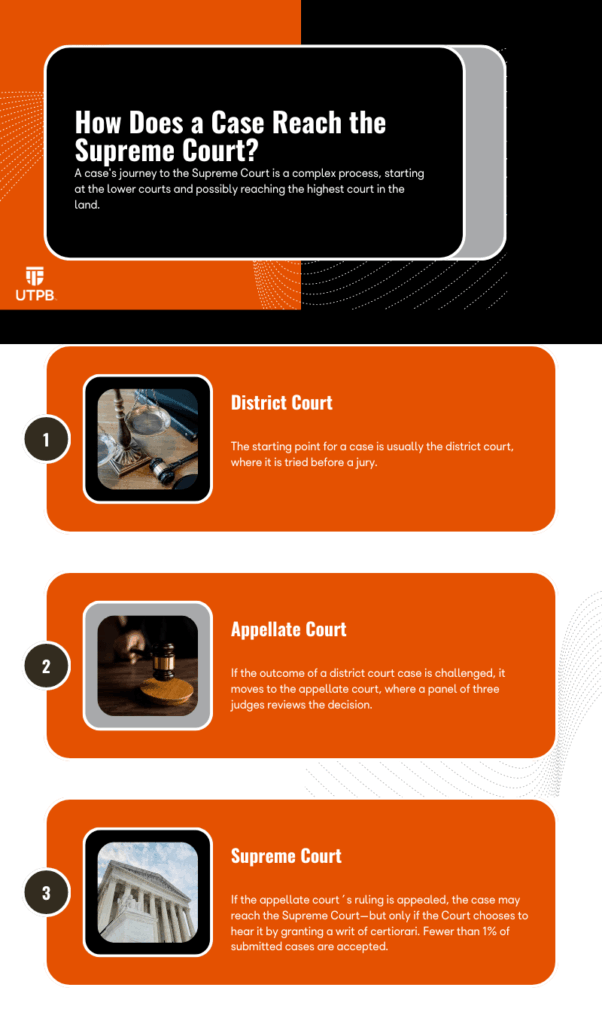
The Supreme Court sits at the top of a broader federal court system that includes two main levels below it: the U.S. District Courts and the U.S. Courts of Appeals.
U.S. District Courts
District courts are trial-level courts where federal cases begin. There are 94 district courts across the country, where judges hear cases involving federal law, often with juries present.
U.S. Courts of Appeals
Above the district courts are the U.S. Courts of Appeals, also known as circuit courts. These courts review district court decisions to determine whether the law was applied correctly.
Appellate courts don’t use juries. Rather, they employ panels of judges who evaluate legal arguments and issue rulings.
What Does the Supreme Court Do With Appeals?
After a case moves through lower courts, a party may ask the Supreme Court to review it by filing a writ of certiorari. The Court is not required to accept these requests—and in fact, it accepts fewer than 1% of them.
The justices use the “rule of four” to decide which cases to hear. If at least four of the nine justices agree that a case is significant, the Court will review it.
Once the Supreme Court issues a decision, that ruling is typically final unless:
A constitutional amendment overturns it, or
The Court later reverses itself in a future case
Why the Supreme Court Matters
The Supreme Court’s responsibilities extend far beyond individual cases. Its rulings influence civil rights, federal authority, voting laws, business regulations, and many other aspects of daily life.
Because of this reach, understanding the role of the Supreme Court is essential for anyone interested in:
Law and public policy
Criminal justice
Government and public service
Constitutional rights
Study the U.S. Justice System Online at UT Permian Basin
If you’re interested in how courts function—from trial courts to the Supreme Court—The University of Texas Permian Basin offers flexible online programs that explore the justice system in depth.
When you live in one country your entire life—or even for just a few years—you begin to feel accustomed to how its justice system works. In the United States, for example, there are two types of legal cases: criminal and civil. In addition, all defendants are considered innocent until proven guilty and have the right…
If you ask Dr. John Fisher, assistant professor and coordinator for UTPB’s criminal justice program, he’ll tell you that “serial killer” is a misleading term. “We need to change the nomenclature on that because it’s murder. It’s serial murder.” While the terminology may change, our widespread fascination with serial murderers seems unlikely to. For insight,…
Miami police officers responding to a 911 call found two men sitting in the street. One was holding an unknown shiny object. The other man put his hands up, but the man holding the object ignored police commands. An officer fired a gun at him, but the shot missed its intended target and hit the other man in the leg. The shiny…
Crisis scenarios like these happen more often than you think: A customer gets sick or injured using your product or service. A company official makes an embarrassing public remark. A data breach exposes sensitive customer information.
These types of incidents can cast an entire organization in a negative light. When crises occur, it’s important that an organization respond quickly and appropriately, as failing to do so can lead to lasting financial and legal problems.
Response is where crisis communication comes in. In short, this means getting your side of the story out to the public, acknowledging mistakes were made, and providing specifics about what you’re going to do to correct them and prevent future occurrences.
You can learn how to respond to a variety of crises in The University of Texas Permian Basin’s online Bachelor of Arts in Communication program, which offers a dedicated crisis communication course. With the knowledge you’ll gain, you can help any organization avoid PR nightmares like those below.
3 Real-World Crisis Communication Case Studies
A 24-hour news cycle and minute-by-minute social media updates have made the circulation of videos, pictures, and stories fast and unforgiving. Bad news generally gathers the most attention and spreads quickly.
Below are some examples of high-profile crises and how the parties involved handled them.
#1 Boeing’s Crisis: Deadly 737 Max Crashes and CEO Fallout
Aircraft manufacturer Boeing experienced a crisis when two of its 737 Max planes crashed under similar circumstances, killing hundreds of people. In both cases, the planes automatically went into nosedives, and the pilots were unable to retake control.
In response, Boeing’s CEO at the time, Dennis Muilenburg, stated that such problems could be avoided in the future through pilot training, seemingly implying that the pilots were at fault for the accidents.The true culprit turned out to be a faulty sensor, a problem which had already been reported to the FAA hundreds of times but went unaddressed.
After that came to light, all 737 Max planes were grounded and given technical upgrades. Boeing also renamed the aircraft the 737-8, since the public had come to associate the 737 Max with deadly accidents. Still, many airlines cancelled their orders with Boeing for the model. The company’s stock took a major hit as well, and CEO Muilenburg was ultimately fired.
#2 United Airlines: Dragged Passenger Incident Sparks Outrage
In 2017, a passenger on a sold out United Express flight out of Chicago O’Hare International Airport was asked to deboard the plane. The reason? To accommodate airline employees who needed to reach Louisville—the flight’s destination—to work on another flight.
The passenger refused to give up his seat and was eventually dragged off the plane by law enforcement. He soon managed to reboard the plane, blood streaming down his face, before collapsing and being taken off on a stretcher. Many passengers filmed the incident on their cell phones.
United Airlines’ now-former CEO Oscar Munoz initially made light of the incident, stating that the airline had had to “re-accommodate” some passengers. That response angered the public, but Munoz insisted employees had acted appropriately and that the passenger had been “disruptive.”
Two days later, Munoz called the incident “horrific” and took responsibility for it. PR specialists at the time said he should’ve immediately issued an unconditional apology. Ironically, Munoz had been named U.S. Communicator of the Year by PRWeek just one month prior.
#3 Crock-Pot Controversy: Fictional Fire, Real Backlash
Not all public relations nightmares involve harm to actual people, fortunately. One prominent example involved the death of a beloved fictional character. In 2018, Jack Pearson, a character on the popular TV program This Is Us, died in a fire as the result of a malfunctioning Crock-Pot. Fans of the show were incensed and took to social media to announce they were going to throw out their Crock-Pots for their own safety.
To its credit, Rival, the manufacturer of Crock-Pots, also took to social media to state that they loved Jack and asked that the public not add to their “heartbreak” by no longer using the product, which had been tested for generations. Rival also reassured the public that such an incident had never occurred with their product and that its design made an occurrence “nearly impossible.” The company was widely praised for its response.
What You’ll Learn in a Crisis Communication Course
If you’re part of a communications team for a large organization, particularly a corporate entity, or you represent one as part of a PR firm, it’s important to be able to manage crises, especially when so much is at stake—the company’s reputation, financial standing, and long-term viability.
A crisis communication plan can help you prepare to handle any number of public challenges. Drafting a plan involves drawing up a comprehensive set of potential crises and determining how your organization will respond to them. You must be able to react quickly and appropriately in such circumstances. Often, as we saw in the United Airlines example, an organization’s initial reaction to a crisis can actually deepen its woes.
Crisis communication requires an organization to be able to answer many questions, all of which may be explored in a crisis communication course:
How do you communicate in a crisis?
What are the known risks?
What other potential risks are there?
How will your organization respond?
How will your organization not respond?
Who will make up the crisis management team?
Who will lead the crisis management team?
How will you avoid similar occurrences in the future?
What steps will you take to repair your reputation?
How Our Online BA Provides Crisis Communication Training
UT Permian Basin offers a 3-credit crisis communication course as an elective within our online Bachelor of Arts in Communication program. As our catalog indicates, COMM 3342 Crisis Communication “provides study and practice of communication strategies involved in preparing for and responding to crises. While a wide range of crises are considered, the course pays particular attention to corporate crises.”
We consider Crisis Communication to be an integral part of our online BA in communication program, which delves into a varied array of critical types of communication, helping you develop in-demand skills that are useful in many fields.
Today’s employers consistently name communication as one of the primary skills they seek in new hires. Our BA in communication program places an emphasis on written and spoken communication and provides a comprehensive foundation in this multifaceted field, from its ancient origins to present-day communication media.
Our program is 100% online with asynchronous class sessions, enabling you to complete your coursework anywhere on your own schedule. Courses are eight weeks long, and you can begin the program at any of six start dates per year.
Most of today’s employers are looking for a particular set of skills in job candidates, and certain college degrees are better oriented toward helping you develop them than others. You’ve probably heard of “soft skills,” but what are they? Verbal and written communication, teamwork, critical thinking, and problem-solving are the among the most important skills,…
Stage fright is more common than you might think. Millions of people struggle with public speaking skills, and the fear even has a name: glossophobia. Being asked to speak in front of others can trigger a fight-or-flight response, especially when you feel unprepared or exposed. The good news? Effective public speaking is a learned skill,…
As someone who’s been talking to people since they were a toddler, communication may like a simple concept at first glance. But it’s worth a deeper look, especially if you’re thinking about studying it. First, understanding what communication really entails helps you see how important it is to our daily lives. Second, communication isn’t limited…
Long hours, late nights, and sore feet are challenges that have plagued nurses since the time of Florence Nightingale. However, the advent of the 21st century has brought with it a new set of challenges that nurses must learn to overcome if they are to rise through the ranks, and there’s no telling what challenges await nursing leaders in the years to come.
At The University of Texas Permian Basin, we’ve made it our goal to help nurses adapt to the shifting landscape of modern nursing. Every day may bring new patients, new challenges, and new opportunities, but there’s no reason nurses can’t be prepared for what tomorrow brings. As we look at the challenges of being a nurse in the 21st century, consider how earning a Bachelor of Science in Nursing and taking on a leadership role will better enable you and your fellow nurses to overcome these obstacles and so many more.
Health Concerns
It would be impossible to discuss the challenges of being a nurse in the 21st century without discussing the COVID-19 pandemic. With full knowledge that they could become infected and spread the virus to others, nurses are putting their own mental and physical health on the line to help those affected by COVID-19. This selflessness is explored in a review paper on nurses’ experiences during respiratory pandemics, which found that a nurse’s duty to their patient outweighs their competing obligations to themselves and their families. What drives nurses to put the needs of patients above their own? It’s simply the right thing to do. However, for nurses to perform at their best, they need a system supporting them.
“You talk about how essential, how needed, how grateful you are, and yet you throw us to the wolves,” said Jean Ross, president of National Nurses United. Ross is referring to a lack of personal protective equipment (PPE) for frontline healthcare workers that sparked protests at the start of the pandemic. To this day, PPE shortages continue to be sporadic and reuse practices for single-use PPE are becoming commonplace. Over half of nurses feel unsafe reusing and decontaminating masks. Nurses across the nation continue to fight against the “new normal” and protest for the safety of not only themselves but also their patients.
Always Online
One of the main challenges of being a nurse in the 21st century is the growing need to engage in decision-making related to health information technologies (HIT). Nursing informatics uses data, information, and knowledge to improve patient outcomes and improve healthcare services in all aspects of nursing, including clinical nursing. Electronic health records allow nurses and other healthcare professionals to access, monitor, and update patient information in real time on mobile devices. Moreover, HIT allows nurses to instantly communicate with their team and access evidence-based information. Directors, managers, chief nursing officers, and other nursing leaders who adopt HIT can make informed strategic and operational decisions, including those related to staffing and scheduling needs.
Research has shown, however, that nursing leaders often leave IT decisions to others due to a lack of nursing informatics competencies. “It is clear that nursing informatics and HIT knowledge should no longer be delegated to a specialist, but should be an expected core competency of professional practice,” noted researchers. We couldn’t agree more, which is why our online RN to BSN program includes Informatics and Innovation, a course that helps students integrate the knowledge of health information and data analysis to drive clinical decision-making and patient care outcomes.
HIPAA Compliance
Like any double-edged sword, technological advancements can result in unintended consequences. While 21st-century nurses may be well aware of the Health Insurance Portability and Accountability Act (HIPAA) and the need to keep protected health information (PHI) confidential, they may be unaware of just how easy it is to accidentally share PHI, especially over social media. Sharing information, photos, or videos related to a patient’s health is expressly prohibited by HIPAA. Something as seemingly innocuous as posting about a patient’s experience in a private Facebook group can and has resulted in nurses losing their jobs. While patient confidentiality has always been important in nursing, it has become a growing challenge when it comes to preparing nursing students for practice in the 21st century.
Fierce Competition
Employment in the nursing field is expected to grow by 7% from 2019 to 2029, but that doesn’t mean the competition for jobs is any less fierce. In years past, nurses needed little more than a nursing license to find and thrive in a rewarding role. “Now lots of areas, including mine, want those things as well as Advanced [Cardiac] Life Support (ACLS) and Pediatric Advanced Life Support (PALS) cards, and a certification in some specific fields,” said Nancy Whitt, a gastrointestinal nurse in California. “You also have to pass a math, pharmacology, and nursing test.”
The bar has been raised, making UT Permian Basin’s online RN to BSN program more relevant than ever. Core courses, such as Healthcare Leadership and Policy and Leadership Immersion & Capstone, ensure that nursing professionals have the experience and skills needed to succeed in leadership roles. Our students can also pursue the optional Sigma Nurse Manager training and certification exam, which prepares students for leadership roles and makes them more marketable in their practicing institutions. If you’re interested in taking the exam and becoming a nurse manager, our online program can prepare you in as little as eight months.
Multicultural Nursing
The U.S. is an increasingly multicultural society, requiring nurses to grow both professionally and personally in order to connect with people of differing cultures, ethnicities, genders, religions, and sexual orientations. Appreciating these differing perspectives is necessary for building a rapport with patients, providing for their needs, and improving their outcomes. However, in order to overcome the challenges cultural differences present, it’s not enough to be an effective communicator. Nursing leaders must be able to foster an inclusive team environment where a patient’s unique perspective is always considered.
At UT Permian Basin, our goal is to provide professionals with every tool they’ll need throughout their careers as leaders in the nursing field. Social Determinants of Health, Population Public Health, and Healthcare Leadership and Policy are core courses in our online RN to BSN program designed to teach nurses how culture impacts individuals, families, communities, and populations. Apply to UT Permian Basin’s online program if you’re interested in taking on a leadership role that will help you overcome—and help your fellow nurses overcome—21st-century challenges like this one.
It sounds convincing. After all, a transcript of a passionate speech can capture the words, but it can’t fully capture the speaker’s tone, facial expressions, pauses, or gestures. Something gets lost when communication is stripped down to words alone.
But is the 90% claim actually true?
The short answer: not exactly. Nonverbal communication plays a powerful role in how people interpret meaning (especially in face-to-face interactions), but there’s no universal percentage that applies to every conversation.
Let’s take a closer look at how much of communication is nonverbal and why body language, tone, and context still matter.
What Is the 55/38/7 Rule in Communication?
The 55/38/7 formula describes how much of communication is nonverbal: 55% through body language, 38% through tone of voice, and only 7% through spoken words.
But the 90% figure wasn’t plucked out of thin air. It was Albert Mehrabian, a researcher of body language, who first broke down the components of a face-to-face conversation. This is where the idea that most communication is nonverbal originated. But does this really mean that less than 10% of information is conveyed in spoken words?
It turns out that the above formula was developed with a specific purpose in mind: comparing facial and vocal components to decipher a person’s attitude. According to Mehrabian, “When there are inconsistencies between attitudes communicated verbally and posturally, the postural component should dominate in determining the total attitude that is inferred.”
Is 90% of Communication Nonverbal?
In short, no. Information is conveyed verbally, but in a face-to-face conversation, body language and facial expressions can have an incredible impact on how information is interpreted.
In “The Definitive Book of Body Language,” Allan and Barbara Pease analyzed thousands of recorded sales negotiations from the 1970s and 1980s and found that body language accounted for most of the impact made negotiating. They also considered how the person with the strongest argument usually wins in negotiations over the phone but not always in face-to-face conversations.
Although the idea that 90% of communication is nonverbal can be put to rest, a person’s body language and our first impression of them can heavily influence our decision-making.
The Power of Body Language in Communication
Now that we know the important role nonverbal signals play in communication, how can we use body language and tone to communicate more effectively? Perhaps more importantly, how can we prevent nonverbal forms of communication from falsely influencing our perceptions of others?
The key is awareness: recognizing how your tone, posture, and expressions shape the message you send. At the same time, pay attention to these cues in others and consider the context behind them.
One of the most visible ways body language shapes communication is through first impressions—the split-second judgments we make before a single word is spoken.
For anyone pursuing a career in communication, mastering first impressions can make all the difference. Allan and Barbara Pease also assert that when we meet people for the first time, we make snap judgments about their friendliness, assertiveness, and appearance. Without a single word being spoken, without even realizing it, people rely on nonverbal communication to size people up.
Psychologist Albert Mehrabian’s communication model famously suggests that much of human communication is nonverbal. That means your nonverbal body language—from your facial expressions to your hand gestures—plays a major role in how others interpret your message.
Although people are rarely conscious of their body language and facial expressions, there are a couple of behaviors a person can tweak to improve their communication skills. For instance, research has shown that it takes conscious effort for a person to frown when looking at someone smiling. A smile is literally infectious.
Research also shows that both men and women are more attracted to people who make eye contact and smile more often. A smile and just the right amount of eye contact can help you effectively convey information during first impressions and long after.
Hand gestures can not only express your thoughts but also convey your enthusiasm and passion for a topic. According to body language expert Dr. Carol Kinsey Goman, “Gesturing can help people form clearer thoughts, speak in tighter sentences and use more declarative language.” As with tone, try to ensure that your hand gestures match what you’re saying, otherwise people will notice the mismatch and may be less likely to trust you.
How to Interpret Body Language Accurately
Body language can also provide insight into a person’s emotional condition. For example, you likely already know that someone who crosses their arms is guarded or discontent even when they claim the contrary. Reading body language is like learning a second language and can help separate perception from reality.
According to Dr. Jeff Thompson, we can better decipher nonverbal signals by remembering the three C’s of nonverbal communication: context, clusters, and congruence. We’ve already covered congruence—comparing spoken words to body language and tone.
Applying context means better understanding the setting. For example, knowing that someone has anxiety can explain why they appear tense during a fireworks display. Finally, using clusters means using not one but multiple expressions or movements to influence our interpretation of a person’s body language.
Why Nonverbal Communication Still Matters
How much of communication is nonverbal? It may not be exactly 90%, but nonverbal communication—eye contact, smiling, hand gestures—heavily influences how people interpret and react to information. This is an important lesson for anyone interested in a communications career, and it’s only the tip of the iceberg.
Understanding nonverbal communication can help you connect more effectively across every medium—from in-person meetings to social media.
The University of Texas Permian Basin offers an online BA in communication program that teaches theories on communication about human interactions, groups and organizations, intercultural interactions, and mass and social media.
Whether you’re working toward a career in journalism, speechwriting, or social media, our online program can empower you with the skills needed to convey your message clearly and profoundly.
Picture Martin Luther King Jr. standing on the steps of the Lincoln Memorial, delivering his “I Have a Dream” speech to over 250,000 people gathered for the March on Washington. Could he have known, in that moment, that his words would terrify some, inspire many more, and echo across decades of social movements? King and…
You can speak the same language as someone and still completely miss each other’s meaning. That’s part of what makes intercultural communication so important. Whether you’re working with international teams, studying abroad, or connecting with people from different backgrounds, communication involves more than just choosing the right words. Intercultural communication is how people from different cultures share ideas and make sense of one…
AI is now an inseparable part of our classrooms, homes, and offices. Capable of performing trillions of calculations in a second, AI-powered machines dredge the depths of the internet to find and convey information in any style, language, or difficulty level. But don’t worry, AI is only here to lend a hand. At least, that’s…