No one likes to admit it, but we’ve all been drawn into purchasing a product or service by the subtle techniques advertisers use. Most of the time you may not even be aware of these efforts, but many of these tricks have been around for years and transitioned seamlessly from traditional advertising into the digital realm. Some, however, have been created specifically for digital platforms. Here are seven examples that may sound familiar to you:
Trick #1: Make You Believe in Ghosts
Have you ever been astonished by the number of followers a brand has on social media? To generate interest, some companies have created ghost followers—primarily fake accounts or bots—that deceptively drive up their follower numbers. This is done to make a brand seem more popular than it is. It’s human nature to be curious about something that’s popular, so those high numbers may draw your attention—and even make you a follower. It should be noted that social media platforms have banned such deceptive tactics.
Trick #2: Get You to Work for Them for Free
When products become “hot,” sometimes their brand identity follows suit. While you may wear Nike shoes because you find them comfortable for walking and running, you may also want others to know that you’re wearing them. Companies often make that easy to do, with large, distinctive logos that are immediately recognizable. When you’re so enamored with a brand that you’ll also wear a t-shirt featuring their name and logo, the company has achieved an advertising goal. Congratulations, you’re a walking billboard for them. You’re providing a service that they also pay ad agencies a lot of money for—but don’t expect a paycheck!
Trick #3: Make You Confuse Advertising for Entertainment
One way TV advertisers get you to pay attention is to tie their content in with content you’re already watching, e.g., the Super Bowl. Football- or sports-themed commercials featuring superstar athletes make the commercials seamlessly blend with the game and keep you in your seat. Advertisers logically surmise that, if you’re watching the game, you have an affinity for sports. Companies that market children’s products also commonly make their TV spots resemble the programming during which they air, e.g., animated shows.
Trick #4: Display a Price and Immediately Lower It
You see it inside apps, on web pages, in emails, and on the direct snail mail that arrives in your mailbox. The price says “$400,” but it’s crossed out. Underneath it, another lower price, “$299” for example, is displayed. That is ostensibly a good deal, but it may compel you to purchase something you didn’t want or to pay a higher price than you’d planned (say, $250 max) for the same product. Often, what the advertiser has done is artificially inflate the price up front to make the actual price they’ll charge you seem irresistible.
Trick #5: Manipulate Numbers to Manipulate You
There may be another reason behind this $299 price tag. The company marketing this product or service may have originally planned to charge you $300 but brought it down to $299 to make their price more appealing. When an item costs hundreds of dollars, does one dollar really make that big of a difference with consumers? Many times, the answer is yes. Seeing a price of $299 moves the product from the $300 range to the $200 range in the mind of the consumer. It’s instantly much cheaper! In actuality, it’s not, but that’s human psychology. The same tactic is used in grocery stores daily, often in the cent range rather than the dollar range, e.g., a can of peas for $0.99.
Trick #6: Use “Experts” to Get You to Buy Something
That man in a lab coat trying to recommend a pain reliever for you is probably an actor or a model, not a doctor, unless the ad specifies otherwise. You may see that same “doctor” appear minus the lab coat in stock photography libraries.
Trick #7: Gain Your Interest in Products That Don’t Exist
Discover all of today’s advertising and marketing tricks through UT Permian Basin’s online programs. Our AACSB-accredited College of Business offers two online undergraduate credentials that can launch your marketing career or propel it to new heights. Both programs are presented in a flexible online format that enables you to complete coursework on your own schedule from just about anywhere. No campus visits are required. Choose from:
You don’t need to love spreadsheets to succeed in accounting (but it does help). Behind every balance sheet and tax return, however, is a professional who’s strategic, detail-oriented, and trusted to keep finances on track.
So, what makes a great accountant? Whether you’re aiming for the CPA exam or stepping into business finance, here are the top six skills that can shape a thriving accounting career.
#1 Tech-Savvy Accounting Tools & Platforms
Modern accounting has moved far beyond pen, paper, and calculators. Today’s professionals rely on powerful, computer-based accounting systems and specialized software to manage everything from data entry and reporting to auditing and forecasting.
Cloud accounting, in particular, is transforming how firms operate—offering real-time access to financial data, increased collaboration, and enhanced security. To stay competitive in the field, accountants must be comfortable adopting new technologies that drive accuracy, efficiency, and insight.
#2 Strategic Business Insight
Accountants working within organizations need more than number-crunching skills. They need a clear understanding of how the business operates as a whole.
As cross-functional collaboration becomes more common, employers increasingly expect accountants to communicate with multiple departments and align their financial expertise with broader organizational goals. A strong grasp of overall business strategy gives accountants the insights to support smarter decision-making across the company.
#3 Sector-Specific Accounting Expertise
Accountants who wish to work in a specific field such as healthcare or residential housing may increase their employment potential by expanding their expertise through courses focused on that particular field.
For instance, within each sector, there are distinct financial regulations, reporting standards, and challenges. Specialized knowledge allows accountants to deliver more accurate and strategic guidance. This added layer of expertise not only makes you more marketable but can also position you as a valuable, niche expert in your field.
#4 Problem-Solving
When problems arise, whether they’re regulatory concerns for a business or a complex tax scenario, accountants must be able to think on their feet and devise effective, timely solutions. Strong problem-solving skills don’t just prevent mistakes; they build trust and long-term value.
#5 Time Management
Accountants juggle multiple priorities on any given day, and during peak times like tax season, their calendars can feel like a high-stakes game of Tetris.
Strong time management skills are essential for several reasons, including:
Staying organized
Meeting strict deadlines
Keeping projects moving without compromising accuracy.
Falling behind can lead to missed filings, reporting errors, or unhappy clients, so the ability to prioritize and plan effectively is key to thriving in this fast-paced profession.
#6 Clear and Effective Financial Communication
Accounting may be rooted in numbers, but success in the field also depends on how well you communicate them. Whether you’re explaining a tax issue to a client or presenting a budget forecast to leadership, the ability to translate complex financial information into clear, understandable language is critical. Strong written and verbal communication builds trust, reduces confusion, and ensures that clients and colleagues can act confidently on your advice—even if they’ve never opened a spreadsheet in their life.
How to Build These Skills: Online Accounting Degree Options
If you’re ready to turn these essential skills into a lasting career, the right education can make all the difference. The University of Texas Permian Basin offers online bachelor’s and master’s degree programs for aspiring accountants through our AACSB-accredited College of Business. These skill-driven programs prepare you for numerous rewarding roles within the accounting profession.
Where available, we’ve provided earnings information from the U.S. Bureau of Labor Statistics (BLS) for careers associated with these degrees below.
BBA in Accounting Haven’t earned your bachelor’s yet? Our online BBA in Accounting is a smart first step.
Our program provides the foundational skills to analyze and resolve accounting problems within specialized areas, including healthcare, governmental and non-profit organizations, energy, and other important sectors of the economy using the latest tools.
Our program gives you the flexibility to choose from one of two tracks to align with your professional aspirations:
The CPA track is intended for students who intend to pursue a public accounting career.
The non-CPA track consists of general accounting studies and is designed for students who wish to work in a related business role.
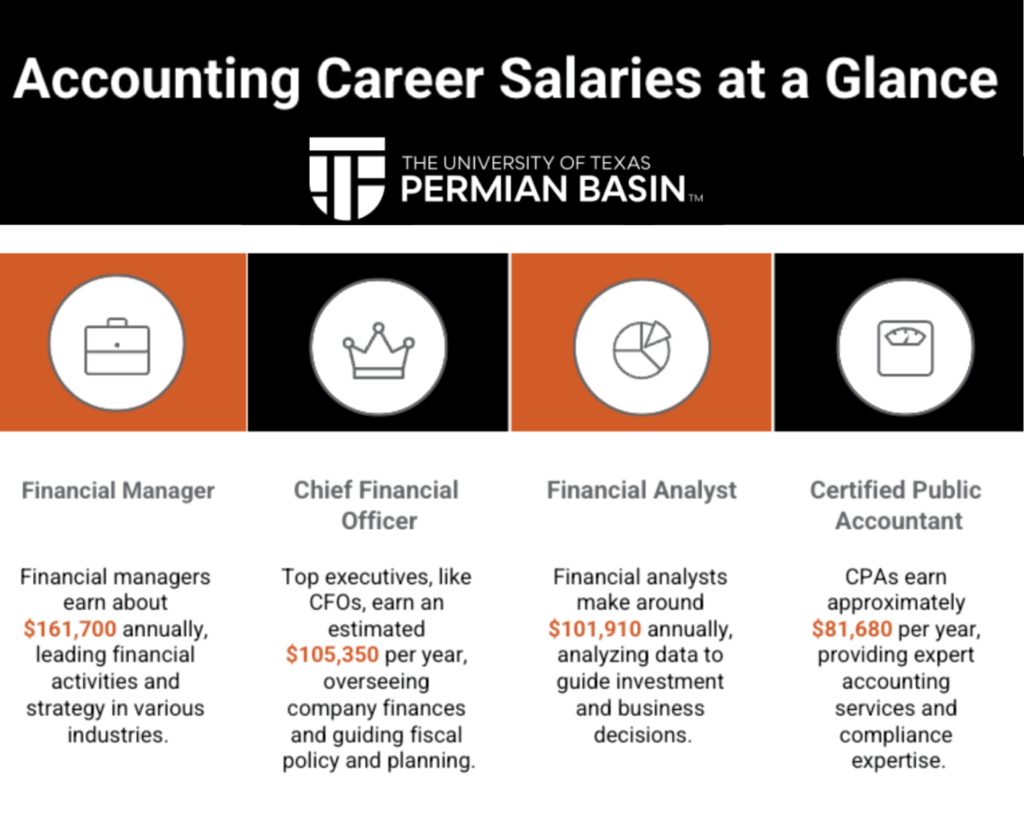
Many students complete our accounting MBA program in as little as four semesters and go on to work in a variety of careers. Potential career paths include financial manager (BLS annual earnings estimate: $161,700) and financial analyst (BLS annual earnings estimate: $101,910). Having a master’s degree can also help you compete for leadership positions.
Master of Professional Accountancy If you’ve completed a bachelor’s degree and are certain you want to achieve CPA certification, our online Master of Professional Accountancy is your program. Online courses cover all the CPA exam topics, making it essential for exam preparation.
Many students finish our professional accountancy master’s program in 2 to 4 years and graduate with the potential to become a certified public accountant (BLS annual earnings estimate: $81,680) or even chief financial officer (BLS annual earnings estimate: $105,350). According to the BLS, some employers prefer candidates who’ve earned a master’s degree, and with the added credential of a CPA license, there’s no telling where your career can take you.
Earn Your Degree, On Your Terms
Each of our online accounting degree programs features the same curriculum as its campus-based version and is taught by the same distinguished faculty and CPAs.
Our programs are delivered asynchronously, which enables you to complete coursework on your own schedule, around any professional or personal responsibilities you might have. And since they’re presented online, you can access our programs from any location in the world with internet access. Distance is never a barrier to you earning an accounting degree from UT Permian Basin.
Learn the skills you need to succeed as an accountant or in a related field with a respected degree from UTPB!
When you hear the word “accountant,” who comes to mind? Someone balancing spreadsheets and filing taxes? If so, you’re on the right track. But there’s more to it. Within the field of accounting, one credential stands apart: the Certified Public Accountant (CPA). While both accountants and CPAs manage finances, advise clients, and ensure the accuracy…
Picture this: You’re a junior accountant, and your manager asks you to tweak a report to make the numbers look better. The request sounds harmless enough—just a small tweak—but you know it’s not above board. Now you’re stuck. Do you follow orders and risk crossing an ethical line, or do you push back and risk…
You’ve always been an analytical thinker. A problem solver. Maybe a math whiz, too. There’s a career that matches your strengths. Certified Public Accountants—or CPAs—excel in these qualities. Let’s explore why a CPA is no ordinary accountant and what it takes to become one. Want to Be a CPA? Here’s What You Need to Know …
What does the year ahead hold for marketing? For starters, some changes spurred by the pandemic and others born from technological and/or sociological evolution. Let’s look at a few anticipated marketing trends for 2022 now:
Tossing the Cookies
Cookies have always left a bad taste in the mouths of some internet users who didn’t appreciate being “followed” around the internet. Google is removing third-party tracking cookies from its Chrome browser in 2023 (postponed from 2022) and doesn’t plan to replace them with an alternate feature. Other major web browsers have already banned these cookies, which track users from website to website and deliver ads that align with users’ interests based on those sites. The new 2023 target date means marketers will spend a good portion of 2022 ramping up alternative tactics such as first-party cookies, which eliminate privacy concerns by enabling users to opt in.
Offering Artificial Assistance for Real People
The use of artificial intelligence in the customer service experience is on the rise. This shift doesn’t replace customer service agents, but rather helps them complete their jobs more efficiently.
Sticking (Mostly) to Virtual Events
Webinars and other types of virtual events have been around for years, but the COVID-19 pandemic helped illustrate the value and cost-savings of these events. Individuals and organizations can save significant money on airfare, lodging, rental space, and other costs related to holding in-person events when a virtual option is feasible. With some people preferring in-person events and others opting for virtual attendance, marketers can please both audiences by holding hybrid events.
Shrinking Influence
While using influencers for marketing is not new, their price tag and credibility have come under increasing scrutiny. Many marketers are considering moving to micro-influencers whose follower bases are more compact but typically very loyal.
Making a Difference With Nonprofits
Philanthropy is becoming increasingly important to consumers. Marketers are taking note of this trend and aligning their efforts with organizations and causes that matter to their targeted consumers.
Moving From a Funnel to a Flywheel
The traditional “sales funnel” approach, which focuses on getting individual customers through the sales cycle, is being replaced by a reengagement model known as Flywheel, which puts more value on keeping customers once they are acquired.
Posting More Shorts
With short-form video finishing out 2021 as a major attraction for social media users, marketers are expected to increase their video content output.
Becoming More Inclusive
Marketing efforts will more clearly speak to multiple demographics in an increasingly diverse consumer pool.
Stay Ahead of Marketing Trends Through Online Learning
The University of Texas Permian Basin’s AACSB-accredited College of Business offers two online programs that can keep you abreast of the latest marketing trends and position you to prosper in a related career:
Today’s marketing is data driven. When you earn an online Bachelor of Business Administration in Marketing from UT Permian Basin, you’ll look at data about consumer behavior and demographics to help you develop targeted, effective marketing strategies. Our undergraduate degree prepares you to market a product or service using traditional (direct mail, print ads, broadcast media, etc.) and digital (social media, email, SEO, influencer) channels. Along the way, you’ll hone communication and strategic thinking skills that can help you excel in many professional roles.
Digital or internet-based marketing has become essential to the success of just about every organization. Compared to most traditional marketing methods, digital marketing can save an enterprise money, hit the public eye more quickly, and target a specific audience more easily. To meet the growing need for digital marketing proficiency among today’s business and marketing professionals, UT Permian Basin has developed a 12-credit online, undergraduate digital marketing certificate program. As a student, you’ll explore digital marketing’s unique advantages and learn how to use the latest tools of the trade.
Add Two Career-Enhancing Credentials to Your Resume
All the courses that comprise our stand-alone digital marketing certificate are also available as electives for the BBA in marketing degree. Choose your electives carefully and you can earn both the certificate and the degree in the same amount of time it takes to complete just the degree! You can then apply that combined expertise in many marketing specialties, including:
Brand management
Digital marketing/social media marketing
Marketing research
Product management
Sales management
Advertising & promotion
Earn Your Credentials on Your Schedule
Our BBA in marketing degree and digital marketing certificate are delivered in a 100% online, asynchronous format that enables you to complete coursework at your own pace from practically anywhere in the world. We offer the flexibility to earn important education credentials as you continue to meet your professional and personal obligations. You can finish most individual courses in just eight weeks!
UT Permian Basin’s online marketing programs prepare you to be a successful marketer no matter what trends may lie ahead. Apply today!
Clean energy comes in many forms. These renewable power sources create little to no pollution in the air, water, or soil, and some are even inexhaustible. Let’s look at a few clean energy sources, substantial clean energy efforts around the world, and energy business career potential—including salaries.
Solar panels direct sunlight to photovoltaic (PV) cells, which then convert sunlight into electricity. This energy can be used immediately or stored in batteries for later use.
Wind turbines, modern-day windmills that often resemble airplane propellers, are set into rotation by wind. The blades of the turbine are mounted on a rotor, which is attached to a generator that can generate electric power from the motion of the blades.
Also known as hydropower, hydroelectric power also uses turbines attached to a generator to produce power. The turbines spin from the force of rapidly moving water, such as that from a river or waterfall.
Sizeable Clean Energy Projects
Let’s see how some of the clean energy sources mentioned above are being used today. Here are a few of the largest clean energy projects in the world:
Imagine the power that a single wind turbine more than 620 feet tall—nearly 60 stories—can generate. The European Offshore Wind Deployment Centre, situated in Scotland’s Aberdeen Bay, has 11 such turbines. This massive offshore wind farm is anticipated to meet more than 70% of Aberdeen’s electricity needs.
Australia is about 18% desert, and there’s no shortage of sunlight in those deserts, making them optimal locations for certain clean energy projects. Once construction commences in Western Australia in 2026, the Asian Renewable Energy Hub will be home to 78 square kilometers (about one-tenth the size of Chicago) of solar panels and 1,600 immense wind turbines that, when used in combination, have the potential to generate 40% of the continent’s electricity output. According to the project’s website, as much as “3,000 MW of generation capacity will be dedicated to large energy users” locally, while most of the energy will be put toward “large scale production of green hydrogen products for domestic and export markets.”
As of 2021, Amazon is both the world’s top-grossing e-commerce retailer and the world’s biggest buyer of clean energy. With a stated goal of reaching zero carbon emissions within the next two decades, Amazon has invested in a total of 206 renewable energy projects, the most of any organization on the planet. These projects are situated on multiple continents across the world and incorporate solar, wind, and other types of clean power.
Rewarding Energy Sector Jobs
With the right credentials, you can take advantage of the current surge in clean energy projects by securing a lucrative position within the clean energy sector, and even a managerial role. Here are some in-demand energy jobs and their median annual pay, according to the U.S. Bureau of Labor Statistics:
If you’re considering a career in the energy industry or are looking for a way to improve your performance and advancement potential in your current energy role, you’ll benefit immensely from one of The University of Texas Permian Basin’s online energy programs. Offered by our AACSB-accredited College of Business, these programs equip you with vital career skills and credentials. Choose from the following graduate options:
This MBA program helps you develop operational acumen and leadership abilities highly valued by employers in the energy industry. Choose designated elective courses to earn a second graduate credential, the Graduate Certificate in Energy Business, without adding any extra time to your MBA program. You may be able to finish your MBA and graduate certificate in as little as four semesters!
If you’ve completed a bachelor’s degree program and are looking to add to your energy business skillset without committing to a master’s degree program, you can earn this 12-credit certificate as a stand-alone professional credential. Through your choice of four courses, you’ll enhance your existing abilities in accounting, business law, finance, management, and/or marketing with an energy industry perspective.
Programs That Work on Your Schedule
All courses for both programs are presented in a 100% online asynchronous format, enabling you to complete coursework at the times that best fit your schedule from just about anywhere in the world. If you have professional and personal commitments, as most of our students do, you’ll find this flexibility invaluable. These programs also feature the same quality curriculum taught by the same renowned faculty who teach on campus at UT Permian Basin. Online convenience is the only difference!
Strengthen your mastery of energy business concepts in an online UT Permian Basin program.
It might feel like just yesterday that the CPA exam was made up of four fixed sections, offering little flexibility for your individual career goals or interests. But the exam has gone through some major updates in recent years. From new licensure paths and continuous testing windows to ongoing format tweaks, the 2025 CPA Exam introduces changes you can use to your advantage as you move closer to becoming a CPA.
In this guide, you’ll find the latest updates, plus expert tips on how to stay qualified and succeed.
Core + Discipline CPA Exam: What Changed in 2024
The CPA Evolution framework launched in 2024, introducing a new structure known as the Core + Discipline model. This model gives candidates more flexibility while making sure they maintain a strong foundation in essential accounting knowledge. Let’s break it down further:
Core sections that all candidates must complete include:
Auditing and Attestation (AUD)
Financial Accounting and Reporting (FAR)
Regulation (REG)
In addition to the core sections, there’s also a discipline section that allows test takers to choose based on their professional goals, including:
Business Analysis and Reporting (BAR)
Information Systems and Controls (ISC)
Tax Compliance and Planning (TCP)
2025-Specific CPA Exam Updates
In addition to the major changes introduced in 2024, the CPA exam continues to evolve in 2025 with updates designed to make the process more flexible and accessible for candidates:
Continuous Testing for Core Sections Previously, exams were only offered during four testing windows per year. Now, blackout periods have been eliminated, allowing candidates to take Core sections (AUD, FAR, REG) year-round.
Expanded Testing Window for Discipline Sections Discipline sections (BAR, ISC, TCP) now include a fifth testing window in June. This added session gives candidates more flexibility when mapping out their study schedules and exam timelines.
New Licensure Pathway via the Uniform Accountancy Act (UAA) As of May 2025, the UAA now recognizes a third pathway to licensure. Candidates who hold a bachelor’s degree, have completed two years of supervised accounting experience, and have passed the CPA exam are eligible to become license, providing an alternative to the traditional 150-credit hour requirement in some states.
How to Prepare for the Latest CPA Exam Changes
With even more CPA exam updates rolling out in 2025, preparation is about more than just practice tests. Here are a few ways to confidently navigate the new format and walk into test day ready to succeed:
Plan ahead Take advantage of continuous Core testing and the expanded Discipline testing windows. With greater scheduling flexibility, you can map out an exam plan that fits your goals and your life.
Stay current Use the most recent CPA exam blueprints to guide your studies. This makes sure you’re focusing on up-to-date content that reflects the latest exam expectations.
Check your eligibility Planning to sit for the CPA exam in Texas or another state? Make sure your education and experience meet the most current licensure requirements, especially if you’re exploring the new bachelor’s plus experience pathway.
Achieve Eligibility Through Our 100% Online Program
Presented by our AACSB-accredited College of Business, UT Permian Basin’s online Master of Professional Accountancy program helps you become eligible to sit for the CPA exam by empowering you with comprehensive knowledge of contemporary accounting principles and business applications. You’ll master traditional and modern accounting practices while developing skills that help you expertly navigate an ever-evolving business landscape.
Presented in a 100% online, asynchronous format, our program allows you to complete coursework on your own schedule from practically anywhere in the world. And that’s just one of the many benefits:
Earn a career-boosting graduate credential while still meeting your work and personal commitments.
Finish most program courses in eight weeks or fewer (summer sessions are seven weeks each).
Learn from the same renowned PhD-level accounting experts and CPAs who teach courses at the UT Permian Basin campus.
Graduate with a Master of Professional Accountancy in 2 to 4 years.
Our program meets the Texas State Board of Public Accountancy requirements to sit for the CPA exam and attain certification in Texas. You can confirm whether it also meets your state’s board of accountancy requirements here.
After you complete our Master of Professional Accountancy program, you’ll have met important requirements to sit for the CPA exam in Texas. Once you become a CPA, you’ll be able to enjoy higher earning potential and compete for many more professional opportunities.
Prepare yourself for success as a CPA with an online Master of Professional Accountancy from UT Permian Basin.
When you hear the word “accountant,” who comes to mind? Someone balancing spreadsheets and filing taxes? If so, you’re on the right track. But there’s more to it. Within the field of accounting, one credential stands apart: the Certified Public Accountant (CPA). While both accountants and CPAs manage finances, advise clients, and ensure the accuracy…
Picture this: You’re a junior accountant, and your manager asks you to tweak a report to make the numbers look better. The request sounds harmless enough—just a small tweak—but you know it’s not above board. Now you’re stuck. Do you follow orders and risk crossing an ethical line, or do you push back and risk…
You’ve always been an analytical thinker. A problem solver. Maybe a math whiz, too. There’s a career that matches your strengths. Certified Public Accountants—or CPAs—excel in these qualities. Let’s explore why a CPA is no ordinary accountant and what it takes to become one. Want to Be a CPA? Here’s What You Need to Know …
Social responsibility is a virtue that we can demonstrate through our buying habits and living practices and through an awareness of how these behaviors affect others around us. In the petroleum industry, which has a global footprint and the power to impact many economies and ecosystems, social responsibility takes on monumental importance. Companies in this field must incorporate corporate social responsibility (or CSR) into their business models to ensure that they wield their influence with the necessary forethought, perspective, and restraint.
According to Investopedia, corporate social responsibility is “a self-regulating business model that helps a company be socially accountable—to itself, its stakeholders, and the public. By practicing corporate social responsibility, also called corporate citizenship, companies can be conscious of the kind of impact they are having on all aspects of society, including economic, social, and environmental.”
In more concise terms, corporate entities need to be responsible global citizens in multiple respects.
Philanthropy: Raising and donating money to charitable causes.
Volunteerism: Working directly with or for charitable organizations or events.
Ethical labor practices: Hiring a diverse range of employees (with regard to gender, race, ethnicity, religious faith, sexual orientation, etc.) and treating them fairly and ethically.
Environmentally sound practices: Minimizing negative impact on the natural world through the responsible use of resources, carbon footprint reduction, and ongoing innovation.
Dr. Archie B. Carroll, a noted business management author and professor, suggests a pyramid of social responsibility for corporations comprised of four hierarchical levels including, from top to bottom, philanthropic, ethical, legal, and economic considerations.
Who’s Being Responsible in the Petroleum Industry?
A list of the world’s 100 most reputable companies for corporate responsibility includes enterprises that manufacture and sell toys, software, coffee, furniture, cars, and more. However, not a single petroleum company appears on the list. The list may not be definitive, but clearly, the petroleum industry can do more.
Among petroleum companies alone, there are some standouts in terms of efforts to safeguard the environment. For example:
BP, formerly British Petroleum, has invested significant capital into renewable forms of energy, such as solar, wind, biofuel, and hydrogen, and has been recognized for its operational transparency.
Petroteq Energy has developed a unique process to extract oil from sand that creates no greenhouse gases or waste and involves the use of what the company calls “benign chemicals.”
Royal Dutch Shell is seen as a clean energy leader and is gearing its operations toward carbon reduction and investment in electricity. The company is also investing in solar energy in different parts of the world.
Total, one of the world’s largest oil producers, has a subsidiary company that’s dedicated to increasing the availability of renewable energy sources including hydropower and biomass. The company’s goal is for up to 20% of its sales to come from renewable energy by 2040.
In addition to petroleum producers, other organizations within the petroleum industry are fostering greater social responsibility. IPIECA is a not-for-profit association dedicated to responsible practices within the petroleum industry. The association also acts as a conduit for information between the industry and the United Nations.
How the Petrochemical Industry Can Do Better
How can petroleum companies earn a place among the world’s most reputable companies for corporate responsibility? The companies mentioned above are obviously going in the right direction and may inspire others in the industry to follow suit. All must work toward clean, renewable, sustainable forms of energy while pursuing their business interests. All must avoid polluting the environment and take responsibility by cleaning it up if they do.
Responsibility is not just about having good environmental practices, however. To be considered a corporate responsibility leader, a company must contribute to the greater good in a variety of ways. That includes allocating more time, money, and effort to charitable organizations and maintaining safe, inclusive, and ethical workplaces.
Online Programs to Advance Your Energy Career
The University of Texas Permian Basin offers online degree and certificate programs that can help you start or advance within a career in the petroleum industry or another energy-related field. All programs are provided 100% online through our AACSB-accredited College of Business.
This bachelor’s degree program gives you a foundation in fundamental management concepts, supply chain management, and other areas that will help you tackle technical and industrial issues for your employer. The optional graduate certificate helps you develop a comprehensive understanding of petroleum industry technology.
This certificate program is available as a 12-credit stand-alone credential and translates your accounting, business law, finance, management, and marketing expertise to the rapidly expanding energy industry.
Career-Friendly Online Convenience
All courses for these programs are presented in an asynchronous online format that enables you to earn a valued credential at your own pace while maintaining your professional and personal responsibilities. Our program courses are taught by the same acclaimed faculty who teach them at our campus, and many of the courses last just eight weeks!
Build the expertise needed to excel as a socially responsible leader in an energy-related career with a UT Permian Basin online program.
Are you deciding between an MBA in Accounting and a Master of Professional Accountancy (MAcc)? Both graduate programs open doors to rewarding accounting careers, but they offer different paths depending on your goals.
Whether you’re aiming for a CPA or want to pursue broader business opportunities, understanding the MBA vs. MAcc differences is key. In this guide, we’ll explore how each program prepares you for accounting jobs and help you choose the best degree for your future.
What Is a Master of Professional Accountancy (MAcc)?
The Master of Professional Accountancy is solely focused on CPA certification and prepares you to sit for the CPA exam. The degree is a must if you wish to work as a certified public accountant and advance into management-level roles.The program is geared toward accounting undergraduates who need to get their 150 hours for the CPA exam and individuals with a non-accounting bachelor’s degree who wish to transition into an accounting career.
Career Potential: Where You Can Go With This Degree
A Master of Professional Accountancy and CPA certification set you up for success in top management roles including:
Corporate controller
Corporate auditor
Chief financial officer
The U.S. Bureau of Labor Statistics reports that some employers give preferential treatment to job candidates who’ve completed a master’s degree. In combination with a CPA license, a graduate degree can give you an even greater competitive advantage in the working world.
Does the MPAc Prepare You for the CPA Exam?
Yes, our Master of Professional Accountancy program offers courses on all the CPA exam topics. It also provides a comprehensive grounding in accounting standards and business applications.
During your course of study, you’ll become proficient in traditional and contemporary accounting practices as you build skills that will enable you to expertly navigate today’s quickly changing business landscape.
When you finish our Master of Professional Accountancy program, you’ll have fulfilled the main requirements to sit for the CPA exam and gained a respected master’s degree that will bolster your resume and your employment potential.
Program at a Glance
Prepares you to sit for the CPA exam
Requires 36 credits
Can be completed in as little as one year
What Is an MBA in Accounting?
Our MBA in Accounting program is geared toward working professionals and recent graduates from undergraduate programs of various types. It provides a functional knowledge of accounting principles and business applications.
This degree is a must if you desire the flexibility to work in a variety of business-oriented careers. It provides a broader business focus with an emphasis on accounting that gives you the ability to choose what you want to do.
To that end, it has two tracks that you can choose based on your career goals:
The “CPA track” is recommended if you may wish to work in public accounting at some point in the future.
The “non-CPA track” is recommended for a general path of accounting study that can lead to a position in business.
Careers You Can Pursue with an MBA in Accounting
Graduates of this program have gone on to pursue roles such as:
Comptroller
Financial analyst
Tax manager
Budget analyst
Regulatory compliance manager
Program at a Glance
Provides broad knowledge of accounting and business principles
Requires 33 to 42 credits
Can be completed in as little as four semesters
Shared Benefits of UTPB’s Online Accounting Master’s Programs
Both of UT Permian Basin’s accounting-oriented master’s programs are offered online through our AACSB-accredited College of Business. Each is taught by the same doctoral-level professors and CPAs who teach the programs on campus and features the identical curriculum.
When you enroll in either of these programs, you will experience the benefits of 100% online, asynchronous learning, which allows you to complete coursework on your own schedule from virtually any location in the world—from Texas to Tasmania. This flexibility is a tremendous advantage when you’re simultaneously juggling professional, personal, and educational commitments.
In addition, both programs help you develop skills that will benefit you in a range of rewarding jobs in accounting and related fields. Compensation is generally higher in those jobs, too. According to the U.S. Bureau of Labor Statistics (BLS), as of 2024, professionals who have completed a master’s degree have some of the highest earnings and an impressively low unemployment rate.
Which Program Should You Choose?
If you definitely plan to pursue a career as a CPA, the Master of Public Accountancy is your best bet. If you want to build a foundation in accounting as part of a broader business career, choose the MBA in Accounting. Again, it’s all about your professional goals.
We’d be happy to tell you more about these programs and what they can do for you! Reach out to us anytime.
Are you authoritative? Intuitive? Experienced? A natural-born leader whose direct reports would follow off a cliff? That’s a phenomenal start, but these days, it’s only half the equation. Modern business leaders need a seamless blend of high-level human skills and data analytics skills. In competitive markets, professionals with both are known as dual-threats. Data skills…
According to the World Health Organization, 99% of the global population breathes polluted air. Yet we’re surrounded by clean, sustainable energy sources. Despite coal and natural gas being the most widely used energy sources, the urgency of climate change and resource depletion is making the shift to clean energy increasingly essential. In 2023, about 23%…
Some of the best career growth strategies for BBA graduates are building experience intentionally, developing leadership habits early, and expanding your skills before you need them. That’s the blueprint. But here’s how it usually plays out. Most graduates start in roles like “marketing coordinator” or “financial analyst trainee.” That’s normal (and honestly, a good thing). Those early roles are where you…
Black Friday may get the headlines for crowded stores and doorbuster chaos, but Cyber Monday has become one of the biggest shopping days of the year without requiring anyone to leave the couch.
Cyber Monday is the Monday after Thanksgiving, when retailers offer online deals and limited-time discounts to holiday shoppers. What started as a marketing term has grown into a major retail event and a big part of how people shop during the holiday season.
As online shopping took off in the early 2000s, retailers noticed that online sales tended to spike on the Monday after Thanksgiving, and they wanted a name for the trend.
At the time, one theory was that people were returning to work after the holiday weekend and shopping online from their desks, where internet connections were often faster than what they had at home. Whether that was the whole story or not, the pattern was clear: Shoppers were still in gift-buying mode, and online deals made it easy to keep going.
Who Coined the Term Cyber Monday?
The term “Cyber Monday” was coined in a 2005 press release from Shop.org, a division of the National Retail Federation (NRF). The term was proposed by Ellen Davis, a PR executive at the NRF at the time. “It’s a random bit of cocktail party conversation I like to bring up sometimes,” Davis told Fast Company. “It’s surreal to think that I’m associated with a term that has taken off like this.”
Before settling on Cyber Monday, the team considered the name “Black Monday” to match the already-established Black Friday—but that name was already tied to the 1987 stock market crash.
Online sales on the Monday after Thanksgiving had been steadily increasing in the early 2000s. Retailers, always eager to promote the holiday season, responded by offering special promotions and discounts on that day. Experts lacked a definitive reason for the spike in sales but suspected it was a combination of better internet access at work, leftover shopping lists from the weekend, and the looming pressure of holiday gift-giving.
What started as a catchy marketing term quickly became an industry-changing phenomenon—and a new kind of holiday tradition.
From Cyber Monday to Cyber Week
One big reason Cyber Monday became so popular is that shopping online is more convenient than driving to the stores and waiting in line for a product (that may or may not already be sold out). No one has time for that.
Instead, Cyber Monday made it easy to browse the hottest deals from your favorite stores on your phone or laptop—from anywhere. For a lot of shoppers, it was a welcomed alternative.
Retailers also helped turn Cyber Monday into a bigger event by offering deeper discounts, flash sales, and online-only promotions. Over time, the day grew from a one-day shopping push into something closer to Cyber Week, with deals stretching across several days.
How Cyber Monday Changed Online Shopping Forever
Cyber Monday helped change the way people think about holiday shopping. It showed that online retail could compete with (and often outperform) traditional in-store events like Black Friday.
It also helped normalize the idea of shopping online for everything from electronics and clothing to gift cards and streaming subscriptions. These days, buying gifts with a few taps feels like the norm. In 2005, that still felt new to most shoppers.
And while plenty of people still enjoy the Black Friday experience, Cyber Monday has become a go-to option for anyone who prefers less chaos and more clicking.
Cyber Monday FAQ
What is Cyber Monday? Cyber Monday is an online shopping holiday that takes place on the Monday after Thanksgiving. It was created to promote internet-exclusive deals and is now one of the biggest e-commerce events of the year.
When was the first Cyber Monday? The first official Cyber Monday took place on November 28, 2005, after the National Retail Federation observed a trend of consumers shopping online the Monday following Thanksgiving weekend.
Why was Cyber Monday created? Cyber Monday was introduced as a marketing initiative to encourage people to shop online. At the time, retailers noticed increased web traffic and sales on the Monday after Thanksgiving, likely due to people returning to work and using high-speed internet connections.
How has Cyber Monday changed over the years? Since 2005, Cyber Monday has evolved from a single-day event into a week-long shopping phenomenon. It’s been fueled by changing technology, consumer preferences, and the growth of major online retailers. (We’re sure you’re acquainted with Amazon.) Today, it’s a key driver of holiday sales and a cornerstone of digital commerce strategy.
Explore Digital Marketing at UT Permian Basin
The University of Texas Permian Basin offers an online undergraduate Certificate in Digital Marketing that helps students build skills in areas like digital branding, e-marketing, and e-commerce.
If you want to better understand the strategies behind online shopping trends like Cyber Monday, UTPB’s online program can help you build practical knowledge for the digital marketplace.
A traditional MBA path often means finishing your bachelor’s degree, entering the workforce, then returning to school years later for your MBA: an expensive and time-consuming journey that can take six or more years in total. At The University of Texas Permian Basin, we offer a smarter, faster option: our online 4+1 MBA program. In…
If you’re considering earning a Master of Business Administration (MBA), you may already be aware that adding an MBA to your resume can be a career-defining accomplishment. But what does that mean in terms of real-world benefits? If you’re earning an MBA from The University of Texas Permian Basin online, we can confirm that there…
Apple’s logo—an apple with a bite taken from the right side—is synonymous with innovation and imagination. But why? How can simple images like the Apple logo, McDonald’s golden arches, or Nike’s swoosh evoke such powerful emotions? The answer lies in the meticulous work companies put into developing, refining, and protecting their brand identities. So, let’s…
A Bachelor of Business Administration (BBA) degree is your ticket to the world of business. A BBA provides a comprehensive overview of business, touching on foundational concepts like accounting, finance, marketing, and management. Typically, undergraduate students also choose the major that best aligns with their interests. This specialized focus allows students to explore a subject deeply, through theoretical and practical lenses, preparing them for success in their chosen fields.
The University of Texas Permian Basin offers online BBAs with majors in accounting, finance, healthcare management, management, and marketing.
These programs are accredited by the prestigious Association to Advance Collegiate Schools of Business (AACSB), the world’s largest business education alliance. They also share a convenient online format. Entirely online, our BBA programs can be completed anywhere and at any time, assuming you have a Wi-Fi connection.
We’ve touched on the quality and convenience of our BBA programs, but now we’re going to discuss the unique qualities of our degree options. This breakdown should provide some added insight to help you apply to your preferred major with confidence.
BBA in Accounting
Accountants are the stewards of financial records, ensuring their accuracy and compliance with state and federal laws. Their financial insights are invaluable for organizations. They must be technically skilled, able to automate a number of their routine tasks. They are also expected to possess communication skills, attention to detail, poise under pressure, and other soft skills. Accountants are, above all else, expected to hold a degree that affirms their accounting competencies.
Our online BBA in accounting program provides the knowledge and skills needed in the evolving field of accounting. Courses like Auditing, Accounting Information Systems, and Cost Accounting Principles empower students to measure, record, summarize, and report financial data for business enterprises. Graduates leave our program with a competitive edge that allows them to thrive in a number of positions, including:
Accountant
Auditor
Financial manager
BBA in Finance
Financial professionals are highly sought after in the world of business. The employment outlook for financial analysts, for example, is expected to grow 5% by the year 2029, faster than the average for all occupations.
Financial professionals help businesses assess their health and make sound financial decisions. Before becoming valued a valued asset within an organization, however, aspiring professionals must expand their knowledge of accounting, finance, and investments.
Professionals interested in developing well-rounded financial management skills can pursue a BBA in finance at UT Permian Basin. Undergraduate students enroll in business and finance courses and have the opportunity to tailor their education to fit their interests with business and finance electives. Through our program, students explore many of the topics needed to earn career-transforming Chartered Financial Analyst (CFA) and Certified Financial Planner (CFP) designations, if they so desire. For example, our online course Financial Markets and Institutions covers government and corporate debt, determinants of interest rates, and mortgage-backed securities, among other essential topics.
Graduates of our BBA in finance program are positioned for a number of rewarding roles, including:
Chief financial officer
Financial analyst
Investment banker
BBA in Healthcare Management
Healthcare managers help with business activities, not unlike the other occupations we’ve mentioned. They are, however, employed exclusively at hospitals, physician’s offices, nursing homes, and other patient care facilities. Their duties entail managing finances, recruiting staff, organizing records, and, above all else, ensuring the delivery of quality healthcare. Performing these tasks to the best of their abilities requires healthcare managers to remain abreast of the ever-changing healthcare landscape.
UT Permian Basin’s online BBA in healthcare management program prepares students to excel as decisive leaders in the dynamic healthcare field. Through our online program, students learn to apply business fundamentals in a healthcare setting. Business courses provide students with foundational knowledge that courses like Accounting for Healthcare, Healthcare Finance, Healthcare MIS, and Healthcare Marketing build upon.
This major can help aspiring professionals become healthcare managers, but there are also a number of other healthcare roles ideal for graduates of our online healthcare management program, including:
Undergraduate students in our BBA in management program are given a comprehensive education encompassing the fundamentals of communication, finance, marketing, and law. Through our program, students gain a deeper understanding of what it takes to be a business leader while sharpening their decision-making and problem-solving skills. Additionally, our online program’s environment option allows students to tailor their education by enrolling in one of three courses: Project Management Elements, International Management, or Business and Ethics.
Whether you’re a freshman or transfer student, our online program will empower you to take on competitive leadership roles, including:
Entrepreneur
Human resources manager
Operations manager
BBA in Marketing
Marketing efforts are essential for ensuring an organization’s success and longevity. Professionals with a mind for marketing are increasingly valued by companies as advertisements continue to dominate digital spaces. Regardless of the medium, these professionals are expected to manage client expectations, deploy marketing strategies, and oversee marketing staff, among other responsibilities. To do so effectively, they need an education encompassing the fundamentals of business and marketing.
UT Permian Basin’s online BBA in marketing empowers students to promote organizations through the most effective avenues, whether traditional or digital. Through our program, students learn to analyze demographics and consumer behavior to build marketing strategies and overcome challenges during the marketing life cycle.
Students also have the opportunity to add our Undergraduate Certificate in Digital Marketing to their BBA in marketing without needing to take additional credits. This certificate helps students strengthen their understanding of search engine optimization (SEO) tools and further prepares graduates for a number of rewarding careers, including:
Marketing manager
Public relations specialist
Social media manager
Pursue Your Interests at UT Permian Basin
At UT Permian Basin, you’ll find convenient online programs that prioritize your growth as a professional, regardless of the major you choose. Our programs are entirely online and feature asynchronous elements, allowing you to engage with course content at your own pace. They are led by the same educators—experts with years of experience in their respective fields—who lead our on-campus programs. Finally, they share a straightforward application process that can be completed in a single sitting.
Our BBA programs are unique in their focus but connected by our college’s commitment to student success. Apply to the online program of your choice, and see for yourself why UT Permian Basin is the ideal home for aspiring business professionals.
The energy industry is experiencing growing pains. The increased deployment of renewable energy is juxtaposed by the growth of shale oil and gas, and the threat of climate change looms over the entire industry. This shifting landscape demands that energy companies proceed with caution and carefully consider every outcome when conducting business. To do so, they need the assistance of a professional with a mind for business: someone familiar with the capabilities and limitations of companies in the energy sector. In other words, they need an analyst.
Let’s look at three analyst careers and the important role these professionals play in energy-related fields.
Business Analyst
Business analysts define the capabilities of an organization to understand how it can better deliver products and services. To accomplish this, an analyst will interview leaders, team members, and subject matter experts: anyone who can provide a unique perspective. They take an objective approach to solving problems and in doing so help companies overcome challenges and meet their objectives.
Business analysts are critical in the energy sector, where their business and technical knowledge allow them to consider multiple perspectives when problem-solving and articulating solutions to stakeholders of varying skill sets. For example, a professional with a Master of Business Administration with Certificate in Energy Business could help a power or utility company transition to renewable energy while taking into account the legal, financial, and organizational aspects unique to the energy industry.
Financial Analyst
Think of financial analysts as fortune tellers who, rather than gaze into a crystal ball, pore over financial data to predict market trends. Industry insights allow financial analysts to help organizations make strategic decisions and turn a profit. Before developing a strategy, however, an analyst must meet with leaders to assess a company’s prospects and financial health. Only by considering factors that affect a specific industry (microeconomics) and the economy as a whole (macroeconomics) can a financial analyst recommend an appropriate course of action, usually in the form of an investment.
Financial analysts do their best work when turning their attention to a particular industry, such as the energy sector. In energy-related fields, where energy prices can fluctuate wildly, a financial analyst can mitigate risk by helping companies invest in energy commodities. Known as hedging, this process allows energy companies to lock in the price of a commodity, such as natural gas, and meet their financial goals.
Energy risk management is invaluable in the energy industry, but it’s only one area a financial analyst must be familiar with. Energy Finance, for example, explores value chain analysis, oil and gas financial statement analysis, and financing energy companies and projects. Available to students pursuing an MBA with Certificate in Energy Business or a Graduate Certificate in Energy Business, this online course can help professionals adopt a skill set sought after by energy companies in need of financial guidance.
Budget Analyst
Budget analysts, more so than financial analysts, oversee a company’s financial health. These professionals help public and private companies plan their finances, developing budgets an organization can follow to meet their future financial needs. Budget analysts do far more than develop budgets, however. They are gatekeepers who evaluate budget proposals, financial requests, and funding methods. If an initiative isn’t deemed cost-effective, a budget analyst may recommend making changes or nixing it altogether. Final budget decisions are left to leadership, but without the expertise of budget analysts, a company could find itself in the red.
The price of an energy commodity is incredibly volatile, as it’s susceptible to changes in weather, storage, and regulations. In a sector where the future is uncertain, budget analysts must be on top of their game. They must account for not only previous and future expenditures but also actual expenditures. Ensuring compliance with budgetary allocations, maintaining spending records, and establishing budgetary control processes are all responsibilities of a budget analyst in the energy industry.
Gain the Mindset of an Analyst at UT Permian Basin
The University of Texas Permian Basin offers two online programs with an emphasis on energy business:
Master of Business Administration with Certificate in Energy Business: This 36- to 45-credit online program provides operational knowledge and leadership skills highly sought after in energy-related fields. In as little as four semesters, students can graduate prepared to excel in various levels of the energy industry.
Graduate Certificate in Energy Business: This 12-credit online program will help professionals translate their accounting, finance, management, and business knowledge to the rapidly growing energy industry. This certificate is ideal for professionals in energy-related fields who want to advance their careers.
Entirely online and featuring asynchronous elements, our programs will allow you to pursue graduate credentials on your own time, at your own pace. Through Canvas, you’ll be able to connect with your professors and peers on 24-hour discussion boards. Online tools like these will facilitate your learning and help you develop the soft skills analysts need to interact with stakeholders and articulate their findings. Finally, our programs are taught by the same experienced professionals who teach on campus. Every measure has been taken to help ensure that you receive the highest quality education possible, comparable to anything found on UT Permian Basin’s campus.
Accredited by the Association to Advance Collegiate Schools of Business, our programs will provide you with the skills needed to thrive as an analyst or any number of other careers in energy-related fields. Apply now to your program of choice if you’re interested in putting your analytical mind to work in the energy industry.