How Do Video Games Affect the Brain? Benefits and Risks
Video games affect the brain by influencing attention, learning, memory, reward processing, and behavior. Research shows that gaming can enhance certain cognitive skills, including attention and visuospatial ability. At the same time, it can activate the brain’s reward system in ways that may increase the risk of addiction.
We’re not here to vilify video games. (The author of this post has sunk far too many hours into “Elden Ring” for that stance.) Rather, we’re taking an unbiased look at this form of entertainment to answer a topical and evolving question:
How Do Video Games Affect the Brain?
To find the answer, researchers conducted a systematic review of 116 scientific studies on video games. They found that gaming affects various brain functions, including behavior and cognitive performance. Here are some of the most notable areas affected:
Effects of Video Games on Attention
Surprisingly, many studies included in the review found that gaming may actually improve several types of attention, including selective attention, divided attention, and sustained attention. Plus, the regions of the brain associated with attention were more efficient in gamers.
Effects of Video Games on Visuospatial Skills
Researchers also found that gaming can enlarge parts of the brain tied to visuospatial skills, or a person’s ability to understand visual and spatial relationships. On top of that, long-term gamers showed an increase in the size of their hippocampus, the region of the brain crucial for learning and memory.
Video games, it would seem, can have some great benefits for the brain. After all, many games require sharp reflexes and clever thinking. But don’t pick up that controller just yet. There’s still the risk of addiction to consider.
Video Games, Dopamine, and Addiction
Stay with us; we’re talking neurotransmitters.
When we encounter something enjoyable, our brains release dopamine. Dopamine, along with serotonin, endorphins, and oxytocin, is a neurotransmitter that promotes happiness, but it doesn’t so much make us happy as it reinforces behaviors that make us happy.
This is the brain’s reward system, and it’s meant to reinforce positive behaviors. Unfortunately, our brains can’t always distinguish between something good for us, such as a delicious meal, or bad for us, such as an illicit drug.
How Video Games Activate the Brain’s Reward System
When a gamer beats a challenging boss, discovers a new weapon, or unlocks a cosmetic item, they experience a rush of dopamine that encourages them to play another round. After this initial rush, there’s a dopamine dip. Every encounter brings a lower and lower dip. If gamers chase these diminishing returns to the detriment of their lives, they run the risk of becoming addicted.
“Roughly speaking, there are no big differences between video game addiction and other addictions,” says cognitive neuroscientist Marc Palaus. In the systematic review Palaus co-authored, researchers noted that video game addiction seems to be related to other behavioral addictions, such as gambling, internet, or smartphone addiction, since people affected by video game addiction have similar abnormal reward processing patterns.
Balancing the Cognitive Benefits and Risks of Gaming
Video games could have positive effects on the brain (the good), but there’s also the risk of addiction (the bad) — or your favorite developer sneaking predatory monetization tactics into an upcoming release (the ugly).
As with many things in life, moderation is key. It’s okay to get lost in a beloved video game, but be sure to put down the controller on occasion to go outside and touch grass.
Study Psychology Online at UT Permian Basin
The subject of video games and their effect on the brain, like so many topics related to psychology, is far more nuanced than it might first seem. If you found this topic fascinating, we encourage you to dive deeper into the world of psychology.
The University of Texas Permian Basin’s online Bachelor of Arts in Psychology offers a comprehensive education that delves into the intricacies of human psychology. We may be biased, but we think earning a bachelor’s degree and securing your future in an exciting field is as exciting as rescuing Princess Toadstool, defeating Ganon, or shooting Covenant.
Study Fascinating Topics at Your Convenience
If you’re interested in learning more about the human mind, check out our course Cognitive Psychology, which explores problem-solving, memory, and attention, among other topics related to cognitive processes. Other courses include:
Child/Adolescent Psychology
Drugs and Behavior
Psychology of Sports
By joining our program, you’ll gain the knowledge and skills needed to find a rewarding career, whether you’re interested in research, clinical practice, or applying psychological principles in various industries.
The Cold War between the U.S. and the Soviet Union lasted nearly 45 years. This period of global tension was fueled by political differences, expansionism, a nuclear arms race, and constant propaganda. But these factors were symptoms of a deeper, underlying psychological force: group polarization. Both sides steadily grew more entrenched in their opposing views,…
When the final “ber” months roll around, the world wraps itself in holiday cheer. Families make travel plans, calendars fill with festive gatherings, and store shelves overflow with stocking stuffers and seasonal treats. But behind the twinkle lights and snow-covered commercials, the holidays can be a stressful time. According to the American Psychological Association, 41%…
Does your pulse race at the thought of glancing out of a plane window at 30,000 feet? How about swimming through shark-infested waters? Or delivering a speech to a roaring crowd? While a fear of heights, sharks, or public speaking is normal, most people won’t be diagnosed with a phobia of these common fears. To…
Have you ever wondered how a particular TikTok trend goes viral so quickly? How about why we never take the blame when something goes wrong, but we’re the first to take credit after a personal victory?
Cue the social biases, a subset of cognitive bias that shapes how we view—well, everything. From relationships and workplace dynamics to healthcare and politics, social biases color our perception of almost every aspect of our lives.
Join us as we dig into four of the social biases that have shaped us on both an individual and societal level.
#1 Bandwagon Effect
Most of us have heard the phrase “jumping on the bandwagon” before, but what does it really mean? Let’s use the Taylor Swift phenomenon as an example. With sold-out concerts all over the world and songs that consistently top the charts week after week, it’s clear that T. Swift is beloved by fans worldwide.
While many fans have loved Taylor from her very first era, others are just now jumping on the bandwagon because everyone else is, too—whether they’re true Swifties or not.
The bandwagon effect can occur in all areas of our lives, from politics to the food we eat and everything in between. But what is the psychology behind the bandwagon effect? Below, we dissect some of the root causes driving this “herd mentality”:
Conformity For many, it feels good to fit in with the crowd. A shared passion, a built-in discussion point—what’s not to love? Others conform because they don’t want to be isolated from others.
Heuristic A heuristic, or mental shortcut, helps us create opinions, especially when we need to make a decision quickly. For example, if all of your friends are voting for a particular politician, you may simply assume they’re a trustworthy candidate and vote in favor of them.
#2 Self-Serving Bias
If you make it to work on time, it’s because you’re a punctual person. But, if you’re late, it’s due to unforeseen circumstances, like the person in front of you who was driving 10 miles under the speed limit. Or maybe you were unlucky enough to hit every red light. Whatever the reason, the cause was definitely an external force.
That’s a self-serving bias, a predisposition that affects how you perceive your achievements and failures. Many people will gladly take credit for their successes while attributing their failures to outside factors.
But why do we all rely so heavily on this bias in our daily lives? Mostly, we find it essential to protect our self-esteem. It hurts our confidence to take responsibility for something that went wrong at work or school. So, instead of recognizing our failures as a natural part of life, it’s easier to blame something else to avoid humiliation.
#3 Actor-Observer Bias
Like the self-serving bias, the actor-observer bias involves attributing internal and external factors to the behavior of others as well as yourself. However, this bias explains the reasoning for other people’s actions as a result of negative internal factors.
For example, let’s say you notice a car weaving in and out of traffic. Instead of wondering if the driver has an emergency and is taking someone to the hospital (i.e., an external cause for their behavior), you assume they’re a careless and reckless driver, attributing the behavior to their personality (i.e., internal factors).
#4 Authority Bias
Have you ever placed your trust in someone simply because they had an impressive job title? For example, let’s say you recently participated in an important company-wide meeting in which the CEO was presenting data. Whether their information was accurate or not, you’re more likely to believe them simply because they hold a position of power. However, if a colleague with a similar job title as yours were presenting the same data, you may be more inclined to question the accuracy of the information.
Authority bias has been instilled in us since childhood. Our parents instructed us to listen to authority figures, like our teachers, and public service officials like police officers. While it’s engrained in us to trust what people in authoritative positions say, it’s important to challenge this bias by thinking for yourself and questioning someone when you have doubts or concerns, no matter their title.
Examples of Social Bias in Everyday Life
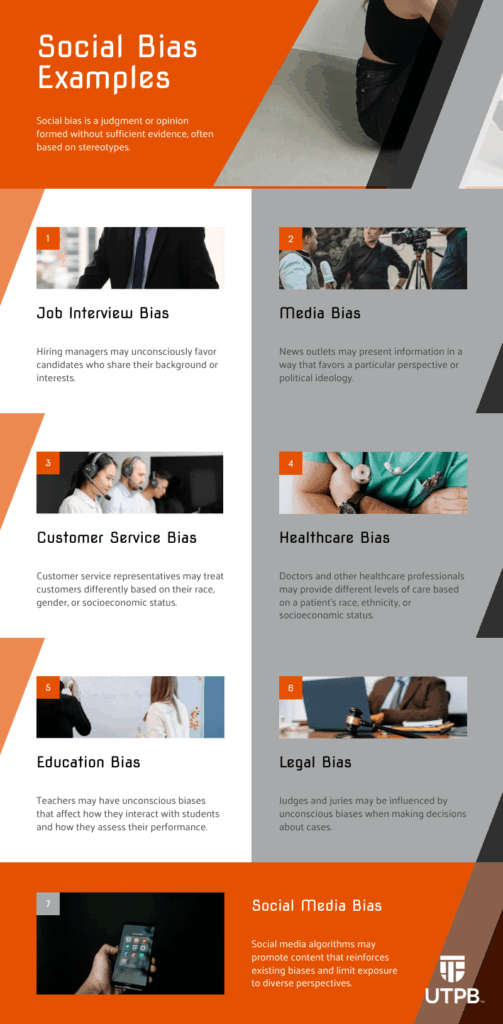
Curious how social bias shows up in the real world? Here are seven everyday scenarios that you might recognize—or may have experienced yourself.
Frequently Asked Questions About Social Bias
Understanding social bias can feel a bit overwhelming at first, especially because it often operates under the surface. This quick FAQ clears up some common questions and helps break things down in a straightforward way.
What is social bias? Social bias refers to the tendency to favor or disfavor certain people or groups based on stereotypes, assumptions, or cultural norms—often without realizing it.
Is bias always intentional? Not necessarily. Many biases are unconscious, meaning we might act on them without being aware. That’s why awareness is such a key first step toward change.
How does social bias affect decision-making? Social bias can influence how we perceive others, how we interact, and even the choices we make (like who we trust, hire, or include), often in ways that aren’t fair or logical.
Can social bias be unlearned? Yes. It takes effort, but by slowing down, questioning assumptions, and engaging with different perspectives, we can start to reduce bias over time.
What’s the difference between social bias and prejudice? Prejudice usually refers to strong negative feelings toward a group, while social bias can be more subtle and unintentional. Both can be harmful, but bias is often harder to spot.
How to Start Recognizing Social Bias in Yourself
Recognizing social bias starts with paying closer attention to your thoughts, decisions, and interactions. Here are a few ways to become more aware:
Notice your snap judgments. Ask yourself: Why did I assume that? or Where did that impression come from?
Reflect on patterns. Are there certain types of people you tend to trust more, interrupt less, or give the benefit of the doubt to?
Slow down decisions. Whether you’re choosing a coworker for a project or forming an opinion, pausing gives you time to think critically instead of relying on instinct.
Stay curious. Seek out different perspectives, especially from people with backgrounds or experiences different from yours.
Welcome feedback. Being open to gentle correction or insight from others can reveal unintentional blind spots.
No one is completely free from bias, but noticing it is the first step toward making more fair, inclusive, and thoughtful choices.
Earn Your BA in Psychology From UTPB
As a student in The University of Texas Permian Basin’s online Bachelor of Arts in Psychology program, you can learn more about how social biases affect our perceptions of ourselves and others. These perceptions play a role in our everyday decisions, from the music we blast on the way to work to the politicians we vote for in elections.
Some of the exciting courses you can expect to take in our online psychology program include:
PSYC 3311: Social Psychology Examine how and why people are influenced by their social environment with topics including social perception, eyewitness identification, social influence, cognitive dissonance, aggression, and prejudice.
PSYC 3350: Positive Psychology Discover how human behavior allows for success in life, empowers our performance, and demonstrates resilience in the face of the adversities of life.
Learn more about our online bachelor’s in psychology program and make a decision that could positively impact your entire future. Apply today!
The Cold War between the U.S. and the Soviet Union lasted nearly 45 years. This period of global tension was fueled by political differences, expansionism, a nuclear arms race, and constant propaganda. But these factors were symptoms of a deeper, underlying psychological force: group polarization. Both sides steadily grew more entrenched in their opposing views,…
When the final “ber” months roll around, the world wraps itself in holiday cheer. Families make travel plans, calendars fill with festive gatherings, and store shelves overflow with stocking stuffers and seasonal treats. But behind the twinkle lights and snow-covered commercials, the holidays can be a stressful time. According to the American Psychological Association, 41%…
Does your pulse race at the thought of glancing out of a plane window at 30,000 feet? How about swimming through shark-infested waters? Or delivering a speech to a roaring crowd? While a fear of heights, sharks, or public speaking is normal, most people won’t be diagnosed with a phobia of these common fears. To…
Every day, your brain processes an astonishing 11 billion bits of information per second. With so much going on behind the scenes, it leans on mental shortcuts—known as cognitive biases—to make decisions more efficiently. While these shortcuts can be helpful, they don’t always lead to the best outcomes.
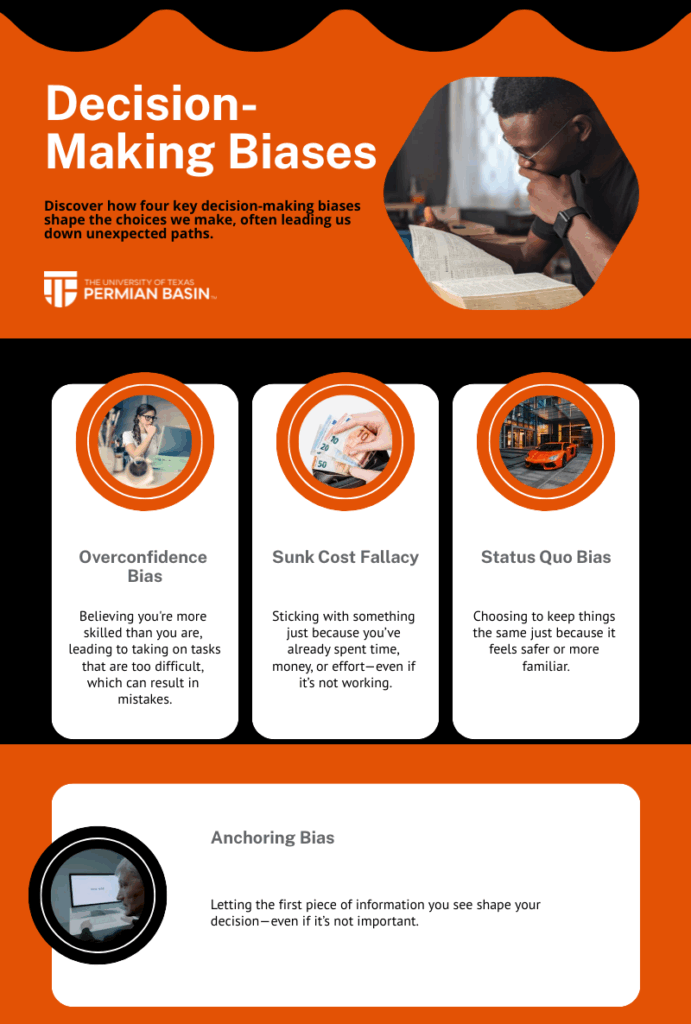
One specific category, decision-making biases, affects how we choose between options, especially in uncertain or high-stakes situations. Let’s explore what decision-making biases are and look at four common types that influence your daily choices.
What Is a Decision-Making Bias?
A decision-making bias is a type of cognitive bias that influences how we choose between options, especially in uncertain or high-pressure situations. These mental shortcuts help us make quicker decisions, but that doesn’t mean they always lead to the best outcomes.
In fact, they often don’t.
Decision-making biases can be harmless. Take deciding what to eat for dinner, for example. To help you reach a quick and easy conclusion, you might choose one of your favorite go-to options.
However, there are times when your brain’s attempt to simplify your choices can lead to less rational decisions: for example, feeling confident enough to make Julia Child’s coq au vin from scratch, even though you normally struggle not to burn grilled cheese sandwiches.
4 Types of Decision-Making Biases
Below, we discuss four of the common decision-making biases that help you shape your choices throughout the day.
#1 Overconfidence Bias
Overconfidence bias can lead to overestimating your skills in a particular area, whether it be cooking dinner, renovating the bathroom, or assembling your little one’s new state-of-the-art playset.
Let’s take the coq au vin example above. While you may not naturally be the head chef in your kitchen, you might feel like a culinary artist after watching hours of “Top Chef” reruns over the weekend. With an artificially inflated ego, coq au vin suddenly seems like an easy dinner solution, even though, in reality you usually struggle to boil pasta without checking the directions twice.
#2 Sunk Cost Fallacy
The sunk cost fallacy is a decision-making bias that occurs when you continue to invest in an endeavor based on the resources you’ve already committed.
Let’s pretend it’s New Year’s, and you’ve decided to purchase an annual gym membership. It’s a large sum of money upfront, but you’re dedicated to your fitness journey.
Fast forward a few months. The passion is gone, and though you dread the thought of sliding your feet into your tennis shoes time and time again, you continue to go to the gym.
Why? Simply because you’ve already paid for the entire year.
Even if cutting your losses is the more rational decision, you’re more likely to keep investing your time because you’ve committed too much money and effort.
#3 Status Quo Bias
The status quo bias affects our decisions by making us inclined to stick with our current situation. We often choose to stay the same because we fear change or have grown used to doing things a certain way.
For instance, your doctor might suggest a new medication that provides better health benefits than the one you’ve been taking. However, the status quo bias may rear its ugly head, reminding you that you’ve been fine with your current medication for years, so why switch it up now?
#4 Anchoring Bias
Have you ever locked eyes with the most expensive item on the menu? It seems stiflingly high at first, but after a few moments, it becomes the anchor item on the menu. Suddenly other plates seem more reasonable, even if they’re still priced higher than usual.
Welcome to the anchoring bias, which occurs when you find an initial piece of information and rely heavily on it when making subsequent decisions. While your anchor may be irrelevant to your final choice, it exhibits a strong influence on your decision, nonetheless.
Make the Decision That’s Right for You at UTPB
With The University of Texas Permian Basin’s online Bachelor of Arts in Psychology, your higher education decision is simple. Our program offers online students plenty of benefits:
Flexibility: Complete your coursework wherever you want within a timeframe that works for you.
Affordability: We’re ranked the #2 Most Affordable Online Psychology Degree by STEPS.
Networking: Meet virtually with distinguished professors and other like-minded students from around the country, expanding your network and potential career opportunities.
Take the first step toward deciding your future and apply today!
Don’t miss part two of our series on cognitive bias, where we’ll discuss social biases and how they influence the way we behave and perceive ourselves and others.
The Cold War between the U.S. and the Soviet Union lasted nearly 45 years. This period of global tension was fueled by political differences, expansionism, a nuclear arms race, and constant propaganda. But these factors were symptoms of a deeper, underlying psychological force: group polarization. Both sides steadily grew more entrenched in their opposing views,…
When the final “ber” months roll around, the world wraps itself in holiday cheer. Families make travel plans, calendars fill with festive gatherings, and store shelves overflow with stocking stuffers and seasonal treats. But behind the twinkle lights and snow-covered commercials, the holidays can be a stressful time. According to the American Psychological Association, 41%…
Does your pulse race at the thought of glancing out of a plane window at 30,000 feet? How about swimming through shark-infested waters? Or delivering a speech to a roaring crowd? While a fear of heights, sharks, or public speaking is normal, most people won’t be diagnosed with a phobia of these common fears. To…
Psychology permeates every human endeavor, and its rich field of study boasts many specialties that address psychological matters from varied perspectives. The American Psychological Association (APA) recognizes no fewer than 15 subfields, ranging from the individual to the organizational.
The University of Texas Permian Basin’s online Bachelor of Arts in Psychology program—ranked among U.S. News & World Report’s Best Undergraduate Psychology Programs—enables you to customize your degree to your interests with one of four optional focus areas drawn from the most popular specializations in the field. Each of these areas has a designated set of courses that give you deeper insight into the specialization:
Clinical psychology
Developmental psychology
Forensic psychology
Health psychology
Here we’ll look at each of these focus areas in greater depth to help you understand whether they align with your professional goals and desired psychological studies. We’ll also highlight why you may want to consider a career in psychology and why earning a BA in psychology may be a smart move no matter what career you intend to pursue.
Clinical Psychology
Clinical psychology is a multifaceted and intricate field within the broader scope of psychology. It deals with a wide array of mental, emotional, and behavioral issues, blending psychological science with strategies for preventing, evaluating, diagnosing, and addressing various complex human challenges. Clinical psychologists offer clinical or counseling assistance aimed at assessing and managing mental, emotional, and behavioral disorders. Their approach involves merging psychological science with problem-solving methodologies to foster positive changes.
Developmental Psychology
Developmental psychology is central to understanding the processes of learning, maturation, and adjustment in humans. Individuals undergo distinct developmental stages throughout their lives, and developmental psychologists examine how people evolve, develop, and adjust during these phases. Research in this field aims to help individuals reach their maximum abilities, such as investigating disparities in learning approaches between infants and adults. Developmental psychologists’ work encompasses physical, cognitive, social, intellectual, perceptual, personality, and emotional development.
Forensic Psychology
This emerging discipline utilizes psychological principles in forensic assessment. It offers a spectrum of in-demand services and specialized knowledge used by social welfare agencies, law enforcement agencies, the military, and judicial bodies. As often depicted in mainstream media, forensic and public service psychologists hold positions within public safety and legal frameworks, though they work in other sectors as well. They perform assessments that shape legal proceedings and may appear in court to testify and provide professional guidance to the proceedings.
Health Psychology
Health psychology investigates the impact of biological, social, and psychological elements on health and disease. Professionals in this field analyze the factors that empower individuals to stay healthy, reclaim their health following illnesses, or manage chronic conditions. They also endeavor to understand the motivation behind healthy lifestyle choices. Health psychologists work at the nexus of health and behavior and are sought-after members of healthcare teams, collaborating with other healthcare professionals to address individuals’ holistic needs.
The Wisdom of Psychology as a Degree and a Career
One fact that too few people understand is that a psychology degree provides a route to a wide variety of careers within psychology and beyond. A Bachelor of Arts in Psychology is so marketable and versatile because it helps you develop broadly applicable career skills, such as:
Communication
Critical thinking
Problem-solving
Collaboration
These are among the skills that authoritative sources including the Department of Labor, Forbes, and Indeed say today’s employers seek. Many employers consider soft skills to be more crucial than “hard” skills, yet they often have difficulty finding qualified job candidates. Developing these skills through our psychology program can give you an edge at hiring time for a diverse range of jobs.
If your ultimate goal is to become a psychologist, you’ll need additional education and licensure after completing this degree. The focus areas of our BA in psychology provide a strong foundation for both. By earning your BA in psychology, you’ll be on track to enter a rewarding career field that’s growing at a faster-than-average rate of 6% and has median annual pay of $85,330.
Put Your Mind at Ease With a Convenient, Flexible, Affordable Degree
Our online Bachelor of Arts in Psychology—available online exclusively from this UT System institution—is a valuable degree no matter what direction you may take professionally. Our asynchronous online format enables you to complete your degree from any location, on your own schedule, while maintaining your personal and professional commitments. And our tuition rates are acknowledged as some of the most affordable of accredited institutions.
Smartphone addiction has such a hold on our society that—hey! We see you eyeing that back button. Your attention span may be as short as a golden retriever’s, but you’ll want to stick around, because today we explore the psychology of smartphone addiction.
We’ll also provide some tips and resources to help you break away from your phone—at least, long enough to accomplish the goals most important to you.
The Call Is Coming From Inside the House
Your smartphone is often the first thing you see after lifting your head from your pillow and the last thing you see before drifting off to sleep. It’s your constant companion, a magical gateway granting access to near-infinite distractions, opportunities for engagement, and stores of information.
Yet when you’re out to dinner, you haven’t checked your notifications in ages, and the compulsion builds until you just have to peek, your phone can be your greatest adversary.
If you can’t put down your phone even when it has a severe negative impact on your life, you may be addicted to your phone—and you aren’t alone.
“[Technology] interrupts our own story, interrupts our ability to have a thought or a daydream, to imagine something wonderful because we’re too busy bridging the walk from the cafeteria back to the office on the cell phone.” —Steven Spielberg
Teens, whose brains have yet to fully develop, are especially susceptible to the algorithms tech companies use to keep them clicking and scrolling. According to a 2022 survey conducted by the Pew Research Center, about 35% of teens say they are on YouTube, TikTok, Instagram, Snapchat, or Facebook “almost constantly,” with about half of teens saying it would be hard to give up social media.
Diminishing Returns
The problem is dopamine. Commonly referred to as the “feel-good” hormone, dopamine is the brain’s major reward and pleasure neurotransmitter. Anything that causes pleasure triggers a dopamine release. While it’s a common misconception that dopamine makes you happy, the hormone actually reinforces behaviors that make you happy.
Smartphones are so addictive because every time we use them—to like an Instagram post, watch a YouTube video, or play Wordle—it triggers a surge of dopamine. After an initial rush of dopamine, there’s a dip like a craving: What goes up must come down. If a person isn’t addicted, the craving passes, but if they continue binging, the brain compensates with lower and lower dips.
“Mommy let you use your iPad; you were barely two. And it did all the things we designed it to do.” —Bo Burnham in “Welcome to the Internet”
By then, the brain is hooked. It needs more dopamine; it needs to feel like it felt the first time it engaged with the stimulus. The brain is now dependent on diminishing dopamine returns, and like any addict, the smartphone user is chasing a high they’ll never reach.
If you think you’re addicted to your smartphone, don’t be too hard on yourself. Smartphones and apps are designed to be as addictive as possible. There are scientists at billion-dollar companies who are toiling away to make these devices even more addictive.
As with any addiction, there’s no shame in reaching out. Doctors and therapists can help address the underlying causes of smartphone addiction. However, making a few changes in your routine can make a world of difference in how you interact with your devices.
Here are some steps you can take to develop a healthier relationship with your smartphone:
Keep your phone in another room when you need to focus.
Change your settings to turn off push notifications.
Delete mobile games and apps that consume too much time. (You know the ones.)
Take a break from social media. Better yet, get off it completely.
Download a focus app and improve your productivity while you’re at it.
Smartphones are addictive precisely because they are incredible tools, but that’s all they are: tools. At the end of the day, you’re the one in control.
Learn More About the Psychology of Addiction
We hope you’ve enjoyed this look at the psychology of smartphone addiction. If you’re fascinated by all things psychology, your journey doesn’t have to end here.
Whether you’re fascinated by the inner workings of the human mind or driven to make a positive impact on individuals and communities, our online BA in psychology program can be your gateway to a fulfilling and impactful career. Courses like Cognitive Psychology, Positive Psychology, and Drugs and Behavior provide a comprehensive education while being flexible enough to fit around your schedule.
Whether you enjoy football, basketball, or another sport entirely, you know one thing to be true—a person’s allegiance to their favorite sports team runs deep. Whether you’re an unwavering Houston Texans supporter or your devotion lies with the red, gold, and white of the Kansas City Chiefs, most fans stand by their team regardless of its season’s victories (or quickly accruing losses).
And if you dare to challenge these fans by suggesting your team is somehow superior to theirs? There’s a solid chance that the discussion will end in a heated debate. But what fuels these passionate sports rivalries? Enter group polarization, a phenomenon that sheds light on the existence of these heated conflicts.
So, grab your ball caps, sports fans, while we explain what group polarization is and how it plays a role in decades-long sports rivalries.
What Is Group Polarization?
Group polarization describes how individuals in a group can develop more extreme views and opinions on a particular topic based on the influence of others in the group. In the realm of sports rivalries, the existence of group polarization is as clear as the freshly washed windowpanes of a luxury suite.
Let’s say you’re a lifelong Dallas Cowboys fan. You grew up watching their games every Sunday night with your family, and as you got older, you became friends with fellow Cowboys enthusiasts. Now, you have a group chat that lights up incessantly on game days. You share stories, statistics, and the occasional frustration as you argue against a ref’s bad call.
As the text thread continues, individuals in the group begin adopting more extreme views about how incredible their team is. So, regardless of how perfect or disappointing their season may be, nearly every person in the group chat believes that the Cowboys are the best team in the NFL. If you were to express any opposing thoughts on the matter, they would likely respond with strongly formed opinions as to why you’re incorrect.
How Does Group Polarization Factor Into Team Rivalries?
You might be wondering exactly how group polarization plays into team rivalries. We’re so glad you asked. Below, we’re diving into the psychology behind how this phenomenon manifests in sports rivalries.
In-Group Bias
When you belong to a group, like a passionate bunch of sports fans who love the same team, you share a sense of belonging. The more you discuss your team’s skills and performance with your group, be it a virtual or in-person gathering, the collective agreement usually becomes more extreme in your team’s favor. This is one factor that contributes to group polarization.
Out-Group Hostility
On the flip side, group polarization can also give rise to heightened hostility toward fans of opposing teams, particularly rivals. Fans from other leagues may be seen as an ‘other,’ making it easier for your group to capitalize on the superiority of your team over theirs. This dynamic not only provides an opportunity to cultivate a negative attitude toward rival fans but also enhances the affection for your team, implicitly positioning it as superior.
Confirmation Bias
Confirmation bias is a cognitive bias that involves believing information that confirms a person’s existing beliefs. It also lends itself to ignoring information that contradicts those beliefs. In terms of sports rivalries, let’s say you’re a Boston Celtics fan. As they’re playing the L.A. Lakers, you and your friends applaud the referee when their decision benefits your team. In contrast, you’re the first person to clap back on a ruling against the Celtics.
Social Comparison
Who doesn’t love comparing something they love against something they, well, don’t? Sports teams are a great example. In a group setting, fans relish the heated discussions that compare their team’s achievements and players against those of rival teams. These comparisons can lead individuals in the group to form even more extreme opinions about the greatness that is their team—and the inferiority of rivals.
Emotional Amplification
When you reminisce on the moment you were in the stadium watching the quarterback throw the final ball that secured your team’s Super Bowl victory, it can amplify the emotions of other members of your group. These shared emotional experiences help forge stronger bonds within the group, which can lead to extreme emotional responses against rival teams.
When It Comes to Your Education, There Is No Rival
While group polarization may play a hefty role in influencing some of the biggest sports rivalries, your educational journey should be defined by the pursuit of a degree that aligns with your career aspirations. At The University of Texas Permian Basin, we understand the importance of realizing your professional goals.
Explore our online Bachelor of Arts in Psychology, a program designed to be your initial step toward turning your dreams into reality. Ranked among the Most Affordable Online Psychology Degrees by STEPS and #11 in Top Online Bachelor of Psychology Degree Programs by TopCounselingSchools.org, our degree provides a quality education that is both accessible and esteemed.
As a virtual student at UTPB, you can benefit from the flexibility of asynchronous courses, allowing you to complete your coursework at your convenience. And with rolling admissions, you have the flexibility to start your educational journey when it suits you best. Take the next step in achieving your academic and career aspirations by applying to The University of Texas Permian Basin today.
Did you know you experience cognitive bias daily? For example, what’s your favorite color? Let’s pretend it’s purple. Without even hesitating, you tell me as much. It’s been purple for as long as you can remember (even if you don’t recall exactly why).
That’s an example of cognitive bias, a pattern of thinking that occurs when your brain takes a shortcut based on a past experience, belief, or feeling. Because purple felt familiar to you, you chose that color—even if you’ve recently found yourself enamored with teal or navy.
Aside from helping us come up with quick and easy conclusions about our favorite color, how else does cognitive bias affect our lives? Let’s immerse ourselves in the realm of cognitive bias, from what it is to how it impacts us and how we can make a conscious effort to reduce it in our daily lives.
What Is Cognitive Bias?
Cognitive bias refers to the systematic errors in thinking that occur when the brain processes vast amounts of information. The human brain is a powerful anomaly. It can process 11 million bits of information every second. Our conscious minds, however, can only keep up with 40 to 50 pieces of information each second. Though significantly less than 11 million, that’s still an impressive amount of information to juggle at any given moment.
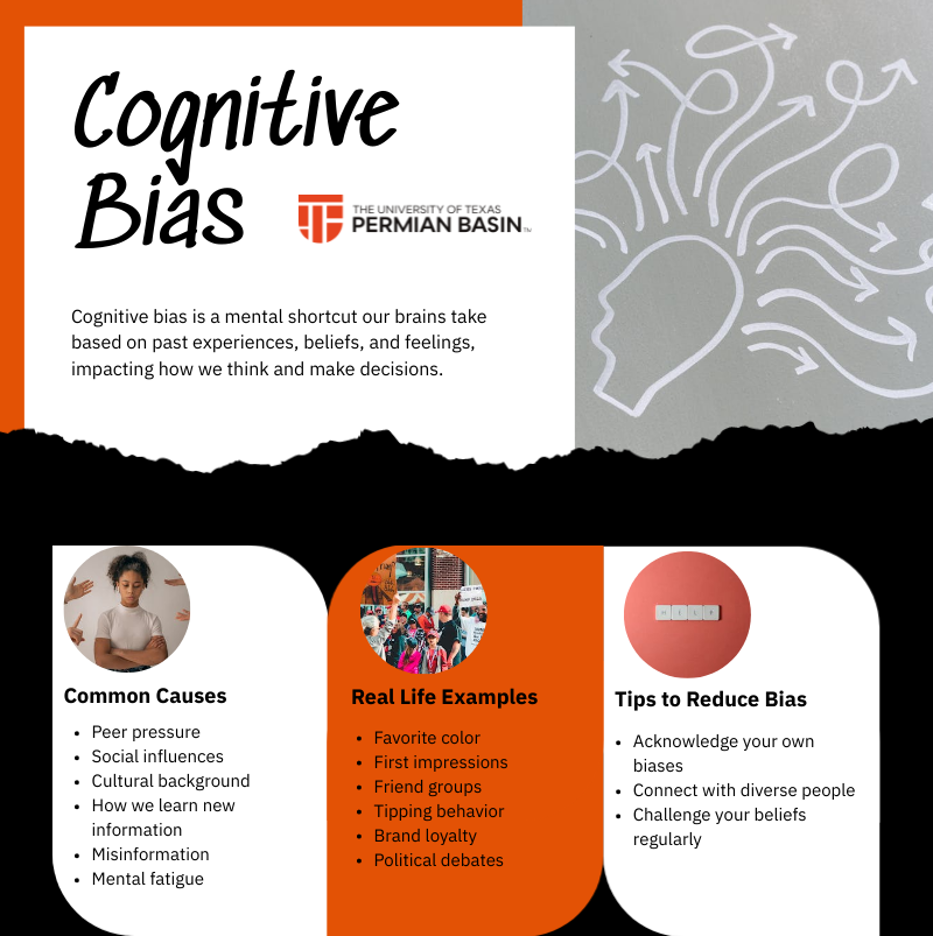
To help us keep up with all the bits and pieces, our brains occasionally take cognitive shortcuts to simplify information processing. The result? Cognitive biases, which serve as a quick way for your mind to make judgments based on your past experiences. So, instead of contemplating what your favorite color may be based on how you’ve decorated your home recently or the color you can’t seem to get enough of in your wardrobe, you go with the easy answer—the cognitive bias.
What Causes Cognitive Bias?
Cognitive bias refers to the systematic errors in thinking that occur when the brain processes vast amounts of information. Since your brain is consciously computing 40 to 50 items per second, it’s challenging to contemplate every single option 100% of the time, even when asked the simplest of questions. Even with an endless supply of information available to you at the swipe of a finger, sometimes it’s easier to take advantage of mental shortcuts.
Some of the most common causes of cognitive bias include:
Emotions Your emotions and beliefs can affect your decision-making and thinking.
Social influences Many of your judgments and beliefs are formed by your friends and family.
Cultural conditioning Our upbringing and cultural background often shape our thinking and contribute to our biases.
Availability of information As we age, we learn new bits of information through our social circles, books, or deep dives on the internet. Sometimes, rather than learning more about a topic we’re familiar with, we rely on our memories to relay what we know and overestimate our understanding of that topic, denying ourselves a new viewpoint on a particular topic.
How Does It Affect Our Lives?
Cognitive bias affects more than just our go-to responses for our favorite color. Below, we highlight some of the typical effects that cognitive biases can have on our lives:
Distorted perception Biases can lead you to create your own perceptions of reality. For example, let’s say you’re at a social gathering with your friends. You meet a woman named Suzie, who tells you she’s a librarian. Based on your prior stereotypes of librarians, you assume she’s reserved and enjoys speaking about her latest reads. When she brings up a popular book, she confirms part of your stereotype. As you focus on this, you miss out on the other qualities Suzie has to offer, like her quick wit, sarcasm, and love for college football.
Closed-mindedness When you’ve developed a set of beliefs via social, familial, or societal norms, cognitive biases can lead to close-mindedness on a variety of topics, from the education system to religion, politics, and more. Rather than hearing out another person’s perspective on a specific topic, you may be more likely to immediately shut their ideas down or simply not listen to their side of an argument.
Communication issues Cognitive biases can make it more challenging to have effective communication with others. Sometimes one or both parties can misinterpret or misconstrue what the other is saying due to their own personal biases.
Tips for Reducing Cognitive Bias in Our Daily Lives
While not all cognitive biases have negative consequences, it’s helpful to be aware of any biases you have so you can overcome them with these tips:
Accept that everyone has cognitive biases The first step to surpassing cognitive biases is to acknowledge that you (and everyone else) have biases. This will help you become more open to understanding others’ perspectives.
Experience life with a variety of people When you’re at a work function or family gathering, the comfortable choice is to remain close to your friends. Instead, try branching out from your usual group and speaking with individuals from diverse backgrounds and who have different ways of viewing the world.
FAQ About Cognitive Bias
Curious how cognitive bias shows up in everyday life or how to keep it in check? Let’s recap the core concepts.
What is cognitive bias? Cognitive bias is a mental shortcut your brain uses to make quick judgments based on past experiences, beliefs, or emotions.
Why do we experience cognitive bias? Our brains are constantly processing vast amounts of information. To keep up, they rely on shortcuts influenced by emotion, memory, culture, and social context.
How does cognitive bias affect daily life? Cognitive biascan distort perception, limit open-mindedness, and lead to miscommunication in everyday situations.
Can cognitive bias be reduced? Yes—by acknowledging your biases, engaging with diverse perspectives, and actively questioning your assumptions.
Earn a Bachelor of Arts in Psychology at The University of Texas Permian Basin
Your interest in the human mind and behavior doesn’t have to end with cognitive bias. With a BA in psychology, you can take your fascination (and career) to the next level. With UTPB’s online Bachelor of Arts in Psychology, you’ll gain a broad foundation of psychological science knowledge and written communication and research skills that can jump-start your career in a variety of industries.
Our program is ranked among the Most Affordable Online Psychology Degree by STEPS and as one of the Top Online Bachelor of Psychology Degree Programs by TopCounselingSchools.org. If you’re ready to start your next chapter, apply today!
The Cold War between the U.S. and the Soviet Union lasted nearly 45 years. This period of global tension was fueled by political differences, expansionism, a nuclear arms race, and constant propaganda. But these factors were symptoms of a deeper, underlying psychological force: group polarization. Both sides steadily grew more entrenched in their opposing views,…
When the final “ber” months roll around, the world wraps itself in holiday cheer. Families make travel plans, calendars fill with festive gatherings, and store shelves overflow with stocking stuffers and seasonal treats. But behind the twinkle lights and snow-covered commercials, the holidays can be a stressful time. According to the American Psychological Association, 41%…
Does your pulse race at the thought of glancing out of a plane window at 30,000 feet? How about swimming through shark-infested waters? Or delivering a speech to a roaring crowd? While a fear of heights, sharks, or public speaking is normal, most people won’t be diagnosed with a phobia of these common fears. To…
Once the New Year’s celebrations wind down and the post-midnight fatigue fades away, the reality of your New Year’s resolution sets in. You’ve declared your goals to friends and family, and there’s no turning back.
We’ve all been there: committing to healthier eating, more exercise, or mastering the guitar. Yet, our enthusiasm often wanes by the end of January, and making it even to February feels like a triumph.
How can you ensure you follow through on your resolutions and goals? It boils down to understanding effective goal setting and implementing strategies to maintain your momentum. With these insights and a solid plan, success can be a year-round affair, not just a fleeting January endeavor.
What Are the Key Principles of Goal Setting?
What better time to announce the ways you plan to change for the better than the start of a shiny new year? January allows you to start fresh so you can accomplish all of the goals that didn’t quite make the to-do list last year.
How committed are you to achieving your goal? If an obstacle gets in your way, are you willing to overcome it? Multiple factors can affect your level of commitment, including how badly you want to achieve your objective and whether you believe you can do it.
#2 Clarity
Is your goal specific and measurable? For example, deciding to “lose weight” isn’t a clear resolution. If your stated ambition poses more questions than answers, it may be more effective to create a goal that’s clear and concise.
Instead, you could say, “I want to lose 10 pounds by April and will do so by eating 2,000 calories a day that are split between 40% carbohydrates, 30% protein, and 30% fat.” That goal is Specific, Measurable, Achievable, Relevant, and Timebound (SMART).
#3 Level of Challenge
If your usual annual reading range is 10 to 15 books, aiming to read just 15 isn’t particularly challenging. The key question is: What motivates you to achieve this goal?
Setting more challenging targets enhances your self-satisfaction and propels you to overcome obstacles on your journey. Try opting for a challenging number, like 25 or 30 books, to motivate you to go the extra mile. Trust us, you’ll feel a bigger sense of achievement when you complete your goal.
#4 Task Complexity
Goldilocks knew what she wanted. A bed that wasn’t too hard or too soft; one that was just right. Similarly, the resolution you create shouldn’t be too easy or difficult. It should be realistic, manageable, and on par with your current skill level. This ensures that your goals are challenging enough to motivate you without being so difficult that you become discouraged.
#5 Feedback
Whether you’re providing your own feedback via a daily journal or a friend or family member is offering their insights every week, feedback allows you to monitor your journey, stay motivated, and hold yourself accountable for advancing toward your goal.
Strategies to Help You Follow Through on New Year’s Resolutions (and Other Goals)
Now that you have a better grasp on how to create an achievable goal, let’s review some strategies that can help you follow through on that New Year’s resolution.
Make It a Habit
Forming habits is a process that typically takes several weeks, and in some cases even longer. However, consistency is key. So, stick to your resolution, and over time, it’s likely to become second nature.
Consider this: If your objective is to read 25 books by the end of the year, begin by dedicating 10 minutes a day to reading. As this becomes more manageable, gradually increase the time you spend reading. This progressive approach can significantly contribute to the achievement of your goal.
Reward Yourself Along the Way
Staying consistent with a New Year’s resolution isn’t as easy on day 30 as it was on day one. That’s why it’s important to reward yourself for your hard work along the way.
Suppose your resolution involves working out three times a week. In that case, you might treat yourself every week you accomplish this goal, whether it’s indulging in a new pair of running shoes or granting yourself an extra hour of sleep on the weekend. Recognizing and celebrating these milestones can be a powerful motivator in sustaining your dedication to your resolutions.
Take Advantage of Social Support
What better way to hold yourself accountable than by involving others in your goals? Shout those resolutions from the rooftop for all to hear, or at the very least, text your friends and ask them to hold you accountable for completing your agreed-upon objectives each week.
Track Your Progress
From progress-tracking apps to old fashioned pen-and-paper logs, keeping tabs on your progress not only helps you stay on course but also provides a mini sense of accomplishment each time you record a new milestone. Don’t forget to celebrate these small victories on your journey towards achieving your ultimate goal.
Jumpstart Your Career By Choosing the Right Goals
Setting goals is the easy part. The real challenge lies in committing to and achieving them. If you’re prepared to turn your professional aspirations into reality, it’s time to take the next step.
At UTPB, we understand the complexities of balancing a full-time job, taking care of family commitments, and pursuing an education. That’s why we’re excited to offer our 100% online Bachelor of Arts in Psychology program. Designed to accommodate your busy life, our program offers a diverse range of courses that allow you to choose classes that align with your interests, all while completing them on your schedule.
Apply now and take the first step toward making your New Year’s resolution a tangible achievement. Your future self will thank you for your commitment to your professional growth and success.
Cults are a thorny topic, because exactly what constitutes a cult is highly contentious and subjective. The commonalities they share can sometimes put a fine line between cult and religion. Some cult members may insist they’re involved of their own free will and are living happy lives, further complicating a consensus. Bear these facts in mind as we delve into the psychology of cults and their members.
Cults Defined
Let’s start with a definition of “cult” from the APA Dictionary of Psychology as a baseline:
“n. 1. a religious or quasi-religious group characterized by unusual or atypical beliefs, seclusion from the outside world, and an authoritarian structure. Cults tend to be highly cohesive, well organized, secretive, and hostile to nonmembers.”
They’re usually led by a charismatic individual whom the members worship without question.
Cult members often live together in their own dedicated community.
The Psychology of Cults: How They Lure People In and Take Control
Cults recruit new members anywhere you might expect to meet new people: social media, discussion groups, community clubs, events, and the like. These are typically nonthreatening, public situations that would not cause anyone to be suspicious. Cult recruiters get to know as much as they can about people and identify individuals who may be receptive to meeting a group of the recruiter’s friends at dinner or another social event. Though the chosen targets are generally unaware, these seemingly innocent gestures are the first steps to being drawn into a cult.
Targeting Vulnerable Prey
Receptive people are those who are looking to escape something—such as an unhappy life situation—and to belong, be accepted, and find meaning. Cults prey upon the vulnerable among us, such as teenage runaways, drug addicts, abuse survivors, those who have lost someone close to them through death or a breakup, those suffering from insecurity or mental health issues, or anyone who feels disconnected from society.
Drawing in Recruits
Once the potential recruit is in the presence of cult members, typically still oblivious to the group’s agenda, they are showered with love and validation. This tactic, referred to as “love bombing,” makes the recruit believe they’ve found what they’re looking for and more likely to return for group activities in the future. This is critical in the early stages of cult indoctrination since the recruit is not yet under their influence and needs to feel secure.
Taking Control
As they indoctrinate new members, many cults separate them from their families, friends, and jobs, slowly remaking their identities to suit the group. They may force recruits to surrender their money, belongings, and bodies to the cult’s leader and other members. Sometimes they compel new members to marry people they just met. They may use punishment, deprivation, and other tactics to wear them down. These efforts, which sometimes include threats, make new members dependent on and afraid to leave the group. Fully indoctrinated members often engage in behavior they never would’ve considered in their former lives.
Notorious Cult Cases
Here are just a few groups that have drawn significant attention to the dangers of cults:
The Manson Family
Charles Manson directed his “family” of runaways and other troubled individuals to start a race war by murdering several people in Los Angeles. There were eight victims in all—including pregnant Hollywood actress Sharon Tate—but the group claimed to have murdered and disposed of the bodies of many more.
The Sullivanians
Perhaps less known than some other cults, yet one that operated virtually in the open in Manhattan’s upscale Upper West Side, this group began as a psychoanalytical institute in the 1950s but evolved into a coercive sex cult that lasted for decades and counted famous artists among its membership.
The Peoples Temple
Reverend Jim Jones ran the Peoples Temple in several California locations before moving the congregation to Guyana and establishing the “Jonestown” commune. The temple’s methods came under increasing scrutiny, and upon an unwelcome visit from a U.S. Congressman, Jones ordered his congregation to drink Flavor Aid (often misattributed to Kool-Aid) laced with valium and cyanide. Many victims were children, and many adults were forced at gunpoint. More than 900 people died that day.
Heaven’s Gate
Marshall Applewhite, leader of Heaven’s Gate, was convinced that an extraterrestrial spacecraft was hiding behind the recently discovered Hale-Bopp comet and that members of his group would be taken to a higher level of existence by that spacecraft following their deaths. As the comet passed close to Earth, 39 members of Heaven’s Gate drank vodka mixed with phenobarbital, placed plastic bags over their heads, and died.
Nxivm
Outwardly a self-help organization, Nxivm was secretly a sex cult assaulting women, branding the initials of founder Keith Raniere on them, and blackmailing them. The organization operated partly on a pyramid scheme structure, with “masters” recruiting “slaves” who would eventually recruit more “slaves” as subordinates. The case also drew attention for the involvement of “Smallville” actress Allison Mack, who recruited women for Raniere.
Good News
Hundreds of members of the Kenya-based Good News international church willingly starved to death at the direction of their leader, Paul Nthenge Mackenzie, who himself abstained from the slow suicide. Mackenzie claimed to have determined the date on which the world would end, and purportedly wanted his followers to go to heaven in advance of the apocalypse.
Join a Program Truly Dedicated to Positive Personal and Professional Outcomes
Motivation. Physiology. If you’re fascinated by what drives people and want to acquire the top skills today’s employers are seeking, The University of Texas Permian Basin’s online Bachelor of Arts in Psychology is an affordable, convenient way to start or further your college career. Explore diverse applications and perspectives of psychology as you complete a respected credential that can lead to a variety of rewarding professional roles. During the program, you’ll have the opportunity to create a pro-social cult for the betterment of yourself and others.
As the fall season nears, the spooky-loving souls of the world begin decorating their houses with ghouls and goblins, making orders for pumpkin spice lattes, and busting out old VHS tapes of “Hocus Pocus” for their annual rewatch. For some, the movie’s backdrop in Salem, Massachusetts, evokes thoughts of the Salem witch trials.
Suddenly, their minds are riddled with questions: Who were the accused? How did the trials end? And the biggest question of them all—why did the Salem Witch trials happen in the first place?
History suggests a combination of factors, including a smallpox epidemic in the region, economic disparities, and the looming threat of Native American attacks. However, there’s another potential factor at play: group polarization.
Grab your favorite fall-flavored beverage as we discuss the concept of group polarization and how it may have played a role in the Salem Witch Trials of 1692.
What Is Group Polarization, Anyway?
Can you remember a time when you experienced peer pressure as a child? Maybe your friends asked you not to talk to the new kid in class or they convinced you to ditch your plans in favor of hanging out with them. Whatever the case may have been, peer pressure is a form of group polarization, a situation that refers to how people adopt more extreme positions when they’re part of a group.
Other examples of group polarization in different contexts include:
Changing your behavior when you’re around your coworkers or friends
Taking on different roles in a group depending on who you’re with
Altering your opinions based on the influence of others
The Salem Witch Trials: A Brief Overview
The Salem witch trials began in 1692 when a few young girls in Salem Village, Massachusetts, began exhibiting strange behaviors. When doctors could find no scientific cause for their outbursts, the girls accused social outcasts Sarah Good and Sarah Osborne, along with Tituba, a servant of the Puritan town minister, of witchcraft. These accusations sparked mass hysteria in the religious and superstitious little town.
The trials soon followed, and when Tituba confessed, it only added to the town’s hysteria. At the conclusion of the trials in 1693, more than 150 people had been accused, leading to 19 hangings, one pressing, and five deaths in jail.
Everyone Drank the Potion: Group Polarization During the Salem Witch Trials
With only 550 people living in Salem Village at the time of the trials, it’s not difficult to see how group polarization may have played a role in the convictions of numerous village citizens. Below, we discuss some of the ways group polarization may have wormed its way into the minds of the people of Salem.
Conforming to Social Norms
Many Salem Village townspeople were Puritans who conformed to the religious belief that witchcraft was God’s punishment for committing sins. Those who outspokenly deviated from that belief were more likely to cast themselves in a negative light in the eyes of the rest of the community.
So, instead of forming their own opinions of the accused, many individuals may have felt pressured to conform to the belief that the women were sinners, and therefore witches, even if they didn’t necessarily agree with that sentiment.
Echo Chamber Effect
As citizens became swept up in the gossip of the accusations, it created an echo chamber effect, which occurs when people only hear one side of a story. In this case, it happened to be that the accused women were, without a doubt, witches.
Many of the townsfolk already believed this to be true, so when they heard similar stories from others, the gossip only solidified their opinions. If someone had decided to question the complainants’ stories and stand up on behalf of the accused, some townsfolk may have come to a different conclusion: Maybe the women weren’t witches. Perhaps, they were innocent.
Public Pressure
The judges of the trials were probably under immense scrutiny to take action against the potential threat of witchcraft. A combination of building pressure from the community mixed with the desire to be seen as righteous problem solvers could have pushed them over the edge in terms of their judgment of the accused. In the end, this form of group polarization may have led the judges to make more extreme decisions than they were comfortable with.
Fear and Hysteria
While many of us appreciate the occasional rerun of “The Exorcist” or “The Craft” around Halloween, the idea of witchcraft and the devil was a tangible fear for the people of Salem in the 1600s. With the number of accusations increasing weekly, this growing fear created an atmosphere of complete panic. This rising dread may have caused moderately minded individuals to become caught up in the town’s collective sense of hysteria, resulting in people forming less rational judgments and pointing fingers at innocent neighbors.
Join the Bandwagon: Earn Your BA in Psychology at UTPB
Not every aspect of group polarization holds a negative connotation. Under the right circumstances, it can also lend itself to solving problems, fostering positive changes, and encouraging individuals to explore and expand their values.
If you’re interested in broadening your ethical understanding of the world around you and enlightening others, The University of Texas Permian Basin offers an online Bachelor of Arts in Psychology program that’ll help you develop fundamental skills and knowledge in the expanding field of psychology, including:
Reasoning about empirical research that apply to psychological phenomena
Writing strong, cohesive arguments
Thinking critically about the theoretical and applied aspects of psychology
With a degree in psychology, you’ll be one step closer to achieving your dream profession, whether you aspire to be a clinical or counseling psychologist, a behavioral scientist, a researcher, or something else entirely. Your future is up to you to decide—so, start today by exploring all that our online psychology program has to offer.