Graduate Certificate vs. Master’s Degree: Which One Is Right for You?
Trying to decide between a graduate certificate and a master’s degree? You’re not the only one. Both can help you grow your skills, strengthen your resume, and move your career forward, but they’re built for slightly different goals.
A master’s degree is usually the better fit if you want a broader graduate education or qualifications for higher-level roles. A graduate certificate makes more sense if you want to build a specific skill set in a shorter timeframe.
Here’s a closer look at how they compare.
Graduate Certificate vs. Master’s Degree: What’s the Difference?
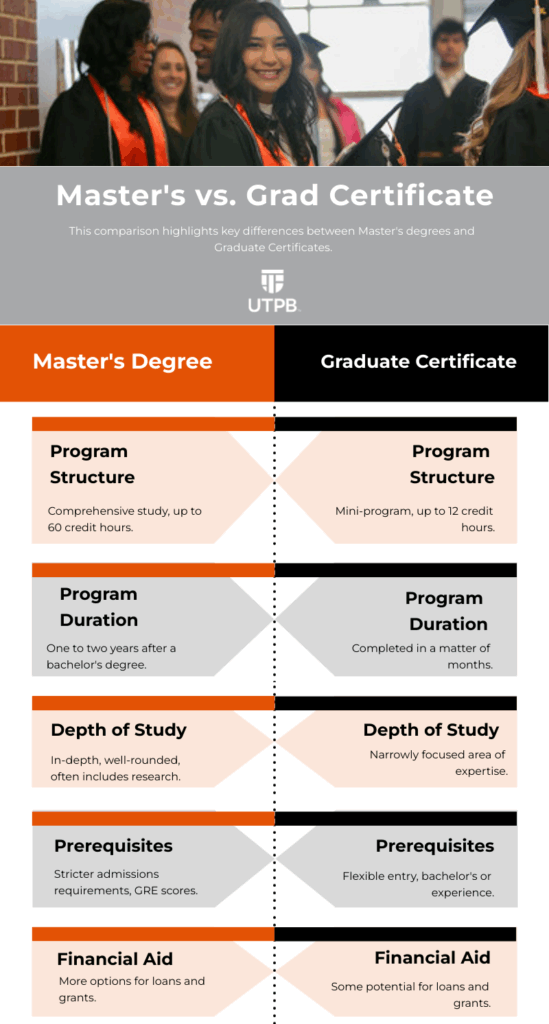
A master’s degree is a full graduate program in a broader field of study. These programs often require 30 to 60 credit hours and may include research, internships, or thesis work, depending on the field.
A graduate certificate is shorter and more focused. Most require about 9 to 15 credit hours and are designed to help students or working professionals build skills in a specific area.
Program Length
For many students, a master’s degree takes one to two years to complete. A graduate certificate can often be finished in a matter of months, which makes it appealing if you’re looking to upskill without committing to a full degree program.
Depth of Study
Master’s degree programs cover a specific discipline in depth, typically including research and thesis components, and more coursework overall.
Graduate certificate programs help aspiring professionals build expertise in a focused area without the extensive coursework of a full master’s degree.
Career Options
Depending on the field and profession you’ll pursue, a master’s degree can qualify you for specialized roles and lead to higher earning potential.
A graduate certificate can still add value, especially if you want to sharpen a certain skill, meet licensing requirements, or transition into a new area without starting from scratch.
Prerequisites
Master’s degree programs often have stricter admission requirements. This can sometimes include letters of recommendation or passing scores from standardized tests like the GRE.
Graduate certificates usually have a more flexible admission requirements and are accessible to professionals with a bachelor’s degree or relevant experience.
Financial Aid
Students pursuing a master’s degree often qualify for federal financial aid, including loans and grants.
Those pursuing a graduate certificate may also qualify for financial aid, depending on the school’s policies.
A master’s degree may be the better choice if you:
Want a broader graduate education
Are aiming for leadership or specialized roles
May pursue a doctorate later
Need a graduate degree for your field
A graduate certificate may be a better fit if you:
Want to build a specific skill set quickly
Are changing careers or testing a new field
Need a shorter, more flexible program
May want to stack credits into a master’s later
Frequently Asked Questions: Graduate Certificate vs. Master’s Degree
Still deciding between a graduate certificate and a master’s degree? These common questions can help clarify your options and guide you toward the right next step.
Is a graduate certificate worth it? Yes, especially if you want to build specialized skills quickly, boost your resume, or explore a new field without committing to a full degree. It’s also a great way to test the waters before pursuing a master’s degree.
Can I use a graduate certificate toward a master’s degree later? In many cases, yes. Some programs allow you to transfer certificate credits into a related master’s degree, which can save time and money. Be sure to check with the specific program you’re considering.
Which option leads to better career opportunities? A master’s degree typically qualifies you for higher-level roles and increased earning potential, especially in leadership or research-based careers. A graduate certificate can still enhance your qualifications but is best suited for more targeted career moves.
Explore Your Flexible Learning Options at UT Permian Basin
UTPB offers the flexibility to start with a graduate certificate and later transition to a master’s degree program—or vice versa. Whether you’re a prospective student or mid-career professional, you’ve got the opportunity to customize your educational path to align with your goals.
You only get one chance to make a first impression. Cover letters have long been one of the best ways to set yourself apart in a competitive market. But in the era of AI screeners, even the most polished resumes—and their accompanying cover letters—feel like they’re disappearing into the void. With the job market more…
Getting accepted to The University of Texas Permian Basin is a big milestone. If you’re a working professional, the next step—asking your employer about tuition reimbursement—can feel a little intimidating. But it doesn’t have to be. Most organizations want employees who grow, stay, and contribute at a higher level. And many companies offer tuition reimbursement,…
The University of Texas Permian Basin is home to over 7,000 students. Whether on campus in West Texas or from a laptop hundreds of miles away, they’re part of a diverse community that values culture, connection, and progress. Every member of our Falcon Family deserves some time in the spotlight. But with Hispanic Heritage Month…
“Whoever saves one life, saves the world entire”
—Thomas Keneally, paraphrased from the Talmud
Imagine if you could solve the world’s problems with a wave of your hand. Like magic, you could reform melted glaciers, shelter the country’s stray animals, and provide free meals to school children.
Sadly, the world’s problems can’t be fixed so easily.
Choosing a focus area allows students the opportunity to tailor their degree to their interests, ensuring their time and energy (not to mention tuition) are spent on topics that align with their career goals.
Nonprofit
Nonprofit organizations like the American Red Cross, Feeding America, and the Humane Society of the United States engage with communities to further social causes. Nonprofits are funded by grants, fundraising, and donations specifically devoted to accomplishing a mission rooted in a public or social benefit.
Career Outlook in Nonprofit
Nonprofit employment has also grown by 33% since 2006. To put that into perspective, the for-profit sector grew by only 9% during that time. If you’re looking for a career in the nonprofit sector, you’re going to find plenty of opportunities.
Students in this focus area gain in-depth knowledge crucial for nonprofit management, exploring such topics as public engagement, managerial decision-making, marketing concepts, and financial management. Available courses include:
Financial Management for Public and Nonprofit Organizations
Innovation in Public and Nonprofit Organizations
Marketing Management
Education
The U.S. public school system has been marred by controversy, to say the least. Every week, there seems to be a headline about a school district banning books or a politician attacking educators to rile their base. Along with administrators, teachers, and staff, public school students need champions willing to fight for a safe, effective learning environment.
Will you be that champion? Choose our Education focus area and you’ll have the opportunity to enroll in:
Issues in Health and Human Services Policy Management
School Public Relations
School Law
Student learning outcomes outline the knowledge needed to promote student success. Throughout these courses, students develop the capacity to fulfill administrative responsibilities in an honest, fair, and ethical manner. Above all, students learn how to collaborate with families and stakeholders and mobilize community resources to realize a shared vision.
Healthcare
Healthcare is a critical yet vulnerable system. Doctors, nurses, and other medical professionals, once celebrated as essential workers, are under as much pressure as ever—and there’s no indication that the pressure will let up. Public administrators in the healthcare sector can champion these essential workers, ensuring they have the resources their patients need.
Apply to our online MPA program with a Healthcare focus and enroll in:
Issues in Health and Human Services Policy Management
Healthcare Management
Healthcare Marketing
Through this focus area, you’ll acquire a profound understanding of accounting, finance, marketing, information systems, and human resources management within the healthcare sector. We’ve developed this focus area to prepare you for the managerial, policy, and healthcare issues you’ll likely encounter early in your career. Learn what it takes to ensure doctors, nurses, and other medical professionals receive the resources they need to deliver high-quality healthcare.
Core Courses and Electives in UTPB’s Online MPA Program
Seven core courses, each 3 credit hours in length, are designed to set students up for success in all areas of public administration. Analytical techniques, personnel administration, and public budgeting are only some of the essential topics covered in these required courses. Students can expect to cultivate career skills as well as soft skills highly sought after within the public administration sectors.
Elective Courses
Students pursuing an education, nonprofit, or healthcare focus will take three courses in their focus area, which will count toward their five-course elective requirement. After, students will need to select two additional courses (6 credit hours in total). Students may enroll in courses from other focus areas, such as School Law, Healthcare Management, or Innovation in Public and Nonprofit Organizations. However, other UT Permian Basin courses from our course catalog may be acceptable.
Apply to UT Permian Basin’s Online MPA Program
The benefits of our online Master of Public Administration program extend far beyond our focus areas. Entirely online, our program offers the flexibility you need to pursue your degree without putting your life on hold. (Good luck trying to find a graduate student without personal or professional commitments.)
UT Permian Basin, and by extension its online MPA program, is accredited by the prestigious Commission on Colleges of the Southern Association of Colleges and Schools. Our program is led by an experienced team of educators, each of whom has years of experience in public administration. If you want to give back to your community, our online program offers the prestigious education and degree you need to make a difference.
Assuming the role of superintendent is not for the faint of heart. While it offers significant rewards, such as professional recognition and leaving a lasting educational impact, it also carries a substantial (and worthwhile) load of responsibilities.
From educational leadership to community engagement, the qualities required to become an effective superintendent are diverse. Some—like resilience—are innate, while others, such as mastering curriculum development, can be learned through experience and a relevant education. Join us as we discuss five qualities in a superintendent that have shaped effective leaders in school districts around the country.
#1 Educational Vision
As a superintendent, one of your primary responsibilities is to establish a clear vision for your school district. Your vision will set the tone for the district, inspire stakeholders, and create a sense of purpose that motivates everyone to achieve the shared goals you’ve determined.
A well-rounded vision encompasses multiple aspects of education, including:
Community engagement To create a supportive learning community, it’s important to forge strong partnerships with parents, community organizations, and local businesses.
A student-centered approach Students are the foundation of why you do what you do. As such, they are the focal point of all policies and decisions you make.
Professional development Ensure an abundance of professional development opportunities for educators that enable them to further their instructional strategies and classroom management skills.
A safe and supportive environment Teachers, faculty, students, and parents should feel safe at school. That’s why it’s essential to brainstorm and establish effective strategies that foster a nurturing and respectful educational environment for everyone.
#2 Strong Leadership
While superintendents have significant administrative authority over the school personnel in their district, they are also responsible for listening to and addressing the needs of teachers, faculty, parents, and especially students.
To successfully work with and guide so many distinct personalities, superintendents must possess strong leadership skills to uphold effective district-wide management. Not only are they creating a vision and working with all the people in a community, they’re also demonstrating leadership in other tasks, such as:
Establishing a positive culture in the schools.
Making critical decisions, like allocating funds and choosing the most appropriate curriculum that has the power to alter the education experience for staff and students.
Motivating and inspiring administrators, teachers, and other faculty members to continually improve and be the best at what they do.
#3 Strategic Planning
The board of trustees is responsible for many tasks within the district, including hiring and transitioning superintendents. They work closely with each superintendent to establish goals for their district, leaving it up to the superintendent to carry them out.
In order for a district leader to effectively accomplish the board’s short- and long-term goals, they need to be able to plan ahead with a solid strategy in mind. This includes appropriately allocating resources, adapting to ever-changing circumstances, and making sure that their progress is measurable.
#4 Curriculum and Instructional Expertise
Although women make up 76% of K–12 teachers in the United States, only 24% of the nation’s superintendents are female. How can aspiring superintendents, including the many incredible female teachers making up that 76%, start their path to school leadership? Additionally, given that the demand for administrators, like teachers, is outstripping the supply,, how do superintendents without significant experience in the classroom ensure the district’s curriculums are of the highest caliber and align with the state standards and the needs of their students?
Superintendents can gain a concrete understanding of effective educational programs by:
Collaborating with educators.
Creating educational leadership teams to assess and refine the curriculum and instructional strategies.
Gaining a superintendent certification to strengthen their skills as an experienced leader in education within the school district.
#5 Top-Tier Communication
One of the primary responsibilities of a superintendent involves communicating with board members, administrators, faculty, parents, and even students from across the district. There are several ways effective communication can make you more successful in your role, including:
Building trust When your constituents feel heard and valued, they’re more likely to trust your leadership abilities.
Aligning goals As you carry out the goals of the board and the community at large, your ability to plan and facilitate productive work groups will help to align the stakeholders’ goals with the district’s mission and vision.
Resolving conflicts During your time as superintendent, there will inevitably be disagreements between constituents in the district. Explicit communication can help facilitate constructive dialogue between conflicting parties so that the issues can be resolved promptly.
Master The Qualities Needed as a Superintendent at UTPB
If you’re considering whether you have the skills necessary to become an effective superintendent in your school district, you already possess one valuable quality of most successful superintendents—the drive to succeed.
At UT Permian Basin, our online Superintendent Certification program offers principals and assistant principals all the foundational skills needed to develop and maintain relationships with school boards, teachers, parents, and students. In as little as two semesters, our online 16-credit certification program can help prepare you for your role as a groundbreaking and dedicated superintendent.
Our program is an approved educator program in Texas and boasts the following accreditation and awards:
Nationally accredited by the prestigious Council for the Accreditation of Educator Preparation (CAEP)
Approved by the Texas Education Agency (TEA)
Accredited by the Accountability System for Educator Preparation (ASEP)
If you’re currently working outside of Texas and are interested in our program, don’t let your location stop you! Out-of-state candidates should contact Dr. Rod Uzat to determine if UTPB’s online Superintendent Certification program will meet the requirements of their state.
A year from now, you could be changing the lives of thousands of students. Take the first step and apply today!
This November, American families will gather around the dinner table to feast on stuffed turkey before celebrating a timeless Thanksgiving tradition: Thursday Night Football.
Thanksgiving as we know it bears little resemblance to historical events. Once upon a time, Native Americans shared stores of food with English settlers—strangers from across the Atlantic—who would have starved were it not for their generosity.
That’s the story of Thanksgiving—at least, the story told to school children. The idea that Native Americans capitulated to colonialism by welcoming English settlers to their ancestral land is a myth: one perpetuated to cover up a tragic and bloody history.
Let’s travel back to a time when fortune and freedom were promised to anyone who could lay claim to the Americas and discover what led to Native Americans and English settlers sharing the first harvest feast.
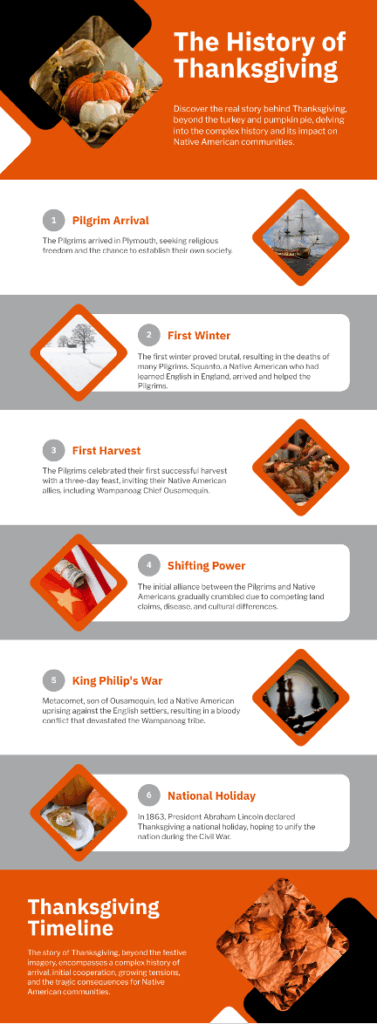
The Pilgrims traveled to the Americas in search of religious freedom, or so the story goes. In truth, they were separatists who wanted to own land, make their fortune, and set up a religious theocracy, which is kind of the opposite of freedom. Sidenote: They never referred to themselves as Pilgrims. The term “Pilgrim” wouldn’t pop up until the 1880s.
After 66 days at sea, the Mayflower made landfall near the tip of Cape Cod and, one month later, crossed Massachusetts Bay. There, the Pilgrims established Plymouth Colony, having found a village, spring, and fertile fields ready for the taking. A prime example of manifest destiny, right? Well, the only reason the land was unoccupied was because the Native Americans living there had been wiped out by disease.
The First Winter: Squanto Arrives
The first winter was unforgiving. Of the 102 passengers aboard the Mayflower, half wouldn’t live to see spring. That’s when they received a surprise visit from a member of the Abenaki tribe. He spoke English and later returned with Tisquantum, known as Squanto.
A member of Pawtuxet, a band of the Wampanoag tribe, Squanto had been captured and sold into slavery in 1614. He learned English in England. Later, he escaped in London and returned to his home across the Atlantic.
Making Contact: Wampanoag and Pilgrim Relations
Wampanoags had experienced a century of contact with English settlers, and they didn’t always exchange pleasantries. At least two Wampanoags had been victims of the slave trade and had already been to and returned from Europe.
Squanto became a translator and teacher, showing the Pilgrims how to fish, grow corn, avoid poisonous plants, and extract sap from maple trees. However, for all his kindness, Squanto may have only been laying the groundwork for a meeting with Wampanoag sachem (chief) Ousamequin.
The Thanksgiving Feast of 1621
The Pilgrim’s first corn harvest was successful. Governor William Bradford organized a feast to celebrate and invited the colony’s Native American allies, including Wampanoag chief Ousamequin. America’s “first Thanksgiving” lasted three days. Alas, there was no pumpkin pie, candied yams, or potato casserole on the menu. Without an oven, the Pilgrims made due with dishes prepared using traditional Native American cooking methods, including roasted wild fowl and deer.
“… many of the Indians coming amongst us, and amongst the rest their greatest king Massasoit (Ousamequin), with some ninety men, whom for three days we entertained and feasted … And although it be not always so plentiful, as it was at this time with us, yet by the goodness of God, we are so far from want, that we often wish you partakers of our plenty.”
Ousamequin would form a shaky alliance with the Pilgrims in the hopes that they would fend off their rivals: the Narragansetts. The alliance lasted 50 years (hey, there’s a silver lining!), but would end in war. King Philip’s War, also known as the Great Narragansett War, was a bloody conflict that resulted in the ruin of the Wampanoag tribe.
Was 1621 Really the First Thanksgiving?
Was this the first-ever Thanksgiving? Doubtful. Harvest festivals date back millennia and were celebrated across cultures. Ancient Egyptians, Greeks, and Romans all feasted and paid tribute to their gods after the fall harvest. Before landing in the Americas, European settlers had a long history of feasting during times of plenty. Native Americans had similar feasts to commemorate the fall harvest.
Why the Thanksgiving Story Turned Bloody
While the tale of Thanksgiving is often told as a celebration of harmony between Pilgrims and Native Americans, the truth behind the holiday’s origins is far more complex and tragic. What began as a fragile alliance forged out of necessity soon gave way to a long history of broken promises, violent clashes, and devastating losses for the Native communities.
To understand how the story of Thanksgiving evolved from a feast of cooperation to one of conflict and bloodshed, we must look at the factors that led to the unraveling of the initial peace and the hardships that followed:
Fragile alliances over land and power The Wampanoag–Pilgrim alliance was born of mutual convenience: Native leaders like Massasoit sought help against rival tribes (e.g., the Narragansetts), and settlers needed food and guidance. Once those immediate threats faded, competition for land and resources reignited old tensions.
Disease and displacement European‑borne epidemics (smallpox, influenza) decimated Native populations, leaving “empty” villages that colonists claimed under the doctrine of discovery. The resulting dispossession fueled resentment and periodic violent clashes.
King Philip’s War: New England’s bloodiest conflict In 1675, Metacomet (King Philip), Massasoit’s son, led a pan‑Indian uprising against New England settlements. The war resulted in thousands of deaths and the near‑destruction of the Wampanoag people—turning a once‑celebrated harvest alliance into a chapter of deep tragedy.
Thanksgiving: A National Holiday to Heal the Nation
In 1827, abolitionist and “Mary Had a Little Lamb” author Sarah Joseph Hale launched a campaign to establish Thanksgiving as a national holiday. She spent 36 years writing to politicians and presidents and became known as the “Mother of Thanksgiving.”
At the height of the Civil War in 1863, Abraham Lincoln called for an annual Thanksgiving celebration to be held on the last Thursday of November. The move was likely strategic, with Lincoln encouraging Americans to ask God to “heal the wounds of the nation.”
Thanksgiving Today
Thanksgiving is taxing for many Native Americans, particularly those of the Wampanoag tribe, whose lives were forever changed after the Pilgrims arrived in Plymouth. Wampanoag adults recall learning about the history of Thanksgiving in grade school, feeling invisible while teachers dispensed a Disneyfied version of events. Society, in their eyes, is making light of tragic events that weigh heavily on Native Americans. The Wampanoags of today commemorate Thanksgiving not as a day of thanks but as a day of mourning.
Pursue Your Passion for History
If you’re interested in Native American history, consider enrolling in our online course Native North America: Contact to Removal. This course surveys American Indigenous history from the period before European contact through forced removal policies and is offered as part of our 100% online Master of Arts in History program.
Earn an MA in History From UT Permian Basin
The University of Texas Permian Basin’s online MA in history program is ideal for aspiring educators, historians, and legislators, among others. Throughout this 30-credit online program, students explore the diverse people and unbelievable events that shaped the world we live in.
We’ve already mentioned Native North America: Contact to Removal, but other core courses include:
Industrial Revolutions
American Revolution
Civil War
The 1920s
World War I
We’ve designed our program to be as accessible as possible. We offer a non-thesis option, in which all credit hours are devoted to coursework. Courses are entirely online and asynchronous, allowing you to pursue your graduate degree on your schedule. As a student, you’ll also have the option to enroll in graduate-level live remote courses offered by the history department.
If you’re an aspiring professional or a history buff looking to turn your passion into a career, our program may be right for you. Apply now to our online Master of Arts in History program before history repeats itself—and you have to wait another semester.
Studying classics helps us understand where many of our biggest modern questions came from, including who gets power, how societies define justice, and why humans keep telling the same stories in new outfits. A single, harmless question comes up a lot in humanities courses (usually from someone trying very hard not to care): Why does any of this matter? And…
Monsters have been with us since the beginning of storytelling. Before novels, there were myths. Before myths, there were campfire stories about things lurking just outside the firelight. Something about the human brain is wired to conjure creatures (and compelled to write entire books about them). But literary monsters have never just been about scaring people. The…
“I took the road less traveled by, And that has made all the difference.” Even if you don’t know the entire poem, you may recognize the closing words from Robert Frost’s “The Road Not Taken.” They’re quoted at graduations, shared during moments of change, and used to describe the quiet courage of choosing your own path. So why have these simple words endured across generations? The power of…
After narrowing down your top university contenders and completing your applications, it’s time to consider what comes after you’ve been accepted. From choosing your classes for your first semester to purchasing every book on each course syllabus, there are so many items to add to your educational to-do list ahead of your first day of classes.
However, have you considered how you’ll be paying for those courses and textbooks? That’s why prioritizing your FAFSA application should be at the top of your to-do list. This simple application is your gateway to accessing multiple forms of financial aid, from grants to loans (and plenty in between).
Today, we’re discussing all things FAFSA, including what it is and why it’s important to fill out—the sooner the better!
The FAFSA 411: Everything You Need to Know
The Free Application for Federal Student Aid, better known as FAFSA, is a form that most students are eligible—and encouraged—to complete. The application collects the following information to determine the amount of financial aid you may be qualified to receive from the college you’re attending:
Your social security number (or alien registration number if you’re not a U.S. citizen)
Your federal income tax returns and W-2s*
Bank statements*
*Please note that if you’re a dependent student, you’ll need the above information from your parents to apply.
After submitting your FAFSA, your information will be reviewed and sent to the universities listed on your application. The colleges will then use that information to determine your eligibility for financial aid. You may qualify for a variety of different types of financial aid, including but not limited to:
Federal grants Grants are mostly given on the basis of need and don’t require repayment.
Scholarships Like grants, scholarships don’t need to be repaid once you’ve earned your degree. However, unlike grants, they’re usually awarded based on merit, such as academic achievements or extracurricular activities.
Federal student loans Funded by the U.S. Department of Education, federal loans are based on financial need and must be paid back with interest.
Work-study This is a federal work program that allows undergraduate and graduate students at participating schools to earn money while working to pay for tuition.
Why Is Filling Out the FAFSA Essential?
Some students receive financial assistance through scholarships or their parents’ college savings funds. However, those avenues may not always fully cover tuition and other expenses. Whether you believe you can afford college independently or feel you won’t qualify for aid, consider the following reasons you should run, not walk to your keyboard and fill out the online application before the deadline.
The FAFSA Is Your Window Into Financial Assistance
True to its name, the Free Application for Federal Student Aid costs nothing. It takes just an hour to complete, and within a few weeks, you’ll know whether you qualify for one or more of the various forms of financial aid.
If you find out you’re eligible for funds, you can rest assured that you have a guaranteed means to pay for your education. In addition, if you learn that you don’t need the financial aid offered to you, you’re not legally bound to take it. You can say “No, thank you,” and happily move on with your to-do list.
The FAFSA Can Help You Budget Effectively
Have you broken down the costs for all the items you’ll need for your courses? From laptops and lab equipment to textbooks and everything in between, there are a few additional expenses you may not have accounted for—and that’s okay! The FAFSA is here to help.
Your application results can give you a clear understanding of the general costs associated with attending college, whether you need the assistance or not. It also shines a light on the financial resources available to you, so you can make informed decisions about budgeting and financing for the future.
The FAFSA Can Present Work-Study Opportunities
Looking for ways to pay for your education, sharpen your skills, and give your resume a boost? After completing your FAFSA, you might find that you’re eligible for a federal work-study program. These programs offer part-time job opportunities that help you earn money for educational expenses while allowing you to gain valuable work experience that you can proudly add to your resume.
Secure Your Future (and Your Funds) by Filling Out Your FAFSA Today
At The University of Texas Permian Basin, we strongly encourage all students, regardless of their program, to submit a FAFSA. Whether you’re an incoming freshman, transfer student, or graduate student, all you need to do is fill out the application. The Department of Education and UTPB will handle the rest.
If you’re worried that you missed your window for the 2024 school year, worry not. The FAFSA deadline isn’t until June 30, 2024, with the application window likely to begin in December 2023. Since schools often allot and distribute funding on a first-come, first-served basis, it’s in your best interest to submit your application as early as possible to ensure you’re able to secure your funds.
Take the next step in financing your future by making sure you’ve got your expenses covered. Explore our FAFSA page today.
For some recent grads, the concept of getting a job is simple. They browse listings, submit their applications, and wait for responses from hiring managers. However, if that process doesn’t result in a shiny new job after a few weeks, they begin to wonder why they haven’t heard back from more employers.
One factor to consider is when they’re applying for jobs. That’s right—the time of year you’re job hunting may play a role in determining not only how many employers are hiring but also how actively they’re pursuing applicants for open positions. Below, we dive into the most (and least) ideal times of year to apply for jobs and offer some tips to help you get hired no matter the season.
When Is the Best Time to Apply for Jobs?
While you should feel motivated to submit applications any time of year, certain months may prove more fruitful than others. Some of the best times of year to apply for positions include:
January and February
The first two months of the year are known by many as the best months to get hired. Why, you ask? There are several possible reasons:
The start of the year often provides the push some people need to switch roles or quit their current positions in favor of finding employment elsewhere. This frees up roles for other job seekers.
In the fall, many companies review their budget for the following year. Ahead of the holidays, hiring managers use that information to post job openings in December to fill those positions in January and February.
By the end of January, most employees have returned from vacation and work resumes its usual pace. This gives HR the chance to finally post vacant positions.
September and October
The arrival of fall brings more than just cooler temperatures and autumn-scented candles. September and October also carry the possibility of more open job vacancies. This could be due to a few different factors:
Like January and February, employers and hiring managers are often returning from vacations around this time. They then begin to focus on what’s ahead for the business, such as filling roles that opened up over the summer.
These months create urgency to fill open positions as hiring managers anticipate the upcoming holiday season, which tends to see fewer job applications due to people’s focus on holiday-related activities.
Do Employers Have “Lull” Months in Hiring Activity?
In December, the work environment tends to be more relaxed, with employees operating at a more leisurely pace. This is typically a result of the exciting and festive celebrations that occur during this time of year. Many employees use their paid time off for traveling and spending time with family, which in turn makes December one of the slower hiring periods for employers.
The summer months of June, July, and August may also prove slightly more challenging for job seekers. Like November and December, children are often out of school on vacation, making family vacations a high priority for many of the managers hiring new employees.
Tips for Getting Hired Year-Round
While employers might have their “preferred” hiring times throughout the year, there’s no one-size-fits-all guidebook to abide by. That said, if you feel qualified for a role (or even if you don’t), there’s no harm in applying no matter the time of year. Plus, with the following pointers, you’ll be ready to apply when the role you’ve been waiting for unexpectedly appears in your job search one day:
Tailor Your Resume
While it may feel like a lot of up-front work, tailoring your resume to each job you apply for can showcase the specific qualities and experience you possess that align with what each employer is currently seeking. To target your resume for each application, carefully read the job listing to locate the skills they’re looking for, determine which of those you possess, and add those abilities to your resume.
Think Outside the Box for Relevant Skills and Experience
If you’re a recent grad or are changing careers, you might not have much experience related to the jobs you’re applying for—and that’s okay. Instead, you can include abilities that are most relevant for the job.
For example, if you’re applying for a job in marketing but have no prior experience, you can highlight other relevant skills or responsibilities you’ve had in past jobs, like proofreading, collaborating with colleagues, or helping a local business manage their social media accounts.
Apply, Apply, and Apply Some More
We get it. Sometimes, you read the experience required for a position and scroll right past because you don’t feel qualified. According to the Harvard Business Review, you’re not alone. 41% of women and 46% of men avoid applying to certain positions because they don’t feel they meet the qualifications. However, we strongly urge you to consider applying regardless. It could show the hiring manager you’re proactive and driven. They may even reach out regarding the role you applied for or suggest a different job for which they think you’d be a perfect fit.
Earn the Skills You Need to Get a Job Any Time of the Year
To become one of the top candidates for your dream job, there are a few aspects that can increase your chances of receiving a call from the hiring manager:
Come equipped with the skills listed on the job posting.
List a degree from a reputable university on your resume.
Have the tenacity and confidence to apply to the jobs you’re qualified for—and some of the ones you’re not.
In 2023, The University of Texas Permian Basin is proudly celebrating 50 years of providing a world-class education to students from Texas and around the globe! To commemorate this milestone, we’ve put together a list of 50 historical, informative, fun, and even surprising facts about our university, our campuses, and the surrounding area. You’re sure to discover a lot you never knew about UT Permian Basin!
UT Permian Basin was established by the Texas Legislature in 1969, but construction didn’t begin until 1972.
The first classes at UT Permian Basin were held on September 4, 1973.
We were originally designated as an upper-level university.
We opened to freshmen and sophomore classes during the Fall 1991 semester.
We have campuses in Odessa and Midland, Texas.
We were ranked #23 of 200 in Newsweek’s “America’s Top Online Colleges 2023.”
We were named among Best Online MBA Programs for 2023 by U.S. News & World Report.
We were named among Best Online Master’s in Business Programs (Excluding MBA) for 2023 by U.S. News & World Report.
We were named among Best Online MBA Programs for Veterans for 2023 by U.S. News & World Report.
We were named among Best Online Master’s in Education Programs for 2023 by U.S. News & World Report.
We were named among Best Online Bachelor’s Programs for 2023 by U.S. News & World Report.
We were named among Best Online Bachelor’s Programs for Veterans for 2023 by U.S. News & World Report.
We were awarded as one of “America’s Best Colleges” by Money in 2023.
With a Falcon Family of about 5,000 students, UT Permian Basin is uniquely positioned to provide a welcoming, personalized college experience.
UT Permian Basin is accredited by the Southern Association of Colleges and Schools Commission on Colleges (SACSCOC). This accreditation signifies that we meet the highest educational quality standards in our region.
Our College of Education programs are nationally accredited by the distinguished Council for the Accreditation of Educator Preparation (CAEP).
Our College of Education programs are accredited by the Association to Advance Collegiate Schools of Business (AACSB)—a distinction held by just 5% of business programs worldwide!
Our School of Nursing is accredited by the Commission on Collegiate Nursing Education (CCNE).
The Permian Basin, home to both UT Permian Basin campuses, is 75,000 square miles in size.
The UT Permian Basin Odessa campus is home to a Stonehenge replica that’s nearly the same size as the original monument.
The childhood home of President George W. Bush is displayed at the UT Permian Basin Midland campus.
UT Permian Basin’s dance team received their first bid to Nationals (NCA) in 2023.
We hold FalconPalooza—a unique celebration featuring food, music, and amateur sports—every spring.
Odessa was the inspiration for the award-winning Friday Night Lights book, movie, and TV show.
UT Permian Basin is composed of six academic colleges and schools.
We’re the academic home of students from 45 countries and counting.
We have students from 36 states and counting.
More than half of our students are first-generation college students.
UT Permian Basin students beat the Texas average in medical school admissions by 30%.
We’re one of eight academic institutions in the acclaimed University of Texas System.
UT Permian Basin confers in excess of $49.8 million in financial aid annually.
Through Falcon Free, UT Permian Basin is helping eligible Texas residents earn a bachelor’s degree at virtually no cost.
We’re one of the state’s top five most affordable universities.
UT Permian Basin has some of the lowest tuition rates nationwide for an accredited university.
UT Permian Basin was honored with a “UTPB Day” at the Texas capitol in May 2023.
Our notable alumni include an energy services company CEO, a NASA flight surgeon who worked on the International Space Station, a New York Times best-selling author, a professional tennis player, a poet laureate, and a social justice leader.
UT Permian Basin has six men’s sports teams and eight women’s sports teams.
The world’s largest oil field, the Permian Basin stretches across Texas and New Mexico.
The Permian Basin is increasingly becoming known for renewable energy production.
UT Permian Basin is one of only two University of Texas System academic institutions serving West Texas.
Many of our programs offer students the flexibility of six start times per year.
We accept applications on a rolling admissions basis, which means any applications that miss the deadline will automatically roll over for consideration during the following semester.
We strive to give online students access to all the same services as campus-based students, including advising, career services, library services, and more.
We have more than 18,000 alumni, and every one of them is considered forever a Falcon.
Located on our Midland campus, the beautiful Wagner Noël Performing Arts Center hosts internationally renowned musical and theatrical acts.
Believe it or not, there’s still much more to learn about UT Permian Basin and our programs! We invite you to do so now.
GIS professionals are no longer limited to mapping and land surveys. Today, industries like healthcare, finance, and even retail rely on geospatial data to drive decisions. If you’re curious about where your GIS skills can take you (or wondering what industry GIS belongs to), we’re exploring six sectors that use GIS and the types of roles you’ll find in various industries.
#1 GIS in Education: Teaching Data Literacy
Teachers in many disciplines can use maps and location analytics to illustrate patterns and connections to their students. This strengthens their ability to make data-based conclusions about human-made and natural systems.
#2 How Financial Institutions Use GIS
Banks and other financial institutions can use spatial analysis to identify customers likely to help their business grow. This allows them to identify common characteristics among these individuals and seek new customers with similar traits in other geographic areas.
#3 GIS in Healthcare: Mapping Public Health Trends
GIS technology proved invaluable during the COVID-19 pandemic, allowing officials to track case rates and analyze data on mortality, hospitalization, and recovery. Today, healthcare professionals use GIS to identify disease hotspots and high-risk areas, helping to target prevention and treatment efforts more effectively.
#4 GIS in Insurance: Assessing Risk by Location
Is your home likely to be hit by a hurricane? Is your car likely to be stolen? (Or damaged by a hurricane, for that matter?) Are there high rates of certain diseases in your area of the country? Insurance companies of all types can look at data collected through GIS-driven analytical tools to decide if you are insurable, and if so, what your premiums are going to be.
#5 Retail Industry GIS Applications: Finding the Right Location
From high-end clothing stores to fast food restaurants, retail businesses use GIS to determine where to open new brick-and-mortar locations. The technology helps identify information such as proximity of potential customers and local saturation of competing businesses.
Potential business owners can also use these tools to find out what consumers in these areas want to wear, eat, etc. to ensure that they meet the demand through proper inventory management.
#6 Telecommunications and GIS: Planning and Expansion
Telecommunications companies can use GIS to locate and gauge the extent of service outages. It helps them plan ahead for the expansion of services required by population growth and new construction.
Careers for GIS and Geospatial Professionals
As GIS and geospatial technologies expand into new industries, so do the career opportunities for skilled professionals. Whether you’re entering the field or looking to advance your career, here are just a few of the roles available across industries using GIS:
Location analyst: Evaluate optimal store or facility locations using demographic and spatial data. (Retail, real estate)
Health geographer: Track and analyze disease patterns to support public health efforts. (Healthcare, government)
Risk analyst: Assess environmental and crime-related risks for insurance underwriting. (Insurance)
Market research analyst: Use spatial data to understand consumer behavior and identify target audiences. (Financial institutions, digital marketing)
GIS technician/analyst: Create and manage geospatial databases and maps for a range of organizations. (Telecommunications, urban planning, education)
Remote sensing specialist: Analyze satellite or aerial imagery to support environmental monitoring or infrastructure planning. (Environmental science, agriculture, oil and gas/energy)
Data visualization specialist: Turn complex GIS data into clear, actionable visual insights for stakeholders. (Public health and epidemiology, finance, insurance)
Update Your GIS/Geospatial Experience and Credentials in Less Than a Year
Drawing from the decades-long relationship between The University of Texas Permian Basin and the GIS and geospatial industries, our online graduate GIS and Geospatial Certificate program helps you stay up to date with the latest GIS systems that are vital across various industries. And because we understand the challenge that can come with balancing a work-life schedule, our program allows you to arrange your studies around your professional and personal commitments (while adding a new credential and practical expertise to your resume).
Here are a few more reasons to consider earning our GIS and Geospatial Certificate:
Modern video games can recreate the real world with stunning precision, and GIS technology is what makes that possible. In fact, when fire ravaged Notre-Dame Cathedral in Paris in 2019, a detailed digital model built for the video game “Assassin’s Creed Unity” surfaced as a potential reconstruction reference. GIS is rapidly reshaping what it means to play video games today. This article examines: What Is GIS? …
On December 26, 2004, a massive earthquake struck beneath the Indian Ocean and sent a wall of water nearly 100 feet high outward. It barreled into South Asia at 30 miles an hour, wiping out communities before most people even knew what was coming. By the time the waves crossed the ocean, nearly 230,000 lives had…
Imagine you’re commuting to work and your Google Maps loses signal. Suddenly, the little blue dot stops moving and you don’t know where you are. Panic ensues (for some of us). Modern devices constantly broadcast our location through GPS, Wi-Fi, cell towers, and apps. We’re basically walking beacons of sensitive data. But here’s the flip side:…
Presidents’ Day (aka Washington’s Birthday) is always the third Monday of February. Labor Day is always the first Monday of September. And Election Day is always the first Tuesday in November.
But what is it about that day and that month that led to it being chosen for one of the most important traditions of our democracy? Let’s take a quick trip back to the mid-19th century to find out before reframing Election Day in a 20th-century context.
Selling Crops and Attending Church Services
As was common in the decades following the founding of the United States, different states set their own rules, including when to hold elections. In 1845, Congress decided to bring some order to the process by establishing one voting day for all states—initially just for presidential elections. Most employed people were farmers, so the date needed to be one that worked best for their needs.
November was an ideal choice, since farmers were no longer harvesting but were instead selling their crops at markets, and the harshness of winter had usually not yet set in for most areas of the country. Based on typical work and worship schedules, and the need for many remote farmers to travel for as much as an entire day to their polling place, Tuesday was chosen as the best day of the week. The first Tuesday was chosen because it was early in the month and the weather was more likely to be favorable.
Why Not Make Election Day a Saturday or a Holiday?
While agriculture will always be important to the American economy and diet, the United States is no longer an agrarian society. This and other factors have led some to question the continuing tradition of holding Election Day on the first Tuesday in November. Data from the nonpartisan Pew Research Center puts the United States in the minority among industrialized democracies that hold national elections on a weekday.
Many registered voters work or attend school on weekdays, and those activities typically fall somewhere between the hours of 7 a.m. and 7 p.m. This is also the window during which polls are open for voting, potentially posing difficulties for those who are trying to fulfill that civic duty. Prominent members of both major political parties have suggested that Election Day should be made a national holiday. This would enable a greater number of voters to reach the polls without concern about interfering with regular weekday commitments.
Any changes to when we vote remain controversial, however, as political parties and special interest groups suspect one another of implementing such changes to influence the outcome of elections. Others still prefer to honor historical tradition. As a result, little progress has been made toward creating a new national holiday or changing Election Day to another day of the week. Like daylight savings time, an idea that originated with Benjamin Franklin, voting on Tuesday has its roots in a bygone era of our country, and for the time being at least, those roots remain firmly planted in the ground.
This Degree Is a Solid Candidate Any Day of the Week
Discover how the branches of our government work; how local, state, and federal agencies interact with one another; and how our political system compares to those of other countries in The University of Texas Permian Basin’s online Bachelor of Arts in Political Science. You’ll explore the election process and policymaking roles at different levels of government through illuminating courses including:
What can you do with this degree? Use it as a foundation for law school, graduate studies, or a rewarding career in government and private sector roles such as:
When you earn your BA in political science online from UT Permian Basin, you get all the quality of the campus-based program—including faculty made up of the same doctoral-level political science experts—and enjoy some added benefits. You can complete your program from anywhere, on your own schedule, while continuing to meet your professional and personal commitments. And, like all UTPB students, you have access to academic advising, tutoring, career services, and many other support services from day one. We’re here for you because we want you to succeed!
As the fall season nears, the spooky-loving souls of the world begin decorating their houses with ghouls and goblins, making orders for pumpkin spice lattes, and busting out old VHS tapes of “Hocus Pocus” for their annual rewatch. For some, the movie’s backdrop in Salem, Massachusetts, evokes thoughts of the Salem witch trials.
Suddenly, their minds are riddled with questions: Who were the accused? How did the trials end? And the biggest question of them all—why did the Salem Witch trials happen in the first place?
History suggests a combination of factors, including a smallpox epidemic in the region, economic disparities, and the looming threat of Native American attacks. However, there’s another potential factor at play: group polarization.
Grab your favorite fall-flavored beverage as we discuss the concept of group polarization and how it may have played a role in the Salem Witch Trials of 1692.
What Is Group Polarization, Anyway?
Can you remember a time when you experienced peer pressure as a child? Maybe your friends asked you not to talk to the new kid in class or they convinced you to ditch your plans in favor of hanging out with them. Whatever the case may have been, peer pressure is a form of group polarization, a situation that refers to how people adopt more extreme positions when they’re part of a group.
Other examples of group polarization in different contexts include:
Changing your behavior when you’re around your coworkers or friends
Taking on different roles in a group depending on who you’re with
Altering your opinions based on the influence of others
The Salem Witch Trials: A Brief Overview
The Salem witch trials began in 1692 when a few young girls in Salem Village, Massachusetts, began exhibiting strange behaviors. When doctors could find no scientific cause for their outbursts, the girls accused social outcasts Sarah Good and Sarah Osborne, along with Tituba, a servant of the Puritan town minister, of witchcraft. These accusations sparked mass hysteria in the religious and superstitious little town.
The trials soon followed, and when Tituba confessed, it only added to the town’s hysteria. At the conclusion of the trials in 1693, more than 150 people had been accused, leading to 19 hangings, one pressing, and five deaths in jail.
Everyone Drank the Potion: Group Polarization During the Salem Witch Trials
With only 550 people living in Salem Village at the time of the trials, it’s not difficult to see how group polarization may have played a role in the convictions of numerous village citizens. Below, we discuss some of the ways group polarization may have wormed its way into the minds of the people of Salem.
Conforming to Social Norms
Many Salem Village townspeople were Puritans who conformed to the religious belief that witchcraft was God’s punishment for committing sins. Those who outspokenly deviated from that belief were more likely to cast themselves in a negative light in the eyes of the rest of the community.
So, instead of forming their own opinions of the accused, many individuals may have felt pressured to conform to the belief that the women were sinners, and therefore witches, even if they didn’t necessarily agree with that sentiment.
Echo Chamber Effect
As citizens became swept up in the gossip of the accusations, it created an echo chamber effect, which occurs when people only hear one side of a story. In this case, it happened to be that the accused women were, without a doubt, witches.
Many of the townsfolk already believed this to be true, so when they heard similar stories from others, the gossip only solidified their opinions. If someone had decided to question the complainants’ stories and stand up on behalf of the accused, some townsfolk may have come to a different conclusion: Maybe the women weren’t witches. Perhaps, they were innocent.
Public Pressure
The judges of the trials were probably under immense scrutiny to take action against the potential threat of witchcraft. A combination of building pressure from the community mixed with the desire to be seen as righteous problem solvers could have pushed them over the edge in terms of their judgment of the accused. In the end, this form of group polarization may have led the judges to make more extreme decisions than they were comfortable with.
Fear and Hysteria
While many of us appreciate the occasional rerun of “The Exorcist” or “The Craft” around Halloween, the idea of witchcraft and the devil was a tangible fear for the people of Salem in the 1600s. With the number of accusations increasing weekly, this growing fear created an atmosphere of complete panic. This rising dread may have caused moderately minded individuals to become caught up in the town’s collective sense of hysteria, resulting in people forming less rational judgments and pointing fingers at innocent neighbors.
Join the Bandwagon: Earn Your BA in Psychology at UTPB
Not every aspect of group polarization holds a negative connotation. Under the right circumstances, it can also lend itself to solving problems, fostering positive changes, and encouraging individuals to explore and expand their values.
If you’re interested in broadening your ethical understanding of the world around you and enlightening others, The University of Texas Permian Basin offers an online Bachelor of Arts in Psychology program that’ll help you develop fundamental skills and knowledge in the expanding field of psychology, including:
Reasoning about empirical research that apply to psychological phenomena
Writing strong, cohesive arguments
Thinking critically about the theoretical and applied aspects of psychology
With a degree in psychology, you’ll be one step closer to achieving your dream profession, whether you aspire to be a clinical or counseling psychologist, a behavioral scientist, a researcher, or something else entirely. Your future is up to you to decide—so, start today by exploring all that our online psychology program has to offer.