What’s happening in a child’s mind when they’re learning to read? What’s the process they go through as they transition from a nonreader to a reader? Naturally, there are plenty of theories and lots of research. Let’s review some theories of how children learn to read before looking at a generally accepted explanation and what some recent research says about how they should learn.
How Do Children Learn to Read: Environment or Guesswork?
Some theorize that children develop the ability to read naturally, as they do with speech. This theory suggests that a child with access to a selection of books will develop basic reading skills over time. Other theories suggest that reading is clever guesswork on the part of children, who use contextual clues to narrow down the meaning of words on the page.
The ability to speak generally comes years before the ability to read, but these two essential skills develop in dissimilar ways. Children mimic the spoken sounds they hear back to others and the more accurate those sounds are—meaning, the more like the actual words they are—the more excited the people around them act and the more positive reinforcement the child receives. Most children do not easily make the connection between the letter they see and the sound they hear at first, however.
Reading, by the Numbers
For most children, the process of developing the ability to read goes something like this:
The child becomes aware of sounds—a phase known as phonological processing.
The child’s brain associates a sound with a letter.
Through repetition, the child begins to understand the combinations of letters as words and their meanings.
This condensed explanation has exceptions, of course, and a plethora of research has been conducted and is still being conducted in order to understand how children of all abilities learn to read.
A Focus on Phonics in Reading Instruction
How do children learn to read in a formal educational setting? As university professor emeritus and former director of reading for Chicago Public Schools Timothy Shanahan told U.S. News & World Report in 2021, “Beginning reading instruction needs to emphasize decoding—letters, sounds, phonemic awareness, sounding out words, spelling, and oral reading fluency—and reading comprehension.” Reading comprehension includes spoken language, vocabulary, and strategies for students to understand what they’re reading.
Researchers have compared reading to working out written code, with specific letter combinations representing specific sounds. When a child is taught how to break the code, they become able to read. The research illustrates that children who have trouble learning phonics will correspondingly have trouble learning to read. Hence, the guiding wisdom is to place a heavy emphasis on phonics in reading instruction.
According to Education Week in 2019, research indicates that “reading is not a natural process” and “teaching systematic phonics … is the most reliable way to make sure that they learn how to read words.” With systematic phonics, teachers use an organized method to teach children how to read. Some of the principles are:
Teaching students every letter-sound correspondence in order.
Ensuring every student grasps a specific letter-sound correspondence before moving on to the next one.
Telling students exactly what letters and sounds correspond instead of asking them to guess or work out the answers for themselves.
Be the One Who Teaches Them to Read
Reading and writing are fundamental skills that help determine our ability to be successful throughout our lives. The University of Texas Permian Basin’s CAEP-accredited online Master of Arts in Literacy program was designed for people like you who wish to empower young learners with these essential abilities. View our program curriculum.
You’ll enjoy many advantages by earning this degree:
Learn Under the Guidance of Accomplished Educators
Our program is led by highly experienced, passionate professors who are eager to help you master literacy education and prepare you for the next stage of your career.
Experience Unmatched Convenience
You can complete your degree on your own schedule from any location—even around the world—while maintaining your professional and personal commitments.
Prepare for Career-Transforming Certification
Our program is aligned with the Texas Education Agency (TEA)’s reading specialist certification. Live outside Texas? Check with your state’s certification agency or email Dr. Tara Wilson to see if our program fulfills the requirements.
Fund Your Program With a Grant
Wondering how to pay for your literacy degree? Check now if you might qualify for a TEACH grant of up to $4,000 per year.
Set Yourself Up for Greater Earning Potential
U.S. Bureau of Labor Statistics data shows that master’s degree holders nationwide generally earn about 16% more than bachelor’s degree holders and are more likely to be employed.
If you’re interested in becoming a nurse, you’ve probably seen the terms “RN” and “BSN” pop up everywhere. ut what do they really mean, and how are they connected?
An RN, or registered nurse, is a licensed healthcare professional who provides hands-on patient care, educates individuals about health conditions, and works closely with doctors and other medical staff. While you can become an RN with an associate degree, many nurses choose to go a step further by earning a Bachelor of Science in Nursing (BSN): a degree that opens the door to broader job opportunities, higher earning potential, and greater responsibility.
So, how do you become a BSN nurse? There are two main routes: enrolling in a traditional four-year BSN program or advancing your education through an RN to BSN bridge program. Below, we’ll break down the key differences between these two paths so you can decide which one best fits your goals.
What Is an RN to BSN?
For many registered nurses seeking to advance their career, the next logical step is to earn a Bachelor of Science in Nursing. This advanced degree not only opens up new avenues for career growth but can also positively impact your earning potential in future roles.
Below, we explore key factors that define the RN to BSN pathway, including who it’s for, how it works, and what it can lead to:
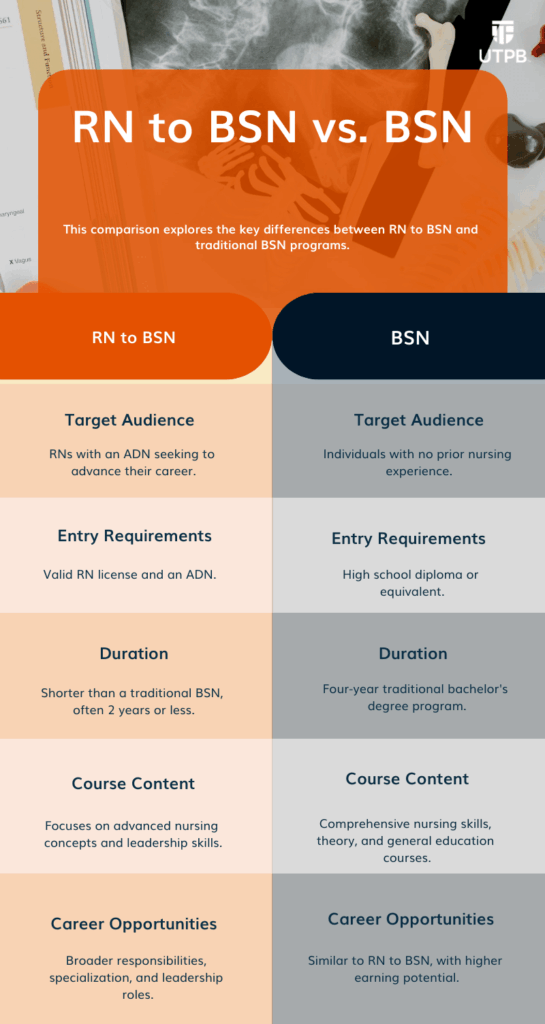
Target Audience An RN to BSN attracts individuals who have already completed an Associate Degree in Nursing (ADN). This type of program allows RNs to continue their education while applying the skills they’re learning in their current nursing role.
Entry Requirements To be eligible for an RN to BSN program, prospective students need to have a nursing license. To receive a nursing license, you must first complete an ADN or obtain a nursing diploma. Then, you need to pass the National Council Licensure Examination for Registered Nurses (NCLEX-RN).
Duration Since individuals interested in RN to BSN programs have already completed fundamental nursing courses while earning their ADN, the time to completion for an RN to BSN program is shorter than a BSN program. Many students can work full-time and complete the coursework in two years or less.
Course Content In an RN to BSN program, courses are built upon the foundational knowledge gained while earning your RN license. Instead of rehashing the basics, you’ll gain a deeper understanding of high-level nursing concepts and leadership skills needed to advance your career as a nurse.
Career Opportunities After earning a BSN, your opportunities for career growth expand exponentially. With an advanced skillset, you can broaden your responsibilities and specialize in a wider range of areas, like obstetrics and gynecology, pediatrics, and more. With time and experience under your belt, you can also apply for leadership roles as a manager, educator, or researcher.
What Is a BSN Program and How Does It Differ From an RN to BSN Program?
A Bachelor of Science in Nursing (BSN) program will ultimately lead to the same outcome as an RN to BSN program. However, there are some differences:
Target Audience BSN programs are ideal for individuals with no prior background in nursing. If you’re interested in jump-starting your career as a nurse and want to bypass earning an associate degree in favor of a bachelor’s in nursing, a BSN might be the perfect choice for you.
Entry Requirements To qualify for entry into a BSN program, many universities accept a high school diploma. Unlike an RN to BSN program, no prior nursing courses are required.
Duration A BSN is a traditional four-year bachelor’s degree program crafted for students entering the nursing industry for the first time. The first few semesters will consist of general education courses alongside entry-level nursing classes. As you progress through the program, you’ll begin taking core nursing classes which will consist of more advanced nursing topics.
Course Content Like an RN to BSN program, a BSN program will provide a comprehensive foundation of nursing skills, including patient care and nursing theory. In addition to core nursing classes, students can also expect to complete several general education courses including English composition, mathematics, social sciences, natural sciences, and humanities.
Career Opportunities The career opportunities for students who’ve completed a BSN or an RN to BSN program are similar. With a BSN in hand, you are likely to find more opportunities to take your career to the next level and earn a higher salary. For example, individuals with an RN license that have zero to five years of experience make an average of $61,170 annually. However, those with a BSN (with the same level of experience) earn approximately $70,190.
Want a side-by-side comparison of the two pathways? We’ve broken down the key differences between a traditional BSN and an RN to BSN program in the chart below:
Frequently Asked Questions
Whether you’re just starting your nursing journey or considering going back to school, it’s natural to have questions. Here are a few quick answers to help you navigate your options.
What’s the difference between an RN and a BSN? An RN is a licensed nursing professional, while a BSN is an academic degree. You can become an RN with an associate degree or a BSN, but a BSN can open the door to more career opportunities and higher pay.
Do I need a BSN to become an RN? No. You can become an RN by earningan associate degree in nursing (ADN) and passing the NCLEX-RN exam. However, many healthcare employers now prefer or require a BSN.
Can I work while completing an RN to BSN program? Yes! UTPB’s online RN to BSN program is designed for working nurses and offers flexible online coursework that can be completed on your own time frame.
How long does it take to earn a BSN? A traditional BSN typically takes four years. If you’re already an RN, an RN to BSN program can usually be completed in two years or less.
Elevate Your Nursing Career With UTPB’s Online RN to BSN Program
If you’re an RN who wants to invest in your future nursing career, look no further than The University of Texas Permian Basin’s online RN to BSN program. Our 38-credit program is CNNE-accredited and prepares you for a variety of nursing roles, from becoming a clinical nurse specialist to working toward an advanced position as a medical and health services manager.
Our courses are designed and led by experienced nursing leaders, all of whom come equipped with firsthand experience (and tips) to prepare you for common challenges faced in the healthcare industry. All coursework can be completed online, with the exception of two clinical courses conducted in person with a local nurse preceptor of your choice.
Whether you’re interested in caring for children, mending hearts in cardiac care, or another specialty altogether, level up your nursing game and answer the call to make a real difference in patient care by applying to our RN to BSN program today.
Picture this: You’re in a hospital room, and a nurse walks in—flustered, but still smiling—with a chart in hand. This expert provider is checking your vitals, catching early warning signs, coordinating with doctors, reassuring your anxious family outside, and solving small healthcare crises in the hallway … all before lunch. Today, nurses are no longer…
Of the growing number of fields actively using artificial intelligence (AI) technology—including finance, manufacturing, marketing, and customer service—the field that arguably makes the most significant impact in our lives is healthcare. AI is supporting all healthcare sectors, simultaneously making nurses more efficient, elevating their level of care, and improving patient outcomes. Here we’ll examine some…
Every year, over 150,000 registered nurses (RNs) graduate from nursing school, ready and eager to make a difference in the lives of patients. They’ve spent up to four years preparing for this moment, poring over textbooks, completing clinicals, and mastering skills. But when it comes time to face the challenges on the hospital floor or…
Casinos don’t just rely on luck to make money—they rely on psychology. From the moment you step onto a gaming floor, everything around you is designed to keep you playing longer than you planned.
While gambling industry groups promote responsible gaming, the subtle cues that influence behavior are often hiding in plain sight. Lighting, sounds, and layout (and yes, even décor) all work together to shape the level of risk guests take and how hard it is for them to walk away.
In this article, we’ll explore the psychology of gambling from two angles: how casinos are intentionally designed to influence behavior and how the brain’s reward system can make gambling especially compelling (and hard to stop).
How Are Casinos Designed to Keep Gamblers Playing?
While most gamblers arrive focused on winning, casinos focus on something else entirely: keeping people engaged for as long as possible.
To do this, casino designers rely on principles from behavioral psychology and neuroscience. The goal is to:
Reduce distractions
Distort the perception of time
Create a sensory experience that keeps the brain stimulated and focused on the games
Many of these design elements work subtly, influencing attention, comfort, and decision-making without players consciously realizing it.
The Psychology of Casino Design: How Gambling Environments Influence Behavior
While gamblers are keeping their eyes on the prize (cash money), casinos employ some of their own moves to keep gamblers playing. You may win, but the longer you play, the higher the odds are that you’ll lose money before leaving the casino.
That’s why they don’t want you to leave.
Psychology plays a central role in how casinos encourage gamblers to stay and keep playing. It’s easy to identify the reasoning behind all those free drinks, meals, and even fully comped hotel rooms, but you may not recognize some other ways they encourage you to stay put.
Many casino design strategies are based on behavioral psychology and insights from former gamblers. These choices influence how players perceive time, risk, and when—or whether—to leave. This approach is often described as casino design psychology: the intentional use of layout, lighting, sound, and décor to influence attention, decision-making, and how long players remain engaged.
Sensory Overload on the Casino Floor
The bright lights and colors, music, collective hum of slot machines, and pleasant scents pumped through ventilation systems (casino scent marketing) all say, “Stay and have fun!” (Online gambling doesn’t share the same appeal and is less conducive to compulsive playing.)
These elements are a core part of casino psychology, using sensory stimulation to keep players focused on the games rather than on time or spending.Why Casinos Use Busy, “Ugly” Carpet DesignsThose ugly casino carpets aren’t the work of an interior decorator with bad taste: They have their own psychological purpose. Most of the designs are so busy” you couldn’t possibly relax, get tired, and call it a night in their vicinity. Further, they can help keep your eyes on the games.
No Windows, No Clocks, No Sense of Time
Many casinos have no windows or clocks within eyeshot of the gaming floor, so gamblers may not realize how long they’ve been playing or that the sun has set and risen since they last saw it.
Maze-Like Layouts That Make Leaving Harder
The best gaming floors are the hardest ones to leave. That’s why many are laid out in a maze-like fashion that makes a quick exit difficult.
The Psychology of Gambling Addiction: Dopamine, Risk, and Reward
The psychology of gambling doesn’t stop with casino design. t also involves how the brain responds to risk, reward, and anticipation. So, why is gambling addictive? The Mental Health Foundation says that it has to do with, “the adrenaline rush to win money, socialise or escape from worries or stress.”
The chance to walk away richer is an undeniably compelling reason to take financial risks. And if that wasn’t enough, the pleasure of indulging in bright games of chance causes the release of the hormone dopamine in the human brain.
According to the Cleveland Clinic, “our brains are hard-wired to seek out behaviors that release dopamine in our reward system … You feel good and you seek more of that feeling.” Risk-taking is part of what makes gambling exciting, triggering the release of adrenaline and dopamine that creates a temporary sense of pleasure and reward.
There’s also evidence that losing motivates gamblers to start new games more quickly to recoup their losses, a phenomenon known as “post-loss speeding.” 2022 study suggests that gamblers are more predisposed to psychopathy, a “neuropsychiatric disorder marked by deficient emotional responses, lack of empathy, and poor behavioral controls …”
Americans show no signs of giving up the rush their gambling habits provide anytime soon. To the contrary, gambling establishments are reaping record revenue.
Make a Responsible Investment for Your Future
When it comes to career potential, earning a bachelor’s degree in psychology is the move. A psychology degree develops core skills in analysis, communication, and human behavior that are useful across many professional fields, not just clinical psychology.
Our program’s 100% online, asynchronous format also makes it a sensible choice for anyone who needs to juggle professional and personal responsibilities while earning their degree. No campus visits are required, and you can complete your studies on your own schedule from any time zone on the planet.
Curious where an understanding of human behavior can take you? Explore UTPB’s online BA in psychology and see if it fits your goals.
Psychology is one of the broadest academic fields, and one of the most versatile. It spans everything from courtrooms to corporate offices, from childhood development to competitive sports. With so many specialties (and subspecialties), it can be tough to know where to even start. So exactly how many branches of psychology are there? The field is…
Ever reach for your phone and instantly face a barrage of messages, notifications, subscription reminders, and social media updates? You’re not alone. Scientists have estimated that the average person processes about 74 gigabytes of information daily: equivalent to watching 16 high-definition movies back-to-back in a single day. Cognitive overload is real. And over time, constant stimulation quietly changes how we think, focus, and feel. In this article, we’ll explore: What Does Cognitive Overload Mean? Cognitive overload happens when your brain receives more information than…
When someone struggles with depression, homelessness, or discrimination, who steps in to help? A psychologist? A social worker? A sociologist? These three fields all address human challenges, but they explore humanity from very different angles: one from society, one from the mind, and one from the front lines. So what are the similarities and differences between sociology, psychology, and social work? This guide clears up…
When people picture a day in the life of an accountant, they often envision a professional diligently tapping away on the keys of a calculator while tracking the funds coming in and out of their client’s accounts. All the better to ensure the numbers add up correctly, of course.
But thousands of years ago, when accounting was in its infancy, there were no “accounts” and there were certainly no calculators. So, what is the history of accounting, exactly? Hitch a ride on our well-oiled time machine as we journey to the past to learn more about one of the world’s oldest professions: accounting.
The Origins of Accounting: From Then to Now
While modern accounting is much more technical and numbers-based than its millennia-old prototype, this wasn’t always the case. Below, we look at the start of accounting and how it’s adapted to society’s changing needs over the centuries.
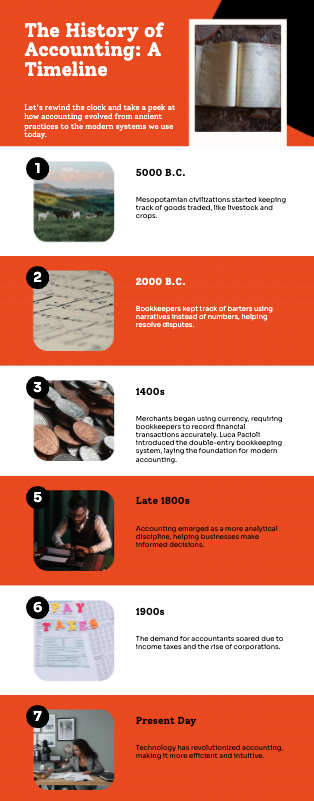
5000 B.C.: It Begins
Accounting made its grand entrance into the world more than 7,000 years ago in some of Mesopotamia’s civilizations. When historians found records dating to that time, they learned that some Mesopotamians kept track of goods they traded and received, such as livestock, animals, and crops.
2000 B.C.: Bartering and Bookkeeping 101
For thousands of years, societies used the barter system, trading chickens for grains or material for clothing. Despite not using money as a medium of exchange, people still used bookkeepers to keep track of barters made between individuals. Instead of numbers, the entries read more like narratives and were brought out and used when disputes between traders arose.
The 1400s: Currency Is the New Trend
Eventually, countries began making their own currencies. With a more modernized means of exchange came the need for mathematical whizzes to accurately record the numbers. Many merchants didn’t know how to record the comings and goings of their earnings accurately, so they hired bookkeepers to maintain their business accounts for them.
Until the late 1400s, these records were still largely narrative. While bookkeepers began adding and subtracting amounts from the merchant’s accounts, the records were written as single entries. For example, an entry might look like this:
Monday, August 18. Sold two cows. +$70.
Tuesday, August 19. Bought a five-pound bag of sugar. -$5.
The Late 1400s: A Monk Shakes Up the Status Quo
Toward the end of the 15th century, the Italian monk Luca Pacioli changed the bookkeeping structure and set the stage for accounting as we know it today. He introduced the double-entry system that utilizes a balance sheet with separate debits and credits. Debits refer to the values coming into an account, whereas credits record the amounts coming out.
The Late 1800s: From Bookkeeping to Accounting in One, Two, Three
The expansion of the railroad and the beginnings of U.S. corporations meant that bookkeeping needed to up its ante. Enter accounting, bookkeeping’s older, more analytical-minded sibling. Where bookkeeping focused on tracking numbers and transactions, accounting took things a step further by analyzing those numbers to help companies make more informed decisions. With the help of accountants, businesses were more successful at attracting investors.
The 1900s: The Need for Accountants Soars
In 1887, the American Association of Public Accountants (AAPA) was founded due to the increasing demand for accountants. Then, in 1896, the certified public accountant (CPA) title was introduced, given to those who passed state exams and had three years of industry experience.
In 1913, the U.S. government began charging income taxes to citizens to use as funds to supply the country’s war efforts. Because of this change, the demand for CPAs grew exponentially, with personal and professional accounts seeking the assistance of professional accountants.
Present Day: Technological Advancements in Accounting
Gone are the days of recording credits and debits with a quill and ink. Instead, we’ve replaced pen and paper with technology that’s infinitely more powerful than a simple calculator. Today’s accounting software has made the job more intuitive, helping CPAs complete their job more accurately and efficiently.
Frequently Asked Questions About the History of Accounting
Below, we’ve rounded up answers to some of the most common questions about accounting’s long and fascinating history.
How old is accounting? Accounting dates back over 7,000 years, originating around 5000 B.C. in Mesopotamia, where early civilizations recorded trade and bartering activity.
Where did accounting start? The earliest known accounting records were discovered in ancient Mesopotamia. These records tracked traded goods such as livestock and crops, marking the start of accounting practices.
What is the history of accounting? Accounting began as a method to track bartered goods and evolved over time—from narrative bookkeeping in ancient civilizations to the mathematical double-entry system developed in the 1400s. In the 1800s and 1900s, it further developed into a professional discipline, driven by industrialization and government taxation.
Who invented the accounting system? While bookkeeping existed for centuries, the double-entry accounting system was introduced by Italian mathematician and monk Luca Pacioli in the late 1400s. He is often referred to as the “Father of Accounting.”
Is accounting one of the oldest professions? Yes, accounting is widely considered one of the world’s oldest professions. Its roots can be traced back thousands of years to ancient trade-based societies.
Start Your Career in Accounting With a Little Help From UTPB
Accounting has advanced by leaps and bounds in the past century alone. Who knows where these advancements will lead 20 years from now? If you’re interested in starting a career in an ever-expanding industry, The University of Texas Permian Basin can help you achieve your goals, one step at a time.
Whether you’re ready to obtain a bachelor’s degree and jump-start your career or you want to take your current skillset to the next level by earning your master’s degree, UTPB offers two AACSB-accredited online degree options:
Bachelor of Business Administration (BBA) in Accounting
Gain a broad knowledge base in analyzing and solving financial problems for a diverse set of organizations including non-profit, government, public, and private. With your BBA in accounting, you’re prepared to choose from a variety of career options, from credit analyst to financial risk specialist (and plenty in between).
Master of Business Administration (MBA) in Accounting
Strengthen your strategic thinking, decision-making, and business acumen while honing your skills in traditional and contemporary accounting practices. This customizable 33- to 42-credit online program can be completed in as little as four semesters. In addition, the program offers two tracks depending on your career goals:
When you hear the word “accountant,” who comes to mind? Someone balancing spreadsheets and filing taxes? If so, you’re on the right track. But there’s more to it. Within the field of accounting, one credential stands apart: the Certified Public Accountant (CPA). While both accountants and CPAs manage finances, advise clients, and ensure the accuracy…
Picture this: You’re a junior accountant, and your manager asks you to tweak a report to make the numbers look better. The request sounds harmless enough—just a small tweak—but you know it’s not above board. Now you’re stuck. Do you follow orders and risk crossing an ethical line, or do you push back and risk…
You’ve always been an analytical thinker. A problem solver. Maybe a math whiz, too. There’s a career that matches your strengths. Certified Public Accountants—or CPAs—excel in these qualities. Let’s explore why a CPA is no ordinary accountant and what it takes to become one. Want to Be a CPA? Here’s What You Need to Know …
Nurses are the key to a working healthcare system and one of the fastest-growing professions in the United States. According to the Bureau of Labor Statistics, nurse practitioners have the highest projected growth rate of any occupation in the U.S., increasing by 46% by 2031. This number will likely increase even more as the population continues to age. If you’re considering a career in healthcare, nursing offers more paths, flexibility, and growth potential than almost any other field. Whether you’re just starting out or ready to level up your credentials, understanding your career options can help you make confident, informed choices.
From fast-track licenses to leadership roles, nursing careers come in many forms, and each one plays a vital role in patient care.
Entering the Healthcare Field
Most nursing students can start working after completing a two-year associate degree and can gain direct experience with entry-level positions such as a certified nursing assistant(CNA). These nurses provide direct care to patients under the supervision of a registered nurse. Many CNAs choose to further their studies to become licensed practical nurses or registered nurses.
LPN vs. RN: What’s the Difference?
Becoming a licensed practical nurse (LPN) may be a good option for you if you want to fast-track your career. An LPN training program can be completed in as little as 12 to 15 months, and once you pass your examination and earn your licensure, you’ll be able to provide basic patient care.
Registered nurses (RN) can provide a higher level of care and educational support to patients. To become an RN,you’ll be required to earn a four-year bachelor’s degree or other diploma from an accredited nursing program—and, like LPNs, you’ll need to make sure you’re licensed in the state you plan to practice in.
Registered nurses with a BSN or master’s degree in nursing can pursue a multitude of advanced career options. Best of all, you don’t have to stay in one career: Your knowledge and experience is applicable to many other nursing professions.
#1 Nurse Practitioner (NP)
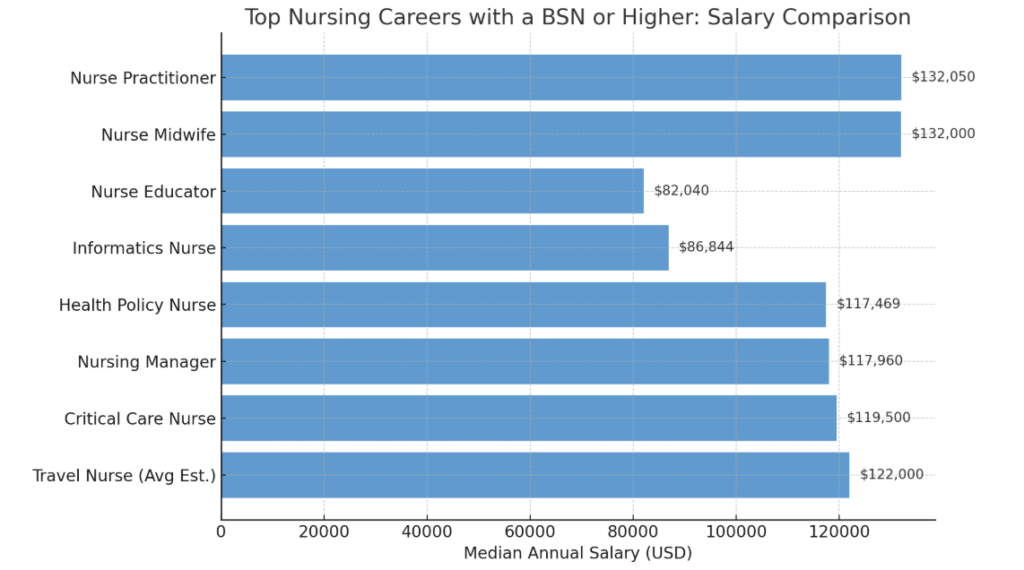
A nurse practitioner provides primary and specialty care and often works in collaboration with a doctor. Some states even allow NPs to open their own clinics. NPs are the fastest-growing profession in the United States and enjoy a median annual pay of $132,050.
#2 Nurse Midwife
Students interested in becoming a midwife will need to be a licensed RN and complete at least a BSN. Nurse midwives deliver babies, provide gynecological exams and family planning services, and advise women throughout their pregnancies. They enjoy an annual salary similar to NPs and can expect to see similar job growth.
#3 Nurse Educator
RNs with a passion for teaching may consider becoming a nurse educator and training the next generation of nurses. Nurse educators usually work both in the classroom and clinical settings and earn a mean annual wage of $82,040.
#4 Informatics Nurse
Nurse informaticists integrate technology and information science with patient care. These professionals work to manage projects, develop systems, and analyze data in hospital settings. A nurse informaticist can expect to make around $86,844 a year. According to a 2020 Nursing Informatics Workforce Survey, about 51% of nurse informaticists report being highly satisfied with their position.
#5 Health Policy Nurse
Health policy nurses integrate healthcare into public policy and the government. These kinds of nurses examine policies and practices in the healthcare system and can expect to make about $117,469 a year.
#6 Nursing Manager
Nursing managers and other health services managers oversee, plan, and direct the business activities and workflow of healthcare professionals in each department. Nursing managerial occupations are a great option if you’re planning on taking on a leadership role in healthcare, with an annual salary of around $117,960 per year and expected job growth of 29% by 2033.
#7 Critical Care Nurse (CCN)
About 37% of nurses in hospital settings work in critical care and intensive care units (ICU).
These nurses usually perform direct care for critically ill or injured patients and provide immediate medical interventions for pre-surgery or post-surgery critical cases. CCNs can make up to $119,500 with a job growth outlook of about 6% by 2032.
#8 Travel Nurse
Travel nurses are RNs with varying clinical backgrounds who are often on short-term assignments. If you enjoy new environments and the flexibility to move, this career path can be both adventurous and rewarding.
In addition to the opportunity to work in different states—and sometimes even internationally—travel nurses typically earn 10% to 15% more than permanent nursing staff, thanks to high demand and the temporary nature of their roles.
Compare Nursing Career Paths and Salaries at a Glance
Wondering which nursing specialty fits your goals and your budget?
The chart below breaks down eight top nursing careers that require a BSN or higher, including their estimated median annual salaries as of 2024. Use this side-by-side view to help inform your next step in the nursing field.
Control the Pace of Your Education. Earn a BSN Online.
Registered nurses who are interested in furthering their career may want to consider our CCNE-accredited RN to BSN. Our courses are entirely online and designed and taught by nursing leaders with firsthand knowledge of the challenges experienced in the healthcare field. Our online RN to BSN program can provide the education you need to pursue virtually any career path in healthcare.
In addition, most of our courses are asynchronous, which means you control the pace of your education. Study after shifts, during the weekends, or whenever you can make time.
Join the next generation of healthcare leaders at The University of Texas Permian Basin. Apply to our online RN to BSN program!
Picture this: You’re in a hospital room, and a nurse walks in—flustered, but still smiling—with a chart in hand. This expert provider is checking your vitals, catching early warning signs, coordinating with doctors, reassuring your anxious family outside, and solving small healthcare crises in the hallway … all before lunch. Today, nurses are no longer…
Of the growing number of fields actively using artificial intelligence (AI) technology—including finance, manufacturing, marketing, and customer service—the field that arguably makes the most significant impact in our lives is healthcare. AI is supporting all healthcare sectors, simultaneously making nurses more efficient, elevating their level of care, and improving patient outcomes. Here we’ll examine some…
Every year, over 150,000 registered nurses (RNs) graduate from nursing school, ready and eager to make a difference in the lives of patients. They’ve spent up to four years preparing for this moment, poring over textbooks, completing clinicals, and mastering skills. But when it comes time to face the challenges on the hospital floor or…
“I am looking for someone to share in an adventure …”
— Gandalf in “The Hobbit” by J.R.R. Tolkien
Adventure calls and a hero answers. Along the way, they encounter unlikely allies, formidable foes, and trials that will test their resolve. Against all odds, they prevail, and the world will never be the same.
Sound familiar?
This is the hero’s journey: a story structure followed by virtually every bestselling novel, blockbuster movie, and hit TV show. Spoiler alert! We’re here to talk about how the hero’s journey has shaped the craft of storytelling. Join us as we spoil every plot point and twist ending you’ll ever encounter!
What Is the Monomyth?
The hero’s journey comes from author Joseph Campbell and his seminal work “The Hero With a Thousand Faces,” which was published to widespread acclaim in 1949. In it, Campbell presents the concept of the monomyth: a narrative pattern shared by all heroic tales, transcending historical, cultural, and regional differences. (Shoutout to James Joyce for coining the term.)
Myths reveal universal truths about human nature, with themes “appearing everywhere in new combinations while remaining, like the elements of a kaleidoscope, only a few and always the same.” Myths, Campbell believed, inspire us to live a blissful life in harmony with our inner selves.
Campbell described anywhere from 17 to 31 stages in the hero’s journey. Inspired by “The Hero With a Thousand Faces,” Hollywood story consultant Christopher Vogler developed a condensed, simplified version of the hero’s journey that can be applied to almost any story, particularly screenplays.
The 12 stages of the hero’s journey, as described by Vogler, are:
The Ordinary World: We see the hero in the Ordinary World before they’re thrust into a Special World.
The Call to Adventure: The hero is presented with a challenge that can only be overcome by abandoning the comfort of the Ordinary World.
Refusal of the Call: No journey worth taking is without risk, and the hero is reluctant to take on such a life-altering challenge.
Mentor (the Wise Old Man or Woman): A Merlin-like character appears to guide the hero on their journey, representing the bond we share with our role models (e.g., parents and teachers).
Crossing the First Threshold: The hero accepts the Call to Adventure and enters the Special World. Now the story really begins.
Tests, Allies, and Enemies: The hero encounters new challenges, learning the rules of the Special World the hard way.
Approach to the Inmost Cave: The hero pauses before entering the most dangerous place in the Special World: the Inmost Cave, where the villain and the object of the journey reside.
The Supreme Ordeal: It’s life or death! The hero confronts their greatest fear in battle and dies (literally or metaphorically), so they can be reborn.
Reward (Seizing the Sword): The hero prevails to claim the reward: a “sword” — a weapon, elixir, or bit of knowledge that can “heal the wounded land.”
The Road Back: Vengeful forces chase the hero for Seizing the Sword, leaving no choice but for them to return to the Ordinary World.
Resurrection: The villain makes one last desperate attempt to thwart the hero: a final test to prove whether the hero’s learned the lesson of the Supreme Ordeal.
Return With Elixir: The hero returns to the Ordinary World and delivers the Elixir, a treasure (e.g., love, freedom, wisdom, or knowledge), to their community.
Which Book-to-Screen Adaptations Use the Hero’s Journey?
Scriptwriters and storytellers have for decades used the hero’s (and heroine’s) journey as a blueprint to craft stories that resonate with all audiences. Famously, George Lucas took inspiration from “The Hero With a Thousand Faces” when making “Star Wars: A New Hope.” A more contemporary example can be found in “The Hunger Games” and its heroine, Katniss Everdeen. (Luke is trained by the wizened Ben Kenobi, while Katniss is mentored by the jaded Haymitch Abernathy. Can you spot any other parallels?)
The hero’s journey has influenced countless books, films, and TV shows. If, however, you’re worried it leaves little room for originality, don’t be. Think of the hero’s journey as a tool, highlighting the common elements of modern storytelling. And like any other tool in a writer’s repertoire, its effectiveness depends on how it’s used.
Answer the Call to Adventure
Whether you’re an aspiring writer or avid reader, there’s so much more to learn about literature, visual arts, and the cultural, historical, and psychological elements that influence these works. If you have an insatiable appetite for storytelling, we recommend studying English online at The University of Texas Permian Basin.
We offer two English degrees: A Bachelor of Arts in English and a Master of Arts in English, both of which are offered entirely online. Gain a deep understanding of the English language by looking at modern and classic literary works. Study your favorite movies in one of our film courses, or enroll in a literature course to examine the works of British and American authors. (Check out Literature and Mythology for more on the mythological allusions found in pop culture.)
Stuck in the Ordinary World? Visit the above program pages to learn more about online learning at UT Permian Basin. If, however, you’re ready to answer the Call to Adventure, apply to one of our online English programs.
At some pivotal moment in our professional journey, many of us harbor a remarkable idea or long to embark on a path of independence and self-expression. Yet, most of us wonder: “How can I transform this dream into reality?” In fact, upwards of 27 million Americans dream of pursuing self-employment, but many are unsure of how and where to start.
Becoming an entrepreneur is an exhilarating pursuit that requires a combination of determination, passion, and strategic thinking. In this article, we’ll explore various pathways to entrepreneurship, catering to diverse ambitions and aspirations.
Exploring Diverse Routes to Entrepreneurship
There’s no one-size-fits-all approach to entrepreneurship, and your path may vary based on your business idea, product, leadership style, and work strategy. Let’s examine some of the options available to you.
Start a Small Business
The most traditional and direct path toward self-employment is to secure an investor and build your own business from scratch. Currently, the most popular small businesses launching are in retail and business services. On the upside, potential small business owners already have a product and a plan and waste no time pursuing their dream. But beware of the potential downsides: You’ll bear responsibility for more complex business skills like finance and marketing and the risk of losing your investment if your business doesn’t thrive.
Join a Startup Company
Startups are innovative, rapidly growing small businesses built to disrupt the local market, attract significant investment, and garner a lot of media attention (think Silicon Valley). If you like to take lots of risks and are attracted to quick growth and rapid expansion, consider creating or joining a startup. Many social entrepreneurs, for example, start their initiatives in startups to implement innovative solutions to social issues and scale their impact quickly.
Acquire a Business
If you have a lot of money (or an investor) at your disposal, you may want to consider taking over a business that has an existing customer base and products. It provides an easier foray into business ownership and provides a head start on many of the complex (and sometimes tedious) tasks required to launch a business for the first time.
You can also acquire a business by buying into a franchise. However, a franchise owner follows strict guidelines according to the franchisor’s rules, such as paying fees and relinquishing creative and managerial control.
Find an Incubator
If you prefer to find a mentor and grow into a trade, consider an incubator. Incubators are organizations that provide support, resources, and guidance to early-stage startups and hopeful entrepreneurs. Incubators help startups grow by offering mentorship, networking opportunities, resources to funding, workspaces, and more. Entrepreneur First is a leading incubator to check out.
Work for a Corporation
According to a study by Xero, 58% of entrepreneurs work in a corporation prior to starting their own business. Philanthropist and billionaire entrepreneur Pierre Omidyar worked for years in different tech companies before launching his globally renowned auction website eBay, which revolutionized the e-commerce industry.
Working full-time before starting a business can provide you with skills, ideas, and a supportive network, but it may limit your personal investment, since you’ll be spending a lot of time working for another company.
Become an Intrapreneur
An intrapreneur is an employee within a company who acts like an entrepreneur. Intrapreneurs demonstrate proactive behavior and implement new ideas, products, or services within the organization they work for. If you’re keen to test the waters of innovation but not ready to start a business, you may want to pursue this path.
Collaborate With a Team
Team up with like-minded individuals, combine your diverse skills and resources, and spread out the workload. This type of collaborative entrepreneurship promotes high creativity and problem-solving situations. According to a 2019 report by Global Entrepreneurship Monitor (GEM), one in five entrepreneurs own or manage a business with a family member.
Work As a Contractor
If you’re talented and knowledgeable about a certain service or product, you may even want to consider working as a “worker for hire,” or independent contractor. Gain experience, clients, and income on a flexible schedule.
Acquire Essential Skills to Turn Your Business Dreams into Reality
Imagine honing your business knowledge with a transformative degree while conceiving your dream venture at the same time. Our AACSB-accredited online Master of Business Administration explores the latest trends, cutting-edge strategies, insights on investing, brand marketing, and how to effectively manage a company. With an MBA, you can unlock your full potential and pursue any business pathway you envision.
Complete your degree in as a little as a year—no lengthy commitments—at a fraction of the national average for MBA tuition. Classes are asynchronous and entirely online, meaning you can study on your own terms, wherever you want. Choose from a wide array of entrepreneurship-focused courses and develop expertise in finance, marketing, brand building, organization, and team management.
Some of the invaluable entrepreneurial skills you’ll learn:
business strategy
financial management
marketing and sales
operations management
innovation and creativity
leadership and team management
business law and ethics
networking and collaboration
problem-solving and decision-making
global perspective
Ready to become a business leader? UT Permian Basin will equip you with the abilities, networking, and resources to make your vision a reality. We offer online MBA specializations in marketing, finance, and accounting as well as an additional certificate in energy business. When you’re ready to start your journey, apply here!
Whether you’re an educator structuring an engaging curriculum for your English language learners (ELLs) or you’re thinking about checking an item off of your bucket list by learning a second language, one thing is for sure—mastering a new language isn’t for the faint of heart.
From language-learning apps to one-on-one lessons with a personal tutor, adults often choose the mode of learning that’s most effective for them. Students in the classroom, however, aren’t always as lucky. Moving to a new country with new customs, cultural differences, and a completely different language is often disorienting and can make for an arduous learning experience. This begs the question—what challenges do ESL students face?
Below, we discuss four difficulties many ESL learners encounter and review some tips for creating an inclusive learning environment for everyone.
#1 Limited English Proficiency
Many students who move to the United States have little to no background in speaking English. When they’re thrust into a classroom that uses an entirely different vocabulary, it can be both stressful and difficult to understand or communicate effectively.
#2 A Lack of Self-Confidence and Motivation
It’s common for students to experience frustration as they strive to master the new words, pronunciation, grammar, and syntax associated with a new language. As such, it’s not uncommon for them to become discouraged and fear making mistakes or embarrassing themselves in front of their peers. That’s why it’s essential to motivate and encourage students learning new languages during every step of their journey.
#3 Varying Proficiency Levels
Within any classroom, there are often a variety of ELLs: students brand new to the language, mid-level learners, and nearly proficient speakers. New students are more likely to feel self-conscious while testing their new abilities, while the highest-level learners may feel like they have mastered the language and can focus their efforts elsewhere.
With differentiated materials and multiple modes of learning available, it becomes easier to provide each learner with content that will challenge them appropriately and increase their proficiency in vocabulary, grammar, and overall comprehension.
#4 Limited Educational Support
With a growing number of ESL students in the classroom comes an increased need for ESL teachers. Without proper support, these students are more likely to experience an achievement gap compared to students that are native English speakers. ESL students may have difficulty comprehending course materials, feel excluded from class discussions, or feel unequipped to demonstrate their learning during assessments.
Tips for Creating an Inclusive Learning Environment for ESL Students
With approximately 10% of public-school students falling into the category of ELLs, it’s essential to incorporate effective strategies that enhance their ability to learn alongside their English-speaking peers. Below, we discuss a few helpful tips to promote learning for ELLs of all proficiency levels.
Create a Welcoming Environment
The first step to creating an effective learning environment for ELLs involves curating a safe classroom setting for each student. You can do this in a number of ways, including:
offering individual assistance when possible.
assigning a peer partner to help students translate and understand assignments and to provide a friendly face to make them feel more comfortable.
finding opportunities to invite their culture into the classroom.
Use Multimodal Instruction
There’s never one “right way” to learn a new concept. So, when you incorporate multiple modes of instruction, your ELL students are more likely to find a strategy that helps them best absorb the material.
Here are some multimodal learning strategies to consider adding to your lesson plans:
Visual: Incorporate visual aids and graphic organizers.
Auditory: Read passages out loud and use videos to reiterate content.
Read/Write: Encourage note-taking and sort key concepts and vocabulary into lists.
Kinesthetic: Use facial expressions and gestures to help explain concepts.
Incorporate Scaffolded Learning
Offering structure and support can go a long way in encouraging ELL students to work toward grasping new material. To do this, it’s helpful to break down complex assignments into smaller, easier-to-complete tasks.
One strategy teachers often use to scaffold lessons into manageable chunks is called the gradual release method. This strategy utilizes three separate steps:
Step 1: “I do.” The teacher will demonstrate how to complete a new concept while students observe.
Step 2: “We do.” Next, the teacher and students will complete a similar task together. The task will include the same tasks they just learned during the “I do” portion of the method.
Step 3: “You do.” Once students are more comfortable, teachers can “release” students to complete the task on their own to gauge which students have mastered the concept.
Make a Difference for ELL Students From Around the World
With the number of ELL learners in the U.S. rising from 4.5 million in 2010 to 5 million in 2020, ESL and bilingual educators are in high demand around the country. These educators give ESL students the best chance at learning a second language and feeling confident in school and beyond.
At The University of Texas Permian Basin, you can level up your education and career with a Master of Arts in Bilingual/English as a Second Language (ESL) Education. You can complete this affordable and completely online 30-credit online program in as little as one year, and there are two concentrations to choose from:
Master of Arts in Bilingual Education Learn to explore cultural diversity, promote effective learning environments, and discover different perspectives on teaching and learning.
Master of Arts in ESL Education Develop, implement, and manage strategies for effectively teaching students whose native language is not English.
Apply to UTPB’s bilingual/ESL education program today!
When it comes to recent shifts in global temperatures, changes in precipitation totals, and the imminent loss of species on land and sea, climate change is the large, disruptive elephant in the room. Caused in large part by the excessive levels of fossil fuels used to power cars and generate electricity, climate change has led many countries to consider cutting back on the amount of fossil fuels they use.
The solution? Implementing cleaner forms of energy to slow the progression of climate change.
With so many countries switching to clean energy, however, there are bound to be a few noticeable impacts felt by citizens and governments around the world. After all, nothing worth doing is ever easy. Today, we’re reviewing some of the possible impacts of moving to clean energy too quickly.
What Is Clean Energy, Anyway?
Clean energy refers to the development and use of sustainable forms of energy to power our homes and cars. Some of the most popular forms of clean energy include:
Solar
Wind
Hydropower
Geothermal
Bioenergy
Nuclear
By taking advantage of clean energy options, not only can humanity slow down the effects of climate change globally, but we can improve the quality of our air, create new job opportunities, and protect Earth’s natural resources and ecosystems.
Effects of Switching to Clean Energy in a Hurry
Despite the long-term advantages of making the switch to cleaner energy, there are a few potential repercussions that could occur if we move to clean energy too quickly. They include:
Disrupting the Economy
While transitioning to clean energy fuels and other sustainable resources will provide plenty of career opportunities for those in the field, it is also likely to leave employees of coal mines, natural gas power plants, and oil refineries without jobs. Many newly unemployed individuals will find work in other industries, but the loss of jobs could result in a temporary economic downturn while they search for other forms of employment.
Challenging the Current Energy Supply
Certain types of clean energy depend on ever-changing weather conditions. For example, solar power relies on consistent sunlight while wind power is dependent on—you guessed it—the wind. Both of those resources are indispensable, but they’re also not completely reliable. One day, you may find yourself with a blustery day ideal for churning out energy. The next? Not a breeze for miles.
If we make the switch to clean energy too swiftly, it could be challenging to find a consistent supply of energy to generate enough electricity for entire cities and countries. The result could be unexpected blackouts or power shortages until Mother Nature decides to bestow her gifts upon solar panels and wind turbines again.
Increased Energy Costs
A substantial amount of capital is required to purchase the materials needed for a rapid expansion of clean energy. While estimated long-term financial benefits include lower monthly electric bills for businesses and individuals alike (approximately $500 a year), those high upfront investment costs have the potential to lead to a short-term surge in energy costs for consumers.
Technological Limitations
In addition to the large upfront cost associated with getting clean energy up and running, there’s also the potential challenge of locating enough materials to establish the entire clean energy infrastructure. From the excessive minerals required to build wind farms and photovoltaic (solar) plants to the batteries needed for energy storage, some locations may face supply chain constraints as they search for the necessary components to quickly establish clean energy resources.
Make an Impact on Energy at The University of Texas Permian Basin
Whether you’re just starting your career or honing your skills to excel in your current role, UTPB offers three entirely online graduate programs that center around the energy industry:
Graduate Certificate in Energy Business
In as little as two semesters, you can complete this 12-credit program and gain both a graduate certificate and an exclusive set of skills relevant to the rapidly growing energy industry. If you’re looking to advance your career or move into an analyst or managerial role, this is the perfect certificate for you.
MBA with Certificate in Energy Business
This 36- to 45-credit AACSB-accredited online program can be completed in as little as four semesters and provides the knowledge and leadership skills needed to give you an edge in this competitive field. Our MBA with a certificate in energy business also prepares you for a diverse range of roles in the energy industry, deeply examining the intersection of energy and business so you understand this complex field from every perspective.
Master of Science in Energy Business
Our Master of Science in Energy Business is designed specifically for energy industry professionals and is one of very few programs of its kind in the United States. This program gives students a robust foundation in financial principles by offering courses that focus on energy finance, financial management, financial derivatives, and corporate finance and strategy. With this master’s degree, you’ll obtain not only an impressive credential but also all the expertise that today’s energy industry leaders need to succeed.
With UTPB’s flexible online format, you can complete your coursework 24/7 from almost anywhere. Start your journey toward a career you’ve only ever dreamed of and apply to one of our energy business programs today!
Have you ever wondered how meteorologists predict the path of that soon-to-be Category 5 hurricane that’s lurking out in the ocean? For people who live on coastlines, familiar models like forecast cones and spaghetti models that show a storm’s projected path offer the integral information needed to prepare for a life-saving evacuation.
How We Track Hurricanes
Bringing historic flooding, record-breaking wind speeds, and storm surges that devastate communities, hurricanes make destructive impacts to our coastlines and have been increasing in intensity and frequency in the 21st century. Understanding how these powerful cyclones form and behave is critical to saving lives.
Scientists at the National Hurricane Center and other agencies follow a series of procedures to track a developing storm system using sophisticated tracking tools. This information is sent to Weather Forecast Offices, who then relay the information to the public.
Prior to the development of advanced storm tracking technology, however, forecasters relied on communications from boats at sea and from watching pressure changes on barometers. These forecasting methods were unreliable and often unable to prevent devastation.
The Galveston Hurricane of 1900 claimed up to 12,000 lives and is considered one of the deadliest disasters in U.S. history. The town’s decimation marked a turning point in hurricane tracking and forecasting. As a result, advancements were made in meteorological technologies, such as telegraph communication to transmit weather data, establishing hurricane observation stations, and developing detailed hurricane tracking charts.
Meteorologists today use many sophisticated methods and tools to predict and manage hurricanes, such as:
Weather satellites
Computer models
Doppler radar
Observation stations
Reconnaissance aircraft/hurricane hunters
Ocean buoy networks
Weather balloons
GIS-based models
What Is GIS?
Most of us use GIS each day and don’t even realize it. That map or navigational app you use on your phone for directions and when searching for a nearby store, landmark, or gas station? It operates with the support of GIS technology.
GIS is short for geographic information system. It refers to a computer system that stores and interprets spatial data and technology from a specific geographic location. Geographic information systems are used in numerous industries, like urban planning, environmental management, public health, transportation networks, natural resources, and climatology.
Meteorologists, researchers, and emergency managers use GIS-based models to visualize and integrate data from sources like satellite imagery and topographical maps into a geographical framework. The framework is used to predict and manage hurricanes more effectively. This technology also makes real-time weather and storm tracking apps possible.
How Is GIS Applied When Tracking Hurricanes?
Data visualization and integration GIS integrates data sources like satellite imagery, radar data, weather station observations, and topographic and oceanographic data.
Models and forecasts GIS-based models use historical storm data, atmospheric conditions, and geography to help predict storm paths, storm intensity, and impacts. These predictions help meteorologists create early warning systems and aid in decision-making and hurricane preparedness.
Evacuation planning GIS allows for the identification of proper evacuation and routing zones based on a storm’s projected path, transportation networks, and the affected region’s topography.
Real-time data for public use Real-time weather is presented in the form of interactive maps, such as the National Ocean Service’s nowCOAST web portal, and in any real-time map you use when tracking the movement and intensity of a storm. Many hurricane tracking apps also include evacuation zones and routes, shelters, and other details powered by GIS technology.
Potential impacts GIS-based models help predict the potential impacts to areas at risk, including vulnerable populations, affected infrastructure, and potential economic loss.
Damage assessment After a storm, officials use GIS-based models to assess damage in the affected region, which helps organize response and recovery efforts.
Explore the Dynamic World of Geospatial Technology
The University of Texas Permian Basin has been involved in the GIS and geospatial industry for over two decades, empowering us to develop a program curriculum with an in-depth industry perspective. Our 12-credit online GIS and Geospatial Graduate Certificate program dives into the wide-ranging applications of geoscience information systems and geospatial technology. You’ll master geoscience tools like GPS, mapping, and cartography and attain knowledge that’s applicable to a wide range of careers including:
Meteorologist
Geographer
Energy and petroleum professional
Environmental analyst
Real estate developer
Epidemiologist
Natural resource manager
Cartographer
GIS is also commonly used by retail businesses, marketing companies and engineering companies and applied in scientific and criminal investigations, giving you an astonishing array of career options.
The knowledge you’ll gain with our online GIS and geospatial graduate certificate is also applicable to critical real-life challenges, such as understanding the logistics of transportation, familiarity with regional geography in the event of a disaster, and even how to track hurricanes. With climate change causing more frequent and intense storms in many of our regions, understanding the process of how we track severe weather is essential.
Embark on a journey of discovery and earn a unique geoscience credential that will set you apart in any industry! Classes are entirely online and asynchronous and can be completed on your own time. There are no prerequisite courses required. Apply here!