From Arraignment to Verdict: 10 Common Criminal Justice Terms
Watch any televised trial and you’ll hear terms like “discovery,” “objection,” and “subpoena,” being thrown around, but what do they mean? That’s what we’re here to find out.
Here are 10 of the most common criminal justice terms. We hope to provide some insight into the complex legal system and the essential roles performed by the criminal justice professionals within it. If you’re enjoying the read, stick around to learn how your interest in criminal justice can lead to a rewarding career.
1. Arraignment An arraignment, or initial hearing, is a proceeding in which a defendant is brought before a judge, informed of their rights and the charges against them, and given an important choice: plead guilty or not guilty. Arraignments take place the day after an arrest at the latest, during which a judge will decide whether the defendant will be released on bail to await trial.
2. Bail A judge will grant bail unless a defendant is likely to interfere with legal proceedings, e.g., miss their court date or intimidate a witness. A defendant posts bail, thereby securing their release from prison until their case is resolved, by paying an amount of money dependent on case specifics, such as the severity of the alleged crime. Once the trial is over, bail is returned to the defendant. Think of it as an incentive for defendants to show up for their criminal trial.
4. Discovery Discovery is a process in which legal teams inform each other of the evidence and witness testimony that will be presented at trial. Parties can take depositions (an out-of-court statement), submit interrogatories (a list of questions), or file a subpoena (a request for evidence).
A trial is only fair if both sides are given the chance to support their argument and prepare for what the other side will present; otherwise, it’s known as a “trial by ambush.” Surprises are welcome in TV legal dramas—not in a court of law.
5. Habeas corpus Habeas corpus (Latin for “you shall have the body”) commands that a prisoner be brought before a judge to determine if they are lawfully imprisoned. A prisoner can file a writ of habeas corpus, challenging the legality of their confinement, and can be released if their individual freedoms were violated.
The legal maxim “innocent until proven guilty” is a core element of the U.S. legal system. At any given time, however, about 445,000 people are in jail awaiting trial, many of whom are unable to afford bail. Habeas corpus helps protect these individuals from unlawful and indefinite imprisonment.
6. Hearsay Anyone who followed the Johnny Depp-Amber Heard defamation trail is familiar with this common criminal justice term. (Hearsay objections were raised often, with Heard’s lawyer objecting to his own line of questioning at one point.) Hearsay is a statement made by a witness who learned of an event secondhand and is, therefore, not usually admissible in court.
7. Objection The favored exclamation of ace attorneys everywhere, an objection is a challenge made by an attorney in a court of law. Objections are raised when evidence violates procedural law, e.g., an attorney is leading the witness (asking questions that could illicit a suggested response) or a witness statement is hearsay. Common objections include: argumentative, irrelevant, repetitive, and speculative. A judge decides whether to sustain or overrule the objection.
8. Reasonable Doubt A reasonable doubt is an uncertainty based on reason, not speculation, derived after careful consideration of all the evidence. A member of the jury who is not convinced of a defendant’s guilt beyond a reasonable doubt is obligated to find them not guilty. Such was the case in the trial of Casey Anthony, who was found not guilty of murdering her two-year-old daughter. Anthony lost in the court of public opinion, but the prosecution could not convince the jury of her guilt beyond a reasonable doubt.
9. Subpoena There always seems to be news of a politician being subpoenaed, but what does this term mean in the context of criminal justice? A subpoena is a command issued by a judge for a witness to appear in court and give testimony. Similarly, a subpoena duces tecum is a command for a witness to produce documents or other form of evidence.
10. Verdict After deliberating, the jury returns and the foreperson or court clerk delivers the verdict, or to put it simply, the final ruling. This is the moment of truth: when the defendant is found guilty or not guilty. A losing party can appeal to have the case reviewed by a higher court. An appeal is not a new trial, however, and unless a mistake was made during the proceedings, the verdict will stand.
Curious About a Career in Criminal Justice?
We hope this list of common criminal justice terms has been informative and at least a little entertaining. Try as we might, we’ve only touched on the finer nuances of these terms, let alone what they really mean to professionals in criminal justice, including correctional, police, and probation officers.
The University of Texas Permian Basin offers two online programs ideal for preprofessionals and current criminal justice professionals:
Bachelor of Science in Criminology and Criminal Studies: Composed of robust, research-based curriculum, this program empowers students to create change from within the criminal justice system. Explore all aspects of the criminal justice system, including corrections, courts, and law enforcement agencies.
Master of Science in Criminal Justice Administration: Gain a deeper understanding of the issues plaguing the criminal justice system, whether they pertain to criminal law or law enforcement. Graduate in as little as one year, ready for leadership roles in which you’ll operate with the utmost integrity in the pursuit of justice.
Entirely online, our criminal justice programs allow you to study when it’s convenient for you, whether you prefer to study after a workday or over the course of a long weekend. Our online programs are of the highest quality, with courses taught by experts with extensive experience in the field of criminal justice. When you graduate, you’ll receive the same prestigious degree awarded on campus.
The common criminal justice terms we’ve listed are only a taste of what’s in store for you in our virtual classroom. Apply to one of our online criminal justice programs and prepare to pursue a career that will let you give back to your community and better society.
What’s Valentine’s Day without a bouquet of roses, heartfelt greeting card, or heart-shaped box of chocolates? At least, that’s what it feels like for anyone shopping for their significant other, if only to outdo the previous year.
No wonder so many people believe that this commercial holiday started as a marketing ploy. In actuality, the origins of Valentine’s Day are steeped in history. (The same can’t be said about Singles Awareness Day, which follows on the 15th.)
How Did Valentine’s Day Start? The Real History
Valentine’s Day is named after St. Valentine, the patron saint of lovers, beekeepers, and epileptics. Little is known of St. Valentine, and there’s dispute as to whether he was one person. Multiple historical figures were named Valentine or Valentinus, the two most likely candidates being martyrs beheaded on February 14 around 270 A.D. for performing miracles.
According to legend, St. Valentine was a bishop of Terni put to death for healing a blind child. Another legend tells how, after being imprisoned for helping Christians escape Roman persecution, he signed a letter to his jailor’s daughter “from your Valentine.” Separating fact from fiction in these romantic backstories is challenging, however, as most originated after the time of St. Valentine.
How exactly did a Christian martyr become the patron saint of lovers? No one knows. Nonetheless, St. Valentine became a religious and romantic figure, and by the Middle Ages he was one of the most popular saints throughout Europe.
Ancient Origins of Valentine’s Day Traditions
We’ll get back to St. Valentine. Now, our look at the origins of Valentine’s Day takes us to Ancient Rome and the pagan holiday Lupercalia. Celebrated on the ides of February, Lupercalia saw Roman men drink to excess, remove their clothes, and sacrifice a goat. (When in Rome!) They then took to the streets, slapping women with strips of goat hide. Roman women—if history is to be believed—lined up to take part, hoping it would lead to a healthy pregnancy.
Pope Gelasius was not a fan of Lupercalia, to say the least. Condemning the superstitious holiday in the late fifth century, Gelasius and the Catholic Church declared February 14 to be St. Valentine’s Day. Certainly, Gelasius picked the date to commemorate the death of St. Valentine, but we can’t help but wonder if he saw an opportunity to replace a pagan holiday.
When Did Valentine’s Day Become Romantic?
English poet Geoffrey Chaucer was the first to associate Valentine’s Day with romance. In his 1375 poem “Parliament of Foules,” Chaucer pointed out that Valentine’s Day coincided with the start of bird nesting season, lending credence to the idea that the day should be a celebration of love.
The idea caught on, especially after poets and playwrights further romanticized the holiday. “Tomorrow is Saint Valentine’s Day. / All in the morning betime, / and I a maid at your window, / to be your Valentine,” says Ophelia in Shakespeare’s “Hamlet.”
When Did Valentine’s Day Become Commercialized?
By the 1400s, friends and couples throughout Europe were exchanging handwritten poems: a precursor to today’s greeting cards. The practice came to the New World in the 1700s, about the time commercially printed cards were gaining popularity.
When Esther Howland of Massachusetts came across an imported card in the 1840s, she was inspired to improve on its beautiful but expensive design. Her creation of gilded lace, wafer paper, and cupid ornaments led to the first mass-produced valentines in America. “No other producer of commercial valentines understood so well their potential for the tactile communication of complex feeling,” wrote author Barry Shank.
A Brief History of Valentine’s Day and It’s Commercial Rise
Over the centuries, Valentine’s Day has transformed from a blend of Roman rituals and Christian martyrdom into one of the most celebrated and commercial holidays worldwide. Here’s a quick look at how it all unfolded, from ancient rites to record-breaking spending:
How Valentine’s Became a Commercialized Holiday
Today, Valentine’s Day is celebrated the world over. According to Hallmark, about 145 million Valentine’s Day cards are exchanged every year. Americans spent approximately $24 billion on Valentine’s Day in 2022.
Love it or hate it, Valentine’s Day has grown into one of the largest commercial holidays, with people everywhere shopping online and in person for the perfect gift for that special someone.
No, Valentine’s Day didn’t start as a marketing ploy. However, that hasn’t stopped marketers from using the holiday to boost sales or tailor their messaging to lovestruck audiences. (We’re guessing this isn’t what Pope Gelasius had in mind.)
Still, marketers must be capable of leveraging holidays like Valentine’s Day if they’re to help businesses, particularly e-commerce sites, rise above the competition.
Frequently Asked Questions About the Commercialization of Valentine’s Day
Curious how a holiday rooted in ancient Rome and Christian martyrdom evolved into one of the biggest spending events of the year? These commonly asked questions unpack the history, myths, and marketing behind Valentine’s Day.
When did Valentine’s Day become commercialized? The commercialization of Valentine’s Day began in the 19th century with the mass production of valentines. Esther Howland is credited with creating the first commercially successful Valentine’s Day cards in the U.S. By the 20th century, candy, flower, and jewelry companies joined in, transforming the holiday into a full-blown retail event.
Was Valentine’s Day invented by greeting card companies? No. Valentine’s Day has deep historical roots going back to both Roman and Christian traditions. While card companies like Hallmark helped popularize Valentine’s Day in the 1900s, the holiday predates them by centuries.
Why is Valentine’s Day considered a commercial holiday? Valentine’s Day is considered commercial because it heavily revolves around gift-giving, dining out, and spending on loved ones. In 2022 alone, Americans spent roughly $24 billion on Valentine’s Day gifts and celebrations.
How did Valentine’s Day become a holiday? The Catholic Church officially declared February 14th as St. Valentine’s Day in the late fifth century, possibly to replace the pagan festival Lupercalia. Over time, the day became associated with romance, especially after medieval poets linked it to love and courtship.
What role does marketing play in modern Valentine’s Day? Modern marketing plays a major role in shaping Valentine’s Day spending habits. From limited-edition product lines to email campaigns and influencer promotions, brands use targeted strategies to encourage consumer purchases leading up to February 14th.
Explore Marketing and E-Commerce at UT Permian Basin
The University of Texas Permian Basin offers an online undergraduate certificate in digital marketing. Accredited by the prestigious Association to Advance Collegiate Schools of Business (AACSB International), our certificate program provides foundational knowledge of advertising, marketing analytics, social media marketing, and other tools and strategies essential for careers in marketing.
We think you’ll be particularly interested in our online course E-Commerce, which covers such topics as content management, mobile commerce, and online auctions. Upon completion, you’ll be capable of implementing an e-commerce plan of your own.
Our certificate program can be completed in tandem with any of UT Permian Basin’s bachelor’s degree programs. Visit our Programs and Courses page to discover what UT Permian Basin online has to offer.
Ready to get started? Apply now to our online undergraduate certificate in digital marketing. We can’t offer you a Valentine’s Day card, but we think an undergraduate certificate is a worthy substitute.
Women comprise the majority of today’s marketing workforce. Although women are often touted as better communicators, this characterization alone doesn’t explain why women so often pursue an education and career in this dynamic field. Marketing is an area of business unlike any other. In this growing field, anyone can enter on the ground floor and…
A small candle business with a limited budget once relied solely on word of mouth to attract customers. But with a few well-placed social posts, some glowing customer reviews, and a simple video tutorial, their reach started to grow—and so did their sales. Stories like this aren’t rare. Small businesses everywhere are learning that with…
Shopping holidays are a time-honored American tradition. Now, however, shoppers can decide whether to line up outside a brick-and-mortar store on Black Friday or fill a virtual shopping cart on Cyber Monday—or do both. We’re here to explore the history behind seven of the biggest shopping days. Looking back, we may glean what makes shoppers…
The Harlem Renaissance wasn’t just an artistic movement: It was a cultural revolution that redefined Black identity in America. In the 1920s, Harlem became the epicenter of a creative explosion in literature, music, and art, as Black Americans sought new opportunities and self-expression. The movement gave rise to legendary figures like Langston Hughes, Zora Neale Hurston, and Duke Ellington whose influence still shapes American culture today.
But what sparked this extraordinary era of innovation? What led to its decline? And how did it transform Harlem and beyond? Below, we explore the forces that fueled the Harlem Renaissance and the lasting impact it left on the world.
What Caused the Harlem Renaissance?
By the 1920s, the American economy was booming. American youth rebelled against pre-war cultural conventions and rigid traditions with the rise of speakeasies, short hairstyles, and, of course, jazz—a genre deeply rooted in African American musical traditions. Created through a fusion of ragtime and blues, jazz was more than just music: It was an expression of freedom and cultural defiance.
While Harlem was originally intended as an upper-class white neighborhood, excess housing left many buildings empty. This opportunity appealed to Black New Yorkers and those fleeing oppression in the South.
As Harlem filled with musicians, poets, and artists, it became the heartbeat of the Jazz Age. Legendary venues like the Cotton Club and the Savoy Ballroom hosted performers such as Duke Ellington, Louis Armstrong, and Bessie Smith, shaping the sound of a generation. Harlem had become the center of a movement that redefined American culture, bringing African American artistry to the mainstream while challenging racial barriers.
Who Were the Most Influential Artists of the Harlem Renaissance?
The flourishing new music, art, fashion, and theater scene quickly translated to the literary world. Alain Locke published his famous work “The New Negro” in Harlem in 1925, which featured a collection of stories by African Americans that detailed their lives and struggles after the Civil War. His work coined the term the “New Negro Movement,” which became synonymous with the Harlem Renaissance.
In 1921, poet Langston Hughes arrived in Harlem and pioneered “jazz poetry”: an infusion of jazz beats into lyrical written works, seen in some of his poetry, including:
“Dreams”
“The Weary Blues”
“Words Like Freedom”
He would become one of the most defining poets of the movement.
Hughes joined other Harlem Renaissance writers like Wallace Thurman and Zora Neale Hurston to create the controversial and influential journal Fire!! in 1926.Zora Neale Hurston would eventually publish the classic “Their Eyes Were Watching God,” which was greatly influenced by her time in New York.
What Ended the Harlem Renaissance?
In 1935, a race riot forced the closure of the bustling Cotton Club. That event, in addition to the looming Great Depression, marked the end of the Harlem Renaissance. However, its influence on American culture was indelible.
African American life was brought to the forefront and acted as a challenge to the Jim Crow-era laws of the age, prompting a rising spirit, pride, and commitment to change and, eventually giving rise to the Civil Rights movement of the 1950s and 1960s. The literature and the arts born in the Harlem Renaissance inspired many other contemporaneous writers across the world, especially in France and the Caribbean, and served as a vessel to change the face of American culture.
“The best of humanity’s recorded history is a creative balance between horrors endured and victories achieved, and so it was during the Harlem Renaissance.”
Explore Historic Literary Movements With our BA in English
If you’re interested to learn more about literary movements like the Harlem Renaissance, consider exploring our course “American Literature Since 1865” (ENGL 2328), part of our online BA in English program. As part of the General Requirements for the BA in English, students will also learn about the Jazz Age with our course “Jazz, Pop & Rock” (MUSI 1301).
A BA in English can help you develop the key skills needed to become a better writer and researcher—and hone your critical thinking and problem-solving skills as well. Our BA in English is affordable, convenient, flexible, and completely online, making it easy to study from anywhere in the world.
UT Permian Basin is home to some of the “Best Online Bachelor’s Programs” according to U.S. News & World Report. And as a future graduate with a BA in English, you can go on to pursue your professional or academic journey in fields such as:
communication
law
teaching
writing
graduate and post-graduate studies
Ready to delve into history’s defining movements through the eyes of influential writers while developing your own writing skills? Join our online BA in English program today!
Studying classics helps us understand where many of our biggest modern questions came from, including who gets power, how societies define justice, and why humans keep telling the same stories in new outfits. A single, harmless question comes up a lot in humanities courses (usually from someone trying very hard not to care): Why does any of this matter? And…
Monsters have been with us since the beginning of storytelling. Before novels, there were myths. Before myths, there were campfire stories about things lurking just outside the firelight. Something about the human brain is wired to conjure creatures (and compelled to write entire books about them). But literary monsters have never just been about scaring people. The…
“I took the road less traveled by, And that has made all the difference.” Even if you don’t know the entire poem, you may recognize the closing words from Robert Frost’s “The Road Not Taken.” They’re quoted at graduations, shared during moments of change, and used to describe the quiet courage of choosing your own path. So why have these simple words endured across generations? The power of…
Laws are designed to protect people, organizations, and their property by codifying the “do’s and don’ts” of society. While many laws clearly state their purpose—at least to attorneys, who speak legalese—some are nebulous, confusing, counterintuitive, or otherwise open to (mis)interpretation. These are the “buts” to those “do’s and don’ts,” and we’ll be discussing them below. Some are shocking, others merely amusing. While we do not condone exploiting legal loopholes and advise that everyone follow the laws of their state or jurisdiction, these do make for interesting discussion. We think you’ll agree …
Come for the Murder, Stay for the View
In breathtaking Yellowstone National Park, a legal loophole related to the park’s boundaries ostensibly makes it impossible to convict someone for committing murder or other crimes. Most of Yellowstone—a national park subject to federal law—is in Wyoming, but an uninhabited 50-square-mile portion of it is in Idaho. It’s in this so-called “Zone of Death” that an unusual constitutional crisis exists: The Sixth Amendment states that, in criminal prosecutions, the accused has the right to be tried by “an impartial jury of the state and district wherein the crime shall have been committed…” The issue is complex and involves multiple states and the federal government, but some legal scholars argue that since no one resides in that 50-square-mile area, it would be impossible to seat a jury for a criminal case.
Drink Up, Young Man
The national minimum legal drinking age (MLDA) of 21 was enacted in 1984, and today all 50 states abide by it. The MLDA includes a prohibition on the sale of alcohol to anyone under the age of 21. However, several states allow people under the age of 21 to drink either in the presence of or with the permission of their parents and in certain designated locations. Wisconsin is one such example. There, anyone under 21 can drink with their parents at a bar or restaurant, provided the manager of the establishment is willing to serve them.
Roman Candles and Raccoons
Florida outlawed the sale and use of fireworks in the state in 1941. For decades following, you might be able to find some sparklers at a convenience store, but anything that exploded or lifted off the ground was strictly forbidden. Eventually, some Floridians with an entrepreneurial spirit and a knowledge of Florida’s fireworks law began to exploit a loophole that allows farmers to use fireworks to scare birds and other pesky creatures away from their crops. Fireworks buyers must sign a paper acknowledging this, but many sellers have long since dispensed with that formality. Today, it’s common to find huge fireworks warehouses and seasonal roadside fireworks sales in Florida. One postscript to this story: In 2022, Florida’s governor signed a law allowing Floridians to legally use fireworks on Independence Day, New Year’s Eve, and New Year’s Day. The loophole remains on the books.
A Legal Argument Literally Full of Holes
Though generally an individual’s head should be fully visible in a driver’s license photo, many states allow people to wear faith-mandated head coverings, provided their face is clearly visible. This sometimes raises questions about whether an individual’s head covering is a genuine expression of their faith or a satirical gesture, stunt, or an attempt to make a point about tolerance. It’s a tricky legal area, and on occasion—to avoid controversy, litigation, and unwanted attention—states will allow unconventional headgear to be worn in a driver’s license photo. An Ohio man wore a colander on his head for his driver’s license photo, and though the state later voided the license, he continued to pursue the matter through the courts.
Challenges for the Criminal Justice System
While the criminal justice system doesn’t make laws, it does enforce them and administer appropriate penalties when they’re violated. Though some legal gray areas have an element of humor, they may also create challenges, particularly for law enforcement. For example, when responding to a complaint about fireworks, can a police officer be certain that an individual was using them within legal parameters? This may be the determining factor between issuing a citation or walking away. And the implications of the Zone of Death for the courts are frightening, though there is support for closing the loophole.
Having a firm educational foundation and credentials can help you more effectively navigate challenges you may face in the criminal justice field and foster positive change. They can even prepare you for a leadership post, which will better position you to develop responses to situations where the appropriate course of action is not always set in stone.
Degrees Designed for Your Experience Level and Aspirations
Whether you’re considering a criminal justice career or are ready to advance within your current career in the field, UT Permian Basin has an online degree program that can put you on the path to achieving your goals. Our programs are designed for those who want to promote change from within the criminal justice system while minimizing challenges for criminal justice professionals and fostering a more just society for all.
Built on a groundwork of multi-disciplinary general education courses, this program examines multiple facets of the criminal justice system through a research-based curriculum and provides a strong starting point for a criminology or criminal justice career.
Already completed a criminal justice-related bachelor’s degree? Take the next step toward a leadership role by earning your master’s degree. Discover how to tackle today’s hot-button issues while protecting your department and those you serve. Our MS-CJAD has no GRE or thesis requirements.
Both programs are:
Expert-driven: Learn directly from faculty with extensive professional experience in the criminal justice field.
Flexible: Complete your program at your own pace from just about anywhere in the world as you continue to meet your professional and personal obligations.
Affordable: Enjoy some of the most competitive tuition rates available from any accredited university.
More than 21 million dead, most of them civilians. The map of Europe redrawn. World War I—a conflict associated with the introduction of tanks, bombers, advanced artillery, chemical weapons, and trench warfare—left an indelible mark on civilization and the collective human psyche.
History might’ve played out very differently, however, had a driver not made a wrong turn while chauffeuring a dignitary through the streets of Sarajevo, Bosnia-Herzegovina in the summer of 1914.
Let’s look at the incident that reverberated worldwide and answer the question once and for all: How did World War I start?
The Assassination of Archduke Franz Ferdinand: A Defining Moment in History
The 1914 visit of Archduke Franz Ferdinand, heir to the throne of Austria-Hungary, to Sarajevo remains one of the most consequential occurrences in modern history. Ferdinand was a member of the Hapsburg (Habsburg) family, a dynasty that dated back to the Holy Roman Empire.
His open-topped car journey through the capital of a country that his own country had annexed just a few years prior was ill-advised to say the least. A terrorist group of Serbian citizens—whom Ferdinand referred to as “scoundrels” and worse—attempted to assassinate Ferdinand by lobbing a grenade at his car. The explosive detonated, damaging another car, but all three occupants of Ferdinand’s car were unharmed.
This was not the end of the story, however. Following that assassination attempt, Ferdinand continued with his plans to visit a local government office. He then directed his motorcade to visit a hospital where people injured in the earlier blast were being treated.
Along the way, Ferdinand’s driver unintentionally turned onto the wrong street where an armed Serbian teenager, by coincidence, was walking. As the driver realized his mistake and tried to back out of the street, the teen shot Ferdinand and his wife Sophie at close range. Both died within several minutes. Ferdinand’s successor, his great-nephew Karl, was forced out of power a few years later, marking the end of the Hapsburg monarchy.
The Ripple Effect: How the Assassination Triggered a Global Conflict
One wrong turn caused the world to take an immense turn for the worse. Ferdinand’s assassination is widely considered to be the catalyst for World War I, aka the “Great War,” with Austria-Hungary declaring war on Serbia soon after the incident. Existing regional conflicts, increasing nationalism, militarism, imperialist expansion, an arms race, and other factors also played a role.
Let’s briefly review how the Sarajevo incident catalyzed a conflict that would engulf other parts of the globe until a true world war was raging.
How Europe’s Conflict Spilled Over to the Rest of the World
Just as the annexation of Bosnia-Herzegovina stoked the assassination of Ferdinand, European colonies in Africa—where world powers including the United Kingdom, France, and Belgium had claimed large portions of land during the prior decades—were drawn into the conflict as they chose to fight for independence from their colonizers rather than fight for them in the larger war.
A Comprehensive Look at the War and Other Historical Turning Points
More than a century later, World War I remains a gripping subject. The University of Texas Permian Basin’s online Master of Arts in History program can help you unpack the Great War in a 16-week course devoted to the topic. HIST6348 World War I will enlighten you with detailed background and context for the war and its lasting effects. The 16-week online format of our courses facilitates an in-depth examination of important historical events from the United States and around the world. And there are many other program benefits:
Complete coursework on your own schedule from practically anywhere in the world.
Maintain your professional and personal commitments while you earn your degree.
Complete your master’s degree in as little as two years.
Select a thesis or non-thesis track.
Look Forward to Greater Professional Potential
If you already hold a bachelor’s degree from an accredited college or university, consider expanding your knowledge and professional potential with a graduate degree. Our MA in history helps you develop critical thinking, communication, analytical, and other transferrable “soft” skills that, according to the U.S. Department of Labor and Forbes, today’s professionals must possess. The U.S. Bureau of Labor Statistics (BLS) reports that master’s degree holders earn about 18% more than bachelor’s degree holders and are more likely to be employed. Our MA in history prepares you for doctoral-level studies, law school, advancement within your current career, or a transition into professional areas such as:
Government
Law enforcement
Management
Education
Gain a broader understanding of the past as you strengthen your future with our online MA in history program. Apply now!
The Boston Tea Party was a political protest against British taxation and trade control in the American Colonies. In 1773, colonists in Boston dumped tea from British ships into the harbor to protest the Tea Act and Parliament’s growing control over colonial trade. More than an act of destruction, the Boston Tea Party became a…
Summer isn’t just about vacations and sunshine (though we appreciate those irreplaceable aspects, too). It’s also when some of the most important historical events and global milestones took place. From the birth of a nation to a cultural revolution and even a journey to the moon, these three historical events happened during the summer months…
The American continent before European contact was home to around 60 million people, with up to 18 million living in North America and divided into more than 500 diverse nations and tribes. The westward expansion of incoming European settlers who coveted the rich resources and fertile land in North America resulted in a purge of…
Students and graduates across the nation held their collective breath as President Biden announced his long-awaited student debt relief plan on August 24, 2022. Borrowers making less than $125,000 per year will receive up to $20,000 in debt cancelation. About 20 million borrowers will have their debt wiped out, and how many still need student loan forgiveness for nurses through specialized programs?
An associate degree in nursing costs as much as $20,000, or $40,000 if you attend a private school. Graduates who go on to pursue a Bachelor of Science in Nursing (BSN), which is becoming the norm, can take on tens of thousands of dollars in additional student loan debt—if they choose the wrong program. That can be a heavy burden, even for RNs in high-paying roles.
What Is Student Loan Forgiveness for Nurses?
Student loan forgiveness means you will no longer be required to repay some or all of your student loans. As an RN, you possess a highly sought-after skill set, and the government may be willing to forgive your student loans if you agree to their terms.
There’s sure to be a state or federal nursing student loan forgiveness program you qualify for; we’ve included some examples in the list below to help you begin your research.
What’s the Catch?
In exchange for nurse loan forgiveness, nurses typically—but not always—agree to serve a set number of years in a designated area, often an underserved area in need of healthcare professionals.
Nurses who don’t like to be tied down may chafe at the idea, but those who are willing to relocate or already work in an HPSA probably won’t mind making the commitment if it means debt relief for nurses who need it most.
6 Nursing Student Loan Forgiveness Programs to Know
There’s no one-size-fits-all nursing student loan forgiveness program—and that’s a good thing. Whether you’re working in public service, rural care, education, or a high-need specialty, there’s likely a nurse debt relief option that fits your career path.
Below, we break down several programs that can reduce or even eliminate your student loan burden.
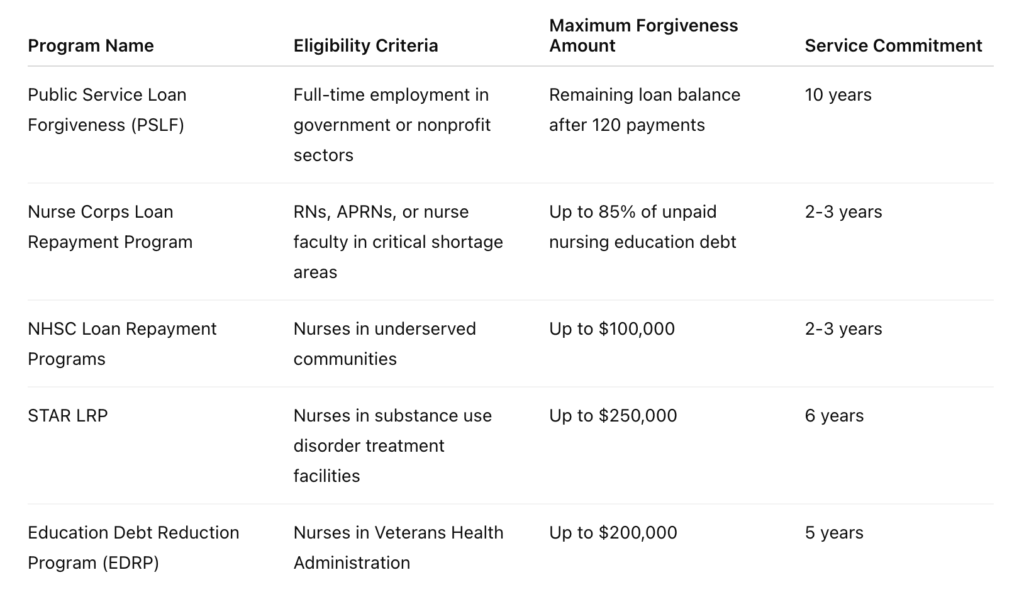
The best option for most nurses, the Public Service Loan Forgiveness Program is available to nurses who work full-time at a government or nonprofit organization and have made 120 monthly payments under a qualifying repayment plan. Nurses who qualify can receive tax-free forgiveness on their remaining federal student loans.
Courtesy of the Health Resources and Services Administration (HRSA), the Nurse Corps Loan Repayment Program covers up to 85% of unpaid nursing education debt for RNs, advanced practice registered nurses (APRNs), and nurse faculty.
To qualify, nursing professionals must agree to serve for two years in a critical shortage facility or as a nurse faculty member at an eligible nursing school. If you’re looking for loan forgiveness for nurses in direct care or education, this is a great place to start.
Nurses can receive up to $40,000 in repayment in exchange for two years of service to American Indians and Alaska Natives, who’ve long faced significant healthcare disparities. If you’re the adventurous type, you can pay off your student loan debt while practicing within an Indian health community in some of the most remote parts of the western U.S. and Alaska.
Earn Your BSN For Free
The University of Texas Permian Basin and the Permian Strategic Partnership are proud to offer a PSP Scholarship to undergraduate students majoring in healthcare-related fields, including nursing. This renewable four-year scholarship will cover tuition and fees while you pursue your degree in our online RN to BSN program.
Earn your BSN for free—no student loan needed! Visit our PSP Scholarships page for additional information and requirements.
#4 National Health Service Corp (NHSC) Loan Repayment Program
The NHSC offers four nurse and nurse practitioner loan repayment programs for those serving communities in need, particularly those affected by the opioid epidemic. These programs are:
NHSC Loan Repayment Program: Awards up to $50,000 for full-time service and $25,000 for part-time service to nurse practitioners who agree to serve two years at an NHSC-approved site.
NHSC Rural Community Loan Repayment Program: Awards $100,000 for full-time service and $50,000 for part-time service to nurse practitioners and RNs who agree to serve three years at a rural NHSC-approved SUD treatment facility.
It’s never too early to tackle student loan debt. Suppose you’re in your last year of nursing school. In that case, you may qualify for the S2S Loan Repayment Program, which awards up to $120,000 to students who agree to work full-time for three years at an NHSC-approved site. While working to fulfill your service requirement, you can continue your education and access a nursing student loan forgiveness program before graduation day.
Nurses who pursue careers with the Veterans Health Administration can receive up to $40,000 in annual reimbursements, or $200,000 over a five-year period, thanks to this VA program. Funds are tax-free, and no mandatory service is required.
“I still have a very large amount of medical school debt to service,” said physician Dr. Stephen Gau. “The EDRP program helps to accelerate the pay off dramatically.” Visit the VA Careers website and search for “EDRP” to find reimbursement-eligible positions. Compare Student Loan Forgiveness Programs for Nurses
Not sure which program is right for you? We’ve compiled a quick comparison chart of some of the popular options so you can easily see how much debt relief is available, what service commitments are required, and who qualifies.
Whether you’re just starting out or already working in the field, one of these nurse loan forgiveness programs could help lighten your financial load.
Frequently Asked Questions About Student Loan Forgiveness for Nurses
Still have questions? Here are answers to some of the most common questions about student loan forgiveness for nurses.
Who qualifies for student loan forgiveness for nurses? To qualify, you typically need to be a licensed RN, APRN, or nurse faculty member. Most programs also require you to work full-time in a nonprofit, government, or underserved area.
Can nurse practitioners get student loan forgiveness too? Yes! Many programs, including the NHSC and STAR LRP, offer nurse practitioner student loan forgiveness with generous repayment amounts in exchange for service commitments.
Is loan forgiveness taxable? It depends on the program. Forgiveness under the Public Service Loan Forgiveness (PSLF) program is tax-free, while other programs like the EDRP and STAR LRP also offer tax-free debt relief for nurses.
Nurses: Invest in Your Future
Imagine the relief that comes from having the weight of student loan debt lifted from your shoulders in an instant. For nurses, the benefits are even more pronounced: Student loan repayment brings not only ease of mind but also the chance to take risks and pursue new career opportunities.
At UT Permian Basin, we offer an online RN to BSN program designed for nurses interested in pursuing leadership roles in healthcare. We know the prospect of taking out another student loan isn’t always appealing, which is why we’ve made our online program as affordable as possible. Tuition is competitively priced and the same for all students, whether they’re in or outside of Texas. Plus, scholarship opportunities and student loan forgiveness for nurses mean that students gain the training needed to pursue high-paying, high-level management roles without having to go into debt.
Picture this: You’re in a hospital room, and a nurse walks in—flustered, but still smiling—with a chart in hand. This expert provider is checking your vitals, catching early warning signs, coordinating with doctors, reassuring your anxious family outside, and solving small healthcare crises in the hallway … all before lunch. Today, nurses are no longer…
Of the growing number of fields actively using artificial intelligence (AI) technology—including finance, manufacturing, marketing, and customer service—the field that arguably makes the most significant impact in our lives is healthcare. AI is supporting all healthcare sectors, simultaneously making nurses more efficient, elevating their level of care, and improving patient outcomes. Here we’ll examine some…
Every year, over 150,000 registered nurses (RNs) graduate from nursing school, ready and eager to make a difference in the lives of patients. They’ve spent up to four years preparing for this moment, poring over textbooks, completing clinicals, and mastering skills. But when it comes time to face the challenges on the hospital floor or…
People pursue a college education for a variety of reasons. They may be going straight into college following high school graduation or heading back to school after concentrating on personal or professional responsibilities. Some may yearn for the sense of pride and accomplishment that comes with completing a college credential.
Today’s Top Careers and Recommended Education Credentials
In 2023, U.S. News & World Report published a list outlining the 100 best jobs based on compensation, demand, work-life balance, and other criteria. Notably, many of the top careers align with The University of Texas Permian Basin’sonline degree and certificate programs. These UTPB credentials can fulfill employment requirements, set the stage for a future career in the field, or improve one’s performance and potential within their current role.
Let’s look at a few top careers from the U.S. News & World Report 100 best jobs list, the corresponding online UTPB programs, and job growth projections from the U.S. Bureau of Labor Statistics (BLS), starting with number 22 from the list:
#22 Data Scientist
Data scientists use various tools to collect and analyze data before providing stakeholders with recommendations for business decisions and process changes.
Bachelor of Arts in Psychology This program helps you develop the analytical, communication, and problem-solving skills the role of data scientist requires and prepares you for advanced data science studies.
Demand for data scientists is projected to expand by 36%—much faster than the average for all occupations—between 2021 and 2031.
#15 Market Research Analyst
Market research analysts use various data collection methods to assess consumer trends, competitor marketing, and other factors to enable their organization to market its products and/or services more effectively.
These UT Permian Basin online programs will strengthen your skills in research and analytics, paving the way for or boosting your performance in a market research analyst career:
Financial managers direct the financial affairs of an organization, producing financial reports, making investment decisions, and devising strategies to ensure the organization’s financial goals are met.
Our AACSB-accredited College of Business offers a variety of online undergraduate and graduate degree programs that can lead to a financial management career:
Demand for financial managers is projected to expand by 17%—much faster than the average for all occupations—between 2021 and 2031.
#4 Physician Assistant
Physician assistants (PAs) provide a wide range of care to patients, can perform many of the same functions as a doctor, including prescribing medications, and may assist in surgeries. PAs must earn a master’s degree or higher from an accredited medical school or a center of medicine before obtaining licensure.
Many physician assistants start their careers as registered nurses before earning the graduate degree and certification required to work as a physician assistant. This CCNE-accredited program can put you in line for nursing leadership roles and lay the groundwork for a physician assistant job.
Demand for physician assistants is projected to expand by 28%—much faster than the average for all occupations—between 2021 and 2031.
#3 Medical and Health Services Manager
Often called healthcare administrators or healthcare executives, these professionals plan, lead, and support healthcare services for a medical facility, one of its departments, or a stand-alone practice.
Demand for medical and health services managers is projected to expand by 28%—much faster than the average for all occupations—between 2021 and 2031.
#2 Nurse Practitioner
Nurse practitioners (NPs) also provide a broad range of services to patients and can perform many of the same functions as a doctor, in some cases including the authority to prescribe medications. NPs must have a minimum degree of Master of Science in Nursing from an accredited college to become licensed.
To become a nurse practitioner, you must first become a registered nurse. Earning your RN to BSN can subsequently position you for greater professional responsibilities and provide a stepping stone to a master’s degree that puts nurse practitioner opportunities within reach.
Demand for nurse practitioners is projected to expand by 40%—much faster than the average for all occupations—between 2021 and 2031.
Advantages Shared by All These Programs
No matter which UTPB online program you choose, you’ll enjoy these unequalled benefits:
Quality UT Permian Basin’s SACSCOC accreditation is your assurance that you’ll receive a high-quality education widely respected by employers and other educational institutions.
Affordability UTPB has some of the most competitive tuition rates among accredited universities of our stature.
Flexibility Delivered 100% online, our programs enable you to complete valuable credentials from just about anywhere on the planet at your own pace and empower you to maintain your professional and personal commitments.
Reach out to us if you’d like to discuss which online program most closely aligns with your professional goals! Our advisors are here to help steer you in the right direction.
Already know which program is right for you? Apply now!
A Master of Science in Finance (MS in finance) opens the door to high-paying roles across industries like banking, corporate finance, investment management, and consulting. Whether you’re seeking career advancement or the tools to become an entrepreneur, this degree can help you reach your goals.
In this article, we’ll cover what you can do with an MS in finance, the jobs it prepares you for, and how The University of Texas Permian Basin’s online program makes earning your degree flexible and affordable.
Why Earn a Master’s in Finance? 7 Reasons
In finance, there’s a direct line from an organization’s actions to its profitability. Equipped with an advanced finance credential, you can make a significant impact on your organization’s bottom line. An MS in finance empowers you to:
#1 Enjoy Greater Earning Potential and Job Security
According to the 2022 GMAC Corporate Recruiters Survey, salaries for Master of Finance degree holders are on the rise, with a 15%+ increase in median salaries from $95,000 in 2021 to $110,000 in 2022 alone. Further, the U.S. Bureau of Labor Statistics (BLS) reports master’s degree holders are more likely to be employed than individuals with a degree from the undergraduate level or lower.
#2 Land Top Roles in Top Companies
What do Jeff Bezos, Martha Stewart, and former Nike CEO Phil Knight have in common? Apart from considerable fame and financial success, all of these entrepreneurs have a background in finance. In fact, most Fortune 500 company executives come from a finance background. An MS in finance can be your key to the C-suite.
#3 Pursue a Broad Range of Rewarding Careers
An MS in finance prepares you to follow many finance-related career paths, from executive leadership to crucial supporting roles. Here are a few examples of those roles and their median annual pay as reported by the BLS:
Unlike some other business degrees, an MS in finance provides students with a specific financial management perspective. The curriculum will help you hone your analytical and executive decision-making skills and build your expertise in statistics, business analytics, investments, corporate finance and strategy, and international finance.
Elective courses in energy finance, investments, and risk management or financial services topics like real estate analysis or financial planning allow you to focus on your preferred industry emphasis.
#5 Chart Your Own Course
With the right combination of skills, credentials, and ambition, you can become an entrepreneur. As part of our online program, you’ll choose the elective courses that best suit your interests and professional goals. By following your passion, mastering the fundamentals, and putting in the effort, you just may become a household name!
#6 Differentiate Your Resume
While employers receive many MBA resumes for finance positions, an MS in finance indicates a more targeted financial education and can make your resume stand out.
#7 Get to the Finish Line Faster
An MS in finance program typically requires fewer credits than an MBA in finance program.
Earn Your MS in Finance Online at UT Permian Basin
The University of Texas Permian Basin offers a 100% online MS in finance that provides all these benefits —and so much more. Our program is:
Rigorous Our online MS in finance features the same rigorous curriculum taught by the same industry-experienced, research-oriented faculty who teach at our Odessa, TX campus.
Recognized Offered through our renowned College of Business, this program has been awarded AACSB accreditation—a designation that just 5% of business programs worldwide share. Further, our program is among the very few Texas university programs of its kind to boast STEM certification.
Affordable We have some of the most competitive graduate tuition rates among accredited universities of our standing in the United States.
Convenient Delivered 100% online, our program enables students to complete coursework on a flexible schedule from virtually anywhere. This is an irreplaceable benefit when professional and personal commitments are also involved.
See where you can steer your career with an MS in finance! We accept applications year-round, so there’s no need to wait until the end of the current or any semester. Apply now!
Are you authoritative? Intuitive? Experienced? A natural-born leader whose direct reports would follow off a cliff? That’s a phenomenal start, but these days, it’s only half the equation. Modern business leaders need a seamless blend of high-level human skills and data analytics skills. In competitive markets, professionals with both are known as dual-threats. Data skills…
According to the World Health Organization, 99% of the global population breathes polluted air. Yet we’re surrounded by clean, sustainable energy sources. Despite coal and natural gas being the most widely used energy sources, the urgency of climate change and resource depletion is making the shift to clean energy increasingly essential. In 2023, about 23%…
Some of the best career growth strategies for BBA graduates are building experience intentionally, developing leadership habits early, and expanding your skills before you need them. That’s the blueprint. But here’s how it usually plays out. Most graduates start in roles like “marketing coordinator” or “financial analyst trainee.” That’s normal (and honestly, a good thing). Those early roles are where you…
The energy business is a dynamic and challenging field and, for many, the source of a satisfying career. If you’re already working in the field and want to get more involved in the business aspects of the energy industry and increase your potential for advancement, you need to have a few advantages. First is drive, which you must nurture and maintain within yourself. Second is the specialized knowledge and skills required of every energy business leader. And the third? Credentials. You must possess the academic qualifications that validate your expertise before any employer will consider you for a leadership role. With these noteworthy advantages, you’ll find a more diverse and lucrative set of energy jobs at your fingertips.
The #1 Leadership Skill Set
While it’s important for just about everyone to have some level of analytical skills, they’re especially important for a professional in a leadership role. Defined as the ability to “observe, research and interpret a subject in order to develop complex ideas and solutions,” analytical skills inform all the decisions you will make as a leader. Put simply, you must understand everything that’s going on and know how to proactively address any concern that may come your way while making your team and your larger organization more efficient and profitable.
An Uncommon Credential
The University of Texas Permian Basin offers an energy-focused graduate program that helps you hone the crucial analytical skills every leader must have. Our online Master of Science in Energy Business program was created alongside energy industry professionals to serve the needs of ambitious, leadership-minded graduate students. There aren’t many other online university-level programs of this type available in the U.S.!
During this 30-credit program, you’ll focus on core business topics through an energy industry lens in courses including Energy Accounting, Global Energy Business, Energy Finance, Energy Investments, Energy Technology & Risk Management, and Energy Law. You’ll also gain a firm grounding in financial principles through a curriculum of finance-focused course and explore statistics and analytics.
Benefits During Your Program and Beyond
UTPB’s MS in energy business program offers significant benefits that you’ll experience while completing your studies and long after you’ve finished them.
Receive a High-Quality Education
Our online MS in energy business is offered by our AACSB-accredited College of Business. This coveted accreditation is shared by only 5% of business programs worldwide and signifies that AACSB has put our business school through a rigorous peer-review process to verify that it meets “the highest standards of excellence in teaching, research, curriculum, and learner success.”
Earn a Top-Quality Degree at a Lower Cost Than Most Competitors
The tuition rates for the master’s degree in energy business and all our programs rank among the most affordable of those at any regionally accredited university of our stature.
Start a Career-Defining Credential When You’re Ready
Unlike some other programs, you can begin your degree any time of year. You never have to wait until the fall semester.
Finish in as Little as Four Semesters
If you take the recommended course path, you can finish your degree in as little as four semesters.
Experience Unequalled Online Convenience
Though you may finish your master’s degree quicker than you expected, your pace of completion is always your choice. Our program is delivered in a 100% online, asynchronous format that empowers you to complete your master’s degree on your own schedule from just about anywhere in the world. No campus visits are required.
Enjoy Higher Employability and Earning Potential
Your resume will garner more attention from employers with a master’s degree on it. Master’s degree holders not only enjoy higher employment rates than those with a bachelor’s degree alone, they also enjoy about 18% higher median earnings, according to the U.S. Bureau of Labor Statistics.
Work in a Variety of Management Roles
This degree may help you secure a role on the business side of the energy industry. Some of these rewarding careers include:
Energy manager
Operations manager
Energy consultant
Energy risk analyst
General energy analyst
There’s virtually no limit to what you can do with an MS in energy business. You have the drive—now get the skills and credentials you need to excel as an energy business leader. Apply today!
If you’re considering a degree program as an entry point to a rewarding new career or greater earning potential, you have many choices. One path to higher earning potential may surprise you, however.
You may have heard from well-intentioned family members or advisors that English is a degree to avoid if future employability and earning potential are important to you. Yet data shows that English degree holders outperform tech professionals in earnings— even as the Society for Human Resource Management (SHRM) reports salaries for U.S.-based tech professionals averaging in the six figures.
Tech professionals may start out with robust salaries, but that premium can be short-lived. Professionals with English and humanities degrees often out-earn them over the course of their career. This may seem like a disconnect, but there’s solid reasoning behind it, according to The New York Times. Technological change is constant, and some skills can become obsolete very quickly. This obsolescence puts more experienced tech workers at a disadvantage compared to professionals entering the workforce with up-to-date skills, and it can cause industry veterans’ earnings to stagnate.
Skills That Last and Earnings that Surpass
Skill obsolescence isn’t an inevitable risk for all graduates. English majors sharpen written and verbal communication, critical thinking, problem-solving, collaboration and other respected “soft” skills that are broadly applicable in professional life and beyond. This may be among the reasons the U.S. Department of Labor and Forbes cite soft skills among the most highly sought-after abilities by employers. The American Bar Association also cites these skills among the most important when applying to law school.
Translating employment to earnings, The New York Times states majors in liberal arts subjects like English more often pursue careers in business, management, law, and other generally high-earning fields than tech majors. This explains why, though tech professionals may earn more early in their career, English majors often end up surpassing those earnings in the long run. If English is your passion, you can leverage your mastery of the written word in a broad range of fields without sacrificing financial success.
Programs That Prepare You for Higher Earning Potential
The University of Texas Permian Basin offers online English degree programs to match your education and professional experience. Each is a valuable credential that can prepare you to thrive in a variety of rewarding careers.
This program explores the English language and culture in all its complexity through literature and other creative works from Shakespeare to Spielberg. Our BA in English enables you to:
Build the essential critical thinking, problem-solving, and writing skills that employers value.
Choose from a broad selection of general education courses that provide a foundation for a more fulfilling career and life.
Aim for a law career with a curriculum that prepares you to take the LSAT.
This program takes a deeper dive into English language and culture and connects aesthetic, cultural, historical, psychological, and social themes in literature from yesterday and today to current cultural, psychological, and sociopolitical realities. If you’ve completed or are about to complete a bachelor’s degree, we invite you to apply to our MA in English, which allows you to:
Expand your exploration of topics from our core BA in English courses.
~ 38% higher than those of associate degree holders.
~ 32% higher than those who’ve taken college classes but haven’t finished a degree.
Master’s degree holders have median earnings:
~18% higher than bachelor’s degree holders.
BLS data also shows that an individual’s likelihood of being employed increases with each successive level of education they complete. Let’s look at some of the jobs which an English degree may help you achieve and their pay, many of which approach or exceed six figures:
Advertising, Promotions, and Marketing Managers: Median annual pay $133,380
An Affordable, Convenient Way to Earn Career Credentials
As you’re working toward a degree that can help you secure a high-paying position, you’ll save with English programs that offer some of the most affordable tuition rates of any accredited university of our stature. We accept many forms of financial aid, and our financial aid office can help field your questions about the process. Once enrolled, you’ll experience unequalled flexibility, learning on your own schedule from anywhere in the world. There’s no better way to earn a degree that can help you get ahead while maintaining your current work and family responsibilities.