The Differences Between Our BAAS in Healthcare Leadership and BBA in Healthcare Management
Future healthcare leaders are made here at The University of Texas Permian Basin, where we proudly offer an online Bachelor of Applied Arts and Sciences in Healthcare Leadership and an online Bachelor of Business Administration in Healthcare Management. Without question, both programs confer skills and credentials that are invaluable for anyone aspiring to a leadership role in healthcare. But there are some fundamental differences in the admission requirements, curriculum, and other aspects of these two programs. Let’s review those now to help you decide which program is right for you.
How The Two Programs Differ
Workforce vs. Workplace
Our BAAS in healthcare leadership equips future graduates to inspire and guide staff to deliver safe, effective, and efficient healthcare services. In our BBA in healthcare management program, you’ll find greater emphasis on managing the day-to-day business operations of a healthcare facility.
Prior Education Credentials
The BAAS in healthcare leadership program was designed for students who hold an associate degree in applied science (AAS) in healthcare fields such as emergency medical services, nursing, or radiology. You are not required to complete an AAS or other college-level degree before applying to our BBA in healthcare management, however, making this an accessible option for transfer and first-time college students.
Math-Focused Curriculum
Math proficiency is considered crucial for anyone who wishes to manage an organization, and both of our programs have a mathematics component as part of their general education requirements. As a business-oriented program, our BBA in healthcare management—like all our BBA programs—also covers statistics, accounting, finance, and data analysis among its required lower-level business courses. None of these topics are the focus of any BAAS in healthcare leadership course.
A Global Component
Our BBA in healthcare management includes courses in international management, international marketing, international finance, and global health nursing, from which you must choose one course. None of these courses are a required part of the BAAS in healthcare leadership program, however.
Bigger on Business
The BBA in healthcare management explores traditional business disciplines such as finance, management, accounting, marketing, and law in depth from healthcare and general business perspectives. The BAAS in healthcare leadership does not include dedicated finance or accounting courses, though it does introduce the topics in the required Quantitative Decision Tools (ITEC 3301) course.
What These Programs Have in Common
There are certain advantages that all our business programs share, and the BAAS in healthcare leadership and BBA in healthcare management are no exceptions.
Recognized Quality
Both programs are offered online through our AACSB-accredited College of Business. AACSB accreditation signifies that a college’s programs have undergone a rigorous peer-review process and have been verified as exemplifying the “highest standards of excellence in teaching, research, curriculum, and learner success.” Only 5% of business programs worldwide share this coveted designation. The University itself is regionally accredited by the Southern Association of Colleges and Schools Commission on Colleges (SACSCOC).
A Flexible Learning Experience
Delivered in an asynchronous, 100% online format, our programs enable you to learn on your own schedule from just about anywhere in the world—from Athens, Georgia to Athens, Greece and beyond. You’ll find this especially advantageous if you have ongoing professional or personal obligations.
How to Choose the Right Program for You
You may already have a sense of the best program for you based on the differences discussed here, but two simple questions should help clarify your decision:
Coming into UT Permian Basin with an AAS? The BAAS in healthcare leadership is your program.
Want to build a broad healthcare business foundation as a UTPB freshman or transfer student? The BBA in healthcare management suits you best.
If you’re still uncertain which program you need, we recommend you speak with our online academic advisors, who are here to answer any questions you have and to help guide you toward the right decision.
Plentiful Job Prospects in Healthcare Leadership
Equipped with the applicable credentials and skills, you’ll be primed to take advantage of the tremendous growth that’s happening right now in healthcare leadership professions. Just look at what the U.S. Bureau of Labor Statistics (BLS) has to say on the subject:
The number of available medical and health services manager jobs is expected to grow by 28%—much faster than the average for all occupations—between 2021 and 2031. Offering a potential median annual salary of $101,340, these jobs include:
The statistics are shocking: About 25 million people worldwide are victims of human trafficking, an “industry” from which criminals profit to the tune of $150 billion each year. The COVID-19 pandemic worsened an already dire situation by leaving countless people out of work and consequently more vulnerable to accepting dubious offers of employment. Human trafficking, not to be confused with migrant smuggling, is defined by the U.S. Department of Homeland Security as “the use of force, fraud, or coercion to obtain some type of labor or commercial sex act.”
Primary Types of Human Trafficking
Though human trafficking is a multifaceted phenomenon, the United States government separates human trafficking into two main types:
Forced Labor
This type of human trafficking involves an individual of any age being compelled, coerced, or deceived into working for others in a nonsexual labor capacity. Examples include being forced into domestic servitude or working at sweatshop factories.
Sex Trafficking
This type of human trafficking entails an individual of any age being compelled, coerced, or deceived into performing sex acts for money, most or all of which ends up in the hands of other parties.
Solutions to a Growing Problem
Government officials at the highest level and people just like you are joining forces to combat human trafficking in the United States and elsewhere. Let’s explore some specifics of those efforts now.
What’s Being Done
According to the White House, the United States has a four-pronged strategy for combatting human trafficking:
Prevention involves a broad range of actions from “educating vulnerable populations and mitigating risk factors” to stopping goods produced through forced labor from coming into the U.S.
Protection includes “interventions, services, and supports needed to protect and assist victims.”
Prosecution entails “holding individuals and entities engaged in human trafficking accountable and dismantling human trafficking networks.”
Partnerships require “collaboration to complement and support the other [three] pillars” of the plan.
What You Can Do
The U.S. Department of State offers many suggestions to those who wish to help combat human trafficking:
Educate yourself: Learn the circumstances that contribute to human trafficking (poverty, homelessness, lack of family support) and become able to recognize signs that a person is being trafficked.
Consume responsibly: Buy products from companies that do not engage in practices that encourage or benefit from human trafficking.
Support local efforts: Volunteer your time and services to organizations that are working against human trafficking in your area.
Spread the word: Share news stories and information about human trafficking on your social media pages.
Mentor the vulnerable: Give time and support to individuals who are most likely to fall prey to human traffickers.
Use your professional abilities: If you’re a lawyer or a journalist, you can offer tremendous assistance in protecting victims and educating the public.
In addition, you can take the critical step of building education credentials in career fields that combat human trafficking, up to and including working on the front lines.
Become an Indispensable Part of the Solution
The University of Texas Permian Basin’s online criminal justice degree programs provide a path to a variety of careers in which you can make a direct impact against human trafficking and empower you to make a bigger impact in your current career. Led by criminal justice experts who have worked extensively in the field, our programs accommodate different levels of education and professional experience.
This program provides a strong foundation for those looking to enter the public service sector with a desire to reshape the American criminal justice system from the inside. We examine a diverse selection of essential general education topics before delving into modern-day challenges in the criminal justice system; the roles of law enforcement, the courts, and corrections; ethics; crime prevention methods; criminal justice research methods; and conflict resolution.
If you have your eyes on a leadership role within criminal justice and have a related bachelor’s degree, consider this top-ranked program a prerequisite. Undertake an in-depth examination of complex topics from a leadership perspective, such as striking a balance between protecting your agency while best serving the public. A master’s degree is a must-have for promotion to many top jobs, and our MS in criminal justice administration provides the focus you need. You can complete this degree in as little as one year, positioning advancement opportunities closer than you may have imagined. No GRE is required.
Rewarding Career Options
Our criminal justice degrees will benefit you in a variety of roles and agencies, including:
Law Enforcement
Courts
Corrections
Probation and Parole
Federal Agencies
Nonprofit/Nongovernmental Agencies
Crime Scene Investigation
Forensic Science
Child Protective Services
Prepare for a New Stage of Your Career at Your Own Pace
The asynchronous online format of our criminal justice programs offers unequalled educational flexibility. Complete coursework at your own pace, 24/7, from virtually anywhere on the planet. Whether you work the day shift or need to travel frequently, our program is always here for you. There’s no better way to maintain your professional and personal commitments while earning a degree that can help you thrive in your career and beyond.
Build the expertise and credentials to lead the fight against human trafficking in our online criminal justice programs. Start your application today!
Group polarization is a social psychology concept that describes how people’s views can become more extreme after discussing them with like-minded others. In other words, that old question “If everyone jumped off a cliff, would you?” is not as simple as it sounds.
What Is Group Polarization?
Group polarization occurs when a group of like-minded people reinforce each other’s opinions, positive or negative, and these opinions become more extreme as they’re discussed. If you’ve ever walked out of a movie that let you down only to hate it after chatting with friends, you’ve experienced group polarization firsthand.
Group polarization is thought to have two causes:
Homophily is the tendency for people to associate with like-minded individuals, which positively reinforces certain beliefs.
Discursive arguments, on the other hand, are used to reason with group members and promote an agenda. For instance, a team leader might emphasize how adopting a new workflow will improve efficiency and benefit everyone, framing the change as a collective gain.
Group members can be influenced by one or both psychological processes. Regardless, their opinions and those of their peers will tend to become more extreme.
Why Does Group Polarization Happen?
Group polarization happens because people rely on social cues, mental shortcuts, and group reinforcement when forming opinions. Let’s break it down a little more simply.
Every day we face decisions ranging from the mundane to the critical: what to wear, which mechanic to trust, where to buy a house, etc. If we slowed down to consider every possibility, we’d never make it through the day, so our minds use heuristics (mental shortcuts) to make snap judgments.
For example, Amazon shoppers who search by popularity are using a heuristic to arrive at a decision. The natural tendency to create mental shortcuts based on the behaviors of others is part of what makes people susceptible to group polarization.
Something else to consider is that humans evolved to be social creatures. Ancient humans were relatively defenseless and learned to survive by banding together to fend off predators. Adaptive behaviors like conformity were essential for gaining acceptance and surviving, whereas causing trouble brought banishment and, most likely, death. Natural selection favored conformity, and over time, these social behaviors were passed through generations.
Though far removed from ancient hunter-gatherer societies, modern humans are still predisposed to follow along with the majority for fear of exclusion.
Why Is Group Polarization Important?
Group polarization is important because it can shape group decisions in ways that push beliefs and actions to greater extremes.
Communities make decisions collectively. Local businesses, religious institutions, and entire governments are run by groups, all of whom are susceptible to group polarization. Swayed by the majority, individuals may say and do things they never normally would, sometimes with disastrous results.
Consider a jury deciding someone’s fate based not on logic or facts but rhetoric. Group polarization may have helped our ancestors survive, but it’s beginning to unravel our modern way of living.
How Group Polarization Affects Politics and Social Media
Social psychologists have taken a renewed interest in group polarization in response to growing political discord and extremism throughout the world. In the U.S., liberals and conservatives shun opposing viewpoints, seek fellow party members, and have their beliefs amplified in echo chambers. Tensions between the two political parties have reached a fever pitch, and group polarization may be part of the problem.
Social media has only added fuel to the fire. Seemingly by design, platforms like Facebook and Twitter are hotbeds of misinformation where political extremists can enter an anonymous forum and have their opinions celebrated, no matter how corrosive.
Social media communication is prone to manipulation.
Group polarization facilitates the spread of misinformation.
Surprisingly, researchers found that while social media does create echo chambers, the diverse information on these platforms can also offer users an escape. According to researchers, group polarization is the result of:
How we consume and share contentHow leaders communicate on social media
Social media platforms driven by traffic and addiction
Spontaneous group dynamics
Weak regulation and a lack of ethical design
Researchers concluded that while social media does contribute to increased polarization, it can’t take all the blame. We’re simply wired to follow along with people who think and feel as we do.
Is Group Polarization Good or Bad?
Group polarization is neither good nor evil but a way to explain human behavior. For all the political discourse it’s caused, group polarization exists for a reason and can help groups achieve cohesion, coordinate an agenda, and overcome impossible odds. The civil rights movement of the 1950s and 1960s and the recent #MeToo movement are proof that public outrage can be a force for good.
Back to our initial question: “If everyone jumped off a cliff, would you?” Group polarization is a powerful phenomenon, no doubt, but you’re in control of your life. Social media and other tactics used to leverage the power of group polarization can be mitigated. Stepping out of an echo chamber or leaving a group whose beliefs you no longer agree with is always your choice.
Explore Psychology and Its Influence on Everyday Life
Group polarization is one of the countless explanations for why we behave the way we do, and every day, psychology reveals more and more of the invisible mental world that influences our lives. If you’re looking to learn more about yourself and, in doing so, learn how to help others, consider pursuing an online Bachelor of Arts in Psychology at The University of Texas Permian Basin.
Our online BA in psychology program provides a comprehensive view of this exciting field. If you liked reading about group polarization, you might enjoy our course in Social Psychology.
We also offer courses on Abnormal Psychology, Experimental Psychology, and Positive Psychology, among others. As a graduate, you’ll gain in-depth knowledge of human motivation, communication, and perception.
Psychology is one of the broadest academic fields, and one of the most versatile. It spans everything from courtrooms to corporate offices, from childhood development to competitive sports. With so many specialties (and subspecialties), it can be tough to know where to even start. So exactly how many branches of psychology are there? The field is…
Ever reach for your phone and instantly face a barrage of messages, notifications, subscription reminders, and social media updates? You’re not alone. Scientists have estimated that the average person processes about 74 gigabytes of information daily: equivalent to watching 16 high-definition movies back-to-back in a single day. Cognitive overload is real. And over time, constant stimulation quietly changes how we think, focus, and feel. In this article, we’ll explore: What Does Cognitive Overload Mean? Cognitive overload happens when your brain receives more information than…
When someone struggles with depression, homelessness, or discrimination, who steps in to help? A psychologist? A social worker? A sociologist? These three fields all address human challenges, but they explore humanity from very different angles: one from society, one from the mind, and one from the front lines. So what are the similarities and differences between sociology, psychology, and social work? This guide clears up…
The term gender roles is coming up more often in conversations and in society in general as we begin to rethink long-held notions about gender. Gender was once seen as a relatively straightforward concept. With time, examination, world events, and myriad social changes, however, it has become obvious that we must treat gender roles as a more complex and nuanced issue.
What Are Gender Roles?
Consult a sociology dictionary and you’ll find gender role defined as, “the expected role determined by an individual’s sex and the associated attitudes, behaviors, norms, and values.” What that means in simple terms is that some attitudes, activities, and interests have traditionally been considered inherently feminine and others inherently masculine. Over time, these notions have become increasingly obsolete, having been challenged and defeated in irrefutable ways. The following example shows a major shift in gender roles that took place in the United States within just the last century.
War Catalyzes a Major Shift in Gender Roles
For a sizable portion of the 20th century, women in the United States were expected to get married, have children, and generally take care of their family’s daily domestic needs. Men held traditional jobs in the workplace and looked out for the family financially. Many women did not enter the workforce, whether they attended college or not. Attending college was seen as a way for women to prepare for being a wife and mother—and an ideal place to meet a future husband.
The onset of World War II forever changed the role of women in American society. With many men off fighting the war overseas, the need for skilled workers skyrocketed. Who was left to work on assembly lines and do other jobs that would’ve otherwise been done by men? Women. This new workforce trained the same way men had, took on the same roles, and did so with excellence. Rosie the Riveter inspired and exemplified the new working woman. World War II laid the foundation for women’s widespread emergence in the workforce.
A Global Event Shifts Gender Roles Again
While significant changes to gender roles began to develop and solidify in the second half of the twentieth century, in the modern era, many sociologists have cited COVID-19 as a driving force for yet another wave of shifting gender roles. As the pandemic began in 2020, multitudes went home to continue the work they had previously done in an office setting. However, an estimated 1.1 million women in the U.S. left the workforce entirely from early 2020 to early 2022. Many of these women devoted themselves to full-time care for children or aging relatives when the pandemic shuttered schools and daycares and increased health risks in elder care facilities.
Our nation’s longstanding gender wage gap may be at least partly to blame for this mass exodus of women from the workplace, since for many families, the lowest wage earner is seen as the most expendable. But the still-entrenched gender norms of male breadwinners and female caregivers are undeniably a factor in the division of domestic duties, particularly in heterosexual households. As the pandemic lingers, a full-scale return of women to the workforce remains to be seen, though COVID-19 certainly reversed some progress toward eliminating traditional gender role expectations in the professional context.
The Limitations of Gender Roles
Adherence to gender roles can prevent some individuals from seeing through arbitrary social constructs and considering a wider range of alternatives. If a person wants to pursue a career or a role that is not typically associated with their expressed gender, they may be discouraged and opt for something else—even though they may have excelled in that desired role. Predetermined gender roles may compel a person to conform to a path that’s not right for them. That’s one unfortunate example of how gender roles can negatively affect people, but it’s not the most consequential.
If the gender an individual identifies most closely with does not match the sex designated on their birth certificate, and they are unable to express their gender identity, it can have deadly consequences. One study showed a shocking 52% of transgender youth considered suicide during 2020. Societal acceptance—in the form of a less rigid view of gender roles—and self-acceptance are key to reversing such alarming trends. A reexamination of gender roles can help a broader segment of our population experience a more fulfilling life with a healthy self-image.
An Online Exploration of Sociology
The University of Texas Permian Basin’s online Bachelor of Arts in Sociology examines gender issues from multiple perspectives as part of a robust, diverse curriculum that includes core and elective sociology courses and a broad spectrum of general education topics. Our program equips you with a crucial understanding of human interaction within a culture and its various subcultures, and between differing cultures.
Career Potential With a BA in Sociology
As you complete our BA in Sociology program, you’ll develop key skills that will help you in all aspects of your life, from your personal relationships to your career, including critical thinking and communication. Studies by major companies and U.S. government agencies show that “soft skills” like these are highly sought after by employers and, in some cases, are considered of equal importance to “hard skills” for job candidates. These soft skills are transferrable to any profession and will serve you well no matter what route you follow. BA in sociology graduates can pursue a variety of rewarding roles, such as:
Management consultant
Nonprofit specialist
Human resources professional
Guidance counselor
Public administrator
Teacher or teaching assistant
Social researcher or social worker
A Quality Program With Added Flexibility
Our online BA in sociology program features the same courses taught by the same acclaimed faculty who teach them at our Odessa, Texas campus. The asynchronous online format offers added flexibility, so you can complete coursework at your own pace from virtually any location in the world. No campus visits are required. Earning a bachelor’s degree need not interfere with any existing personal or professional obligations. Six start times per year allow you even greater flexibility in pursuing your degree.
E-commerce has evolved from a niche online activity to a central part of everyday shopping and business. Since the 1990s, we’ve had major advancements in internet access, mobile technology, and digital marketing. These online upgrades have transformed how companies sell products and how consumers buy them.
One early milestone came on April 3, 1995, when Amazon recorded its first purchase from a non-employee customer. That was the beginning of Amazon’s journey to becoming the world’s largest e-commerce platform.
Let’s look back at the evolution of e-commerce and how it continues to shape our society.
How Did E-Commerce Begin?
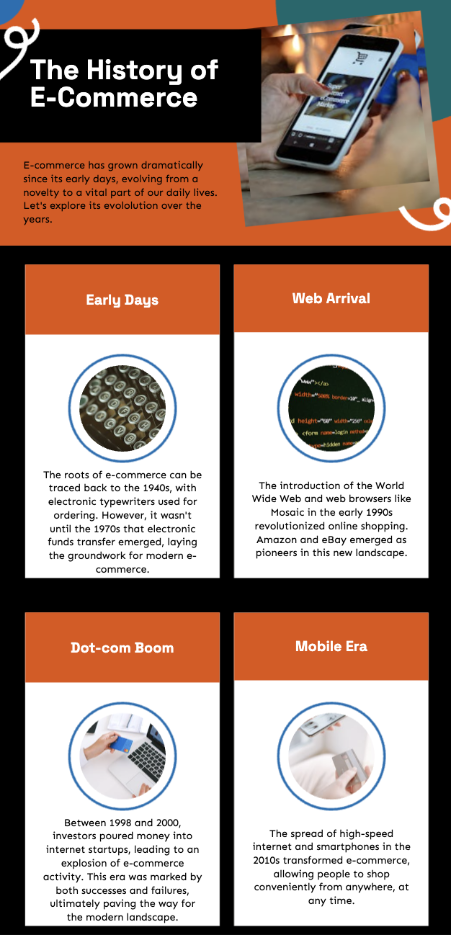
The origins of e-commerce can be traced back to the 1948-49 Berlin Blockade, which saw West Germany ordering supplies using a system of electronic typewriters called telex.
However, it wasn’t until the early 1970s that we began seeing innovations that would become staples of modern e-commerce, such as electronic funds transfer (EFT). At the time, e-commerce was little more than a convenient way to exchange documents within a company.
Everything changed with the introduction of the World Wide Web in 1991 and the web browser Mosaic, the precursor to Internet Explorer, two years later. These advancements provided the means for the public to search for and purchase products online. E-commerce transitioned to the internet soon after, and it wasn’t long before two of the world’s largest online retailers came on the scene: Amazon and eBay.
How Did the Dot-Com Boom Shape E-Commerce?
E-commerce exploded as internet service providers like AOL connected tens of millions of homes to the web. Excitement reached a fever pitch between 1998 and 2000 as investors poured money into internet startups.
This era is known as the dot-com bubble, a period marked by many promising but ultimately unprofitable online companies. Notoriously, online fashion retailer Boo.com burned through $185 million in 18 months before going bankrupt. The bubble burst in 2000 but left behind a robust digital infrastructure that paved the way for modern e-commerce.
What Does E-Commerce Look Like Today?
E-commerce sales worldwide reached an estimated 5.8 trillion in 2024. This explosive growth has been fueled by increased access to high-speed internet and the spread of smartphones, which are owned by over 5 billion people globally.
Online shoppers, once at the mercy of dial-up connections, can now shop anywhere. They can roll over in the middle of the night, fumble for their phone in the dark, and place an order with a single click.
E-commerce is now a part of everyday life.
Amazon, Walmart, and eBay remain the largest e-commerce companies, but the way they conduct business is far more refined than it was in the early days of e-commerce. Websites are clean and responsive. Search engines make finding deals easy and even make recommendations based on a person’s search history. And customizable orders give buyers more options and more control over their online shopping experience than ever before.
How Do Businesses Reach Online Buyers Today?
This evolving ecosystem also offers new ways for companies to reach customers. Email, text message, social media, and influencer marketing campaigns are all normal facets of online retail marketing.
Buyers are encouraged to leave reviews, opt into mailing lists, join loyalty programs, and post on social media, all to build an emotional connection between them and a brand. In this new ecosystem, there’s no right way but many possible ways to reach buyers, and they must all be accounted for if businesses are to thrive in this competitive environment.
Expand Your Knowledge of Digital Marketing
The evolution of e-commerce has led to an ecosystem where anyone can open an online shop and compete with leading retailers. Etsy is famous for its marketplace of one-of-a-kind items made by fledgling entrepreneurs. However, this diverse landscape of leading retailers and independent sellers means that any marketing strategy must be louder, bolder, and smarter to make an impact.
Earn an Online Undergraduate Certificate in Digital Marketing
UT Permian Basin’s College of Business offers an online undergraduate certificate in digital marketing. Accredited by the prestigious Association to Advance Collegiate Schools of Business (AACSB International), our online undergraduate certificate in digital marketing program will provide you with the foundational knowledge you need to develop and implement brand, marketing, and social media campaigns.
In addition to exploring the many facets of e-commerce, our program looks at:
Digital Branding
E-Marketing
Digital Advertising
Digital Marketing Analytics
Social Media Marketing
This 12-credit certificate program can be completed in tandem with any of our undergraduate bachelor’s degree programs, such as our Bachelor of Business Administration in Marketing. Attend UT Permian Basin online, and you’ll be able to enter the world of marketing with both a bachelor’s degree and an undergraduate certificate on your resume.
Gen Z and younger millennials haven’t just entered the consumer marketplace. They’re reshaping it. According to a 2024 survey, 20% of U.S. consumers made purchases on a social media platform at least weekly. This means Gen Z and millennials are setting the tone for how future generations will discover and buy from brands. These digital…
Honoring and celebrating our mothers has been a global tradition throughout history. Although Mother’s Day was officially declared a U.S. holiday in 1914, its origins date back centuries. People have honored their mothers across cultures and time periods through festivals, religious observances, and communal gatherings. Understanding the historical significance of holidays like Mother’s Day provides…
Many of us feel the invigorating sense of fresh starts and second chances that New Year’s brings. On January 1st, we’re often eager to embrace a healthier, polished version of ourselves—and we’re not alone. According to a 2024 Forbes Health poll, 48% of participants said improving their fitness was their top priority, 36% cited improving…
Where did our modern philosophies and systems of government take shape? All began as theoretical approaches, or a “set of assumptions about reality that inform the questions we ask and the kinds of answers we arrive at as a result.” Political science, the study of government at all levels, laws, and political thought, has provided centuries of debate in the form of myriad evolving theories.
The Influence of Historical Figures on Political Theory
Contemporary methods of governing have their foundation in ancient times, when philosophers such as Plato first put forth ideas regarding government structures. Plato’s work The Republic introduced the concept of a government composed of individuals who represent the interests of the greater populace and rule on their behalf. The United States, founded more than two millennia after Plato walked the earth, is considered a republic based on his definition of the word. Indeed, “republic” is right there in the U.S. Pledge of Allegiance: “I pledge allegiance to the flag of the United States of America, and to the republic for which it stands …”
Aristotle, a fellow Greek philosopher and student of Plato, also espoused theories that were influential in the formulation of political science. Aristotle held respect for political structures such as monarchy and aristocracy but also felt that the potential for corruption and tyranny was great. His theory of “polity,” where all economic classes respect one another and the most capable individuals govern with the approval of the general populace, was his preferred form of government. Curiously, he considered democracy equivalent to anarchy. Aristotle ultimately refined Plato’s approach, incorporating observable facts into his political theories.
Niccolò Machiavelli was likewise considered one of the earliest political science theorists, though he trailed the great ancient Greek philosophers by some 2,000 years—an indication of the “work in progress” nature of political science. Machiavelli’s view eschewed religious beliefs in favor of reason in governance. This also meant disavowing morality in the pursuit of political goals, which centered on the acquisition and possession of power. His theories were the origin of the term “Machiavellian,” which is still used today to indicate an amoral willingness to achieve one’s ends by any means.
John Locke, a 17th century English philosopher, posited that people have “natural rights” and that government’s purpose is to protect those rights. Further, he held that overthrowing a government that did not protect such rights was a legitimate course of action. His belief that people have the right to “life, liberty, and property” was later echoed in the Declaration of Independence’s notable phrase, “Life, Liberty and the pursuit of Happiness.”
The Transitory Nature of Theory
As times change, theories naturally evolve. Communism, for example, is a political theory, but it was said to have ended with the destruction of the Berlin Wall in 1989. Clearly, political science theories aren’t necessarily made to last, even if that is the initial intention of their proponents. Time can prove any theory impractical or just plain wrong. This gravitation toward newer, more viable theories doesn’t mean that humanity will determine one “correct” theory for all time, but it’s clear from the examples listed above that some foundational political theories still exist in practice in the United States and elsewhere.
Build a Foundation for Your Own Career Through Political Science
UT Permian Basin’s online Bachelor of Arts in Political Science looks at theoretical approaches to the field in several disciplines, including international relations, political theory, and public policy. Our program includes courses covering each of these areas, including one course dedicated solely to theory:
If you’re looking to lay the groundwork for admission to law school and/or seek a career in one of many law and/or government roles, our program was designed for you. Our online BA in political science provides a broad foundation in essential areas including U.S. history, philosophy, math, and political science before shifting focus to judicial politics, the role of law and courts in the U.S., the structures and procedures of our judicial system, and judicial policymaking.
Potential Career Paths for You
A degree in political science is a pathway to many satisfying careers, such as:
Attorney
Journalist
Legislative Assistant
Market Research Analyst
Policy Analyst
Political Consultant
Public Relations Specialist
Public Servant
An Online Degree Program Marked by Quality and Convenience
Our BA in political science program is led by the same extensively published, doctoral-level political science experts who teach on campus and follows the same meticulously developed curriculum. The asynchronous, 100% online format of our program empowers you to complete coursework from practically anywhere in the world at your own pace, offering tremendous flexibility and convenience. If you have ongoing professional commitments and family responsibilities, you’ll find our online format allows you to earn your degree without interfering with those other important aspects of your life.
Discover the lasting influence of political science theory as you build career-critical knowledge and credentials in our bachelor’s degree program!
A principal’s day begins with greeting students in the morning. The rest of the day is spent visiting classrooms, meeting parents, and making sure the needs of students and teachers are met. At night, they might support students by attending a school play or football game before heading home and starting again the next day.
The job of a school principal is unlike any other, but you already knew that, didn’t you? Chances are you’re a teacher who’s had their eye on the role of assistant principal or principal for some time, but you’re not sure if it’s the right fit for you. We’re here to tell you that enrolling in a preparation program, earning your Principal as Instructional Leader certification, and becoming a school leader is 100% worth it.
Make a Difference
The number one reason why teachers transition to leadership roles is to have more control over key administrative decisions. As an assistant principal or principal, you’ll oversee all school operations and:
Allocate resources where they’re needed most.
Collaborate with parents and community members.
Foster a safe, supportive learning environment.
Support and help teachers grow as professionals.
Above all else, principals promote a shared vision of student success. Traditionally, principals were seen as little more than school managers, but this role has evolved over the past few decades, and many principals are now student advocates who set high standards and help young learners achieve their full potential.
The Profound Effect Principals Have on Students
Commissioned by the Wallace Foundation, a recent review looked at over 20 years of data involving over 22,000 principals to determine the connection between leadership and learning. Turns out, principals have a far greater and broader impact on the student experience than previously thought. Researchers found that effective principals have nearly as large an impact on student achievement as similarly effective teachers, largely through their hiring, development, and support of teachers.
Teachers are essential to student achievement, but their reach is often limited to a single classroom. Principals affect every student in every classroom on campus. “Principals really matter,” concluded researchers. “Indeed, it is difficult to envision an investment with a higher ceiling on its potential return than a successful effort to improve principal leadership.”
Advance Your Career
Elementary, middle, and high school principals earn an average median salary of $98,420, with top earners making over $153,520 per year. The chance to earn a six-figure salary while making a difference in students’ lives is enough of an incentive for most educators to pursue their principal certification, but the real financial reward may come long after a principal has left their mark on a campus.
Ensure a Cushy Retirement
Here in Texas, educators are part of the Teacher Retirement System of Texas (TRS). Working for TRS-covered institutions, educators contribute a percentage of their salary toward retirement: 8% as of September 1st, 2021.
As a Texas educator, you already make monthly contributions to TRS. You may even be well on your way to reaching your retirement goals. Unfortunately, Texas’ pension plans for educators leave a lot to be desired. Payments are not automatically adjusted for inflation, so inflation will erode the value of your pension with each passing year. Becoming an assistant principal or principal can significantly increase your annual salary, thereby boosting your retirement savings. This way, when you do crack open your nest egg, you’ll have enough saved to sustain your lifestyle.
Rise to the Challenge
Anyone familiar with the role of school principal knows how challenging it can be. A principal’s days are filled with incredible highs — watching students make significant academic gains — and incredible lows — realizing a student isn’t receiving the support they need at home. Most days are a mix of predictable and chaotic moments.
John King Jr., former U.S. Secretary of Education, described the job of school principal as an “exercise in love.” As the heart of their community, school principals form connections with students, parents, and teachers, celebrating their successes and sharing in their struggles. This is part of what makes the role of principal so demanding, but it’s also what makes it so rewarding. Something as simple as letting a student know that they’re cared for can be enough to make a difference in a young learner’s life.
Earning your Principal as Instructional Leader certification and stepping into the role of school leader won’t be easy, but if you’re up to the challenge, you’ll find a rewarding career like no other.
Become a School Leader Through UT Permian Basin
The University of Texas Permian Basin offers an online Master of Arts in Educational Leadership designed for aspiring K-12 principals. This program helps professionals meet the Texas Education Agency’s (TEA) principal certification requirements, which include earning a master’s degree, and prepare for the certification exams. (Aspiring principals outside of Texas should confirm with their state agency whether our program meets their state’s eligibility requirements.)
UT Permian Basin offers far more than a preparation program, however.
Our online MA in educational leadership program will introduce you to the diverse responsibilities of a school principal. Composed of online and practicum courses, our program will take you on an exploration of the theoretical aspects of the principalship while letting you apply what you’ve learned in a real-world setting. If you’re interested in taking on the role of school principalship, meeting the requirements isn’t enough; you need the knowledge and experience to inspire your students, teachers, and community.
During the remainder of this decade, the U.S. healthcare industry is expected to undergo a tremendous expansion, with an anticipated growth rate of 16%. That translates to roughly 2.6 million new jobs in the U.S. alone. Globally, the healthcare market will have an estimated value of more than $300 billion by 2027 and exceed $665 billion before the end of the decade. A variety of factors impact the state of the industry, including aging populations; changes in insurance standards, regulations, and laws; increased competition; an evolving pandemic; and emerging medical technologies.
As a result of this rapid expansion, healthcare leaders will be in greater demand than ever before. Industry leaders will seek out individuals with the credentials and corresponding expertise to lead facilities, employees, and initiatives. This presents some promising career opportunities for professionals with the necessary qualifications and drive. It also presents the opportunity to make a much greater impact as a healthcare professional working in a non-medical role.
Healthcare Leadership Salaries and Job Growth
Here we review a pair of examples of management and leadership roles with generous salaries hovering around the six-figure mark and strong growth potential.
These professionals manage the multifaceted business end of healthcare organizations to enable medical professionals to deliver the highest quality of care.
Median earnings: $101,340 annually
Projected growth through 2030: 32%, much faster than the average for all occupations.
Vital to healthcare and numerous other industries, these professionals manage administrative employees, ensure the safety and compliance of their organizations, and supply them with all necessary materials and equipment.
Median earnings: $99,290 annually
Projected growth through 2030: 9%, or steady growth.
How to Build Your Healthcare Leadership Qualifications
The University of Texas Permian Basin is preparing future healthcare leaders to meet the demands of a booming healthcare industry. UTPB’s College of Business offers online bachelor’s degree programs that provide a firm foundation in general education disciplines complemented by essential courses focused on healthcare leadership. These bachelor’s degree programs will prepare you to take on coveted management and related roles in the industry:
As a healthcare manager, the decisions that you’ll make can impact the health of your patients, your community, and your organization. This AACSB (Association to Advance Collegiate Schools of Business)-accredited program will give you the foundation you need to confidently make the right choices for all of those who depend on your leadership in roles including:
Meet the needs of your patients, employees, and your organization with leadership-level financial aptitude and quantitative decision-making, budgeting, and resource allocation expertise. This program is ideal for AAS-degree holders in emergency medical services, nursing, radiology, and other healthcare-focused fields and will equip you to thrive in rewarding careers including:
Facility Director
Health Services Manager
Operations Manager
Practice Administrator
Project Manager
Quality Assurance Manager
Prepare for Your Healthcare Leadership Role Online
No matter which of our online healthcare bachelor’s degree programs you choose, you’ll be able to enjoy the flexibility of an asynchronous, 100% online format. That means you can complete coursework on your own schedule from just about anywhere in the world, without compromising your professional and personal commitments. No campus visits are required. However, you’ll still benefit from the expertise of our renowned faculty, as both programs are led by the same acclaimed educators who teach at our Odessa, Texas campus.
Fill the rapidly expanding need for healthcare leaders with an industry-respected credential from UT Permian Basin.
Nursing is a challenging, yet highly rewarding career. There is a growing need for nursing professionals who can assume leadership roles to advocate for patients and their fellow professionals. To fill this need, The University of Texas Permian Basin offers an Online RN to BSN program for RNs to elevate their education to a Bachelor of Science in Nursing (BSN) degree.
The RN to BSN program is designed by, and for, nurses. It is an affordable, convenient way to earn your BSN, preparing you for higher-acuity patients and even high-level management roles in healthcare. We’re here to discuss how our online nursing program works, detail its benefits and learning outcomes, and help you determine whether pursuing a Bachelor of Science in Nursing (BSN) is right for you. Let’s begin!
The Convenience of Online Courses
Time is a precious commodity, especially in healthcare. When not with patients, nurses are likely with their family or friends, only making time here and there for their own interests. Long shifts can leave nurses feeling exhausted, challenging their work-life balance. This is why we designed our online RN to BSN program to be as flexible as possible.
With the exception of two clinical courses—we’ll talk about those later—our program is 100% online and asynchronous. This means that you can log-on to Canvas, our learning management system, and engage with course materials anywhere, and anytime, you want. Watch a recorded lecture at home after a shift or take a quiz at a coffee shop over a long weekend – you determine your study schedule.
Take On Only What You Can Handle
As a rule of thumb, one credit hour corresponds to three hours of work per week. So, expect to spend about nine hours a week studying and completing assignments in a 3-credit course. How many courses you take in a given semester is up to you. Graduate in as little as one year or take your time pursuing your BSN. You’re trusted in your nursing career to deliver effective patient care and make critical decisions, and deciding the pace of your education should be no different.
Learn Under Nursing Leaders Who Came Before
Our online RN to BSN is led by a dedicated team of educators, all nurses with firsthand experience of the challenges facing today’s nursing profession. Some faculty members are even online learning alums, so they know how to balance the rigors required of a nursing program with the flexibility students need. They also respond promptly to emails, usually within 24-48 hours, and will answer any questions you may have as you work toward your BSN.
Course Spotlight: Informatics and Innovation
Let’s take a look at our online course Informatics and Innovation to give you a better idea of how our online RN to BSN program works. This 3-credit hour course explores the impact of technology on clinical decision-making and patient outcomes. Courses like Informatics and Innovation are located in our learning management system, Canvas, where you’ll submit assignments, post on discussion boards, and take quizzes. By the time you complete this course, you’ll have gained a deeper understanding of legal and ethical issues associated with technology, as well as its impact on workflow and the role of healthcare providers.
Attend an Accredited Nursing Program
UT Permian Basin’s School of Nursing is accredited by the prestigious Commission on Collegiate Nursing Education (CCNE). This accreditation demonstrates the quality and integrity of our nursing programs that include the traditional BSN and online RN to BSN programs.
The Practicality of Clinical Courses
As a student, you’ll be required to complete two clinical courses conducted in-person with a local nurse preceptor of your choice. Your preceptor must have at least a BSN degree and be working in a leadership role. Clinical courses will give you the opportunity to apply what you learn in class to your career. By working with a nursing leader you respect, you’ll learn what it takes to succeed in high-level management roles while developing your own leadership style.
Like the rest of our online RN to BSN program, clinical courses require no UT Permian Basin campus visits.
Who Can Enroll in the Online RN to BSN Program?
UT Permian Basin’s online RN to BSN program is open to any Registered Nurse (RN) holding a current license from any state in the USA.
Ready to Get Started?
We hope this discussion has shed some light on our CCNE-accredited online RN to BSN program, how it works, and what you have to gain by earning your BSN. UT Permian Basin offers critical, comprehensive instruction in a convenient online format. Through our program, you’ll learn how to better provide for patients and fellow nurses by:
Addressing organizational issues;
Promoting evidence-based practice; and
Fostering a healthy work environment.
Join our online nursing program and gain a prestigious degree and a highly sought-after skillset. You’ll also have the opportunity to procure a Nurse Manager Certificate from Sigma Theta Tau Nursing Honor Society for an additional fee. Together, these credentials and skills will help you advance your career, advocate for change, and provide patients with the high-quality healthcare they deserve.
Interested in learning more about our online RN to BSN? Visit our Program page, and apply now to begin the next phase of your career.
An alarming 32% of fourth grade students in the United States lack basic reading skills. Nearly a quarter of eighth graders suffer from the same limitations, and the upheaval in education spurred by the COVID-19 pandemic has only exacerbated these deficits.
The ability to read is essential to every individual’s potential for living a productive, fulfilling life. Everything we do—from nurturing personal relationships to pursuing careers—involves that foundational skill. Those who are inspired to help future generations develop fundamental abilities and who are equipped with the right training and credentials have the power to change many lives for the better. A master’s degree in literacy can be the first step on the path toward many rewarding careers that share that common goal. Let’s consider a few of them now.
Careers That Empower Literacy Majors to Change Lives
With a master’s degree in literacy, you can guide people of all ages who are learning to read for the first time or help non-English speakers master the language. Potential careers include:
Reading Interventionist Help elementary school students understand basics such as the alphabet, pronunciation, and syllables.
Literacy Coach Assist other educators in developing effective reading curricula for their students.
Educational Writer Develop class curricula and author textbooks, articles, reading guides, and the like.
TESOL Teacher Prepare children and adults to thrive in an English-speaking culture with thorough instruction in the language.
Reading Specialist Work with groups of schoolchildren to refine their reading abilities.
Whatever professional path you follow with your MA in literacy, you bring with you the power to fundamentally change lives for the better.
Choose A Degree With So Much to Offer
If sharing the priceless gift of reading is your passion, UT Permian Basin’s online Master of Arts in Literacy can help you fulfill it. Offered through our acclaimed College of Education, this 30-credit program is led by educators with more than three decades of combined experience working in the Texas public education system. With their guidance, you’ll hone the expertise to:
Work with fellow educators, parents, and mental health professionals to establish needs-based reading programs.
Determine students’ reading strengths and weaknesses and develop suitable plans to help struggling or at-risk students.
Offer district officials suggestions about ways to enhance the quality of reading and language arts instruction.
Review Our Program’s Considerable Accolades
Some of the most respected organizations in education have acknowledged our program for its exceptional quality:
Reading/Literacy Specialist Preparation Program nationally recognized by the International Literacy Association (ILA)
Nationally accredited by the prestigious Council for Accreditation of Educator Preparation (CAEP)
State approved/accredited Accountability System for Educator Preparation (Texas Education Agency [TEA]/ASEP)
Start Your Degree With a Grant
Thanks to our association with the Teacher Education Assistance for College and Higher Education (TEACH) Grant program, you may qualify for a grant of up to $4,000 per year to put toward your UTPB master’s degree in literacy. Check here to determine if you may be eligible for a TEACH grant.
Experience the Advantages of Our Online Format
The online format of our literacy MA program provides tremendous flexibility for busy educators. Delivered asynchronously, our program enables you to complete coursework on your own schedule, around the work and personal responsibilities that require so much of your attention every day. What’s more, you can access all lectures, materials, and everything else from nearly anywhere on the planet. No campus visits are required.
Get the Most Out of Your Investment in Education
Earning a master’s degree is especially important for educators. However, that doesn’t mean the program requires an excessive investment of time and money. Take the recommended number of courses each semester and you can complete your MA in literacy in under two years. Our program is also affordable, with one of the most competitive tuition rates you can find from an accredited university of our standing.
Increase Your Earning Potential
Research published by the U.S. Bureau of Labor Statistics (BLS) shows that master’s degree holders typically earn more than bachelor’s degree holders—a median amount of about 18%. The same BLS chart reveals that master’s degree holders are more likely to remain employed than those with undergraduate degrees alone.
Advance Your Career With Reading Specialist Certification
Our program was created to meet certain requirements of the Texas Education Agency (TEA) reading specialist certification. If you plan to pursue certification in Texas after graduating from your MA in literacy program, you’ll already be partway there. For reading specialist certification requirements in another state, please consult the appropriate agency for that state.
See what our online MA in literacy can do for your career—and how you can use it to transform the lives of others!