British English vs. American English: Why We Say Things Differently
You know summer is over when you hear “autumn is coming” and “it’s brass monkey weather.” Or at least, you do if you’re British. An American might say “fall’s on its way” or “I’m freezing my tail off.” Either way, both speakers may scratch their heads over the other’s way of speaking.
The differences between British and American English have fascinated people for years. While the two dialects are easy to understand for speakers on both sides of the Atlantic, they have distinctive differences in vocabulary, spelling, grammar, and usage. Let’s take a closer look.
How British and American English Developed Differently
British English originated from Old English, called Englisċ, with the arrival of the Anglo-Saxons in the 5th century. It developed further with influence from Latin, Norse, and Norman French. Modern English emerged around the 16th century and brought with it a standardization of grammar and spelling.
When British settlers brought English to America in the 17th century, it began to evolve separately due to cultural and environmental changes. Later, Americans pushing westward on the frontier in the 19th century often coined new words when needed, and the 20% of settlers who spoke a language other than English also influenced its early development.
Vocabulary Differences Between British and American English
One of the most noticeable differences between British and American English is their vocabulary. While “autumn” and “fall” are used in both variants, British English speakers prefer “autumn” — from the Latin “autumnus” — while Americans favor “fall,” derived from the 16th century British expression “fall of the leaf.”
Did you know that many words we categorize as typically American were originally British? “Soccer” and “sidewalk,” for example, were once common in British English but became outdated, while remaining in use in America.
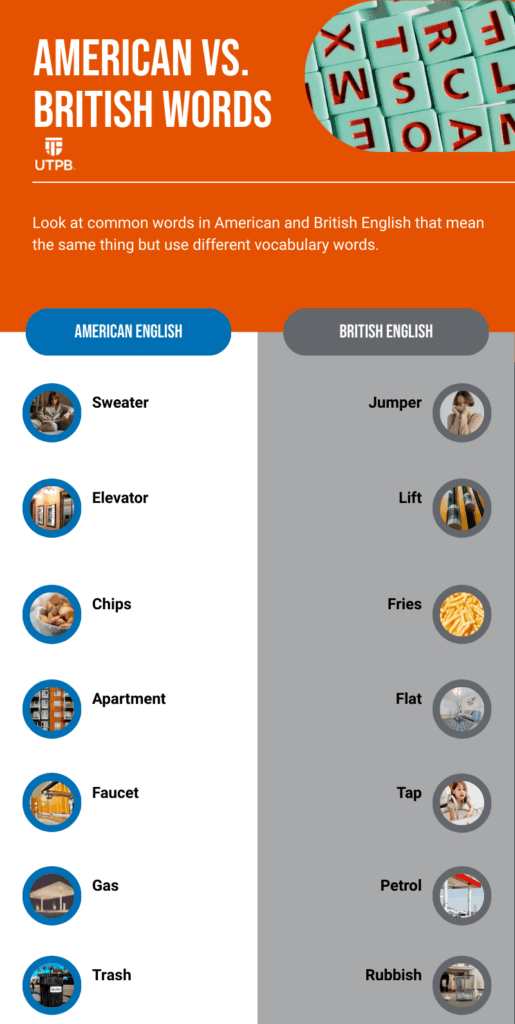
In some cases, words that are commonly used in one variant may be unfamiliar or have different meanings in the other. For example:
Spelling Divergences Between British and American English
British English spelling was inconsistent before the invention of the printing press, as evidenced by Middle English classics like Geoffrey Chaucer’s “The Canterbury Tales,” published in the late 14th century.
British spelling became standardized after Samuel Johnson published “A Dictionary of the English Language” in 1775. In response, Americans created their own standard with Noah Webster’s “An American Dictionary of the English Language” in 1828. Webster aimed to simplify English spelling and reflect pronunciation more closely, likely influenced by the United States’ newfound independence from Great Britain.
British English vs American English: Grammar and Usage Differences
While the basic rules of English grammar remain consistent across both variants, there are subtle differences. British English speakers often use the present perfect tense to describe recent actions with present relevance, while American English speakers commonly use the simple past tense.
An example would be:
British English: “I have just eaten.”
American English: “I just ate.”
Prepositions and collective nouns also often differ slightly between the two dialects. A British speaker may say “at the weekend” while an American says “on the weekend.” In British English, “the team are winning,” while in American English, “the team is winning.”
How British and American English Pronunciation Differs
British and American speakers are easily distinguishable by their pronunciation and enunciation. The most noticeable difference is the use of the letter “r”. Many British accents, especially Received Pronunciation (RP), do not pronounce the “r” at the end of words before consonants (e.g., “car” sounds like “cah”). Most American English accents are rhotic, pronouncing all instances of “r”.
Regional accents can vary, however, and some regions of England (such as Cornwall) use rhotic pronunciation, while some U.S. dialects like the Boston accent drop the “r” sound.
Confused yet? These differences extend to vowels, as well. American English speakers tend to emphasize vowels, while British speakers use different vowel sounds and enunciate the entire word more distinctly. For instance, in British English, “bath” is pronounced with a broad “a” (like in “ah”), while in American English, it has a short, elongated “a” sound.
Common Idioms in British and American English
Idioms reflect cultural differences and historical contexts, so it’s unsurprising that British and American English differ here as well. Some idioms like “break the ice,” which originated from ships breaking through frozen waters, are used in both variants. But most idioms have evolved to incorporate local culture and experiences.
For example:
British English: Tea is a cultural staple in the British Isles, and the idiom “It’s not my cup of tea” (it’s not to my taste) is very common.
American English: Baseball is a popular sport in the United States, and the idiom “ballpark figure” is commonly used to refer to an estimate of cost or quantity, similar to the term “ballpark” referring to a general area or range in baseball.
Explore the Rich Diversity of the English Language at The University of Texas Permian Basin
Are you fascinated by the contextual and historical differences between British and American English? Consider The University of Texas Permian Basin’s two English programs:
Both programs are taught entirely online and cover linguistic differences, literature, and cultural contexts, equipping students with a profound understanding of the English language. While our online MA in English requires a bachelor’s degree, it can lead to higher earnings and opportunities for doctoral studies or a career in law.
Graduates pursue careers in fields like:
Education
Publishing
Communication
Civil services
Advertising
An English degree is incredibly versatile, leading to numerous and diverse opportunities based on your interests and goals. If you’re passionate about the English language and want to explore its rich diversity, take the next step in your educational journey and apply here.
The Age of Johnson was an eighteenth-century period of English literature named for Samuel Johnson (1709-1784), an acclaimed poet, essayist, literary critic, lexicographer, and biographer. Also referred to as the Age of Sensibility, the Age of Johnson was nestled between the Augustan Age—distinguished by writers such as Jonathan Swift and Alexander Pope—and the Romantic period,…
If you’re considering a degree program as an entry point to a rewarding new career or greater earning potential, you have many choices. One path to higher earning potential may surprise you, however. You may have heard from well-intentioned family members or advisors that English is a degree to avoid if future employability and earning…
“Painting is silent poetry, and poetry painting that speaks.” This phrase, first attributed to Simonides from Plutarch’s “Moralia” and later reiterated by the Roman poet Horace in “ut pictura poesis,” holds true even today. Writers have shaped—and simultaneously been influenced by—great works of art throughout history, and sociopolitical and cultural movements started by impactful literary…
While there is legitimate reason for concern about the viability of our national power grid, there are some glimmers of hope as the grid managed to withstand a summer of record high temperatures. And there are some promising ways to preserve our energy resources through storage methods and the strategic use of renewable energy sources.
The key to not burning out our already overburdened power grid and making smarter use of intermittent renewable energy sources is building up energy reserves. But how do you store energy? We’re glad you asked! We’ll discuss a few of the primary energy storage methods below.
The Grid
We use batteries to operate any number of devices in our homes every day, but both the batteries and the devices tend to be small. Grid-scale batteries, however, can be as large as the houses they help supply power to. Yes, batteries—the most common energy storage method—are helping ease the strain on our power grid, and broader, more prudent use and distribution of them may enable us to avert future power crises.
Batteries can store power for later use during spikes in demand, e.g., during heatwaves and cold spells, reducing the likelihood of brownouts and blackouts.
Batteries enable the integration of intermittent renewable energy sources into our energy mix by providing a backup power source when solar and wind resources are unavailable.
Pumped storage hydropower, another means of generating and storing electrical power, involves pumping water back and forth between two reservoirs. The water passes through turbines, creating power, which is then stored and used on demand.
The Green
Most of us are already using a form of thermal energy in our own homes: the water heater, which is essentially a water tank. However, plans are underway to use giant subterranean water tanks to supply energy to entire districts.
The molten salt energy storage method involves temporarily placing hot salt into storage tanks which are also kept hot. The resulting thermal energy is then converted into electricity by using steam turbines.
We Put the Power in Your Hands
Situated in the heart of America’s energy industry, The University of Texas Permian Basin has the distinct advantage of being able to draw on local expertise to create first-in-class energy programs. Our AACSB-accredited online graduate degrees and certificates will help you develop skills and techniques based on the latest advances, prepare you to thrive in leadership roles, and set you apart from competing job candidates:
Allows you to quickly acquire new energy business skills and credentials
Gives you a master’s program preview without committing to a degree
Attainable in as little as two semesters (12 credits)
Save Fuel
Whether you drive a gas-powered vehicle or an electric one, online learning will enable you to save energy by eliminating the commute from your graduate experience. All courses and related activities for these programs are conducted online, and no campus visits are required. That means you’ll save on the commute costs, too.
Because English language learners enter the classroom with different levels of English proficiency, educators often need to adjust instruction to meet students where they are. Teaching strategies such as differentiated instruction, scaffolding, culturally responsive teaching, and ongoing assessment can help students improve in several ways.
Building their language skills? Absolutely. Having a better understanding of academic content and participating more confidently with their peers? That too.
In this article, you’ll learn how these strategies can support English language learners at different proficiency levels to help create a more inclusive, effective classroom environment.
What Are the Levels of English Language Proficiency?
English language proficiency levels describe how well a student can understand, speak, read, and write in English. Because English language learners have different needs, identifying their proficiency levels can help educators provide the right kind of support. Some students may know how to hold a basic conversation, while others may struggle with even the most basic vocabulary.
Proficiency levels vary by state, but in Texas, they include:
Beginning Level Students at this level are new to English. They may understand basic phrases.
Intermediate Level These students can communicate in English but will make frequent errors. They understand more than they can express.
Advanced Level These students can understand and use more complex language structures, engaging in detailed conversations with minimal errors.
Advanced High Students at this level possess near-native proficiency and can engage in complex and wide-ranging topics.
5 Effective Teaching Strategies for English Language Learners
To support English language learners at all stages, educators can use a range of evidence-based teaching methods.From differentiated instruction to culturally responsive teaching, the five techniques below can be adapted based on each learner’s needs and background.
#1 Differentiated Instruction
Differentiated instruction means tailoring teaching methods to meet the individual needs of each student. For beginner students, this might mean the use of:
Visual aids
Simplified language.
For instance, an educator might pair a picture of an apple with the word “apple” to help the student connect the word with its meaning.
Intermediate students can benefit from group work and peer interactions, such as role-playing activities. Advanced students are challenged with higher-level tasks and analytical thinking. Encouraging them to assist peers may help reinforce their own knowledge, for example.
Rather than treating all ELLs the same, it’s vital for educators to determine each individual student’s strengths and needs.
#2 Scaffolding
Psychologist Jerome Bruner first introduced the scaffolding technique in the 1970s. Teachers use this technique to support students before they’re ready to tackle a new educational milestone.
Some scaffolding methods include:
Modeling: Teachers demonstrate tasks, like writing a paragraph, before students perform them.
Think-Alouds: In this strategy, a teacher will solve a problem or read from a text and verbalize their thought process to the student.
Sentence Frames: These sentence starters help students structure their responses, such as: “I think that ____ because ____.” This gives students a framework to use when they form complex sentences on their own in the future.
#3 Concrete and Abstract Concepts
Abstract language involves concepts we can’t directly experience with our five senses, like “freedom” or “love.” In contrast, concrete language uses words we can experience with our senses, like “car” or “music.” Concrete concepts tend to be more immediately relatable to us, which means we tend to learn them much faster in a new language.
Educators help students grasp concrete concepts and gradually introduce abstract concepts through visual aids like:
Venn diagrams
Flowcharts
Mind maps
They may also leverage real-life context by connecting lessons to students’ own experiences.
#4 Culturally Responsive Teaching
While we all come from different backgrounds, ELL students face the additional challenge of acculturating to a new society that may differ greatly from their own. Culturally responsive teaching recognizes and respects the cultural backgrounds of ELL students. A few ways teachers do this:
Incorporating cultural references into lessons, including literature from students’ home countries
Encouraging cultural sharing by allowing students to share their traditions and experiences, enriching the learning environment and building a sense of respect and community
#5 Ongoing Assessments
ELL students have been found to benefit significantly from corrective feedback that’s actionable and specific. In contrast to a simple letter grade, formative assessments help identify specific areas needing improvement. Educators can use quizzes, oral presentations, and class participation to continually gauge students’ understanding.
ESL Teaching Strategies by English Proficiency Level
Ongoing assessments help educators understand where each English language learner is in their journey and what support they need next.
To make this process easier, the following guide outlines effective ESL teaching strategies by English proficiency level. Whether your students are just beginning or nearly fluent, this quick-reference chart can help you adapt instruction to meet them where they are.
Lead the Way in Bilingual/ESL Education With a Master’s Degree
As the number of non-English-speaking households continues to rise, the demand for ESL educators is growing. The University of Texas Permian Basin’s CAEP-accredited online Master of Arts in Bilingual/ESL Education equips you with the skills and knowledge needed to effectively teach and support ELL students.
In this program, you’ll learn to develop and implement innovative strategies, assess language proficiency, and create culturally sensitive learning environments. You’ll study teaching methodologies, language acquisition, and the history and politics of bilingual education while gaining hands-on experience through a full-semester practicum.
Choose from two concentrations:
Master of Arts in Bilingual Education: For educators who will teach in Spanish and English.
Master of Arts in ESL Education: For educators who will teach in English.
Best of all, you can study from the comfort of your home while tackling other commitments.
Texas teachers, here’s the reality: More than half of all K-12 students in the state are Hispanic, and nearly a quarter are enrolled in bilingual/ESL programs. That translates to over a million students who needed specialized language support throughout the 2023-2024 school year. Districts are struggling to find enough certified bilingual and ESL teachers. A critical shortage for schools? Absolutely. But…
Can speaking multiple languages boost your salary? Make travel easier? Even help prevent dementia? The answer is yes. But multilingual societies also face real challenges, from schools struggling with resources to entire languages disappearing. Whether you’re considering learning a second language or wondering how multilingual communities work, this guide covers what you need to know….
Bilingualism can come in handy for travel, work, and personal conversations. But did you know bilingual brains function better and longer? Bilingual people: Impressed yet? Let’s explore the cognitive advantages of a bilingual brain. How Does Being Bilingual Benefit Your Brain? Delayed Cognitive Decline People can stay sharp as they age by reading, playing word…
Why pursue an education in humanities?
Contrary to common perceptions that a humanities degree is less practical than a STEM degree, the skills you’ll develop through a humanities education are crucial for navigating the complexities of today’s world. According to the US. Department of Labor, the most desired soft skills include oral and written communication, collaboration, critical thinking, and problem-solving. In fact, employers today report a lack of these essential soft skills in the job market.
For professionals looking to strengthen these practical and incredibly versatile skills in a competitive job market, there’s no more effective way to take advantage of the soft skills gap than earning a humanities degree. In this article, we’ll explore the impact a humanities education has on two essential life skills: critical thinking and problem-solving.
Cultivating Independent Thought
One of the primary benefits of a humanities education is the cultivation of critical thinking. For example, The University of Texas Permian Basin’s online Bachelor of Arts in Humanities takes a multidisciplinary and well-rounded approach to subjects like:
writing and literature
communication and public speaking
history and culture
foreign languages
music and the arts
philosophy and social sciences
physical sciences
As a humanities student, you’ll learn how to analyze texts, interpret historical events, and engage with philosophical debates. Additionally, you’ll acquire the skills needed to question assumptions, consider multiple perspectives, and evaluate evidence critically. This analytic process promotes independent thought and well-reasoned arguments that can benefit you in countless career paths—and even daily interactions.
You’ll also dive deeply into cultural and social contexts, which is vital for critical thinking and understanding multiple, often controversial perspectives. For instance, in many of our literature courses, you’ll examine characters’ motivations and societal influences, enabling you to better understand the nuances and complexities of human behavior. This kind of skill makes you highly valuable in numerous professional settings.
Solving Real-Life Problems
While we often equate problem-solving skills with technical knowledge, a humanities education teaches you how to navigate and analyze causes and consequences. For example, the study of history involves analyzing past events to understand what happened and come up with solutions to contemporary issues. The ability to creatively draw connections between different fields of knowledge and apply interdisciplinary approaches is a hallmark of a humanities education. This skill is particularly relevant in a world where problems are rarely confined to a single discipline.
Philosophy courses, with their focus on logical reasoning and ethical dilemmas, further enhance your problem-solving and reasoning abilities. By engaging with complex questions and developing coherent arguments, students learn to approach problems methodically and creatively. This skill is essential for careers that require innovative thinking, leadership, and strategic planning.
Versatility and Career Diversity
As a humanities student, you’ll certainly reap the communication and analytical skills that can ease your navigation of day-to-day problems. But these versatile skills can also open doors to a wide range of careers. The ability to think critically and solve problems effectively are highly valued in fields such as:
law
education
journalism
public service
Humanities majors are not limited to academic or cultural institutions but can also thrive in business, technology, and healthcare industries.
Excel in Multiple Fields With an Online UTPB Humanities Degree
By fostering an understanding of cultural and social contexts, encouraging interdisciplinary approaches, and promoting versatile skill sets, a humanities education can be an invaluable asset in an increasingly complex world. In fact, LinkedIn lists some of the top workplace skills in 2024 as adaptability, communication, problem-solving, and research: all skills you’ll develop with a humanities degree.
Flexible Online Learning
The University of Texas Permian Basin’s online Bachelor of Arts in Humanities offers a well-rounded and comprehensive education that equips you with skills highly valuable in a competitive job market. Take it from one of our humanities graduates:
“I am confident that the valuable education I receive here from the incredible professors will serve me in my profession as an educator and law student.”
Our graduates work in diverse and reputable companies, such as:
NASA
Dell
Fidelity Investment
Apple
Best of all, you can study from anywhere in the world, on your own terms: Classes are synchronous and entirely online.
Become an invaluable asset in today’s world with a humanities degree. Apply here.
Federal government shutdowns. The words are meant to stoke fear in the average American. They represent a concerning but largely avoidable annual tradition of political brinksmanship between the two major U.S. political parties. Threatening a government shutdown is often used as a negotiation tactic to push the political priorities of a single party, who are quick to blame the opposition for their lack of cooperation if any shutdown should occur.
What Is a Government Shutdown?
The federal government is funded to operate in annual increments, and each year Congress must agree on a budget and pass 12 appropriations bills to keep it running. Any “nonessential” government functions stop unless Congress enacts those bills by September 30—the end of the fiscal year. If they aren’t enacted, nonessential government offices, national parks, and monuments may close; federal workers may be furloughed; and some corresponding services may be suspended.
Even if some of the 12 appropriations bills are passed, however, partial shutdowns are still possible. Essential government employees must continue to work without pay during partial or total shutdowns. This is obviously problematic for them, because like anyone else, they need to continue to pay for their mortgages, childcare, utilities, groceries, and other common expenses.
Has It Ever Happened?
Four federal government shutdowns of different lengths have occurred under three different presidential administrations since the mid-1990s. No significant disasters have resulted from these shutdowns, but some problems and inconveniences certainly did. During the shutdown spanning late 2018 and early 2019, security lines at airports swelled as unpaid TSA agents called out sick in record numbers. Terminals at some major airports even closed.
When government shutdowns happen (or even simply loom), politics is often at the center. Fortunately, outside of the political realm, responsible management of budgets and finances can be far less contentious, and financial management can even become the focus of a rewarding career.
Responsible Financial Management Begins With an MBA
If keeping a close eye on financials is a critical part of your chosen career, The University of Texas Permian Basin’s online MBA program is a good place to hone your expertise. In courses including Financial Management, Corporate Finance & Strategy, and International Finance, you’ll discover how business organizations operate from a prudent financial perspective.
Why UTPB’s online MBA program makes good financial sense for you:
We have some of the most affordable tuition rates among accredited universities of our stature.
U.S. News & World Report ranks us among its Best Value Schools for 2024.
Master’s degree holders aged 25 or older have median earnings about 16% higher—more than $12,000 annually—than those who hold a bachelor’s degree alone.
Online learning enables students to save on commuting costs while earning a degree on a flexible schedule from anywhere in the world.
UTPB’s accolades speak to the quality of our education:
Our MBA program is AACSB-accredited, an honor shared by only 5% of business programs worldwide.
We’re a proud part of the renowned UT System, a distinction that can stand out on a resume.
Political parties play a central role in how American policies are created, debated, and carried out. At their core, each party contains groups of people who share broad viewpoints on major issues and work to turn those ideas into laws. They recruit candidates, organize voters, help the government run, and shape the direction of national and local policy.
While the United States has two major parties, several smaller parties and independent candidates also influence elections and public debate. Below, we break down what political parties do and how they shape policy and governance. What Do Political Parties Do?
If you’ve ever wondered “what is the role of political parties?” you’re in the right place. Political parties help organize American government at every level. But to understand how parties function, it helps to look at the core responsibilities they carry out within our political system.
How Political Parties Shape Government Policy
Political parties, often working with think tanks, develop policy platforms that outline where they stand on major issues. These platforms also clarify the purpose of a political party, helping voters understand what each group represents.
When their candidates win elections, those platforms become the basis for the policies they try to move forward. Putting these ideas into law takes negotiation and compromise, and progress can slow—or stop entirely—when other lawmakers or the public oppose a proposal.How Political Parties Organize Elections and Candidates
Before enticing voters, however, parties must attract suitable candidates to represent their ideology. After taking office, these individuals ideally continue to represent the interests of their supporters. Their roles involve performing the balancing act of representing their broader constituency, which may include people who don’t support them.
How Parties Influence the Lawmaking Process
Lawmakers turn a party’s platform into actual bills through the legislative process. They rely on support from fellow party members and, often, on cooperation from lawmakers in the opposing party.
Compromise is common, especially when no single party holds full control. When a party does have a strong majority in the House or Senate, it gains significant influence and can advance legislation even when there is partisan disagreement.
Checks, Balances, and How Parties Work in Congress
Designed to provide checks and balances to governmental authority, the two houses of Congressshare the lawmaking duties but must come to a consensus to pass laws.
There is a clear division of labor:
The House alone can originate revenue bills, impeach federal officials, and elect the president if there’s a tie in the Electoral College.
The Senate oversees approval of presidential cabinet and judicial nominees, authorization of treaties, and management of the federal budget.
How Parties Communicate With the Public
Political parties try to rally support around specific issues, appealing to their own senators and representatives as well as those of opposing parties (“reaching across the aisle”). Public outreach efforts sometimes take the form of rallies, town halls, and talk show appearances.How Parties Coordinate Within Congress
Political parties regularly hold caucus meetings to make sure all their members are aware of key legislation and concerns. These meetings also help build unified support for the party’s policy positions.
Advance Your Understanding With Our Online Political Science Degree
If you’re interested in understanding these processes more deeply, a formal education in political science can provide the broader context behind how parties and institutions shape U.S. governance.
The American political system as viewed through an international lens
Some students use our online political science degree as a stepping stone to law school and a legal career, while others pursue roles in government, education, and private business.
Ready to deepen your understanding of the political system? Explore how UTPB’s online BA in political science can support your academic and professional goals.
From Congress to the White House to the Supreme Court, America’s political institutions shape every part of our lives. They decide how much you pay in taxes, whether your vote counts, and what rights you have. But are they working the way they’re supposed to? What Is a Political Institution? Political institutions are the organizations…
When people picture women who reshaped American politics, Ruth Bader Ginsburg often comes to mind first—and for good reason. RBG changed how the law sees gender equality from the inside of the Supreme Court. But here’s the thing: she wasn’t in Congress. Long before women were reliably winning elections—long before it was even legal for…
Ever wonder how elections actually work? The answer lies in electoral systems. Not to be confused with the Electoral College, an electoral system is a set of rules for casting and counting votes and determining who wins. Different countries use different methods to choose their leaders. Some systems can declare a winner with just 34%…
Imagine stepping onto a factory floor where robotic arms work with laser precision, smart sensors detect issues before they happen, and AI keeps production running without a hitch. This isn’t science fiction. It’s the reality of today’s industrial world.
As robots take on risky and time-consuming tasks, they’re not just transforming how we manufacture. They’re also making work safer, faster, and smarter.
Let’s take a look at how advancements in robotics are transforming our industrial landscape.
How Industrial Robots Evolved Over Time
The use of robots in industrial settings is hardly a new concept. The first industrial robot was the Unimate 001, sporting a six-foot robotic arm on a two-ton machine..
Industry 4.0, or the Fourth Industrial Revolution, marks the transition of factories into a digitalized, automated workspace. At the heart of this shift are robots that streamline operations, increase output, and reduce downtime.
One of the most impactful developments? Collaborative robots, or cobots.
What Are Cobots?
Unlike traditional industrial robots that operate behind safety cages, cobots are designed to work alongside humans, enhancing our capabilities and efficiency. They can handle repetitive, physically demanding, and sometimes impossibly precise tasks, which allows their human co-workers more time for the more complex and creative aspects of their work.
Some examples of cobots that work in industrial settings are:
Amazon’s Kiva Robots These machines enable faster order fulfilments and efficient inventory management.
Tesla’s Robotic Arms These machines allow for faster car manufacturing with minimal errors.
Robots can work continuously without breaks, which improves output and adaptability and enables companies to meet ever-increasing consumer demand.
How Robots Are Making Workplaces Safer
The industrial sector once meant dangerous environments in which laborers toiled from dusk till dawn in toxic conditions, prone to numerous and even fatal injuries. Robotics have improved safety significantly. Machines can take over dangerous, repetitive, and remote tasks, ensuring a safer environment for human workers.
For example, the Semi-Automated Mason (SAM), deployed in the construction industry, has the capability to safely and efficiently lay bricks, sparing a human performing the same workload from possible injuries.
Chemical plants and nuclear facilities, notoriously dangerous and toxic environments, employ robots to perform inspections and maintenance tasks that would otherwise be perilous to humans. Drones perform aerial inspections of high structures, pipelines, and power grids to find errors and anomalies early. Autonomous robots are equipped with sensors that can pinpoint things the human eye can’t see, enabling early detection and timely interventions.
What’s Next for Industrial Robotics?
Advancements in robotics are currently driven by advancements in artificial intelligence, machine learning, and sensor technology. As AI is increasingly integrated into robots, these systems become more intelligent and autonomous, capable of learning and adapting to new tasks.
Unplanned downtime costs Fortune Global 500 industrial companies nearly $1.5 trillion a year: about 11% of their total revenue. Fortunately, the Internet of Things (IoT) is ushering in more connected and data-driven robotic systems that can communicate with each other and their central control systems. As this technology progresses, robots can perform real-time monitoring and predictive maintenance, creating a truly interconnected, resilient operation.
So, what do these advancements in robotics mean for you? As the industrial landscape evolves, industrial workers will need to acquire new skills to work effectively alongside these advanced systems. This includes skills in:
Programming
Artificial intelligence
Machine learning
Data analysis
Frequently Asked Questions About Robotics in Industry
As robotics and automation transform industrial environments, here are a few common questions (and quick answers) you may have.
Which technological improvements did the industrial robot bring? Industrial robots introduced precision automation, allowing for faster production, fewer errors, and improved worker safety.
How do robots improve productivity in factories? Robots operate 24/7 without breaks, handle repetitive tasks efficiently, and reduce downtime through predictive maintenance.
Are industrial robots replacing workers? Not exactly. Cobots and AI-driven systems are designed to work with humans, handling routine or hazardous tasks while workers focus on higher-level thinking and creativity.
Propel Your Career With a Degree in Industrial Technology
To thrive in industrial technology, understanding robotic systems is vital. The University of Texas Permian Basin offers online programs to equip you with these essential skills:
Bachelor of Science in Industrial Technology This program offers a deep focus on technical and engineering principles to prepare you for roles like industrial engineer and general and operations manager.
These programs cover robotics, automation, and systems integration, preparing you to lead and innovate. Both are entirely online and asynchronous, so you can study at your own pace.
Ever check the tag on a t-shirt or appliance and see “Made in China” or “Made in Mexico”? Soon, you may be seeing more tags labeled “Made in the USA.” Today, there’s a reshoring trend that’s reopening factories, strengthening American manufacturing, and creating new opportunities for businesses and workers. As more companies move toward domestic…
Ransomware, phishing, viruses: If it’s connected to the internet, someone’s probably trying to hack it. Threats are everywhere in today’s digital world, and now that factories run on smart technology, it’s not just laptops at risk. Industry 4.0 has moved manufacturing from traditional methods to smart, automated systems (think robots and sensors on the factory…
Imagine a factory where machines, robots, and sensors are all talking to each other, like nerves sending signals to a brain. Before a human notices anything, the system’s already flagged a motor that’s starting to lag and adjusted a product’s assembly in seconds. This is connected manufacturing in action. Today’s smart factories run on connected…
As hurricane season ramps up, people in affected parts of the country and the world are once again thinking about how to prepare for the prospect of a big storm impacting their lives. GIS systems are central to the efforts public officials, first responders, meteorologists, and others make in managing crisis situations, including hurricanes, earthquakes, floods, and wildfires. Here we’ll discuss how they’re harnessing these tools.
Benefits of GIS Applications Before, During, and After Disaster Strikes
Here are some ways GIS is aiding in disaster management:
GIS is used to identify areas at riskfor natural disasters such as floods, earthquakes, hurricanes, and landslides and predict the impact of these disasters on the local population and infrastructure.
GIS enables officials to pinpoint shelter locations, identify ideal evacuation routes, and allocate resources where they are needed most.
GIS technology empowers users to run simulations of potential disaster scenarios to aid in the training of emergency personnel.
GIS helps project potential damage before a disaster, assess the extent of the destruction after it occurs, and prioritize rescue and reconstruction efforts.
GIS collects data from sensors and monitoring systems to providereal-time information on potential hazards, enabling officials to alert the public about developing and imminent dangers.
Long used for map creation, GIS technology is the source of maps and other informative materials officials distribute to show the public where floods are most likely to occur and whether they’re living in an evacuation zone.
GIS enables utility companies to locate service outage areas and prioritize their restoration efforts to those locations.
GIS offers officials a way to reduce the risk of crises and their subsequent damage when such crises may be within human control.
GIS helps officials assess the possible impact of disasters on natural resources, woodlands, and wetlands so they can take steps to mitigate damage.
Map Out Your Own Plan for Greater Career Mobility
A broad range of career fields rely on GIS applications, including government, finance, telecommunications, real estate, healthcare, and insurance. Whether you aspire to move into a field where GIS is used or simply want to expand your resume to qualify for advancement, we have an online program designed to help you.
The University of Texas Permian Basin’s 12-credit online graduate GIS and Geospatial Certificate introduces you to the technology, principles, and practices of GIS through courses that provide valuable hands-on experience with common GIS applications. Build expertise that will benefit you in disaster management and beyond.
Here are some of the reasons you should consider our 100% online GIS graduate certificate program:
Earn your certificate after completing just four eight-week semesters.
Take courses in any order that’s convenient for you.
Access our 100% online, asynchronous courses from any location, 24/7.
Maintain your professional and personal commitments.
Stage fright is more common than you might think. Millions of people struggle with public speaking skills, and the fear even has a name: glossophobia.
Being asked to speak in front of others can trigger a fight-or-flight response, especially when you feel unprepared or exposed. The good news? Effective public speaking is a learned skill, and with the right techniques, it becomes easier over time. ome people even enjoy it.
Below, we break down what effective speaking really means and how to improve public speaking skills with practical, research-backed strategies.
What Is Effective Public Speaking?
Effective public speaking is the ability to communicate ideas clearly, confidently, and in a way that engages your audience. It combines preparation, audience awareness, and delivery techniques, along with strategies that help reduce anxiety and make your message more impactful.
In other words, it’s not about being perfect; it’s about speaking effectively so your message lands.
8 Techniques to Improve Public Speaking
You may not gain the public speaking chops of Dr. Martin Luther King Jr. or Barack Obama overnight, but the right techniques can help you feel more confident and communicate more effectively.
1. Shift Your Mindset
Many people approach public speaking as a performance, worrying about how others might judge them. A more effective approach is communication-oriented thinking, which treats your speech like a conversation focused on sharing ideas rather than delivering a presentation.
This mindset shift alone can significantly reduce anxiety.
2. Prepare with Purpose
Strong preparation is one of the most effective public speaking techniques. Structure your speech with a clear beginning, middle, and end, and plan your timing carefully. Visual aids can support your message and keep your audience engaged.
3. Practice to Build Confidence
Practice is one of the most reliable methods to improve public speaking. Rehearse out loud, record yourself, or practice in front of a trusted audience. Familiarity can reduce nerves and improve delivery.
4. Use Confident Body Language
Your posture, eye contact, and vocal tone all influence how your message is received. Standing tall, slowing your pace, and maintaining eye contact help you appear—and feel—more confident.
5. Know Your Audience
Effective speaking requires understanding who you’re addressing. Consider your audience’s background and expectations any questions they may have. Tailoring your language and examples helps your message resonate.
6. Calm Your Nerves
Public speaking anxiety is rooted in the body’s stress response. Techniques like visualization, positive self-talk, and box breathing can help regulate nerves before and during a presentation.
7. Practice in Real-Life Situations
The more often you speak publicly, the easier it becomes. Repeated exposure can strengthen confidence and reinforce public speaking skills through experience.
8. Learn from a Mentor
If anxiety persists, working with a mentor or instructor can accelerate improvement. Feedback and guidance help refine speech technique and build long-term confidence.
Frequently Asked Questions About Public Speaking
What are the most effective public speaking techniques? Preparation, regular practice, confident body language, and audience connection are among the most effective techniques of public speaking.
How can I improve my public speaking over time? Consistent practice, feedback, exposure to real speaking opportunities, and formal training all help improve public speaking skills.
What is effective speaking? Effective speaking means delivering a clear, organized message in a way that engages listeners and achieves your communication goal.
Strengthen Your Communication Skills With a Degree
If you’re interested in developing professional communication skills, The University of Texas Permian Basin offers a fully online Bachelor of Arts in Communication. The program includes coursework in public speaking, interpersonal communication, and persuasive messaging: skills that translate across industries.
Graduates pursue careers in public relations, journalism, leadership, politics, and more. If you’d like to explore how a communication degree can support your personal and professional goals, learn more about UT Permian Basin’s online Bachelor of Arts in Communication.
Picture Martin Luther King Jr. standing on the steps of the Lincoln Memorial, delivering his “I Have a Dream” speech to over 250,000 people gathered for the March on Washington. Could he have known, in that moment, that his words would terrify some, inspire many more, and echo across decades of social movements? King and…
You can speak the same language as someone and still completely miss each other’s meaning. That’s part of what makes intercultural communication so important. Whether you’re working with international teams, studying abroad, or connecting with people from different backgrounds, communication involves more than just choosing the right words. Intercultural communication is how people from different cultures share ideas and make sense of one…
AI is now an inseparable part of our classrooms, homes, and offices. Capable of performing trillions of calculations in a second, AI-powered machines dredge the depths of the internet to find and convey information in any style, language, or difficulty level. But don’t worry, AI is only here to lend a hand. At least, that’s…
Anyone in a position of power can face ethical dilemmas. Effectively handling these challenges is central to maintaining a career and the respect of your employer—particularly when your employer is the tax-paying public, and you’re spending their money.
Here we’ll discuss some of the ethical concerns public administrators may face. We’ll also provide some suggested strategies that can benefit both the public and your personal career longevity.
Issue: Unethical Behavior
Identifying and addressing corrupt, fraudulent, or otherwise unethical behavior may be one of the most difficult duties a public administrator has, but it’s also among the most crucial.
Strategies
Establish and enforce strong whistleblower protections to encourage reporting of unethical behavior.
Implement robust auditing and oversight procedures and tools to detect and prevent such behaviors.
Offer recurring, mandatory ethics training to employees.
Lead by example.
Issue: Conflicts of Interest
A public administrator may encounter situations in which their personal interests or relationships conflict with their professional duties.
Strategies
Disclose conflicts of interest to appropriate parties or departments.
Recuse yourself from decision-making processes in these situations.
Institute and adhere to policies regarding conflicts of interest.
Issue: Public Accountability
At times a public administrator may have to answer to the public for actions that they or members of their department took.
Strategies
Keep communication channels open with the public.
Ensure the public knows you take public concerns and feedback seriously.
Be as specific as possible, e.g., use empirical data and statistics, when justifying actions.
Make maintaining integrity top priority.
Issue: Maintaining Transparency
A public administrator builds trust through transparency, but there are some instances when confidential information must be protected.
Strategies
Follow all legal requirements regarding transparency and confidentiality.
Adhere to ethical guidelines and organizational policies on information sharing.
Endeavor to balance the public’s right to know with the need to protect sensitive information.
Issue: Allocation of Resources
It’s common for a public administrator to have to allocate limited resources among various competing needs and groups.
Strategies
Focus on fair and equitable ways to distribute resources, keeping in mind where the greatest needs are and what will make the broadest positive impact.
Seek input from all interested parties before making allocation decisions.
Develop and implement transparent criteria and processes in resource allocation.
Issue: Conflicts Involving Personal Beliefs
A public administrator may have to implement policies that conflict with their personal beliefs or values.
Strategies
Maintain a professional attitude and consider the public interest over personal beliefs while implementing policies.
Push for policy changes through official channels if you believe a policy may be unethical or harmful.
Request advice on the matter from managers and other leaders within and outside the department.
Build a Foundation for an Ethical, Rewarding Career in Public Administration
If you have a public leadership role in mind, The University of Texas Permian Basin’s online Master of Public Administration (MPA) provides an opportunity to build the skills and knowledge you’ll need to excel in the public and nonprofit sectors—or move from one to the other.
Our program curriculum empowers you with the management savvy to address organizational challenges and policy questions with practical, proficient, ethical, legal, and politically astute approaches, all while advancing your fundamental goal of serving the public interest.
If you’re passionate about ethics, you may be interested in these online MPA program courses: