3 Reasons Bilingual/ESL Education is a Great Teacher Career Pathway
Chances are you’re already a certified classroom teacher or well on your way to becoming one. So why go through the trouble of earning a master’s degree in bilingual/ESL (English as a second language) education? How about the chance to help a growing generation of students learn a new language that’ll increase their chance of academic, personal and professional success?
Two teacher career pathways lie before you: ESL and bilingual education. The right pathway for you depends on your goals and skill set, but teachers who speak a foreign language should choose bilingual education.
ESL Education Pathway
Students and teachers may not always speak the same language — sometimes figuratively and sometimes literally. ESL classrooms are composed of immigrants, international students, and other students who speak a native language other than English. Almost 750,000 grade school students in the 2020-2021 school year—about one in five Texas grade school students—were English language learners.
Intimidated by the thought of speaking a different language than your students? Don’t be.
English is the only language spoken in an ESL classroom. You’ll teach essential school subjects while helping students read, write, and speak English. At those moments when students are frustrated, unsure how they can possibly learn a new language, you’ll be there to help. An MA in ESL program will teach you how.
Bilingual Education Pathway
Speaking a foreign language has its perks.
As a bilingual educator, you’ll teach students in both English and their native language, usually Spanish. Not only will your students receive a high-quality education, they’ll also have the best chance of becoming fluent in both languages.
Consider how speaking a foreign language has helped you in your career. Now, imagine each and every one of your students gaining that same advantage.
You don’t have to speak Spanish to succeed as an ESL or bilingual educator, especially if you choose to earn an MA in ESL education. If, however, you do pursue a career in bilingual/ESL education, your classroom will likely be filled with students from Mexico, Cuba, and other Spanish-speaking countries, regardless of the teacher career pathway you choose.
2. Career Advancement
An analysis of teacher vacancies revealed that most U.S. states are experiencing some degree of teacher shortage. If you haven’t experienced the effects of the teacher shortage firsthand, you undoubtedly know those who have.
Schools are looking for teachers who specialize in more than one subject area, since this lends educators added versatility in school districts scrambling to fill open roles. Graduate with an MA in bilingual/ESL education and an ability to teach English language learners (ELLs) and you’ll hold a great deal more bargaining power.
3. Earn a High Salary
Teacher salaries may seem respectable from the outside looking in. If teachers were fairly compensated for time spent grading, creating lesson plans, supporting students, and speaking with parents, however, they’d be paid like kings and queens.
Teachers who earn a master’s degree in bilingual/ESL education can increase their earning potential, especially in Texas.
Created in 2019, the Teacher Incentive Allotment (TIA) offers the opportunity for educators like you to earn a six-figure salary. Participating school districts receive funding allotments of $3,000–$32,000 per designated teacher, 90% of which must go to teachers’ salaries. “It puts [teachers] on a playing field with other high-paying professions and allows teachers to stay in the classroom and receive high compensation,” said John York, chief human resource officer for Longview ISD in Longview, Texas.
Although only in effect in select school districts, TIA is a prime example of how experience and a prestigious degree can help teachers receive the pay they deserve.
Earn Your Master’s Degree at UT Permian Basin
UT Permian Basin offers an online MA in bilingual/ESL education program that can help you advance your career and make a difference in the lives of ELLs. With its flexible online format, our program allows you to pursue your degree while you continue teaching in your current position. Earn your master’s degree without ever leaving the classroom!
Choose from one of two concentrations:
Master of Arts in ESL Education
Learn how to foster an inclusive learning environment for immigrants, international students, and other ELLs from all walks of life. Courses like Methods of Teaching ESL will teach you how to overcome language, cultural, and learning barriers in the classroom.
Master of Arts in Bilingual Education
Learn what it takes to be a pillar of support for students who speak a native language other than English. Courses like History and Politics in Bilingual Education will help you keep up with current trends and identify the best instructional models to use when working with ELLs.
Imagine yourself 10 years from now. What does your nursing career look like? After years of hands-on patient care, are you ready to step into a more advanced and impactful role? With so many advanced nursing roles to consider, finding the right path can be challenging.
If you’re dedicated to elevating the quality of care for your patients, the role of clinical nurse leader (CNL) might be the perfect fit for you. While you may not be directly interacting with patients as often, you’ll play a crucial role in guiding your team and ensuring they deliver exceptional care.
Today, we’ll explore what it means to be a clinical nurse leader, including the responsibilities of the role and what a typical day on the job looks like.
What Is a Clinical Nurse Leader?
The role of a clinical nurse leader was created by the American Association of Colleges of Nursing (AACN) in 2007 to improve patient care outcomes. Initially, CNLs worked primarily in acute care settings, such as intensive care units and emergency departments, which focus on treating severe and immediate medical conditions. Over time, CNLs have expanded into other areas, including primary care, hospice, and long-term care.
According to the AACN, CNLs are master’s-prepared RNs who collaborate with a team of healthcare providers, including physicians and nurses, to ensure seamless patient care across different departments. Their primary goals are to improve the quality of patient care, reduce patient costs, and lower the chances of patient readmission.
What Are a CNL’s Primary Responsibilities?
A CNL’s responsibilities vary depending on their work environment and the unit they oversee, but generally consist of the following:
Managing and coordinating patient care.
Implementing evidence-based practices.
Ensuring patients receive the latest advancements in care.
Monitoring and evaluating patient outcomes.
Assessing the risk within patient groups.
Working with various departments to create and update patient care plans.
A Day in the Life of a Clinical Nurse Leader
Curious about what it really means to be a CNL? Step into the role for a day and experience the busy yet rewarding life of a clinical nurse leader:
Check in with nursing staff As the CNL of a 30-bed oncology unit, you oversee all patient care within the unit. Your day begins with a meeting with the nursing staff to address any immediate concerns or questions they might have about their patients.
Participate in the daily discharge planning meeting Next, you attend the discharge planning meeting to review patient discharges for the day. Collaborating with social workers and physicians, you identify patients with complex discharge needs and discuss strategies to prevent readmissions. This recent intervention, which you implemented, has successfully reduced patient readmissions by 30% over the past six months.
Conduct rounds You check in with nursing staff, their patients, and family members to ensure there are no complications and that each patient is receiving quality care.
Improve patient outcomes After a late lunch, you dedicate time to a new evidence-based intervention. Today, you’re working on the initial phase of implementing an anti-fall training program designed to reduce the number of falls in your unit.
Lead a training session Later that afternoon, you lead a team of nurses on a training that focuses on advanced techniques in patient communication.
Run a final team debriefing Before leaving, you conduct an evening huddle with the nursing staff on duty to recap the day’s events. You take the opportunity to acknowledge the team’s accomplishments and discuss any ongoing challenges they encountered.
Your Path to a Leadership Role in Nursing Starts at UTPB
In 2017, there were 5,500 clinical nurse leaders in the United States, and that number has continued to grow. If you’re interested in becoming a CNL, the first step is earning your Bachelor of Science in Nursing (BSN). After that, you’ll need to complete a Master of Science in Nursing (MSN) and pass the CNL certification exam.
If you’re an RN looking to pursue your BSN and potentially move into a leadership role, UTPB offers a 30-credit online RN to BSN program tailored for working RNs like you. We value your time and know how busy the role of a nurse can be, so only two of our clinical classes require an in-person format, where you’ll work alongside a local nurse preceptor of your choice. This flexible format allows you to hone your skills and prepare for more advanced future roles. The rest of your coursework is asynchronous, so you can complete it on your own schedule.
Ten years will have passed before you know it. Where will you be?
Take the first step toward your future and apply today.
Halloween is the perfect excuse to grab some popcorn, turn off the lights, and binge some scary movies. You know, the one with the hockey-mask wearing slasher, the chainsaw-wielding hillbilly, or the space alien with acid for blood.
Maybe keeping the lights on isn’t such a bad idea after all.
There’s an undeniable thrill to being scared, though not everyone might agree. For some, the very thought of watching a horror film, stepping into a haunted house, or embarking on a ghost tour is a definite no-go. So, what draws so many of us to these hair-raising experiences?
The Psychology of Fear
Fear is a profound motivator, designed to trigger defensive behaviors or escape responses when we encounter specific stimuli. Essentially, the sensations we identify as fear are physical and emotional reactions to perceived threats.
For our ancestors facing dangerous predators, treacherous terrain, and severe weather, fear was vital to survival. Today, our fear response can kick in at less opportune moments—like experiencing a panic attack before a public speech. However, when the conditions are right, fear can be thrilling.
Why We Seek Out Scares
The reasons we seek out frightening experiences are as diverse as they are fascinating. Let’s explore some of the key psychological factors that drive our attraction to fear-inducing situations.
To Engage in Extreme Experiences Safely
Often, we can’t control what makes us feel afraid, such as an unexpected jump scare in a cheesy horror flick. But our brains are quick to realize that, while startling, these scares are not real threats. Once our mind realizes we’re safe, we can relax and enjoy the adrenaline rush.
To Feel a Rush Like No Other
When we feel fear, our bodies undergo a physiological change that prompts a behavioral response—this could be fight, flight, or freeze. Our amygdala signals our adrenal glands to release cortisol and adrenaline, spiking our dopamine and endorphin levels. Our heart rate increases, pupils dilate, and senses sharpen. This biochemical rush can be pleasurable, especially when we know we’re safe, allowing us to revel in the euphoria.
To Release Pent-Up Emotions
Throughout life, we’re encouraged to control our emotions and keep our feelings in check. Fear, however, gives us a socially acceptable way to let loose—screaming our way through a haunted house or cursing at the movie screen after a jump scare. Such activities provide a healthy outlet to release pent up emotions, helping to alleviate stress and anxiety.
To Bond Over Frights
Experiencing fear in a group can amplify emotions. Anyone who’s sat through a horror movie on a packed night knows what we’re talking about. This shared euphoria can strengthen bonds with others, as fear can foster a sense of closeness and camaraderie. There’s nothing like trauma bonding to cement a friendship!
To Overcome the (Seemingly) Impossible
Confronting and overcoming fears can be deeply satisfying and empowering. For example, someone afraid of spiders might feel immense pride after watching the classic horror comedy “Arachnophobia.” (Again, watch with the lights on.)
To Indulge Our Curiosity
Many scares await inside a haunted house, but that’s not going to stop anyone who’s the least bit curious about what lurks beyond the threshold. Humans are naturally curious; we want to learn more about the world so that we can make better sense of it. This drive to understand the unknown propels many of us to seek out frightening experiences, even if it means venturing alone into a haunted house.
Face Your Fears
There’s one last fear that many never overcome—one so terrifying we hesitate to mention it:
The fear of attending college.
Many potential students tremble at the thought of the time, money, and resources it must take to earn a degree. Fortunately, The University of Texas Permian Basin offers a flexible online Bachelor of Arts in Psychology program that addresses these fears head-on:
No commuting: Never step foot on campus.
Manage social anxiety: Connect with fellow classmates from a distance.
Flexible scheduling: Explore courses that fit your lifestyle and responsibilities.
Affordable learning: Attend one of the most affordable colleges in the University of Texas System.
UT Permian Basin’s online BA in psychology program will take you on a comprehensive exploration of the human mind. Explore not only the psychology of fear but also all emotions that influence human behavior. With focus areas in clinical, developmental, forensic, and health psychology, you can tailor your education to your passions.
What is it about horror stories that’s so captivating? More than any other literary genre, horror has the power to leap off the page, sending shivers down our spines and turning shadows into lurking dangers. It brings us to the darkest corners of our minds, where our deepest fears live.
Journey with us beyond the sparkling vampires, scarred wizards, and eternal faeries of modern horror fiction and dive into the chilling narratives that birthed an entire genre. This is your guide to the history of horror literature.
What Is Horror Fiction?
The horror genre is best defined by the emotions it seeks to evoke: shock, disgust, and above all else, fear. While it often shares supernatural and fantastical elements with other genres—such as ghosts, witches, vampires, or werewolves—horror wields these elements with the singular purpose of eliciting feelings of dread and suspense.
If you’re reading a passage that makes you feel as if the terrifying events depicted on the page could happen to you, chances are you’re reading a piece of finely crafted horror fiction.
The Origins of Horror Literature
Horror stories have always captivated the imagination. Take, for instance, the “Epic of Gilgamesh,” a Mesopotamian odyssey that dates to 2100 B.C. and weaves supernatural elements into its narrative. But the horror genre as we know it began to take shape with the publication of Horace Walpole’s 1764 novel, “The Castle of Otranto.”
A work of gothic fiction, “The Castle of Otranto” follows the royal family of Sicily as they attempt (and fail) to divert an ancient prophecy, mixing supernatural elements and realistic characters to create a fantasy grounded in reality.
Just as a werewolf is transformed by the light of a full moon, the horror genre has undergone its own metamorphosis over the centuries. Early works featured many of the dark tropes we’re familiar with today: villainous men and supernatural beings set against grim, oppressive backdrops. However, the 1818 publication of “Frankenstein” marked a pivotal shift in the genre.
Horror Refined
With “Frankenstein,” Mary Shelley introduced a new element to horror: the terror of pseudoscience. Her novel features a grotesque creature—intelligent yet monstrous, brought to life by science—who seeks revenge against its creator. (Can you believe Shelley was only 19 when she penned the novel?)
This chilling narrative captivated readers and inspired a generation of writers, including Edgar Allan Poe. Poe further refined and popularized the genre. His short stories, such as 1839’s “The Fall of the House of Usher,” infused the horror genre with his unique blend of macabre and psychological terror. The visionary works of Shelley and Poe defined horror literature, setting the stage for centuries of thrilling storytelling.
The subsequent decades produced numerous seminal works that have stood the test of time:
1860’s “Woman in White” and 1868’s “The Moonstone” by Wilkie Collins
1863’s “The House by the Churchyard” and 1872’s “Green Tea” by Sheridan Le Fanu
1886’s “The Strange Case of Dr. Jekyll and Mr. Hyde” by Robert Louis Stevenson
1890’s “The Picture of Dorian Gray” by Oscar Wilde
1897’s “Dracula” by Bram Stoker
1898’s “The Turn of the Screw” by Henry James
Modern Horror Literature
The horror genre boomed in the 20th century, giving rise to new subgenres like paranormal, occult, dark fantasy, survival, and science fiction horror. The genre began to feature contemporary trappings, such as serial killers and slasher stories, presenting a dark reflection of modern society.
Standing on the shoulders of literary giants, modern horror authors continue to terrify readers. H.P Lovecraft, for instance, merged elements of science fiction and horror to give us “The Call of Cthulhu” and “At the Mountains of Madness.” His stories invite readers to peer beyond the veil of reality, where horrors are ancient and alien. Stephen King, a master of modern horror, can twist the ordinary and mundane into the terrifying, as anyone who’s read “The Shining” or “Pet Sematary” knows.
We also celebrate contemporary voices like Stephen Graham Jones, Jonathan Maberry, and Silvia Moreno-Garcia who continue to bring us fresh horror literature. These writers ensure that the horror genre not only remains relevant but also evolves and captivates new generations of readers.
A Taste of What’s to Come
We hope you’ve enjoyed this look back at the origins of horror literature. Unfortunately, we couldn’t cover every influential author and spine-chilling story deserving of your attention, but that doesn’t mean the story has to end here.
If you want to delve deeper into the world of literature and explore the tremendous impact words have on the world, consider expanding your understanding through academic study. The University of Texas Permian Basin offers two outstanding online programs designed for literature enthusiasts:
An English degree could be your gateway to a fulfilling career in which you teach, edit, or even author your own work. Alternatively, you could venture into fields like advertising, public relations, or law, where mastery of the English language is vital.
Our English programs are entirely online, meaning you can seamlessly switch from enjoying your favorite horror story—we’re fans of “House of Leaves” by Mark Z. Danielewski—to studying British and American Literature.
“Culture is simply a shared way of doing something with a passion.” —Brian Chesky, co-founder and CEO of Airbnb
Psychologist Ed Schein first coined the phrase “company culture,” defining the concept as a set of common beliefs and habits developed by a group to solve problems and fit in. So how can we build such a culture?
Ingredients to a Happy Workplace
We spend a third of our lives at work, so it’s beneficial to ensure the workplace we spend these hours within is a positive one. Since the core of every successful company is in its operations, let’s look at some core elements of a successful and happy workplace.
Defined Core Values
The three Cs of company culture are communication, collaboration, and coordination. At the foundation of any strong company lies the ability to communicate a clear set of core values and a well-defined mission. These values should reflect what the company stands for and guide all business decisions (coordination). Involving employees in the process of defining those values (collaboration) ensures that they resonate with everyone in the organization.
Strong Leadership
Likewise, a positive workplace begins at the top. A survey by 100 Best Companies found that workers valued a manager’s honesty and ethics, as well as their willingness to engage with employees.Additionally, a study by MIT Sloan Management Review found that respect is one of the top deciding factors in a happy workplace. Managers with integrity can positively affect an employee’s overall motivation, workplace satisfaction, and retention. For example, the company Adobe minimizes micromanagement to build trust among workers.
Communication
Open communication fosters transparency and collaboration through regular check-ins, meetings, and feedback sessions. A 2023 workplace survey found that 92% of workers felt valued by management who considered their emotional and psychological well-being.
Investments in Employee Development
According to GoRemotely, 72% of workers leave jobs seeking career advancement, and unrecognized employees are twice as likely to quit. High-stress fields like hospitality and nursing have the highest turnover rates.
Some of the ways management can invest in employee development include:
recognizing and rewarding employees’ efforts.
providing opportunities for growth and development.
When professionals feel safe at work, they become more productive and efficient. This improves mental health and focus, encouraging innovation and risk-taking without the fear of getting fired.
As a result, employee turnover decreases, enhancing the company’s reputation among clients and partners. Additionally, it’s cost-effective: It takes abouttwo yearsfor a new employee to efficiently take over a previously held position.
Work-Life Balance
A healthy work-life balance is essential for employee well-being and productivity, and this professional value has seen renewed emphasis since the Great Resignation. Encouraging employees to take breaks, use their vacation days, and maintain boundaries between work and personal life helps prevent burnout.
Benefits
Reasonable benefits and perks help attract and retain top talent, allowing your company to set itself apart. Prospective talent will usually consider at least health insurance and paid time off when considering a new position. In fact, healthcare one of the main factors preventing unhappy employees from resigning.
Foster Team Spirit
Building community through team activities, social events or volunteering fosters innovation and strong relationships.
Why Does Company Culture Matter?
A good company culture:
shapes a company’s identity.
drives innovation, growth, and productivity.
helps attract and retain talent.
turns employees into powerful advocates.
improves customer relations and satisfaction.
strengthens brand reputation.
Professional Outlook
While flexible and remote work have become commonplace since the COVID-19 pandemic, future businesses will see an increase in integrating AI software like Chat GPT, promoting diversity and mental wellness, and encouraging employee autonomy.
As climate change becomes a growing concern, environmental sustainability is becoming a central focus across allindustries. Companies are also shifting towards purpose-driven goals and values, ensuring that everyone can find meaning and impact in their work.
These trends reflect a transition towards more human-centric and socially responsible workplaces.
Become a Leader with an Online BBA in Management
Are you passionate about developing the leadership skills needed to build a thriving business with a strong company culture? If you’re planning on studying management, consider the online Bachelor of Business Administration (BBA) in Management from The University of Texas Permian Basin. Our BBA in management offers a comprehensive curriculum that covers essential management principles, leadership strategies, and organizational behavior. This flexible, fully online program allows you to balance your education with work and personal commitments, ensuring you can gain the skills you need without sacrificing your current responsibilities.
Graduates of this program are poised to pursue dynamic careers such as:
Human Resources Manager
Logistician
Organizational Development Consultant
Operations Manager
Apply today and start your journey towards becoming a leader dedicated to making a positive impact in the corporate world.
Apple’s logo—an apple with a bite taken from the right side—is synonymous with innovation and imagination. But why?
How can simple images like the Apple logo, McDonald’s golden arches, or Nike’s swoosh evoke such powerful emotions?
The answer lies in the meticulous work companies put into developing, refining, and protecting their brand identities. So, let’s explore the essential elements that make a brand identity unforgettable. By the end, you’ll have a solid foundation for establishing your own distinctive brand.
What Is Brand Identity?
A brand identity is the essence of your brand, encompassing numerous elements that come together to create a compelling image that resonates with your audience, or customers, whenever they interact with your brand.
While an eye-catching logo is important, it’s only one piece of the puzzle. Amazon founder Jeff Bezos notes: “A brand for a company is like a reputation for a person. You earn reputation by trying to do hard things well.”
A brand identity is composed of these key components:
Brand name: What a brand stands for.
Purpose: How a brand creates an emotional connection with its audience.
Positioning: How a brand differentiates itself from its competitors.
Voice: How a brand communicates with its audience.
Visual identity: The “face” of a brand.
Google, Amazon, and Disney are globally recognized brands not for their excellence in any one specific area but because they align every aspect of their brand with a unified vision.
Why Is Brand Identity Important?
“People don’t buy what you do; they buy why you do it.” This quote comes from Simon Sinek, and if you want to make it in marketing, you’ll want to remember it. It highlights that customers are motivated by a company’s purpose, cause, or beliefs.
Imagine you own a watch company. You and your competitors both sell high-quality watches. So, how will customers decide which company to give their business to? They’ll choose the company with a brand identity that speaks to them on a deeper level. Fingers crossed, your “why” will be powerful enough for them to choose you.
How to Create a Memorable Brand Identity
Creating a memorable brand identity requires careful consideration and planning. Before launching your brand, you need to ask yourself some important questions.
Who Are We (and Who Are Our Competitors)?
Start by defining what your brand stands for. Discover the “why” that drives you and your company. And don’t forget to take your audience and competition into account.
When researching your audience, consider creating buyer personas: fictional representations of your audience segments. This will help you think of your target audience as real people, rather than data points.
Knowing your competition is essential for positioning your brand in your industry. Analyze how they reach their audience and what they’re saying. Learn from their successes and mistakes. Remember, your brand doesn’t need to be better than their brand; it just has to resonate more deeply with your audience.
Now that you know what your brand stands for, you’ll be able to position your brand effectively and develop a meaningful brand name and purpose.
What Do We Sound Like?
Find your voice. Determine the tone and style of your brand’s communications. Is it serious but not pretentious, or is it confident and welcoming? Many brands model their voice after a celebrity or fictional character. For example, if you want your brand to come across as funny and relatable, you could take inspiration from Ryan Reynolds, who is coincidentally a marketing genius.
Alternatively, you can select a brand archetype: common personality types ascribed to companies. If your brand aligns with the Innocent archetype, for example, you’d want your messaging to be optimistic, charming, and honest.
What Do We Look Like?
Now you’re ready to work on your brand’s visuals, which will consist of your logo, typography, and color palette, as well as any other visuals associated with your brand. You don’t have to be a graphic designer to get started. Tools like Canva and website builders like Wix can help you create professional-looking designs.
Consistency is crucial in all your marketing efforts. Whether your messaging appears in ads, emails, or social media posts, it must all seem like it’s coming from a singular entity.
We’ve Only Scratched the Surface
With these questions answered, you should have a clear understanding of your brand’s “why.” Still, you have much work ahead of you to ensure your brand stands above the competition. To fully grasp the power of branding, you’ll need to take a deeper dive into the marketing world.
Not interested in a BBA? We also offer an online undergraduate certificate in digital marketing that can be completed in tandem with any of our undergraduate bachelor’s degree programs.
At UT Permian Basin, you can pursue a prestigious degree while networking with other like-minded professionals. Ready to take the next step? Learn more about earning an online undergraduate or graduate marketing degree from our University.
Video games affect the brain by influencing attention, learning, memory, reward processing, and behavior. Research shows that gaming can enhance certain cognitive skills, including attention and visuospatial ability. At the same time, it can activate the brain’s reward system in ways that may increase the risk of addiction.
We’re not here to vilify video games. (The author of this post has sunk far too many hours into “Elden Ring” for that stance.) Rather, we’re taking an unbiased look at this form of entertainment to answer a topical and evolving question:
How Do Video Games Affect the Brain?
To find the answer, researchers conducted a systematic review of 116 scientific studies on video games. They found that gaming affects various brain functions, including behavior and cognitive performance. Here are some of the most notable areas affected:
Effects of Video Games on Attention
Surprisingly, many studies included in the review found that gaming may actually improve several types of attention, including selective attention, divided attention, and sustained attention. Plus, the regions of the brain associated with attention were more efficient in gamers.
Effects of Video Games on Visuospatial Skills
Researchers also found that gaming can enlarge parts of the brain tied to visuospatial skills, or a person’s ability to understand visual and spatial relationships. On top of that, long-term gamers showed an increase in the size of their hippocampus, the region of the brain crucial for learning and memory.
Video games, it would seem, can have some great benefits for the brain. After all, many games require sharp reflexes and clever thinking. But don’t pick up that controller just yet. There’s still the risk of addiction to consider.
Video Games, Dopamine, and Addiction
Stay with us; we’re talking neurotransmitters.
When we encounter something enjoyable, our brains release dopamine. Dopamine, along with serotonin, endorphins, and oxytocin, is a neurotransmitter that promotes happiness, but it doesn’t so much make us happy as it reinforces behaviors that make us happy.
This is the brain’s reward system, and it’s meant to reinforce positive behaviors. Unfortunately, our brains can’t always distinguish between something good for us, such as a delicious meal, or bad for us, such as an illicit drug.
How Video Games Activate the Brain’s Reward System
When a gamer beats a challenging boss, discovers a new weapon, or unlocks a cosmetic item, they experience a rush of dopamine that encourages them to play another round. After this initial rush, there’s a dopamine dip. Every encounter brings a lower and lower dip. If gamers chase these diminishing returns to the detriment of their lives, they run the risk of becoming addicted.
“Roughly speaking, there are no big differences between video game addiction and other addictions,” says cognitive neuroscientist Marc Palaus. In the systematic review Palaus co-authored, researchers noted that video game addiction seems to be related to other behavioral addictions, such as gambling, internet, or smartphone addiction, since people affected by video game addiction have similar abnormal reward processing patterns.
Balancing the Cognitive Benefits and Risks of Gaming
Video games could have positive effects on the brain (the good), but there’s also the risk of addiction (the bad) — or your favorite developer sneaking predatory monetization tactics into an upcoming release (the ugly).
As with many things in life, moderation is key. It’s okay to get lost in a beloved video game, but be sure to put down the controller on occasion to go outside and touch grass.
Study Psychology Online at UT Permian Basin
The subject of video games and their effect on the brain, like so many topics related to psychology, is far more nuanced than it might first seem. If you found this topic fascinating, we encourage you to dive deeper into the world of psychology.
The University of Texas Permian Basin’s online Bachelor of Arts in Psychology offers a comprehensive education that delves into the intricacies of human psychology. We may be biased, but we think earning a bachelor’s degree and securing your future in an exciting field is as exciting as rescuing Princess Toadstool, defeating Ganon, or shooting Covenant.
Study Fascinating Topics at Your Convenience
If you’re interested in learning more about the human mind, check out our course Cognitive Psychology, which explores problem-solving, memory, and attention, among other topics related to cognitive processes. Other courses include:
Child/Adolescent Psychology
Drugs and Behavior
Psychology of Sports
By joining our program, you’ll gain the knowledge and skills needed to find a rewarding career, whether you’re interested in research, clinical practice, or applying psychological principles in various industries.
Psychology is one of the broadest academic fields, and one of the most versatile. It spans everything from courtrooms to corporate offices, from childhood development to competitive sports. With so many specialties (and subspecialties), it can be tough to know where to even start. So exactly how many branches of psychology are there? The field is…
Ever reach for your phone and instantly face a barrage of messages, notifications, subscription reminders, and social media updates? You’re not alone. Scientists have estimated that the average person processes about 74 gigabytes of information daily: equivalent to watching 16 high-definition movies back-to-back in a single day. Cognitive overload is real. And over time, constant stimulation quietly changes how we think, focus, and feel. In this article, we’ll explore: What Does Cognitive Overload Mean? Cognitive overload happens when your brain receives more information than…
When someone struggles with depression, homelessness, or discrimination, who steps in to help? A psychologist? A social worker? A sociologist? These three fields all address human challenges, but they explore humanity from very different angles: one from society, one from the mind, and one from the front lines. So what are the similarities and differences between sociology, psychology, and social work? This guide clears up…
Robots are taking over the world, but not in the way science fiction writers imagined.
Welding robots assemble our cars. ATMs and online banking handle our deposits. And where overworked retail cashiers once asked, “Did you find everything okay?” there now stands self-checkout terminals.
Automation has long promised to revolutionize blue-collar work, which is repetitive and sometimes dangerous. Now, artificial intelligence (AI) is shaking things up for white-collar workers. Jobs like technical writing, web development, and budget analysis—roles once thought safe from automation—could be at risk.
Will AI take over your job? Let’s find out.
An Algorithm for Every Occasion
Generative AI, such as ChatGPT, Google Gemini, DALL-E, and Midjourney, are deep-learning models that mimic human decision-making processes to create new content, including:
Code
Images
Text
Video
Music
Ask ChatGPT to write a children’s book in the style of Dr. Seuss and the large language model (LLM) will generate whimsical rhymes in seconds. Tell DALL-E to paint a picture of Nosferatu in RuPaul’s Drag Race or Darth Vader ice fishing and that’s exactly what you’ll get.
The truth is that no one knows how generative AI will affect jobs, only that it will.
No one can compete with the speed and efficiency of these AI tools, which have come out of (seemingly) nowhere to threaten office jobs. “To be brutally honest, we had a hierarchy of things that technology could do, and we felt comfortable saying things like creative work, professional work, emotional intelligence would be hard for machines to ever do,” said Erik Brynjolfsson, a professor at the Stanford Institute for Human-Centered AI. “Now that’s all been upended.”
How Will AI Affect Jobs?
The truth is that no one knows how generativeAI will affect jobs, only that it will. A 2023 study conducted by OpenAI, ChatGPT’s parent company, looked at 923 occupations and found that:
LLMs could perform some (at least 10%) of the work performed by 80% of American workers.
About 1 in 5 workers could see at least half of their tasks impacted by generative AI.
Only 4% of jobs were unaffected.
So, unless you’re a world-class athlete or a skilled tradesperson, your world is about to change.
“You can replace people, you can augment people, and you can create new opportunities for people. But you do have winners and losers.”
—Mary Daly, CEO of the Federal Reserve Bank of San Francisco
What Does This Mean for Workers?
AI, particularly generative AI, is inherently disruptive. However, technological advancements of this kind have consistently fueled economic and employment growth.
Some jobs may be lost, but most will benefit from integrating AI technologies. No matter how sophisticated generative AI may be, human expertise remains irreplaceable. There will always be work for people; only now, it will be like everyone has an AI-powered assistant, making it easier to perform advanced tasks and closing the gap between entry-level and experienced workers.
Worry About Your Rivals
Chances are AI won’t take over your job: your rivals will. Professionals who are more willing to embrace AI tools will almost certainly gain a competitive edge. “When I think of generative AI—or AI writ large—what I see is an opportunity,” explained Mary Daly, CEO of the Federal Reserve Bank of San Francisco. “You can replace people, you can augment people, and you can create new opportunities for people. But you do have winners and losers.”
Embrace AI Tools
The future of work remains uncertain, but it will be intensely competitive. If you hope to keep up, your best bet is to embrace AI tools like ChatGPT and DALL-E, which will serve as valuable additions to your repertoire of skills. Only by honing your technical and interpersonal abilities can you accomplish things that neither your competitor nor AI can achieve.
Through our online program, you’ll master both traditional and digital marketing, equipping you with the skills you need to leave the competition behind. Not only will you explore the latest marketing trends, you’ll also learn what it takes to thrive in a competitive landscape increasingly reliant on AI.
Our online BBA in marketing courses include:
Principles of Marketing: An introduction to marketing concepts. Throughout this course, you’ll be encouraged to use any AI tools at your disposal to complete course assignments. After all, you’ll be using tools like these in your career.
Digital Marketing Analytics: Gain a deep understanding of consumers’ needs, exploring the effectiveness of various digital marketing strategies while learning about AI topics and analytics tools.
Marketing Strategy: Taking a top-down approach to marketing, this course focuses on how businesses operate across borders. Learn to think like a strategy manager, and in the process, learn how companies can integrate AI to remain competitive.
Join The University of Texas Permian Basin’s online BBA in Marketing program to stay ahead of the curve. Apply today!
On cold winter days, hedgehogs huddle together for warmth. However, the sharp quills protecting their soft bodies make it difficult, if not impossible, for the creatures to be near each other without causing considerable harm. They disperse, only for the cold to drive them together again.
This is the Hedgehog’s Dilemma, a metaphor for the challenges of forming intimate relationships with others. This dilemma mirrors the isolation many Americans feel today. Despite having access to technology that can connect us, we’re more isolated than ever.
Why are Americans so lonely? Today, we look for the answer.
Loneliness Across America: The Growing Disconnect
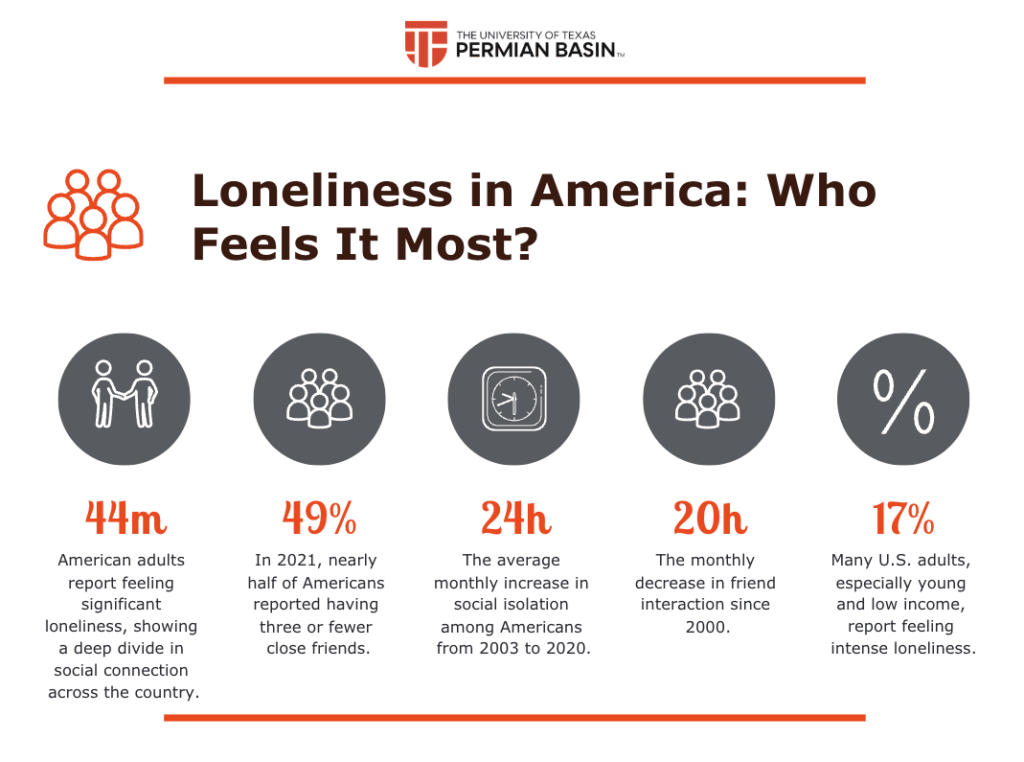
Loneliness is a feeling of discomfort or distress resulting from a perceived gap between a person’s desire for social connection and their reality. The feeling is subjective, and someone can feel deep, pervasive loneliness whether they’re isolated or have numerous casual connections. Yet objective measures reveal a country truly divided and disconnected.
Here’s a closer look at how social connection has changed across America:
Household family social engagement decreased by 5 hours per month.
Companionship (shared leisure) decreased by 14 hours per month.
Social engagement with friends decreased by 20 hours per month.
Social engagement with others decreased by 10 hours per month.
Regarding the millions of Americans struggling with social connection, Surgeon General Vivek Murthy said, “We now know that loneliness is a common feeling that many people experience. It’s like hunger or thirst. It’s a feeling the body sends us when something we need for survival is missing.”
Why Are Americans So Lonely? The Underlying Causes
Loneliness isn’t unique to America. Around the globe, you’ll find members of collectivist cultures who are no less lonely and isolated. Still, Americans are becoming less engaged with community organizations, such as faith-based groups and clubs. We’re also getting married later and having fewer children. These are, of course, valid lifestyle choices, but it’s important to note why people are forming fewer connections.
Specifically, loneliness can increase the risk of premature death by 26% and increase the risk of anxiety, depression, dementia, cardiovascular disease, and stroke.
“If we fail to [build more connected lives], we will pay an ever-increasing price in the form of our individual and collective health and well-being. And we will continue to splinter and divide until we can no longer stand as a community or a country. Instead of coming together to take on the great challenges before us, we will further retreat to our corners—angry, sick, and alone.”
The Loneliness Crisis in Context: The Past Two Decades
The past twenty years have been rough, to say the least. From the Great Recession to COVID-19, America has experienced one once-in-a-generation event after another, like a line of crashing waves. Many of us have held off on important life events, such as marriage or starting a family, while others have had to adjust to a new normal.
Americans are lonelier than ever, but don’t count us out just yet. Mental health and well-being have never been discussed as freely or emphasized as strongly as they are today. The Surgeon General’s report is indicative of shifting public sentiment, and now that we know there’s a problem, we can set about fixing it.
Can Loneliness Be Overcome? A Path to Reconnection
With all this talk of loneliness, we’d like to leave you on a more hopeful note. Consider again the Hedgehog’s Dilemma: a metaphor on the difficulties our tangled lives bring.
A key piece of information the metaphor doesn’t consider is that hedgehogs are solitary animals. Humans aren’t. We need and are perfectly capable of forming connections with family, friends, neighbors, and strangers.
Sometimes life gets in the way, and it seems like the people we want to be closest to couldn’t be farther away. If there’s a bright side to any of this, it’s that there’s a world of people out there who are reaching out, desperate for a connection, if only someone else would reach back.
See the Bigger Picture: Study Sociology Online
Sociology is the study of the causes and consequences of human behavior. Loneliness is only one piece of the puzzle. If you’re interested in the bigger picture, consider formally studying sociology.
Upon graduating, you’ll be prepared to continue your education and ultimately pursue a career in sociology. A BA in sociology can qualify you for a wide variety of careers, including:
Human resources specialist
Regulatory affairs manager
Social science research assistant
Our BA in sociology program is entirely online, but that doesn’t mean you’ll be alone. You’ll be joined by students from around the country, all of whom you can connect with in our online discussion boards. Your advisor and professors will also be there every step of the way to assist you.
When someone struggles with depression, homelessness, or discrimination, who steps in to help? A psychologist? A social worker? A sociologist? These three fields all address human challenges, but they explore humanity from very different angles: one from society, one from the mind, and one from the front lines. So what are the similarities and differences between sociology, psychology, and social work? This guide clears up…
Lunar eclipses don’t happen often, but when they do, everything seems to slow down. People step outside. Neighborhoods get quieter, tuned in to the skies above. Suddenly, something outside of our control brings us all together for a shared moment of collective awe. Eclipses remind us that we’re all living under the same moon, no…
How many times a day do you unlock your phone to scroll through your favorite feed? Ten? Twenty? Lost count after breakfast? You’re not alone. The average American checks their phone 205 times a day and spends about two and a half hours of that time on social media. Whether you’re catching up on family…
Smartphone addiction has such a hold on our society that—hey! We see you eyeing that back button. Your attention span may be as short as a golden retriever’s, but you’ll want to stick around, because today we explore the psychology of smartphone addiction.
We’ll also provide some tips and resources to help you break away from your phone—at least long enough to accomplish the goals most important to you.
Quick Answer: What Is Smartphone Addiction?
Smartphone addiction is a pattern of compulsive phone use that feels difficult to control, even when it interferes with sleep, work, school, relationships, or mental health. Psychologically, it’s often tied to reward-seeking behavior. Small cues like notifications, likes, videos, games, and messages can activate dopamine-driven feedback loops that keep people reaching for their phones again and again.
Why Are Smartphones So Addictive?
Your smartphone is often the first thing you see after lifting your head from your pillow and the last thing you see before drifting off to sleep. It’s your constant companion, a magical gateway granting access to near-infinite distractions, opportunities for engagement, and stores of information.
Yet when you’re out to dinner, you haven’t checked your notifications in ages, and the compulsion builds until you just have to peek, your phone can be your greatest adversary.
If you can’t put down your phone even when it has a severe negative impact on your life, you may be addicted to your phone—and you aren’t alone.
“[Technology] interrupts our own story, interrupts our ability to have a thought or a daydream, to imagine something wonderful because we’re too busy bridging the walk from the cafeteria back to the office on the cell phone.”
Teens, whose brains have yet to fully develop, are especially susceptible to the algorithms tech companies use to keep them clicking and scrolling. According to a 2022 survey conducted by the Pew Research Center, about 35% of teens say they are on YouTube, TikTok, Instagram, Snapchat, or Facebook “almost constantly,” with about half of teens saying it would be hard to give up social media.
How Dopamine Reinforces Smartphone Addiction
The problem is dopamine. Commonly referred to as the “feel-good” hormone, dopamine is the brain’s major reward and pleasure neurotransmitter. Anything that causes pleasure triggers a dopamine release. While it’s a common misconception that dopamine makes you happy, the hormone actually reinforces behaviors that make you happy.
Smartphones are so addictive because every time we use them—to like an Instagram post, watch a YouTube video, or play Wordle—it triggers a surge of dopamine. After an initial rush of dopamine, there’s a dip like a craving: What goes up must come down. If a person isn’t addicted, the craving passes, but if they continue binging, the brain compensates with lower and lower dips.
“Mommy let you use your iPad; you were barely two. And it did all the things we designed it to do.”
By then, the brain is hooked. It needs more dopamine. It needs to feel like it felt the first time it engaged with the stimulus. Over time, the brain may start chasing the same reward response, making it harder to stop checking, scrolling, or tapping even when the experience feels less satisfying than it used to.
Not every long scroll session means you’re addicted to your phone. But smartphone use can become a problem when it feels compulsive, interferes with daily responsibilities, or starts replacing sleep, relationships, hobbies, or focus time.
Checking your phone even when you meant to focus on something else
Feeling anxious, bored, or restless without your phone nearby
Losing track of time while scrolling, gaming, or watching videos
Using your phone late at night even when you’re tired
Feeling like phone use is affecting your work, school, mood, or relationships
How to Reduce Smartphone Addiction
If you think you’re addicted to your smartphone, don’t be too hard on yourself. Many smartphones, apps, and platforms are designed to keep you engaged for as long as possible. Teams at billion-dollar companies are constantly testing ways to keep users engaged longer.
As with any addiction, there’s no shame in reaching out. Doctors and therapists can help address the underlying causes of smartphone addiction. However, making a few changes in your routine can make a world of difference in how you interact with your devices.
Here are some steps you can take to develop a healthier relationship with your smartphone:
Keep your phone in another room when you need to focus.
Change your settings to turn off push notifications.
Delete mobile games and apps that consume too much time. (You know the ones.)
Take a break from social media. Better yet, get off it completely.
Download a focus app and improve your productivity while you’re at it.
Smartphones are addictive precisely because they are incredible tools, but that’s all they are: tools. At the end of the day, you’re the one in control.
Take Your Interest in Psychology Further
If topics like dopamine, addiction, and behavior keep pulling you in, UTPB’s online psychology program can help you take that curiosity further.
Psychology is one of the broadest academic fields, and one of the most versatile. It spans everything from courtrooms to corporate offices, from childhood development to competitive sports. With so many specialties (and subspecialties), it can be tough to know where to even start. So exactly how many branches of psychology are there? The field is…
Ever reach for your phone and instantly face a barrage of messages, notifications, subscription reminders, and social media updates? You’re not alone. Scientists have estimated that the average person processes about 74 gigabytes of information daily: equivalent to watching 16 high-definition movies back-to-back in a single day. Cognitive overload is real. And over time, constant stimulation quietly changes how we think, focus, and feel. In this article, we’ll explore: What Does Cognitive Overload Mean? Cognitive overload happens when your brain receives more information than…
When someone struggles with depression, homelessness, or discrimination, who steps in to help? A psychologist? A social worker? A sociologist? These three fields all address human challenges, but they explore humanity from very different angles: one from society, one from the mind, and one from the front lines. So what are the similarities and differences between sociology, psychology, and social work? This guide clears up…