A Bachelor of Business Administration (BBA) degree is your ticket to the world of business. A BBA provides a comprehensive overview of business, touching on foundational concepts like accounting, finance, marketing, and management. Typically, undergraduate students also choose the major that best aligns with their interests. This specialized focus allows students to explore a subject deeply, through theoretical and practical lenses, preparing them for success in their chosen fields.
The University of Texas Permian Basin offers online BBAs with majors in accounting, finance, healthcare management, management, and marketing.
These programs are accredited by the prestigious Association to Advance Collegiate Schools of Business (AACSB), the world’s largest business education alliance. They also share a convenient online format. Entirely online, our BBA programs can be completed anywhere and at any time, assuming you have a Wi-Fi connection.
We’ve touched on the quality and convenience of our BBA programs, but now we’re going to discuss the unique qualities of our degree options. This breakdown should provide some added insight to help you apply to your preferred major with confidence.
BBA in Accounting
Accountants are the stewards of financial records, ensuring their accuracy and compliance with state and federal laws. Their financial insights are invaluable for organizations. They must be technically skilled, able to automate a number of their routine tasks. They are also expected to possess communication skills, attention to detail, poise under pressure, and other soft skills. Accountants are, above all else, expected to hold a degree that affirms their accounting competencies.
Our online BBA in accounting program provides the knowledge and skills needed in the evolving field of accounting. Courses like Auditing, Accounting Information Systems, and Cost Accounting Principles empower students to measure, record, summarize, and report financial data for business enterprises. Graduates leave our program with a competitive edge that allows them to thrive in a number of positions, including:
Accountant
Auditor
Financial manager
BBA in Finance
Financial professionals are highly sought after in the world of business. The employment outlook for financial analysts, for example, is expected to grow 5% by the year 2029, faster than the average for all occupations.
Financial professionals help businesses assess their health and make sound financial decisions. Before becoming valued a valued asset within an organization, however, aspiring professionals must expand their knowledge of accounting, finance, and investments.
Professionals interested in developing well-rounded financial management skills can pursue a BBA in finance at UT Permian Basin. Undergraduate students enroll in business and finance courses and have the opportunity to tailor their education to fit their interests with business and finance electives. Through our program, students explore many of the topics needed to earn career-transforming Chartered Financial Analyst (CFA) and Certified Financial Planner (CFP) designations, if they so desire. For example, our online course Financial Markets and Institutions covers government and corporate debt, determinants of interest rates, and mortgage-backed securities, among other essential topics.
Graduates of our BBA in finance program are positioned for a number of rewarding roles, including:
Chief financial officer
Financial analyst
Investment banker
BBA in Healthcare Management
Healthcare managers help with business activities, not unlike the other occupations we’ve mentioned. They are, however, employed exclusively at hospitals, physician’s offices, nursing homes, and other patient care facilities. Their duties entail managing finances, recruiting staff, organizing records, and, above all else, ensuring the delivery of quality healthcare. Performing these tasks to the best of their abilities requires healthcare managers to remain abreast of the ever-changing healthcare landscape.
UT Permian Basin’s online BBA in healthcare management program prepares students to excel as decisive leaders in the dynamic healthcare field. Through our online program, students learn to apply business fundamentals in a healthcare setting. Business courses provide students with foundational knowledge that courses like Accounting for Healthcare, Healthcare Finance, Healthcare MIS, and Healthcare Marketing build upon.
This major can help aspiring professionals become healthcare managers, but there are also a number of other healthcare roles ideal for graduates of our online healthcare management program, including:
Undergraduate students in our BBA in management program are given a comprehensive education encompassing the fundamentals of communication, finance, marketing, and law. Through our program, students gain a deeper understanding of what it takes to be a business leader while sharpening their decision-making and problem-solving skills. Additionally, our online program’s environment option allows students to tailor their education by enrolling in one of three courses: Project Management Elements, International Management, or Business and Ethics.
Whether you’re a freshman or transfer student, our online program will empower you to take on competitive leadership roles, including:
Entrepreneur
Human resources manager
Operations manager
BBA in Marketing
Marketing efforts are essential for ensuring an organization’s success and longevity. Professionals with a mind for marketing are increasingly valued by companies as advertisements continue to dominate digital spaces. Regardless of the medium, these professionals are expected to manage client expectations, deploy marketing strategies, and oversee marketing staff, among other responsibilities. To do so effectively, they need an education encompassing the fundamentals of business and marketing.
UT Permian Basin’s online BBA in marketing empowers students to promote organizations through the most effective avenues, whether traditional or digital. Through our program, students learn to analyze demographics and consumer behavior to build marketing strategies and overcome challenges during the marketing life cycle.
Students also have the opportunity to add our Undergraduate Certificate in Digital Marketing to their BBA in marketing without needing to take additional credits. This certificate helps students strengthen their understanding of search engine optimization (SEO) tools and further prepares graduates for a number of rewarding careers, including:
Marketing manager
Public relations specialist
Social media manager
Pursue Your Interests at UT Permian Basin
At UT Permian Basin, you’ll find convenient online programs that prioritize your growth as a professional, regardless of the major you choose. Our programs are entirely online and feature asynchronous elements, allowing you to engage with course content at your own pace. They are led by the same educators—experts with years of experience in their respective fields—who lead our on-campus programs. Finally, they share a straightforward application process that can be completed in a single sitting.
Our BBA programs are unique in their focus but connected by our college’s commitment to student success. Apply to the online program of your choice, and see for yourself why UT Permian Basin is the ideal home for aspiring business professionals.
The energy industry is experiencing growing pains. The increased deployment of renewable energy is juxtaposed by the growth of shale oil and gas, and the threat of climate change looms over the entire industry. This shifting landscape demands that energy companies proceed with caution and carefully consider every outcome when conducting business. To do so, they need the assistance of a professional with a mind for business: someone familiar with the capabilities and limitations of companies in the energy sector. In other words, they need an analyst.
Let’s look at three analyst careers and the important role these professionals play in energy-related fields.
Business Analyst
Business analysts define the capabilities of an organization to understand how it can better deliver products and services. To accomplish this, an analyst will interview leaders, team members, and subject matter experts: anyone who can provide a unique perspective. They take an objective approach to solving problems and in doing so help companies overcome challenges and meet their objectives.
Business analysts are critical in the energy sector, where their business and technical knowledge allow them to consider multiple perspectives when problem-solving and articulating solutions to stakeholders of varying skill sets. For example, a professional with a Master of Business Administration with Certificate in Energy Business could help a power or utility company transition to renewable energy while taking into account the legal, financial, and organizational aspects unique to the energy industry.
Financial Analyst
Think of financial analysts as fortune tellers who, rather than gaze into a crystal ball, pore over financial data to predict market trends. Industry insights allow financial analysts to help organizations make strategic decisions and turn a profit. Before developing a strategy, however, an analyst must meet with leaders to assess a company’s prospects and financial health. Only by considering factors that affect a specific industry (microeconomics) and the economy as a whole (macroeconomics) can a financial analyst recommend an appropriate course of action, usually in the form of an investment.
Financial analysts do their best work when turning their attention to a particular industry, such as the energy sector. In energy-related fields, where energy prices can fluctuate wildly, a financial analyst can mitigate risk by helping companies invest in energy commodities. Known as hedging, this process allows energy companies to lock in the price of a commodity, such as natural gas, and meet their financial goals.
Energy risk management is invaluable in the energy industry, but it’s only one area a financial analyst must be familiar with. Energy Finance, for example, explores value chain analysis, oil and gas financial statement analysis, and financing energy companies and projects. Available to students pursuing an MBA with Certificate in Energy Business or a Graduate Certificate in Energy Business, this online course can help professionals adopt a skill set sought after by energy companies in need of financial guidance.
Budget Analyst
Budget analysts, more so than financial analysts, oversee a company’s financial health. These professionals help public and private companies plan their finances, developing budgets an organization can follow to meet their future financial needs. Budget analysts do far more than develop budgets, however. They are gatekeepers who evaluate budget proposals, financial requests, and funding methods. If an initiative isn’t deemed cost-effective, a budget analyst may recommend making changes or nixing it altogether. Final budget decisions are left to leadership, but without the expertise of budget analysts, a company could find itself in the red.
The price of an energy commodity is incredibly volatile, as it’s susceptible to changes in weather, storage, and regulations. In a sector where the future is uncertain, budget analysts must be on top of their game. They must account for not only previous and future expenditures but also actual expenditures. Ensuring compliance with budgetary allocations, maintaining spending records, and establishing budgetary control processes are all responsibilities of a budget analyst in the energy industry.
Gain the Mindset of an Analyst at UT Permian Basin
The University of Texas Permian Basin offers two online programs with an emphasis on energy business:
Master of Business Administration with Certificate in Energy Business: This 36- to 45-credit online program provides operational knowledge and leadership skills highly sought after in energy-related fields. In as little as four semesters, students can graduate prepared to excel in various levels of the energy industry.
Graduate Certificate in Energy Business: This 12-credit online program will help professionals translate their accounting, finance, management, and business knowledge to the rapidly growing energy industry. This certificate is ideal for professionals in energy-related fields who want to advance their careers.
Entirely online and featuring asynchronous elements, our programs will allow you to pursue graduate credentials on your own time, at your own pace. Through Canvas, you’ll be able to connect with your professors and peers on 24-hour discussion boards. Online tools like these will facilitate your learning and help you develop the soft skills analysts need to interact with stakeholders and articulate their findings. Finally, our programs are taught by the same experienced professionals who teach on campus. Every measure has been taken to help ensure that you receive the highest quality education possible, comparable to anything found on UT Permian Basin’s campus.
Accredited by the Association to Advance Collegiate Schools of Business, our programs will provide you with the skills needed to thrive as an analyst or any number of other careers in energy-related fields. Apply now to your program of choice if you’re interested in putting your analytical mind to work in the energy industry.
We hear a lot about “green jobs,” but do you know exactly what that phrase means? The U.S. Bureau of Labor Statistics (BLS) defines green jobs in these two ways:
Jobs in businesses that produce goods or provide services that benefit the environment or conserve natural resources.
Jobs in which workers’ duties involve making their establishment’s production processes more environmentally friendly or use fewer natural resources.
Green energy jobs utilize wind, solar, geothermal (using heat from the earth), biomass (natural waste products), and hydroelectric power (dams), among other environmentally friendly technologies.
Perhaps the most important question is, “What do green energy jobs mean for you?” Tremendous career potential is just one answer. Let’s look at some promising green energy job statistics, a few specific roles that you can pursue within the field, and education programs that can help you qualify for those roles.
The Green Energy Job Market Is Booming
There’s no shortage of green energy jobs right now. Growth in this field has been underway for a few years, and the numbers will only increase with time. As one example, the International Renewable Energy Agency (IRENA) reported the addition of 700,000 green energy jobs globally between 2017 and 2018, for a total of about 11 million jobs. In its Global Renewables Outlook: Energy Transformation 2050 report, IRENA also projects the number of green energy jobs to quadruple over the next three decades.
While the green energy field is expanding, new green ventures are only part of that picture. Many traditional energy companies are leading the drive toward greater dependence on green energy sources. Others are modifying their operational practices to reduce negative impacts on the environment.
Potential Careers in Green Energy
There are numerous professional roles available in green energy, including some you may not have thought of. Many technical and hands-on positions are available for those with the passion and qualifications, as you might expect. But not all jobs in energy involve getting your hands dirty, especially when it comes to clean energy. Qualified professionals are also needed on green energy’s business side to fill many rewarding, high-paying positions, including:
Some of these positions are experiencing considerable growth. For example, the BLS states in its Occupational Outlook Handbook (updated April 2021) that financial analyst jobs are expected to grow at a rate of 5% between 2019 and 2029—faster than average for all occupations. BLS also reports that financial manager jobs are anticipated to grow at a whopping 15% through 2029. That’s much faster than the average growth rate for all occupations. Further, the median annual salary for financial managers is $138,180. And these are just a few examples. There are many more jobs available in the green energy sector. Having the right credentials can give you a leg up in the green energy job boom and position you for a career that helps protect our planet and its precious resources.
The Right Credentials
The University of Texas Permian Basin offers energy-focused online degree and certificate programs that can equip you with the knowledge and credentials you need to transition into (or advance within) a career in green energy. Both of these 100% online programs are offered through UT Permian Basin’s AACSB-accredited College of Business:
This graduate degree program helps you build highly marketable operational insight and leadership capabilities that will be beneficial to you in the energy industry. By taking specified electives, you can also earn a second credential—a Graduate Certificate in Energy Business—without needing any extra time to complete your MBA. Many people finish this Master of Business Administration degree in as little as four semesters!
If you already have an undergraduate degree and are looking to build some additional energy business expertise without pursuing a graduate degree, this 12-credit stand-alone certificate program is ideal. Through four courses, you’ll adapt your current proficiencies in management, business law, finance, accounting, and/or marketing to a career in the energy industry.
Programs Made With Working People in Mind
All of the courses for these online programs are delivered in an asynchronous format that allows you to complete coursework on your own schedule, 24/7, from virtually any location. That means that you can continue to meet your work and family responsibilities while earning a valuable career credential. Program courses feature the same curriculum and acclaimed faculty as the corresponding on-campus programs, but with added convenience. You can finish most courses in just eight weeks, with summer courses lasting just seven weeks!
Gain the knowledge and credentials required to thrive in a green sector job with one of UT Permian Basin’s online programs.
“The most dangerous leadership myth is that leaders are born—that there is a genetic factor to leadership. That’s nonsense; in fact, the opposite is true. Leaders are made rather than born.” — Warren Bennis
Do you dream of making a real impact in the healthcare field—not just treating patients, but shaping the systems that care for them? Becoming a healthcare leader gives you the power to influence policies, drive innovation, and improve lives on a broader scale.
Whether you see yourself managing a hospital department or overseeing vital healthcare projects, this step-by-step guide will show you how to turn your passion into a purpose-driven leadership career.
What Is a Healthcare Leader?
A healthcare leader is someone who oversees key services that directly or indirectly impact patient care and organizational outcomes. This includes:
Administrators
Department directors
Project managers
Other decision-makers who guide healthcare operations
What Does It Take to Become a Healthcare Leader?
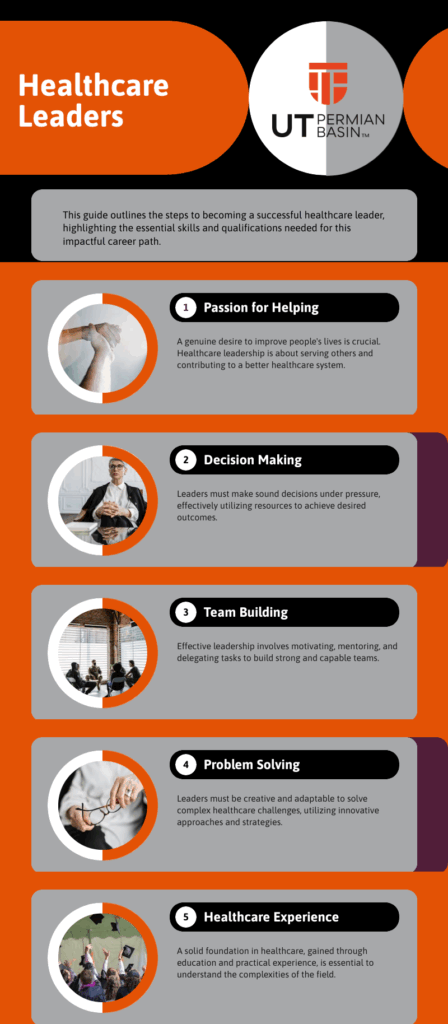
To succeed in a healthcare leadership role, you’ll need a combination of personal drive, practical skills, and real-world experience. Here are some key qualities and steps to help you get there:Be driven by a genuine passion for helping others.
Make sound decisions—even under pressure—and turn them into effective actions.
Use available resources strategically and efficiently.
Delegate responsibilities and mentor team members.
Think creatively to solve complex problems.
Gain prior work experience in healthcare, as most leaders work their way up in the field.
Becoming a healthcare leader takes more than ambition. t requires a unique mix of skills, experience, and education. Whether you’re just starting out or looking to move up, this infographic breaks down the essential steps to help you rise to the top and make a lasting impact in the healthcare industry.
Top Skills of an Effective Healthcare Leader
As you work toward a leadership position in healthcare, you’ll need to develop the skills required of a leader in practically any profession, including:
Determination
Integrity
Confidence
Charisma
Communication
Creativity
Patience
Flexibility
Quality focus
If you already possess some of these, you’re ahead of the game. But leadership is about lifelong learning, and even natural leaders benefit from refining their skills.Do You Need a Degree to Become a Healthcare Leader?
In addition to personal development, you also need to have formal credentials in healthcare leadership that show you’ve been educated by a credible source. This typically means earning a bachelor’s degree from an accredited institution.Why Now Is a Great Time to Enter Healthcare Leadership
The healthcare industry is growing rapidly due to an aging population, technological advancements, and policy changes. This growth has created demand for professionals who can lead teams, manage systems, and improve outcomes.
Here are in-demand leadership roles and their average salaries and job outlooks:
Medical and Health Services Managers According to the U.S. Bureau of Labor Statistics (BLS), the predicted job outlook for medical and health services managers through 2032 boasts a tremendous 29% growth rate—much faster than the average for all occupations. Median annual pay, as of 2020, is $117,960.
Project Management Specialists O*NET (Occupational Information Network) reports that jobs for project management specialists between 2022 and 2032 will grow by 7%—faster than average for all occupations. Median yearly pay, as of 2025, is $100,750.
Administrative Services and Facilities Managers BLS projections show that employment for administrative services and facilities managers will grow by 6%—faster than the average rate for all occupations—through 2032. Median pay, as of 2025, is $106,880 per year.
We Can Help Make You a Leader
The University of Texas Permian Basin is doing its part to nurture tomorrow’s healthcare leaders. Our AACSB-accredited College of Business offers two online bachelor’s degree programs that will help you develop effective healthcare leadership skills:
Learn demonstrated ways to implement BBA business fundamentals in a healthcare context through courses focused on financial management among healthcare providers, patient services, and the legal and regulatory environments of the healthcare industry.
In this program, you’ll learn proven strategies for complex problem-solving, project management and forecasting, and overcoming common limitations in the workplace regarding budget, time, and resources that every healthcare leader needs to know.
The Advantages of Online Learning at UT Permian Basin
Most courses for both of our healthcare management/leadership degree programs last just eight weeks, and all are delivered in an asynchronous, 100% online format. You can complete coursework on your own schedule, 24/7, from anywhere in the world while tending to ongoing work and family responsibilities. You’ll learn the same curriculum from the same renowned faculty who teach the programs on campus at UT Permian Basin, with added flexibility.
Hone your leadership skills for a rewarding career in healthcare. You’ll find the foundation you need in one of UT Permian Basin’s online healthcare management and healthcare leadership bachelor’s degree programs.
You’re interested in a healthcare career, but you envision yourself in a management or leadership role rather than a hands-on position. While patient health remains your top priority, you know that leading a team or managing an office, department, or even an entire facility is just as vital to the overall healthcare mission. Many of…
A Bachelor of Business Administration (BBA) degree is your ticket to the world of business. A BBA provides a comprehensive overview of business, touching on foundational concepts like accounting, finance, marketing, and management. Typically, undergraduate students also choose the major that best aligns with their interests. This specialized focus allows students to explore a subject…
“The most dangerous leadership myth is that leaders are born—that there is a genetic factor to leadership. That’s nonsense; in fact, the opposite is true. Leaders are made rather than born.” — Warren Bennis Do you dream of making a real impact in the healthcare field—not just treating patients, but shaping the systems that care…
Earning a university degree can equip you with skills and credentials that will be a tremendous asset in your professional life. As Abigail Johnson Hess reports on CNBC.com, the long-held notion that a college degree “can be a clear path to stronger job opportunities and higher earnings” still holds true. College graduates take home about $30,000 more each year than those whose highest level of education completed is high school.
When choosing a college degree, it’s important to follow your passion, but you should also consider whether the field you’ve chosen has growth potential. Once you’ve found a promising professional area, having an educational credential that employers value can help you compete for emerging positions.
With these facts in mind, let’s look at the added benefits of a degree in business. According to the U.S. Bureau of Labor Statistics, employment in business and financial operations occupations is expected to grow by 5% by 2029, which is faster than the average growth rate for all occupations. That amounts to nearly half a million new jobs for which a bachelor’s degree is the minimum educational requirement. If you’re a business-oriented job seeker, or plan to be one, earning a Bachelor of Business Administration can be the differentiator that gets you in on the ground floor.
A four-year degree is not your only option for professional advancement, however. You can add an undergraduate certificate in digital marketing to any online bachelor’s degree program at The University of Texas Permian Basin. If you have a passion for business, mastering digital commerce is a shrewd career move. Commerce in the digital realm is growing and is expected to continue doing so, creating more job opportunities in this innovative field. Let’s look at digital commerce a little more closely and see why a BBA degree combined with an undergraduate certificate can benefit you.
What Is Digital Commerce? According to one definition, digital commerce “enables customers to purchase goods and services through an interactive and self-service experience. It includes the people, processes and technologies to execute the offering of development content, analytics, promotion, pricing, customer acquisition and retention, and customer experience at all touchpoints throughout the customer buying journey.” Some of the most popular digital marketing channels include social media, paid search, search engine optimization (SEO), affiliate marketing, and email.
The Future of Digital Commerce Digital commerce, also referred to as e-commerce, has been growing steadily for some time. What’s more, COVID-19 has hastened a digital-first strategy among retailers in a market where brick and mortar commerce was already on the decline, according to an Entrepreneur.com article. In parts of the world where the coronavirus was particularly prevalent, Facebook marketing jumped 50%. The increase in digital commerce is expected to spur a corresponding increase in job growth in roles as diverse as sales, operations, software and app development, and content creation. As of 2020, purchases through digital commerce channels made up 10% of all retail sales, a number that’s predicted to increase by 15% annually.
Our Online Bachelor of Business Administration Programs UT Permian Basin offers four AACSB-accredited BBA programs online, each in a vital and dynamic business field:
Bachelor of Business Administration in Accounting Build awide-ranging skillset in analyzing and solving financial problems as you receive expert guidance for accounting careers in nonprofit, government, public, or private organizations, or as a CPA.
Bachelor of Business Administration in Marketing Prepare to expertly promote an organization through both traditional and digital marketing efforts based on effective analyses of demographics and consumer behavior.
Our Online Undergraduate Certificate in Digital Marketing You’ll compound the skills and credentials gained from our BBA programs with a specialized undergraduate certificate. Certificates will expand your expertise and help position you for a broader choice of professional roles.
Our online undergraduate certificate in digital marketing is a 12-credit certificate program comprised of your choice of four eligible courses, all of which are offered as electives in our BBA programs. By choosing these applicable electives, you’ll earn an additional credential while completing the same number of total credits in the same amount of time—with no delay in graduation.
Our digital marketing certificate program will help you understand and succeed within the rapidly evolving digital landscape. You’ll gain a foundational understanding of the differences between traditional and digital marketing, build proficiency in Google Analytics and other search engine optimization tools, and master social media’s unique marketing tactics.
Advantages of Earning College Credentials Online Our Bachelor of Business Administration degrees and undergraduate certificate in digital marketing are presented in a 100% online asynchronous format. This allows you to complete your coursework anywhere with internet access, 24/7, at your own pace. If you have professional or family responsibilities to attend to, or both, our flexible program is just what you need. Most of our program courses last just eight weeks, and all are taught by the same acclaimed faculty who teach them on campus. When you’re done with your degree program, you’ll graduate with two respected, career-enhancing credentials that can help you in many business roles.
Expand your business acumen and career potential by adding our undergraduate certificate in digital marketing to your UT Permian Basin BBA program!
The energy sector is growing steadily, and that means that there will be many jobs available to those with the right qualifications for years to come. If you’re already in one of these roles, an advanced degree or certificate can position you for management-level roles within your organization. However, at any stage of your career, you may be able to directly benefit from: A credential from an accredited, renowned business school on your resume.
A credential from an accredited, renowned business school on your resume.
Faster-than-average job growth.
Six-figure income potential.
Let’s examine what types of energy business roles are available and the educational credentials that can help keep you competitive for them at hiring time.
Rewarding Career Paths Here are three vital business roles that you can pursuewithin an energy organization:
Financial Manager Financial managers develop financial documents, guide organizations’ investments, and map out future financial objectives. Financial management is experiencing an employmentboom, and with that boom comes highly competitive compensation rates. The U.S. Bureau of Labor Statistics(BLS) projects that financial manager jobs will grow by 15%—much faster than the average growth rate for all jobs—from 2019 to 2029. Perhaps even more notably, median annual pay for financial managers in 2019 was$129,890.
The BLS also reports that many businesses favor candidates who have a master’s degree in business administration or a related field, making our Master of Business Administration degree, which includes financial management as a core part of its curriculum,a sound professional investment.
Marketing Manager Marketing managers are in charge of promoting a business’ brand, and their field is also a growing and highly lucrative one. According to the BLS, there will be a 6% increase in the number of marketing management jobs in the United States between 2019 and 2029. That’sfaster than the average growthratefor all jobs, which is 4%. Further, median pay for marketing managers is $135,900 per year. Marketing management is also included as a core part of ourMaster of Business Administration degree program.
Financial Analyst Financial analysts guide organizations and individuals in their investment choices. Right now, there’s a strong need for financial analysts in the U.S., and that trend will continue. The BLS forecasts a 5% increase in financial analyst jobs from 2019 through 2029, representing a growth rate faster than the national average. Median annual pay for financial analysts is estimated at $81,590, but some sources suggest those who work as financial analysts in the renewable energy sector can earn even more per year. In addition, the BLS states that a Master of Business Administration can boost a financial analyst’s potential for career advancement.
Online Programs to Accelerate Your EnergyBusiness Career The University of Texas Permian Basin offers online graduate degree and graduate certificate programs that can help youlaunch or advance within a career in the energy industry or an energy-related field.Both of these programs are delivered 100% online through our AACSB-accredited College of Business.
Graduate Certificate in Energy Business This graduate certificate program is offered as a 12-credit stand–alone credential and translates yourexpertisein accounting, business law, finance, management, and marketing to the rapidlyexpanding energy industry.
Career-Friendly Online Convenience All program courses are presented in an asynchronous online format that allows you to earn a respected credential on your own schedule while upholdingyour professional and personal responsibilities. Our program courses are taught by the same celebrated faculty who teach them here on campus, and most of the courses last only eight weeks!
Build the expertise needed to excel as a leader in an energy-related careerwith a UT Permian Basin online MBA or Graduate Certificate in Energy Business.
If you’ve ever Googled “How hard is the CPA exam?” you know the answer: very. The full exam runs 16 hours and is divided into four sections, each one focused on a core area of accounting:
Auditing and Attestation (AUD)
Business Environment and Concepts (BEC)
Financial Accounting and Reporting (FAR)
Regulation (REG)
If you asked a student preparing for the CPA, they’d probably tell you it feels like a part-time job.
The good news? The University of Texas Permian Basin’s online Master of Professional Accountancy (MPA) is built to support that journey. Our coursework aligns with all four CPA exam areas and helps you meet key eligibility requirements—especially if you’re planning to become a CPA in Texas.
The takeaway: You don’t have to navigate this process alone. The right program can make all the difference.
How UTPB’s Online Master of Professional Accountancy Helps You Become a CPA in Texas
UT Permian Basin’s 100% online, AACSB-accredited Master of Professional Accountancy gives you the flexibility and structure you need to move toward CPA eligibility—without pressing pause on your career or personal life.
This program helps you build a strong foundation in both traditional accounting principles and the modern, tech-forward practices today’s organizations rely on. As you progress, you’ll learn to think critically, communicate clearly, and apply accounting concepts in real business settings.
And because the entire program is delivered online and asynchronously, you can learn:
Anywhere (your couch, a coffee shop, even a late-night study session after work)
Anytime (early mornings, lunch breaks, weekends)
At a pace that works for you
Additional program benefits include:
Courses designed for busy schedules—most run just eight weeks
Instruction from the same respected PhD-level faculty who teach on campus
The option to finish your degree in 2 to 4 years
Once you graduate, you’ll have completed key educational requirements needed to sit for the CPA exam, and you’ll hold a graduate degree that helps you stand out in a competitive field. For many employers, that combination—MPA + CPA eligibility—signals readiness, commitment, and advanced training.
6 Great Reasons to Become a Certified Public Accountant
Accounting is already a stable, respected career. But earning your CPA license takes things one step further. Here’s why so many professionals decide the extra effort is worth it:
Professional respect: The “CPA” credential carries serious weight. Clients and colleagues see CPAs as experts at the top of their field.
Higher earning potential: On average, CPAs earn up to 15% more than non-CPA accountants.
Career advantage: That three-letter credential on your résumé instantly helps you stand out during hiring.
Strong job demand: Changes in regulations, demographics, and student pipelines mean CPAs remain in high demand across industries.
More variety in your work: Today’s CPAs aren’t limited to one type of accounting job. Many work in consulting, analytics, technology, or even travel-based roles.
Industry flexibility: CPAs are needed everywhere—from healthcare and finance to nonprofits, energy, government, and tech.
Put simply: Earning your CPA opens doors you may not even know exist yet.
How Long Do You Have to Pass the CPA Exam?
Once you start the CPA exam, the clock begins ticking. You’ll have 18 months to pass all four sections, in any order you choose. Pass rates typically fall between 50 to 66%, so many candidates retake at least one section. It’s normal—and it’s exactly why strong academic preparation matters.
The CPA exam isn’t just a test; it’s a journey. Programs like UTPB’s online Master of Professional Accountancy are designed to help you start that journey with confidence.
Prepare for the CPA Exam With UTPB
If earning your CPA is part of your long-term plan, now is the perfect time to take the next step. Our online Master of Professional Accountancy can help you meet educational requirements, sharpen your accounting expertise, and prepare to sit for the exam, all while fitting school around your life—not the other way around.
Your future as a CPA starts with a program designed for where you’re headed.
When you hear the word “accountant,” who comes to mind? Someone balancing spreadsheets and filing taxes? If so, you’re on the right track. But there’s more to it. Within the field of accounting, one credential stands apart: the Certified Public Accountant (CPA). While both accountants and CPAs manage finances, advise clients, and ensure the accuracy…
Picture this: You’re a junior accountant, and your manager asks you to tweak a report to make the numbers look better. The request sounds harmless enough—just a small tweak—but you know it’s not above board. Now you’re stuck. Do you follow orders and risk crossing an ethical line, or do you push back and risk…
You’ve always been an analytical thinker. A problem solver. Maybe a math whiz, too. There’s a career that matches your strengths. Certified Public Accountants—or CPAs—excel in these qualities. Let’s explore why a CPA is no ordinary accountant and what it takes to become one. Want to Be a CPA? Here’s What You Need to Know …
Want to be a more effective leader? Understanding your management style is the first step.
From hands-off to motivational, every leader brings a unique approach to guiding their team. In this article, we’ll break down 7 common management styles, how they work, and when to use them—especially in today’s workforce, where collaboration, flexibility, and purpose matter more than ever.
Whether you’re a current manager or planning your next career step, this guide can help you align your leadership style with team needs and long-term goals.
7 Management Styles to Consider
You’ll find that there are many management styles and many ways to describe them. Let’s examine some of these management styles, in no particular order, and begin to explore what kind of leader you might want to be.
#1 The Autocratic Approach
Take control and keep it. Make all key decisions yourself. You may consult with others, but ultimately, it’s all up to you. You must also stay very directly involved in everything your team is doing. This doesn’t necessarily mean micromanaging your employees, but rather staying tapped into the status of all projects.
Example: A CEO of a startup might use the autocratic approach when making pivotal decisions about the company’s vision and product development. They take full control of the decision-making process, consulting with team members but ultimately making the final call.
#2 The Hands-Off Approach
Sit back and let your people do what they do best, with minimal interference from you. If you’ve hired the right people, you may be surprised at what they can achieve when management steps out of the way.
Example: A senior manager at a tech company may delegate the responsibility of handling daily operations to their team while stepping back. With the hands-off approach, they trust them to use their expertise to meet goals with minimal intervention from leadership.
#3 The Big Picture Approach
Focus on the overall direction of your team or organization and let your people deal with the day-to-day specifics that will help make your vision a reality.
Example: A creative director at an advertising agency might focus primarily on the agency’s overall direction, ensuring the team’s projects align with the company’s long-term vision. This leaves specific tasks like design and deadlines to the respective teams.
#4 The Influential Approach
Show your people, in a positive way, why your vision and direction will ultimately benefit them and your organization. If you can create a clear picture for them, they will come over to your side.
Example: A marketing manager could use the influential approach by presenting the benefits of a new product campaign to the team. By showing how it aligns with both company goals and their professional growth, it may motivate them to work toward a shared vision.
#5 The Motivational Approach
Motivate your team through the judicious use of rewards such as bonuses and other incentives. This shows them in very tangible ways that you value their efforts and find them worthy of acknowledgement.
Example: A retail manager might offer performance bonuses and incentives to sales staff, rewarding them for meeting targets, and thereby boosting morale and encouraging continued high performance across the team.
#6 The Cooperative Approach
Be a member of your team as much as its leader. Work together to find solutions to problems and develop effective strategies for success.
Example: A project manager leading a cross-functional team may collaborate closely with all members to devise strategies for overcoming challenges. This ensures that everyone’s input is valued and contributing to the overall success of the project.
#7 The Coach Approach
Envision your staff as a team with you as its coach. Guide and mentor them, helping them improve their “game” and working as a cohesive unit driving toward the same goal.
Example: A sales leader mentors their team, offering regular feedback and guidance to help them improve their performance. They work alongside them to refine techniques and celebrate wins, creating a supportive learning environment.
For a snapshot of how each management style works, refer to the infographic below for brief descriptions that highlight their unique characteristics.
Which Management Style Is Best for You?
There’s no such thing as the “best” or “perfect” management style. What works for your team might not work for another. The management style that aligns with you and your team depends on both your personal preferences and the unique makeup of your team.
Every team has its own dynamic, shaped by the specific individuals who are part of it. Change one person, and you can completely alter the team dynamic. An effective leader “takes the temperature” of the team and adapts their approach to fit the situation, recognizing that no single management style is a one-size-fits-all solution.
How to Prepare for Management Roles
Ready to sharpen your leadership skills and find your management style? The University of Texas Permian Basin offers an online Bachelor of Business Administration in Management. Our business program is one of a select few in the nation to be accredited by the respected Association to Advance Collegiate Schools of Business (AACSB International). Only 5% of the world’s business programs can claim this distinction.
We designed our program to build an in-depth theoretical understanding and practical, working knowledge of business and leadership fundamentals. It will help you strengthen your ability to think strategically and execute functional components of corporate operations, as well as improve your decision-making skills and your ability to apply business concepts in real-world scenarios.
What Are the Advantages of Our Online Program?
Our Bachelor of Business Administration in Management is presented 100% online through asynchronous courses. This enables you to complete your coursework anywhere, 24/7, on your own schedule. If you’re currently working, have ongoing family responsibilities, or both, you’ll find this flexibility to be a tremendous advantage. Most of our program courses last just eight weeks. When you’re finished, your BBA provides a respected educational credential that can help you in your current and future professional endeavors in practically any business sector.
Develop leadership qualities that can help you gear your management style to today’s workforce with an online Bachelor of Business Administration in Management!
Video calls. Robot vacuums. Voice assistants. Thirty years ago, we only saw this technology in cinema or on TV. Today, they’re billion-dollar industries. Many of the technologies now reshaping how we live and work first appeared in movies or on TV. While most viewers were happy to lose themselves in the narrative, an enterprising few…
Forget everything you think you know about management roles, like the idea that for the rest of your life, you’ll be chained to a desk under a ceiling of fluorescent lights. That’s not what management looks like—or at least, it doesn’t have to be. A business management degree doesn’t condemn you to a cubicle; it…
“It’s a beautiful summer day …” your star employee says as they stare longingly out the window. And chances are, they’re not the only one. Summer tests even the strongest teams. As the dog days hit, bloggers and journalists love citing a 2012 survey claiming that productivity drops a massive 20% during the summer. But…
From groceries to furniture to Friday night entertainment, more and more of our purchases happen with a tap or a click. Digital commerce—once a novelty—is quickly becoming the default way people buy and sell products and services.
But what is digital commerce exactly, and why does it matter so much today?
Simply put, digital commerce is the buying and selling of goods and services through digital channels, like websites, apps, and social media platforms. But it’s more than just online shopping. Digital tools create seamless, personalized, and accessible buying experiences from the moment a customer finds your product until the moment it’s in their hands (or downloaded to their device).
In this article, we’ll explore why digital commerce is essential for today’s businesses, how consumer habits are shifting, and how you can prepare for a future that’s increasingly digital.
Why Is Digital Commerce Important?
While the COVID-19 pandemic gave online shopping an extra push, the shift began long before and shows no signs of slowing down.
So, why does digital commerce matter so much? Several factors contribute to its growing importance:
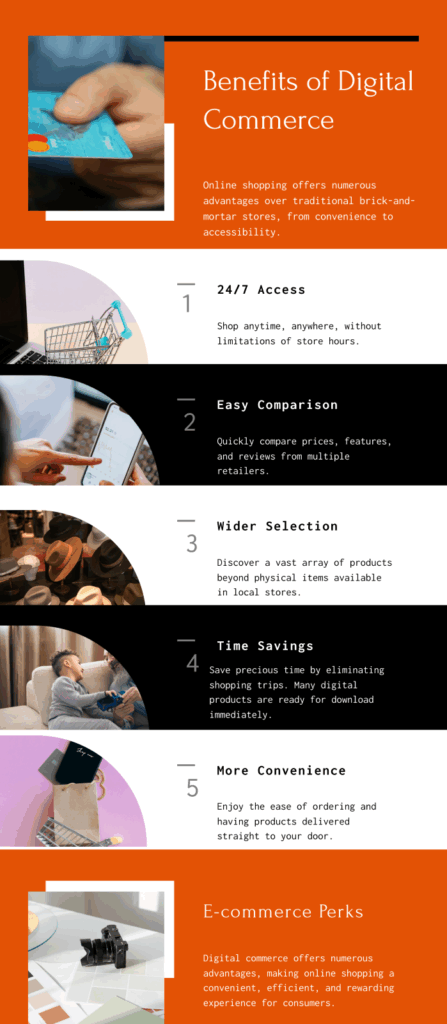
Convenience: Shoppers can browse and buy anytime, anywhere—no traffic, no parking, and no crowds.
Accessibility: A brand’s digital presence makes it easier to reach broader audiences beyond geographic limitations.
Efficiency: Streamlined checkout processes, fast delivery options, and real-time updates make the buying experience smoother than ever.
Even traditional retailers have adapted. Many brick-and-mortar retail chains are closing multiple locations, while others are completely closing up shop while keeping their virtual doors open through online channels.
You may still open a brick-and-mortar shop today, but a digital commerce component is essential to every business. Many people browse in physical stores to get to know a product, especially if it’s an expensive item, but ultimately purchase it online.
So, what makes digital commerce so appealing? There are several reasons why customers prefer online shopping over in-store experiences:
Cyber Monday vs. Black Friday: Why Online Wins
Black Friday, traditionally a bustling day for retail shopping and special deals after Thanksgiving, has been declining in popularity. It seems people are becoming less willing to wait outdoors for days to score a 50-inch OLED display TV for $50 than they once were.
Starting in 2005, Cyber Monday—the Monday following Thanksgiving—has grown in popularity and become a boon for digital commerce. The deals are equally as appealing as any offered on Black Friday, but there’s zero chance of getting trampled by overzealous bargain hunters, and there’s no need to camp out on cement sidewalks in inclement fall weather. Cyber Monday takes place entirely through retailers’ e-commerce sites.
From Downloads to Streaming: How Digital Commerce Delivers Instantly
The intangible nature of the internet has made possible the sale of intangible products. Of course, you can still order and pay for a couch, a fishing pole, or a pizza on the internet and have it delivered to your home. That’s not likely to change. But the internet itself has become the actual means of delivery for many purchases, some of which we discuss below.
Digital Media and Streaming Services
Music and movie purchases today are often in the form of downloads rather than physical media. (An exception, the vinyl LP has reemerged in retail stores after largely disappearing in the ‘90s.) Many people also have subscription services (Netflix, Prime, Hulu, Spotify, Apple Music, etc.) for these types of entertainment that enable them to watch or listen to whatever they want anytime, but they don’t actually own physical copies of the movies or music.
Electronic Gift Cards
Paper gift certificates have been sold since at least the 1930s. In the 1990s, paper certificates gave way to gift cards, which were harder to copy, more durable in the wallet, and easier for a store clerk to use. If a paper gift certificate had a remaining balance, the clerk often had to create a new certificate reflecting the new balance, whereas modern clerks can simply swipe a gift card like a credit card and leave the remaining balance on the card.
While tangible gift cards remain popular, the electronic version allows recipients to shop online using a code they receive through their email. An individual can receive a gift card from another individual who lives far away and use it—all within moments—through an online retailer equipped for digital commerce.
Who’s Driving Digital Commerce?
The growing popularity of digital commerce appears to be a generational phenomenon. Research has shown that 80% of Gen Z and 75% of millennial buyers prefer to shop online compared to 65% of Gen Xers and 55% of baby boomers.
As the older population moves on, younger shoppers—largely millennials, for whom digital commerce has been a near-constant—will become the driving retail force, and their preference for online shopping isn’t likely to change. Shrewd businesses have prepared for this by expanding their digital commerce capabilities.
Become an Asset in Digital Commerce
If you want to build a career in digital commerce, whether that means starting a career or furthering your existing career, education is a must. The University of Texas Permian Basin offers an online undergraduate certificate in digital marketing —naturally—through our AACSB-accredited College of Business. Our digital marketing certificate complements your business degree with specialized knowledge that will equip you to thrive in a career within the rapidly evolving digital landscape. You’ll learn:
Differences between traditional and digital commerce
Google Analytics and other search engine optimization tools
Social media marketing tactics that can help you achieve organizational goals
You can complete our 12-credit certificate program in tandem with any of our undergraduate bachelor’s degree programs. Each program course is dedicated to key aspects of digital marketing. Choose any four courses from the following:
Digital Branding
E-Marketing
E-Commerce
Digital Advertising
Digital Marketing Analytics
Social Media Marketing
Benefits of Our Online Format
Our flexible, 100% online digital commerce program features eight-week courses delivered in an asynchronous format. That means coursework is accessible anywhere, 24 hours per day. Complete your studies around any professional and personal responsibilities you may have—an advantage campus-based programs don’t offer. The future of your education, as with commerce, may be online.
Gen Z and younger millennials haven’t just entered the consumer marketplace. They’re reshaping it. According to a 2024 survey, 20% of U.S. consumers made purchases on a social media platform at least weekly. This means Gen Z and millennials are setting the tone for how future generations will discover and buy from brands. These digital…
Honoring and celebrating our mothers has been a global tradition throughout history. Although Mother’s Day was officially declared a U.S. holiday in 1914, its origins date back centuries. People have honored their mothers across cultures and time periods through festivals, religious observances, and communal gatherings. Understanding the historical significance of holidays like Mother’s Day provides…
Many of us feel the invigorating sense of fresh starts and second chances that New Year’s brings. On January 1st, we’re often eager to embrace a healthier, polished version of ourselves—and we’re not alone. According to a 2024 Forbes Health poll, 48% of participants said improving their fitness was their top priority, 36% cited improving…
In recent decades, accounting has unfortunately become synonymous with scandal in the world of big business. While the vast majority of companies use legal and ethical accounting practices, many of those involved in scandals are or were major players with household names. This cast an unfortunate shadow over a very important and legitimate profession.
What causes accounting scandals? Greed is a factor, though some types of accounting frauds are carried out to protect the solvency of a company. Let’s look at five of the biggest headline-generating accounting scandals in recent memory and see what steps have been taken to prevent future occurrences.
Infamous Accounting Scandals
General Electric (2019)
In early 2018, the Securities and Exchange Commission (SEC) announced it was investigating General Electric (GE) for what it called “aggressive accounting” practices. Later the same year, the Department of Justice also began an investigation of GE. The following summer, a whistleblower accused the corporation of fraud to the tune of $38 billion. The company had financial woes due, in part, to losses in its long-term care insurance division. Put simply, policyholders were living longer than expected, forcing the company to pay out more claims year after year. The company was accused of hiding massive losses to disguise its true value. Its stock took a large hit, CEO John Flannery stepped down, and the company was removed from the Dow Jones Industrial Average after more than 120 years.
Bernie Madoff (2008)
One of the most highly publicized financial scandals was stockbroker Bernie Madoff’s Ponzi scheme. Named after Charles Ponzi, who conned investors in the 1920s, this type of scheme involves paying current investors with funds solicited, under the guise of an investment, from new investors rather than through an actual investment. The fraudsters typically skim some money for themselves from every transaction. Madoff was ultimately sentenced to 150 years in prison and had his $170 billion fortune and property seized. Several others who were involved in Madoff’s scheme, including one of his sons and a number of investors, committed suicide. His scheme wiped out the life savings—estimated in the billions—of investors worldwide.
Lehman Brothers (2008)
This renowned global financial services firm went bankrupt after misrepresenting its financial assets, constituting the largest bankruptcy case in U.S. history at the time. Executives at the company and Ernst & Young, the company’s auditor, collaborated to hide $50 billion in loans by listing them as sales. Lehman Brothers had been an aggressive lender during the housing bubble of the early 2000s. When the subprime mortgage market collapsed (starting around 2007), the firm was dealt a financial blow that eventually proved fatal. Ironically, Lehman Brothers had been named the #1 “Most Admired Securities Firm” by Fortune Magazine just one year before its collapse.
AIG (2005)
Multinational insurance company American International Group (AIG) acknowledged securities fraud to the SEC. In a press release, the commission declared that AIG “materially misstated its financial results through sham transactions and entities created for the purpose of misleading the investing public.” The press release details various irregularities connected with the corporation’s financial misstatements, concluding that “as a result of these actions and other accounting improprieties, AIG fraudulently improved its financial results.” The bailout of AIG, considered “too big to fail” since its assets were intertwined with so many other financial institutions worldwide, created its own scandal, as American taxpayers bankrolled the rescue with funds that AIG executives accepted as bonuses. AIG is still in operation to this day.
As a response to unchecked use of taxpayer funds that occurred after financial scandals such as AIG, efforts have been made to prohibit companies that receive coronavirus-related bailouts from enacting mass layoffs or compensating executives. So far, these efforts have been unsuccessful.
Enron (2001)
Enron Corporation was an energy, commodities, and services company that collapsed due to multiple financial offenses, taking with it the massive accounting firm Arthur Andersen. Enron had misled regulators with fake holdings and off-the-books accounting practices. The company, which had losses of $591 million and was $690 million in debt by late 2000, had managed to hide its debt and toxic assets from investors and creditors. Enron’s stock tumbled, the company declared bankruptcy, and thousands of employees lost their jobs and pension benefits. Some of Enron’s executives were eventually charged with conspiracy, insider trading, and securities fraud. Company founder and former CEO Kenneth Lay was convicted but died before sentencing. Lay’s replacement as CEO, Jeffrey Skilling, was convicted in 2006 and received a 17.5-year prison sentence; he was released in 2019.
Modern Efforts at Accounting Reform
As a result of the accounting scandals of the early 2000s, Congress passed the Sarbanes-Oxley Act to shield investors from fraudulent financial reporting by corporations. This law strengthened existing securities regulations and levied stricter penalties on lawbreakers. Later, in response to the financial recession that started in the U.S. in 2007, the Obama administration helped enact the Dodd-Frank Wall Street Reform and Consumer Protection Act, which created a dedicated consumer financial protection watchdog, made financial markets more transparent, and gave the government more tools to monitor risk and rein in firms whose failure might jeopardize the country’s financial system.
AccreditedAccounting Degree Programs Online
Learn modern accounting practices as you prepare for a career in accounting or position yourself to advance within the field in an online degree program from The University of Texas Permian Basin. Gain the skills that can help you thrive as a knowledgeable, ethical CPA or in other related professions. We offer multiple programs at the undergraduate and graduate level, including:
All of these programs are available 100% online through our AACSB-accredited College of Business, the gold standard for business schools. Classes are delivered asynchronously, which means you can complete coursework on your own schedule. This is a tremendous advantage when you have professional and family responsibilities to meet while you’re earning your degree.
See how you can become an ethical and successful financial professional with help from an online UT Permian Basin accounting program.