Technology in Cinema and TV: 8 Innovations That Became Real Products
Video calls. Robot vacuums. Voice assistants. Thirty years ago, we only saw this technology in cinema or on TV. Today, they’re billion-dollar industries.
Many of the technologies now reshaping how we live and work first appeared in movies or on TV. While most viewers were happy to lose themselves in the narrative, an enterprising few may have seen those fictional gadgets and thought, “I could build that.”
The driving force? Vision and business smarts. These innovators simplified our lives while building rewarding careers and thriving brands.
Let’s check out some fiction-to-fact technology success stories—and see how you could help shape the next big thing.
Which Fictional Technologies Became Real Products?
Even when they only exist on the screen, technologies can spark real-world business innovation. Consider these global successes:
#1. Video Calling
The first video call? “Metropolis,” from 1927. In this silent film, two men chatted by phone while watching each other on screens—in an era where no one even owned a TV.
Real-World Business Success
Today, apps like Zoom, FaceTime, and WhatsApp connect people across the world by voice and video.
The 1960s “Star Trek” TV series showed us mobile “communicators” that looked a lot like 1990s flip phones. And the communications officer took calls through a device that probably inspired Bluetooth earpieces.
Real-World Business Success
Compact cell phones were introduced around 1989. Smaller, colorful flip phones came later.
And today? We don’t need to tell you how lucrative the smartphone market has become—you’re probably reading this article on one right now. As of 2025, the global mobile phone market is set to top $485 billion.
#4. Touchscreens
“2001: A Space Odyssey” (from 1968) may show the first touchscreen technology in cinema: a video tablet.
The 2013 film “Her” showed a man’s obsession with a device barely bigger than a credit card. Programmed with a natural-sounding female voice, the assistant could learn and create—even write music. Gradually, it became his “companion.”
Real-World Business Success
The film came out shortly after Siri, the first modern voice assistant. Voice-enabled chatbots and robots are now performing an increasing number of tasks and providing companionship for some, including older adults.
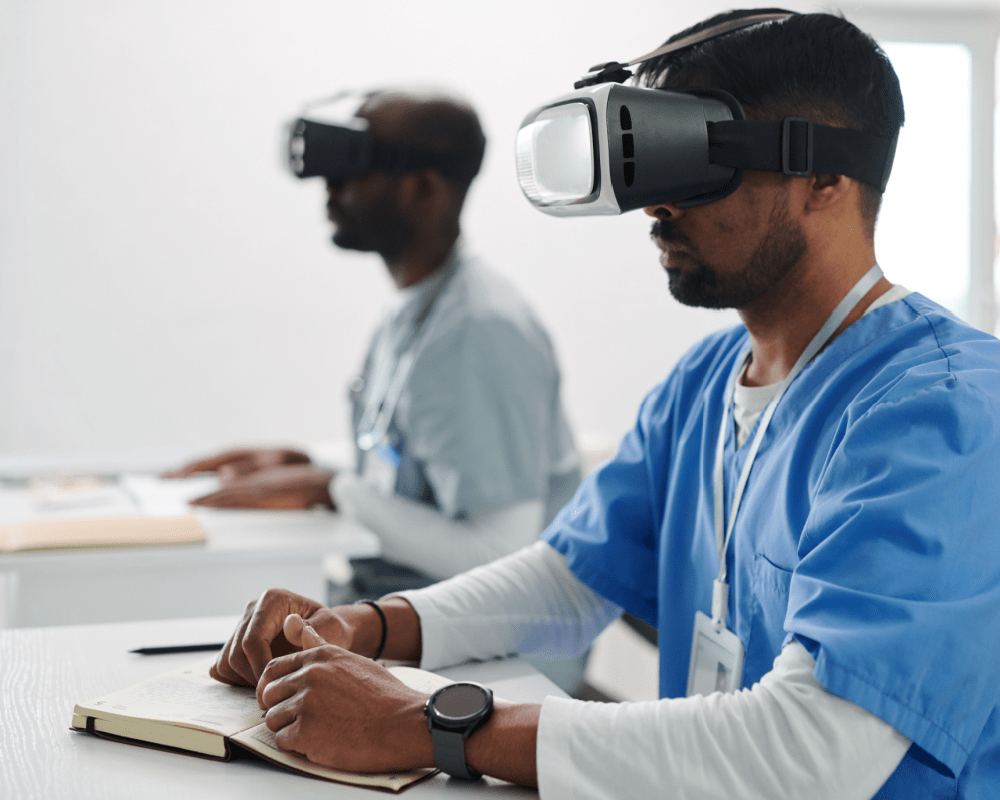
A VR headset immerses you in a digital world you can explore and interact with. “The Lawnmower Man” gave us a scary glimpse back in 1992. In the movie, a scientist tried to boost a man’s brain power with drugs and VR-based training. The subject became superintelligent—and homicidal.
A VR technology in cinema trend followed. The theme appeared throughout 1990s films, including:
A chilling tale of AI gone rogue, the film “Demon Seed” showed a surprisingly accurate smart home—in 1977. The house featured automated, voice-controlled appliances, lighting, and security features throughout. (Even a doorbell camera.)
Real-World Business Success
Smart home technology was developed in the 1960s. But “Demon Seed”-level smart homes? That technology wouldn’t arrive until the 2010s.
Ever hailed a Johnny Cab? (True, most people prefer “rideshare” now.) The 1990 movie “Total Recall” gave us Johnny Cab, with a chatty, human-like—but robotic—driver.
Real-World Business Success
We can’t buy fully-autonomous cars … yet. But some semi-autonomous models are available, as well asdriverless taxis. And some consumers are getting to test-ride personal autonomous vehicles, which may be parked in our driveways soon.
The 2024 global market for self-driving cars? $1.7 trillion!
How Screen Innovations Can Inspire Real-World Success
Do screen stories inspire real-life technology, or is it the other way around?
Filming on “2001: A Space Odyssey” began shortly after touchscreens were developed. (Probably not a coincidence.) But on-screen depictions of compact, ergonomic flip phones and Bluetooth earpieces were clearly echoed in consumer product designs from later decades.
These products met a need we didn’t know we had. It took futuristic stories for us to realize it.
Business visionaries understand that consumers crave innovative gear. And once they get it, they can’t live without it. Is it also well-designed? Does it solve a real problem? Those combined elements can be a springboard to success.
There’s a huge opportunity for ambitious business leaders inspired by technology in cinema or TV—or who see untapped markets.
Drive Real-World Success With a Business Administration Degree Online
The entrepreneurs who brought movie tech to life had big ideas and knew how to execute them. They understood consumer behavior, identified market gaps, and built strategies to turn prototypes into products people actually buy.
Whether you’re inspired by technologies you’ve seen on screen or you’ve spotted an untapped market, you’ll need the same skills those innovators used: marketing principles, strategic management, and the ability to weigh market potential.
The University of Texas Permian Basin’s online business programs can help you build that foundation:
Forget everything you think you know about management roles, like the idea that for the rest of your life, you’ll be chained to a desk under a ceiling of fluorescent lights. That’s not what management looks like—or at least, it doesn’t have to be. A business management degree doesn’t condemn you to a cubicle; it…
“It’s a beautiful summer day …” your star employee says as they stare longingly out the window. And chances are, they’re not the only one. Summer tests even the strongest teams. As the dog days hit, bloggers and journalists love citing a 2012 survey claiming that productivity drops a massive 20% during the summer. But…
Meetings. Emails. Last-minute requests. Some days, it feels impossible to knock anything off the to-do list. If this sounds like you, you might be in need of some time management tips and tricks. Time management is a skill like any other, and it can be honed with practice and patience. We’re here to show you…