Why Do We Play the Lottery? The Psychology Behind Our Obsession
“And may the odds be ever in your favor.”
— Effie Trinket in “The Hunger Games” by Suzanne Collins
On November 8, 2022, Edwin Castro walked into Joe’s Service Center in Altadena, California, and walked out with a winning Powerball ticket worth $2.05 billion, the largest national lottery jackpot in history.
The odds of Castro choosing the six winning numbers? One in 292.2 million. A person is far more likely to be struck by lightning (less than one in a million) than win the lottery. Why, then, do so many Americans play? To find the answer, we’ll need to dive into the psychology of the lottery and explore how drawings like the Powerball take advantage of mental processes and limitations to keep people hooked.
What Is the Psychology Behind the Lottery?
Lottery psychology refers to the mental shortcuts, biases, and emotional motivations that shape why people buy tickets—even when they know the odds are overwhelmingly against them. Our brains struggle to grasp huge probabilities, and when numbers reach into the millions, they become abstract and almost impossible to visualize.
What are your chances when the odds in winning the lottery are 1 in over 252 million?
Mathematics and statistics professor Steven Bleiler offers this analogy: A swimming pool measuring 40 feet wide, 120 feet long, and 5 feet deep is filled to the brim with M&Ms. A single green M&M is hidden among the mass of candies. The odds of winning the Mega Millions or Powerball jackpot are comparable to wading in blindfolded and picking that single green M&M.
To understand why people keep playing despite those long odds, psychologists point to a series of cognitive biases that subtly influence how we think about risk vs reward.
What Is the Gambler’s Fallacy
The gambler’s fallacy is the mistaken belief that past results influence future outcomes, even when each event is completely random. Lottery players fall into this trap when they assume certain numbers are “due” to appear simply because they haven’t shown up recently.
For instance, lottery drawings like the Powerball are independent events. No matter how often a number is drawn, it’s just as likely to be drawn in the future. There are no patterns, making it impossible to predict the outcome of future drawings. You can pick the same “lucky” numbers each week or select numbers at random. It makes no difference.
How Do Heuristics Affect Lottery Thinking?
Heuristics influence lottery thinking by pushing people to rely on quick mental shortcuts instead of slow, logical reasoning—making random outcomes feel more predictable than they really are.
We make countless small decisions every day while under a time crunch or working with limited information:
“It looks like rain. I’ll take an umbrella.”
“I’ve eaten at that restaurant. I’ll order from there.”
“There’s construction on the way to work. I’ll leave a little earlier.”
Heuristics are mental shortcuts, or rules of thumb, we use to make snap decisions, freeing up cognitive resources for more complex tasks. Conscious or unconscious, heuristics help ensure we don’t get hung up on life’s endless details, but they can mislead us into acting on unfair biases, as is the case with lottery players.
Why Does Availability Bias Affect Lottery Players?
Availability bias affects lottery players because vivid stories about winners come to mind more easily than the countless examples of people who never win.
By publicizing winners, lotteries promote the idea that wins are commonplace, when that couldn’t be farther from the truth. Availability bias helps explain why lottery players refuse to learn from past losses and instead spend money on what is sure to be a winning ticket—at least to them.
Why Do People Keep Playing Because of Sunk-Cost Bias?
Sunk-cost bias occurs when a person makes increasing commitments to a failing course of action in order to justify the time and effort they’ve invested, leading to feelings of helplessness. Lottery players are particularly vulnerable to this process since many pick the same numbers each week.
Imagine a lottery player named Dorothy. Every week, Dorothy plays the same numbers, and every week, she loses. She’s spent thousands of dollars on tickets over the years, which is why she can’t stop now.
The thought of quitting one week only for her numbers to come up the next is enough to keep her going. She’s fallen victim to sunk-cost bias, which only becomes stronger with every passing week, month, and year.
How Does the Illusion of Control Affect Lottery Players?
Illusion of control occurs when a person overestimates the influence of their choices on outcomes, even when those outcomes are left to chance. Anyone who’s experienced a near miss—perhaps one number off from a winning ticket—and felt like they were a hair’s breadth from a payout has been influenced by this self-serving bias.
Misled by the illusion of control, many lottery players believe skill can somehow tilt the odds in their favor. Players who pick their own numbers, for instance, are more confident in their odds of winning.
Never Gamble on Your Future
Considering the slim odds of winning and the biases and heuristics that make players vulnerable to addiction, we must insist that players contribute their hard-earned money to a more worthwhile pursuit … their education, for instance.
The psychology of the lottery is far more nuanced than what we’ve covered here. If you’re interested in learning more about how mental processes shape our beliefs and behaviors, consider pursuing a Bachelor of Arts in Psychology online at The University of Texas Permian Basin.
Entirely online, our BA in psychology program explores the theoretical and applied aspects of psychology. Courses like Social Psychology, which examine how our opinions and perceptions are the product of our environment, offer the chance to learn about the intricate subtleties of human behavior. Graduates, equipped with a degree and expanded skill set, are better prepared for a wide variety of careers in marketing, human resources, and public health, among many others.
Psychology is one of the broadest academic fields, and one of the most versatile. It spans everything from courtrooms to corporate offices, from childhood development to competitive sports. With so many specialties (and subspecialties), it can be tough to know where to even start. So exactly how many branches of psychology are there? The field is…
Ever reach for your phone and instantly face a barrage of messages, notifications, subscription reminders, and social media updates? You’re not alone. Scientists have estimated that the average person processes about 74 gigabytes of information daily: equivalent to watching 16 high-definition movies back-to-back in a single day. Cognitive overload is real. And over time, constant stimulation quietly changes how we think, focus, and feel. In this article, we’ll explore: What Does Cognitive Overload Mean? Cognitive overload happens when your brain receives more information than…
When someone struggles with depression, homelessness, or discrimination, who steps in to help? A psychologist? A social worker? A sociologist? These three fields all address human challenges, but they explore humanity from very different angles: one from society, one from the mind, and one from the front lines. So what are the similarities and differences between sociology, psychology, and social work? This guide clears up…
After becoming principal, walking the halls quickly becomes many a leader’s favorite part of the day—greeting students by name, offering encouragement to teachers, and feeling the pulse of the campus. But after years of success at the school level, some leaders start to wonder: What would it look like to shape the future of an entire district?
The answer often starts with earning superintendent certification. But is superintendent certification really worth it? In this article, we explore the numbers, responsibilities, and real-world impact behind this next step in educational leadership.
Superintendent Salaries in Texas: A Look at the Numbers
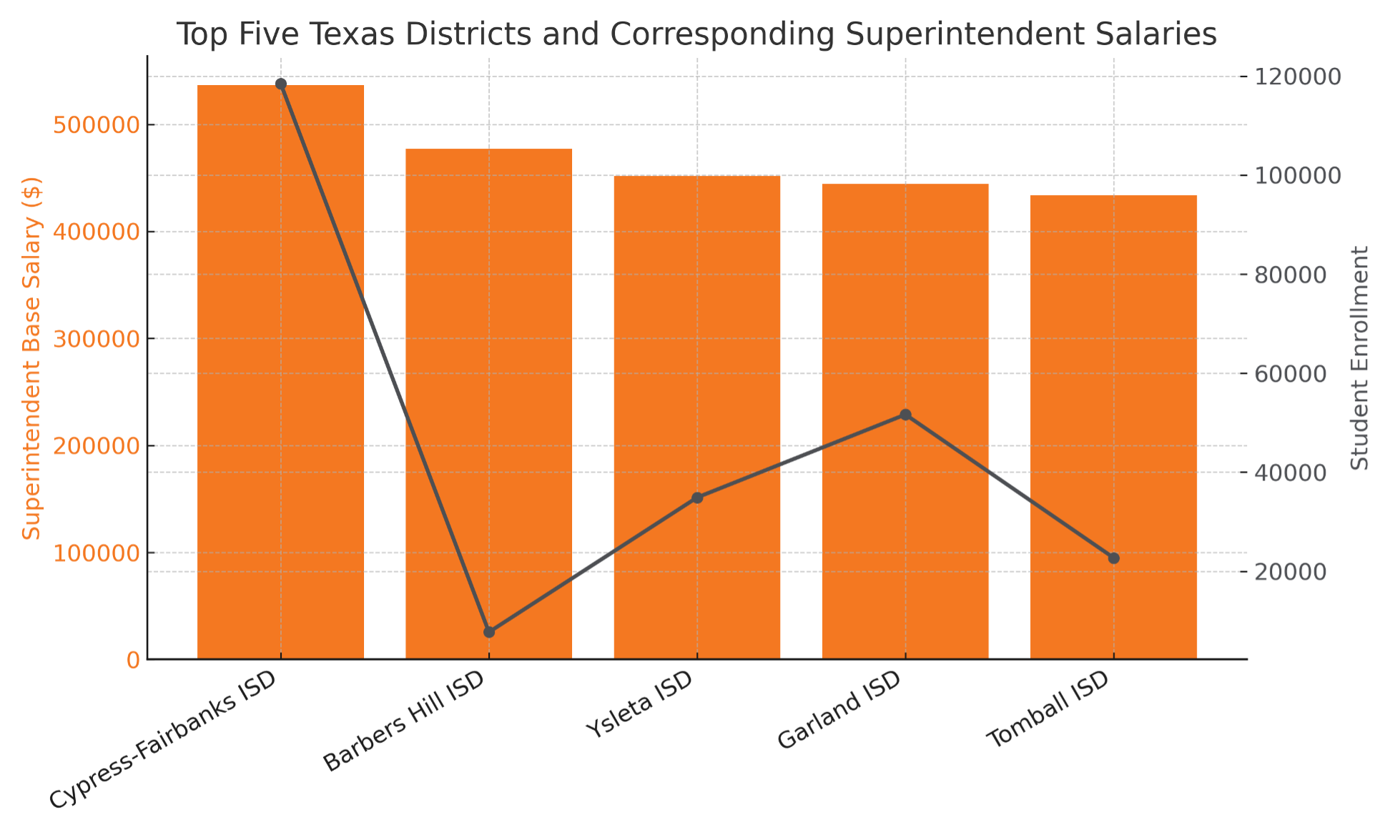
As of May 2025, the average school superintendent salary is $143,531.That’s a respectable number and appealing to many superintendent candidates, but as an average it doesn’t tell the whole story. A September 2022 report sourced from the Texas Education Agency showed some annual superintendent salaries approaching or exceeding $500,000. These salaries do not always correspond directly to student enrollment. Instead, they vary by school district.
Consider the top five Texas districts in terms of superintendent salary:
Cypress-Fairbanks ISD: 118,470 enrollments | Superintendent base salary $536,775
Barbers Hill ISD: 7,723 enrollments | Superintendent base salary $477,213
Ysleta ISD: 34,918 enrollments | Superintendent base salary $451,457
Garland ISD: 51,659 enrollments | Superintendent base salary $444,124
Tomball ISD:22,273 enrollments | Superintendent base salary $433,390
With more than 1,200 school districts across Texas, there are ample opportunities for qualified candidates—but competition is fierce. Most openings become available only when a current superintendent retires or moves on. Earning your superintendent certification through TEA makes you a viable contender. To do so, you must complete a Texas-approved educator preparation program (EPP).
What Does a Superintendent Do?
While principals focus on the day-to-day operations of individual schools, superintendents oversee the entire district, making decisions that affect thousands of students and staff.
Here’s a quick look at some of the key responsibilities of a superintendent:
Set the vision and strategic goals for the district to improve academic achievement and ensure equity across schools.
Manage district-wide budgets and resources, including staff, facilities, and technology.
Serve as the face of the district, working closely with the school board, community stakeholders, and elected officials.
Make high-level hiring decisions, such as selecting principals and other senior administrators.
Respond to crises and lead through change, from navigating policy shifts to managing public health concerns.
Advocate for funding and policy at the local and state levels to support district needs.
Stepping into this role means influencing far more than one school; it’s a chance to shape the educational experience of an entire community.
Expand Your Influence as a Superintendent
As a school principal, you unquestionably have the power to influence the lives of young people. As superintendent, your expertise in managing people, money, and other resources, carving out a vision for education in your district, engaging public officials and the greater community, and guiding your school board multiplies that influence exponentially.
At UT Permian Basin, we’re educators, too. We understand that you’re a passion-driven professional who strives to make a positive impact on as many students’ lives as possible. To quantify that potential, one Texas school district has an enrollment of nearly 200,000 students and several others are in or approaching the 100,000 range:
Houston ISD: 194,607 enrollments
Dallas ISD: 143,558 enrollments
Cypress-FairbanksISD: 117,217 enrollments
Northside ISD: 102,377 enrollments
Katy ISD: 88,368 enrollments
The reach is massive—and so is the potential for meaningful leadership. That reach also comes with tangible benefits: higher salaries, broader responsibilities, and greater professional prestige.
Earn Your Superintendent Certification Online at UT Permian Basin
If you aspire to a superintendent role in Texas, you already know that one of the requirements is successful completion of an approved superintendent EPP. UT Permian Basin is here to help. Our online Superintendent Certification program is 100% focused on helping principals and assistant principals who are ready to move into a district-level leadership role prepare to become certified superintendents in Texas. (If you live outside of Texas, check with Dr. Rod Uzat to confirm that your state’s certification requirements align with our program.)
Though a search of the Texas Education Agency (TEA) website will reveal 122 EPPs in Texas, UT Permian Basin’s program offers some considerable advantages. One of few four-course programs in Texas that maintains a practicum component for its duration, our program is:
Nationally accredited by the prestigious Council for the Accreditation of Educator Preparation (CAEP)
Approved by TEA
Accredited by the Accountability System for Educator Preparation (ASEP)
Once enrolled in our program, you can access our virtual classroom online from any location worldwide at any hour. You’ll pay a tuition rate that’s among the most affordable of any accredited university—approximately $6,255.84 plus applicable fees—a fraction of your future earning potential. You can finish the required 16 credits in as little as two semesters as you prepare to qualify for the professional role of a lifetime. And you can count on continued support from us with professional networking and dialogue opportunities after you successfully complete our program.
Given these facts and figures, it’s clear that applying to UT Permian Basin’s Superintendent Certification program is worth the investment in your future. Clear your path to the leadership position you want—apply now!
Summer break hits differently when you’ve been running on fumes since January. That first week is sacred. Your priorities are (in no particular order) sleeping in, ignoring all emails, and reacquainting yourself with your old friend, the couch. You’ve earned it. But once the dust settles, summer becomes something else: a rare window where you’re not just reacting. No lesson plans due, no…
Texas teachers, here’s the reality: More than half of all K-12 students in the state are Hispanic, and nearly a quarter are enrolled in bilingual/ESL programs. That translates to over a million students who needed specialized language support throughout the 2023-2024 school year. Districts are struggling to find enough certified bilingual and ESL teachers. A critical shortage for schools? Absolutely. But…
You’re sitting at your desk after dismissal. The room is quiet (for once), and somewhere between grading essays and planning tomorrow’s lesson, you hear it again in the hallway: “My students are using ChatGPT for schoolwork.” Suddenly, you’re wondering: Is this cheating? This is the real question around AI in education. And as this technology…
If you’ve ever texted ‘LOL’ or used the word ‘selfie,’ you’ve participated in history. The English language has never stood still. Every generation leaves its mark, from Shakespeare’s coinages to social media slang.
Language is ever-changing, and nowhere is that clearer than in the evolution of the English language. Additions like “blousette,” “gatekeep,” and “pumpkin spice” may seem inappropriate to traditionalists but are quaint in comparison to the words and phrases of Old English, the earliest form of the English language.
The history of the English language is punctuated by violent conquests, blending cultures, and intellectual enlightenment. It’s a fascinating story, one without a clear beginning or end. We do, however, have to start somewhere.
Here’s how the English language evolved throughout history, starting with its first main period: Old English.
Old English (5th–11th Centuries): Birth of a Language
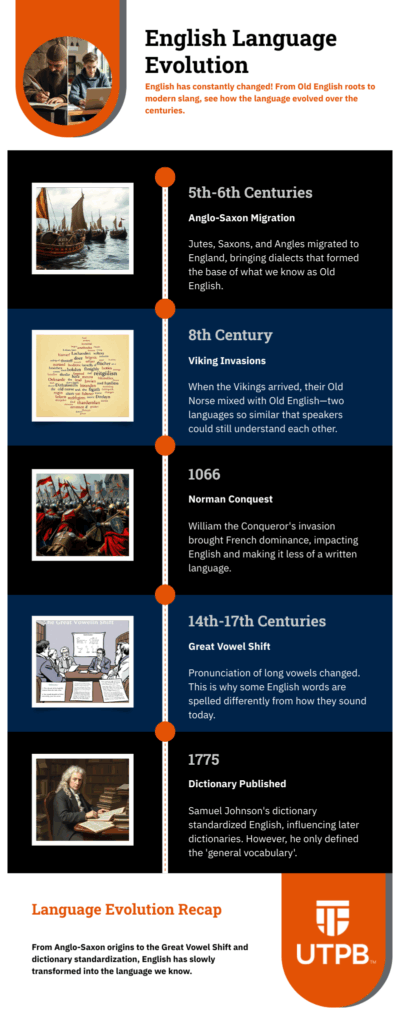
To understand the history of the English language, we have to travel back to the fifth and sixth centuries, when the Jutes, Saxons, and Angles (known collectively as the Anglo-Saxons) settled in England. Their dialects formed the earliest version of English—what we now call Old English.
Each tribe spoke a distinct dialect similar enough for members of different tribes to understand each other. The four dialects spoken by the Anglo-Saxons are:
Kentish
Mercian
Northumbrian
West Saxon
English continued to evolve as other languages and cultures were introduced to the Anglo-Saxons. St. Augustine arrived at the end of the sixth century, leading to the conversion of the Anglo-Saxons to Christianity and the influence of writing and Latin on their language.
Vikings speaking Old Norse invaded in the eighth century, influencing the evolution of the English language. Old English and Old Norse were similar enough for speakers to understand each other, but encounters like these reveal how the English language has changed over time.
Still, these early forms would be unrecognizable to modern-day English speakers—a fascinating chapter in the history of the English language.
Old vs. New: An Example of How the English Language Evolved
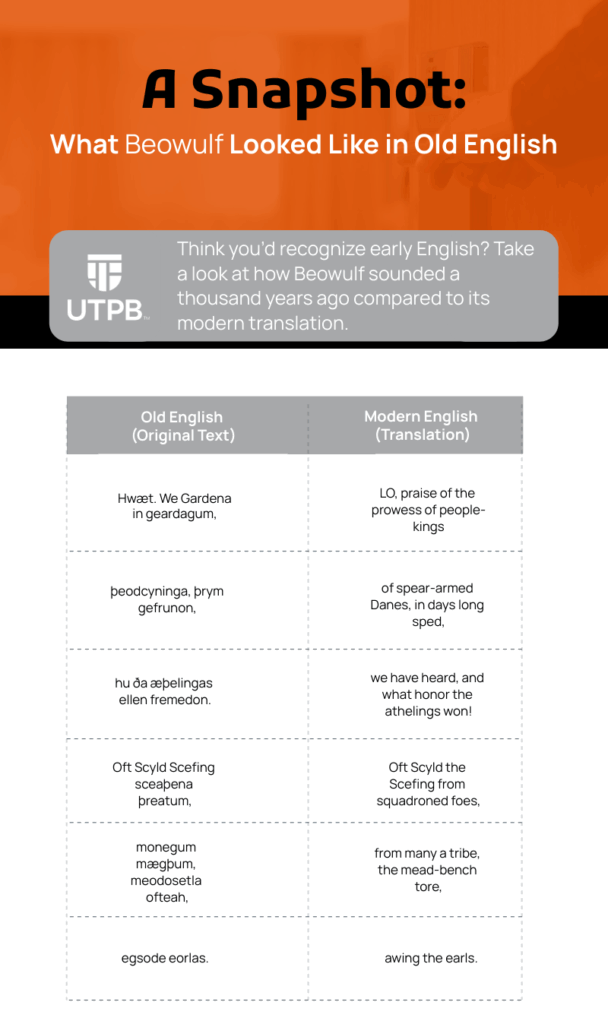
How foreign can Old English really be? Take a look at the opening lines and translation of the epic poem “Beowulf,” which was composed by an unknown author sometime between the 7th and 11th centuries:
You could argue that English got its start in the ninth century, when England became a unified kingdom under King Alfred the Great. At the time, Viking raids were seen as a form of divine punishment for sins stemming from ignorance.
So, Alfred, along with a group of scholars, translated Latin books into West Saxon and distributed them to his people. West Saxon became standard Old English: the first standard language of England.
Middle English (11th–15th Centuries): When French Took Over
William the Conqueror, leading an army of French-speaking Normans, invaded England in 1066 and defeated King Harold Godwinson to become king. As a result of the Norman Conquest, three languages gained dominance: Anglo-Norman French (spoken by the elite), English (spoken by the general populace), and Latin.
Latin was the language of learning throughout Western Europe and became the standard language in England after the Conquest. When Latin wasn’t appropriate, French was spoken.
This period is known as the Interregnum (“between reigns”) and lasted from about 1250 to 1400. English ceased to be a written language, and the establishment of a standard English was, for a time, abandoned.
The Great Vowel Shift
Taking place sometime between the 14th and 17th centuries, the Great Vowel Shift was a phenomenon that changed the pronunciation of English vowels, specifically “long” vowels.
For example, the /a:/ became /e:/ so that the “a” in “name” was no longer pronounced like the “a” in “father.” If you come across a word that’s pronounced nothing like it’s spelled, thank the Great Vowel Shift.
Modern English (16th Century–Present): From Shakespeare to Slang
As French and Latin waned in popularity, there was a push in the 16th century to make English England’s national language. Writers and scholars set to work establishing a written standard, one founded not on West Saxon but on the varieties of English spoken throughout London.
All attempts to codify English failed until Samuel Johnson published “A Dictionary of the English Language” in 1775. Other dictionaries came before, but none contained such elegant definitions or detailed quotations, and its principles would influence later dictionaries for the next century. Johnson saw fit to define only the general vocabulary of his time, a view his successors did not share.
At the behest of the Philological Society of London, the Oxford University Press and James Murray began work on a “complete” dictionary in 1879. Murray and his editors may have bitten off more than they could chew, however; it took them five years to reach the word “ant.”
Completed in 1928, the first copy of “A New English Dictionary on Historical Principles” spanned 12 volumes, defined 414,825 words, and contained 1,827,306 citations. A revised and second edition were published in 1933 and 1989, respectively. We now know this reference work as the Oxford English Dictionary.
Share Your Love of English
Countless plays, poems, and novels have been written in English since the time of “Beowulf.” With every new work published, the language evolves, no doubt to the delight of dictionary editors. This does, however, make mastering its principles a challenge—but one that’s rewarding for lovers of language and literature.
The story of English is still being written, and you can be part of it. If you love exploring how words evolve, consider deepening your knowledge through one of UT Permian Basin’s online English programs.
UTPB offers two online English programs that provide students with a deep understanding of American and British literature in preparation for academic, legal, writing, and marketing careers. Affordable and online, our programs cater to professionals from around the country who are interested in turning their passion for English into a worthwhile career.
Our online English programs are:
Bachelor of Arts in English: Study 18th-century poets, 19th-century novels, and film as literature while developing your composition skills.
Master of Arts in English: Master the structure and complexity of the English language through the exploration of poetry, mythology, and film and media.
Visit our program pages to learn more about or online BA and MA in English, or if you’re ready to get started, apply now to your program of choice. You’ll find yourself in the company of readers, writers, and grammarians at UT Permian Basin.
Monsters have been with us since the beginning of storytelling. Before novels, there were myths. Before myths, there were campfire stories about things lurking just outside the firelight. Something about the human brain is wired to conjure creatures (and compelled to write entire books about them). But literary monsters have never just been about scaring people. The…
“I took the road less traveled by, And that has made all the difference.” Even if you don’t know the entire poem, you may recognize the closing words from Robert Frost’s “The Road Not Taken.” They’re quoted at graduations, shared during moments of change, and used to describe the quiet courage of choosing your own path. So why have these simple words endured across generations? The power of…
Are you fascinated by vampires, haunted houses, or the macabre? If you nodded at any of those horror tropes, chances are you’ve encountered (or at least heard of) Gothic literature. From the timeless terror of “Frankenstein” to modern-day Gothic thrills like “The Haunting of Hill House,” Gothic literature draws us into the creepy underbelly of…
If you work in the criminal justice field and are seeking new career advancement opportunities, earning a master’s degree may be your best path forward. For insight on the topic, we spoke to someone who knows both criminal justice and higher education intimately. Dr. John Fisher, whose background includes work in private corrections and state probation, is the program coordinator and an assistant professor for UT Permian Basin’s criminal justice administration master’s degree program. Dr. Fisher elaborated on why a graduate credential is essential if you want to advance into a leadership role in criminal justice and why UTPB’s online master’s degree in criminal justice administration should be your program of choice.
A Quicker Path to Career Advancement
Dr. Fisher shared a crucial benefit of a Master of Science in Criminal Justice Administration for those looking to attain a leadership position. “If you want to become a chief of police, you either have to be a cop for 30 years or you have to have a master’s degree,” he explained. “If you want to be a warden in a prison, you either have to be a correctional officer for 30 years or have this master’s degree. Having the master’s degree helps you overcome the time limits and the time expectations within your career.”
“You get paid more for the degrees, you get promoted faster for the degrees, and you’re considered a better expert because of the degrees,” Dr. Fisher added, citing one compensation example local to him. “If you have a bachelor’s degree, the Midland Police Department will pay you $400 extra a month. If you have a master’s degree, they’ll pay you $500 extra a month.”
100% Job Placement Rate
How successful are graduates of UTPB’s online master’s degree in criminal justice administration program in their job searches? “We have a 100% placement rate,” Dr. Fisher said. “Since I started this program in 2019, every person that graduated is working in the field and/or has gotten a promotion. I think by the end of 2023 we’ll have issued 50 master’s degrees.”
To provide some real-life examples, Dr. Fisher referred to the “wall of fame” which spans two wall sections of his office. “Once a graduate of our criminal justice undergraduate or master’s degree program gets a job in the field, they send me their picture and I put them on the wall of fame. Most of the people on that wall have a master’s degree. A recent master’s program graduate is Kenrick, who’s from the British Virgin Islands. With our degree, he’s interviewed for and was told that it’s most likely he’s going to become the superintendent of policing for the British Virgin Islands.”
Dr. Fisher continued: “One of the people on my wall was hired into the police department fresh out of graduate school, and instead of having to work on patrol for two years, she was automatically put into an analysis spot to where she was doing crime scene analysis and statistical analysis of hotspots and other places. She didn’t have to do that two-year probationary [period]. Within nine months, she became the investigator for the district attorney’s office. So now she’s quality control and she’s verifying the work done by the police department.”
A Faculty of Experienced Criminal Justice Professionals and Educators
Like Dr. Fisher, all program faculty members have had direct involvement in the criminal justice field in addition to experience as educators. “Every professor in our program, graduate or undergraduate, has at least four years’ experience in the field. We are scholar practitioners that are trying to help bring about positive social change and reform to law enforcement. We’ve all been there. We’ve all done that. We have the scars and the memories.” Dr. Fisher also clarified that that criminal justice experience is ongoing for some faculty: “Our adjuncts are currently working in the field.”
Stronger Educational Background Translates to Better Job Performance
Increased salary and leadership potential are considerable benefits of having a master’s degree. There’s also evidence that criminal justice professionals with an advanced degree have fewer problematic incidents during their career. “Every law enforcement commission report has stated that we need a better educated police force. Our research shows that college graduates have a lower number of ‘use of force’ complaints. There are a lower number of lawsuits against or complaints against officers who have a college education.”
“The master’s degree program teaches you ethics,” Dr. Fisher explained. “It teaches you the theories and philosophies, and the research shows that it will make you a better law enforcement officer. You’ll have a broader aspect of the world around you. You learn diversity—diversity of thought, diversity of culture, diversity of everything in [our program].”
“You don’t have to come here and get this degree,” Dr. Fisher concluded. “You come get this degree because you want to become a better police officer, a better correctional officer, better probation parole officer, and you want to run the agency. It’s an administration degree. We prepare you to bring change to the field.”
Take the Next Step!
If you’ve already completed a criminal justice-related bachelor’s degree and are ready to advance beyond your current role in the criminal justice system, our online Master of Science in Criminal Justice Administration will equip you with the requisite expertise and credentials. Our program’s asynchronous online format empowers you to earn a respected graduate credential in as little as one year with the flexibility that your professional and personal commitments demand. No campus visits are required—you can access our virtual classroom 24/7 from practically any location worldwide.
Move ahead with a master’s degree in criminal justice administration! Apply today.
As April 15th looms, many of us start to scramble. You know the day: Tax Day—the deadline to prove to the IRS that you paid the right amount of income tax, claim a refund if you overpaid, or begrudgingly send what you still owe.
Why do Americans go through this ordeal every year, and how did it begin in the first place? Let’s take a brief look at the history of income tax in the U.S. now.
Timeline of Federal Income Tax History in the United States
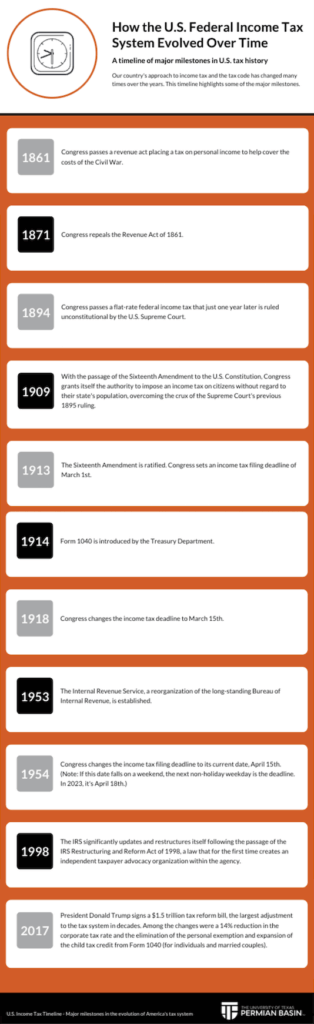
Our country’s approach to income tax and the tax code has changed many times over the years. This timeline highlights some of the major milestones:
1861: Congress passes a revenue act placing a tax on personal income to help cover the costs of the Civil War.
1871: Congress repeals the Revenue Act of 1861.
1894: Congress passes a flat-rate federal income tax that just one year later is ruled unconstitutional by the U.S. Supreme Court.
1909: With the passage of the Sixteenth Amendment to the U.S. Constitution, Congress grants itself the authority to impose an income tax on citizens without regard to their state’s population, overcoming the crux of the Supreme Court’s previous 1895 ruling.
1913: The Sixteenth Amendment is ratified. Congress sets an income tax filing deadline of March 1st.
1914: Form 1040 is introduced by the Treasury Department.
1918: Congress changes the income tax deadline to March 15th.
1953: The Internal Revenue Service, a reorganization of the long-standing Bureau of Internal Revenue, is established.
1998: The IRS significantly updates and restructures itself following the passage of the IRS Restructuring and Reform Act of 1998, a law that for the first time creates an independent taxpayer advocacy organization within the agency.
2017: President Donald Trump signs a $1.5 trillion tax reform bill, the largest adjustment to the tax system in decades. Among the changes were a 14% reduction in the corporate tax rate and the elimination of the personal exemption and expansion of the child tax credit from Form 1040 (for individuals and married couples).
Why Was the U.S. Income Tax Created?
The U.S. income tax system was born out of necessity. In 1861, during the Civil War, Congress passed the Revenue Act to generate funds for the Union war effort, marking the first time Americans were taxed directly on their income. Though this early tax was temporary, it laid the groundwork for future legislation.
How Has Tax Filing Has Changed Over the Years?
Tax filing has shifted from a manual, paper-based process to a fast, mostly digital experience. In the early days of income tax, taxpayers filled out paper forms like the now-famous Form 1040 by hand and mailed them to the IRS. Over time, filing requirements and deadlines evolved, with Tax Day eventually landing on April 15.
The rise of digital technology marked a major turning point. Today, , making the process faster and more accessible. E-filing software, digital W-2s, and online tax tools have simplified what was once a paper-heavy and time-consuming task.
Who Needs to Pay Federal Income Taxes Today?
Today, most working Americans are required to file a federal income tax return if they earn above a certain threshold, which varies depending on factors like:
Age
Filing status
Income type
Currently single filers under age 65 must file if they earn more than $13,850. Self-employed individuals need to file if they earn over $400. Taxable income can include:
Wages
Freelance earnings
Investment returns
Because tax law is complex and ever-changing, many individuals and businesses turn to accountants to ensure compliance, maximize deductions, and reduce the risk of costly errors, making the role of accounting professionals more important than ever.
Online Accounting Degrees to Advance Your Career
Is it your passion to tackle taxes and other financial concerns as a career? Countless busy, frustrated, and confused American taxpayers are anxious to let a professional handle their annual income tax filing and other financial matters on their behalf. The University of Texas Permian Basin offers AACSB-accredited accounting degree programs to match your professional ambitions and education level—all available through an online classroom you can access from anywhere in the world at any time of day. Our programs include:
Generally, you must earn at least a bachelor’s degree before working as an accountant. UT Permian Basin’s BBA in accounting program is designed to help you build the qualifications for accounting and related professional positions. This degree will equip you to take on accounting roles in governmental, private, public, and non-profit sectors.
If you’ve already completed a bachelor’s degree and want to explore accounting at a more advanced level, you have two program choices:
Develop broader business acumen as you expand your expertise in traditional and modern accounting principles, strategic thinking, and decision-making with our online MBA in accounting.
Choose our CPA track if you plan to seek CPA certification.
Opt for our non-CPA track if you prefer broad accounting studies.
Finish your degree in as little as four semesters.
In addition to honing your mastery of historical and current accounting practices and decision-making and strategic thinking skills in a business context, the curriculum of our Master of Professional Accountancy prepares you to sit for the Texas CPA exam.
When you hear the word “accountant,” who comes to mind? Someone balancing spreadsheets and filing taxes? If so, you’re on the right track. But there’s more to it. Within the field of accounting, one credential stands apart: the Certified Public Accountant (CPA). While both accountants and CPAs manage finances, advise clients, and ensure the accuracy…
Picture this: You’re a junior accountant, and your manager asks you to tweak a report to make the numbers look better. The request sounds harmless enough—just a small tweak—but you know it’s not above board. Now you’re stuck. Do you follow orders and risk crossing an ethical line, or do you push back and risk…
You’ve always been an analytical thinker. A problem solver. Maybe a math whiz, too. There’s a career that matches your strengths. Certified Public Accountants—or CPAs—excel in these qualities. Let’s explore why a CPA is no ordinary accountant and what it takes to become one. Want to Be a CPA? Here’s What You Need to Know …
The American continent before European contact was home to around 60 million people, with up to 18 million living in North America and divided into more than 500 diverse nations and tribes. The westward expansion of incoming European settlers who coveted the rich resources and fertile land in North America resulted in a purge of most indigenous nations, driving them into either reservations or extinction.
This dramatic shift in the lives of Native American people is chronicled in an online course from The University of Texas Permian Basin’s online Master of Arts in History program entitled HIST 6341: Native North America: Contact to Removal. Read on for a preview of what you’ll learn in this rich online course and how to join your fellow historians in earning your graduate degree from UTPB.
The Sprawling Cultures of Pre-Columbian America
The Paleo-Indians migrated to the North American continent from Asia around 40,000 to 14,000 years ago and developed into diverse cultures. These communities were thousands of years old by the time Europeans arrived. While tribes like the Lakota of the Great Plains remained semi-nomadic hunter-gatherers, the indigenous nations of the Midwest were urbanized engineers and traders. The Iroquois League that formed as a confederacy in the Northeast is the oldest participatory democracy still in existence today.
Cahokia, an ancient city that was located in modern-day Illinois, was the largest and most sophisticated urban center until the rise of large midwestern cities in the 18th century. At its height, this complex built by the Mississippian culture was a metropolis made of plazas, monuments, shops, ball fields, a solar calendar, and middle-class and elite neighborhoods.
European Contact and Conflict
When European settlers arrived as early as 1000 A.D., many indigenous people welcomed them with caution and hospitality. Every part of the country was bustling with autonomous nations when Christopher Columbus laid claim to the land in 1492.
Although some tribes had strained relationships with colonists, others traded and helped struggling settlements. In 1621, the Pilgrims and Wampanoag people shared a harvest feast that was later declared a U.S. holiday: Thanksgiving. The discovery of abundant resources and farmable land, however, started an ever-moving trek by the U.S. government to expand westward that quickly complicated and strained Native and European relations. Officials frequently broke treaties to gain access to the coveted land, and many spread propaganda that depicted the indigenous nations as backward and barbaric.
Indigenous people were ordered to Americanize through “civilization programs” and adopt Western religion and culture. Many resisted, resulting in hundreds of years of war. Epidemics like smallpox, brought by infected settlers, may have caused a mortality rate of up to 95% among the indigenous population.
Removal of Indigenous Culture
Despite ongoing treaties and meetings between indigenous nations and the U.S. government, the expansion of the United States into Native land occurred much faster than expected, and the first reservation was established in 1786. The Indian Removal Act of 1830 displaced Natives out west, which many tribes resisted. Approximately 4,000 Cherokee died on a forced march now known as “The Trail of Tears.”
1890’s infamous Battle of Wounded Knee was a result of U.S. officials banning a growing religion called the Ghost Dance. The resulting massacre killed 150 Sioux and marked an end to armed Native resistance against the United States.
“The land is sacred. These words are at the core of your being. The land is our mother, the rivers our blood. Take our land away, and we die. That is, the Indian in us dies.”
By 1900, only 237,000 indigenous people remained. Indigenous people living on reservations today are challenged by barren lands, poor living conditions, a struggle to retain their identities and way of life, and a lack of government assistance. Reservations often serve as radioactive dumping grounds, accounting for high cancer rates among the population.
A Course That Examines Native American History
Graduate students interested in this subject and pursuing a Master of Arts will want to consider enrolling in Native America: Contact to Removal (HIST 6341) as part of UTPB’s online MA in history program.
HIST 6341 confronts the challenging history of American settler-colonialism. You’ll take a detailed look at North America before European contact, the period of indigenous removal and extermination, and how indigenous tribes adapted and persisted. Students will also learn how the inclusion of ethnohistory—the study of cultures and indigenous peoples’ customs—changes the master narrative of our history books. HIST 6341 is taught entirely online and asynchronously, meaning you can study anywhere and anytime you want.
An Online Graduate Program Tailored to You
Our online MA in history program prepares you to think critically and analyze how our past shapes who we are today, including how we can understand and prevent repeating tragedies like the Native American genocide. The skills you’ll learn are applicable across multiple career paths like management, politics, teaching, writing, and law enforcement. Our program is affordable, flexible, and there’s no GRE requirement for admission. Earn your master’s degree in as little as two years!
Become a force for change and a leader in any profession. Join the Falcon Family!
States across the U.S. are grappling with a superintendent shortage, with over 60 vacancies in Texas alone. After overcoming unprecedented challenges during the COVID-19 pandemic, many superintendents retired or moved to smaller districts, fueling the shortage. Now that students and teachers are back in the classrooms, a new generation of superintendents is needed to lead school districts.
Superintendents are in high demand, but is it the right time in your career to pursue your superintendent certification? That’s what we’re here to answer. Skip to the end if you’re set on earning your certification and taking on the role of a district leader.
Ask Yourself: Am I Doing This for the Right Reasons?
We’d love to say that you should pursue superintendent certification for no other reason than to advance your career, but that wouldn’t be sound advice. Instead, we suggest that you carefully weight the pros and cons of superintendency before committing to this career path.
Superintendents are the leaders of their school district and, accordingly, face tremendous pressure from their community and school board. There are no “typical days,” as superintendents contend with high-level challenges while overseeing daily operations including leading meetings, coordinating with team members, and managing budgets. Superintendents will encounter many of the challenges you’ve faced as school administrators, only on a larger scale.
We say this not to discourage but to encourage you to transition from principalship to superintendency for the right reasons. If you’re feeling burned out, superintendency likely won’t be the change of pace you’re looking for. If, however, you’re up to the challenge, you’ll find that the rewards are commensurate with the responsibilities of a superintendent.
Ask Yourself: Do I Have What It Takes to Make a Difference?
Principals should pursue a superintendent certification for the same reason they became school leaders: to make a difference in the lives of students. True, superintendency is a high-level, high-paying role, but student achievement must always be an administrator’s main source of motivation.
Superintendents are responsible for allocating resources, such as personnel, technology, and learning materials; collaborating with stakeholders, including administrators, board members, and teachers; and establishing goals—all in the name of fostering a safe, effective learning environment.
As a principal, you have a profound impact on your campus. As a superintendent, you’ll shape the future of an entire school district.
The Importance of Leadership
A 2021-22 meta-analysis of 27 studies involving 2,714 districts sought to answer one question: What is the relationship between district leadership and student academic achievement? Researchers found a strong correlation between the two, noting that effective district leadership does, in fact, add value to the education system. These findings may seem unsurprising, but there are still many who doubt the necessity of superintendents.
Ask Yourself: Do I Want a Higher Salary?
Elementary, middle, and high school principals make a median salary of $98,420 annually. While a nearly six-figure salary is impressive, it doesn’t have the buying power it once had, especially as the cost of living creeps higher. Anyone trying to afford childcare, groceries, or car payments in 2023 knows what we’re talking about. Long-term goals, such as saving for retirement, are similarly growing out of reach.
A principal’s salary is determined, in part, by their experience and education as well as the size of their district. We don’t know the specifics of your situation, but if you’re reading this, it’s possible you’ve reached a compensation plateau. If so, earning your superintendent certification is a surefire way to increase your earning potential.
According to the 2021-22 AASA Superintendent Salary and Benefits Study, superintendents make a median annual salary of $147,000, with superintendents in the largest districts taking home over $200,000 a year. Superintendents of the largest school districts in Texas earn well over $300,000 a year. Now that’s something to look forward to.
Ask Yourself: Do I Have Enough Experience?
If it’s a question of experience, you likely have everything you need—at least on paper. Being a principal, you already meet the first two requirements of the Texas Education Agency (TEA): a master’s degree and a principal certificate. (You’ll also need to complete an approved principal educator preparation program and pass the required exam. More on that below.)
Aspiring principals outside of Texas should confirm eligibility requirements with their state agency before deciding next steps.
Ask Yourself: Am I Ready to Become a School Superintendent?
Only you can decide if this is the right time in your career to pursue superintendent certification. If, however, you’re compelled to make a difference in the lives of hundreds if not thousands of students, you’ll find that there’s no time like the present.
Enroll in Our Online Superintendent Certification Program
The University of Texas Permian Basin offers an online Superintendent Certification program through which you’ll gain the skills, knowledge, and credentials needed to propel your career to new heights. As an approved principal educator preparation program, our program will help you meet Texas’ certification requirements and prepare for the required exam. If you are outside of Texas, contact Dr. Rod Uzat to help you navigate your state’s requirements.
Our program is composed of convenient online courses, each with a 40-hour practicum (internship) component. Study major topics in our virtual classroom, including capacity building, facility planning, fiscal awareness, and social issues. Then apply your theoretical knowledge in a real-world setting during your internship. Through the internship practicum in every course, you’ll also have the chance to collaborate with your district’s superintendent. What better way to learn what it takes to become a district leader?
If now is the right time in your career to pursue your superintendent certification, apply to our online program. In as little as two semesters, you can graduate ready to make a difference as a district leader.
People often use the titles “psychologist” and “psychiatrist” interchangeably. But while they’re separated by just a few letters, practitioners of both specialties would tell you their professions are quite different. There are certainly similarities between psychologists and psychiatrists. Both are “mind experts” who treat their patients’ mental and emotional conditions, albeit in different ways that require different qualifications. Let’s compare the two now to give you an understanding of the vital contributions each of these professionals makes toward improved mental health.
Education, Training, and Licensure for Those Who Wish To Conduct Mental Health Therapy
Psychologists must earn a PhD or MA in clinical, counseling, or school psychology and sit for licensure to become a licensed psychological associate (LPA), a licensed professional counselor (LPC), or a licensed specialist in school psychology (LSSP), respectively, in their state. They are required to complete 3,000 hours of supervised experience on the job prior to sitting for their licensing exam.
Psychiatrists must attend medical school for four years. This includes participating in clinical rotations, typically beginning in the third year. Psychiatrists are licensed medical doctors (MDs) or doctors of osteopathic medicine (DOs) who complete a three- to four-year residency and obtain certification from the American Board of Psychiatry and Neurology (ABPN)—a credential they must renew periodically.
Approach to Treatment
Psychologists diagnose and treat patients through individual counseling (psychotherapy), group therapy, behavior modification, and other techniques and strategies. There are different types of psychologists that treat various conditions. Psychologists sometimes treat patients in tandem with psychiatrists or other medical doctors who can provide treatment for more complex conditions.
As MDs, psychiatrists are authorized to prescribe medications and will often treat their patients’ conditions with one or more medications. In some cases, they may prescribe electroconvulsive therapy (ECT), which today is relatively safe and painless. Psychiatrists also offer psychotherapy and consider the impact of overall physical health on mental health.
Terminology
There’s debate in the psychology world about the use of the term “patient” versus “client,” with many professionals preferring the latter.
Since psychiatrists are medical doctors, “patients” is the appropriate term for the people they treat.
One Psychology Degree, Many Career Possibilities
If you’re fascinated by psychology, considering a psychology career, or want a degree that prepares you for a broad range of careers, The University of Texas Permian Basin’s online Bachelor of Arts in Psychology may be just what you need. Built on a foundation of general education courses, our program provides a firm grounding in psychological science that will benefit you personally and professionally. You’ll develop critical abilities such as reasoning about empirical research, problem-solving, writing compelling arguments, and thinking critically on theoretical and practical facets of psychology. You’ll build “soft skills” that are in high demand among today’s employers, making your psychology degree one of the most marketable university credentials.
When you complete your BA in psychology, you will not graduate as a psychologist. You will graduate ready for the next phase of the journey toward that profession, if you choose, or prepared to take on a variety of careers in which psychology, research, and well-honed soft skills are a core component, including:
Human resources professional
Marketing professional
Nonprofit professional
Data scientist
Management professional
Researcher
Case manager
Online Learning Offers Peace of Mind
We deliver our BA in psychology program in a 100% online, asynchronous format that offers many advantages. You can complete your classwork on your own schedule from just about anywhere in the world—from Venice, California to Venice, Italy and all points in between. No campus visits are required. This flexibility enables you to give your current professional and personal commitments the attention they deserve while earning a credential that will elevate your career prospects immeasurably. And you can begin the program at any of six start dates during the year.
When we think of hackers, we often picture hoodie-clad tech wizards typing furiously in dark rooms, bypassing firewalls in seconds. But the reality is often far more mundane—and more human. Some of history’s most famous hackers weren’t out for money or power. Many just wanted to see if they could do it.
Before we get into the list, it’s helpful to understand that not all hackers operate with the same intentions—or methods. Some hack for profit or chaos; others for curiosity or justice.
Let’s take a quick look at the types of hackers you’ll see on this list.
Types of Hackers: Black Hat, White Hat, and Grey Hat
When you think of a hacker, you’re probably imagining a black-hat hacker: the kind who exploits system weaknesses for personal gain or to cause harm. But not all hackers are bad.
Here’s a quick breakdown of the three main types:
Black-hat hackers: Criminal hackers who break into systems to steal data, cause disruption, or profit illegally.
White-hat hackers: Ethical hackers who are hired by companies to find and fix vulnerabilities before criminals can exploit them.
Grey-hat hackers: Hackers who find and expose flaws without permission, sometimes even sending the company a “bill” for their help. They don’t have malicious intent, but their methods are still legally questionable.
7 Famous Hackers Who Made History
From government network infiltrations to cyber activism, these hackers made headlines and history. Some worked alone, others in collectives. Some sought justice; others sought thrills or financial gain.
Here are seven of the most famous hackers of all time and the stories behind their cyber escapades.
1. Kevin Mitnick
Kevin Mitnick became “the world’s most famous hacker” after stealing computer code from tech companies like Nokia and Motorola. However, his crowning achievement came in 1982 when he hacked into the North American Aerospace Defense Command (NORAD), a stunt that got him on the FBI’s most wanted list and inspired the movie “War Games.” Mitnick was only in it for cheap thrills. Still, that didn’t stop authorities from sentencing him to five years in prison.
Mitnick employed social engineering, a concept he helped popularize that involves deceiving a user into providing secure information. In the case of Motorola, Mitnick simply called and asked for the security manager’s username and password, and he got it! Today, Mitnick is a renowned white-hat hacker, offering his unique set of skills to companies at risk of cyberattack.
2. Anonymous
Anonymous is a collective of online “hacktivists” whose origins can be traced to the early days of 4chan, an anonymous imageboard (hence the name). Members would organize raids of online chatrooms to troll users, but with time, their antics became socially and politically motivated.
Recently, the group declared a cyber war against Russia for its invasion of Ukraine. Dozens of hackers with alleged ties to Anonymous have been arrested, but with no real leadership or structure, the group continues to launch cyberattacks on world governments and million-dollar corporations in the name of social justice.
3. Astra
Little is known of the hacker who went by the name Astra. In 2002, Astra infiltrated the Dassault Group, a French company with civil and military aviation subsidies, and stole and subsequently sold corporate secrets, including information on weapons systems. Dassault reported damages in excess of $361 million.
Astra was arrested in Athens, Greece, in 2008. Greek authorities have yet to release his name to the public but describe him as “a 58-year-old mathematician.”
4. Gary McKinnon
Gary McKinnon committed “the biggest military computer hack of all time” when, between February 2001 and March 2002, he accessed NASA and other defense websites, disrupting supply lines, causing $700,000 in damage, and leaving notes like “Your security is crap.”
His reason?
Aliens.
McKinnon claims he was searching for evidence of UFOs. McKinnon, a London resident, was to be extradited from the U.K. to the U.S., but then-Home-Secretary Theresa May blocked the extradition, declaring that it would infringe upon his human rights.
5. Steve Wozniak
Steve Wozniak, “the Woz,” is known for cofounding Apple, but his first foray into business involved an illegal phone-hacking circuit board. In the fall of 1971, Wozniak happened upon Ron Rosenbaum’s “Secrets of the Little Blue Box,” an article about devices that generate the tones needed to trick telephone networks into making long-distance calls for free.
Wozniak and then-high-school-senior Steve Jobs got to work building a blue box of their own. After making a working model, they went dorm to dorm selling copies to fellow students at Berkeley. (Wozniak was expelled from the University of Colorado Boulder for hacking into the school’s network.) Creating a blue box gave the two Steves enough confidence to build something a little more ambitious. “If we wouldn’t have made blue boxes, there would have been no Apple,” said Jobs.
6. Gummo
Gummo’s story went viral after he sat down for an interview on the YouTube channel Soft White Underbelly. He shared how computers helped him cope with a troubled childhood, including the loss of his mother, and how hacking offered the means to survive.
After creating and selling software that hacked DirecTV, Gummo was arrested and offered a choice: go to prison or lend his expertise as a consultant. He chose the latter. After paying off his debt to society, Gummo did consulting work that led to him setting up networks used by the Chicago Mercantile Exchange (CME) and the New York Stock Exchange (NYSE).
Despite claiming to have over $7 billion in Bitcoin stashed away, Gummo works 9 to 5 protecting organizations and individuals as a white-hat hacker. “Knowing that I’m preventing someone’s grandmother from being a victim of some sort of cyber extortion scheme,” he said, “that’s the thing I get up for each day.”
7. Adrian Lamo
Adrian Lamo is a grey-hat hacker through and through. Known as the “Homeless Hacker,” Lamo would travel around the country by Greyhound bus, hacking into corporations like AOL, Yahoo, and The New York Times and offering to fix their security vulnerabilities for free before notifying the media of his escapades. He did this not to cause harm but to prove how dangerous the internet could be for anyone who left themselves vulnerable.
In the case of the Times, Lamo accessed their internal server in 2002 and added himself to their list of op-ed contributors. He was later caught and sentenced to six months of house arrest. Hacking one of the nation’s largest newspapers has its consequences, but in Lamo’s defense, he was only able to gain access because some Times employees were using their Social Security numbers as passwords.
Ready to Level Up in Your Current Field?
Curious about a career in tech? Or maybe you’re thinking about leveling up in your current field. Whatever the case may be, at The University of Texas Permian Basin, we offer 100% online bachelor’s and master’s degree programs designed for business professionals like you.
Whether you’re considering a new path or building on your current one, our flexible, affordable programs can help you take the next step toward your goals.
“Yes, it is a risk—especially during a health crisis—to assume that the information offered by your friends and family is always accurate.” – ABC News
The COVID-19 pandemic monumentally altered the way we see health crises, interact with one another, and live our daily lives. In healthcare, good communication is key to preventing misunderstandings and empowering society to respond to health hazards in an efficient, constructive manner. Let’s look at some examples of what was done and what could’ve been done to make COVID-19 communication more impactful—and what our experience can teach us about future health communication.
With the benefit of hindsight, we can see that the way COVID-19’s health risks were communicated to the American public (and the world) was highly flawed. A modern pandemic of this scope being unprecedented, public health officials were left to gather and disseminate rapidly changing and vital health information to an enormous, diverse, and sometimes openly unreceptive population. While public dialogue took on its own shape as the pandemic progressed, many misunderstandings about the developing disease stemmed from missteps made by various agencies and individuals within the federal government.
The World Health Organization declared COVID-19 a pandemic on March 11, 2020. Nearly a month later, at a televised White House press conference, the president, vice president, White House coronavirus response coordinator, U.S. secretary of health, and other officials failed to present a united front on the importance of wearing masks and following other measures to minimize the spread of the disease. In addition, broad CDC guidance on COVID-19 was delayed by as much as three months at the outset—a missed opportunity to educate the public on risks and ways to avoid them. In the absence of this information, state and local health officials were left to issue their own guidance, which lacked the science-backed, big-picture view that the CDC had.
While a consistent message is critical, public officials also apparently failed to take into consideration that different types of people, based on their age, beliefs, and other demographic factors, receive and react to messages in different ways. The central message should always be consistent, but ways of delivering it, including different media outlets and even the tone of the messaging, may need to be adapted for the diverse audiences that make up our society.
Let’s review some ways public officials can make health communication consistent and get buy-in from a larger segment of the public.
The Antidote to Misinformation and Misconceptions
“I can only hope that the experts can one day become the experts again, supported and given the platform they need to educate the American public.” – Meeta Shah, assistant professor of emergency medicine at Rush University Medical Center, via Scientific American
Public health communication must be proactive. It’s vital to plan coordinated efforts on an ongoing basis rather than wait for an emergency to develop. This can be achieved in part by using information in some of the resources already available to us.
Public officials must also consider broadening the reach and appeal of health communication by reaching people “where they live.” Young people, for example, are accustomed to receiving their information via social media, so information conveyed in televised press conferences may not reach them. Social media has also acclimated participants to engaging in a two-way dialogue rather than being spoken to, so including them in a conversation about health concerns is likely a more effective approach.
People of different faiths and cultures connect with and respond better to messages that are in tune with their values. Reaching them may require government and health officials to contact recognized leaders of their respective communities and request those individuals share important health messages. Those leaders can also model those messages, setting an example for those who trust them by showing that they are following the recommended health practices, e.g., wearing masks when appropriate.
Bottom line: Public officials need to work together now to combat future health crises—an effort that should include bringing new tactics into the fight.
Contribute to a Stronger Communication Culture
If you value strong communication skills and understand their importance to your career, your life, and to society, UT Permian Basin has a 100% online degree program you should consider. Our Bachelor of Arts in Communication helps you hone exceptional written and verbal communication skills that are among the most marketable, in-demand professional skills today, according to the U.S. Department of Labor and Forbes.
As a student in our program, you’ll begin with a foundation of elective and general education courses that enable you to develop a deeper understanding of the humanities, sciences, mathematics, and other academic areas. As you move into the core curriculum, you’ll explore interpersonal communication, political communication, public speaking, public relations, media, and advertising. Our program allows you to tailor your studies with a select group of courses in popular communication specialties. Choose from tracks in:
Strategic communication
Professional communication
Sports media
The Advantages of Online Learning
UTPB’s online BA in communication provides all the same benefits of our campus-based program, plus a few that are unique to the online experience. Throughout your studies, you’ll learn the same campus-based curriculum from the same renowned faculty who teach it on campus. The difference is that the program is delivered in an asynchronous, 100% online format that enables you to earn a valued credential on your own schedule with no campus visits required. Complete your degree while continuing to meet your professional and personal obligations.