What the Transition to Electric Vehicles Means for the U.S. Power Grid
They’ve been championed as an eco-friendly alternative to traditional cars. But as more rechargeable electric vehicles (EVs) hit the road, how will the U.S. power grid—already strained due to record high temperatures and other factors—be able to meet the demand?
Here, we’ll discuss what’s happening with the power grid right now, what obstacles still need to be removed, and potential risks and benefits associated with the transition from gas-powered vehicles to EVs.
Why EV Adoption Demands a Smarter Grid
By 2030, Bloomberg predicts more than 50% of new cars purchased in the United States will be EVs. Heightened use of electric power in general is also expected, in applications including heating, cooling, and today’s computer-driven industries, which require electricity-hungry semiconductor chips. This will necessitate large-scale and expensive upgrades to our national power grid.
Billions in Funding Powers Grid Updates
The United States has only recently put extensive resources into upgrading our energy infrastructure. The Bipartisan Infrastructure Law, passed in 2021, dedicates more than $20 billion to upgrading our power grid. Portions of these funds are currently being allocated to:
Constructing new transmission lines.
Reinforcing existing transmission lines for weather resistance.
Making smart grid updates.
Expanding battery storage capacity.
Creating local microgrids.
Modernizing underground monitoring and control equipment.
These endeavors are both costly and complex. A study ordered by the California Public Utilities Commission projects that it will cost their state $50 billion to upgrade its grid to power the number of EVs it hopes to have on its roads by 2035. High-voltage transmission lines, which can effectively deliver power from a variety of sources to all corners of the country, must span myriad cities, counties, and states, and those areas fall under the authority of many different utility companies and regulatory agencies. Permitting can sometimes take more than 10 years.
As during the fuel crisis of 1973-1974, which saw nationwide gasoline shortages and long lines at the filling station, we could see similar situations at charging stations, with no end in sight.
So, what would happen if shortages became the norm? They could show up as power outages or blackouts, which wouldn’t just bring EVs to a halt: It could disrupt countless aspects of daily life.
How EVs Could Become Grid Heroes (and Create Jobs)
There is some hope on the horizon for California, which is leading the way nationally on EVs despite an expensive road ahead. They’re working toward tripling their electric grid capacity ahead of their 2035 targets and producing significant energy through renewable sources. They’ve also forecast that EVs will only total about 4% of their energy demand in 2035 and therefore not place a major strain on resources.
During extreme temperatures when power demand increases, an EV owner could sell excess power from their EV battery back to the utility company, alleviating strain on the power grid.
During a power outage, an EV owner could actually use their own car battery to get electricity flowing back into their house.
The need for workers to install the power lines that connect electric vehicle charging stations to the power grid, as just one example, will also lead to expanded job opportunities for those in that field. So, while the challenges of transitioning our power grid to accommodate EVs and our other needs are considerable, they may not be insurmountable and are certainly offset by some of the advantages that will likely result.
Frequently Asked Questions
Curious about how electric vehicles will impact the U.S. power grid—or if the grid is even ready? Below, we answer some of the most common questions people are asking about EVs, electricity demand, and the challenges and opportunities ahead.
Can the U.S. power grid support electric vehicles? Not yet—but it’s getting there. The U.S. is investing over $20 billion in grid upgrades through the Bipartisan Infrastructure Law. By 2030, electricity demand is expected to increase by 18% due to EVs and other electric use, so expanding capacity is essential to avoid shortages or blackouts.
Do electric vehicles use the electric grid? Yes. EVs depend on the power grid to charge their batteries, whether at home or at public charging stations. This makes them a new and growing part of electricity demand.
What are the main challenges and opportunities with EVs and the power grid? Challenges include upgrading aging infrastructure, long permitting timelines for new transmission lines, and the cost of meeting rising demand. Opportunities include using EVs as mobile energy storage, job creation, and growth in renewable energy integration.
Refine Your Energy Business Skills and Credentials With UTPB’s Online Programs
With our longtime ties to the energy industry, The University of Texas Permian Basin is uniquely positioned to provide programs built around the latest developments in the field. Our AACSB-accredited College of Business empowers you to complete these career-enhancing credentials from practically anywhere in the world, 24/7, on your own schedule:
In the early morning hours of April 26, 1986, reactor number four at the Chernobyl nuclear power plant exploded. As the reactor building was destroyed, over 100 radioactive elements were launched into the atmosphere. Today, Chernobyl remains frozen in time. A protective radiation shield entombs the nuclear reactor’s remains. The Ukrainian city of Pripyat lies…
We hear a lot about “green jobs,” but do you know exactly what that phrase means? The U.S. Bureau of Labor Statistics (BLS) defines green jobs in these two ways: Jobs in businesses that produce goods or provide services that benefit the environment or conserve natural resources. Jobs in which workers’ duties involve making their…
What if your neighborhood stayed powered through the next hurricane? That’s exactly what happened in Babcock Ranch: America’s first solar-powered city. Built with sustainability and storm resilience in mind, this Florida town is changing the future of energy and urban design. Why Was Babcock Ranch Built This Way? If you’ve ever lived in Florida or…
Shopping holidays are a time-honored American tradition. Now, however, shoppers can decide whether to line up outside a brick-and-mortar store on Black Friday or fill a virtual shopping cart on Cyber Monday—or do both.
We’re here to explore the history behind seven of the biggest shopping days. Looking back, we may glean what makes shoppers tick and, for the aspiring marketers out there, how to connect with them. Mark your calendar, grab your coupons, and watch out for deal alerts: We’re going shopping.
Prime Day is now a two-day event hosted in over 20 countries, generating billions of dollars in sales annually. According to technology reporter Annie Palmer, “it has completely altered the retail calendar.” Other retailers have followed suit with events of their own, such as the Target Deal Days, but Prime Day remains the undisputed king of summer sales events.
Black Friday: The Day After Thanksgiving Black Friday is the day many retailers generate enough revenue to turn a profit and operate “in the black,” but that’s not where the name originated. Starting in the 1960s, Philadelphia police used the term “Black Friday” to describe the traffic jams, crowded sidewalks, and pandemonium they witnessed on the day after Thanksgiving—the start of the Christmas shopping season. Retailers tried to promote the day as “Big Friday” with little success. Black Friday was here to stay.
Small Business Saturday: Last Saturday of November American Express created Small Business Saturday in 2010 as a way to support independent businesses reeling from the Great Recession. Consumers were encouraged to shop for the holidays at locally owned businesses or smaller online retailers. The “Shop Small” initiative was a hit, and the following year, the U.S. Small Business Administration (SBA) cosponsored the event. In 2022, Americans went all out on Small Business Saturday, spending $17.9 billion at independent retailers and restaurants. Here’s hoping that this year is an even bigger success.
Cyber Monday: First Monday After Thanksgiving “Cyber Monday” first popped up in a 2005 Shop.org press release noting that online sales on the Monday after Thanksgiving were on the rise. Without smartphones or widespread access to high-speed internet, it’s believed that sales were driven by shoppers who were placing their online orders on their work computers. (Maybe Black Friday shoppers were just tired of throwing elbows to get a good deal on a laptop.)
Giving Tuesday: First Tuesday after Thanksgiving Giving Tuesday was introduced in 2012 in New York City by the 92nd Street Y and the United Nations Foundation to “inspire generosity around the world.” The idea was that after some indulgent holiday consumption, shoppers would welcome the chance to give back, and since Cyber Monday and Black Friday were taken, why not Tuesday?
Need your faith in humanity restored? #GivingTuesday went viral in its first year and generated about $10 million for charity. $28 million was donated the following year, and today, nonprofits all over the world host fundraisers for Giving Tuesday.
Super Saturday: Last Saturday Before Christmas Like Cyber Monday, Super Saturday was born out of existing shopping habits, with news outlets noting as early as 2007 that the last Saturday before Christmas was often the biggest shopping day of the holiday season. Super Saturday (Panic Saturday, if you prefer) is a chance to swoop in for a last-minute Christmas gift or stocking stuffer. “Fasten your seat belt because it’s going to be busy, it’s going to be deep discounts, and it’s going to be mayhem,” said Marshal Cohen, chief industry analyst for NPD Group.
Singles’ Day: November 11th Singles’ Day started as an anti-Valentine’s day, not unlike the U.S.’s Singles Awareness Day. As the story goes, four students at China’s Nanjing University wanted to celebrate singledom (and maybe an excuse to party) in 1993 and came up with “Bachelor’s Day.” The students agreed to celebrate the holiday on November 11th because 11/11 has four singles banding together.
Singles’ Day caught on among men and women, and it didn’t take long before it was an unofficial national holiday in China. Singles’ Day is now the world’s largest online shopping holiday, with the e-commerce company Alibaba generating $84.5 billion in sales on Singles’ Day in 2022.
Learn the Habits of Shoppers
Interested in learning more about what makes shoppers tick? The University of Texas Permian Basin offers two online programs you may be interested in, especially if you’re keen on learning how to leverage consumer behavior for marketing and business strategies:
We also offer an undergraduate certificate in digital marketing that can be completed in tandem with any of our online bachelor’s degree programs. If you’re a fan of window shopping, check out our online marketing programs before applying to the one that’s right for you.
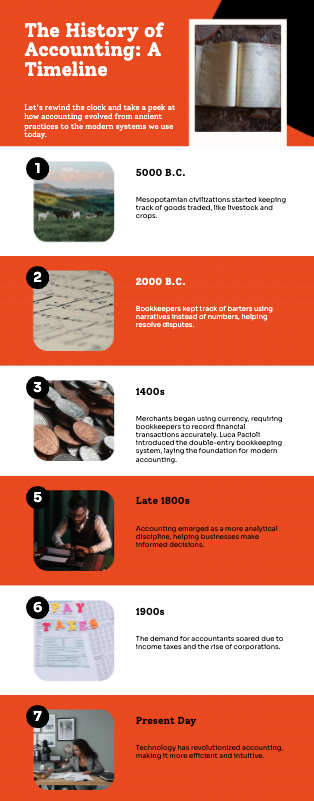
When people picture a day in the life of an accountant, they often envision a professional diligently tapping away on the keys of a calculator while tracking the funds coming in and out of their client’s accounts. All the better to ensure the numbers add up correctly, of course.
But thousands of years ago, when accounting was in its infancy, there were no “accounts” and there were certainly no calculators. So, what is the history of accounting, exactly? Hitch a ride on our well-oiled time machine as we journey to the past to learn more about one of the world’s oldest professions: accounting.
The Origins of Accounting: From Then to Now
While modern accounting is much more technical and numbers-based than its millennia-old prototype, this wasn’t always the case. Below, we look at the start of accounting and how it’s adapted to society’s changing needs over the centuries.
5000 B.C.: It Begins
Accounting made its grand entrance into the world more than 7,000 years ago in some of Mesopotamia’s civilizations. When historians found records dating to that time, they learned that some Mesopotamians kept track of goods they traded and received, such as livestock, animals, and crops.
2000 B.C.: Bartering and Bookkeeping 101
For thousands of years, societies used the barter system, trading chickens for grains or material for clothing. Despite not using money as a medium of exchange, people still used bookkeepers to keep track of barters made between individuals. Instead of numbers, the entries read more like narratives and were brought out and used when disputes between traders arose.
The 1400s: Currency Is the New Trend
Eventually, countries began making their own currencies. With a more modernized means of exchange came the need for mathematical whizzes to accurately record the numbers. Many merchants didn’t know how to record the comings and goings of their earnings accurately, so they hired bookkeepers to maintain their business accounts for them.
Until the late 1400s, these records were still largely narrative. While bookkeepers began adding and subtracting amounts from the merchant’s accounts, the records were written as single entries. For example, an entry might look like this:
Monday, August 18. Sold two cows. +$70.
Tuesday, August 19. Bought a five-pound bag of sugar. -$5.
The Late 1400s: A Monk Shakes Up the Status Quo
Toward the end of the 15th century, the Italian monk Luca Pacioli changed the bookkeeping structure and set the stage for accounting as we know it today. He introduced the double-entry system that utilizes a balance sheet with separate debits and credits. Debits refer to the values coming into an account, whereas credits record the amounts coming out.
The Late 1800s: From Bookkeeping to Accounting in One, Two, Three
The expansion of the railroad and the beginnings of U.S. corporations meant that bookkeeping needed to up its ante. Enter accounting, bookkeeping’s older, more analytical-minded sibling. Where bookkeeping focused on tracking numbers and transactions, accounting took things a step further by analyzing those numbers to help companies make more informed decisions. With the help of accountants, businesses were more successful at attracting investors.
The 1900s: The Need for Accountants Soars
In 1887, the American Association of Public Accountants (AAPA) was founded due to the increasing demand for accountants. Then, in 1896, the certified public accountant (CPA) title was introduced, given to those who passed state exams and had three years of industry experience.
In 1913, the U.S. government began charging income taxes to citizens to use as funds to supply the country’s war efforts. Because of this change, the demand for CPAs grew exponentially, with personal and professional accounts seeking the assistance of professional accountants.
Present Day: Technological Advancements in Accounting
Gone are the days of recording credits and debits with a quill and ink. Instead, we’ve replaced pen and paper with technology that’s infinitely more powerful than a simple calculator. Today’s accounting software has made the job more intuitive, helping CPAs complete their job more accurately and efficiently.
Frequently Asked Questions About the History of Accounting
Below, we’ve rounded up answers to some of the most common questions about accounting’s long and fascinating history.
How old is accounting? Accounting dates back over 7,000 years, originating around 5000 B.C. in Mesopotamia, where early civilizations recorded trade and bartering activity.
Where did accounting start? The earliest known accounting records were discovered in ancient Mesopotamia. These records tracked traded goods such as livestock and crops, marking the start of accounting practices.
What is the history of accounting? Accounting began as a method to track bartered goods and evolved over time—from narrative bookkeeping in ancient civilizations to the mathematical double-entry system developed in the 1400s. In the 1800s and 1900s, it further developed into a professional discipline, driven by industrialization and government taxation.
Who invented the accounting system? While bookkeeping existed for centuries, the double-entry accounting system was introduced by Italian mathematician and monk Luca Pacioli in the late 1400s. He is often referred to as the “Father of Accounting.”
Is accounting one of the oldest professions? Yes, accounting is widely considered one of the world’s oldest professions. Its roots can be traced back thousands of years to ancient trade-based societies.
Start Your Career in Accounting With a Little Help From UTPB
Accounting has advanced by leaps and bounds in the past century alone. Who knows where these advancements will lead 20 years from now? If you’re interested in starting a career in an ever-expanding industry, The University of Texas Permian Basin can help you achieve your goals, one step at a time.
Whether you’re ready to obtain a bachelor’s degree and jump-start your career or you want to take your current skillset to the next level by earning your master’s degree, UTPB offers two AACSB-accredited online degree options:
Bachelor of Business Administration (BBA) in Accounting
Gain a broad knowledge base in analyzing and solving financial problems for a diverse set of organizations including non-profit, government, public, and private. With your BBA in accounting, you’re prepared to choose from a variety of career options, from credit analyst to financial risk specialist (and plenty in between).
Master of Business Administration (MBA) in Accounting
Strengthen your strategic thinking, decision-making, and business acumen while honing your skills in traditional and contemporary accounting practices. This customizable 33- to 42-credit online program can be completed in as little as four semesters. In addition, the program offers two tracks depending on your career goals:
When you hear the word “accountant,” who comes to mind? Someone balancing spreadsheets and filing taxes? If so, you’re on the right track. But there’s more to it. Within the field of accounting, one credential stands apart: the Certified Public Accountant (CPA). While both accountants and CPAs manage finances, advise clients, and ensure the accuracy…
Picture this: You’re a junior accountant, and your manager asks you to tweak a report to make the numbers look better. The request sounds harmless enough—just a small tweak—but you know it’s not above board. Now you’re stuck. Do you follow orders and risk crossing an ethical line, or do you push back and risk…
You’ve always been an analytical thinker. A problem solver. Maybe a math whiz, too. There’s a career that matches your strengths. Certified Public Accountants—or CPAs—excel in these qualities. Let’s explore why a CPA is no ordinary accountant and what it takes to become one. Want to Be a CPA? Here’s What You Need to Know …
At some pivotal moment in our professional journey, many of us harbor a remarkable idea or long to embark on a path of independence and self-expression. Yet, most of us wonder: “How can I transform this dream into reality?” In fact, upwards of 27 million Americans dream of pursuing self-employment, but many are unsure of how and where to start.
Becoming an entrepreneur is an exhilarating pursuit that requires a combination of determination, passion, and strategic thinking. In this article, we’ll explore various pathways to entrepreneurship, catering to diverse ambitions and aspirations.
Exploring Diverse Routes to Entrepreneurship
There’s no one-size-fits-all approach to entrepreneurship, and your path may vary based on your business idea, product, leadership style, and work strategy. Let’s examine some of the options available to you.
Start a Small Business
The most traditional and direct path toward self-employment is to secure an investor and build your own business from scratch. Currently, the most popular small businesses launching are in retail and business services. On the upside, potential small business owners already have a product and a plan and waste no time pursuing their dream. But beware of the potential downsides: You’ll bear responsibility for more complex business skills like finance and marketing and the risk of losing your investment if your business doesn’t thrive.
Join a Startup Company
Startups are innovative, rapidly growing small businesses built to disrupt the local market, attract significant investment, and garner a lot of media attention (think Silicon Valley). If you like to take lots of risks and are attracted to quick growth and rapid expansion, consider creating or joining a startup. Many social entrepreneurs, for example, start their initiatives in startups to implement innovative solutions to social issues and scale their impact quickly.
Acquire a Business
If you have a lot of money (or an investor) at your disposal, you may want to consider taking over a business that has an existing customer base and products. It provides an easier foray into business ownership and provides a head start on many of the complex (and sometimes tedious) tasks required to launch a business for the first time.
You can also acquire a business by buying into a franchise. However, a franchise owner follows strict guidelines according to the franchisor’s rules, such as paying fees and relinquishing creative and managerial control.
Find an Incubator
If you prefer to find a mentor and grow into a trade, consider an incubator. Incubators are organizations that provide support, resources, and guidance to early-stage startups and hopeful entrepreneurs. Incubators help startups grow by offering mentorship, networking opportunities, resources to funding, workspaces, and more. Entrepreneur First is a leading incubator to check out.
Work for a Corporation
According to a study by Xero, 58% of entrepreneurs work in a corporation prior to starting their own business. Philanthropist and billionaire entrepreneur Pierre Omidyar worked for years in different tech companies before launching his globally renowned auction website eBay, which revolutionized the e-commerce industry.
Working full-time before starting a business can provide you with skills, ideas, and a supportive network, but it may limit your personal investment, since you’ll be spending a lot of time working for another company.
Become an Intrapreneur
An intrapreneur is an employee within a company who acts like an entrepreneur. Intrapreneurs demonstrate proactive behavior and implement new ideas, products, or services within the organization they work for. If you’re keen to test the waters of innovation but not ready to start a business, you may want to pursue this path.
Collaborate With a Team
Team up with like-minded individuals, combine your diverse skills and resources, and spread out the workload. This type of collaborative entrepreneurship promotes high creativity and problem-solving situations. According to a 2019 report by Global Entrepreneurship Monitor (GEM), one in five entrepreneurs own or manage a business with a family member.
Work As a Contractor
If you’re talented and knowledgeable about a certain service or product, you may even want to consider working as a “worker for hire,” or independent contractor. Gain experience, clients, and income on a flexible schedule.
Acquire Essential Skills to Turn Your Business Dreams into Reality
Imagine honing your business knowledge with a transformative degree while conceiving your dream venture at the same time. Our AACSB-accredited online Master of Business Administration explores the latest trends, cutting-edge strategies, insights on investing, brand marketing, and how to effectively manage a company. With an MBA, you can unlock your full potential and pursue any business pathway you envision.
Complete your degree in as a little as a year—no lengthy commitments—at a fraction of the national average for MBA tuition. Classes are asynchronous and entirely online, meaning you can study on your own terms, wherever you want. Choose from a wide array of entrepreneurship-focused courses and develop expertise in finance, marketing, brand building, organization, and team management.
Some of the invaluable entrepreneurial skills you’ll learn:
business strategy
financial management
marketing and sales
operations management
innovation and creativity
leadership and team management
business law and ethics
networking and collaboration
problem-solving and decision-making
global perspective
Ready to become a business leader? UT Permian Basin will equip you with the abilities, networking, and resources to make your vision a reality. We offer online MBA specializations in marketing, finance, and accounting as well as an additional certificate in energy business. When you’re ready to start your journey, apply here!
When it comes to recent shifts in global temperatures, changes in precipitation totals, and the imminent loss of species on land and sea, climate change is the large, disruptive elephant in the room. Caused in large part by the excessive levels of fossil fuels used to power cars and generate electricity, climate change has led many countries to consider cutting back on the amount of fossil fuels they use.
The solution? Implementing cleaner forms of energy to slow the progression of climate change.
With so many countries switching to clean energy, however, there are bound to be a few noticeable impacts felt by citizens and governments around the world. After all, nothing worth doing is ever easy. Today, we’re reviewing some of the possible impacts of moving to clean energy too quickly.
What Is Clean Energy, Anyway?
Clean energy refers to the development and use of sustainable forms of energy to power our homes and cars. Some of the most popular forms of clean energy include:
Solar
Wind
Hydropower
Geothermal
Bioenergy
Nuclear
By taking advantage of clean energy options, not only can humanity slow down the effects of climate change globally, but we can improve the quality of our air, create new job opportunities, and protect Earth’s natural resources and ecosystems.
Effects of Switching to Clean Energy in a Hurry
Despite the long-term advantages of making the switch to cleaner energy, there are a few potential repercussions that could occur if we move to clean energy too quickly. They include:
Disrupting the Economy
While transitioning to clean energy fuels and other sustainable resources will provide plenty of career opportunities for those in the field, it is also likely to leave employees of coal mines, natural gas power plants, and oil refineries without jobs. Many newly unemployed individuals will find work in other industries, but the loss of jobs could result in a temporary economic downturn while they search for other forms of employment.
Challenging the Current Energy Supply
Certain types of clean energy depend on ever-changing weather conditions. For example, solar power relies on consistent sunlight while wind power is dependent on—you guessed it—the wind. Both of those resources are indispensable, but they’re also not completely reliable. One day, you may find yourself with a blustery day ideal for churning out energy. The next? Not a breeze for miles.
If we make the switch to clean energy too swiftly, it could be challenging to find a consistent supply of energy to generate enough electricity for entire cities and countries. The result could be unexpected blackouts or power shortages until Mother Nature decides to bestow her gifts upon solar panels and wind turbines again.
Increased Energy Costs
A substantial amount of capital is required to purchase the materials needed for a rapid expansion of clean energy. While estimated long-term financial benefits include lower monthly electric bills for businesses and individuals alike (approximately $500 a year), those high upfront investment costs have the potential to lead to a short-term surge in energy costs for consumers.
Technological Limitations
In addition to the large upfront cost associated with getting clean energy up and running, there’s also the potential challenge of locating enough materials to establish the entire clean energy infrastructure. From the excessive minerals required to build wind farms and photovoltaic (solar) plants to the batteries needed for energy storage, some locations may face supply chain constraints as they search for the necessary components to quickly establish clean energy resources.
Make an Impact on Energy at The University of Texas Permian Basin
Whether you’re just starting your career or honing your skills to excel in your current role, UTPB offers three entirely online graduate programs that center around the energy industry:
Graduate Certificate in Energy Business
In as little as two semesters, you can complete this 12-credit program and gain both a graduate certificate and an exclusive set of skills relevant to the rapidly growing energy industry. If you’re looking to advance your career or move into an analyst or managerial role, this is the perfect certificate for you.
MBA with Certificate in Energy Business
This 36- to 45-credit AACSB-accredited online program can be completed in as little as four semesters and provides the knowledge and leadership skills needed to give you an edge in this competitive field. Our MBA with a certificate in energy business also prepares you for a diverse range of roles in the energy industry, deeply examining the intersection of energy and business so you understand this complex field from every perspective.
Master of Science in Energy Business
Our Master of Science in Energy Business is designed specifically for energy industry professionals and is one of very few programs of its kind in the United States. This program gives students a robust foundation in financial principles by offering courses that focus on energy finance, financial management, financial derivatives, and corporate finance and strategy. With this master’s degree, you’ll obtain not only an impressive credential but also all the expertise that today’s energy industry leaders need to succeed.
With UTPB’s flexible online format, you can complete your coursework 24/7 from almost anywhere. Start your journey toward a career you’ve only ever dreamed of and apply to one of our energy business programs today!
Just as the internet revolutionized our lives starting in the 1990s, artificial intelligence (AI) is transforming the way we interact with others, run businesses, and conduct many other aspects of our lives in the 2020s. While AI is by no means a new concept (depending on which source you consult, it was conceived sometime during the 1940s to 1960s), you’re hearing so much about it now for good reason.
There’s an analog to the journey of the computer in the recent emergence of AI. Computing once required a large room filled with banks of giant tape-driven machines with limited speed and storage capacity and a hefty price tag. Then came the personal computer, which put computing literally at the average person’s fingertips.
At one time we only saw AI applications in business, the military, and scientific sectors. Now AI is available to the masses in a robust, user-friendly form thanks to applications such as ChatGPT, Jasper, and Midjourney. Average people are now more aware of its power and potential, though many of us have long been using AI, even if we didn’t know it. Interactive, automated phone menus are one everyday example.
Like computers and the internet, AI has the potential to be another game-changer for business and society in general.
Increasingly Commonplace AI Applications in Business
The business applications of AI are many—and growing. This technology is being broadly adapted, and an increasing number of businesses rely on AI to complete tasks faster, more accurately, and more affordably than was previously possible. Here are some of the ways AI is currently being harnessed in the business world:
Automating routine and repetitive tasks such as reviewing candidate resumes, scheduling meetings, and debugging software, allowing human employees to focus on more complex duties.
Assessing and improving workflows by identifying problems and wasteful steps, thereby increasing efficiency and lowering costs.
Analyzing massive amounts of data to determine past and present performance of a product, service, or organization and predicting future performance, enabling fact-based decision making.
Securing data networks and equipment by detecting fraud, cyber breaches, or any out-of-the-ordinary activities that may compromise these systems.
Personalizing the customer experience by delivering recommendations that align with their previous preferences, whether it’s a book genre or their favorite pizza.
Connecting consumers with the content or information they want in mere seconds via voice recognition applications like Alexa and Siri and virtual customer service representatives.
Jump-starting the ideation and product development process by suggesting ideas and providing simulations that help to determine their viability.
Considering the Risks of AI Implementation Versus Non-Implementation
An organization that uses AI for any combination of the tasks outlined above can certainly establish a competitive edge. Still, there are increasing concerns that AI will put many people out of work. And unlike those of us who must “cite our sources,” AI draws liberally from existing works without identifying them, potentially violating all manner of copyrights, trademarks, and intellectual property rights.
Credentials That Prepare You for Whatever’s to Come in Business
No matter what the prevailing technology is, the fundamentals of business remain the same. That means that you still need recognized business credentials to flourish in the field, no matter what kind of high-tech help you may be getting. The University of Texas Permian Basin’s AACSB-accredited College of Business offers online programs that enable you to acquire those qualifications. Choose the degree that corresponds to your education level:
Build the foundation for a leadership role in a variety of business disciplines. This undergraduate degree program allows you to add a concentration in operations management, a highly lucrative career field. As you complete your degree, you’ll gain a deep understanding of practical and theoretical business fundamentals.
Aim for the highest levels of business management with an MBA, the degree the U.S. Bureau of Labor Statistics says is closely associated with top executives of large corporations. Our in-demand graduate program comprises all the business disciplines, including management, marketing, finance, and accounting, giving you the broad perspective essential to leading a business of any size. “MBA” is a title you’ll be proud to wear and a designation hiring managers look for in their candidates. Some companies may require a master’s degree for new hires or those seeking advancement within their organization.
UTPB Online’s Technological Edge
The introduction of any new technology to a field brings the potential to transform that field for the better. Just consider the unequaled benefits of getting an education through our 100% online degree programs:
Access your program from anywhere in the world, at any time of day—no campus visits required.
Enjoy the flexibility to complete assignments and exams on a schedule that makes room for your professional and personal commitments.
Build the expertise to succeed in business no matter what technology is leading it. UTPB has the online programs you need. Apply today!
A small candle business with a limited budget once relied solely on word of mouth to attract customers. But with a few well-placed social posts, some glowing customer reviews, and a simple video tutorial, their reach started to grow—and so did their sales.
Stories like this aren’t rare. Small businesses everywhere are learning that with the right strategies, it’s possible to market effectively without overspending. From digital tools to creative content, there are plenty of ways to get noticed without breaking the bank.6 Cost-Effective Marketing Ideas
Below, we explore six cost-effective marketing ideas for businesses, no matter their size:
#1 Leverage Online Reviews
Some surveys reveal that about 95% of shoppers consult online reviews before making a purchase and nearly 60% are willing to pay a premium for a product that has positive reviews. With that in mind, it’s critical for businesses to provide a good customer experience. If you’re a business owner or marketing professional, encourage satisfied customers to share reviews on your website and highly trafficked review sites. Reviews cost nothing and can have a significant impact on your business.
#2 Write SEO Blogs and Articles
If you can effectively use SEO tactics to tie your product or service to something that’s trending on the internet, you can attract potential customers at a very low cost. Offering interesting, useful, timely blogs or articles on a regular basis is key.
#3 Create Short Videos
New AI tools enable you to assemble shareable, professional-looking videos with minimal text using stock photos and music in just minutes with minimal expenditure. You may even be able to create high-quality videos on a cell phone alone. Share these videos on popular social media platforms and your own website.
#4 Offer Digital Coupons
Coupons are very easy to send and share electronically. Still, there are risks: A discount coupon can become too popular and end up costing you more than you expected. It’s important to limit the number of coupons you distribute and also limit their stated discount amount.
#5 Incorporate Email and Text Blasts
With qualified leads—people with a genuine interest in or need for your product or service—and valid email addresses, an email list can yield many prospective customers at a relatively low cost. It’s crucial to make sure you have a vetted list and the recipients’ opt-in permission. The same applies to SMS or text marketing.
#6 Tap Into Social Media Marketing
Start by conducting a bit of market research to identify which social media platforms your target audience uses most. Once you’ve narrowed it down to one or two key platforms, create a content plan and start building a following through posts, reels, stories, and engaging visuals. Organic content helps grow brand awareness over time, while paid ads—despite requiring a budget—can be highly targeted and surprisingly affordable.
FAQs About Affordable Marketing Strategies
Whether you’re launching a business or looking to stretch your current marketing budget further, it’s natural to have questions about what actually works. Below are a few commonly asked questions and clear, practical answers to help guide your next steps.
What’s the most affordable way to market my business online? One of the most affordable and effective methods is using social media and organic content. Platforms like Instagram, Facebook, and TikTok allow you to build awareness, engage with customers, and even drive sales—all for free. Paid ads are also an option, but you can start seeing traction without spending a cent.
Are email newsletters still worth it? Yes—especially if you’re targeting people who’ve already shown interest in your product or service. Email marketing tends to have one of the highest returns on investment of any strategy, and with tools like Mailchimp or Constant Contact, it’s easier than ever to get started on a budget.
How can I generate content if I don’t have a marketing team? Start simple: Repurpose customer testimonials into posts, shoot short videos on your phone, or write blog articles based on frequently asked questions. Free or low-cost design tools like Canva and AI-powered writing assistants can also lighten the load.
Do I really need SEO if I’m a small, local business? Absolutely. Local SEO helps your business appear in “near me” search results and on Google Maps. Simple steps like claiming your Google Business Profile, adding keywords to your website, and collecting online reviews can make a big difference—without costing much.Cost-Effective Strategies for a Successful Marketing Career
Boost your marketing savvy and career potential with an online marketing program from The University of Texas Permian Basin. All of our AACSB-accredited online business programs are built around a robust curriculum and taught by our accomplished faculty. They’re also a cost-effective choice:
We offer some of the most competitive tuition rates among regionally accredited universities of our stature.
We save you the costs associated with a campus commute—gas, tolls, parking, etc.
Master the marketing strategies that work for your business goals and budget in these programs:
When you choose UT Permian Basin for your degree you’ll enjoy great quality from the start—and tremendous potential at the finish. We’ve been recognized for our online programs in criteria including engagement, faculty, services, and support:
See what a marketing bachelor’s degree can do for your career potential:
Bachelor’s degree holders with marketing-related experience can earn $133,380 in median annual pay as marketing managers—just one example of a potential career path.
Faster-than-average growth is projected for this job through at least 2031.
38% higher median pay than those who hold an associate degree alone.
32% higher median pay than those who’ve completed college courses but no degree.
65% higher median pay than those whole hold a high school diploma alone.
The first true test of your marketing expertise may be marketing yourself to potential employers. Be ready to show them you have the credentials and corresponding skills! Apply today.
Not even a week has passed since you stored away your Christmas decorations, and signs of the next big holiday are already on the rise. Pink and red heart-shaped boxes and a plethora of lovestruck stuffed animals line the shelves in every store. It’s official: Valentine’s Day is approaching. Thanks to several well-planned marketing strategies,…
Apple’s logo—an apple with a bite taken from the right side—is synonymous with innovation and imagination. But why? How can simple images like the Apple logo, McDonald’s golden arches, or Nike’s swoosh evoke such powerful emotions? The answer lies in the meticulous work companies put into developing, refining, and protecting their brand identities. So, let’s…
If you’re considering earning a Master of Business Administration (MBA), you may already be aware that adding an MBA to your resume can be a career-defining accomplishment. But what does that mean in terms of real-world benefits? If you’re earning an MBA from The University of Texas Permian Basin online, we can confirm that there…
The MBA is the most popular graduate management degree in the world—and for good reason. According to a 2022 report by the Graduate Management Admission Council, 86% of graduates holding a Master of Business Administration were employed by the time of graduation.
Many students pursue this degree to switch industries, catapult their careers, or open doors to a variety of business opportunities, from entrepreneurship to management. However, it can be one of the most expensive graduate degrees to earn, with some students paying up to $200,000 in total.
So, the burning question for you may be: Is it worth the investment?
Like any graduate degree, analyzing the costs and benefits is an important business decision by itself. Let’s break down what an MBA can truly offer and help you make an informed decision.
MBA Program Costs: What to Expect
The first step in determining an MBA’s worth is to analyze the cost. For a full-time, two-year MBA program, expect to pay:
living expenses and school materials, which can cost up to $50,000 (depending on what materials are needed and where you’ll stay).
Given the significant financial commitment, it’s important to weigh your options carefully. At The University of Texas Permian Basin, our students come first, and we’ve made every effort to keep programs affordable while offering a top-notch education.
UTPB is ranked one of the top business schools in the nation and is accredited by the Association to Advance Collegiate Schools of Business. Our accelerated MBA program costs less than $15,000 and can be completed in just a year. Classes are entirely online and asynchronous, meaning you can complete your courses from anywhere in the world with no extra living expenses or the hassle of a set schedule.
Financing Your MBA: Understanding Loans and Financial Aid
Your next question may be: What about student loans? On average, MBA students owe between $28,000 and $100,000 after graduation. With the increasing demand for MBA programs, securing financial aid can sometimes be a competitive process.have its challenges..
At UT Permian Basin, our online programs don’t require you to be on campus and don’t charge out-of-state tuition rates, meaning you won’t have to make that move or even leave your house. Most students who attend our online MBA program take out a median of $16,779 in loans to complete their studies: far less than the national average. (Visit our respective financial aid and scholarships pages to learn more.)
MBA Graduate Salaries: What to Expect After Graduation
MBA graduates make about twice as much as other graduate degree holders. According to a 2022 GMAC Report, full-time MBA students see their median salary increase 50% from pre-MBA to post-graduation—from $80,000 to $120,000 a year.
The sector you choose to work in also plays a role in your overall salary potential. If you pursue a career in consulting, you may make around $147,200 yearly, while government employees make around $87,700 yearly.
Top MBA Careers and Salary Expectations
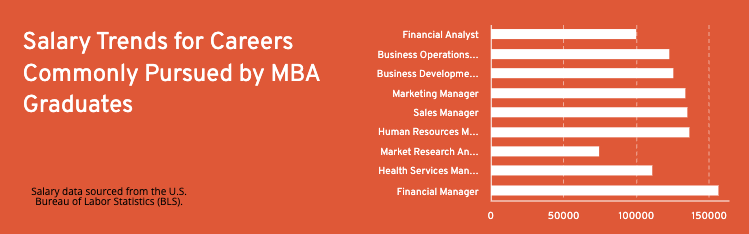
According to 2023 Lightcast data, financial analysts are in highest demand in the business sector, followed by operations managers and product managers. Business development managers and marketing managers are also among the top-10 in-demand positions.
To give you a better idea of annual salary potential in these roles, here is a list of some top occupations for an MBA graduate:
As you can see, earning an MBA has considerable, long-term payoff. What if you can do all of this without risking your financial resources and work-life balance—from the comfort of your home?
Pursue A Top-Ranked Business School With UTPB’s Online Programs
UTPB offers the flexibility and convenience of online learning with the prestige of a top-ranked business school. According to 2023 data from SeekUT, students who graduate from our MBA program enjoy a starting median salary of around $77,000, which exponentially increases about 20% for every two years of employment.
Many prospective MBA students want to grow their skills in areas of interest in which they lack experience. For example, if you have a strong grasp on finances but need marketing skills to climb the corporate ladder, you may want to hone your skills in the weaker area. Our online MBA allows you to choose specializations in Accounting, Finance, and Marketing or add an Energy Certificate to your degree.
Ready to make an invaluable, life-changing investment? Join our successful students at UTPB’s College of Business. We accept applications year-round, so whenever you’re ready, apply here!
If you’re considering earning a Master of Business Administration (MBA), you may already be aware that adding an MBA to your resume can be a career-defining accomplishment. But what does that mean in terms of real-world benefits? If you’re earning an MBA from The University of Texas Permian Basin online, we can confirm that there…
Just as the internet revolutionized our lives starting in the 1990s, artificial intelligence (AI) is transforming the way we interact with others, run businesses, and conduct many other aspects of our lives in the 2020s. While AI is by no means a new concept (depending on which source you consult, it was conceived sometime during…
Video calls. Robot vacuums. Voice assistants. Thirty years ago, we only saw this technology in cinema or on TV. Today, they’re billion-dollar industries. Many of the technologies now reshaping how we live and work first appeared in movies or on TV. While most viewers were happy to lose themselves in the narrative, an enterprising few…
Depending on whom you ask, we are already in a recession, we can expect one very soon, or we may experience only a small correction in the coming months. As of this writing, a definitive conclusion remains elusive. There are certainly factors that suggest a recession is looming. However, there are also indications that a 2020s recession could differ in some significant ways from the Great Recession of 2008. We’ll examine these indications before discussing how financial professionals are well positioned to withstand troubled economic times and what you’ll need to succeed in this resilient field.
The Picture Looks Different This Time
Is the writing on the wall for a recession? If so, the wording is different. Consider these factors:
The Housing Market
The 2008 recession—when unemployment in the United States reached 10%—was triggered in large part by the 2007 “housing bubble” burst. While many people snatched up homes with loans they couldn’t afford in the early 2000s, many eventually defaulted on their mortgage payments. According to Experian, the subprime mortgages at the center of the housing bubble that were designed to enable individuals with poor credit to buy a home are now subject to greater government regulations.
The Job Market
One significant difference between the 2008 recession and a potential 202X recession is the state of the job market. We entered 2023 with the employment sector still reeling from the “Great Resignation” largely attributed to the COVID-19 pandemic. The federal government has reported that an unprecedented 50 million people voluntarily resigned from their jobs during 2022 alone.
An NPR report explained the resulting problem: “Some businesses say they’re reluctant to let employees go, even if demand drops, after struggling for much of the last two years to find enough workers.” At present, the job market is still considered to be in good shape, though recent layoffs announced by major companies including Amazon, Google, and Disney suggest a formerly “hot” job market may be cooling off.
Inflation
Forbes states it plainly: “Inflation is much worse today than in 2008.” The 2022 consumer price index (CPI) was +8.3%: a significant increase over 2008’s -0.02%. Financial experts do not expect to see inflation level out until at least 2024.
A Recession-Resistant Career
Whatever the status of any possible recession may be, it’s always a wise idea to stay prepared, since this phenomenon certainly appears to be cyclical. Over the last three quarters of a century, the United States has not gone much longer than 10 years without experiencing a recession. Considering the last recognized recession ended in 2009, any impending recession is behind schedule.
One way to prepare for an unknown economic future is to build credentials in a field that doesn’t typically experience the full brunt of a downturn. Many prominent sources, including the ones listed below, have included financial services among their lists of recession-proof industries. Some financial services firms may even thrive during a recession: a time when people are typically more concerned than ever about their finances.
Indeed says that business for big financial services firms may grow during an economic slump.
LinkedIn reports that client-facing roles remain some of the most stable jobs in finance during a recession.
Monster states that some industries continue to need financial services personnel regardless of the financial climate, including healthcare, public accounting, and software development.
Northwestern Mutual, itself a top-rated financial services company, suggests that the need for financial professionals increases during troubled times and accountants and auditors are among the professions that help keep businesses above water.
Credentials That Can Fortify Your Career
Having the right professional credentials can make all the difference in sustaining employment when a recession hits, companies reduce staff, and new jobs become scarce. The corresponding skills and knowledge can make you an indispensable part of your team or a leading candidate for a new position in a competitive hiring environment.
During a downturn, companies and individuals will need experts who can help them manage their money wisely. The University of Texas Permian Basin’s 100% online finance degree programs empower you with financial management expertise that can make you irreplaceable and put you in line for rewarding finance-related positions. Led by acclaimed faculty with real financial industry experience, our AACSB-accredited finance programs include:
Build core financial management skills that will serve you well in a variety of careers and prepare for Chartered Financial Analyst (CFA) and Certified Financial Planner (CFP) professional designations with a BBA in finance.
Already have a bachelor’s degree? Add the prestige of an MBA to your resume. Gain vital operational acumen and leadership savvy in a 33-42 credit program that you can complete in as little as four semesters.
Focus on honing your financial management competencies in a 30-credit program that is one of very few Texas university programs of its kind with STEM certification. Finish in 12 to 24 months.
With one of these degrees, you can compete for a new position or perform to a higher standard in roles such as:
The asynchronous online format of our finance degree programs offers you the freedom to complete studies on your own schedule from virtually anywhere in the world. No campus visits are ever required. If you have work and/or personal responsibilities, our programs can enable you to meet your obligations as you earn a widely respected, career-enhancing degree.
Gas prices are shaped by a combination of economic, political, and logistic factors. While prices can feel unpredictable at the pump—dropping one day and rising the next—the cost you pay reflects how oil is produced, refined, transported, taxed, and sold within a global market.
Gasoline depends on interconnected systems that span countries and industries, so even small shifts in supply, demand, or international relations can influence prices quickly.
What Affects Gas Prices?
Below, we break down 10 key factors that help explain why gas prices rise and fall.
#1 The Price of Oil
The gasoline we put in our cars is derived from crude oil. In fact, most of the cost of gas comes from the cost of crude oil itself. Global oil prices fluctuate due to a variety of factors, including supply and demand and geopolitical tensions. When crude oil prices rise, so does the cost of gasoline.
#2 Refining
Crude oil must be refined to become gasoline, and the refining process adds its own cost to the pump price. Refinery expenses include the cost of labor, equipment, and compliance with environmental regulations. Seasonal changes also impact costs: Refineries switch to a different fuel blend in the summer to meet air quality standards, often leading to higher prices.
#3 Taxes
Gas is subject to taxation from the federal government down to the local level, and this added cost is factored into the final price. For instance, state and local taxes vary, so gas prices can differ depending on where you fill up.
#4 Distribution
Gas must be delivered from petroleum companies to gas stations, so there are associated transportation costs. The farther gas has to travel—whether by plane, train, or automobile—the higher the cost.
#5 Marketing
Like any product, gas has marketing costs. Gas stations and oil companies attract customers with marketing tactics, such as advertising, promotions, and loyalty programs. While these strategies don’t make up the majority of the final price per gallon, they’re still a factor.
#6 Gas Stations
While some gas stations are affiliated with oil companies—Shell, Exxon, etc.—many are independent companies that purchase gas from refiners and add their own costs on top before reselling it to consumers.
#7 Supply
The amount of available gas is another factor in the price. Natural disasters, refinery shutdowns, or international disruptions can lead to shortages that drive up costs. Conversely, an oversupply of oil or gasoline can cause prices to drop.
#8 Demand
When the demand or projected demand for gas puts a significant dent in the supply, the price goes up. For example, summer travel and holiday road trips increase the demand for gas, driving up the cost per gallon.
#9 International Relations
Foreign policy and geopolitics can cause significant fluctuation in gas prices. For example: Amidst rising tensions between their two nations, President Biden visited major oil producer Saudi Arabia in 2022 to ask the Saudi government to increase oil production and thereby supply. However, the Saudis declined, and gas prices rose.
#10 International Crises
International calamities such as Russia’s 2022 invasion of Ukraine can result in skyrocketing fuel prices around the globe. In that instance, the U.S. and other countries introduced sanctions including a ban on the importation of oil from Russia—a major oil-producing country—resulting in a supply shortage that drove up prices.
Drive Your Career Success With Energy Business Credentials
Explore finance, law, risk management, and other key business disciplines through the lens of today’s energy industry. Leveraging our decades-long affiliation with that industry, The University of Texas Permian Basin has developed online graduate programs that prepare you to take on coveted leadership roles or magnify your mastery of your existing role in the field.
An MBA is a widely respected credential that can make current and future employers take notice. Our online MBA program gives you a broad business foundation through courses covering all key business areas coupled with energy-focused specialty courses.
Built on a foundation of financial principles, this is an online master’s degree dedicated to the energy business, and one of very few university programs of its kind to be offered in the U.S. You can complete our 30-credit program in as little as four semesters.
If you aren’t ready to begin a master’s program, or you’ve already earned a degree but lack the energy expertise you need to achieve your career goals, this standalone graduate certificate program was designed with you in mind.
You may not be able to control the factors that influence the price of gas, but you can steer your energy career in the right direction with the right credentials. Begin your journey today!
According to the World Health Organization, 99% of the global population breathes polluted air. Yet we’re surrounded by clean, sustainable energy sources. Despite coal and natural gas being the most widely used energy sources, the urgency of climate change and resource depletion is making the shift to clean energy increasingly essential. In 2023, about 23%…
Thanks to “Landman” on Paramount+, everyone’s curious about what a landman really does. Set in modern-day West Texas, the show follows Tommy Norris (played by Billy Bob Thornton), who manages a crew of roughnecks while contending with wildcatters, cartel members, and a disgruntled ex-wife. The real job is dynamic, rewarding, and essential to how the…
Renewable energy has officially left the “alternative” category and entered the mainstream. And the numbers? They back it up. Renewable energy sources now generate 32% of the world’s electricity, up from just 20% in 2011. Solar is leading the charge, and the pressure to decarbonize the grid isn’t letting up, regardless of who’s setting policy….