What It’s Like to Be a Manager in the Energy Industry
The multifaceted energy industry is growing by the day. The Permian Basin has been setting records for crude oil production. At the same time, the green energy economy is expanding rapidly, with the International Energy Agency (IEA) reporting that renewable capacity is on pace to “[account] for almost 95% of the increase in global power capacity through 2026.” It’s fair to say that in a bustling and dynamic field like energy, managers have many responsibilities to meet, and the need for well-trained managers in this field will continue to grow. Let’s learn more about these managers now.
What Energy Industry Managers Do
Manager is a broad term that can refer to many different roles in energy or in any industry. Energy managers may oversee day-to-day operations from a headquarters, work at production sites, or be responsible for procuring new business. While the specifics of this role will vary depending on the organization you work for, we’ve summarized some typical duties below. Many of these will apply to more than one type of management role, while others are more focused in scope.
According to multiple online employment resources, on any given day, energy managers might be called upon to:
Ensure energy production goals are met.
Find ways to increase energy production.
Verify that personnel are following established safety protocols.
Secure contracts with various vendors, clients, municipalities, etc.
Perform energy market analysis.
Career Potential for Managers in the Energy Industry
According to the U.S. Bureau of Labor Statistics (BLS), many management roles include the potential for salaries of up to six figures. In addition, some coveted positions are expected to experience steady to above-average growth between 2020 and 2030. Take these examples from the BLS website:
Pathways to an Energy Industry Management Position
If you’d like to move up within your current organization, additional levels of training and education are often required. If you’re pursuing a new position, having a specialized graduate credential on your resume can distinguish you from other candidates. UT Permian Basin’s AACSB-accredited College of Business offers two online graduate-level credentials that can help you advance your energy career:
The prestige of an MBA can elevate virtually any business career. Our program explores key areas including finance, marketing, accounting, analytics, and risk management from general business and energy industry perspectives. It also offers a stackable credential option. Choose energy specialty courses to earn a companion credential, a Graduate Certificate in Energy Business, in about the same time it would take to finish your MBA alone—as little as four semesters! When you’re finished, you’ll add two valued graduate credentials to your resume. BLS data shows that master’s degree holders earn nearly 20% more than bachelor’s degree holders.
If you’re not ready to start a master’s degree program but have already earned a bachelor’s degree, a stand-alone Graduate Certificate in Energy Business enables you to quickly acquire new professional skills and credentials. This 12-credit, four-course program complements your existing business expertise with specialized energy business knowledge. You can earn your certificate in as little as two semesters.
Programs That Work on Your Schedule
Our energy business MBA and graduate certificate programs are delivered asynchronously, allowing you to conduct your studies from virtually any location, 24/7. You won’t find a more convenient educational opportunity. Both programs are built on a robust curriculum and taught by acclaimed UT Permian Basin faculty, translating the quality you expect from a UTPB program to the online format.
Discover firsthand what it’s like to be a successful manager in the energy industry! Our online energy business graduate programs provide the skills and credentials you need.
A Master of Business Administration brings with it tremendous prestige and countless potential career benefits. That’s why so many degree holders take pride in saying, “I’m an MBA.” It’s a degree that can define your professional expertise and underscores your dedication to reaching higher. For many professionals, a graduate degree is a pathway to coveted leadership roles within their current company or with a prospective employer.
Arguably the most valued business credential, an MBA doesn’t just come in one “flavor.” There are concentrations or specializations within business that are often the foundation of an MBA program. With different programs available, and a more rewarding career awaiting you, determining which program you want to join is often easier said than done.
Picking an MBA concentration begins with asking yourself a few questions:
What are your areas of interest?
Finance? Accounting? Marketing? If you’re unsure, a general MBA, which examines all the aspects of business, may be your best bet. If you start a general MBA program and then realize you want to switch to another concentration, you can do so by completing a Graduate Change of Program Request. Many of the core courses are the same across UT Permian Basin’s online MBA programs, so you may be able to keep the credits you’ve already earned toward the degree.
No matter which concentration you choose, the commonalities among our MBA programs will give you a comprehensive understanding of how today’s business world operates. Business is becoming increasingly data driven, with analytics applications providing data that enables managers to make informed business decisions. Each one of our MBA programs has an analytics course as part of its curriculum. Another integral part of that curriculum is International Business, which addresses the complexities of conducting business in our global marketplace. All successful business professionals must have a firm grounding in these topics.
If you’re already interested in a specific area of business before applying to one of our MBA programs, you’ll probably want to choose the program with that concentration. However, there’s another question you may want to ask yourself first:
Where is the demand in the business world?
Factors like demand and compensation for professionals with specialized MBA degrees merit consideration as part of your MBA decision-making process. Consider information published by the U.S. Bureau of Labor Statistics (BLS) regarding projected growth from 2020 to 2030 in a few MBA-related job sectors:
Jobs for market research analysts will grow by 22%, or 163,600 jobs—much faster than the average for all occupations. Concentration: Marketing
Jobs for financial managers will grow by 17%—much faster than the average for all occupations—with a median annual salary of $131,710. Concentration: Finance or Energy Business
Marketing managers will experience 10% growth with a median annual salary of $133,380. Concentration: Marketing
Jobs for accountants and auditors will experience a steady 7% growth rate, or close to 100,000 jobs. Concentration: Accounting
UT Permian Basin’s Online MBA Programs
UT Permian Basin offers five online MBAs, four of which feature concentrations that enable you to focus on an area of interest:
You can complete this 36-45-credit program in as little as four semesters and add two respected credentials to your resume.
Benefits of Our Online MBA Programs
Regardless of which MBA program you decide upon, you’ll be able to enjoy many of the same benefits during your studies and beyond. These include:
AACSB Accreditation
When you choose UT Permian Basin for your MBA, you can be sure you’ll get a top-quality education. Our College of Business’ business administration programs are accredited by the Association to Advance Collegiate Schools of Business (AACSB). A designation shared by only 5% of business programs worldwide, AACSB accreditation is your assurance that our program was founded on and maintains the highest academic standards.
Online Convenience
UT Permian Basin’s online programs offer unmatched convenience and flexibility. The online format enables you to complete coursework on your own schedule, 24/7, from just about any location in the world. Your professional and personal commitments need no longer keep you from going back to school for a graduate degree.
Affordability
UT Permian Basin is widely acknowledged as having some of the most affordable tuition rates among accredited higher education institutions.
Higher Salary and Employment Potential
According to the BLS, master’s degree holders earn almost 20% more than those who have only a bachelor’s degree. In addition, the BLS reports that individuals who’ve attained higher levels of education are also more likely to stay employed. It can literally pay to have an MBA!
No one likes to admit it, but we’ve all been drawn into purchasing a product or service by the subtle techniques advertisers use. Most of the time you may not even be aware of these efforts, but many of these tricks have been around for years and transitioned seamlessly from traditional advertising into the digital realm. Some, however, have been created specifically for digital platforms. Here are seven examples that may sound familiar to you:
Trick #1: Make You Believe in Ghosts
Have you ever been astonished by the number of followers a brand has on social media? To generate interest, some companies have created ghost followers—primarily fake accounts or bots—that deceptively drive up their follower numbers. This is done to make a brand seem more popular than it is. It’s human nature to be curious about something that’s popular, so those high numbers may draw your attention—and even make you a follower. It should be noted that social media platforms have banned such deceptive tactics.
Trick #2: Get You to Work for Them for Free
When products become “hot,” sometimes their brand identity follows suit. While you may wear Nike shoes because you find them comfortable for walking and running, you may also want others to know that you’re wearing them. Companies often make that easy to do, with large, distinctive logos that are immediately recognizable. When you’re so enamored with a brand that you’ll also wear a t-shirt featuring their name and logo, the company has achieved an advertising goal. Congratulations, you’re a walking billboard for them. You’re providing a service that they also pay ad agencies a lot of money for—but don’t expect a paycheck!
Trick #3: Make You Confuse Advertising for Entertainment
One way TV advertisers get you to pay attention is to tie their content in with content you’re already watching, e.g., the Super Bowl. Football- or sports-themed commercials featuring superstar athletes make the commercials seamlessly blend with the game and keep you in your seat. Advertisers logically surmise that, if you’re watching the game, you have an affinity for sports. Companies that market children’s products also commonly make their TV spots resemble the programming during which they air, e.g., animated shows.
Trick #4: Display a Price and Immediately Lower It
You see it inside apps, on web pages, in emails, and on the direct snail mail that arrives in your mailbox. The price says “$400,” but it’s crossed out. Underneath it, another lower price, “$299” for example, is displayed. That is ostensibly a good deal, but it may compel you to purchase something you didn’t want or to pay a higher price than you’d planned (say, $250 max) for the same product. Often, what the advertiser has done is artificially inflate the price up front to make the actual price they’ll charge you seem irresistible.
Trick #5: Manipulate Numbers to Manipulate You
There may be another reason behind this $299 price tag. The company marketing this product or service may have originally planned to charge you $300 but brought it down to $299 to make their price more appealing. When an item costs hundreds of dollars, does one dollar really make that big of a difference with consumers? Many times, the answer is yes. Seeing a price of $299 moves the product from the $300 range to the $200 range in the mind of the consumer. It’s instantly much cheaper! In actuality, it’s not, but that’s human psychology. The same tactic is used in grocery stores daily, often in the cent range rather than the dollar range, e.g., a can of peas for $0.99.
Trick #6: Use “Experts” to Get You to Buy Something
That man in a lab coat trying to recommend a pain reliever for you is probably an actor or a model, not a doctor, unless the ad specifies otherwise. You may see that same “doctor” appear minus the lab coat in stock photography libraries.
Trick #7: Gain Your Interest in Products That Don’t Exist
Discover all of today’s advertising and marketing tricks through UT Permian Basin’s online programs. Our AACSB-accredited College of Business offers two online undergraduate credentials that can launch your marketing career or propel it to new heights. Both programs are presented in a flexible online format that enables you to complete coursework on your own schedule from just about anywhere. No campus visits are required. Choose from:
You don’t need to love spreadsheets to succeed in accounting (but it does help). Behind every balance sheet and tax return, however, is a professional who’s strategic, detail-oriented, and trusted to keep finances on track.
So, what makes a great accountant? Whether you’re aiming for the CPA exam or stepping into business finance, here are the top six skills that can shape a thriving accounting career.
#1 Tech-Savvy Accounting Tools & Platforms
Modern accounting has moved far beyond pen, paper, and calculators. Today’s professionals rely on powerful, computer-based accounting systems and specialized software to manage everything from data entry and reporting to auditing and forecasting.
Cloud accounting, in particular, is transforming how firms operate—offering real-time access to financial data, increased collaboration, and enhanced security. To stay competitive in the field, accountants must be comfortable adopting new technologies that drive accuracy, efficiency, and insight.
#2 Strategic Business Insight
Accountants working within organizations need more than number-crunching skills. They need a clear understanding of how the business operates as a whole.
As cross-functional collaboration becomes more common, employers increasingly expect accountants to communicate with multiple departments and align their financial expertise with broader organizational goals. A strong grasp of overall business strategy gives accountants the insights to support smarter decision-making across the company.
#3 Sector-Specific Accounting Expertise
Accountants who wish to work in a specific field such as healthcare or residential housing may increase their employment potential by expanding their expertise through courses focused on that particular field.
For instance, within each sector, there are distinct financial regulations, reporting standards, and challenges. Specialized knowledge allows accountants to deliver more accurate and strategic guidance. This added layer of expertise not only makes you more marketable but can also position you as a valuable, niche expert in your field.
#4 Problem-Solving
When problems arise, whether they’re regulatory concerns for a business or a complex tax scenario, accountants must be able to think on their feet and devise effective, timely solutions. Strong problem-solving skills don’t just prevent mistakes; they build trust and long-term value.
#5 Time Management
Accountants juggle multiple priorities on any given day, and during peak times like tax season, their calendars can feel like a high-stakes game of Tetris.
Strong time management skills are essential for several reasons, including:
Staying organized
Meeting strict deadlines
Keeping projects moving without compromising accuracy.
Falling behind can lead to missed filings, reporting errors, or unhappy clients, so the ability to prioritize and plan effectively is key to thriving in this fast-paced profession.
#6 Clear and Effective Financial Communication
Accounting may be rooted in numbers, but success in the field also depends on how well you communicate them. Whether you’re explaining a tax issue to a client or presenting a budget forecast to leadership, the ability to translate complex financial information into clear, understandable language is critical. Strong written and verbal communication builds trust, reduces confusion, and ensures that clients and colleagues can act confidently on your advice—even if they’ve never opened a spreadsheet in their life.
How to Build These Skills: Online Accounting Degree Options
If you’re ready to turn these essential skills into a lasting career, the right education can make all the difference. The University of Texas Permian Basin offers online bachelor’s and master’s degree programs for aspiring accountants through our AACSB-accredited College of Business. These skill-driven programs prepare you for numerous rewarding roles within the accounting profession.
Where available, we’ve provided earnings information from the U.S. Bureau of Labor Statistics (BLS) for careers associated with these degrees below.
BBA in Accounting Haven’t earned your bachelor’s yet? Our online BBA in Accounting is a smart first step.
Our program provides the foundational skills to analyze and resolve accounting problems within specialized areas, including healthcare, governmental and non-profit organizations, energy, and other important sectors of the economy using the latest tools.
Our program gives you the flexibility to choose from one of two tracks to align with your professional aspirations:
The CPA track is intended for students who intend to pursue a public accounting career.
The non-CPA track consists of general accounting studies and is designed for students who wish to work in a related business role.
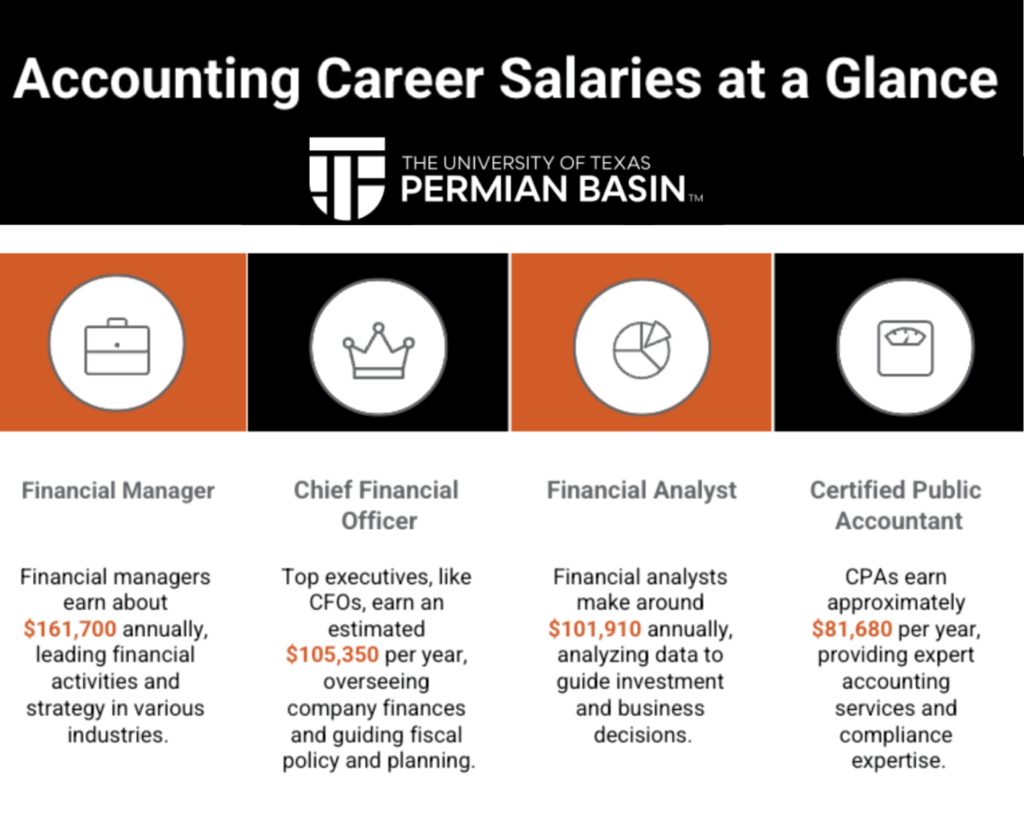
Many students complete our accounting MBA program in as little as four semesters and go on to work in a variety of careers. Potential career paths include financial manager (BLS annual earnings estimate: $161,700) and financial analyst (BLS annual earnings estimate: $101,910). Having a master’s degree can also help you compete for leadership positions.
Master of Professional Accountancy If you’ve completed a bachelor’s degree and are certain you want to achieve CPA certification, our online Master of Professional Accountancy is your program. Online courses cover all the CPA exam topics, making it essential for exam preparation.
Many students finish our professional accountancy master’s program in 2 to 4 years and graduate with the potential to become a certified public accountant (BLS annual earnings estimate: $81,680) or even chief financial officer (BLS annual earnings estimate: $105,350). According to the BLS, some employers prefer candidates who’ve earned a master’s degree, and with the added credential of a CPA license, there’s no telling where your career can take you.
Earn Your Degree, On Your Terms
Each of our online accounting degree programs features the same curriculum as its campus-based version and is taught by the same distinguished faculty and CPAs.
Our programs are delivered asynchronously, which enables you to complete coursework on your own schedule, around any professional or personal responsibilities you might have. And since they’re presented online, you can access our programs from any location in the world with internet access. Distance is never a barrier to you earning an accounting degree from UT Permian Basin.
Learn the skills you need to succeed as an accountant or in a related field with a respected degree from UTPB!
When you hear the word “accountant,” who comes to mind? Someone balancing spreadsheets and filing taxes? If so, you’re on the right track. But there’s more to it. Within the field of accounting, one credential stands apart: the Certified Public Accountant (CPA). While both accountants and CPAs manage finances, advise clients, and ensure the accuracy…
Picture this: You’re a junior accountant, and your manager asks you to tweak a report to make the numbers look better. The request sounds harmless enough—just a small tweak—but you know it’s not above board. Now you’re stuck. Do you follow orders and risk crossing an ethical line, or do you push back and risk…
You’ve always been an analytical thinker. A problem solver. Maybe a math whiz, too. There’s a career that matches your strengths. Certified Public Accountants—or CPAs—excel in these qualities. Let’s explore why a CPA is no ordinary accountant and what it takes to become one. Want to Be a CPA? Here’s What You Need to Know …
What does the year ahead hold for marketing? For starters, some changes spurred by the pandemic and others born from technological and/or sociological evolution. Let’s look at a few anticipated marketing trends for 2022 now:
Tossing the Cookies
Cookies have always left a bad taste in the mouths of some internet users who didn’t appreciate being “followed” around the internet. Google is removing third-party tracking cookies from its Chrome browser in 2023 (postponed from 2022) and doesn’t plan to replace them with an alternate feature. Other major web browsers have already banned these cookies, which track users from website to website and deliver ads that align with users’ interests based on those sites. The new 2023 target date means marketers will spend a good portion of 2022 ramping up alternative tactics such as first-party cookies, which eliminate privacy concerns by enabling users to opt in.
Offering Artificial Assistance for Real People
The use of artificial intelligence in the customer service experience is on the rise. This shift doesn’t replace customer service agents, but rather helps them complete their jobs more efficiently.
Sticking (Mostly) to Virtual Events
Webinars and other types of virtual events have been around for years, but the COVID-19 pandemic helped illustrate the value and cost-savings of these events. Individuals and organizations can save significant money on airfare, lodging, rental space, and other costs related to holding in-person events when a virtual option is feasible. With some people preferring in-person events and others opting for virtual attendance, marketers can please both audiences by holding hybrid events.
Shrinking Influence
While using influencers for marketing is not new, their price tag and credibility have come under increasing scrutiny. Many marketers are considering moving to micro-influencers whose follower bases are more compact but typically very loyal.
Making a Difference With Nonprofits
Philanthropy is becoming increasingly important to consumers. Marketers are taking note of this trend and aligning their efforts with organizations and causes that matter to their targeted consumers.
Moving From a Funnel to a Flywheel
The traditional “sales funnel” approach, which focuses on getting individual customers through the sales cycle, is being replaced by a reengagement model known as Flywheel, which puts more value on keeping customers once they are acquired.
Posting More Shorts
With short-form video finishing out 2021 as a major attraction for social media users, marketers are expected to increase their video content output.
Becoming More Inclusive
Marketing efforts will more clearly speak to multiple demographics in an increasingly diverse consumer pool.
Stay Ahead of Marketing Trends Through Online Learning
The University of Texas Permian Basin’s AACSB-accredited College of Business offers two online programs that can keep you abreast of the latest marketing trends and position you to prosper in a related career:
Today’s marketing is data driven. When you earn an online Bachelor of Business Administration in Marketing from UT Permian Basin, you’ll look at data about consumer behavior and demographics to help you develop targeted, effective marketing strategies. Our undergraduate degree prepares you to market a product or service using traditional (direct mail, print ads, broadcast media, etc.) and digital (social media, email, SEO, influencer) channels. Along the way, you’ll hone communication and strategic thinking skills that can help you excel in many professional roles.
Digital or internet-based marketing has become essential to the success of just about every organization. Compared to most traditional marketing methods, digital marketing can save an enterprise money, hit the public eye more quickly, and target a specific audience more easily. To meet the growing need for digital marketing proficiency among today’s business and marketing professionals, UT Permian Basin has developed a 12-credit online, undergraduate digital marketing certificate program. As a student, you’ll explore digital marketing’s unique advantages and learn how to use the latest tools of the trade.
Add Two Career-Enhancing Credentials to Your Resume
All the courses that comprise our stand-alone digital marketing certificate are also available as electives for the BBA in marketing degree. Choose your electives carefully and you can earn both the certificate and the degree in the same amount of time it takes to complete just the degree! You can then apply that combined expertise in many marketing specialties, including:
Brand management
Digital marketing/social media marketing
Marketing research
Product management
Sales management
Advertising & promotion
Earn Your Credentials on Your Schedule
Our BBA in marketing degree and digital marketing certificate are delivered in a 100% online, asynchronous format that enables you to complete coursework at your own pace from practically anywhere in the world. We offer the flexibility to earn important education credentials as you continue to meet your professional and personal obligations. You can finish most individual courses in just eight weeks!
UT Permian Basin’s online marketing programs prepare you to be a successful marketer no matter what trends may lie ahead. Apply today!
Clean energy comes in many forms. These renewable power sources create little to no pollution in the air, water, or soil, and some are even inexhaustible. Let’s look at a few clean energy sources, substantial clean energy efforts around the world, and energy business career potential—including salaries.
Solar panels direct sunlight to photovoltaic (PV) cells, which then convert sunlight into electricity. This energy can be used immediately or stored in batteries for later use.
Wind turbines, modern-day windmills that often resemble airplane propellers, are set into rotation by wind. The blades of the turbine are mounted on a rotor, which is attached to a generator that can generate electric power from the motion of the blades.
Also known as hydropower, hydroelectric power also uses turbines attached to a generator to produce power. The turbines spin from the force of rapidly moving water, such as that from a river or waterfall.
Sizeable Clean Energy Projects
Let’s see how some of the clean energy sources mentioned above are being used today. Here are a few of the largest clean energy projects in the world:
Imagine the power that a single wind turbine more than 620 feet tall—nearly 60 stories—can generate. The European Offshore Wind Deployment Centre, situated in Scotland’s Aberdeen Bay, has 11 such turbines. This massive offshore wind farm is anticipated to meet more than 70% of Aberdeen’s electricity needs.
Australia is about 18% desert, and there’s no shortage of sunlight in those deserts, making them optimal locations for certain clean energy projects. Once construction commences in Western Australia in 2026, the Asian Renewable Energy Hub will be home to 78 square kilometers (about one-tenth the size of Chicago) of solar panels and 1,600 immense wind turbines that, when used in combination, have the potential to generate 40% of the continent’s electricity output. According to the project’s website, as much as “3,000 MW of generation capacity will be dedicated to large energy users” locally, while most of the energy will be put toward “large scale production of green hydrogen products for domestic and export markets.”
As of 2021, Amazon is both the world’s top-grossing e-commerce retailer and the world’s biggest buyer of clean energy. With a stated goal of reaching zero carbon emissions within the next two decades, Amazon has invested in a total of 206 renewable energy projects, the most of any organization on the planet. These projects are situated on multiple continents across the world and incorporate solar, wind, and other types of clean power.
Rewarding Energy Sector Jobs
With the right credentials, you can take advantage of the current surge in clean energy projects by securing a lucrative position within the clean energy sector, and even a managerial role. Here are some in-demand energy jobs and their median annual pay, according to the U.S. Bureau of Labor Statistics:
If you’re considering a career in the energy industry or are looking for a way to improve your performance and advancement potential in your current energy role, you’ll benefit immensely from one of The University of Texas Permian Basin’s online energy programs. Offered by our AACSB-accredited College of Business, these programs equip you with vital career skills and credentials. Choose from the following graduate options:
This MBA program helps you develop operational acumen and leadership abilities highly valued by employers in the energy industry. Choose designated elective courses to earn a second graduate credential, the Graduate Certificate in Energy Business, without adding any extra time to your MBA program. You may be able to finish your MBA and graduate certificate in as little as four semesters!
If you’ve completed a bachelor’s degree program and are looking to add to your energy business skillset without committing to a master’s degree program, you can earn this 12-credit certificate as a stand-alone professional credential. Through your choice of four courses, you’ll enhance your existing abilities in accounting, business law, finance, management, and/or marketing with an energy industry perspective.
Programs That Work on Your Schedule
All courses for both programs are presented in a 100% online asynchronous format, enabling you to complete coursework at the times that best fit your schedule from just about anywhere in the world. If you have professional and personal commitments, as most of our students do, you’ll find this flexibility invaluable. These programs also feature the same quality curriculum taught by the same renowned faculty who teach on campus at UT Permian Basin. Online convenience is the only difference!
Strengthen your mastery of energy business concepts in an online UT Permian Basin program.
It might feel like just yesterday that the CPA exam was made up of four fixed sections, offering little flexibility for your individual career goals or interests. But the exam has gone through some major updates in recent years. From new licensure paths and continuous testing windows to ongoing format tweaks, the 2025 CPA Exam introduces changes you can use to your advantage as you move closer to becoming a CPA.
In this guide, you’ll find the latest updates, plus expert tips on how to stay qualified and succeed.
Core + Discipline CPA Exam: What Changed in 2024
The CPA Evolution framework launched in 2024, introducing a new structure known as the Core + Discipline model. This model gives candidates more flexibility while making sure they maintain a strong foundation in essential accounting knowledge. Let’s break it down further:
Core sections that all candidates must complete include:
Auditing and Attestation (AUD)
Financial Accounting and Reporting (FAR)
Regulation (REG)
In addition to the core sections, there’s also a discipline section that allows test takers to choose based on their professional goals, including:
Business Analysis and Reporting (BAR)
Information Systems and Controls (ISC)
Tax Compliance and Planning (TCP)
2025-Specific CPA Exam Updates
In addition to the major changes introduced in 2024, the CPA exam continues to evolve in 2025 with updates designed to make the process more flexible and accessible for candidates:
Continuous Testing for Core Sections Previously, exams were only offered during four testing windows per year. Now, blackout periods have been eliminated, allowing candidates to take Core sections (AUD, FAR, REG) year-round.
Expanded Testing Window for Discipline Sections Discipline sections (BAR, ISC, TCP) now include a fifth testing window in June. This added session gives candidates more flexibility when mapping out their study schedules and exam timelines.
New Licensure Pathway via the Uniform Accountancy Act (UAA) As of May 2025, the UAA now recognizes a third pathway to licensure. Candidates who hold a bachelor’s degree, have completed two years of supervised accounting experience, and have passed the CPA exam are eligible to become license, providing an alternative to the traditional 150-credit hour requirement in some states.
How to Prepare for the Latest CPA Exam Changes
With even more CPA exam updates rolling out in 2025, preparation is about more than just practice tests. Here are a few ways to confidently navigate the new format and walk into test day ready to succeed:
Plan ahead Take advantage of continuous Core testing and the expanded Discipline testing windows. With greater scheduling flexibility, you can map out an exam plan that fits your goals and your life.
Stay current Use the most recent CPA exam blueprints to guide your studies. This makes sure you’re focusing on up-to-date content that reflects the latest exam expectations.
Check your eligibility Planning to sit for the CPA exam in Texas or another state? Make sure your education and experience meet the most current licensure requirements, especially if you’re exploring the new bachelor’s plus experience pathway.
Achieve Eligibility Through Our 100% Online Program
Presented by our AACSB-accredited College of Business, UT Permian Basin’s online Master of Professional Accountancy program helps you become eligible to sit for the CPA exam by empowering you with comprehensive knowledge of contemporary accounting principles and business applications. You’ll master traditional and modern accounting practices while developing skills that help you expertly navigate an ever-evolving business landscape.
Presented in a 100% online, asynchronous format, our program allows you to complete coursework on your own schedule from practically anywhere in the world. And that’s just one of the many benefits:
Earn a career-boosting graduate credential while still meeting your work and personal commitments.
Finish most program courses in eight weeks or fewer (summer sessions are seven weeks each).
Learn from the same renowned PhD-level accounting experts and CPAs who teach courses at the UT Permian Basin campus.
Graduate with a Master of Professional Accountancy in 2 to 4 years.
Our program meets the Texas State Board of Public Accountancy requirements to sit for the CPA exam and attain certification in Texas. You can confirm whether it also meets your state’s board of accountancy requirements here.
After you complete our Master of Professional Accountancy program, you’ll have met important requirements to sit for the CPA exam in Texas. Once you become a CPA, you’ll be able to enjoy higher earning potential and compete for many more professional opportunities.
Prepare yourself for success as a CPA with an online Master of Professional Accountancy from UT Permian Basin.
When you hear the word “accountant,” who comes to mind? Someone balancing spreadsheets and filing taxes? If so, you’re on the right track. But there’s more to it. Within the field of accounting, one credential stands apart: the Certified Public Accountant (CPA). While both accountants and CPAs manage finances, advise clients, and ensure the accuracy…
Picture this: You’re a junior accountant, and your manager asks you to tweak a report to make the numbers look better. The request sounds harmless enough—just a small tweak—but you know it’s not above board. Now you’re stuck. Do you follow orders and risk crossing an ethical line, or do you push back and risk…
You’ve always been an analytical thinker. A problem solver. Maybe a math whiz, too. There’s a career that matches your strengths. Certified Public Accountants—or CPAs—excel in these qualities. Let’s explore why a CPA is no ordinary accountant and what it takes to become one. Want to Be a CPA? Here’s What You Need to Know …
Social responsibility is a virtue that we can demonstrate through our buying habits and living practices and through an awareness of how these behaviors affect others around us. In the petroleum industry, which has a global footprint and the power to impact many economies and ecosystems, social responsibility takes on monumental importance. Companies in this field must incorporate corporate social responsibility (or CSR) into their business models to ensure that they wield their influence with the necessary forethought, perspective, and restraint.
According to Investopedia, corporate social responsibility is “a self-regulating business model that helps a company be socially accountable—to itself, its stakeholders, and the public. By practicing corporate social responsibility, also called corporate citizenship, companies can be conscious of the kind of impact they are having on all aspects of society, including economic, social, and environmental.”
In more concise terms, corporate entities need to be responsible global citizens in multiple respects.
Philanthropy: Raising and donating money to charitable causes.
Volunteerism: Working directly with or for charitable organizations or events.
Ethical labor practices: Hiring a diverse range of employees (with regard to gender, race, ethnicity, religious faith, sexual orientation, etc.) and treating them fairly and ethically.
Environmentally sound practices: Minimizing negative impact on the natural world through the responsible use of resources, carbon footprint reduction, and ongoing innovation.
Dr. Archie B. Carroll, a noted business management author and professor, suggests a pyramid of social responsibility for corporations comprised of four hierarchical levels including, from top to bottom, philanthropic, ethical, legal, and economic considerations.
Who’s Being Responsible in the Petroleum Industry?
A list of the world’s 100 most reputable companies for corporate responsibility includes enterprises that manufacture and sell toys, software, coffee, furniture, cars, and more. However, not a single petroleum company appears on the list. The list may not be definitive, but clearly, the petroleum industry can do more.
Among petroleum companies alone, there are some standouts in terms of efforts to safeguard the environment. For example:
BP, formerly British Petroleum, has invested significant capital into renewable forms of energy, such as solar, wind, biofuel, and hydrogen, and has been recognized for its operational transparency.
Petroteq Energy has developed a unique process to extract oil from sand that creates no greenhouse gases or waste and involves the use of what the company calls “benign chemicals.”
Royal Dutch Shell is seen as a clean energy leader and is gearing its operations toward carbon reduction and investment in electricity. The company is also investing in solar energy in different parts of the world.
Total, one of the world’s largest oil producers, has a subsidiary company that’s dedicated to increasing the availability of renewable energy sources including hydropower and biomass. The company’s goal is for up to 20% of its sales to come from renewable energy by 2040.
In addition to petroleum producers, other organizations within the petroleum industry are fostering greater social responsibility. IPIECA is a not-for-profit association dedicated to responsible practices within the petroleum industry. The association also acts as a conduit for information between the industry and the United Nations.
How the Petrochemical Industry Can Do Better
How can petroleum companies earn a place among the world’s most reputable companies for corporate responsibility? The companies mentioned above are obviously going in the right direction and may inspire others in the industry to follow suit. All must work toward clean, renewable, sustainable forms of energy while pursuing their business interests. All must avoid polluting the environment and take responsibility by cleaning it up if they do.
Responsibility is not just about having good environmental practices, however. To be considered a corporate responsibility leader, a company must contribute to the greater good in a variety of ways. That includes allocating more time, money, and effort to charitable organizations and maintaining safe, inclusive, and ethical workplaces.
Online Programs to Advance Your Energy Career
The University of Texas Permian Basin offers online degree and certificate programs that can help you start or advance within a career in the petroleum industry or another energy-related field. All programs are provided 100% online through our AACSB-accredited College of Business.
This bachelor’s degree program gives you a foundation in fundamental management concepts, supply chain management, and other areas that will help you tackle technical and industrial issues for your employer. The optional graduate certificate helps you develop a comprehensive understanding of petroleum industry technology.
This certificate program is available as a 12-credit stand-alone credential and translates your accounting, business law, finance, management, and marketing expertise to the rapidly expanding energy industry.
Career-Friendly Online Convenience
All courses for these programs are presented in an asynchronous online format that enables you to earn a valued credential at your own pace while maintaining your professional and personal responsibilities. Our program courses are taught by the same acclaimed faculty who teach them at our campus, and many of the courses last just eight weeks!
Build the expertise needed to excel as a socially responsible leader in an energy-related career with a UT Permian Basin online program.
Are you deciding between an MBA in Accounting and a Master of Professional Accountancy (MAcc)? Both graduate programs open doors to rewarding accounting careers, but they offer different paths depending on your goals.
Whether you’re aiming for a CPA or want to pursue broader business opportunities, understanding the MBA vs. MAcc differences is key. In this guide, we’ll explore how each program prepares you for accounting jobs and help you choose the best degree for your future.
What Is a Master of Professional Accountancy (MAcc)?
The Master of Professional Accountancy is solely focused on CPA certification and prepares you to sit for the CPA exam. The degree is a must if you wish to work as a certified public accountant and advance into management-level roles.The program is geared toward accounting undergraduates who need to get their 150 hours for the CPA exam and individuals with a non-accounting bachelor’s degree who wish to transition into an accounting career.
Career Potential: Where You Can Go With This Degree
A Master of Professional Accountancy and CPA certification set you up for success in top management roles including:
Corporate controller
Corporate auditor
Chief financial officer
The U.S. Bureau of Labor Statistics reports that some employers give preferential treatment to job candidates who’ve completed a master’s degree. In combination with a CPA license, a graduate degree can give you an even greater competitive advantage in the working world.
Does the MPAc Prepare You for the CPA Exam?
Yes, our Master of Professional Accountancy program offers courses on all the CPA exam topics. It also provides a comprehensive grounding in accounting standards and business applications.
During your course of study, you’ll become proficient in traditional and contemporary accounting practices as you build skills that will enable you to expertly navigate today’s quickly changing business landscape.
When you finish our Master of Professional Accountancy program, you’ll have fulfilled the main requirements to sit for the CPA exam and gained a respected master’s degree that will bolster your resume and your employment potential.
Program at a Glance
Prepares you to sit for the CPA exam
Requires 36 credits
Can be completed in as little as one year
What Is an MBA in Accounting?
Our MBA in Accounting program is geared toward working professionals and recent graduates from undergraduate programs of various types. It provides a functional knowledge of accounting principles and business applications.
This degree is a must if you desire the flexibility to work in a variety of business-oriented careers. It provides a broader business focus with an emphasis on accounting that gives you the ability to choose what you want to do.
To that end, it has two tracks that you can choose based on your career goals:
The “CPA track” is recommended if you may wish to work in public accounting at some point in the future.
The “non-CPA track” is recommended for a general path of accounting study that can lead to a position in business.
Careers You Can Pursue with an MBA in Accounting
Graduates of this program have gone on to pursue roles such as:
Comptroller
Financial analyst
Tax manager
Budget analyst
Regulatory compliance manager
Program at a Glance
Provides broad knowledge of accounting and business principles
Requires 33 to 42 credits
Can be completed in as little as four semesters
Shared Benefits of UTPB’s Online Accounting Master’s Programs
Both of UT Permian Basin’s accounting-oriented master’s programs are offered online through our AACSB-accredited College of Business. Each is taught by the same doctoral-level professors and CPAs who teach the programs on campus and features the identical curriculum.
When you enroll in either of these programs, you will experience the benefits of 100% online, asynchronous learning, which allows you to complete coursework on your own schedule from virtually any location in the world—from Texas to Tasmania. This flexibility is a tremendous advantage when you’re simultaneously juggling professional, personal, and educational commitments.
In addition, both programs help you develop skills that will benefit you in a range of rewarding jobs in accounting and related fields. Compensation is generally higher in those jobs, too. According to the U.S. Bureau of Labor Statistics (BLS), as of 2024, professionals who have completed a master’s degree have some of the highest earnings and an impressively low unemployment rate.
Which Program Should You Choose?
If you definitely plan to pursue a career as a CPA, the Master of Public Accountancy is your best bet. If you want to build a foundation in accounting as part of a broader business career, choose the MBA in Accounting. Again, it’s all about your professional goals.
We’d be happy to tell you more about these programs and what they can do for you! Reach out to us anytime.
Entrepreneurship can take many forms. Sometimes, it looks like building software companies from scratch; other times, it involves reshaping an entire culture, changing how we experience entertainment, or turning one big idea into a brand that ends up everywhere. Black entrepreneurs have been doing all of that for decades. From media and tech to sports…
Businesses can’t survive on guesswork alone. To make informed decisions and stay competitive, companies must be data-driven. While analytics tools give us vital, actionable information, that data only has value when business leaders know how to read and use it. This critical skill is called data literacy: turning raw numbers into smart decisions. Here’s what…
A safe blood supply, steady heartbeats, and early breast cancer detection: Black Americans helped make these and other medical breakthroughs possible. This Black History Month, we’re shining a spotlight on healthcare heroes who changed patient care forever. Black Medical Heroes: Yesterday and Today How many medical heroes can you name? People like nurse and hygiene…
The clock strikes midnight, and the doors burst open. A crowd of people rush in, many of whom camped outside to hold their place in line, some of whom have looked forward to this day all year. Pushing through the throng, shoppers spread out and hunt for the lowest prices. The fervor is highly contagious, and there’s a collective feeling that a brawl or stampede could break out at any moment.
Yet, for many, there’s an easier way. Enter Cyber Monday: a day of deep discounts and online deals, where shoppers can snag the best prices from the comfort of their own homes. No lines, no crowds—just one-click access to serious savings.
Since its inception in 2005, Cyber Monday has exploded in popularity, with 2024 breaking records. In just two hours, consumers spent a whopping 15.8 million every sixty seconds! With e-commerce continuing to dominate, Cyber Monday’s influence shows no signs of slowing down.
But how did this online shopping phenomenon begin? Let’s dive into the history of Cyber Monday and its lasting impact on retail.
How Cyber Monday Became the Next Big Shopping Day
Even after a full weekend of in-store shopping, many people still had holiday gifts left to buy. But instead of heading back to the mall, shoppers discovered a better alternative: browsing online—often right from their desks at work. With easy access to high-speed internet and a quieter environment, online shopping on Monday felt easier, more efficient, and far less chaotic.
Retailers quickly caught on. They began offering limited-time deals the Monday after Thanksgiving, turning what was once a casual trend into a full-blown shopping event. Still, not everyone was convinced at first. In 2005, the The New York Times wrote:
“Hence the catchy Cyber Monday, so called because millions of productive Americans, fresh off a weekend at the mall, are expected to return to work and their high-speed internet connections on Nov. 28 and spend the day buying what they liked in all those stores.”
Turns out, that’s exactly what consumers did. They returned from their Thanksgiving weekend shopping and picked up exactly where they left off—this time online.
Who Coined the Term Cyber Monday?
The name “Cyber Monday” was coined in a 2005 press release from Shop.org, a division of the National Retail Federation (NRF). The term itself was proposed by Ellen Davis, a PR executive at the NRF at the time. “It’s a random bit of cocktail party conversation I like to bring up sometimes,” Davis told Fast Company. “It’s surreal to think that I’m associated with a term that has taken off like this.”
Before settling on Cyber Monday, the team considered the name Black Monday to match the already-established Black Friday—but that name was already tied to the 1987 stock market crash.
Online sales on the Monday after Thanksgiving had been steadily increasing in the early 2000s. Retailers, always eager to promote the holiday season, responded by offering special promotions and discounts on that day. Experts lacked a definitive reason for the spike in sales but suspected it was a combination of better internet access at work, leftover shopping lists from the weekend, and the looming pressure of holiday gift-giving.
What started as a catchy marketing term quickly became an industry-changing phenomenon—and a new kind of holiday tradition.
From Cyber Monday to Cyber Week: The Boom of Online Holiday Shopping
By 2008, the housing bubble had burst, the Great Recession was in full swing, and millions of Americans were left without their careers, homes, or savings. Cyber Monday became less a convenience and more of a way to cover expenses during the holiday season.
Cyber Monday deals drove consumers online (many during work hours), and sales continued to tick upwards. Amazon was the most visited retail website visited on Cyber Monday, with traffic to the website up 21% from the previous year. But a rising tide lifts all boats, and Amazon, Walmart, and other retailers began extending Cyber Monday days throughout the week. Cyber Monday had become “Cyber Week.”
Cyber Monday sales continued their rapid ascent and reached $1 billion for the first time in 2010, confirming it as the largest online shopping day in the U.S.
How Cyber Monday Changed Online Shopping Forever
Black Friday and Cyber Monday are now joined by Small Business Saturday, a celebration of local brick-and-mortar stores, and Giving Tuesday, a day to donate to charitable causes. Amazon Prime Day is yet another e-commerce holiday to spawn in recent years. Total online retail sales during Prime Day surpassed $11 billion, beating out Cyber Monday. The only thing keeping Prime Day from taking the top spot as the world’s largest online shopping day is its 48-hour time frame.
Cyber Monday has forever altered how people wield their purchasing power, especially online. No matter when you read this, Cyber Monday is sure to be one of the largest, if not the largest, online shopping events of the year. It’s one of the few days of the year when frugal shoppers open their wallets and click “Buy Now.”
Cyber Monday FAQ
What is Cyber Monday? Cyber Monday is an online shopping holiday that takes place on the Monday after Thanksgiving. It was created to promote internet-exclusive deals and is now one of the biggest e-commerce events of the year.
When was the first Cyber Monday? The first official Cyber Monday took place in 2005, after the National Retail Federation observed a trend of consumers shopping online the Monday following Thanksgiving weekend.
Why was Cyber Monday created? Cyber Monday was introduced as a marketing initiative to encourage people to shop online. At the time, retailers noticed increased web traffic and sales on the Monday after Thanksgiving, likely due to people returning to work and using high-speed internet connections.
How has Cyber Monday changed over the years? Since its inception, Cyber Monday has evolved from a single-day event into a week-long shopping phenomenon. It’s been fueled by changing technology, consumer preferences, and the growth of major online retailers. (We’re sure you’re acquainted with Amazon.) Today, it’s a key driver of holiday sales and a cornerstone of digital commerce strategy.
Explore Digital Marketing at UT Permian Basin
The University of Texas Permian Basin offers an online Undergraduate Certificate in Digital Marketing. This 12-credit certificate program can be completed in tandem with any of UT Permian Basin’s bachelor’s degree programs, such as our online Bachelor of Business Administration in Marketing.
Courses like Digital Branding, E-Marketing, and E-Commerce empower students in our certificate program with the tools they need to establish a company’s digital presence and connect with consumers on multiple communication platforms. Cyber Monday may only come once a year, but the lessons taught in our virtual classrooms will prove invaluable throughout a graduate’s career.
The clock strikes midnight, and the doors burst open. A crowd of people rush in, many of whom camped outside to hold their place in line, some of whom have looked forward to this day all year. Pushing through the throng, shoppers spread out and hunt for the lowest prices. The fervor is highly contagious,…
A Bachelor of Business Administration (BBA) degree is your ticket to the world of business. A BBA provides a comprehensive overview of business, touching on foundational concepts like accounting, finance, marketing, and management. Typically, undergraduate students also choose the major that best aligns with their interests. This specialized focus allows students to explore a subject…
Honoring and celebrating our mothers has been a global tradition throughout history. Although Mother’s Day was officially declared a U.S. holiday in 1914, its origins date back centuries. People have honored their mothers across cultures and time periods through festivals, religious observances, and communal gatherings. Understanding the historical significance of holidays like Mother’s Day provides…