Why Educators Shouldn’t Wait to Continue Their Education
With an uncertain economy, annual budget showdowns from Congress, and fluctuating financial priorities continually dogging our nation, it’s reassuring to know that government bodies from the federal level downward are still offering financial assistance to enable current and future educators to pursue their passion. Political and economic winds shift, however, and so may the availability of such funds.
As CNN observed, government payments to areas including education can be impacted in an economic crisis. Reporting on the debt ceiling fight in the federal government, The Hill stated more directly that “students [would] not receive the aid they need, in some cases, to stay in class” if the U.S. had defaulted on its debt.
Of course, the primary reason for continuing your education should always be to learn more, to improve your professional performance, and to pass the benefits of those on to your students. But if greater career mobility is your goal, continuing your graduate journey also provides opportunities to network with other educators and impress current and future employers with your new credentials.
Considering the risks of waiting to continue your education—from fewer funding options to hindered career progress—the best time to earn education credentials is now. Think beyond maintaining your teaching licensure to acquiring new credentials that can lead to more advanced and potentially more rewarding roles in education, such as:
Principal
Superintendent
Reading specialist
Bilingual teacher
Educational diagnostician
Special education teacher
Ready to get started? Here’s what you have to do:
Secure education funds.
Choose a respected credential from an accredited institution.
Receive a grant of up to $4,000 per year while completing your education degree. Following graduation, you’ll repay the funds by teaching full time to underprivileged students in a high-need field for four years at an elementary or secondary school or educational service agency (ESA).
Have up to $17,500 taken off your student loan and pay it off more quickly. You will be required to teach for five consecutive years at a school or ESA that serves disadvantaged students.
Look Locally
School districts, cities, and states nationwide offer tuition reimbursement, loan forgiveness, grants, scholarships, and other forms of financial assistance to teachers wishing to further their education. You’ll find options in places from Oregon City, OR to Broken Arrow, OK to Philadelphia, PA—perhaps even in your school district, city, or state! Do research. Ask your supervisor. Speak with your human resources representative. Don’t let those funds—and your potential professional opportunities—go unclaimed.
Choosing a Respected Credential and University
Perhaps the best way to take advantage of tuition assistance is to earn graduate credentials from an accredited university, and preferably one that offers programs in fields that align with the federal grant and loan requirements for educators discussed above.
Why The University of Texas Permian Basin Online Stands Out
UT Permian Basin’s CAEP-accredited online College of Education programs have a lot going for them:
Complete this Texas-approved educator preparation program in as little as two semesters.
Prepare for the Texas Superintendent Certification.**
*Meets TEACH Grant and Teacher Loan Forgiveness requirements. **Certification preparedness programs may be accepted by out-of-state agencies. Contact your state’s department of education to confirm.
Accolades
“Best Online Master’s in Education Programs” for 2023 (U.S. News & World Report)
“America’s Top Online Colleges 2023” (Newsweek)
Streamlined Admission
No GRE required
Flexibility
Programs accessible online 24/7, worldwide
Don’t wait any longer to take advantage of the financial options available to you as an educator. You might be missing out on career satisfaction you never thought possible. Apply today!
Political sociology is a discipline defined as the study of power and the relationship between societies, states, and political conflict. Although the term itself wasn’t officially coined until the 1930s, the concept of political sociology dates all the way back to the third century BCE. Aristotle sought to describe the state of Greece’s governance through the multiple city-states governed by its citizens and first studied the effects social groups have on governance in his work “Politics.”
The Emergence of Political Sociology
While there is significant overlap between political sociology and political science, political science examines the internal workings of a government, while political sociology focuses on the building of nation-states and the power relation in the social structure.
Political sociology became prominent after the horrific events of World War II and the major impacts the war had on society. Sociologists sought to understand how social concepts such as race, ethnicity, and education impacted the political system and vice versa. Specifically, they sought to understand imbalances of power in the hopes of preventing similar events from happening in the future and duplicating structures that have historically worked. The study of political sociology now includes issues such as race, ethnicity, gender, and classism, as well as family dynamics, workplaces, and modern media.
Socio-Political Ideologies
While many thinkers aim to explore the framework of what makes politics and society function together, the works of German sociologists Karl Marx and Max Weber and French sociologist Émile Durkheim stand out as primary sources.
Karl Marx Marx’s 19th-century pamphlet “The Communist Manifesto” discusses how dichotomous social classes and class struggle determine how societies are run. Under capitalism, the economically dominant social class exploits the “have-nots.” Marx explained that under socialism, which seeks to eliminate oppression and social inequality, the power is in the hands of the government. Conversely, under communism, the power is in the hands of the people, which Marx argued would lead to the highest form of equality in a communal setting and eliminate individualism. Although socialism has been practiced in many countries, communism, as a theoretical model of complete social equality, has not been achieved.
Max Weber Weber stated that hierarchies created a stable society and are based on forms of organizational legitimacy. These hierarchies may be established through charismatic leadership through the faith of followers or via a more traditional ruler like a monarch. Weber’s theories are integral to modern political sociology. His vision of a modern bureaucracy imagined a clear set of rules and regulations.
Émile Durkheim Durkheim argued that although capitalism was economically productive, its consumerism drives social groups to suicide (“Suicide,” 1897). He believed that individualism leads to corruption and depression, while a collective community—such as a large family unit or a religious community—creates a healthier sense of belonging necessary for a stable nation-state.
Democracy and the Fight for Equality
Political scientists and sociologists have long debated democratic transitions as an answer to the imbalance of power in a society. The Lipsett hypothesis argues that the more economically developed a nation is, the more prosperous and politically stable it becomes. Urbanization especially helps spread media and literacy among all social groups.
Historically, democracies were led by a small number of people, usually white males of higher social status. Women and racial minorities, for example, have only comparatively recently gained access to political power, resources, and prestige. Influential democratic movements like the Women’s Suffrage Movement of the 1920s and the Civil Rights Movement of the 1960s led to voting rights and better opportunities for oppressed social groups in the United States.
Today, agents like the free media give a voice to historically underrepresented communities and lead to greater participation on political issues.
A Course Exploring Socio-Political Perspectives
Our appropriately named course Political Sociology (SOCI 4324), part of our online BA in sociology program, examines the concepts of power and society in more depth, focusing on the concepts of class, ideology, elites, and political and state officials. During this course, you’ll learn to apply critical concepts of political sociology to current social issues from a national and global perspective. After completing the course, you’ll be able to comprehend and identify key issues related to social structures and power in society.
Political Sociology is offered as part of our online BA in sociology program but can also benefit students studying to earn a degree in political science, business administration, public policy, or finance. Whether you decide to pursue a career in sociology or another field, this course can help you learn key theories and events to make a difference in any leadership role.
Career Options with a BA in Sociology
Our BA in sociology program is asynchronous, flexible, and entirely online. Study from the comfort of your home from anywhere in the world. Students interested in exploring social studies and social justice will gain invaluable knowledge in a field that can inform a variety of career options, some of which include:
Teaching/consulting/law enforcement management
Social work/social services
Public administration/advertising
Human resources
Private and government foundations
Guidance counseling
Become a force for social change. Apply to our online BA in sociology program and join the Falcon family!
A small candle business with a limited budget once relied solely on word of mouth to attract customers. But with a few well-placed social posts, some glowing customer reviews, and a simple video tutorial, their reach started to grow—and so did their sales.
Stories like this aren’t rare. Small businesses everywhere are learning that with the right strategies, it’s possible to market effectively without overspending. From digital tools to creative content, there are plenty of ways to get noticed without breaking the bank.6 Cost-Effective Marketing Ideas
Below, we explore six cost-effective marketing ideas for businesses, no matter their size:
#1 Leverage Online Reviews
Some surveys reveal that about 95% of shoppers consult online reviews before making a purchase and nearly 60% are willing to pay a premium for a product that has positive reviews. With that in mind, it’s critical for businesses to provide a good customer experience. If you’re a business owner or marketing professional, encourage satisfied customers to share reviews on your website and highly trafficked review sites. Reviews cost nothing and can have a significant impact on your business.
#2 Write SEO Blogs and Articles
If you can effectively use SEO tactics to tie your product or service to something that’s trending on the internet, you can attract potential customers at a very low cost. Offering interesting, useful, timely blogs or articles on a regular basis is key.
#3 Create Short Videos
New AI tools enable you to assemble shareable, professional-looking videos with minimal text using stock photos and music in just minutes with minimal expenditure. You may even be able to create high-quality videos on a cell phone alone. Share these videos on popular social media platforms and your own website.
#4 Offer Digital Coupons
Coupons are very easy to send and share electronically. Still, there are risks: A discount coupon can become too popular and end up costing you more than you expected. It’s important to limit the number of coupons you distribute and also limit their stated discount amount.
#5 Incorporate Email and Text Blasts
With qualified leads—people with a genuine interest in or need for your product or service—and valid email addresses, an email list can yield many prospective customers at a relatively low cost. It’s crucial to make sure you have a vetted list and the recipients’ opt-in permission. The same applies to SMS or text marketing.
#6 Tap Into Social Media Marketing
Start by conducting a bit of market research to identify which social media platforms your target audience uses most. Once you’ve narrowed it down to one or two key platforms, create a content plan and start building a following through posts, reels, stories, and engaging visuals. Organic content helps grow brand awareness over time, while paid ads—despite requiring a budget—can be highly targeted and surprisingly affordable.
FAQs About Affordable Marketing Strategies
Whether you’re launching a business or looking to stretch your current marketing budget further, it’s natural to have questions about what actually works. Below are a few commonly asked questions and clear, practical answers to help guide your next steps.
What’s the most affordable way to market my business online? One of the most affordable and effective methods is using social media and organic content. Platforms like Instagram, Facebook, and TikTok allow you to build awareness, engage with customers, and even drive sales—all for free. Paid ads are also an option, but you can start seeing traction without spending a cent.
Are email newsletters still worth it? Yes—especially if you’re targeting people who’ve already shown interest in your product or service. Email marketing tends to have one of the highest returns on investment of any strategy, and with tools like Mailchimp or Constant Contact, it’s easier than ever to get started on a budget.
How can I generate content if I don’t have a marketing team? Start simple: Repurpose customer testimonials into posts, shoot short videos on your phone, or write blog articles based on frequently asked questions. Free or low-cost design tools like Canva and AI-powered writing assistants can also lighten the load.
Do I really need SEO if I’m a small, local business? Absolutely. Local SEO helps your business appear in “near me” search results and on Google Maps. Simple steps like claiming your Google Business Profile, adding keywords to your website, and collecting online reviews can make a big difference—without costing much.Cost-Effective Strategies for a Successful Marketing Career
Boost your marketing savvy and career potential with an online marketing program from The University of Texas Permian Basin. All of our AACSB-accredited online business programs are built around a robust curriculum and taught by our accomplished faculty. They’re also a cost-effective choice:
We offer some of the most competitive tuition rates among regionally accredited universities of our stature.
We save you the costs associated with a campus commute—gas, tolls, parking, etc.
Master the marketing strategies that work for your business goals and budget in these programs:
When you choose UT Permian Basin for your degree you’ll enjoy great quality from the start—and tremendous potential at the finish. We’ve been recognized for our online programs in criteria including engagement, faculty, services, and support:
See what a marketing bachelor’s degree can do for your career potential:
Bachelor’s degree holders with marketing-related experience can earn $133,380 in median annual pay as marketing managers—just one example of a potential career path.
Faster-than-average growth is projected for this job through at least 2031.
38% higher median pay than those who hold an associate degree alone.
32% higher median pay than those who’ve completed college courses but no degree.
65% higher median pay than those whole hold a high school diploma alone.
The first true test of your marketing expertise may be marketing yourself to potential employers. Be ready to show them you have the credentials and corresponding skills! Apply today.
A small candle business with a limited budget once relied solely on word of mouth to attract customers. But with a few well-placed social posts, some glowing customer reviews, and a simple video tutorial, their reach started to grow—and so did their sales. Stories like this aren’t rare. Small businesses everywhere are learning that with…
No one likes to admit it, but we’ve all been drawn into purchasing a product or service by the subtle techniques advertisers use. Most of the time you may not even be aware of these efforts, but many of these tricks have been around for years and transitioned seamlessly from traditional advertising into the digital…
A Bachelor of Business Administration (BBA) degree is your ticket to the world of business. A BBA provides a comprehensive overview of business, touching on foundational concepts like accounting, finance, marketing, and management. Typically, undergraduate students also choose the major that best aligns with their interests. This specialized focus allows students to explore a subject…
The MBA is the most popular graduate management degree in the world—and for good reason. According to a 2022 report by the Graduate Management Admission Council, 86% of graduates holding a Master of Business Administration were employed by the time of graduation.
Many students pursue this degree to switch industries, catapult their careers, or open doors to a variety of business opportunities, from entrepreneurship to management. However, it can be one of the most expensive graduate degrees to earn, with some students paying up to $200,000 in total.
So, the burning question for you may be: Is it worth the investment?
Like any graduate degree, analyzing the costs and benefits is an important business decision by itself. Let’s break down what an MBA can truly offer and help you make an informed decision.
MBA Program Costs: What to Expect
The first step in determining an MBA’s worth is to analyze the cost. For a full-time, two-year MBA program, expect to pay:
living expenses and school materials, which can cost up to $50,000 (depending on what materials are needed and where you’ll stay).
Given the significant financial commitment, it’s important to weigh your options carefully. At The University of Texas Permian Basin, our students come first, and we’ve made every effort to keep programs affordable while offering a top-notch education.
UTPB is ranked one of the top business schools in the nation and is accredited by the Association to Advance Collegiate Schools of Business. Our accelerated MBA program costs less than $15,000 and can be completed in just a year. Classes are entirely online and asynchronous, meaning you can complete your courses from anywhere in the world with no extra living expenses or the hassle of a set schedule.
Financing Your MBA: Understanding Loans and Financial Aid
Your next question may be: What about student loans? On average, MBA students owe between $28,000 and $100,000 after graduation. With the increasing demand for MBA programs, securing financial aid can sometimes be a competitive process.have its challenges..
At UT Permian Basin, our online programs don’t require you to be on campus and don’t charge out-of-state tuition rates, meaning you won’t have to make that move or even leave your house. Most students who attend our online MBA program take out a median of $16,779 in loans to complete their studies: far less than the national average. (Visit our respective financial aid and scholarships pages to learn more.)
MBA Graduate Salaries: What to Expect After Graduation
MBA graduates make about twice as much as other graduate degree holders. According to a 2022 GMAC Report, full-time MBA students see their median salary increase 50% from pre-MBA to post-graduation—from $80,000 to $120,000 a year.
The sector you choose to work in also plays a role in your overall salary potential. If you pursue a career in consulting, you may make around $147,200 yearly, while government employees make around $87,700 yearly.
Top MBA Careers and Salary Expectations
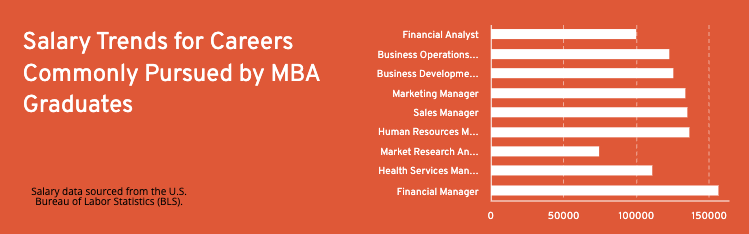
According to 2023 Lightcast data, financial analysts are in highest demand in the business sector, followed by operations managers and product managers. Business development managers and marketing managers are also among the top-10 in-demand positions.
To give you a better idea of annual salary potential in these roles, here is a list of some top occupations for an MBA graduate:
As you can see, earning an MBA has considerable, long-term payoff. What if you can do all of this without risking your financial resources and work-life balance—from the comfort of your home?
Pursue A Top-Ranked Business School With UTPB’s Online Programs
UTPB offers the flexibility and convenience of online learning with the prestige of a top-ranked business school. According to 2023 data from SeekUT, students who graduate from our MBA program enjoy a starting median salary of around $77,000, which exponentially increases about 20% for every two years of employment.
Many prospective MBA students want to grow their skills in areas of interest in which they lack experience. For example, if you have a strong grasp on finances but need marketing skills to climb the corporate ladder, you may want to hone your skills in the weaker area. Our online MBA allows you to choose specializations in Accounting, Finance, and Marketing or add an Energy Certificate to your degree.
Ready to make an invaluable, life-changing investment? Join our successful students at UTPB’s College of Business. We accept applications year-round, so whenever you’re ready, apply here!
A Bachelor of Business Administration (BBA) degree is your ticket to the world of business. A BBA provides a comprehensive overview of business, touching on foundational concepts like accounting, finance, marketing, and management. Typically, undergraduate students also choose the major that best aligns with their interests. This specialized focus allows students to explore a subject…
If you’re considering earning a Master of Business Administration (MBA), you may already be aware that adding an MBA to your resume can be a career-defining accomplishment. But what does that mean in terms of real-world benefits? If you’re earning an MBA from The University of Texas Permian Basin online, we can confirm that there…
Want to be a more effective leader? Understanding your management style is the first step. From hands-off to motivational, every leader brings a unique approach to guiding their team. In this article, we’ll break down 7 common management styles, how they work, and when to use them—especially in today’s workforce, where collaboration, flexibility, and purpose…
If you’ve been considering a bachelor’s degree in communication but are wondering how it can benefit you, we have a lot to tell you! Below we outline skills and career pathways closely connected to a communication degree and explain how you can earn yours while continuing to meet your professional and personal obligations.
Skills You’ll Develop While Earning a Communication Degree
One of the top reasons you may want to choose a communication bachelor’s degree is that it offers broadly applicable and highly transferrable skills: written and verbal communication, critical thinking, problem-solving, collaboration, and research. These are chief among the skills today’s employers value most, according to sources including the federal government and Forbes.
Soft skills, sometimes called durable skills, have become especially critical now that more people are working remotely, though they’re valuable to every professional regardless of their work environment. Yet these skills are also scarce among job candidates. Adding a communication degree and its corresponding expertise to your resume can give you a competitive advantage at hiring time.
Career Pathways for a Communication Degree Graduate
Communication degree graduates can go on to enjoy a variety of rewarding careers. Let’s take a look at communication-related professions that require at least a bachelor’s degree and their commensurate salaries. Though we’ve divided this into eight job categories, you’ll see that each of these pathways forks into multiple potential career paths:
Why You Should Earn Your Communication Degree Online With UTPB
You’ve seen some of the benefits of earning a communication degree. Now let’s look at some of the benefits you’ll experience from the very first day of classes if you choose UT Permian Basin. Our 100% online Bachelor of Arts in Communication degree program equips you with an essential foundation of multidisciplinary courses, followed by core communication courses and the opportunity to pursue one of several specialty tracks that may align with your interests and career goals:
No matter which track you choose, you’ll be guided by the same distinguished faculty who teach on campus while you experience the advantages of our online format. Complete your studies from anywhere in the world, at your own pace, with the flexibility to give other important areas of your life the attention they need. No campus visits are required.
You’ve decided to pursue a degree or certificate online from UT Permian Basin. You complete your application, hit “submit,” and cross your fingers. But what happens next? We spoke with two directors from the University’s admissions team to get an answer to that question. Along the way, we learned the differences between the undergraduate and graduate admissions experience, how soon you can expect an admissions decision, and other information every applicant wants to know.
Before we delve into those topics, first consider these key points:
UT Permian Basin’s application can be completed entirely online.
From the applicant’s standpoint, the process is the same for degree and certificate programs.
It usually takes one day for the University to receive a submitted application.
Applying to a UTPB Undergraduate Program
For the story on undergraduate admissions, we turned to Lorinda Tercero, director of undergraduate admissions for the University.
Important: You Must Submit Official Transcripts
“On the undergraduate side, we can get a transcript from the school, if they’ll send it electronically to us through the Parchment national clearinghouse,” Tercero explained. “Or the school will mail it to us in a sealed envelope. Undergraduate admissions does not accept unofficial copies of transcripts, so students can’t just upload them when applying.”
What Happens During the Admissions Process
“When the student applies, they’re going to get an email saying, ‘Thank you for applying. Sign into the applicant portal to see the progress of your application,’” Tercero continued. “From there, they’re going to start getting emails listing materials that we need to complete their file, so those students know what to turn in. As they turn them in, they get checked off. As the file becomes complete, they go into a pending status, and they should see that on the admitted student portal. Then we have freshman counselors and transfer counselors review the application files and make sure they meet the entrance requirements for undergraduate admission.”
Decision Time: How You’ll be Notified
Now that the admissions team has reviewed your application, how will you find out whether you’ll be a part of the Falcon Family? Tercero walked us through the process:
“When we make a decision in Slate, [the application and communication platform the admissions team uses], applicants are automatically emailed. It says, ‘There’s been an update to your file. Please log in to see your status.’ If [the applicant] did get admitted, they get the whole confetti experience. They see a digital letter from me, congratulating them. We still send out communications to the students about the next steps once admitted, signing up for orientation, etc. In the admitted student experience, there’s a tab for the next steps. If they’re international, there’s a tab there for them. And then there’s a tab for financial aid. It’s really important that they log in just to see if they missed anything and check their email.”
Timeline for an Admissions Decision
Eagerly awaiting your email? Tercero outlined the typical timeline from application submission to “admitted” status:
“It really depends on the student. If the student is very proactive and tries to get their transcripts, they can get their file completed within a week, a week and a half, because they have to contact each individual school they attended and have those transcripts sent to us … The ‘yes’ or ‘no’ is very quick. In undergraduate admissions we mail them an admissions packet. They get a certificate and stickers. That will take about two weeks for them to receive.”
Applying to a UTPB Graduate Program
Graduate admissions are overseen by Phumara Cox, director of graduate admissions and interim director of graduate studies.
Important: You Must Submit Official Transcripts Before Enrollment
“We require an official transcript,” Cox said, “but let’s say it’s one of our international students: We will still process their unofficial transcript so that there’s no delay as far as the application decision. And once they’ve been admitted, we’ll place a hold on their record for the official transcript, and they will not be able to enroll until we’ve received the official documents.”
What Happens During the Admissions Process
“I would say the beginning part is pretty similar to the undergrad side,” Cox explained. “Whenever [the application is] loaded into our system, it’s considered in ‘awaiting materials’ [status] because the file is not complete. Either we’re missing transcripts, or it depends on what program they’re applying to. For example, if it’s … the MBA program, at the very beginning we just need an application and their transcript.”
You’ve officially submitted your application and transcripts. Congratulations! But where are they headed next? Cox explained the process:
“It moves over to our grad first review—basically, our enrollment counselors. They’re going to calculate based off of the last 60 undergrad credit hours, making sure [the applicant] meets the GPA requirements. If it’s regular admission, then they route it to the program coordinator for their review and application decision. For all our grad programs, we have a program coordinator that’s in charge of reviewing applications and also routing [them] to the next reviewer.”
Decision Time: How You’ll be Notified
Next, it’s time for grad final review. As Cox told us, “In the grad final review, the enrollment counselor will review the application decision and they will release it and also send out the admission letter. The admission letter is of course sent from Slate, and it basically says, ‘Congratulations! This is your advisor, this is how to contact them, and basically here are the next steps and let’s get you enrolled.’ In the next steps, it outlines how to access your myUTPB portal. It also outlines how to access the grad catalog and how to enroll in courses.”
Timeline for an Admissions Decision
If you’ve made it this far and your excitement is outweighing your patience, we understand! Fortunately, you won’t have to wait long to hear back on your graduate admissions decision:
“Grad programs require immediate turnaround time,” Cox emphasized. “[Students] want to know the next steps, and the faster the better, honestly. Most of them will be admitted within 24 hours … and they can enroll in classes for that same semester. We’ve had instances where the applicant [was admitted] on the last day to enroll in courses … and then they were able to enroll and honestly start the program that same day.”
Cox did caution that other factors may delay the admissions decision: “If there are other supporting documents, then that means there’s going to be additional approvals, right? So, let’s say the application is not considered regular admission, it’s going to be a conditional admission. That means it’s going to go through multiple approval paths: from the program coordinator to the college dean to the grad studies dean. Once it has all of the approvals and all of the justifications and the conditions for that specific student, then it’s going to the grad final review, and we’ll release the decision.”
You’ve already mastered the ins and outs of UTPB’s admissions process. Ready to get started on your online program? Apply now!
“Effective character education is not adding a program or set of programs to a school. Rather it is a transformation of the culture and life of the school.” – Dr. Marvin Berkowitz, renowned educator and researcher
Is it your professional goal to one day occupy the principal’s office? If so, you’ll need exceptional drive and vision, classroom teaching experience, and at least two key credentials. The National Association of Secondary School Principals reports that 76% of states require a master’s degree to become principal. Allstates require proof of completion of a certification exam, for which the master’s degree in many cases functions as a preparatory program. Together, these qualifications can equip you with the leadership aptitude you need to excel in the role of principal.
Leadership means many things in the context of school principalship. Effective school leaders:
Direct all instructional and organizational efforts.
Develop class schedules.
Establish a mission for the school.
Foster a high-quality, safe, and inclusive learning environment for all students.
As principal—the head of the institution—you will be in a unique position to define school culture. A healthy culture can deliver significant and specific benefits to an educational institution and its faculty, students, and even community.
Taking the Lead in Shaping School Culture
School principals guide all aspects of an institution’s operations, from setting and upholding academic standards to looking after the school’s budget. They ensure that faculty have access to all the resources they need. Capacity building, defined as “a process for strengthening the management and governance of an organization so that it can effectively achieve its objectives and fulfill its mission,” is a core concept with which all principals become intimately familiar.
All these logistical responsibilities figure into the cultural equation, but they’re just the beginning. Human interactions can often yield even more valuable results—sometimes in the form of actionable data. School principals can have a tremendous effect on their school culture by:
Proactively involving parents and the community by hearing concerns and developing ways to address them.
Remaining accessible to students rather than spending most of the school day in the office.
Holding regular activities that involve the entire school and giving students a part in leading these activities.
Delegating some aspects of leadership so that faculty and students have a role in creating a stronger school and world, thereby making their own contributions to the school’s culture.
Cultivating an open environment where all can feel they’re seen, heard, and important members of the school community.
Regularly assessing students’ attitudes toward the school, teachers, administration, and classmates using a variety of data-collection tools.
Where to Prepare for Your Future Principalship
The University of Texas Permian Basin’s online Master of Arts in Educational Leadership empowers you with the acumen to become an impactful principal in the K-12 setting. Led by accomplished professors and built around a robust curriculum aligned with Texas SBEC Principal as Instructional Leader certification competencies, our program dives deeply into the many facets of school leadership. If you live outside of Texas, we encourage you to consult your state’s educator certification agency to confirm that our program meets their certification requirements. You can start our MA in educational leadership degree with no GRE and finish in as little as one year.
Recognized for Excellence in Education
The University, our College of Education, and our programs are widely acknowledged for their quality. UTPB has been:
Ranked in U.S. News & World Report’s Best Online Master’s in Education Programs category for 2023.
Ranked in the top 25 of 200 schools in Newsweek’s America’s Top Online Colleges and America’s Top Online Learning Providers 2023.
Nationally accredited by the prestigious Council for the Accreditation of Educator Preparation (CAEP).
Nationally recognized by the Educational Leadership Constituent Council (ELCC).
Master Educational Leadership Without Sacrificing Other Important Responsibilities
We designed our master’s degree in educational leadership program to be practical for busy educators. Our primarily asynchronous online format enables you to complete exams and all other aspects of the degree from practically anywhere in the world at any hour of the day. You won’t find a more accommodating way to maintain your professional and personal responsibilities while earning a credential that can help you have a greater influence over the education experience of tomorrow’s adults.
You’ll shape school culture and countless lives as a principal. UT Permian Basin’s online master’s degree in educational leadership prepares you for that career leap. Apply today!
Welcome back to our exploration of serial killers, featuring an interview with Dr. John Fisher, coordinator and assistant professor in UT Permian Basin’s criminal justice program and author of “Profiling crime: Exploring serial murder and other crime.” (See part 1 here.) Read on to discover what serial killers really want, how they can live undetected among us, which serial murderer Dexter was partly based on, and what’s happening to their numbers.
Do Serial Killers Want to Get Caught?
According to Dr. Fisher, some serial killers risk getting caught because they crave attention, though they don’t necessarily want to be apprehended.
We spent some time with Dr. Fisher discussing serial killer Dennis Rader, aka the BTK Killer, who is a prime example of this. He committed numerous murders between the 1970s and 1990s before laying low for about 13 years. After a local paper ran a story on him, Rader began sending letters and evidence to local media outlets. Within a year he was apprehended, leading us to ask, “Do some serial killers want to be caught?”
Dr. Fisher explained, “They go out of their way not to get caught. And what was weird about BTK was that he did stop. The profile is that serial killers will not stop until they’re dead or they’ve been incarcerated on another charge. BTK broke that profile.”
When Rader sent a floppy disk to a television station, it was his own undoing. Metadata on that disk revealed the document was created on a nearby church computer. Further investigation took place. “They arrested him and everything else is history. Now he’s in prison. Nobody expected that BTK was Dennis Rader.”
Do Serial Killers Hide in Plain Sight?
Serial killers often blend into society by leading seemingly normal lives. They can appear as regular, social individuals—often with families and steady jobs—making it difficult to suspect them. For example, Rader was a married man with two children, a job, a nonclerical position at his local church, and Boy Scout leader duties: an unlikely description for a serial killer.
How then do some highly social serial killers manage to go undetected among society? Dr. Fisher explained:
“You’ve seen [the TV series] “Dexter”? Dexter is a copy of the BTK Killer. He spent 10 to 15 years without killing anybody, just up in the logging community doing whatever he did. Your highly evolved, highly organized serial murderers like to see what they’re doing. They like to track what they’re doing in the news, but they don’t want to get caught. So, they go [to] extremes to hide what they’re doing.
“Like Ted Bundy, they’re very social people, and nobody would ever expect that they had this ‘dark passenger,’ this bloodlust that they had to fulfill. Dennis Rader and Jeffrey Dahmer and Ted Bundy, they all wanted to hide the fact that they were serial killers, but they liked the attention that they were getting. They marry, they have kids, they do everything that’s expected of them in society. Although the profile suggests that as a sociopath, they have no conscience or ability to show feelings and emotions like the rest of us, so they have to fake it.”
How Do Sophisticated Serial Killers Evade Capture?
Sophisticated serial killers evade capture through careful planning and adaptability. They often change their methods and locations, making it harder for investigators to connect the crimes.
Dr. Fisher cited Ted Bundy as an example: “He dropped out of law school. And his early spree, his early murders were extremely sophisticated. He would abduct in one place, kill in another place, and discard in a third, so you’ve got three actual crime scenes, and it makes it harder for people to find. Ted Bundy started in Washington, [then] went to Utah and Colorado. And every time people started getting close to seeing who he was, and identifying him as a serial murderer, he would move to the next location. Once he got to Florida, he completely devolved. He targeted and killed all those women in that [Florida State University] sorority. What normally catches an organized serial killer is that they devolve into a disorganized serial killer. And a disorganized serial killer makes mistakes.”
Why Are Serial Killer Numbers Declining?
The number of serial killers has been declining due to several factors, including increased public awareness and improved investigative techniques. Better detection methods, more vigilant law enforcement, and greater public awareness have all contributed to the drop in serial murders. Still, serial killers still garner significant media attention despite their decreasing numbers.
Historically, America led in the number of serial killers, with some of the first “famous” cases, like H.H. Holmes, who was active in the late 19th century and predates Jack the Ripper by two years. The number has dropped sharply here since the 1980s when it hit its peak, though Dr. Fisher noted that serial murderers have always been greater in notoriety than number.
Greater Insight Into the Criminal Mind and Beyond
Dr. Fisher oversees and teaches within UT Permian Basin’s criminal justice degree program. Both degrees are offered online and equip you with the knowledge to create positive change within the criminal justice system. Choose the program that matches your educational and professional experience level:
Prepares you to lead an agency within the criminal justice system
Can be completed in as little as one year
Does not require the GRE
If you’re interested in credentials that can propel your criminal justice career, apply to your UTPB program of choice today. And please note, if you plan to take any of our serial killer-related courses, Dr. Fisher says, “they fill pretty quickly.” Don’t miss out!
Women represent about half of the U.S. population, but women in law enforcement make up only 13%: around 96,000 nationwide. This gap matters, especially given the impact women have on policing. Research into gender in policing shows that women officers are viewed by communities as more honest, compassionate, and trustworthy. When it comes to public…
Over 6,900 cyberattacks happen every second against Microsoft users alone. While it’s clear from that staggering number that criminals have gone digital, law enforcement is fighting back with new tools, training, and tactics. The challenge? Digital crimes don’t happen in plain sight. They’re hidden in code, encrypted networks, and anonymous online spaces. For National Cybersecurity…
We all want safer communities, right? Crime prevention can benefit our communities in countless ways, and stopping recidivism—repeat offenses—is a crucial part of that. But how do we get there? Restorative justice programs are helping people and neighborhoods heal while easing the strain on our overburdened criminal justice system. Let’s look at what these programs…
If you ask Dr. John Fisher, assistant professor and coordinator for UTPB’s criminal justice program, he’ll tell you that “serial killer” is a misleading term. “We need to change the nomenclature on that because it’s murder. It’s serial murder.”
While the terminology may change, our widespread fascination with serial murderers seems unlikely to. For insight, we tapped Dr. Fisher’s extensive expertise on the common traits of serial killers, what intrigues us most about them, and why someone might progress from murderer to serial murderer.
What Are the Signs of a Serial Killer?
Dr. Fisher outlined some demographic characteristics common to serial killers, explaining that they tend to be white, balding, highly intelligent males in their 20s to 40s. We then turned to character traits: “This is a controversial discussion,” Dr. Fisher said.
“The Macdonald triad is bedwetting beyond the average age, zoosadism, where you’re abusing animals, and then you start dissecting and killing animals. And the third is pyromania. Just because you have these characteristics, does not necessarily mean you’re going to grow up to be a serial killer, but what [forensic psychiatrist J. M.] MacDonald found is that all the serial killers he interviewed had these three traits.”
Why Are We So Obsessed With Serial Killers?
We’re obsessed with serial killers because they embody a disturbing blend of power, mystery, and taboo that captivates our curiosity. If popular culture is any indication, our shared obsession is ongoing. Netflix, as just one example, has a dedicated true crime section featuring dozens of programs, many of which are expensively produced documentaries, dramatizations, or original dramas about serial killers. This genre is certainly nothing new, with films on this topic dating back to at least 1909.
We asked Dr. Fisher why people are so fascinated with serial killers and predators in general. He explained: “There was an old adage that came out of a New York newspaper: ‘If it bleeds, it leads.’ We as a society are interested in power. That intrigues us. So, the eagle, the falcon, the hawk, the bobcat, the lions, the tigers, and bears. They all have power. They’re all aggressive. They’re all predators. And we give respect to the alpha male. We give respect to the alpha dog of the wolfpack. As a society, we denigrate the delta, right? Or the bravo. Because he’s weak. He’s not masculine. He has no power, where the alpha does. A serial murderer is probably the epitome of that alpha domination.”
“And then we’re interested in why somebody would want to do this. We’re taught that we’re not supposed to kill other people. So, what would cause a person to go out to target, to stalk, to track, and then to kill somebody? We are a society, a community that’s very inquisitive. And if we don’t envision ourselves in this kind of life or doing these kinds of things, then we wonder why other people would do that.”
Serial Killers Around the World: A Global Issue
Though an abundance of notorious cases may incline us to picture the modern serial killer as American, that’s not always the case. “Serial murder goes on around the world,” Dr. Fisher explained. “Every country in the world has their own serial murderers. The difference is that the United States talks about them. Israel has a serial murderer. There’s a serial cannibal that is in Japan. There’s a history of serial murder around the world. It’s not unique to the United States.”
Are Serial Killers Addicted to Murder? Exploring the Habit
Yes—many experts believe serial killers develop an addiction-like compulsion to murder. “Once a dog has tasted human blood, you have to put him down because he’s gonna keep going back after it again and again and again,” Dr. Fisher explained.
“As much as we don’t like to admit it, we are also part of the animal kingdom. Once we find something that we like, we go back to it like a moth to a flame. It’s just our genetics and the way that we’re made. We do the things that we like to do. It’s gonna sound a little religious, but you’ve got this lust of the flesh, and you give in to appease those lusts and desires. Some people, it’s chocolate. Some people, it’s hiking or extreme sports. Some people, it’s rape and murder.”
Frequently Asked Questions About Serial Killers
Our cultural fixation with serial killers has sparked endless questions—from what drives them to how they evade capture. Here, we’ve answered some of the most common inquiries to help shed light on the psychology, behavior, and broader context behind these disturbing figures:
What is the Macdonald triad? The Macdonald triad refers to three behaviors—animal cruelty, fire-setting, and persistent bedwetting—that some studies have associated with future violent tendencies. However, its predictive validity is debated among experts.
Why are people fascinated by serial killers? Our fascination stems from a mix of fear, curiosity, and the desire to understand the unknown. Serial killers challenge our perceptions of humanity and morality, making their stories compelling.
Are serial killers unique to the United States? No, serial killers have been documented worldwide. While the U.S. has a notable number, countries like Colombia, Russia, and England have also had infamous cases.
Credentials for a Criminal Justice Career
Learn directly from Dr. Fisher and other experts who’ve worked in the criminal justice system as you earn a degree that can be your introduction to the field or position you for an agency leadership role.
Don’t miss part 2 of this article, where we’ll discuss which serial murderer seemingly inspired the television show “Dexter,” what serial killers crave the most, how they sometimes hide in plain sight, and where the serial killer trend is headed.
Women represent about half of the U.S. population, but women in law enforcement make up only 13%: around 96,000 nationwide. This gap matters, especially given the impact women have on policing. Research into gender in policing shows that women officers are viewed by communities as more honest, compassionate, and trustworthy. When it comes to public…
Over 6,900 cyberattacks happen every second against Microsoft users alone. While it’s clear from that staggering number that criminals have gone digital, law enforcement is fighting back with new tools, training, and tactics. The challenge? Digital crimes don’t happen in plain sight. They’re hidden in code, encrypted networks, and anonymous online spaces. For National Cybersecurity…
We all want safer communities, right? Crime prevention can benefit our communities in countless ways, and stopping recidivism—repeat offenses—is a crucial part of that. But how do we get there? Restorative justice programs are helping people and neighborhoods heal while easing the strain on our overburdened criminal justice system. Let’s look at what these programs…
Literacy has fundamentally and profoundly changed society. The rise of written communication has allowed us to share and document information and bind together communities like in no way before. The ability to read and write deeply impacts a society’s education, economy, well-being, income, and health. For example: In the mid-15th century, about 30% of Europeans knew how to read and write. After the invention of Johannes Gutenberg’s printing press, the mass printing of books made reading more accessible to different classes. Consequently, literacy rose to about 62% by the late 17th century. The rising literacy levels sparked the start of global information exchange, educational reforms, and movements like the Scientific Revolution.
Today, there are many types of literacy to master apart from reading and writing, including numerical, financial, digital, health, and media literacy. For this article, however, we’ll explore reading and writing comprehension in the United States and how our online master’s degree program helps address national literacy.
U.S. Literacy by the Numbers
In 2022, 79% of adults in the United States possessed reading and writing levels sufficient to complete moderate literacy-based tasks such as comparing and contrasting information and paraphrasing. The average American adult possesses a seventh-to-eighth-grade reading comprehension level; however, eighth-grade students demonstrated higher literacy rates in 2018 than they did ten years prior.
As we move further into the digital age, reading and writing preferences have changed. We read more than ever before in the form of emails, texts, quick reads, and online scrolling, but the preference for advanced, complicated texts has declined.
When a person struggles with reading, the impact on their life is far-reaching. Children who struggle to learn basic literacy skills may develop behavioral problems, repeat school years, or even drop out altogether. 50% of children in the United States who come from low-income families start school up to two years after their peers and often struggle to catch up. Three out of five inmates in our country are illiterate, showing that a lack of adequate schooling in children’s formative years can lead to higher levels of incarceration later in life. Illiteracy and low literacy rates among individuals and communities are also linked to:
Experts argue that a lack of training among educators and misaligned curricula in schools also account for struggling students. This is why it is imperative for literacy educators to intervene as early as possible.
How Our MA in Literacy Addresses National Literacy
To address illiteracy in the United States, educators target root causes: undiagnosed reading disabilities, cultural or language barriers, developmental disabilities, and limited exposure to literary materials at an early age.
The University of Texas Permian Basin offers a CAEP-accredited online master’s degree in literacy that will equip you with the key knowledge you need to tackle these issues and help at-risk students across the nation.
You’ll become an expert in working with educators, psychologists, and parents to create intervention strategies and needs-based reading programs and help identify deficiencies within groups and individuals. You’ll also learn how to collaborate with district administrators and provide recommendations that improve reading and language arts curricula.
As a reading specialist, you’ll be able to work in a multitude of sectors to help promote literacy on a national level, in areas including:
education
private and public organizations
government administrations
Our faculty is dedicated to providing you with the top skills needed to make a change in and beyond the classroom. Learn what our faculty and students are saying about our program and how it’s helped them make a positive impact on their students and surrounding communities.
Additional Benefits of Taking Our Online Program
According to the U.S. Bureau of Labor Statistics, instructional coordinators— a role similar to reading specialists—who hold a master’s degree in literacy enjoy a median annual salary of $63,740 and can expect to see a job growth rate of 7% by 2031.
Earn your master’s degree with a comprehensive, accredited online program that is tailored to your needs. Our classes are asynchronous, online, and flexible enough to accommodate your busy schedule. Complete your courses from anywhere in the world! Furthermore, our 30-credit program is TEACH-Grant eligible and can be completed in as little as two years.
Ready to educate the future? We accept applications year-round and our step-by-step application process makes it easy to apply at your convenience.