What Is Energy Risk Management? Key Risks and Strategies for Success
Businesses face various risks that can affect their operations, such as fluctuating energy prices or shifting regulations. To avoid falling victim to these potential challenges, it’s crucial to proactively manage them.
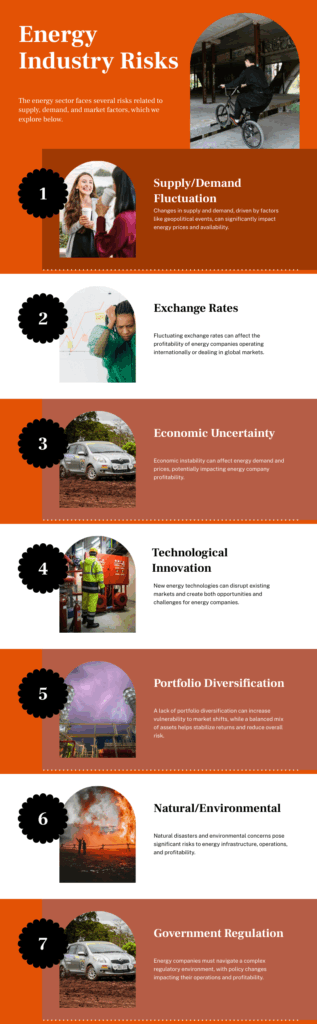
Energy companies that operate internationally or deal in global markets are exposed to exchange rate risks. The value of currencies can fluctuate, and such changes can affect the profitability of international transactions. For example, if an energy company in the U.S. buys oil priced in a foreign currency, a change in exchange rates could increase the cost of that oil. Hedging strategies and careful financial planning are often employed to mitigate this risk.
#3 Economic Uncertainty
Economic uncertainty can have a direct impact on energy prices, demand, and investments. Recessions, inflation, or changes in consumer spending can reduce the demand for energy. In turn, this can lead to lower prices or financial strain for energy companies. Economic instability can also lead to increased costs, particularly in sectors like energy, where infrastructure investments are necessary.
#4 Technological Innovation
While new technologies, like wind turbines and solar panels, offer potential for efficiency and cost savings, they also introduce risks, such as unexpected failures or the potential to disrupt traditional energy markets. Energy companies must manage the integration of new technology while ensuring reliability and cost-effectiveness.
#5 Portfolio Diversification
To manage risk, energy companies often diversify their portfolios, investing in a variety of energy sources (such as renewable energy, oil, and natural gas) and geographic regions. Diversification helps to spread the risk, so if one market or energy source experiences a downturn, other segments may offset the loss. This strategy helps ensure a more stable financial position.
#6 Natural/Environmental Concerns
Natural disasters and environmental challenges, such as climate change or pollution, can disrupt energy production and damage infrastructure. Companies must address environmental risks through sustainable practices and compliance with environmental regulations to minimize operational setbacks.
#7 Government Regulations
Energy companies must comply with government regulations that affect everything from pricing and taxes to environmental standards. Changes in policy or regulation can create financial or operational challenges, and failure to comply may result in penalties or legal issues.
The 3 Key Stages of Effective Energy Risk Management for Businesses
Taking appropriate steps toward decreasing or eliminating risks.
How to Build Expertise in Energy Risk Management: Top Graduate Programs to Consider
The University of Texas Permian Basin offers graduate-level online programs that can help you hone your expertise in energy management as you build broader skills and key credentials for a stronger career.
Online Master of Science in Energy Business
Developed specifically for energy business professionals, this 30-credit program leverages UT Permian Basin’s longstanding connection with the energy industry to provide a firm grounding in financial principles.
Our MS in energy business includes courses that examine risk management, including:
This new 30-credit program caters to one of the most sought-after business concentrations. Tailored toward training current and future executive managers, the MS in finance program includes a balanced and intuitive approach to areas of financial management including corporate financial strategy, investments and electives such as real estate and financial planning. This program also gives the students the ability to select energy classes as electives.
Our online Master of Science in Finance includes courses that explore risk management from corporate and energy perspectives:
Online Master of Business Administration with a Concentration in Finance
This 33- to 42-credit program explores financial management in depth to help you develop career-critical operational acumen and leadership skills. A highly marketable degree, this MBA provides a strong financial management emphasis while also exploring accounting and investments.
Our online MBA in business administration with finance focus includes courses that explore risk management from energy industry and other perspectives:
Online Master of Business Administration with Certificate in Energy Business
This 36- to 45-credit program examines core business areas such as risk management, marketing, accounting, and finance analytics from general and energy industry viewpoints. Our MBA with Certificate in Energy Business boasts a stackable credential option, a unique advantage which enables you to simultaneously earn a Graduate Certificate in Energy Business. That’s two valuable graduate credentials you can complete in about the same amount of time it takes to finish the MBA on its own.
This online program includes courses that examine risk management, including:
The energy industry faces constant change, from shifting regulations to new technologies and environmental concerns. If you’re going to manage these risks, you’ll need specialized knowledge in finance, strategy, and energy markets. UT Permian Basin’s online graduate programs combine quality, flexibility, and affordability to help you build the expertise energy companies need right now.
Our programs hold AACSB accreditation, a distinction earned by only 5% of business programs worldwide. You can complete your master’s degree in as little as four semesters through our 100% online format. Study at your own pace from anywhere—no campus visits required. You can start in spring, summer, or fall and learn to forecast supply trends, navigate exchange rate risks, and integrate new technologies: the real-world skills that help energy businesses identify and address their biggest challenges.
Give your energy industry career a vital boost. Apply now to one of UT Permian Basin’s master’s degree programs.
Are you authoritative? Intuitive? Experienced? A natural-born leader whose direct reports would follow off a cliff? That’s a phenomenal start, but these days, it’s only half the equation. Modern business leaders need a seamless blend of high-level human skills and data analytics skills. In competitive markets, professionals with both are known as dual-threats. Data skills…
According to the World Health Organization, 99% of the global population breathes polluted air. Yet we’re surrounded by clean, sustainable energy sources. Despite coal and natural gas being the most widely used energy sources, the urgency of climate change and resource depletion is making the shift to clean energy increasingly essential. In 2023, about 23%…
Some of the best career growth strategies for BBA graduates are building experience intentionally, developing leadership habits early, and expanding your skills before you need them. That’s the blueprint. But here’s how it usually plays out. Most graduates start in roles like “marketing coordinator” or “financial analyst trainee.” That’s normal (and honestly, a good thing). Those early roles are where you…
Dreaming of a career that makes a real difference? The public sector offers endless possibilities, from shaping policy in government to supporting communities through nonprofit work. No matter where your passion lies, the right credentials can unlock your path. We’re here to guide you through the online degree programs that will help you launch or elevate your public service career—on your schedule, wherever you are.
No matter what stage of a public sector career you may be in—aspiring to enter the field for the first time or ready to advance within your current role—The University of Texas Permian Basin has an online program that will prepare you to take that next step. Each of our programs enables you to maintain your professional and personal commitments with 24/7 online access from anywhere in the world.
Let’s look at 3 of these programs and related positions now.
#1 Online Bachelor’s Degree in Criminology and Criminal Justice Studies
One of the top public service degrees to consider is a bachelor’s degree in criminology and criminal justice studies. Through a mix of theoretical learning and practical application, this degree explores the various components of our criminal justice system and includes a broad range of general education courses to expand your knowledge of math, English, history, communication, and politics. If you’re considering a career in the criminal justice field, this type of bachelor’s degree provides an ideal starting point.
Build a foundation for a fulfilling career and life.
Empower yourself to help reform the criminal justice system from within.
#2 Online Master’s Degree in Criminal Justice Administration
If you’re looking for a public service degree that builds on your experience and prepares you for advancement, a master’s in criminal justice administration is a smart next step. Once you’ve earned a criminal justice-related bachelor’s degree and begun a criminal justice career, a master’s degree program can provide the advanced knowledge and credentials that many agencies require for promotion to leadership positions with higher earning potential.
Take part in a program ranked #5 in the nation for Best Law Enforcement Administration Graduate Programs by bestaccreditedcolleges.org.
Get started faster with no GRE requirement.
Graduate with no thesis requirement.
Empower yourself to help reform the criminal justice system from within.
Complete your degree in as little as one year.
#3 Master’s Degree in Public Administration
If you’ve earned a bachelor’s degree from an accredited university and have three or more years of full-time professional work experience, you can also pursue a public sector career by earning a master’s degree in public administration. This program is designed to help aspiring public and nonprofit professionals begin a career or move up to a more rewarding new phase of their current career.
Tailor your studies toward your specific area of interest.
Graduate with no thesis or internship requirements.
Finish your degree in as little as one year.
Get a High-Quality Public Service Degree Without the High Price Tag
All of these programs feature the same rigorous curriculum used in campus-based classes and are taught by the same field-experienced faculty. High quality doesn’t translate to high cost, however. Our competitive tuition rates are among the most affordable available from any regionally accredited university of our stature.
Boost Your Earning Power With a Public Service Degree
University degrees offer the potential for greater earnings and job security, according to data published by the U.S. Bureau of Labor Statistics (BLS). Bachelor’s degree holders’ median earnings are approximately 38% higher than those of associate degree holders and 48% higher than those who have not yet earned a college degree. Master’s degree holders earn about 18% more than bachelor’s degree holders. BLS data also shows that as an individual’s education level rises, their likelihood of unemployment decreases. The financial benefits of earning an undergraduate or graduate degree are considerable!
The Civil Rights Act of 1964 changed the lives of millions of Americans. It guaranteed the right to vote, ended segregated public spaces, and made employment discrimination illegal. Historians rank it alongside the Constitution and the Emancipation Proclamation as one of the most important documents in U.S. history. Five months after the act passed, Martin…
Dreaming of a career that makes a real difference? The public sector offers endless possibilities, from shaping policy in government to supporting communities through nonprofit work. No matter where your passion lies, the right credentials can unlock your path. We’re here to guide you through the online degree programs that will help you launch or…
If you hop on a Citi Bike in New York City, you’re doing more than just getting across town. You’re helping create real-time data that city planners use to design new bus routes and bike lanes where they’re needed most. Convenient and essential, right? Big data is reshaping our cities—and the future of public administration….
Autism spectrum disorder (ASD) affects an estimated 1 in 68 school-aged children. Children with this neurodevelopmental disorder learn differently than nondisabled students and can experience hardships throughout their lives if unassisted by parents, teachers, and special educators.
As a teacher, you’ve likely encountered children with ASD and potentially students who’ve yet to be diagnosed. Spotting signs of autism early gives students every chance to develop alongside their peers and live happy, fulfilling lives.
The Signs of Autism
ASD is particularly difficult to diagnose. No medical test can detect it, and it’s unlikely to cause physical symptoms. Children of all races, genders, ethnicities, and economic backgrounds can be impacted by ASD, and being a spectrum disorder, ASD affects them in different ways and to varying degrees.
General educators must be mindful that students with ASD behave differently than their nondisabled peers. In particular, they struggle with communicating and interacting with others. According to the National Institute of Mental Health (NIH), people with ASD may struggle with:
Adapting to social situations.
Back-and-forth conversations.
Looking at or listening to anyone talking to them.
Making or maintaining eye contact.
Picking up on social cues.
Playing pretend and making friends.
Responding to their name.
Sharing interests with others.
Modulating their tone and facial expressions.
Understanding other people’s point of view.
Many children with ASD also exhibit restrictive or repetitive behaviors and are known to repeat words and phrases they hear, a phenomenon referred to as echolalia. Adhering to strict routines, they can become upset with small changes to daily life, and they can have a strong or muted reaction to lights, sounds, temperatures, and other sensory inputs.
Every Student Is Unique
ASD can have a serious impact on a child’s development, but it can also provide these young learners with intense focus and the ability to recall information with incredible detail. Visual and auditory learners, children with ASD often excel in the areas of math, science, music, or art, which goes to show that every student is truly unique and comes with their own strengths and challenges.
Hitting Developmental Milestones
The American Academy of Pediatrics recommends that children be screened for ASD at 9, 18, and 24 or 30 months of age. Children as young as 18 months can be diagnosed with ASD, and a reliable diagnosis can be made by age two. However, teachers are often the first to recognize the signs of autism in students.
In addition to signs and symptoms, educators should be mindful of missed developmental milestones that could indicate a student may have ASD. By the time they’re entering preschool—at three and four years of age—most children should:
Avoid danger, such as falls from a tall height.
Comfort others who seem sad.
Enjoy helping others.
Seek to play with other children.
Speak well enough to be understood.
When entering kindergarten, most students should be able to:
Answer simple questions about what they’ve read.
Count to 10.
Focus on activities for 5 to 10 minutes at a time.
Recite simple rhymes.
Tell a story with at least two events.
Fun in the Sun
Having your students play outside is one of the best ways to watch for social, emotional, and developmental milestones. Games like follow the leader; hide and seek; and duck, duck, goose let your students engage in developmentally appropriate play, giving you an opportunity to identify at-risk students. Check out the Go Out and Play! Kit offered by the CDC (Centers for Disease Control and Prevention) for a list of fun activities and additional resources you can use to monitor students’ development.
Intervening on Behalf of Students
If you suspect a student has ASD, your first step is to reach out to your school’s special education teacher, who can perform an initial evaluation. Depending on their findings, you may need to recommend that parents schedule a developmental screening for their child with a healthcare provider.
Parents trust you and look to you for insight into the development of their children, who spend most of the year in your classroom. No parent wants to hear that their child may be falling behind, but broaching the subject may be your best chance at ensuring a student with ASD undergoes a formal evaluation and receives the special education services they’re entitled to.
Making a Difference in Students’ Lives
The connections in a child’s brain, or neural circuits, are essential for learning and most adaptable in early life. Although there’s no cure for ASD, you can make a real difference in the lives of students through early intervention. With your help, they can learn and play alongside their friends, and as they grow older, they’ll have a better chance of avoiding depression and other behavioral problems commonly experienced by adolescents and adults with ASD.
Going Above and Beyond for Students With Disabilities
The University of Texas Permian Basin offers an online Master of Arts in Special Education, Autism Spectrum Disorders track that will empower you to enrich the lives of students on the autism spectrum. In as little as one year, you can graduate from this 36-credit online program with the knowledge and skills needed to:
Implement evidence-based practices for teaching students with ASD.
Create an inclusive classroom for students with disabilities, including ASD.
Communicate intervention strategies and develop intervention plans.
Accredited by the prestigious Council for the Accreditation of Educator Preparation (CAEP), our MA in special education, ASD track will help you overcome the challenges encountered in today’s classrooms. Whether you remain in your current role or pursue a new career in special education, this degree will enable you to reach a broader range of students and help the most vulnerable among them live their lives to the fullest.
“What do you want to be when you grow up?” This question is perhaps never more relevant than when college hopefuls are filling out applications and considering their intended major. Some students make the mistake of choosing a major and locking themselves into a career path they’re not sure about. Others may decide to switch majors but will have already sunk costly credit hours into a subject they’re no longer interested in.
A BA in humanities is ideal for students who don’t want to be tied to a single career path. Students in humanities degree programs can keep their options open and, once they graduate, explore one or multiple career paths. We’ll be discussing the myriad benefits of a humanities degree, but first, let’s talk about why settling on a single career path might not work for everyone.
Getting the Most Out of Your Investment
There’s no question that college leads to greater opportunities. Bachelor’s degree holders earn higher salaries (over $30,000 more each year), have lower unemployment rates, and are more likely to have employer-provided healthcare. About half of all jobs require at least an associate degree, so if you’re interested in a secure, high-paying job, college attendance is a must.
Higher education is a wise, albeit costly, investment. To make the most of it, students tend to start on a career path as early as possible. (The hustle is real!) Affordable, accredited online programs can significantly reduce tuition costs, but the overall expense and pressure to declare a major can push students into career paths that may not be lucrative or fulfilling long-term options.
Settling on a Career Path
Interested in becoming a clinical psychologist? Better pursue an undergraduate degree in psychology. That way, you can move on to a master’s program and eventually a doctoral program. Ten years from now, you could graduate with a doctorate in psychology, having passed your exam, defended your dissertation, and completed a one-year internship. Hopefully, you’re still interested in psychology by then.
This approach works for many students, but not everyone stays on their chosen career path. Priorities change, and people change — not just in college but throughout life. So, where does this leave students who understand the benefits of a college education but aren’t sure of what to major in?
What Is a Humanities Degree?
A BA in humanities provides a deep understanding of human culture, focusing on shared values, beliefs, and attitudes. Humanities programs typically include courses related to:
Art
Communication
English
Foreign language
History
Music
What Skills Are Learned in a BA in Humanities Program?
Humanities programs are concerned more with developing well-rounded individuals than with training students in a single area. That means helping students develop their critical-thinking, problem-solving, and communication skills so that they may see the world and its people from differing perspectives. Students should expect a lot of speaking, reading, and writing in humanities courses.
Developing Soft Skills
At first glance, a humanities curriculum may seem to be composed of unrelated courses. However, courses are carefully selected to provide students with essential “soft skills.” Soft skills are a mix of personal habits and personality traits employers are looking for, many of whom value soft skills over technical skills. Examples include:
Adaptability
Critical thinking
Versatility
The focus of a humanities program is not to provide a single skill set but to develop capable, well-rounded individuals able to acquire any number of skills. Graduates are equipped with a more worldly, contextualized outlook and a stronger understanding of what motivates those around them, giving them a distinctive edge in the workplace. Humanities degree holders tend to be easy to work with and communicate in a clear, cordial manner whether speaking with someone face-to-face or communicating through email, phone, or social media.
What Are Employers Looking For?
Soft skills are valued in virtually every profession. Don’t believe us? Think about it: Would you rather work with someone who doesn’t take part in meetings, tells inappropriate jokes in the workplace, or can’t write a business email to save their life?
LinkedIn’s 2018 Workplace Learning Report found that 92% of executives say that soft skills are as or more important than technical skills. Leadership, communication, and collaboration were cited as the most important skills for employees to learn from learning and development. Soft skills never go out of style and are only growing in importance with the rise of AI (artificial intelligence). “[T]hey are precisely the type of skills robots can’t automate,” reported LinkedIn.
Get In Touch With Humanity
Regardless of the degree you pursue, you’ll be given opportunities to develop soft skills. You may already be a team player capable of communicating, problem-solving, and empathizing with others. However, few courses of study are as focused on reading, writing, and speaking as the humanities. By pursuing a BA in humanities, you’ll gain a sought-after skillset that can open doors in a variety of career fields.
Don’t let the pressure of picking a career path stop you from earning a bachelor’s degree. The University of Texas Permian Basin offers an online BA in humanities program that can instill you with the knowledge and skills needed to navigate and stand out in modern workplaces. Taking an intense, multidisciplinary approach to understanding human cultures, this program looks at the fields of art, music, and history, among others that give life meaning. And our program is 100% online, meaning that you’ll be able to complete coursework on your schedule. Now that’s a flexible program!
Technology is a primary driver of commerce and government today, keeping operations running smoothly for countless organizations worldwide. The University of Texas Permian Basin offers technology-focused online degree and certificate programs that can help you develop greater career expertise and professional potential. Created and taught by some of the top minds in their respective fields, these leading-edge programs can help give you an advantage when seeking new positions or advancement within your current organization. There’s a range of options for all levels of educational and professional experience.
Technology-Focused Degree Program
Our undergraduate industrial technology program gives you a focused education in industrial technology complemented by a broad foundation in essential general education topics including math, English, geology, and history. It’s a degree that can help launch you into the professional world.
Our Bachelor of Science in Industrial Technology program empowers you with the expertise to manage industrial operations within any type of organization. You’ll discover how to recognize and remedy complicated technical, design, and engineering issues; establish health, safety, and environmentally responsible initiatives; and develop a firm grasp of project life cycles.
This program can benefit you in careers including:
We designed our certificate programs to help you develop new career skills and add new professional credentials to your resume quickly. Programs start at just 12 credits.
This certificate program grew out of a decades-long partnership between The University of Texas Permian Basin and the GIS and geospatial industries. We used our insider’s perspective to develop a curriculum around the latest technologies and methods in these fields. The resulting 12-credit graduate certificate program is an exploration of GPS applications, cartography, mapping, and other associated subjects.
This program can benefit you in careers including:
The Connection Between Technology and a Convenient, Quality Online Education
Technology is at the core of UT Permian Basin’s online degree and certificate programs. All of the courses, lectures, and communication tools are internet-based, enabling you to access them from your laptop or mobile device. No campus visits are required. This flexible format allows you to learn on your own schedule from virtually any location in the world while maintaining your existing professional or personal obligations. As with all our programs, the curriculum for each of the programs above is top-notch, based on the latest innovations, and taught by renowned academics and industry professionals. You won’t find a more convenient way to earn respected education credentials. A technology-focused degree or certificate program may be all that stands between you and a truly rewarding career. Apply today.
Financial analysts provide essential financial guidance to businesses and individuals alike. Let’s examine some of the duties they perform to see why financial analysts are so highly valued and why it pays to pursue a career in this lucrative role.
Job Duties of a Financial Analyst
The U.S. Bureau of Labor Statistics (BLS) states that the role of financial analysts is to “guide businesses and individuals in decisions about expending money to attain profit.” Essentially, they assess the amount of money going out and coming in and recommend ways that their clients can spend less money and make more of it. Of course, they don’t just guess at these. Financial analysis is a data-driven field that relies on the use of specialized tools to identify historical and future financial trends. A financial analyst’s duties include:
Suggesting which investments their clients should make.
Monitoring business and economic trends.
Reviewing a client’s current and past financial situations.
Evaluating the effectiveness of a company’s leadership team.
Reporting their findings to clients.
Financial analysts are highly valued because their expertise can guide clients toward greater profitability. They often use data gleaned from accountants and may themselves have an accounting background, but the two jobs are not identical. Financial analysts take a broader look at the financial picture, concentrating their attention on trends to determine a specific financial direction, while accountants tend to focus on their clients’ or employers’ daily financial data.
Rewards and Opportunities for Financial Analysts
According to the BLS, median annual pay for financial analysts in 2021 was $81,410. Future job growth is expected to be steady, with approximately 41,000 financial analyst jobs to be added annually in the United States from 2020 to 2030. Opportunities for those possessing the desired skills and credentials will be plentiful.
Employers prefer to hire or promote financial analysts who have a master’s degree. A graduate degree not only helps a candidate stand out from the competition but also enables them to enjoy higher compensation and employment rates. The BLS reports that master’s degree holders earn about 18% more than those whose highest education credential is a bachelor’s degree. Further, master’s degree holders are more likely to be employed than those who hold an undergraduate degree alone. A Master of Business Administration with a concentration in Finance can help a financial analyst establish a more satisfying, successful career!
Why Earning an MBA in Finance Online Makes Good Financial Sense
If you want to pursue a career as a financial analyst, you’ll need solid credentials. UT Permian Basin’s online Master of Business Administration with a concentration in Finance comes highly recommended. This convenient online UTPB program is offered through our AACSB-accredited College of Business, a revered distinction shared by only 5% of business programs worldwide and awarded after a rigorous peer-review process that ensures accredited business schools “meet the highest standards of excellence in teaching, research, curriculum, and learner success.” Recognized internationally for its university rankings, U.S. News & World Report also named our MBA program among its “10 Most Affordable Online MBA Programs” in 2022.
When you consider our online program’s prominent accolades, competitive tuition rate, and professional benefits, it’s clear that an MBA in finance from UTPB may be the wisest investment you can make in your financial analyst or related career. But the advantages don’t stop there.
Terminally Qualified Faculty and Curriculum
The faculty of our online MBA with a concentration in finance is made up of distinguished doctoral-level business professionals—the same accomplished business veterans who teach an identical high-quality curriculum at our Odessa, TX campus. With their guidance, you’ll master critical financial management skills that will empower you to:
Evaluate and interpret many forms of financial information.
Think strategically.
Navigate various facets of investment, accounting, and economics.
Make ethical choices for a corporate entity.
Apply your expertise in numerous professional roles.
A Program That Works on Your Schedule
Our MBA in finance program is delivered in a 100% online, asynchronous format that offers tremendous flexibility for busy individuals in any stage of their career. You can access and complete coursework 24/7 from virtually any location on the planet. Earning a career-enhancing MBA need not interfere with your current professional responsibilities or personal commitments.
Need some time before beginning your master’s degree? You can choose from six start dates throughout the year. And once you commence your studies, you can finish your degree and add a respected MBA in finance to your resume in as little as 15 months.
If you’re wondering whether all master’s degrees require a thesis, you’re not alone. From MBA programs to Master of Science degrees, students often ask: Do I need to write a thesis? In this article, we’ll break down the differences between thesis and non-thesis master’s programs, including what each option involves and how to decide which is right for you.
What Is a Thesis?
A thesis is an original document a student creates in the final semesters of their program from research they’ve conducted on a topic related to their major. Often, it’s a subject connected to their current professional interests and/or future ambitions.
In writing a thesis, students demonstrate what they’ve learned during the entirety of their program. Before a thesis is accepted, the student must verbally defend it before select faculty from their college—essentially providing a persuasive summary of their work’s main points and findings. Thesis length varies but is generally 60 pages or more.
What if I Choose a Thesis Option?
The research experience you’ll gain while writing a master’s-level thesis can be an advantage if you want to work as a researcher or in any professional role with a large research component. A thesis is also recommended for anyone planning to continue on to doctoral studies after completing their master’s degree. Many master’s degree graduates publish their theses in academic or other periodicals, which can help them establish them as authorities in a specialized academic area.
What if I Choose a Non-Thesis Option?
Writing a thesis takes up a portion of the credit hours of a master’s degree program. Since a non-thesis option doesn’t devote those hours to a thesis, it typically allows you to complete more classes and build expertise in a wider variety of topics. It also enables you to focus on building skills outside of research, e.g., communication, critical thinking, and analysis. Students who choose a non-thesis option must pass an exam toward the end of their program.
Which One Is Right for Me?
To help you better understand the key differences between thesis and non-thesis options, here’s a quick comparison chart that highlights the main factors to consider:
Option
Thesis
Non-Thesis
Focus
Original research and academic writing
Broader coursework or applied projects
Ideal for
Students planning to pursue a PhD or research career
Professionals looking to enter or advance in the workforce
Time Commitment
Includes dedicated research and writing hours
Allows for more elective coursework
Graduation Requirement
Includes dedicated research and writing hours
Allows for more elective coursework
Common In
Research-focused programs (e.g., MA in history)
Professional degrees (e.g., MBA, MA in communication)
Rapid Fire FAQs
Still unsure about whether you need a thesis for your master’s degree? We’ve gathered answers to the most common questions that can help clarify your decision-making process. Below, you’ll find straightforward responses to help you better understand the thesis vs. non-thesis options.
Do all master’s programs require a thesis? No, not all master’s programs require a thesis. Some offer a non-thesis option, and others—like many MBA programs—don’t include a thesis at all.
What’s the difference between thesis and non-thesis master’s programs? A thesis program involves original research and a formal paper, while non-thesis options may include exams, more coursework, or a capstone project instead.
Do you have to write a thesis for an MBA? Most MBA programs do not require a thesis. Instead, they often include practical coursework or a final project.
Can I get a master’s without writing a thesis? Yes. Many master’s degrees offer non-thesis paths that let you graduate by completing coursework or passing exams.
Is a thesis required for an MS degree? It depends. Some Master of Science (MS) programs require a thesis for research-focused tracks, while others offer a non-thesis option for applied fields.
Pick the Choice That’s Right for You at UTPB
The University of Texas Permian Basin’s online Master of Arts in History program enables you to gear your studies toward your own academic and professional goals by offering thesis and non-thesis options:
Thesis Option: If approved, you will complete 24 credit hours (8 courses) from our core history courses and 6 hours of thesis work, for a total of 30 credit hours. You must successfully complete and defend your thesis during the semester of your graduation.
Non-Thesis Option: With this option, you are required to pass written and oral exams during the semester in which you’ll graduate.
Whichever path you choose in our program, you’ll embark on an enlightening exploration of history dating from the American Revolution to the most consequential events of the 20th century. Each course is dedicated to a single topic or era, enabling you to develop a deep understanding of the subject matter. Equipped with graduate-level credentials and expertise, you’ll be ready to achieve even greater success in your career.
Higher Earnings, Stable Employment, and Other Professional Benefits
According to the U.S. Bureau of Labor Statistics, professionals with a master’s degree earn about 18% more than those with a bachelor’s degree alone. The same report shows that master’s degree holders also enjoy higher rates of employment than those with an undergraduate degree. What’s more, the U.S. Department of Labor and Forbes agree that the skills you’ll develop in our MA in history program—including spoken and written communication, critical thinking, and analysis—are among the very skills today’s employers are seeking in job candidates. Our master’s degree offers real professional benefits that start while you’re completing your degree and continue well after graduation.
Earn Your Master’s Degree on Your Schedule
Do you have time-consuming professional and personal commitments? Many of our students do. Fortunately, our MA in history program has a 100% online, asynchronous format that allows you to set your own coursework schedule around any other obligations. You can complete coursework from practically any location that’s convenient for you. No GRE is required for admission, and you may be able to complete your degree in as little as two years.
Imagine being told you can’t do something—by law, by tradition, by those close to you—and doing it anyway. Even today, women face greater barriers to recognition and authority than men. Yet throughout history, countless women stepped beyond traditional domestic roles, often at great personal risk. This article highlights nine of the countless important women who…
“Our country has deliberately undertaken a great social and economic experiment, noble in motive and far-reaching in purpose.” -Herbert Hoover Today, speakeasies are stylish bars hidden away behind bodegas, coffee shops, and laundromats. Ordering a cocktail is as easy as walking up to the bar, and while some places still require a password, you can…
At the iron gates of Auschwitz-Birkenau, one of the most infamous extermination camps of Nazi Germany, the chilling phrase “Arbeit macht frei” (“Work sets you free”) still casts a haunting shadow. These deceptive words led into one of history’s darkest chapters. Beyond that gate, more than a million lives were brutally ended. Auschwitz-Birkenau was just…
If you’re considering earning a Master of Business Administration (MBA), you may already be aware that adding an MBA to your resume can be a career-defining accomplishment. But what does that mean in terms of real-world benefits?
If you’re earning an MBA from The University of Texas Permian Basin online, we can confirm that there are many benefits for your career and beyond. Below we’ll discuss seven of the most compelling reasons aspiring business leaders should consider applying to UTPB’s online MBA program.
Accreditation
When it comes to the quality of a university program, accreditation matters. For business schools, the Association to Advance Collegiate Schools of Business (AACSB) is widely recognized as the preeminent accrediting body. The AACSB’s website defines AACSB accreditation as signifying “a business school’s commitment to strategic management, learner success, thought leadership, and societal impact.” Only 5% of business programs worldwide are awarded AACSB accreditation, which speaks to the high standards and discerning nature of the organization. UT Permian Basin’s online MBA program is offered through our AACSB-accredited College of Business, so you know you’re going to get a quality education that employers respect.
Affordability
UTPB strives to keep tuition for our programs competitive so that a life-changing education can remain accessible. In fact, we’ve been recognized publicly for our affordability. U.S. News & World Report included our MBA program on its “10 Most Affordable Online MBA Programs” list for 2022. In addition, our online program saves you the costs associated with commuting, such as gas, tolls, and parking permits.
Significant Career Potential
“An MBA … is a smart choice for someone who aspires to become a C-suite executive overseeing multiple divisions of a business,” MBA and marketing agency founder Laura Troyani told U.S. News & World Report. With business leadership roles come not only greater responsibilities but the potential for higher compensation and better job security. The U.S. Bureau of Labor Statistics (BLS) confirms that master’s degree holders earn about 18% more than those who hold a bachelor’s degree alone. Further, the same BLS report reveals master’s degree holders have higher employment rates.
Having an MBA on your resume can enable you to pursue a variety of rewarding career paths, including:
Our online MBA is an accelerated program composed primarily of eight-week courses. Plan out your semesters ahead of time with the help of your UTPB academic advisor and you can complete this distinguished online master’s degree in as little as one year. We also allow you to start your program any semester of the year. You don’t have to wait until fall to begin as you may be required to do with some other programs!
Unequaled Convenience
Designed with the busy professional in mind, our online MBA program enables you to earn your degree at your own pace. You can keep up with any work and personal commitments you may have while completing your MBA coursework from just about any location in the world, 24/7. The 100% online, asynchronous format of our program is what makes this possible.
Broad Expertise
An MBA is sometimes referred to as a generalist degree, meaning it encompasses a wide range of business specializations. When you earn your MBA online from UT Permian Basin, you’ll build vital negotiation, strategy, and other leadership skills as you expand your expertise in areas including:
Management
Accounting
Energy Business
Finance
Marketing
Analytics
International Business
Equipped with this broad business knowledge, you’ll have the “big picture” perspective needed to lead an organization.
Abundant Networking Opportunities
In business leadership or in just about any career, networking is a key element for success. The ability to meet and converse with like-minded professionals can yield more plentiful employment and partnership opportunities for you. While there are no campus visits required in our online MBA program, you’ll enjoy rich engagement and collaboration with classmates and faculty alike through a variety of interactive online tools that facilitate networking. In addition, you can stay connected to your classmates and school community through UTPB’s alumni network and Texas Exes, the alumni network for the entire University of Texas System.
Experience the benefits of earning an online MBA from UT Permian Basin for yourself! Apply here.
Assistant principals and principals interested in advancing their careers face a reality familiar to their students: going back to school. Navigating the path to superintendency doesn’t have to pose an additional mental burden for educational leaders, however. Becoming a superintendent is a straightforward process, so long as candidates enroll in a certification program that takes into account their needs and expectations.
The University of Texas Permian Basin’s online Superintendent Certification program is designed for principals and assistant principals who want to strengthen their skills as school leaders and promote the success of all students in their district. This 16-credit program is affordable, accredited, and online, but those descriptors alone might not give a clear idea of what it’s like in our virtual classroom.
Let’s take a look at our online Superintendent Certification program and the experiences principals and assistant principals can look forward to within it.
What Are the Learning Objectives?
UT Permian Basin’s Superintendent Certification program is composed of online courses, each of which includes a practicum component. Through coursework and practicum, graduate students learn how to build relationships with school boards, promote a shared vision, and oversee day-to-day operations within a district.
Learning objectives are designed to help students meet the exemplary leadership standards established by the State Board for Educator Certification (SBEC) and include:
Managing a district’s budget, personnel, and resources.
Fostering an appropriate, effective, and safe learning environment.
Responding to political, social, economic, and legal challenges.
Understanding the sociocultural influences on campus policies.
What’s It Like in Our Virtual Classroom?
Courses are delivered through Canvas, our learning management system. Here you’ll find everything you need for your courses, including lectures, discussion boards, and syllabi. (We don’t have to tell you how it important it is to read the syllabus.) All online coursework is asynchronous, meaning it can be completed where and when it’s convenient for you. Watch a lecture on your lunch break, or wait until the weekend to dive into an assignment. At UT Permian Basin, we leave it to you to decide the pace of your education.
Students in our virtual classrooms aren’t faceless strangers: They’re active participants. Responding to discussion posts, receiving professional feedback, and communicating with students are all integral parts of our program. After all, superintendents are multitalented leaders able to build professional relationships with every encounter.
The College of Education’s dedicated faculty, all of whom have experience as educational leaders, will also be there to advise and assist you on every step of your journey. Our professors are still in touch with many of their former students, and they always respond to emails promptly, usually within 24 hours.
Course Spotlight: Superintendency & the School Board
Over a period of eight weeks, students in our online course Superintendency & the School Board explore the complex relationship between superintendents and school boards, attending at least two school board meetings in the process. By the end of this course, students will have a deeper understanding of how to:
Respond to diverse community needs.
Work with board members to achieve a district’s vision.
Promote collaborative decision-making and problem-solving.
Nurture a district culture that’s conducive to professional development.
What’s the Practicum Experience Like?
UT Permian Basin’s online Superintendent Certification program is one of the only four-course programs in the state that maintains a practicum experience throughout. This combination of theoretical and practical instruction ensures graduates are prepared for the rigors of superintendency, even those who already have extensive experience as educational leaders. Here’s how it works:
Each course includes a 40-hour practicum (internship) component. Assignments incorporate field experiences that, depending on the course, entail collaborating with your superintendent. By working with a mentor, you’ll learn how superintendents conduct themselves while addressing district matters, whether planned or not. This is an opportunity to reflect on your growth as you work toward becoming a district leader.
What Is the Process for Earning a Superintendent Certification?
UT Permian Basin’s online Superintendency Certification program does not certify Texas superintendents. Rather, it helps principals and assistant principals meet the certification competencies required by the Texas Education Agency (TEA).
If you’re a principal, you already meet most of TEA’s certification requirements, but assistant principals will have to submit a Superintendent Certification Application. Your next steps are to complete an approved superintendent educator preparation program, like ours, and pass the required exam. Although our program doesn’t specifically teach to the exam, the instruction delivered in our virtual classroom will prepare you nonetheless.
Within as little as two semesters, you can complete our program and gain the experience, knowledge, and skills needed to earn your superintendent certification.
Pursue Your Certification Through UT Permian Basin
UT Permian Basin’s online Superintendent Certification program offers a clear path to superintendency and, more importantly, provides graduates with the means to promote the success of all students within a district.
As a principal or assistant principal, you understand more than anyone how students, parents, and entire communities can be affected by a district’s policies. By becoming a superintendent, you can develop and propose new school policies to board members, promote a shared vision among stakeholders, and make sure everyone has a seat at the table, including your teachers and fellow educational leaders.
Ready to become a district leader? Apply now and find out for yourself how comprehensive and convenient our online Superintendent Certification program is.
Out-of-state candidates should contact Dr. Rodney Uzat to determine if UTPB’s online Superintendent Certification program will meet the requirements of their state.
If you’re thinking about becoming a Certified Public Accountant (CPA), there’s more to it than just passing the exam. Each state has its own specific path to licensure, including education, testing, and experience requirements.
The good news? Texas doesn’t require U.S. citizenship or even in-state residency to become a CPA. That means you can live almost anywhere and still qualify—unlike some states with stricter requirements.
So, if you’re ready to take the first step toward a respected and rewarding career in accounting, here’s exactly how to become a CPA in Texas.
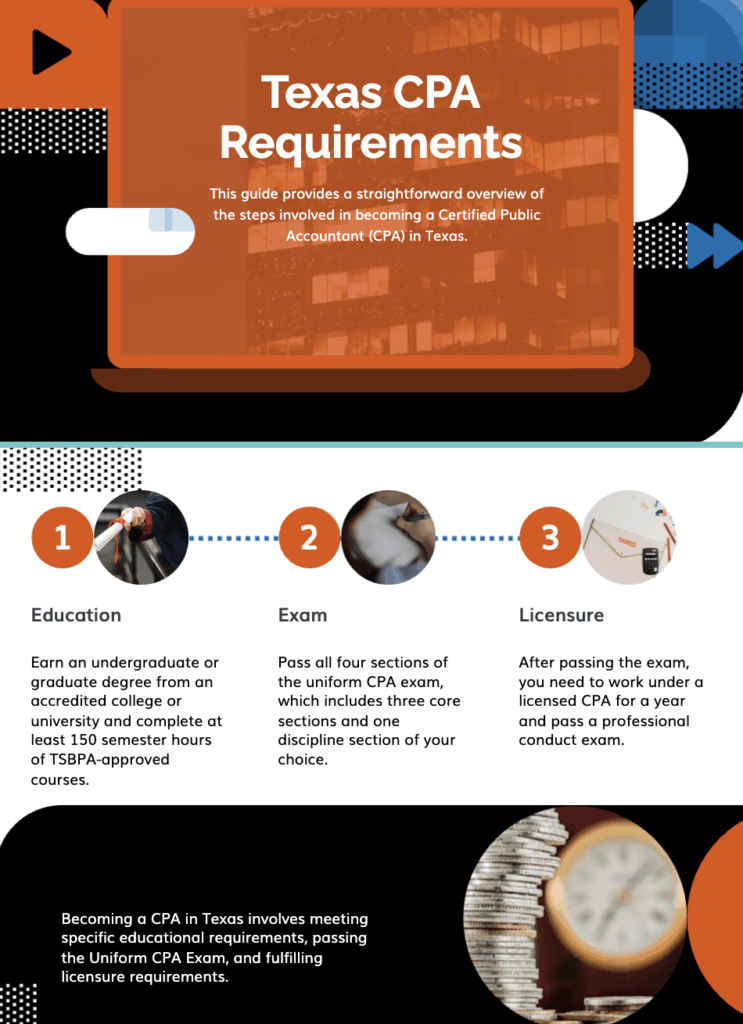
#1 Complete Your CPA Education Requirements in Texas
In Texas, you must earn an undergraduate or graduate degree from an accredited college or university recognized by the Texas State Board of Public Accountancy (TSBPA). You must also complete at least 150 semester hours of courses approved by the TSBPA, which includes several other semester hour requirements, before you can apply to take the CPA exam.
#2 Pass All Four Sections of the CPA Exam
The next step in becoming a CPA in Texas is to study for and pass the CPA exam. As of 2024, the exam consists of four parts, each lasting four hours. Though some changes are made nearly every year to the exam, significant changes were made in 2024. Now, all people taking the exam must pass three core sections and choose from one of the following three discipline sections:
Business Analysis and Reporting (BAR): This discipline is ideal for those interested in financial analysis, reporting, and data interpretation.
Information Systems and Controls (ISC): This option is best for CPAs who want to work at the intersection of accounting and technology.
Tax Compliance and Planning (TCP): A strong fit for those drawn to tax preparation, planning, and strategy, this discipline focuses on individual and business taxation and ethics.
One important fact to note is that the CPA exam is in a uniform format, meaning the content and structure are the same exam from state to state, though requirements do vary by jurisdiction, such as work experience, education, and residency. In addition, passing this exam is a major step toward becoming a CPA, but it doesn’t make you a licensed CPA.
#3 Meet Licensure Requirements and Apply
Texas CPA licensure requirements include working under the guidance of a CPA for one year and passing a TSBPA-mandated professional conduct exam. Though there is extra effort involved in becoming a licensed CPA, the advantages are considerable. Licensed CPAs earn up to 15% more than other accountants. CPA is a widely respected title and having it on your resume can help you stand out among other employment candidates.
Pursue a Texas-Based Education for Your Texas CPA Career
As we’ve discussed, education is the first step on the path to becoming a CPA. The University of Texas Permian Basin’s AACSB-accredited College of Business offers 100% online programs that provide the foundation you’ll need to enter this rewarding field. Each online course features the same curriculum used in our campus-based courses and is led by the same acclaimed faculty and CPAs. Your program choice will depend on your current education level.
Haven’t Earned a Bachelor’s Degree? Start Here.
A bachelor’s degree is usually a minimum requirement to be hired as an accountant. Our online Bachelor of Business Administration in Accounting can prepare you for an accounting position or an associated position. During our program, you’ll learn how to use the tools required to evaluate and remedy accounting issues affecting energy, government/non-profit, healthcare, and other specialized sectors critical to our economy.
Recently Earned a Bachelor’s Degree? Start Here.
Our online Master of Professional Accountancy program offers courses covering all of the topics required for CPA certification in Texas. Adding this degree to your resume can give you an advantage in your job search. According to the U.S. Bureau of Labor Statistics, some employers give preferential treatment to job candidates holding a master’s degree in accounting. You may be able to complete this highly valued degree in 2 to 4 years.
Experience Flexible Online Learning for Your CPA Career
The 100% online, asynchronous format of both programs makes earning your degree a flexible experience. If you’ve got adequate internet access, you’ve got program access! You can complete coursework on your own schedule from practically any location in the world. This is especially beneficial if you have ongoing professional and/or personal commitments. Whether you live in Tennessee or Tasmania, state board requirements and our online program format mean geography needn’t stop you from becoming a Texas CPA.
Begin your path to becoming a Texas CPA by earning an online degree from UTPB!
You don’t need to love spreadsheets to succeed in accounting (but it does help). Behind every balance sheet and tax return, however, is a professional who’s strategic, detail-oriented, and trusted to keep finances on track. So, what makes a great accountant? Whether you’re aiming for the CPA exam or stepping into business finance, here are…
A Bachelor of Business Administration (BBA) degree is your ticket to the world of business. A BBA provides a comprehensive overview of business, touching on foundational concepts like accounting, finance, marketing, and management. Typically, undergraduate students also choose the major that best aligns with their interests. This specialized focus allows students to explore a subject…
The stock market crash of 1929 ushered in an era of economic uncertainty that saw many businesses shutter, banks fail, and life savings evaporate. This economic cataclysm triggered the development of new accounting standards that are still in use today. Here we’ll examine the world’s two primary sets of accounting standards and some related organizations,…