How Industrial Technology Is Revolutionizing Business in 2025
Industrial technology touches more parts of our lives than we oftenrealize. From the cars we drive to the energy that powers our homes and the products we use every day, businesses across industries rely on industrial technology to work smarter, faster, and more sustainably. These tools don’t just boost productivity and profitability. They also improve safety and help companies innovate in ways that benefit us all.
In this article, we’ll explore how key industrial technology innovations—from robotics to AI to clean energy—are transforming modern business, and what they mean for the future of work.
Top 6 Industrial Technology Innovations Transforming Business
“Innovation” has two meanings: the creation of new technologies and how they’re used in industries across the board. The goal of innovative technology? Making our lives easier, —hether it’s as simple as talking to online chatbots or as profound as using robotics to assist in surgery.
Below, we explore six technological innovations that have helped both businesses and consumers thrive in a fast-changing world.
#1 Robotics
Robots are not a new manufacturing tool. In fact, they’ve been used on automobile assembly lines for more than 50 years.
These are not the walking, talking robots depicted in science fiction movies, but rather robotic arms that can easily move heavy components into place or apply paint and adhesives to a vehicle without suffering any effects of toxic fumes.
The automotive industry has provided a testing ground for the widespread use of robotics in manufacturing, paving the way for its use across other business sectors.
Robotics are also reshaping the medical world. For instance, some dentists now use robot-guided arms to place dental implants with extreme precision, reducing the risk of human error during procedures.
#2 Artificial Intelligence (AI)
One particular class of robots, referred to as “smart robots,” do not merely perform as programmed but can learn and implement new tasks on their own. In business, they’re being used to increase efficiency in numerous ways.
More recently, generative AI tools are helping manufacturers in several ways, including:
Optimizing production lines
Predicting maintenance needs
Conducting real-time quality control using simulations and data modeling
Outside of business, we see AI in self-parking cars and robot vacuum cleaners that add convenience to our daily lives.
#3 Clean Technology
Clean technologyClean technology (or cleantech) refers to innovations that minimize environmental impact by reducing resource use and cutting harmful emissions, all while improving efficiency.
The push for companies to operate more responsibly has led to major clean technology breakthroughs, including:
Electric cars
Low-flow toilets
Water filtration systems
Solar panels
Wind turbines
These innovations help reduce environmental impact while meeting growing consumer demand for sustainability.
#4 The Internet of Things
The Internet of Things (IoT) typically refers to physical devices and appliances that are “able to collect and exchange data using embedded sensors.” These aren’t your typical smart devices like phones or computers. Instead, they’re everyday objects that weren’t always built to connect, like thermostats, refrigerators, or even doorbells.
The voice-enabled Alexa, which allows users to access information and entertainment through simple verbal commands, is one consumer-based example. While convenience is an advantage all users can appreciate, Alexa users who are blind or suffer from mobility issues enjoy especially significant benefits from such technology.
A growing number of manufacturing companies are making an investment in IoT, which has been referred to as “the pipeline connecting and collecting mountains of data from an entire spectrum of equipment and devices.” According to one estimate, 81% of industrial manufacturers are using Internet of Things technology to boost their operational efficiency.
#5 Additive Manufacturing
Additive manufacturing, more commonly referred to as 3D printing, has been around since the 1980s, but its potential has increased a thousandfold over the decades. 3D printers are now available to consumers, who can make items such as cell phone holders on their own at home.
But the impact on business has been more dramatic. This technology enables mass-produced items to get to market quicker and at a lower cost. Additive manufacturing is already being used to create prosthetic limbs, dental crowns, and more, and it has the potential to create human organs for people who need transplants. According to GlobalData, industry will invest more than $20 billion into 3D printing by 2025.
#6 Wearable Technology
Popular in the video gaming world for years, virtual reality headsets are now helping businesses in many ways. Car manufacturers can create 360-degree virtual views of prototype vehicles from design specs before beginning the expensive and lengthy process of developing a physical prototype.
Virtual and augmented reality software enables surgeons to perform complex procedures on virtual patients first, improving hospital efficiency and patient outcomes. On the consumer side, wearable tech products like the Oura Ring or Apple Watch help people track everything from sleep quality to heart rate to daily movement, making health data more accessible than ever.
Why Industrial Innovation Matters for the Future of Work
Technological innovation is reshaping not just industries but also the careers that support them. Here’s why it matters:
Rising demand for tech-savvy professionals Businesses need workers who understand how to manage and apply innovations like AI, IoT, and automation.
New roles are emerging across industries Careers in industrial automation, systems integration, clean energy, and data-driven operations are on the rise.
Digital and problem-solving skills are essential Success in tomorrow’s workforce requires a strong blend of technical expertise and critical thinking.
Industries are becoming more efficient and sustainable Professionals trained in industrial technology will help companies meet environmental goals and boost productivity.
Education is a key advantage Earning a degree in industrial technology helps future-proof your career and opens doors to leadership opportunities in tech-driven fields.
Start Your Industrial Technology Career Online
Help lay the path for future innovations that can forever change the way business works and consumers live their lives. The right training and credentials can help position you for a rewarding industrial technology role within a variety of industries. The University of Texas Permian Basin offers online bachelor’s degrees that will be invaluable in your career:
Bachelor of Applied Arts and Sciences in Industrial Technology (BAAS-IT) Expand your expertise in management concepts including optimization theory and supply chain management. This program can benefit AAS-degree holders seeking to advance their careers to include managerial roles. Add an online undergraduate certificate in petroleum technology to enhance your expertise in the energy industry.
All courses for these degree programs are presented in an asynchronous, 100% online format, offering you tremendous flexibility. Complete your coursework at your own pace, from any location, while giving your professional and personal obligations the attention they need. Most program courses last just eight weeks, and you’ll learn from the same distinguished professors who teach the courses on campus at UT Permian Basin.
Explore industrial technology and acquire the skills needed to succeed in a variety of careers with a bachelor’s degree in industrial technology from UT Permian Basin.
Ever check the tag on a t-shirt or appliance and see “Made in China” or “Made in Mexico”? Soon, you may be seeing more tags labeled “Made in the USA.” Today, there’s a reshoring trend that’s reopening factories, strengthening American manufacturing, and creating new opportunities for businesses and workers. As more companies move toward domestic…
Ransomware, phishing, viruses: If it’s connected to the internet, someone’s probably trying to hack it. Threats are everywhere in today’s digital world, and now that factories run on smart technology, it’s not just laptops at risk. Industry 4.0 has moved manufacturing from traditional methods to smart, automated systems (think robots and sensors on the factory…
Imagine a factory where machines, robots, and sensors are all talking to each other, like nerves sending signals to a brain. Before a human notices anything, the system’s already flagged a motor that’s starting to lag and adjusted a product’s assembly in seconds. This is connected manufacturing in action. Today’s smart factories run on connected…
Want to be a more effective leader? Understanding your management style is the first step.
From hands-off to motivational, every leader brings a unique approach to guiding their team. In this article, we’ll break down 7 common management styles, how they work, and when to use them—especially in today’s workforce, where collaboration, flexibility, and purpose matter more than ever.
Whether you’re a current manager or planning your next career step, this guide can help you align your leadership style with team needs and long-term goals.
7 Management Styles to Consider
You’ll find that there are many management styles and many ways to describe them. Let’s examine some of these management styles, in no particular order, and begin to explore what kind of leader you might want to be.
#1 The Autocratic Approach
Take control and keep it. Make all key decisions yourself. You may consult with others, but ultimately, it’s all up to you. You must also stay very directly involved in everything your team is doing. This doesn’t necessarily mean micromanaging your employees, but rather staying tapped into the status of all projects.
Example: A CEO of a startup might use the autocratic approach when making pivotal decisions about the company’s vision and product development. They take full control of the decision-making process, consulting with team members but ultimately making the final call.
#2 The Hands-Off Approach
Sit back and let your people do what they do best, with minimal interference from you. If you’ve hired the right people, you may be surprised at what they can achieve when management steps out of the way.
Example: A senior manager at a tech company may delegate the responsibility of handling daily operations to their team while stepping back. With the hands-off approach, they trust them to use their expertise to meet goals with minimal intervention from leadership.
#3 The Big Picture Approach
Focus on the overall direction of your team or organization and let your people deal with the day-to-day specifics that will help make your vision a reality.
Example: A creative director at an advertising agency might focus primarily on the agency’s overall direction, ensuring the team’s projects align with the company’s long-term vision. This leaves specific tasks like design and deadlines to the respective teams.
#4 The Influential Approach
Show your people, in a positive way, why your vision and direction will ultimately benefit them and your organization. If you can create a clear picture for them, they will come over to your side.
Example: A marketing manager could use the influential approach by presenting the benefits of a new product campaign to the team. By showing how it aligns with both company goals and their professional growth, it may motivate them to work toward a shared vision.
#5 The Motivational Approach
Motivate your team through the judicious use of rewards such as bonuses and other incentives. This shows them in very tangible ways that you value their efforts and find them worthy of acknowledgement.
Example: A retail manager might offer performance bonuses and incentives to sales staff, rewarding them for meeting targets, and thereby boosting morale and encouraging continued high performance across the team.
#6 The Cooperative Approach
Be a member of your team as much as its leader. Work together to find solutions to problems and develop effective strategies for success.
Example: A project manager leading a cross-functional team may collaborate closely with all members to devise strategies for overcoming challenges. This ensures that everyone’s input is valued and contributing to the overall success of the project.
#7 The Coach Approach
Envision your staff as a team with you as its coach. Guide and mentor them, helping them improve their “game” and working as a cohesive unit driving toward the same goal.
Example: A sales leader mentors their team, offering regular feedback and guidance to help them improve their performance. They work alongside them to refine techniques and celebrate wins, creating a supportive learning environment.
For a snapshot of how each management style works, refer to the infographic below for brief descriptions that highlight their unique characteristics.
Which Management Style Is Best for You?
There’s no such thing as the “best” or “perfect” management style. What works for your team might not work for another. The management style that aligns with you and your team depends on both your personal preferences and the unique makeup of your team.
Every team has its own dynamic, shaped by the specific individuals who are part of it. Change one person, and you can completely alter the team dynamic. An effective leader “takes the temperature” of the team and adapts their approach to fit the situation, recognizing that no single management style is a one-size-fits-all solution.
How to Prepare for Management Roles
Ready to sharpen your leadership skills and find your management style? The University of Texas Permian Basin offers an online Bachelor of Business Administration in Management. Our business program is one of a select few in the nation to be accredited by the respected Association to Advance Collegiate Schools of Business (AACSB International). Only 5% of the world’s business programs can claim this distinction.
We designed our program to build an in-depth theoretical understanding and practical, working knowledge of business and leadership fundamentals. It will help you strengthen your ability to think strategically and execute functional components of corporate operations, as well as improve your decision-making skills and your ability to apply business concepts in real-world scenarios.
What Are the Advantages of Our Online Program?
Our Bachelor of Business Administration in Management is presented 100% online through asynchronous courses. This enables you to complete your coursework anywhere, 24/7, on your own schedule. If you’re currently working, have ongoing family responsibilities, or both, you’ll find this flexibility to be a tremendous advantage. Most of our program courses last just eight weeks. When you’re finished, your BBA provides a respected educational credential that can help you in your current and future professional endeavors in practically any business sector.
Develop leadership qualities that can help you gear your management style to today’s workforce with an online Bachelor of Business Administration in Management!
Video calls. Robot vacuums. Voice assistants. Thirty years ago, we only saw this technology in cinema or on TV. Today, they’re billion-dollar industries. Many of the technologies now reshaping how we live and work first appeared in movies or on TV. While most viewers were happy to lose themselves in the narrative, an enterprising few…
Forget everything you think you know about management roles, like the idea that for the rest of your life, you’ll be chained to a desk under a ceiling of fluorescent lights. That’s not what management looks like—or at least, it doesn’t have to be. A business management degree doesn’t condemn you to a cubicle; it…
“It’s a beautiful summer day …” your star employee says as they stare longingly out the window. And chances are, they’re not the only one. Summer tests even the strongest teams. As the dog days hit, bloggers and journalists love citing a 2012 survey claiming that productivity drops a massive 20% during the summer. But…
As someone who’s been talking to people since they were a toddler, communication may like a simple concept at first glance. But it’s worth a deeper look, especially if you’re thinking about studying it. First, understanding what communication really entails helps you see how important it is to our daily lives. Second, communication isn’t limited to just talking or writing. It’s a dynamic field that touches everything from human interaction to technology to business strategy.
Whether you’re watching a show, sending a text, or giving a presentation, you’re engaging in communication. And when you study the art and science behind it, you unlock powerful tools that can propel you in any career.What Is Communication and Why Is It Important?
At its core, communication is the process of sending and receiving messages. This exchange of information helps us express ideas, solve problems, and build relationships. Without effective communication, even the best ideas can get lost in translation.
4 Key Types of Communication
At the fundamental level, communication is getting some kind of message across to others. This can be achieved in a variety of ways:
Verbal communication means communicating with others by creating sounds. These sounds are often words, but a laugh or a groan is also considered verbal communication.
Nonverbal communication includes facial expressions, gestures, body language, eye contact, and other soundless actions: a handshake, a thumbs-up, or a nod, among others.
Written communication is—well, you’re looking at it right now! It’s using words put together in a logical sequence to convey a specific idea, for example: “Why study communication?”
Visual communication is a type of nonverbal communication that uses signs, symbols, and other methods to convey a message. The green traffic light at the intersection tells you to “keep driving” without using written or spoken words, for example.
Communication in the Digital Age: Tech Integration and Careers
Communication is also technology. Phones that we use to speak with and send text messages to one another. Computers that we use to send emails, view videos, and research university articles. Radios that keep us company while we’re driving from place to place. Televisions that show us original scripted programming, sports, and advertisements—often all at the same time.
Communication is also a career. From writers who create the content for all of that technology to the people who disseminate that content via the web or other media, and their colleagues, all have careers in communication. Even in roles outside of specific communication fields, good communication skills will play a vital role in your professional success.
How Communication Skills Strengthen Every Career
Wanted: Hermit. No prior experience necessary. Competitive salary. Apply today. No phone calls, please.
When was the last time you saw a job listing like this? The truth is, no matter what career you pursue, whether you want to be a mathematician or a master chef, communication with other people will be a fundamental part of your job.
You don’t have to be a journalist to need solid written and verbal communication skills. Having a firm foundation in communication means that you can translate critical-thinking, research, and interpersonal skills to professional advancement in any career.
Why Employers Value Communication Skills
An online job search in nearly any field will yield a consistent result: employers seeking candidates with strong communication skills. Unfortunately, they’re not always finding what they’re looking for.
In a recent job outlook survey by the National Association of Colleges and Employers, 77.5% of respondents said written communication skills were a vital attribute on a resume and 69.6% of respondents said the same of verbal communication skills. Among the most valued competencies, employers ranked oral/written communications “essential.”
EducationWeek.com reported that 80% of executives and 90% of hiring managers responding to a survey placed strong speaking skills at the top of a list of 15 skills important in a new hire. This put oral communication above teamwork, decision-making, critical thinking, and other core skills.
In an article for Forbes, Blake Morgan asserts that every employee at a business should have communication training as part of their overall company training. According to Morgan, “everyone can learn from communications training, even someone who has been through it multiple times,” employees get more enjoyment out of their jobs, and employees and companies both perform better when intraorganizational communication is strong.Is There a Communication Skills Shortage?
For all the importance that communication has in the working world, many employers aren’t finding candidates with these skills. Monster.com reports that employers are “desperate to find” communication skills among their job candidates. And according to the EducationWeek.com survey mentioned above, “companies say they have a hard time finding candidates with the skills they want the most.” While 8 in 10 executives acknowledged the importance of oral communication skills in that survey, only 40% of them said that certain candidates were ready to take on duties for which those skills are a necessity.
These gaps in important career skills create employment opportunities for those who possess them, particularly those with a formal education in communication on their resumes.
Earn Your Communication Degree Online at UT Permian Basin
The University of Texas Permian Basin can help you develop skills that are in demand among today’s employers with our online Bachelor of Arts in Communication program. As a student in our program, you’ll learn written and verbal communication skills, as well as critical-thinking and research skills—all of which can benefit you in any role or industry.
Our BA in communication program is presented in a 100% online, asynchronous format that enables you to complete a career-enhancing degree at your own pace, from practically any location. All you need is internet access and a compatible device, and you’ll be able to complete the program while maintaining your personal and professional responsibilities. All of our classes are taught by the same acclaimed faculty who teach them on campus, and most classes last just eight weeks.
Earn a bachelor’s degree in communication from UT Permian Basin and put yourself ahead of the competition.
More than ever, instant communication rules our workplaces, whether over digital platforms and videoconferencing or in-person meetings and discussions. In fact, the ability to effectively communicate is considered one of the top soft skills needed to thrive in the modern workplace. Individuals who can accurately relay information, provide valuable feedback, and listen to ideas can…
Picture this: A TV meteorologist warns about a brewing hurricane, the storm’s cone of uncertainty and spaghetti models streaking all over the screen. As you quietly regret moving to the coast and plan for gas, water and higher ground, you hear the harried meteorologist explain which hurricane category will destroy your home—and which will wash…
Nonverbal communication can make or break a relationship. A single glance can spark an argument, while a simple touch on the shoulder can mend wounded pride. And sometimes, the sting of words is easier to bear than the weight of crushing silence. There’s power in what goes unspoken. We’re here to look at the influence…
Digital commerce is the buying and selling of goods and services through digital channels such as websites, apps, and social media platforms. This includes traditional online shopping—but also that oddly specific TikTok Shop lamp you found at 11:47 p.m.
For many consumers, digital commerce has become part of everyday life because it’s fast, flexible, and easy to use.
Why More Businesses Are Investing in Digital Commerce
More businesses are investing in digital commerce because that’s where customers make purchases. As of 2025, about 59% of consumers preferred shopping online, while only 41% still prefer shopping in stores.
Today’s shoppers expect flexible buying experiences across websites, apps, and social media platforms. Businesses that can meet those expectations are better positioned to stay competitive and reach customers beyond a single physical location.
Digital commerce also gives brands more tools to improve the buying experience, including:
Mobile checkout
Delivery tracking
Personalized recommendations
Targeted promotions
Social shopping features
At this point, having a digital commerce presence is more of a baseline necessity than a bonus feature.
Examples of Digital Commerce
Digital commerce shows up in more places than people realize. A few common examples include:
Buying products online, like clothes, furniture, or groceries
Ordering food online, via takeout, delivery, or meal kits
Purchasing digital media as e-books, rentals, or downloads
Subscribing to streaming services including platforms like Netflix or Spotify
Sending electronic gift cards by email or text
Shopping through social media on Instagram, Facebook, or TikTok
In some cases, a physical product arrives at your door. In others, the product shows up instantly on your device, which is its own kind of satisfaction. Either way, the entire transaction happens through digital channels.
Why Customers Like Digital Commerce
Digital commerce works well for consumers because it eliminates most of the friction from in-person shopping.
There’s no drive across town, no waiting in line, and no rearranging your whole day around store hours. It also gives customers more control: They can browse when they want, read reviews, compare options, and make purchases literally 24 hours a day.
And around major shopping events, online convenience becomes even more obvious. Plenty of people would rather scroll through Cyber Monday deals from the couch than battle Black Friday crowds in a parking lot before sunrise (and honestly, we can’t blame them).
Build Digital Commerce Skills at UTPB
The University of Texas Permian Basin offers an online undergraduate certificate in digital marketing through its AACSB-accredited College of Business. The program helps students build skills in areas such as e-commerce, digital branding, social media marketing, and analytics.
With a flexible online format, it’s designed for students who want to strengthen their digital skill set while balancing the other important areas of their lives.
Gen Z and younger millennials haven’t just entered the consumer marketplace. They’re reshaping it. According to a 2024 survey, 20% of U.S. consumers made purchases on a social media platform at least weekly. This means Gen Z and millennials are setting the tone for how future generations will discover and buy from brands. These digital…
Honoring and celebrating our mothers has been a global tradition throughout history. Although Mother’s Day was officially declared a U.S. holiday in 1914, its origins date back centuries. People have honored their mothers across cultures and time periods through festivals, religious observances, and communal gatherings. Understanding the historical significance of holidays like Mother’s Day provides…
Many of us feel the invigorating sense of fresh starts and second chances that New Year’s brings. On January 1st, we’re often eager to embrace a healthier, polished version of ourselves—and we’re not alone. According to a 2024 Forbes Health poll, 48% of participants said improving their fitness was their top priority, 36% cited improving…
In recent decades, accounting has unfortunately become synonymous with scandal in the world of big business. While the vast majority of companies use legal and ethical accounting practices, many of those involved in scandals are or were major players with household names. This cast an unfortunate shadow over a very important and legitimate profession.
What causes accounting scandals? Greed is a factor, though some types of accounting frauds are carried out to protect the solvency of a company. Let’s look at five of the biggest headline-generating accounting scandals in recent memory and see what steps have been taken to prevent future occurrences.
Infamous Accounting Scandals
General Electric (2019)
In early 2018, the Securities and Exchange Commission (SEC) announced it was investigating General Electric (GE) for what it called “aggressive accounting” practices. Later the same year, the Department of Justice also began an investigation of GE. The following summer, a whistleblower accused the corporation of fraud to the tune of $38 billion. The company had financial woes due, in part, to losses in its long-term care insurance division. Put simply, policyholders were living longer than expected, forcing the company to pay out more claims year after year. The company was accused of hiding massive losses to disguise its true value. Its stock took a large hit, CEO John Flannery stepped down, and the company was removed from the Dow Jones Industrial Average after more than 120 years.
Bernie Madoff (2008)
One of the most highly publicized financial scandals was stockbroker Bernie Madoff’s Ponzi scheme. Named after Charles Ponzi, who conned investors in the 1920s, this type of scheme involves paying current investors with funds solicited, under the guise of an investment, from new investors rather than through an actual investment. The fraudsters typically skim some money for themselves from every transaction. Madoff was ultimately sentenced to 150 years in prison and had his $170 billion fortune and property seized. Several others who were involved in Madoff’s scheme, including one of his sons and a number of investors, committed suicide. His scheme wiped out the life savings—estimated in the billions—of investors worldwide.
Lehman Brothers (2008)
This renowned global financial services firm went bankrupt after misrepresenting its financial assets, constituting the largest bankruptcy case in U.S. history at the time. Executives at the company and Ernst & Young, the company’s auditor, collaborated to hide $50 billion in loans by listing them as sales. Lehman Brothers had been an aggressive lender during the housing bubble of the early 2000s. When the subprime mortgage market collapsed (starting around 2007), the firm was dealt a financial blow that eventually proved fatal. Ironically, Lehman Brothers had been named the #1 “Most Admired Securities Firm” by Fortune Magazine just one year before its collapse.
AIG (2005)
Multinational insurance company American International Group (AIG) acknowledged securities fraud to the SEC. In a press release, the commission declared that AIG “materially misstated its financial results through sham transactions and entities created for the purpose of misleading the investing public.” The press release details various irregularities connected with the corporation’s financial misstatements, concluding that “as a result of these actions and other accounting improprieties, AIG fraudulently improved its financial results.” The bailout of AIG, considered “too big to fail” since its assets were intertwined with so many other financial institutions worldwide, created its own scandal, as American taxpayers bankrolled the rescue with funds that AIG executives accepted as bonuses. AIG is still in operation to this day.
As a response to unchecked use of taxpayer funds that occurred after financial scandals such as AIG, efforts have been made to prohibit companies that receive coronavirus-related bailouts from enacting mass layoffs or compensating executives. So far, these efforts have been unsuccessful.
Enron (2001)
Enron Corporation was an energy, commodities, and services company that collapsed due to multiple financial offenses, taking with it the massive accounting firm Arthur Andersen. Enron had misled regulators with fake holdings and off-the-books accounting practices. The company, which had losses of $591 million and was $690 million in debt by late 2000, had managed to hide its debt and toxic assets from investors and creditors. Enron’s stock tumbled, the company declared bankruptcy, and thousands of employees lost their jobs and pension benefits. Some of Enron’s executives were eventually charged with conspiracy, insider trading, and securities fraud. Company founder and former CEO Kenneth Lay was convicted but died before sentencing. Lay’s replacement as CEO, Jeffrey Skilling, was convicted in 2006 and received a 17.5-year prison sentence; he was released in 2019.
Modern Efforts at Accounting Reform
As a result of the accounting scandals of the early 2000s, Congress passed the Sarbanes-Oxley Act to shield investors from fraudulent financial reporting by corporations. This law strengthened existing securities regulations and levied stricter penalties on lawbreakers. Later, in response to the financial recession that started in the U.S. in 2007, the Obama administration helped enact the Dodd-Frank Wall Street Reform and Consumer Protection Act, which created a dedicated consumer financial protection watchdog, made financial markets more transparent, and gave the government more tools to monitor risk and rein in firms whose failure might jeopardize the country’s financial system.
AccreditedAccounting Degree Programs Online
Learn modern accounting practices as you prepare for a career in accounting or position yourself to advance within the field in an online degree program from The University of Texas Permian Basin. Gain the skills that can help you thrive as a knowledgeable, ethical CPA or in other related professions. We offer multiple programs at the undergraduate and graduate level, including:
All of these programs are available 100% online through our AACSB-accredited College of Business, the gold standard for business schools. Classes are delivered asynchronously, which means you can complete coursework on your own schedule. This is a tremendous advantage when you have professional and family responsibilities to meet while you’re earning your degree.
See how you can become an ethical and successful financial professional with help from an online UT Permian Basin accounting program.
Curious what you can earn with a degree in industrial technology? Whether you want to work in manufacturing, construction, or logistics, a Bachelor of Science in Industrial Technology (BSIT) can open the door to high-paying, high-demand roles.
Entry-level jobs often start around $50,000, and many graduates go on to earn well into six figures as they gain experience and certifications. In this article, we’ll break down salary data and job outlooks for some of the most popular careers in industrial technology and help you picture your future in the field.
3 Top Industrial Technology Careers: Salaries and Job Outlook
“Industrial technologist” is a catchall term that encapsulates plant managers, industrial designers, technology analysts, and other positions centered around productivity. In general, the job outlook for this group of professionals is bright.
As industries increasingly rely on technology and automation, tech-savvy problem-solvers will remain in high demand. For a clearer look at the outlook of your potential career, let’s take a look at the job outlooks for some of the most popular industrial technology job titles.
#1 Industrial Engineers
Industrial engineers apply the lessons in productivity taught by UT Permian Basin’s online BSIT program directly to their positions. Specifically, they ensure that people, processes, and machinery work together in harmony to deliver a product or service.
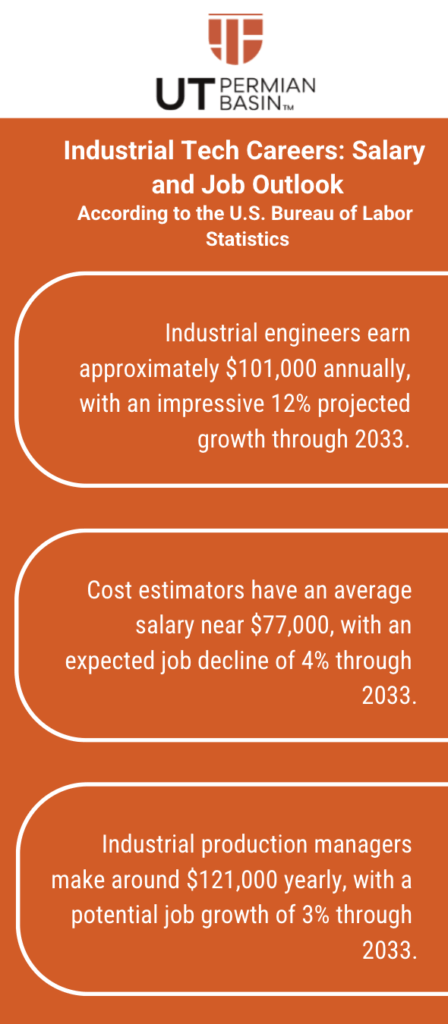
There were 336,600 industrial engineering jobs in the United States in 2023, and there will soon be many more. According to the U.S. Bureau of Labor Statistics (BLS), industrial engineering positions are expected to grow by over 12% over the next decade. For their cost- and time-saving talents, industrial engineers can expect an average annual salary of about $101,000.
#2 Cost Estimators
Cost estimators estimate the money, materials, and manpower needed to complete a project. Although this skill proves valuable in manufacturing industries, cost estimators are most often employed in construction, an industry known for slim profit margins and a need for efficiency.
Cost estimators make about $77,000 a year, but that varies depending on your level of experience and the industry you work in. There were 227,900 cost estimator jobs in the United States in 2023.
While cost estimators have traditionally played a key role in industries like construction and manufacturing, the field is seeing a projected decline of 4% in total jobs through 2033. This shift is largely due to advancements in software and automation, which allow companies to perform more accurate cost analyses with fewer employees.
So, what does this mean for you? There’s still demand for skilled cost estimators, especially those with expertise in digital tools like CAD and cost management software. If you’re tech-savvy and comfortable working across teams, you can still carve out a successful niche with the understanding that competition may be a little more fierce than in the past.
#3 Industrial Production Managers
Industrial production managers oversee the day-to-day operations of manufacturing plants and hold one of the highest-paid positions a BSIT graduate can obtain, earning an average annual salary of about $121,000. There were 230,100 industrial production manager jobs in the United States in 2023.
Employment for this position is expected to grow over the next decade, but only marginally, so competition will remain fierce. You’ll need experience and education to stand out from the crowd in a field like this, which is why earning your BSIT is so important.
Choose From a Number of Exciting Career Fields
Industrial technologists are employed in a wide range of fields. So many, in fact, that you’ll likely have your choice of professional settings when you pursue your new career. There will always be a home for industrial technology graduates in manufacturing industries, but other fields have also been known to hire industrial technologists, like:
Hospitals
Engineering firms
Pharmaceutical companies
Government agencies
Using the careers listed above as examples, we know that cost estimators most often end up employed in the construction industry, while industrial engineers have a bit more freedom thanks to their versatile skill set.
As a graduate of UT Permian Basin’s BSIT program, you’ll be ready for opportunities in any number of exciting industries, including:
Utility
Transportation
Food processing
Computer and electronic product manufacturing
Industrial engineers also offer professional, scientific, and technical services, which means you could one day be earning a six-figure industrial technology salary as a consultant.
Industrial production managers, although more closely tied to manufacturing industries, still have an incredible amount of freedom when it comes to choosing where to work. According to the BLS, industrial production managers worked in the following top industries:
Chemical manufacturing
Transportation equipment manufacturing
Machinery manufacturing
Food manufacturing
Fabricated metal product manufacturing
The job outlook for industrial technology majors is promising, but we’ve yet to discuss an even more important career outlook: your own.
Your Career Path Starts at UT Permian Basin
As an industrial technology graduate, you’ll have a skill set that will serve you well no matter what industry you end up in. Furthermore, once employed, there’s nothing stopping you from moving from one industry to another as opportunities present themselves.
The career path you take may be linear, or it may be winding, with numerous rewarding detours. No matter where successful industrial technologists end up on their career path, their start is the same: a reputable degree in industrial technology.
A BSIT from UT Permian Basin can prepare you for a rewarding career as an industrial technologist by providing the technical and scientific skills needed to thrive in your chosen profession. UT Permian Basin’s online BSIT program can teach you how to:
Use computer-aided drafting (CAD) software: a necessary skill for cost estimators
Develop integrative systems for industrial and commercial establishments
Manage project constraints, such as time, money, and resources
Our program will also teach you the fundamental concepts of management, including principles of administration, leadership, and decision making. We offer flexible 8-week courses in a 100% online format with six start dates a year. You can pay for tuition can by the course, and financial aid is available. Click here to request more information.
Ready to Earn Your BSIT?
Professionals educated in the use of engineering and manufacturing technology are highly sought after and will remain so for years to come. They continue to report high job satisfaction and populate some of the top-paying jobs in their industries.
These benefits, however, are exactly what makes industrial technology such a competitive industry. You get out what you put in, and only professionals with the right levels of education, experience, and work ethic will earn those high-paying, rewarding positions. If you’re ready to start on this career path and see where your hard work takes you, apply for UT Permian Basin’s online BSIT program. Your career outlook is as bright as you make it.
Ever check the tag on a t-shirt or appliance and see “Made in China” or “Made in Mexico”? Soon, you may be seeing more tags labeled “Made in the USA.” Today, there’s a reshoring trend that’s reopening factories, strengthening American manufacturing, and creating new opportunities for businesses and workers. As more companies move toward domestic…
Ransomware, phishing, viruses: If it’s connected to the internet, someone’s probably trying to hack it. Threats are everywhere in today’s digital world, and now that factories run on smart technology, it’s not just laptops at risk. Industry 4.0 has moved manufacturing from traditional methods to smart, automated systems (think robots and sensors on the factory…
Imagine a factory where machines, robots, and sensors are all talking to each other, like nerves sending signals to a brain. Before a human notices anything, the system’s already flagged a motor that’s starting to lag and adjusted a product’s assembly in seconds. This is connected manufacturing in action. Today’s smart factories run on connected…
Businesses concerned only with short-term goals overcome immediate challenges but fail to prevent their recurrence. Alternatively, businesses with only long-term goals may not last long enough to see them reached. Finding an adaptable middle ground between these two attitudes is a balancing act that senior financial analysts, finance managers, investment bankers, and other professionals must perform when making a financial plan.
Professionals capable of finding the balance between optimism and realism are compensated handsomely for their expertise and efforts: financial managers make a median yearly salary of $161,700. As we discuss how to balance long-term and short-term financial planning, a valuable skill in virtually any field, consider where a career in finance could take you. Earning a Master of Business Administration (MBA) with a concentration in finance could lead to your next big career move.
How Can You Build a Strong Foundation With Short-Term Financial Goals?
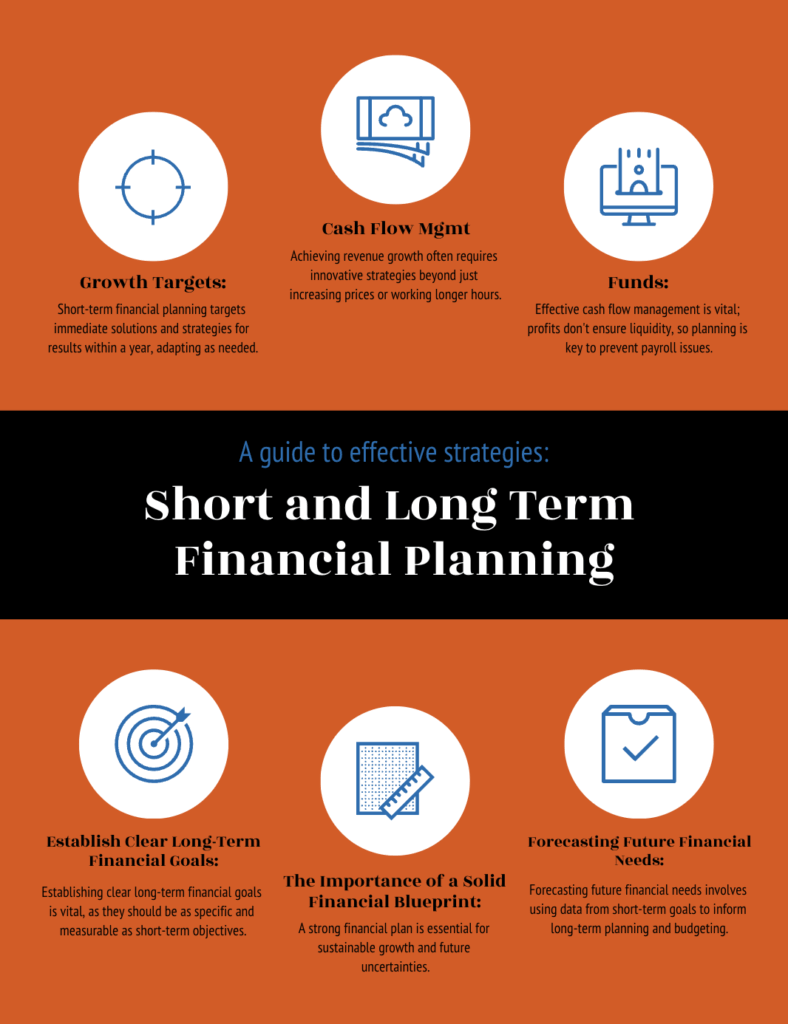
Short-term financial planning is about solving immediate problems and developing strategies that will lead to results, usually within one year. Short-term goals should be achievable and adaptable to emerging circumstances. Let’s take a look at several common short-term goals and see how they translate into long-term success.
Reach Revenue Targets
Increasing revenue by the end of the fiscal year is a common goal for financial professionals, but accomplishing this task is not as simple as charging more for products or services, having employees work longer hours, or taking unnecessary risks—especially if you hope to establish sustainable business practices. Incorporating more forward-thinking strategies, such as broadening your audience or recruiting a loyal workforce, can ensure that your immediate fiscal growth continues into the future.
Resolve Cash Flow Issues
Cash flow issues are not automatically resolved when a company turns a profit. Business leaders who fail to account for how cash flows in and out of their company could experience record profits one month and payroll issues the next.
Balancing long-term and short-term financial planning means more than just surviving from month to month. A strong financial plan will ensure that there are always enough cash reserves, especially during times of economic uncertainty, by budgeting for expenses accordingly.
Choose the Ideal Business Structure
From mom-and-pop stores to large corporations, every business needs to be properly structured. According to the U.S. Small Business Administration, “[t]he business structure you choose influences everything from day-to-day operations, to taxes, to how much of your personal assets are at risk.”
Choosing the ideal structure for a business means saving money in the present and setting a company up for success in the future.
Find Sources of Funding
The axiom “it takes money to make money” will stay with you throughout your career in finance. Whether it’s a loan or investment, finding a reliable source of funding is often necessary to get a venture off the ground.
Still, there’s no need to think of this as a necessary evil. Countless business partnerships have been born from these arrangements and are often instrumental in ensuring a company’s long-term success.
Long-Term Financial Planning
Once short-term goals have been established, it’s time to create a five- or ten-year plan that will see your company’s mission realized. Where will your company be in a decade? It’s okay if you don’t have the answer to that question just yet. That’s what long-term financial planning is for.
What Is Long-Term Financial Planning?
According to the Government Finance Officers Association (GFOA), long-term financial planning is “the process of projecting revenues and expenditures over a long-term period, using assumptions about economic conditions, future spending scenarios, and other salient variables.” Although the GFOA deals with government agencies, the principles of their long-term financial planning definition apply to businesses as well. Essentially, financial professionals are meteorologists who forecast budgetary needs instead of the weather.
How Do You Achieve Effective Long-Term Financial Planning?
To plan for these needs effectively, businesses should have SMART long-term financial goals. As outlined in Forbes, SMART stands for: specific, measurable, attainable, relevant, and time-bound. It may be tempting to keep a long-term financial goal broad—remain profitable, for example—but your long-term goals should be as well defined as your short-term goals.
For instance, if your company has a short-term goal to generate $1,000,000 in net income in one year, you may also want to consider a long-term five-year goal of generating $5,000,000 in net income annually.
To achieve these long-term goals, you’ll need a financial plan that includes the following elements:
Income statement: a statement used to determine profits and losses in a fiscal quarter or year.
Cash flow projection: a prediction of how cash is expected to flow in and out of a business.
Balance sheet: a summary of a business’s assets, liabilities, and equity.
How Do Short-Term Goals Inform Long-Term Financial Planning?
You can gather the data and insights needed for a long-term financial plan by building on the processes established through your short-term goals. The lessons learned in a single fiscal year help shape projections, inform strategic decisions, and strengthen your path toward long-term success. While balancing optimism and realism is still key, integrating both short- and long-term goals into your overall financial plan ensures your business is positioned for sustainable growth.
Plan for Your Future
Long-term and short-term financial planning are two sides of the same coin. You can’t plan for the future without considering current needs. Similarly, you can’t plan for a lifelong career in finance without first considering your immediate next steps. Before enrolling at UT Permian Basin, all of the students in our online MBA program with a concentration in finance had to consider this very dilemma, and they all arrived at the same conclusion.
An MBA is a versatile degree with almost limitless potential, and an MBA with a concentration in finance will only make you a more viable candidate for lucrative positions. If you’re looking to establish a career in finance or advance at your current company, our program can help you get there. At The University of Texas Permian Basin, you will:
Learn to analyze and interpret financial information.
Explore multiple aspects of investment, economics, and accounting.
Nurture your business acumen and leadership skills.
Many of our students already have established careers and demanding schedules. Fortunately, our MBA in finance program is 100% online and can be completed in as little as 15 months, which means you can continue working while pursuing your education. If your personal long-term goal is to rise through the ranks and obtain a high-paying paying position in the field of your choice, an MBA with a concentration in finance can help you achieve it.
Financial planning for millennials isn’t about hitting milestones on the same timeline our parents did. If that were the standard, a large percentage of us would already feel behind. Instead, it’s about understanding your money, making informed decisions, and building stability in a changing economy. If that already feels refreshing, good. Because many millennials are managing student loans, rising living costs, career…
Ever opened your bank account and thought: “How do I have another bill due already?” You’re not alone. Financial stress affects 61% of adults ages 18 to 35, whether it’s from: Gen Z has been through a lot—from the COVID pandemic’s economic impact to inflation and job uncertainty. That’s why smart financial planning matters more…
Imagine sending money across the world in seconds—without waiting for a bank transfer or filling out piles of forms. That’s the promise of cryptocurrency. Cryptocurrency is digital money that doesn’t require banks. Instead, your funds are secured by encryption and passwords only you control. When Bitcoin launched in 2009, it introduced a new way to…
If you’re considering a Bachelor of Business Administration (BBA), you’re likely aiming for a leadership role in the world of business. But with so many directions to choose from, picking the right focus can feel overwhelming. That’s where a BBA in management comes in. This versatile degree is designed to equip you with the communication, strategy, and leadership skills that today’s employers value most.
At The University of Texas Permian Basin, our online BBA in management program is built to prepare you for a wide range of career opportunities, from managing people and projects to launching your own business. Whether you’re drawn to HR, marketing, or entrepreneurship, your journey starts here.
Let’s explore seven rewarding—and often well-paid—careers you can pursue with a BBA in management.
1. Human Resources Manager
The duties of a human resource (HR) manager extend far beyond administrative tasks. HR managers, along with the HR department they oversee, help shape the culture, practices, and policies at their companies.As an HR manager, you’ll wear a number of hats, but your main duty will be to foster communication between a company and its employees.
Our online BBA in management program can prepare you for this role through classes like Business and the Law and Human Resource Management, which covers such topics such as:
Recruiting
Employee relations
Health and safety
Human resources managers made a median annual salary of $140,030 in 2024 per the Bureau of Labor Statistics (BLS). If empathy and communication are among your professional strong suits, this is the role for you.
2. Marketing Manager
A career as a marketing manager is perfect for graduates who would like to continue to express their creativity in BBA management jobs. Marketing managers work with internal teams to implement marketing initiatives, whether that means kicking off a new advertising campaign or crafting click-worthy emails.They may switch between multiple platforms, or they may specialize in one area of marketing, such as social media marketing.
At UT Permian Basin, classes like Principles of Marketing teach students the fundamentals they need to excel in this role. Marketing managers made a median annual salary of $159,660 in 2024, proving that satisfying and high-paying roles are not mutually exclusive.
3. Sales Manager
This career is for the closers. Sales managers promote products and services while engaging in a more direct relationship with customers than marketing managers. They work to understand customer preferences, attract new customers, and resolve customer concerns. Sales managers must also possess hard skills, like:
Analyzing sales statistics
Predicting trends
Setting sales goals
Depending on the size of the organization, sales managers may oversee a single team or a network of sales managers with teams of their own. Whether sales managers specialize in business to business (B2B) or business to consumer (B2C), their skills are highly valued in BBA jobs. According to the BLS, sales managers made a median salary of $138,060 in 2024.
4. Account Manager
Once a sale is made, an account manager is often there to take up the baton. Account managers are the point of contact for a client, passing along goals, rules, and expectations to the rest of their team and ensuring that they are met.
Communication is essential for this position, which is why we make it a priority in our program. Business Communications is an upper-level course covering basic interpersonal communication, including composing, editing, and revising business-related communications. Entry-level salaries for this position are about $71,000 a year; however, account managers can go on to make well over $100,000 a year
5. Analyst
Business analyst, data analyst, market research analyst, financial analyst—take your pick. Thanks to classes like Computers and Problem Solving, graduates of our program possess the problem-solving skills needed to succeed in any of these BBA jobs.
Analysts look at data to devise ways to improve businesses’ processes and systems. They are often called upon to initiate change without losing sight of a business’s overall goals. For example, financial analysts might assist companies with investments while being mindful of risk and potential losses—a valued skill that nets financial analysts an average annual salary of $101,910.
Individuals wishing to continue their education in finance can earn a Master of Business Administration with a concentration in finance. Like our BBA in management program, this program is flexible, 100% online, and accredited by the Association to Advance Collegiate Schools of Business (AACSB).
6. Project Manager
Although their job duties will depend on their chosen industry—law, healthcare, construction and engineering, information technology—project managers are responsible for planning, initiating, and overseeing specific projects. This means considering a number of resources, including time and money.
Production Operations Management is an upper-level core course in our online program that can prepare students for this exciting position by teaching them fundamental concepts of management, including:
Principles of administration
Modern organizational theory
Goal setting
Leadership and decision-making
According to the Project Management Institute, there will be an average of 213,974 newly created positions each year through 2027 in project-management-oriented industries in the U.S. In addition to being in demand, project managers are well compensated, making just over $90,000 a year. Project managers can go on to earn even higher salaries as program managers and portfolio managers.
7. Entrepreneur
One of the major appeals of our online BBA in management program is the access it provides to flexible career paths. Many graduates of our program decide to forge their own career paths by starting small businesses.
UT Permian Basin’s online BBA in management program can prepare you to step into a leadership role by teaching you how to:
Apply operational theory and business ethics in a real-world setting
Develop effective oral and written communication skills
Employ best practices in business management, accounting, and finance
Utilize information technology to inform decision-making
U.S. small business owners make about $70,000 a year, but how much you pay yourself is entirely up to you. This is one of the most important decisions you will face as a business owner. What’s right for you, and what’s right for your business? This is just one of the many questions you’ll be prepared to address as a graduate of our program.
Discover a Career Path That Can Take You Anywhere
If you’re interested in developing the leadership, communication, and management skills needed to succeed in BBA management jobs, our online BBA in management program is for you. Our program is AACSB accredited and 100% online. Earn your degree while prioritizing your personal and professional life. Apply now for an online program as flexible as your future career path.
If you’re considering a Bachelor of Business Administration (BBA), you’re likely aiming for a leadership role in the world of business. But with so many directions to choose from, picking the right focus can feel overwhelming. That’s where a BBA in management comes in. This versatile degree is designed to equip you with the communication,…
“It’s a beautiful summer day …” your star employee says as they stare longingly out the window. And chances are, they’re not the only one. Summer tests even the strongest teams. As the dog days hit, bloggers and journalists love citing a 2012 survey claiming that productivity drops a massive 20% during the summer. But…
What makes a good manager? Whether you lead one or a hundred employees, the expertise and tone you bring to the workplace determines the success and happiness of your team. In recent times, leadership roles have changed: The COVID pandemic and the rise of remote work have created unique situations requiring managers to possess more…
A bachelor’s degree in industrial technology is an undergraduate degree that prepares students for technical and leadership roles in industries like manufacturing, construction, and engineering. Students in these programs learn how to improve processes, solve operational problems, and support the systems that help organizations run more efficiently.
At many schools, including The University of Texas Permian Basin, industrial technology programs also help students prepare for leadership roles in technical workplaces.
What Do You Learn in a Bachelor’s in Industrial Technology Program?
A bachelor’s degree in industrial technology usually covers technical processes, problem-solving, communication, and management concepts. Students in industrial technology programs often study engineering and manufacturing principles as well as workplace skills that support leadership and project coordination.
Common areas of study include:
Engineering graphics
Statistics
Project management
Human resources
Computer-aided drafting
Is Industrial Technology the Same as Engineering?
The short answer is no. UTPB’s online BSIT program is offered by the College of Business and is one of a select group of programs in the nation accredited by the Association to Advance Collegiate Schools of Business (AACSB).
Industrial technology degrees are, however, incredibly versatile and can lead to an exciting career in engineering, if that’s the path you choose.
UT Permian Basin’s online program takes 120 credit hours to complete, including 38 credit hours of industrial technology core courses, 37 credit hours of electives, and a 3-credit-hour internship. Students in our program are taught:
Engineering and manufacturing principles
Creativity and problem solving
Oral and written communication
Management concepts
What Can I Do With a Diploma in Industrial Technology?
There are few industries untouched by engineering or manufacturing, so what you decide to do with your degree is truly up to you. Many industrial technologists find lucrative careers in the manufacturing industry, where a talent for improving production processes is often rewarded with a six-figure salary.
However, many graduates have gone on to industrial technology careers relating to:
Healthcare
Construction
Government
How Flexible Is UTPB’s Online Industrial Technology Program?
Unlike a traditional four-year degree, you can earn this industrial technology degree on your own time. Many students in our program have established careers they’d like to advance within and are looking for a program that can adapt to their work schedule.
Rest assured, our program is 100% online and utilizes a flexible 8-week course model. As long as you have a Wi-Fi connection, a seat somewhere cozy, and a warm cup of coffee (or tea!), you can complete our program at your leisure.
What Courses Do Industrial Technology Students Take?
Core courses like Engineering Graphics, Computers & Problem Solving, and Principles of Statistics provide the technical skills you’ll need in virtually any industrial technology job.
The use of computer-aided drafting (CAD) software is a particularly useful skill we teach. And courses like Project Management, Management Concepts and Organizational Theory, and Human Resource Management provide the soft skills you’ll need for leadership roles.
What Are the Admission Requirements for UTPB’s Industrial Technology Program?
Transfer students (students with 24 credit hours or more from regionally accredited colleges or universities) can transfer up to 90 credit hours towards an industrial technology degree. In addition to submitting student records, freshman and transfer students must:
Have a 2.0 cumulative grade point average or better
Be in good academic and disciplinary standing with previously attended colleges or universities
Even if you don’t meet the minimum grade point average required for the program, you can still be conditionally admitted to UT Permian Basin, so long as you complete 30 credit hours while keeping at least a 2.0 grade point average. At UT Permian Basin, we believe a low GPA shouldn’t automatically bar you from a first-rate education.
Shape Your Own Education Around Your Career Goals
UT Permian Basin’s online BSIT program gives students room to shape their studies around their interests. For example, students interested in petroleum technology can choose electives such as Petroleum Fundamentals, Drilling Technology, Petroleum Production Technology, and Pipeline Technology.
Students interested in other paths can explore courses like Manufacturing Technology or Construction Technology. Because industrial technology applies to a wide range of industries, the degree can support different career goals depending on your background and interests.
Earn Your Bachelor’s Degree in Industrial Technology Online
UT Permian Basin’s 100% online BSIT program was designed for students who need flexibility while building technical and leadership skills. With 8-week courses and six start dates each year, the program can fit around your unique work and other responsibilities.
Ever check the tag on a t-shirt or appliance and see “Made in China” or “Made in Mexico”? Soon, you may be seeing more tags labeled “Made in the USA.” Today, there’s a reshoring trend that’s reopening factories, strengthening American manufacturing, and creating new opportunities for businesses and workers. As more companies move toward domestic…
Ransomware, phishing, viruses: If it’s connected to the internet, someone’s probably trying to hack it. Threats are everywhere in today’s digital world, and now that factories run on smart technology, it’s not just laptops at risk. Industry 4.0 has moved manufacturing from traditional methods to smart, automated systems (think robots and sensors on the factory…
Imagine a factory where machines, robots, and sensors are all talking to each other, like nerves sending signals to a brain. Before a human notices anything, the system’s already flagged a motor that’s starting to lag and adjusted a product’s assembly in seconds. This is connected manufacturing in action. Today’s smart factories run on connected…
A Master of Business Administration (MBA) can provide you with the education and skills needed to obtain a C-suite job or strike out on your own as an entrepreneur. Despite these benefits, many individuals—especially those with a mind for business—may have concerns about whether the time and cost required to earn a degree is an investment worth making. Is an MBA really worth it?
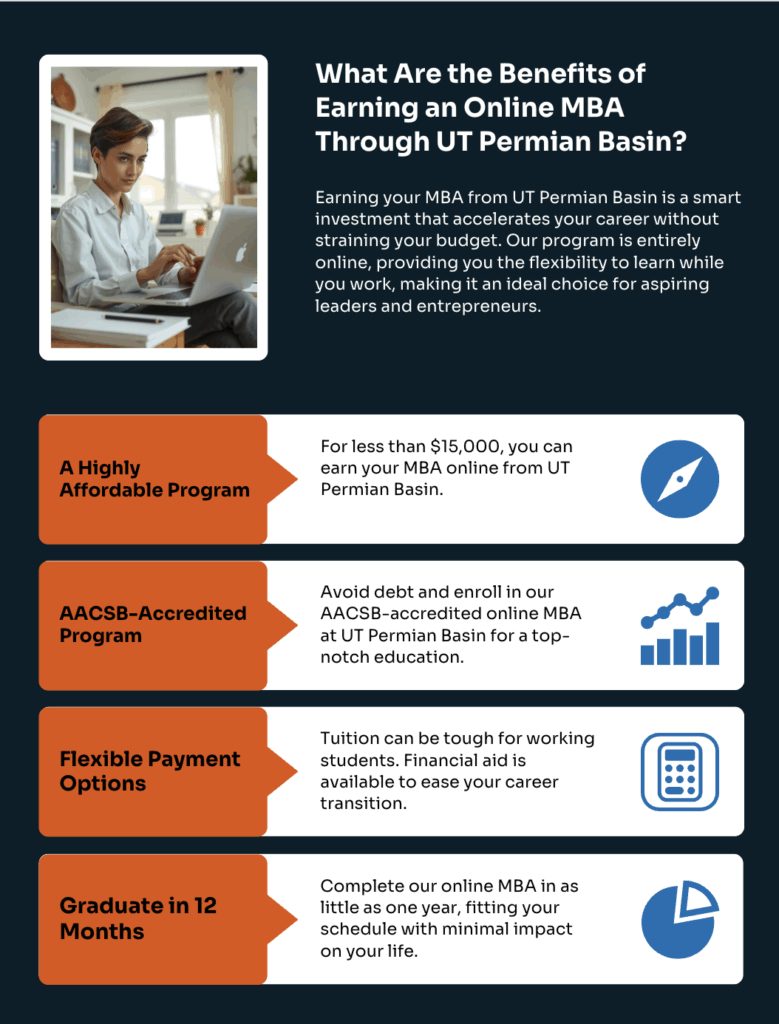
Absolutely! The University of Texas Permian Basin’s MBA program is 100% online, costs less than $15,000 to complete, and can be completed in as little as 12 months. Although we can’t decide for you, this article will provide some helpful information regarding tuition, financial aid, accreditation, and the coursework you can expect in our convenient online program.
If you’re interested in earning an online MBA, you’ll be hard-pressed to find a more affordable, rewarding learning experience in West Texas than the one offered by UT Permian Basin.
What Are the Benefits of Earning an Online MBA Through UT Permian Basin?
Earning your MBA is a big investment, but it doesn’t have to break the bank or take years to complete. UT Permian Basin’s online MBA program is designed to be both affordable and accelerated, helping you take your career to the next level on a timeline and budget that works for you. Whether you’re aiming for a leadership role or looking to launch your own business, our flexible, 100% online MBA program provides the skills and knowledge to make it happen.
A Highly Affordable Program
If you’ve already earned an undergraduate business degree, you can complete UT Permian Basin’s online MBA program with just 30 credit hours, or 27 credit hours of required courses and 3 credit hours of electives. The total tuition for students with an undergraduate business degree is $10,080 ($336 per credit hour). If you have an undergraduate degree in a non-business discipline, you can complete the program in 36 credit hours. Your total tuition will still only be $12,096: a fraction of what you would pay in other MBA programs.
As reported by Forbes, some MBA programs now cost more than $200,000. Although a majority of graduates surveyed in the Forbes article found their programs personally and professionally rewarding, it’s no surprise that only 68% found their programs to be financially rewarding. A $200,000 degree alone does not guarantee success, nor does it help counter the lost wages and personal sacrifices that students in less flexible MBA programs must sometimes make to continue their education.
AACSB-Accredited for Global Recognition
Instead of putting yourself in tens of thousands of dollars in debt, why not apply for our online MBA program and receive an education unparalleled in West Texas? UT Permian Basin’s College of Business is one of a select few business programs in the nation to be accredited by the Association to Advance Collegiate Schools of Business (AACSB). Only 5% of business programs in the world can make that claim. At UT Permian Basin, not only will you have the opportunity to continue your education at an affordable price, but you’ll also be given a caliber of instruction that few other institutions can provide.
Financial Aid and Payment Flexibility
We understand that any tuition amount, no matter how affordable, can be a burden on students. Many of our students are working professionals with responsibilities they must attend to while continuing their education, and others are recent undergraduates hesitant to commit to a graduate program. If you’re concerned with the cost of earning your degree from UT Permian Basin’s online MBA program, we encourage you to contact our financial aid counselor at finaid@utpb.edu to discuss your options. Financial aid, including grants, scholarships, and loans, can help cover tuition costs and ease your transition into a rewarding career as a marketing manager, financial manager, business operations manager, or owner of your own company.
Accelerated Timeline: Graduate in As Little as 12 Months
It takes 30-36 credit hours to complete our online MBA program, but how much time will you need to actually invest? Our online MBA program can be completed in as little as one year.
Our flexible 8-week courses offer six start dates a year, which means that by next year, you could be graduating with a master’s degree, having only minimally impacted your professional and personal life. Our program is so fast, in fact, that it is ranked among “The 50 Fastest Accelerated MBA Degree Programs” by MBA Central.
Invest in Your Future
Our online MBA program provides students with the performance-based knowledge and critical-thinking skills needed to excel as a business executive. Whether you’re looking to advance at your current company, venture into a new field, or start a business of your own, you will be prepared to step into a leadership role. Through our online MBA program, you will be able to:
Apply financial, accounting, economic, and marketing concepts.
Integrate business functions into complex organizations.
Apply your knowledge in a variety of professional fields.
You’ll be receiving an education of the highest caliber in our affordable online program. Core courses are taught by the very same on-campus faculty who provide students with a solid foundation on which to build their careers. In these core classes, you’ll learn alongside other emerging professionals who could one day be invaluable contacts. Core courses include:
Accounting Analysis
Financial Management
Production & Operation Management
Organizational Behavior
Marketing Management
UT Permian Basin also offers an MBA with an Accounting Emphasis program and an online MBA with a Concentration in Finance program for anyone looking to expand their competencies in financial management. Like the UT Permian Basin MBA program, the MBA finance program is affordable, AACSB-accredited, and 100% online. No matter what program you choose, you’ll be earning one of the most prestigious degrees in West Texas.
Secure Your Future Without Compromising Your Present
At UT Permian Basin, we believe that financial concerns should not bar students, especially working professionals, from earning a degree that can open doors to a number of exciting careers. That’s why we’ve made it possible for you to earn an affordable, accelerated, AACSB-accredited MBA program online and receive an education that meets, if not surpasses, the quality of education found elsewhere in West Texas.
You can request more information if you’d like to learn more about our online MBA program, or apply now if you’re ready to take the next step in your education and, ultimately, your career. By next year, you could be a graduate of UT Permian Basin’s online MBA program, equipped with a new set of tools and talents to turn heads in your chosen career field.
Most MBA graduates don’t end up in the C-suite by accident. They got there because of decisions they made long before they reached it, starting with the first one. A Master of Business Administration looks great on a resume, but it also gives you something more lasting: a strong foundation that evolves with you, from your first post-graduate role all the…
Entrepreneurship can take many forms. Sometimes, it looks like building software companies from scratch; other times, it involves reshaping an entire culture, changing how we experience entertainment, or turning one big idea into a brand that ends up everywhere. Black entrepreneurs have been doing all of that for decades. From media and tech to sports…
Meetings. Emails. Last-minute requests. Some days, it feels impossible to knock anything off the to-do list. If this sounds like you, you might be in need of some time management tips and tricks. Time management is a skill like any other, and it can be honed with practice and patience. We’re here to show you…