The challenge? Digital crimes don’t happen in plain sight. They’re hidden in code, encrypted networks, and anonymous online spaces. For National Cybersecurity Awareness Month, let’s investigate how law enforcement is adapting to win the battle against cybercrime.
Modern Cybersecurity Tools in Law Enforcement
Law enforcement’s toolkit for fighting cybercrime is expanding. Agents now have access to a range of powerful, sophisticated technologies for their investigations:
Digital Footprints Every online action leaves a trace. Though cybercriminals try to cover their tracks, law enforcement can often use these digital breadcrumbs to track them down. In a ransomware attack, for example, the attacker may leave bits of identifying code that reveal the location of the server used.
AI Pattern Recognition Machine learning algorithms can flagsuspicious patterns in massive datasets that humans would easily miss. Let’s say a financial institution’s AI tools notice unusual patterns in wire transfers—amounts, locations, times of day. Its cybersecurity team could then jump into action, tracing the source back to a cybercrime forum and contacting the FBI to launch an investigation.
Blockchain Analysis Many cybercriminals on the darknet prefer cryptocurrency. But law enforcement can track these transactions through blockchain records.
Imagine that someone’s using digital currency to buy illegal drugs. Specialized software might reveal information on the transaction from the blockchain’s immutable ledger. Once investigators identify the darknet drug market, they can trace specific purchases back to an individual.
Enhanced Forensics AI-powered facial recognition tools quickly analyze video and photo evidence, helping investigators identify known cybercriminals.
So, if part of a suspect’s face appears in a video posted online, image enhancement tools can reconstruct the rest of the face. When that complete image is run through a facial recognition system against mug shots, international watchlists, and passport databases, law enforcement can target a suspect.
Cybersecurity Training for Law Enforcement
Modern law enforcement personnel must be able to stop threats like malware, ransomware, viruses, Trojans, and phishing quickly and effectively. In addition to traditional training focused on physical crimes, today’s officers need to understand:
Officers and agents aren’t the only ones leveling up their skills, though. Professionals from across the criminal justice spectrum are getting in on the act. The National Computer Forensics Institute (NCFI) offers them free digital forensics and cybercrime investigation training. Other resources offering similar training include:
FBI Cyber Investigator Certification Program (CICP)
Federal Law Enforcement Training Centers (FLETC)
SEARCH Cybercrime & Digital Forensics
Why Is Cybercrime So Hard to Fight?
Even with all these tools and partnerships, law enforcement faces serious challenges in their fight against resourceful, resilient cybercriminals. These outlaws hide their identities and locations using anonymization techniques and tools, from encryption to proxies to VPNs. Some use deepfakes to commit crimes disguised as other people.
Cybercriminals constantly switch tactics and technologies to stay ahead of the law—a cat and mouse game.
And that’s just the beginning:
Law enforcement must work around a slew of privacy laws, data protection regulations, and civil liberty concerns.
Cybercrime may cross international borders, and some countries aren’t helpful. That makes investigation, arrest, and prosecution much harder.
Many local law enforcement agencies simply don’t have cybercrime operations resources. Funding, trained personnel, and tools are often in short supply.
So, is the battle against cybercrime worth it? Absolutely! It’s not easy, but it’s possible and necessary. Cybercriminals adapt their tools and methods, and law enforcement must follow suit if they’re going to ensure public safety and privacy.
Frequently Asked Questions
Let’s look at the highlights of what we’ve discussed.
How big of a problem is cybercrime? Microsoft says its users experience about 600 million cyberattacks every day. That’s more than 6,900 incidents per second!
How is law enforcement combatting these attacks? Agencies worldwide are using sophisticated tools and training to recognize and respond to attacks and intrusions. Many are pushing for new policies, protocols, and partnerships to consolidate their efforts.
What challenges does law enforcement face in the fight against cybercrime? Cybercriminals change tactics regularly, often before law enforcement can adapt. They also use many tools to disguise their identities and location. Law enforcement must navigate resource limitations and other restrictions.
Earn a Criminal Justice Degree Online With Cybersecurity Experts
Despite the challenges they face, law enforcement is making real progress in the fight against cybercrime. Every successful takedown of a criminal network, prevented ransomware attack, and recovered stolen identity makes our digital world a little safer.
The key is staying adaptive. Criminals are constantly evolving their methods, so law enforcement must evolve faster. If you’re prepared to tackle cybercrime and whatever’s next in criminal justice, The University of Texas Permian Basin offers the flexible, convenient programs you need:
From firefighters and teachers to city planners and social workers, public servants play a quiet but essential role in keeping communities safe, healthy, and functioning. If you’ve ever ridden public transportation or even checked out a library book, you’ve benefited from public services. But what exactly are public services—and what kinds of careers exist in…
Laws are designed to protect people, organizations, and their property by codifying the “do’s and don’ts” of society. While many laws clearly state their purpose—at least to attorneys, who speak legalese—some are nebulous, confusing, counterintuitive, or otherwise open to (mis)interpretation. These are the “buts” to those “do’s and don’ts,” and we’ll be discussing them below….
While it may seem a majority of Americans rarely agree on anything, nearly all surveyed adults—a surprising 95%—believe that our criminal justice system and law enforcement need some degree of reform. Criminal justice reform, encompassing law enforcement, the courts, and corrections, touches upon several hot-button issues in the United States. Approaching this type of restructuring…
Remote work brings unique opportunities — and challenges. Issues with communication, technology, payroll, accountability, time differences, and morale can occur. On the other hand, it widens the talent pool and can boost savings, competitiveness, productivity, and sustainability.
Remote work is here to stay. So how do you make it work best for your team or business? Let’s look at the challenges of remote work — and the benefits that make those challenges worthwhile.
What Are the Challenges of Remote Work?
Managing remote teams isn’t always easy. Here are six of the biggest hurdles companies face.
Communication Problems It’s easy for colleagues to miss the message when they’re not in the same room. Body language fills in the gaps, but emails? Their tone is sometimes hard to decipher. Even video calls can fall short. Throw in cultural or language differences, and things get lost fast.
Technology Troubles Getting everyone up and running isn’t always easy — especially when remote work depends so heavily on reliable internet. Even in developed countries, rural areas can struggle with access issues.
Employees must have the right tools: computers, apps, and strong security features. IT can provide most of these remotely. Technical issues? Some problems still require a hands-on fix.
Payroll Challenges Will international employees be paid in their own currency or the company’s? Depending on exchange rates, some employees may not be happy with the arrangement.
Accountability Concerns Some managers struggle to oversee a team they can’t actually see every day. Remote work requires extra training, trust, and touchpoints.
Time Differences A manager in Hong Kong schedules a mandatory “all-hands” Zoom meeting for 3 p.m. For their New York crew, that’s 3 a.m. With 24 time zones, syncing up is no simple feat.
Employee Perceptions and Morale Concerns Some professionals hesitate to work remotely, believing it’ll make them less visible and hurt their chances of moving up. Even if the company’s just down the street, working from home can feel isolating. That disconnect can hurt morale and teamwork
What Are the Benefits of Remote Work?
With record numbers of professionals transitioning to work-from-home positions, it’s clear that remote work isn’t all challenges. It offers real benefits that smart companies are using to their advantage. Here are five benefits of adding remote work as an option for your employees.
Access to More Talent Worldwide Companies no longer need to limit themselves to local candidates. They can look across the country (and the world) to find the skills they’re looking for. Professionals also get a greater range of job opportunities — with no moving required.
Lower Costs Cutting out office space, furniture, and other expenses can shrink overhead for employers. And employees save money by skipping the commute and its costs.
Employee Benefits Remote work has a built-in benefit: flexibility. It gives people more control over their time — and that’s a huge advantage for any company offering it.
More Eco-Friendly Operations Employees working from home means fewer cars on the road. Companies can also save energy (and money) by having employees attend meetings virtually rather than flying them in.
Frequently Asked Questions
Still have questions about remote work? Here are answers to some common questions.
How common is remote work for Americans? About 22% of Americans are working remotely in 2025. Some companies are adding remote or hybrid work as an option or benefit, while others are bringing employees back to the office.
What are the challenges of remote work for companies? Remote work can create challenges with communication, technology, payroll, accountability, and employee morale. Teams struggle without face-to-face interaction, technology issues are harder to fix remotely, and managing payments across countries gets complicated.
What are the benefits of remote work for employers? Many! Employers offering remote positions can choose skilled workers from a global talent pool, save money on office-related costs, enjoy higher productivity, offer flexibility to attract candidates, and operate in an eco-friendlier way.
Earn an MBA With an International Business Concentration Online
Tap into the benefits and overcome any drawbacks of remote work as a global business team leader. The University of Texas Permian Basin‘s AACSB-accredited online MBA with international business concentration equips you with the expertise!
According to the World Health Organization, 99% of the global population breathes polluted air. Yet we’re surrounded by clean, sustainable energy sources. Despite coal and natural gas being the most widely used energy sources, the urgency of climate change and resource depletion is making the shift to clean energy increasingly essential. In 2023, about 23%…
Some of the best career growth strategies for BBA graduates are building experience intentionally, developing leadership habits early, and expanding your skills before you need them. That’s the blueprint. But here’s how it usually plays out. Most graduates start in roles like “marketing coordinator” or “financial analyst trainee.” That’s normal (and honestly, a good thing). Those early roles are where you…
Most MBA graduates don’t end up in the C-suite by accident. They got there because of decisions they made long before they reached it, starting with the first one. A Master of Business Administration looks great on a resume, but it also gives you something more lasting: a strong foundation that evolves with you, from your first post-graduate role all the…
Imagine a factory where machines, robots, and sensors are all talking to each other, like nerves sending signals to a brain. Before a human notices anything, the system’s already flagged a motor that’s starting to lag and adjusted a product’s assembly in seconds. This is connected manufacturing in action.
Today’s smart factories run on connected manufacturing, using real-time data, robotics, and artificial intelligence to make decisions, self-correct, and transform how we make products.
If this sparks your curiosity, you’re already thinking in terms of the future of manufacturing. But what exactly is connected manufacturing? And what’s coming next?
What Is Connected Manufacturing?
Connected manufacturing links machines and software into a real-time, data-sharing network. If you’re familiar with Industry 4.0—the shift from traditional manufacturing into intelligent production—then you’ve likely have heard of connected manufacturing.
In the United States, some factories use connected manufacturing to move closer to net-zeroemissions, meaning less pollution in our atmosphere. But connected manufacturing spans many industries. For example, a beauty brand in South Korea is currently testing connected kiosks to create made-to-order skincare.
How Connected Manufacturing Works Today
Connected manufacturing links every part of a production system. Here’s how it plays out on a factory floor:
IIoT (Industrial Internet of Things) sensorsact like a factory’s nervous system, tracking temperature, pressure, and movement with extreme accuracy.
This data flows into AI-assisted platforms, where algorithms sift through every pulse and signal, flagging issues like a motor showing early signs of failure.
On the floor, robotic arms, conveyors, and smart machines coordinate tasks while supervisors oversee everything digitally.
These kinds of smart factories are already operating in places like Tesla’s Gigafactories in California, where robotic systems produce electric vehicles with minimal human oversight.
The Future of Connected Manufacturing: What’s Next?
Let’s fast-forward a few years and take a look at how connected manufacturing will shape industries in the coming years.
“Lights Out” Manufacturing
Ever heard of a “dark factory”? These ultra-smart spaces (also called “lights out” factories) run with little to no human input, so there’s no need for lights. AI handles everything from quality checks to overnight software updates. A McKinsey study predicts they’ll be much more common by 2030, especially in electronics and automotive.
Humans still matter, however. With digital twins—virtual copies of factory systems—teams can test out changes before they go live. By 2027, nearly half of industries are expected to use them. In Japan, some factories already run 30 days straight … without a single person stepping inside.
Boeing’s smart factory in North Carolina shows what’s possible. For their 787 Dreamliners, they’ve created a system that uses robotics, cloud analytics, and even virtual reality. This hyperconnected technology cuts downtime, trims costs, and catches problems before they become expensive mistakes.
Intelligent Computing: The Tech Driving the Future
Ever run out of cloud storage trying to back up your phone? Now imagine a factory with that problem—except instead of photos, it’s real-time machine data. Industries can’t afford that delay, so they’re using intelligent computing. With private 5G networks and edge processors, factories can process data instantly, right where it’s generated, keeping everything from robot arms to conveyor belts running without issues.
The result? Less waste, fewer delays, and a much smaller environmental footprint.
Inside the Factories of Tomorrow
Picture a microfactory producing custom-fit prosthetics overnight based on a patient’s scan. In a few years, this may be reality.
Manufacturing is rapidly shifting from large factories to microsystems that work in real time, just in time to meet a growing demand for custom, personalized products. Intelligent machines and greener operations are moving us from a “one-size-fits-all” model to a future that’s personalized, aware, and adaptive.
The Big Picture: What We’ve Learned
Let’s recap what we’ve learned:
Connected manufacturing links machines, sensors, and data into a seamless, real-time decision-making network.
“Lights out” factories can use AI and robotics to operate with minimal human input.
Intelligent computing (like 5G and edge processors) increases efficiency and cuts downtime.
AI predicts problems, reducingwaste, improving sustainability, and keeping supply chains flexible for growing consumer demand.
Take Charge of the Future With a Degree in Industrial Technology
What if your job was to build and guide machines that can learn and adapt on their own?
Manufacturing is changing fast, and there’s room at the table for thinkers like you. A degree in industrial technology puts you at the heart of Industry 4.0 and connected manufacturing, preparing you with knowledge in AI, robotics, and systems thinking. It’ll set you apart in a quickly evolving field.
The University of Texas Permian Basin offers two entirely online IT programs:
BAAS in Industrial Technology Already have technical or vocational experience? This flexible path is unique within the UT System. It’s designed to help professionals or transfer students finish their degree faster.
With 100% online classes, you can learn on your own schedule from anywhere. Whether you’re starting or continuing your journey, UTPB provides the tools to get you there.
The future may run on machines, but it’ll be powered by minds like yours. Start building it now. Learn more at UTPB.
Ever check the tag on a t-shirt or appliance and see “Made in China” or “Made in Mexico”? Soon, you may be seeing more tags labeled “Made in the USA.” Today, there’s a reshoring trend that’s reopening factories, strengthening American manufacturing, and creating new opportunities for businesses and workers. As more companies move toward domestic…
Ransomware, phishing, viruses: If it’s connected to the internet, someone’s probably trying to hack it. Threats are everywhere in today’s digital world, and now that factories run on smart technology, it’s not just laptops at risk. Industry 4.0 has moved manufacturing from traditional methods to smart, automated systems (think robots and sensors on the factory…
Imagine a factory where machines, robots, and sensors are all talking to each other, like nerves sending signals to a brain. Before a human notices anything, the system’s already flagged a motor that’s starting to lag and adjusted a product’s assembly in seconds. This is connected manufacturing in action. Today’s smart factories run on connected…
Bilingualism can come in handy for travel, work, and personal conversations. But did you know bilingual brains function better and longer?
Bilingual people:
Have stronger focus, memory, and multitasking abilities
Begin cognitive decline later
Pick up new languages more easily
Are first-rate creative thinkers
Impressed yet?
Let’s explore the cognitive advantages of a bilingual brain.
Executive function, or executive control, is a fancy name for the brain’s higher-level skills, including:
Working memory
Planning
Decision-making
Behavior, emotion, and impulse control
Problem-solving
Flexibility (adaptation to change)
Goal-setting
The brain’s prefrontal cortex (PFC)—just behind the forehead—is its headquarters for executive function. Bilinguals use more of their brain, including the PFC, for language processing.
Bilingual children have higher executive function than their monolingual peers. Switching between two languages keeps the bilingual brain agile!
Better Creativity and Creative Thinking Skills
Bilingual children have been shown to have stronger creativity and creative thinking skills. Divergent thinking (considering different options) and cognitive flexibility (switching mental gears or juggling a few thoughts at once) are bilingualism fringe benefits.
If knowing two languages isn’t enough, bilinguals are in luck. A bilingual mind is already a multilingual mind and eager to take on more languages, says one study. Bilinguals may learn a new language faster than people who only speak one.
When someone learns a second language, their brain literally makes more room for it. Studies show bilingualism produces extra gray matter in parts of the brain that learn and process language.
What does all this tell us? Bilinguals are some pretty sharp people! Learning a second language has advantages far beyond navigating social, work, and travel conversations.
Frequently Asked Questions
Here’s what we’ve learned about bilingualism and its cognitive benefits.
What kind of cognitive benefits do bilingual people enjoy? Their memory, focus, and ability to anticipate what others are going to say are stronger overall. They’re also excellent multitaskers.
When bilingual people want to learn more languages, they have an easier time than people who only know one. And they often maintain their mental sharpness longer—even into their advanced years.
Are there other cognitive benefits? There are! People who know more than one language have better executive function. That’s a wide range of essential skills, including:
Teachers and educators have an incredible influence on their students, whose futures can depend on a teacher’s passion and persistence. Yet there exists a cohort of educators whose influence extends beyond the classroom walls. Armed with education degrees, these educators have harnessed their knowledge to shape policies, ignite change, and inspire students everywhere. Many have…
Because English language learners enter the classroom with different levels of English proficiency, educators often need to adjust instruction to meet students where they are. Teaching strategies such as differentiated instruction, scaffolding, culturally responsive teaching, and ongoing assessment can help students improve in several ways. Building their language skills? Absolutely. Having a better understanding of academic content and participating more…
Chances are you’re already a certified classroom teacher or well on your way to becoming one. So why go through the trouble of earning a master’s degree in bilingual/ESL (English as a second language) education? How about the chance to help a growing generation of students learn a new language that’ll increase their chance of…
September is National Literacy Month! To celebrate, we asked UT Permian Basin’s College of Education faculty to share their favorite books. You may find a few of your own favorites here, or discover something new and inspiring.
This is a book I often turn to when I don’t have much time but am looking for a little inspiration. Oliver, a Pulitzer Prize-winning poet, is one of my favorites—I admire her writing very much, and I relate to her love for the natural world.
“The Backyard Bird Chronicles” by Amy Tan
This was something a little different from Tan who has written several award-winning novels including “The Joy Luck Club.” “The Backyard Bird Chronicles,” also beautifully illustrated by the author, includes journal entries in which Tan teaches us how to pay attention to the beauty around us that is easy to overlook.
“The Kings of Big Spring: God, Oil, and One Family’s Search for the American Dream” by Bryan Mealer
Having moved to West Texas in 2019, I love exploring and learning about the area, and Big Spring is one of the places I’ve enjoyed visiting. This book [is] a combination of memoir and narrative history in which the author tells the story of four generations of his family and their search for the American Dream … right here in West Texas!
I have always been fascinated by the Roaring ‘20s, and this novel captures the glamour, ambition, and complexity of that era. It’s decadent and beautiful in a tragic way.
“Pride and Prejudice” by Jane Austen
This book is such a sharp and witty exploration of social class, gender, and personal growth. Even though it’s not a 20th century novel, it still feels relevant to me.
“Bridget Jones’s Diary” by Helen Fielding
The first time I read this book, I was in my 20s and laughed out loud so many times. I completely identified with Bridget—her relationships, navigating single life, and just trying to figure out life made her so relatable and real.
“The Women” by Kristin Hannah
I could not put this book down. It is an emotional, heartbreaking, and empowering story that really honors the contributions of women during the Vietnam War.
“From Here to the Great Unknown” by Lisa Marie Presley and Riley Keough
I have read this several times. I’m an Elvis fan and even though I was pretty young, I remember being in the car with my mother when the announcement came over the radio that Elvis died. I thought the book was a beautiful tribute to family, legacy, and memory and they did a great job blending personal histories with public legacy.
“Charlotte’s Web” has always captured my heart with its timeless story of friendship, loyalty, and selflessness, told through the sweet bond between a pig named Wilbur and the wise spider Charlotte. It’s a book that feels both comforting and profound, reminding me of the simple yet powerful lessons of kindness and sacrifice.
Any book by Freida McFadden
Freida McFadden’s books pull me into a completely different world—one full of psychological twists, dark secrets, and edge-of-your-seat suspense. I love how her writing keeps me guessing until the very last page, making her books impossible to put down.
Rod Uzat, PhD (Educational Leadership, Superintendent Certification)
“Democracy in America” by Alexis de Tocqueville
Written by a foreigner and largely viewed as an explanation of what made the Great Experiment of the American Republic work, this book should be required reading for every American. In it, the reader will come to understand that as far back as the mid-1830s, the unique characteristics that make up the American cultural fabric and explain the basis of people’s attitudes today towards government, work, community, and faith were already well rooted across the land.
“The Federalist Papers” by Alexander Hamilton, John Jay, and James Madison
A series of essays written by three of the most important players in the First Republic that explains the rationale for a great many of America’s legal and governmental principles, “The Federalist Papers” is another must-read for every American citizen. Most critical in this collection in the context of the other books I have recommended is Madison’s Federalist #10 and his writing on the importance of avoiding factionalism in American society. While factions were a natural and healthy part of the democratic process, when left unchecked, Madison argued they could “strangle freedom and destroy republics.”
“The Vanishing Neighbor: The Transformation of the American Community” by Marc Dunkleman
This is an object lesson in how the social and political conflict in America today represents a shift (via the Information and Social Media Age) from a society of townships … where Americans found common cause to a society of networks where Americans limit their communication to the societal factions they most strongly identify with.
This book has always been special for me because it was the first book that made me reflect about our own choices in the real world. It challenges readers to think deeply about conformity, freedom, and the cost of a perfectly controlled society.
Earn Career-Advancing Educator Credentials Online With Us
Books have the power to capture our imagination and inspire us. Pursue a role in education and help others achieve the same joy and understanding through literacy. UT Permian Basin has the online programs you need:
Summer break hits differently when you’ve been running on fumes since January. That first week is sacred. Your priorities are (in no particular order) sleeping in, ignoring all emails, and reacquainting yourself with your old friend, the couch. You’ve earned it. But once the dust settles, summer becomes something else: a rare window where you’re not just reacting. No lesson plans due, no…
Texas teachers, here’s the reality: More than half of all K-12 students in the state are Hispanic, and nearly a quarter are enrolled in bilingual/ESL programs. That translates to over a million students who needed specialized language support throughout the 2023-2024 school year. Districts are struggling to find enough certified bilingual and ESL teachers. A critical shortage for schools? Absolutely. But…
You’re sitting at your desk after dismissal. The room is quiet (for once), and somewhere between grading essays and planning tomorrow’s lesson, you hear it again in the hallway: “My students are using ChatGPT for schoolwork.” Suddenly, you’re wondering: Is this cheating? This is the real question around AI in education. And as this technology…
So, you’ve decided to take the next step in your career with a Master of Public Administration (MPA). You’re eyeing your next promotion, eager to lead, and one click away from applying—then reality hits: tuition, fees, books.
Your ambitions shouldn’t come with a heavy price tag, and the good news is, they don’t have to. Whether you’re mid-career, mission-driven, or ready to pivot into public service, there are practical, flexible ways to fund your online MPA without breaking the bank or burning out in the process.
Let’s break them down.
Are Graduate Students Eligible for Federal Student Aid?
Federal students aid isn’t just for undergraduates. You’re also eligible for federal grants, loans, and work-study programs as a graduate student. This includes direct unsubsidized loans, which come with fixed interest rates, flexible repayment plans, and no co-signer required.
To apply, submit your FAFSA form online and use The University of Texas Permian Basin’s school code: 009930. It’s free, fast, and the most logical first step—even if you’re not sure whether you’ll need a loan.
Pro tip: Submit your FAFSA as early as possible after the application window opens. This boosts your chances of getting the most financial support available.
What Scholarships Are Available for Online MPA Students?
Looking for scholarships? You have options. Scholarships for graduate students are out there—especially for those in government, policy, or nonprofit work. Two great places to start are UT Permian Basin’s Financial Aid and Scholarship pages.
If you’re in Texas, you may qualify for UTPB’s Graduate Studies Scholarship (GSS). From there, you can expand your search to national organizations like NASPAA or local community foundations.
Here are a few more scholarships to keep on your radar:
Once you’re admitted to UTPB, your program coordinator may send you a list of current scholarships to explore, so you won’t have to search alone.
Pro tip: When applying for scholarships, focus on what makes you stand out. Is it your leadership goals? Your commitment to public service?
Can Employer Tuition Assistance Help Pay for Your MPA?
Many employers want to invest in their team’s growth, and some employers will even help cover tuition costs. When you bring back real-world skills that help your team, agency or community, your education becomes an investment for your employer, too.
If you’re working in a public service, nonprofit or education role, check to see if your workplace offers tuition assistance, reimbursement, or professional development funds. Even if there isn’t a formal program, your supervisor or HR department may be open to supporting your education-especially if your new skills will benefit the organization.
Pro tip:Prepare a short proposal that explains how your MPA will help you contribute more to your team. Highlight the skills and knowledge you’ll gain and how they align with your company’s goals.
What Flexible Payment Options Are Available for Online MPA Students?
Worried that you can’t pay your tuition all at once? Don’t be. UT Permian Basin offers two payment plans to help you spread your tuition costs out over the semester:
UTPB 3 (for current students)
Falcon 4 (for new students)
Approvals are immediate, there are no interest rates, and this option is available year-round. Whenever you’re ready, just reach out—we’re here to help!
Pro Tip:Set up automatic payments for your tuition plan to avoid missed deadlines and late fees.
Recap: Your Questions Answered
Ready to pursue your online MPA? Let’s recap what we’ve discussed in this article:
Are graduate students eligible to submit the FAFSA for federal student aid? Yes! Graduate students are eligible for direct unsubsidized loans, among other federal student aid options.
Can my employer help fund my degree? Some will, especially if you work in public service, nonprofit fields, or education.
Are there scholarships for graduate students?
Absolutely. There are plenty, especially for those in government, policy or nonprofit sectors.
Does UTPB offer payment plans? Yes. UTPB offers flexible payment plans to split your tuition into smaller, more manageable payments.
The UTPB Advantage: Build a Future in Public Service, Your Way
Grow in leadership roles, such as in government or nonprofits.
Understand the ins and outs of policy, budgeting, and ethics from a public-sector point of view.
Advance your career without putting it on hold.
Looking for more support? We’ve got you! Don’t hesitate to reach out to finaid@utpb.edu with additional questions. We look forward to having you join the Falcon Family!
So, you’ve decided to take the next step in your career with a Master of Public Administration (MPA). You’re eyeing your next promotion, eager to lead, and one click away from applying—then reality hits: tuition, fees, books. Your ambitions shouldn’t come with a heavy price tag, and the good news is, they don’t have to….
Women have long been a driving force in public service, bringing fresh perspectives, transformative leadership, and a commitment to progress. As more women step into political and leadership roles, they are reshaping institutions, amplifying voices, and driving meaningful change. Their impact is undeniable—breaking barriers, challenging norms, and paving the way for a brighter future. Changing…
Anyone in a position of power can face ethical dilemmas. Effectively handling these challenges is central to maintaining a career and the respect of your employer—particularly when your employer is the tax-paying public, and you’re spending their money. Here we’ll discuss some of the ethical concerns public administrators may face. We’ll also provide some suggested…
We all want safer communities, right? Crime prevention can benefit our communities in countless ways, and stopping recidivism—repeat offenses—is a crucial part of that.
But how do we get there?
Restorative justice programs are helping people and neighborhoods heal while easing the strain on our overburdened criminal justice system. Let’s look at what these programs do to foster a safer, more just society.
What Are Restorative Justice Programs?
Restorative justice programs bring together offenders, victims, families, and community members to talk openly and find a way forward. The main goals are to:
Hold offenders accountable for their actions.
Develop a plan to make things right rather than focusing on traditional punishment.
Understand what led to the crime.
Reduce the chances of reoffending.
Support offenders as they get back on track.
Rebuild trust within the community.
These programs are usually run by community groups, nonprofits, victim support organizations, government agencies, or correctional facilities.
What Types of Restorative Justice Programs Are There?
Restorative justice programs come in many forms, each designed to address harm and support healing in different ways. Let’s break down the differences:
Victim Impact Panels
Victim impact panels give victims or their families a chance to relate how a crime has affected their lives. Offenders attend to listen and reflect, but they don’t interact directly with the victims. A moderator leads the panel to keep the tone civil.
Here’s what you can expect from a typical victim impact panel:
Panels usually include three or four victims.
Offenders and their victims don’t attend the same meetings.
Drunk driving victim impact panels are common.
Offenders may have to attend as part of their sentencing.
Victim Offender Mediation
Victim offender mediation (VOM) brings the victim and offender together in a private, safe setting. With trained mediators there to guide the conversation, both sides share their feelings about what happened and try to find some common ground.
Direct interaction with offenders allows victims to feel heard.
Community Reparative Boards
Community reparative boards (CRBs) are usually made up of volunteers and bring together victims, offenders, and community members. Offenders appear before these boards to accept responsibility for what they’ve done. Victims may attend or provide impact statements. The board then creates a restorative contract: a legal document laying out what happened, how the offender will make it right, and what positive changes they’ll make moving forward.
There are several benefits to using community reparative boards:
CRBs offer juvenile and nonviolent offenders a different path than the traditional justice system.
These boards promote community awareness about restorative justice.
CRBs can increase community involvement and healing.
Family Group Conferences
Think of this restorative justice approach as a formal “intervention.” Family group conferences bring together victims, offenders, families of both parties, and a trained facilitator. Everyone discusses how the crime affected them and how they can prevent it from happening again. The goal is to walk away with a reparative plan—a clear strategy for how the offender will make amends.
In a family group conference:
Family members help make sure the offender sticks to the plan.
Law enforcement attends to keep the peace.
Circle Sentencing
Circle sentencing is often practiced by Native American and other Indigenous communities. The victim and offender, their support networks, facilitators, and criminal justice representatives all attend. The group discusses their views about the crime and decides how the offender will make reparations.
Sessions continue until everyone agrees the offender is rehabilitated.
The offender “graduates” with a clean record.
Steps Offenders Take in Restorative Justice Programs
Restorative justice programs can deliver customized reparative plans or next steps for offenders, including:
Accepting responsibility and apologizing for their actions.
Promising to stay out of trouble.
Performing community service.
Paying restitution.
Reconciling with victims.
Getting a job.
Going to school (or back to school) and maintaining good grades.
Attending counseling.
Does Restorative Justice Discourage Repeat Offenders?
The statistics on restorative justice and recidivism are encouraging!
A review of 22 studies showed that offenders in restorative justice programs were 27% less likely to reoffend than those who went to jail or were put on probation. Another study showed that community-based restorative justice programs led to 12% fewer repeat offenses compared to a control group.
Does Restorative Justice Help Victims?
Even as restorative justice reduces repeat offenses among participants, it can also offer significant benefits to victims. Victims report feeling more empowered and validated by the restorative justice experience. This process can also offer a lifeline to those awaiting closure from a strained criminal justice system.
Frequently Asked Questions
Here’s what we’ve learned about restorative justice programs.
What is restorative justice? Restorative justice focuses on offenders taking responsibility and making things right, rather than simply facing punishment. It also helps communities heal, understand the causes of a crime, and feel safe again—while helping offenders turn their lives around and avoid reoffending.
What kinds of restorative justice programs are available? Programs range from group or family sessions to supervised conversations between victims and offenders. Some are tailored to certain populations, such as specific cultural groups or younger adults.
Do restorative justice programs reduce recidivism? Studies suggest that restorative justice programs may prevent reoffending better than traditional justice methods by double-digit percentages.
Are there other benefits to restorative justice programs? Some victims feel a greater sense of empowerment through restorative justice and may be able to get to a resolution quicker.
Make Your Own Impact in Criminal Justice With a Degree
You can impact so many lives for the better in a criminal justice career. The University of Texas Permian Basin will set you up for professional success with a degree:
Women represent about half of the U.S. population, but women in law enforcement make up only 13%: around 96,000 nationwide. This gap matters, especially given the impact women have on policing. Research into gender in policing shows that women officers are viewed by communities as more honest, compassionate, and trustworthy. When it comes to public…
Over 6,900 cyberattacks happen every second against Microsoft users alone. While it’s clear from that staggering number that criminals have gone digital, law enforcement is fighting back with new tools, training, and tactics. The challenge? Digital crimes don’t happen in plain sight. They’re hidden in code, encrypted networks, and anonymous online spaces. For National Cybersecurity…
We all want safer communities, right? Crime prevention can benefit our communities in countless ways, and stopping recidivism—repeat offenses—is a crucial part of that. But how do we get there? Restorative justice programs are helping people and neighborhoods heal while easing the strain on our overburdened criminal justice system. Let’s look at what these programs…
About 41 million people speak Spanish in the United States. Worldwide, that number jumps to 595 million. It’s the official language of 21 countries and territories across four continents.
How Can a Spanish Major Help Your Career?
Spanish language skills are certainly handy for social situations and travel. But more importantly, Spanish fluency and cultural understanding are internationally marketable career skills. You can gain both as a Spanish major.
An understanding of Spanish language and culture can open doors to any field. Bilingualism may work to your advantage when seeking advancement and international opportunities.Some employers even pay bilingual employees more—an average of 5% to 20%. Your job doesn’t require Spanish language proficiency? You never know when you may need to speak Spanish with a customer, client, or business associate.
Career Paths for Spanish Majors
A Spanish degree or certificate will benefit you in a wide range of fields and careers. Below are examples—including some that may surprise you!
Education Whether you want to teach Spanish, teach English to Spanish speakers, or teach any subject, Spanish fluency is invaluable. The number of Spanish speakers in U.S. classrooms is growing. This means lots of opportunities for K-12 teachers.
But the need doesn’t stop at state or national borders. There’s also demand at the federal level, including foreign service teaching roles.
Translation and Interpretation Translators work with written words; interpreters handle spoken language. Both help people understand languages they don’t speak. As a Spanish translator or interpreter, you practically have your pick of fields to work in.
Editing and Publishing Books (including e-books). Magazines. Digital publications. From dedicated Spanish-language publishers to English-associated companies like Simon & Shuster that publish Spanish editions, there’s a lot to edit, publish, and read!
Sharp-eyed localization editors ensure that Spanish translations are error-free and reflect the cultural and regional standards of their audience. They also work for top retailers like Amazon; major game, media, and technology companies; and almost any field you can imagine.
Know what a lexicographer is? If not, look it up in a dictionary. They write and edit those!
Social Services Yearn to help disadvantaged families and communities? Community health workers, nonclinical social workers, and social and human service assistants may provide:
Basic needs (food, clothing, shelter)
Counseling
Advocacy
Job training
Financial assistance
Health and safety services
Immigration With Mexicans making up nearly a quarter of U.S. immigrants, the need for Spanish speakers in immigration jobs is strong. Not planning to get government or law credentials? You may want to consider social services-related roles: immigration case managers, program coordinators, humanitarian aid workers, and communications officers.
Journalism, Media, and Film Telemundo. Univision. These US-based Spanish-language TV networks boast millions of viewers. Keeping audiences informed and entertained requires the efforts of many news anchors, reporters, producers, and technicians.
Marketing and Communication Spanish speakers are consumers. They thumb through their phones. Flip TV channels. Marketing and communication companies need professionals who can effectively tap the Spanish-speaking market. These include marketing specialists, the more specialized social media marketers, and marketing managers, who run the show.
Public relations specialists shape and manage a brand’s public image. In this role, you can work for a communication company or a communication department in just about any kind of company. The sky’s the limit.
International Business Business roles, from the office to the outdoors, await in Spanish-speaking countries. (Remember, there are 20+ in the world!) Spanish fluency expands your potential job market from local to global.
Thinking big business? Paired with business expertise, a Spanish degree says you’re ready to compete as a business professional. Have the entrepreneurial spirit? Guide tourists through scenic mountain ranges with your own tour company. Mastering the language is a must for tour guides.
Conservation South American countries like Argentina, Uruguay, Paraguay, Ecuador, Colombia, and Venezuela are home to many at-risk animals and plant species. Mexico also has its share of endangered species. As a conservationist, your Spanish proficiency will help you interact with local officials and communities to protect at-risk wildlife.
Government Spanish-speaking diplomats provide a bridge between foreign governments and the U.S. They work in the United Nations, State Department, embassies, and other diplomatic offices.
States including California, Texas, New Mexico, Florida, and Nevada have a high percentage of Spanish speakers. Knowing Spanish helps you better serve your community in all state government jobs.
Healthcare EMTs, paramedics, and emergency room staff must communicate clearly and quickly. Spanish fluency can help you provide lifesaving care for patients.
Criminal Justice As a Spanish-speaking police officer, general attorney, or immigration attorney, you’ll be able to communicate more effectively with the Spanish-speaking community and help foster trust in the justice system.
Frequently Asked Questions
Here’s what we’ve learned about Spanish and the career potential for Spanish majors.
How many people speak Spanish? About 41 million people speak Spanish in the U.S. alone—and 595 million speak it worldwide! It’s the official language in 21 countries and territories, making it one of the most widely spoken languages on the planet.
How can Spanish help my career? Spanish language skills and cultural knowledge can open up more job opportunities at home and abroad. In roles from teacher to translator to tour guide, Spanish fluency is a major plus. Some employers even offer higher pay—up to 20% more—to bilingual employees.
Should I bother learning Spanish if my job doesn’t require it? Absolutely! Even if it’s not required by your employer, speaking Spanish can make your resume stand out. Plus, it’s a great skill to have in everyday life, from traveling with confidence to connecting with more people.
Master Spanish at Any Skill Level
The University of Texas Permian Basin wants to expand your job prospects in a big way. Majoring in Spanish can do that! Choose from:
With a staggering 457 million people claiming Spanish as their first language, the Spanish language emerges as a cultural powerhouse that’s influenced the fabric of societies worldwide. Its impact spans from literature to education, influencing diverse and vibrant literary traditions while integrating into academic curricula worldwide. Today, we delve into the intricate interplay between language,…
If you haven’t yet begun a career, or are still in the early stages of one, it’s imperative to keep an eye on the horizon for changes and new skills that can turn emerging challenges into opportunities. Often, changes in the working world are connected to technological innovations, e.g., the expanding use of AI across…
If you’re like most people, when you decide to learn Spanish to advance your career, you might reach for your phone. In 2023 alone, there were 231 million language learning app downloads. Social media, websites, and AI offer instant translations. But how good are these quick fixes? Is their content accurate? And can they actually…
You’ve always been an analytical thinker. A problem solver. Maybe a math whiz, too.
There’s a career that matches your strengths. Certified Public Accountants—or CPAs—excel in these qualities.
Let’s explore why a CPA is no ordinary accountant and what it takes to become one.
Want to Be a CPA? Here’s What You Need to Know
General accountants handle many tax and financial duties. CPAs are qualified to do much more, including working with federal agencies and providing a greater range of services. But it takes additional time, education, and effort to become one.
What Accountants Do
How is a general accountant different from a CPA? First, accountants (and auditors) can provide services with just a bachelor’s degree. They often work for private companies, including accounting agencies, tax preparation services, finance and insurance companies, or government offices.
In these organizations and departments, you’ll find accountants:
Reviewing financial records for accuracy, compliance, and efficiency.
Managing taxes to ensure correct and timely payments.
Identifying risks, improving systems, and suggesting ways to boost profits.
CPA vs. Accountant: What’s the Difference?
A CPA is an accountant with higher qualifications and more responsibilities. They’re able to provide expanded services, including:
Running their own public accounting firms.
Representing clients before the IRS.
Filing reports with the Securities and Exchange Commission (SEC).
Performing financial statement audits.
Signing tax returns on behalf of clients.
Before starting their own firms, many CPAs work at public accounting firms.
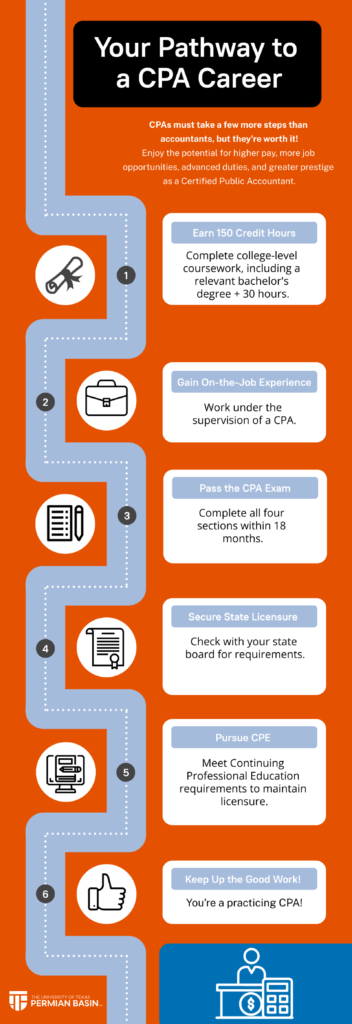
How Do You Become a CPA?
The more advanced your career, the more education and credentials you need. If you’re aiming to become a CPA, here’s what it takes:
Completing 150 semester hours of college-level coursework.
Gaining supervised work experience.
Passing the national CPA exam.
Securing state licensure.
Maintaining licensure through continuing education.
CPAs are also likely to enjoy more job opportunities. They can work internationally, in a wider range of fields, and in upper-level roles. Those extra qualifications count!
Frequently Asked Questions
This information can help you get started on your CPA journey:
What do CPAs do that general accountants don’t? CPAs are qualified to work at the federal level, representing clients before the IRS and filing reports with the Securities and Exchange Commission. While they have all the same abilities, their additional qualifications allow them to offer a broader range of services.
How much more education is required for a general accountant to become a CPA? Accountants must complete a related bachelor’s degree—the equivalent of 120 college-level credit hours. Aspiring CPAs must complete 150 semester hours, show hands-on work experience under a CPA, pass the CPA exam, obtain state licensure, and maintain licensure through continuing education courses.
What are the career prospects for CPAs? CPAs enjoy annual earnings in the $90,000+ range. With their additional qualifications, CPAs are also likely to have more job opportunities, including working in a broader range of industries, more advanced positions, and even internationally.
Online Degrees for Aspiring CPAs at All Levels
Ready to prepare for a career as a CPA? We’ve developed AACSB-accredited programs to help get you there.
When you hear the word “accountant,” who comes to mind? Someone balancing spreadsheets and filing taxes? If so, you’re on the right track. But there’s more to it. Within the field of accounting, one credential stands apart: the Certified Public Accountant (CPA). While both accountants and CPAs manage finances, advise clients, and ensure the accuracy…
Picture this: You’re a junior accountant, and your manager asks you to tweak a report to make the numbers look better. The request sounds harmless enough—just a small tweak—but you know it’s not above board. Now you’re stuck. Do you follow orders and risk crossing an ethical line, or do you push back and risk…
You’ve always been an analytical thinker. A problem solver. Maybe a math whiz, too. There’s a career that matches your strengths. Certified Public Accountants—or CPAs—excel in these qualities. Let’s explore why a CPA is no ordinary accountant and what it takes to become one. Want to Be a CPA? Here’s What You Need to Know …
“I will tell you how to become rich. Close the doors. Be fearful when others are greedy. Be greedy when others are fearful.” –Warren Buffett, American investor and billionaire
Think about the last investment you made. Then think about why you made it. Did it make sense?
Our investment choices often don’t come from a reasonable, rational place but rather somewhere more subconscious. Behavioral economics, a field at the intersection of economics and psychology, seeks to understand, explain, and in some cases exploit this rationale. Behavioral economists may make a career of guiding consumers and investors—or even use their understanding of buying and investing behavior to help companies increase their profits.
Disregarding reason and logic when making financial decisions is often as foolhardy as it sounds, but it’s an interesting topic for discussion. Let’s take a closer look at behavioral economics now and review some finance degrees than can reinforce your investment expertise from a professional perspective.
Behavioral Economics Examples
Here are some of the ways psychology is connected to the decisions we make about where we put our money:
Getting Greedy
A strong stock market can cause investors to see dollar signs and buy and sell accordingly, and overconfidence in a healthy market can lead them to take too many risks. (Contrast this with Becoming Too Self-Assured and Panicking below.)
Becoming Too Self-Assured (Overconfidence Bias)
Some investors may have an inflated sense of their own expertise in choosing lucrative stocks or other types of investments, often due to a single successful experience with investing.
Panicking
When the economy is in poor shape, some investors may impulsively unload their stocks or other investments.
Choosing Loss Over Gain (Loss Aversion)
Out of concern that they might miss an opportunity for an investment to grow in value, an investor may keep an investment of low value for longer than is prudent, ironically missing the opportunity to mitigate their losses.
Jumping on the Bandwagon (Herd Mentality)
When an investment is popular, those other people who got in on it must be onto something, right? This kind of mentality was behind the real estate bubble of the early 2000s, among other financial crises. But FOMO—the fear of missing out—can be a powerful motivator.
Staying the Course (Anchoring)
An investor might use their original stock purchase price as an arbitrary point of reference for when to buy or sell.
Picking Favorites (Cognitive Bias)
An investor may make decisions based on criteria they’re not even consciously aware of, such as finding the company’s logo appealing.
A Quality Finance Education Is Always a Shrewd Investment
No matter what aspect of investment decision-making interests you, you’ll have the opportunity to thoroughly explore it in one of The University of Texas Permian Basin’s online finance degree programs. Whether you’re looking to advance within your current finance career or are eager to get one started, these AACSB-accredited degrees—taught by highly experienced business professionals and educators—will propel you in the right direction:
An MBA commands tremendous respect in the business world. Our program covers the spectrum of core business disciplines with an emphasis on financial management. You’ll enjoy the flexibility of finishing with 33-42 credits and can graduate in as little as four semesters.
Recommended program courses on this topic include:
Sharply focused on financial management, our 30-credit MS in finance has the distinction of being among a very limited number of STEM-certified programs of its kind in Texas. You can complete this degree in as little as four semesters.
Recommended program courses on this topic include:
An excellent foundation for a finance career and many other careers, this program begins with a diverse range of essential general education courses before transitioning into a finance-oriented curriculum that can prepare you for Certified Financial Planner (CFP) and Chartered Financial Analyst (CFA) designations.
Recommended program courses on this topic include:
Finance professionals with the right credentials and plenty of determination can work in a variety of rewarding roles. Just look at some of the jobs listed below and their corresponding median annual salaries, courtesy of Lightcast:
Personal Financial Advisor: $98K
Loan Officer: $66K
Investment Fund Manager: $138K
Financial Risk Specialist: $102K
Financial Manager: $138K
Financial and Investment Analyst: $95K
General or Operations Manager: $98K
Credit Analyst: $79K
Chief Executive: $160K
Set yourself up for financial career success with a finance degree from UT Permian Basin! Apply now.
Financial planning for millennials isn’t about hitting milestones on the same timeline our parents did. If that were the standard, a large percentage of us would already feel behind. Instead, it’s about understanding your money, making informed decisions, and building stability in a changing economy. If that already feels refreshing, good. Because many millennials are managing student loans, rising living costs, career…
Ever opened your bank account and thought: “How do I have another bill due already?” You’re not alone. Financial stress affects 61% of adults ages 18 to 35, whether it’s from: Gen Z has been through a lot—from the COVID pandemic’s economic impact to inflation and job uncertainty. That’s why smart financial planning matters more…
Imagine sending money across the world in seconds—without waiting for a bank transfer or filling out piles of forms. That’s the promise of cryptocurrency. Cryptocurrency is digital money that doesn’t require banks. Instead, your funds are secured by encryption and passwords only you control. When Bitcoin launched in 2009, it introduced a new way to…