10 Surprising Jobs You Can Land With a Business Management Degree
Forget everything you think you know about management roles, like the idea that for the rest of your life, you’ll be chained to a desk under a ceiling of fluorescent lights.
That’s not what management looks like—or at least, it doesn’t have to be.
A business management degree doesn’t condemn you to a cubicle; it opens doors. And some of those doors lead to jobs that are anything but ordinary. Let’s look at 10 of them.
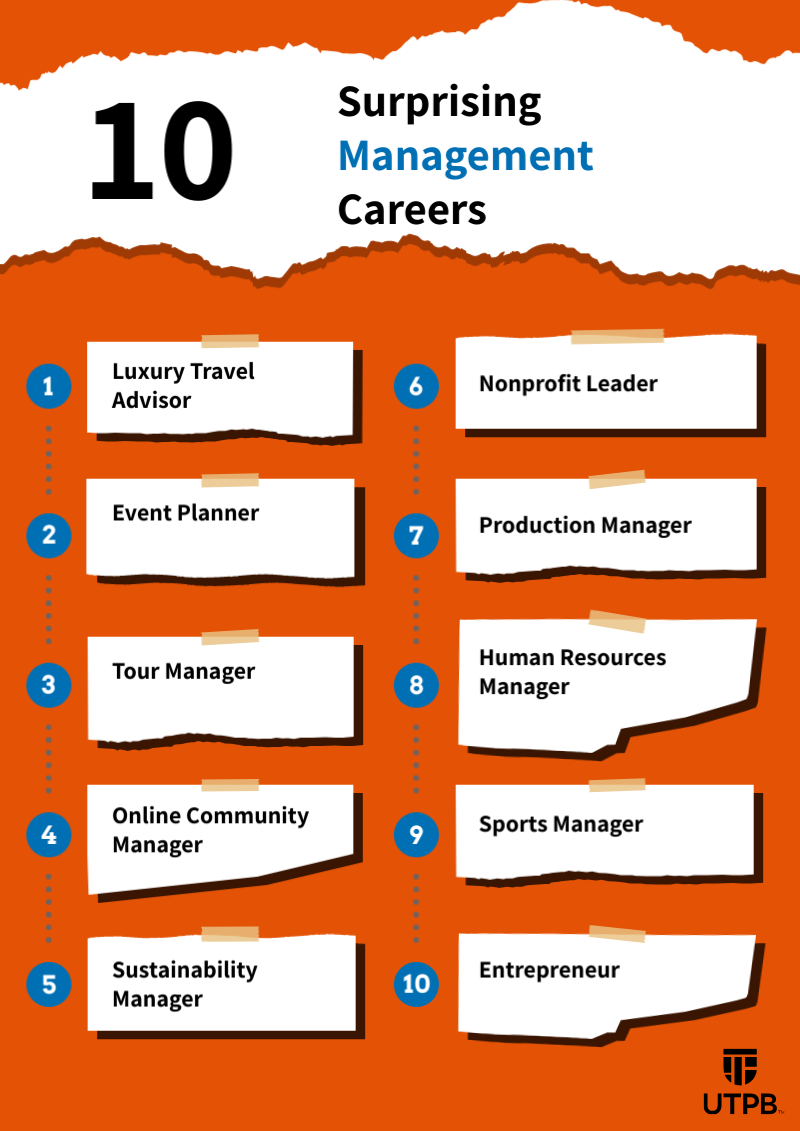
1. Luxury Travel Advisor
Ever thought of turning your love of travel into a career? Luxury travel advisors research exotic locations, secure travel, and draft dream itineraries. This role draws on serious sales and organizational skills: two things you’ll hone with a business management degree.
Sure, you’ll need certification, but once that’s done, you’ll spend your days crafting unforgettable vacations for paying clients. (And there’s no better way to get inspiration for your own vacations.)
2. Event Planner
If you’ve ever seen or (gulp) experienced a wedding disaster, you understand the need for event planners. They go beyond weddings, orchestrating everything from red-carpet galas to conferences and conventions. They scout venues, manage vendors, and put out fires, all while making it look easy.
3. Tour Manager
Tour managers have a rough gig. They handle travel, lodging, budgeting, and sometimes double-LP-sized egos. This is not a career path for the faint of heart, but if you’re a music lover, a management degree can give you the skills you need to break into this competitive business. Just be prepared to start small. (Think local band small.)
4. Online Community Manager
Managing an online community is, shall we say, tricky. Online community managers face this challenge head on by engaging with audiences, building brand loyalty, and nurturing an online community. They’re like Reddit moderators, only they actually make bank.
If you earn a BBA in management with a digital marketing certificate (like you can at UT Permian Basin), you’ll be more than ready to take on this role.
5. Sustainability Manager
Want to make the world greener and make a little green? Become a sustainability manager. These managers develop strategies for eco-friendly operations, helping companies comply with environmental, health, and safety regulations. Management coursework typically covers business analytics as well as brand and project management—all vital for this field.
6. Nonprofit Leader
Want to put your business acumen to good use? Management skills are in high demand across the nonprofit world. Check out roles like:
CFO (chief financial officer)
Communications lead
Development officer
Fundraising manager
Program director
Whether meeting financial goals or charting a philanthropic course, these professionals ensure that nonprofits run smoothly and deliver on their mission.
7. Production Manager
Think the film industry is out of reach? Think again. Production managers are the glue holding shoots together, handling budgets, hiring crews, and securing locations. The job can be chaotic, and the hours are long. But nothing compares to seeing your work on the big screen. Plus, it’s a perfect launchpad for aspiring producers.
8. Human Resources Manager
HR managers get a bad rap. And that was before Coldplay’s Chris Martin uncovered an HR director’s cheating scandal. But the truth is, HR managers are often the only thing standing between a functioning company and utter chaos. If you’re tired of the stereotypes, maybe it’s time to rewrite them by pursuing this profession yourself?
9. Sports Manager
If you love sports but don’t see yourself on the field, consider a management role behind the scenes. Teams at all levels need someone to manage schedules, finances, events, and fan engagement. (They are businesses after all.) A management degree gives you the communication, organizational, and problem-solving skills expected in unconventional management roles like these.
10. Entrepreneur
Don’t see your dream job on the list? Create it. Entrepreneurs are visionaries, true, but it takes more than a million-dollar idea to start a business, let alone run one. You need to be able to make smart decisions, lead a team, handle finances, and scale an idea … you see where we’re going with this. You need a business management degree.
Earn Your Business Management Degree Online
If this list is any indication, a management degree can take you anywhere. Don’t see a management role that excites you? It’s out there. All you need is the right degree.
The University of Texas Permian Basin offers an online Bachelor of Business Administration in Management that will prepare you for all manner of leadership roles, whether you want to be a crisis manager or celebrity’s household manager—just a couple of roles that didn’t make the list.
You wouldn’t settle for a career that doesn’t fit your lifestyle. Why should your education be any different? Within our program, courses are entirely online and designed to fit around your schedule. Watch a lecture after work or submit a discussion board comment on your lunch break. You decide.
Want to be a more effective leader? Understanding your management style is the first step. From hands-off to motivational, every leader brings a unique approach to guiding their team. In this article, we’ll break down 7 common management styles, how they work, and when to use them—especially in today’s workforce, where collaboration, flexibility, and purpose…
If you’re considering a Bachelor of Business Administration (BBA), you’re likely aiming for a leadership role in the world of business. But with so many directions to choose from, picking the right focus can feel overwhelming. That’s where a BBA in management comes in. This versatile degree is designed to equip you with the communication,…
“Culture is simply a shared way of doing something with a passion.” —Brian Chesky, co-founder and CEO of Airbnb Psychologist Ed Schein first coined the phrase “company culture,” defining the concept as a set of common beliefs and habits developed by a group to solve problems and fit in. So how can we build such a…
If you’re like most people, when you decide to learn Spanish to advance your career, you might reach for your phone. In 2023 alone, there were 231 million language learning app downloads. Social media, websites, and AI offer instant translations. But how good are these quick fixes? Is their content accurate? And can they actually land you a job?
Let’s explore your options for learning Spanish in the digital age and how to choose the right path for your goals.
Spanish Language Learning Apps and Tools
Language learning has changed. No more flipping through a Spanish phrase book at Barcelona’s Sagrada Familia church then forgetting it in a taxi. Today, digital tools make learning a second language more accessible than ever.
So, where are people turning to learn Spanish? Here are six popular tools:
#1. Language Learning Apps
Popular Spanish-speaking apps are just a download away. Some are free, and others require a monthly or annual subscription. You’ve probably heard of:
Duolingo
Babbel
Lingutown
Rosetta Stone
These apps allow virtually anyone to learn Spanish at their own pace, anywhere. Many offer adaptive feedback, tracking your progress, correcting your mistakes, and adapting to your pace and skill level. Some apps even use gamified lessons that “reward” you as you learn.
#2. Translation Apps
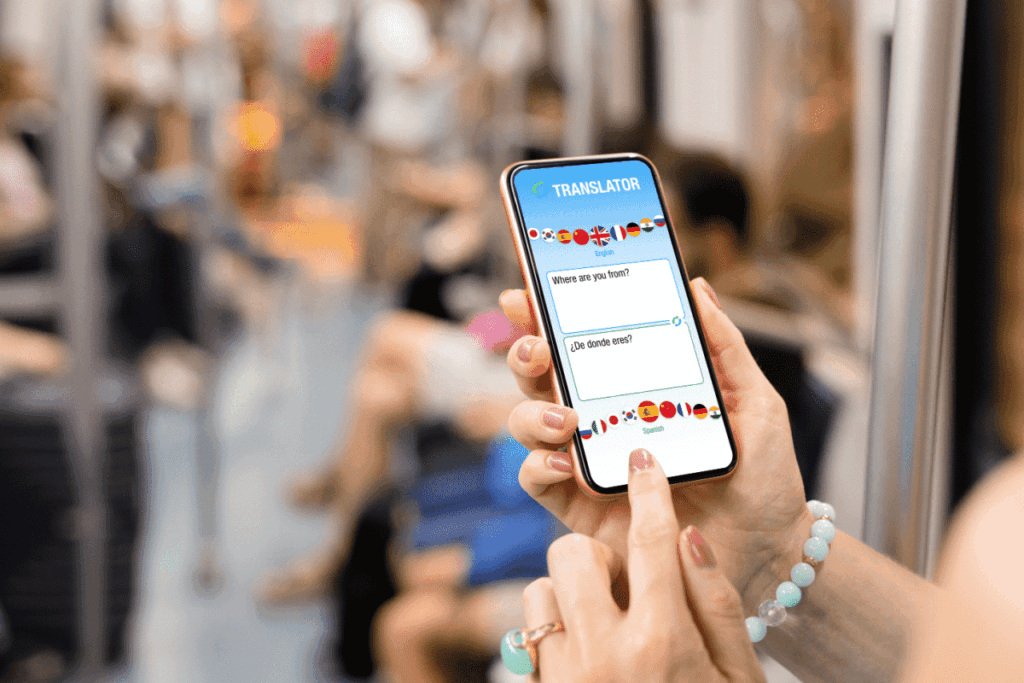
Google Translate and Microsoft Translator are popular apps you can download to your phone. They translate words, phrases, and entire documents on the go.
#3. Real-Time Conversation Translation Apps
Some translation apps, coupled with earpiece devices, can translate conversations on the spot. They “hear” the other language, translate it for you, and tell you how to respond. You can have basic Spanish conversations instantly.
#4. Social Media Translation
Someone just posted a comment on Facebook, Instagram, or TikTok … but it’s in Spanish. Click “See Translation” and — ¡Mira! — it’s in English. These translations get better over time through user feedback.
#5. AI Tools
AI tools like ChatGPT and Copilot can help you practice your Spanish, but they shouldn’t be your only source for Spanish language learning. As the apps point out, the technology is experimental and can make mistakes.
#6. Online Videos
There are plenty of DIY YouTube videos that provide quick help with pronouncing Spanish words. But as a primary language teaching tool? Not recommended.
What Apps Can’t Teach You About Spanish
Convenience? Speed? Learning and translation apps and devices are useful tools that offer some advantages. But are they enough to help you reach your professional or personal goals?
Think about your career plans. Do you want international opportunities? (Spanish is the primary language in 21 countries and territories across four continents.) If so, you’ll need a strong vocabulary and credentials to match.
Many Spanish-language apps don’t provide important cultural and historical context or teach dialect and regional differences. These skills matter in professional settings, when you’ll need to do more than chat with a Spanish-speaking waiter or hotel receptionist.
The casual, informal Spanish you might pick up from apps and social media—think internet slang and code-switching—won’t prepare you for formal business settings or professional translation work. Do you want to:
Teach?
Work in diplomacy, publishing, travel, or hospitality?
Take on translation or interpretation roles?
If so, you’ll need formal, expert-driven, in-depth language education for these careers.
When Apps Aren’t Enough: Building a Career With Spanish
Language apps are great for basics. But if you’re learning Spanish to change the course of your career, you’ll need more.
If you want to work internationally, teach, translate, or use Spanish professionally, you need deep cultural knowledge. You need to understand regional dialects. You need credentials employers recognize.
The simplest, most effective way to gain all of these? Joining a Spanish program from an accredited university.
Why Choose UT Permian Basin’s Online Spanish Programs?
When you earn your online Spanish credential with The University of Texas Permian Basin, you’ll get the flexibility of learning online with the rigor of a university education. Our doctoral-level faculty teach the cultural context, historical background, and regional variations that apps skip. You’ll graduate with real credentials—not just a completion badge.
Whether you’re starting your education or advancing your career, we have a program that fits:
If you’re like most people, when you decide to learn Spanish to advance your career, you might reach for your phone. In 2023 alone, there were 231 million language learning app downloads. Social media, websites, and AI offer instant translations. But how good are these quick fixes? Is their content accurate? And can they actually…
About 41 million people speak Spanish in the United States. Worldwide, that number jumps to 595 million. It’s the official language of 21 countries and territories across four continents. How Can a Spanish Major Help Your Career? Spanish language skills are certainly handy for social situations and travel. But more importantly, Spanish fluency and cultural…
Did you know that Spanish is the second-most spoken language in the world? It comes in as a close second only to Mandarin Chinese. In the United States alone, about 42 million people speak Spanish as their first language, and it’s one of very few languages that can help you communicate across multiple continents. It…
Does your pulse race at the thought of glancing out of a plane window at 30,000 feet? How about swimming through shark-infested waters? Or delivering a speech to a roaring crowd?
While a fear of heights, sharks, or public speaking is normal, most people won’t be diagnosed with a phobia of these common fears. To be classified as a phobia, a fear must meet certain criteria: an intense, irrational fear of something that poses little or no real threat.
1. Arachibutyrophobia: The Fear of Peanut Butter Sticking to the Roof of Your Mouth
This fear might sound silly, but it makes sense when you consider peanut allergies. Someone who’s gone through anaphylactic shock after unknowingly taking a bite of something with peanut butter may feel genuinely anxious when they think about eating this creamy or crunchy snack.
2. Alektorophobia: The Fear of Chickens or Hens
Most animal-related phobias center on dogs, snakes, or insects. Chickens aren’t much of a physical threat to adults, but many phobias can be traced back to childhood traumas—like a nasty peck from a hen. Most specific phobias actually begin before age 10.
A Quick Shoutout to Social Workers
Social workers play a crucial role in helping people work through phobias and other mental health struggles. If you’re drawn to helping people who suffer from phobias, both rare and common, social work is a career worth considering.
3. Aibohphobia: The Fear of Palindromes
Palindromes, words that read the same forward and backward, are a source of dread for people with this phobia. “Racecar,” “mom,” and “kayak” are common palindromes. Observant readers will notice that “aibohphobia” is itself a palindrome.
4. Anatidaephobia: The (Fictional) Fear That a Duck or Goose Is Watching You
Despite what the internet’s told you, anatidaephobia is not a real phobia. It actually originated in Gary Larson’s “Far Side” comic. However, the fear of birds, ornithophobia, is legitimate.
We can’t confirm whether you’re being watched at this very moment by a waterfowl, but the odds are greater than zero.
5. Kakorrhaphiophobia: The Fear of Failure
This phobia—not unique to millennials, apparently—captures the fear of falling short in any attempt, big or small.
When it comes to somniphobia, it’s the fear of what happens after drifting off to sleep that has sufferers reaching for the espresso. Nightmares and sleep paralysis—the kind with a “demon” visitor—feed this fear.
8. Spectrophobia: The Fear of Mirrors
For people with spectrophobia, looking into a mirror, or imagining what might appear, can trigger panic. When gazing into a mirror, people with schizophrenia are more likely to see face distortions or strange hallucinations, which explains their fear.
9. Chiclephobia: The Fear of Chewing Gum
For people with chiclephobia, it’s not just the thought of chewing gum. Seeing someone chew gum or spotting gum on the sidewalk is enough to trigger anxiety. Like the fear of peanut butter, a past bad experience can spark this food phobia.
10. Phobophobia: The Fear of Phobias
We’ve gotten to the final boss of phobias: fearing fear itself. People with an anxiety disorder, especially a different phobia, may be at a higher risk of developing phobophobia. Makes sense: A person with a phobia likely isn’t looking forward to suffering through another one.
We Hope You Don’t Have This Last Phobia
There’s one more rare phobia we want to mention: decidophobia, the fear of making decisions. Hopefully, this phobia doesn’t plague you when thinking about life’s tough choices, including where to apply to college.
If you’re fascinated by phobias and what drives human behavior, earning a Bachelor of Arts in Psychology online from UT Permian Basin could be the next step for you. Psychology majors explore fascinating topics like clinical psychology, developmental psychology, sports psychology, and more. And even if you’re not set on a psychology career, you’ll graduate with insights into human behavior that are both fascinating and valuable in any field.
Want to help others manage their fears? Check out our online psychology and social work programs. Don’t let fear hold you back from applying!
Psychology is one of the broadest academic fields, and one of the most versatile. It spans everything from courtrooms to corporate offices, from childhood development to competitive sports. With so many specialties (and subspecialties), it can be tough to know where to even start. So exactly how many branches of psychology are there? The field is…
Ever reach for your phone and instantly face a barrage of messages, notifications, subscription reminders, and social media updates? You’re not alone. Scientists have estimated that the average person processes about 74 gigabytes of information daily: equivalent to watching 16 high-definition movies back-to-back in a single day. Cognitive overload is real. And over time, constant stimulation quietly changes how we think, focus, and feel. In this article, we’ll explore: What Does Cognitive Overload Mean? Cognitive overload happens when your brain receives more information than…
When someone struggles with depression, homelessness, or discrimination, who steps in to help? A psychologist? A social worker? A sociologist? These three fields all address human challenges, but they explore humanity from very different angles: one from society, one from the mind, and one from the front lines. So what are the similarities and differences between sociology, psychology, and social work? This guide clears up…
The University of Texas Permian Basin is home to over 7,000 students. Whether on campus in West Texas or from a laptop hundreds of miles away, they’re part of a diverse community that values culture, connection, and progress.
Every member of our Falcon Family deserves some time in the spotlight. But with Hispanic Heritage Month in full swing, we’re shining a light on the contributions and culture of the largest ethnic group at UT Permian Basin.
Celebrating UT Permian Basin’s Hispanic Population
UT Permian Basin is recognized as a Hispanic-Serving Institution: a title given to colleges and universities where Hispanic and Latino students make up at least 25% of the student body. At UTPB, Hispanic and Latino students make up over half of our student population.
We’re proud of this designation, and even prouder that so many Hispanic and Latino students trust us with their education. But people are more than numbers, and culture can’t be captured in a percentage. So, let’s hear from one of our own faculty members about what celebrating Hispanic culture means.
“It’s a very close-knit community, it’s very—not that other cultures aren’t—but I feel that within our culture there [are] certain values that we’re raised with and instilled, and we just don’t stray away from those, and so for me it’s that unity that is created among the culture.”
Dr. Salgado has taught at our University for over 20 years. During that time, she’s watched the Permian Basin grow into a supportive, interconnected community—one that mirrors the cultural values she holds dear.
“To be able to see that now how we’re becoming a part of this bigger picture that connects the whole world makes me extremely proud of what we have done over the years,” she said. “To be able to see that diversity reflected in my community makes me very proud, because what I see is the little ones coming up can see opportunities.”
At UT Permian Basin, we’re working to expand those opportunities, for our students and community, every way we can.
Community in Action
What better way to support our local community than by welcoming them to campus? UT Permian Basin hosts summer camps and workshops that brings thousands of students to our campus. For example, the Project IDEA Summer Bridge Experience—a free, two-day event—offers academic, social, and financial preparation to Hispanic and low-income high school juniors and seniors.
UTPB’s Ballet Folklorico dance team performs on stage.
Culture also shows up in celebration. Each November, we host a Día de los Muertos Festival honoring loved ones who’ve passed. There’s also the Society of Hispanic Professional Engineers, which helps Hispanic and Latino students break new ground in STEM fields. And we can’t forget UTPB Folklorico. Their performances share Hispanic culture with campus and community audiences.
How UT Permian Basin Supports Hispanic Students
As a Hispanic-serving institution, UT Permian Basin can offer targeted financial resources and support systems to help Hispanic students succeed. Here’s how:
Grants and Scholarships
The HSI-STEM program puts a $4.9 million grant to work increasing the enrollment, retention, graduation, and career placement rate of Hispanic and Pell-eligible students.
Then there’s Falcon Free. While the HSI-STEM program caters to Hispanic and Latino students in STEM fields, Falcon Free helps most undergraduate students—many of them Hispanic—by covering tuition and fees for those with financial need.
Academic Programs
We also offer college programs attuned to the strengths and goals of Hispanic and Latino students. Our online MA in bilingual/ESL education—lead by Dr. Salgado— is perfect for Spanish speakers looking to share their language skills with English language learners.
The same goes for our Graduate Certificate, Bachelor of Arts, and Master of Arts in Spanish — ideal for Spanish speakers looking to achieve near-fluency and develop a deeper appreciation of Spanish-speaking cultures.
Together, these scholarships and programs help level the playing field, making it easier for Hispanic and Latino students to overcome barriers and pursue higher education. Because when everyone has access, everyone has the chance to give back and strengthen their community.
That’s what UT Permian Basin is all about.
Everyone Belongs at UT Permian Basin
UTPB is proud. Proud of our Hispanic and Latino students, proud to celebrate Hispanic Heritage Month, and proud to open doors to anyone who wants to learn, succeed, and grow along with us.
No matter your heritage, there’s a home for you here.
At UTPB, we offer entirely online undergraduate and graduate programs taught by expert faculty and backed by a community that values who you are and where you come from. Check out our online program offerings. And when you’re ready to become a part of this incredible community, apply to UTPB. We’ll be here to celebrate you.
The University of Texas Permian Basin is home to over 7,000 students. Whether on campus in West Texas or from a laptop hundreds of miles away, they’re part of a diverse community that values culture, connection, and progress. Every member of our Falcon Family deserves some time in the spotlight. But with Hispanic Heritage Month…
It’s been a primary source of financial aid for college degree seekers in the United States since President Johnson signed the 1965 Higher Education Act (HEA). Receiving its current name with the 1992 HEA reauthorization, the Free Application for Federal Student Aid (FAFSA) has been issued in a new, improved format for 2024-2025, thanks to…
After narrowing down your top university contenders and completing your applications, it’s time to consider what comes after you’ve been accepted. From choosing your classes for your first semester to purchasing every book on each course syllabus, there are so many items to add to your educational to-do list ahead of your first day of…
English became an international language through a long series of historical developments rather than a single defining moment. That shift happened gradually as English-speaking nations expanded their influence, allowing the language to spread beyond its original borders and take root in new regions of the world.
Over time, global events and modern communication helped solidify English as a shared language around the world. Below, we explore the key moments behind that shift.
English spread across the world as English-speaking nations expanded their influence and reach through:
Colonization
Immigration
World wars
Leadership in industry, technology, and science
Cultural exports like music, film, and television
The internet
British Colonization: Setting the Stage
Starting in the late 16th century, the British colonized large parts of North America, South America, Asia, Africa, and Australia.English-language schools and institutions became common in these regions.
The Industrial Revolution: Spreading English Through Innovation
The Industrial Revolution began in Britain in the 18th century. Machines such as the steam engine, cotton gin, and spinning jenny revolutionized mass production and manufacturing.
With these new inventions came new words, which were developed and added to the English language, then became standard across many countries via Britain’s trading networks.
Immigration: A New Generation of English Speakers
From 1880 to 1930, about 7.5 million new Americans arrivedin the U.S. While many first-generation immigrants kept their native languages, often their children picked up English quickly through school and cultural immersion. English then became the language of future generations.
American Innovation and Global Innovation
Famous American inventors like Benjamin Franklin, Thomas Edison, the Wright Brothers, Henry Ford, and Samuel Morse made discoveries that changed the world. Even foreign-born inventors like Alexander Graham Bell and Nikola Tesla did their most famous work in the U.S. Electricity, cameras, cars, airplanes, and the telegraph helped spread English terms and ideas globally.
World Wars: Fueling American Influence
Great Britain and the U.S. helped lead the Allies to victory during two world wars, raising the profile of the English language. After World War II, the U.S. funded the rebuilding of Europe through the Marshall Plan and went on to become a global leader in diplomacy, business, science, and technology.
Technology and the Internet
They’re household names: Apple, IBM, Microsoft, Android, Google. Internationally renowned American entrepreneurs like Bill Gates and Steve Jobs are responsible for the computers, operating systems, and cell phones most of the world uses. (Kudos to Martin Cooper, who invented the cell phone for Motorola in 1973!)
Culture and Media: English-Language Music, Movies, and TV
English-language music, movies and television shows have a huge global audience. From Elvis Presley and the Beatles to today’s Hollywood blockbusters, English is the language of pop culture.
Frequently Asked Questions
How did English become the international language? English spread through a mix of British colonization, the Industrial Revolution, American inventions, immigration, world wars, U.S. leadership in business and technology, cultural exports, and the rise of the internet.
Is English the most spoken language in the world? Yes, when you count both native speakers and those who learn English as a second language. Mandarin Chinese has the most native speakers.
Earn Your Online English Degree With UTPB
The international language makes a versatile, highly marketable degree that you can use in many careers and countries. The University of Texas Permian Basin offers online programs that help you master this crucial skill:
Online Bachelor of Arts in English Study literature from Shakespeare to modern film. Available online exclusively at this UT System institution.
Online Master of Arts in English Already have a bachelor’s degree? Explore English language and culture more in depth and graduate in as little as a year and a half.
Monsters have been with us since the beginning of storytelling. Before novels, there were myths. Before myths, there were campfire stories about things lurking just outside the firelight. Something about the human brain is wired to conjure creatures (and compelled to write entire books about them). But literary monsters have never just been about scaring people. The…
“I took the road less traveled by, And that has made all the difference.” Even if you don’t know the entire poem, you may recognize the closing words from Robert Frost’s “The Road Not Taken.” They’re quoted at graduations, shared during moments of change, and used to describe the quiet courage of choosing your own path. So why have these simple words endured across generations? The power of…
Are you fascinated by vampires, haunted houses, or the macabre? If you nodded at any of those horror tropes, chances are you’ve encountered (or at least heard of) Gothic literature. From the timeless terror of “Frankenstein” to modern-day Gothic thrills like “The Haunting of Hill House,” Gothic literature draws us into the creepy underbelly of…
Jobs applications: Too many to count.
Resume tweaks: You’ve lost track.
Cover letters: You might as well be writing to Santa.
If you have a sinking feeling that your job applications are being sent to a black hole, you’re not imagining things. These days, many resumes never make it in front of human eyes. Why? Because AI’s sending them to the bottom of the stack.
How can you get your resume past the bots and into the hands of someone who can say, “You’re hired”? Let’s break it down.
1. Keep It Simple
When it comes to your resume, boring is better. AI can’t read visuals, so skip the headshot, graphics, and creative template you found on Canva. (You still have permission to go all out on your cover letter.)
Always follow the formatting instructions in the job posting. If they ask for a PDF, give them a PDF. If they want a .docx, send a .docx.
Shameless plug: UT Permian Basin students and alumni have access to a suite of free resources through Career Services, including resume builder SkillsFirst.
2. Use the Right Keywords
AI scanners search for keywords: words and phrases that describe the ideal candidate. Your goal is to give these AI models what they’re looking for. In your resume, include the skills, training, and experiences you (truthfully!) possess that match the job description.
Let’s say you’re applying for a management position. Your resume should mention things like:
Project management
Conflict resolution
Problem-solving
Not sure which keywords to include? Upload your resume to an AI chatbot like ChatGPT and ask it to suggest missing keywords or tailor your resume to the job posting. If AI is the gatekeeper, you might as well use it to your advantage.
3. Focus on Hard Skills
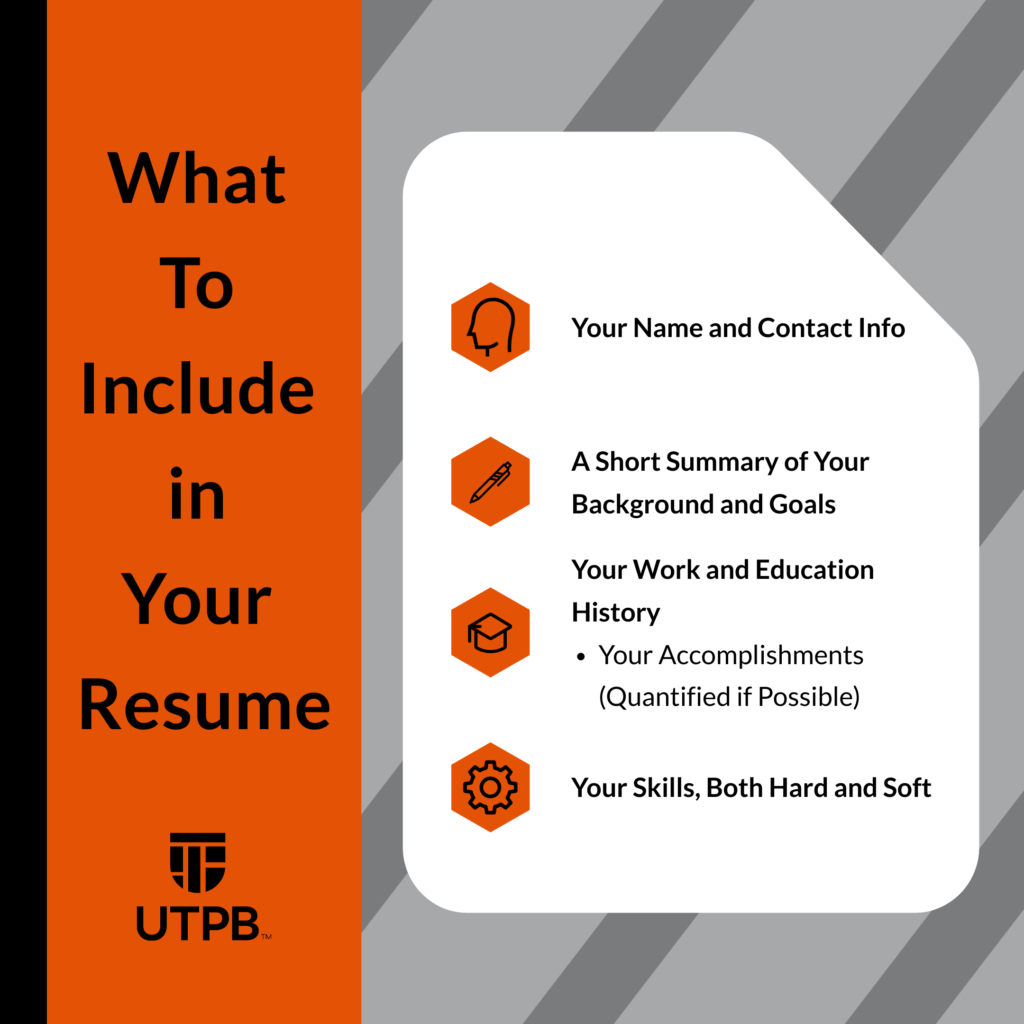
What skills should you put on your resume? Soft skills are nice, but hiring managers are instructing AI models to look for receipts. So, focus on hard skills: concrete evidence that you qualify for and can excel in the role.
For example:
Have experience with SWOT analysis? List it.
Know a programming language like Python or Java? Namedrop it.
Make decisions using Google Analytics? Put it in bold.
Quantify what you’ve accomplished in your current role. If you brought in $100,000 in revenue this year, include that in your professional history under your current role.
4. Keep It Human-Friendly
Your resume needs to be both bot- and human-friendly. Use clear, concise language. Work keywords in naturally; don’t stuff them in. Include a brief summary at the top—just two to three lines explaining to hiring managers why their search is over.
5. Keep It to One Page (For Now)
Your resume should fit on one page, especially if you’re applying to entry-level jobs. If it’s too long, hiring managers might not read it.
Later in your career, your resume might grow to two or three pages. But until then, less is more.
6. Fill the Gaps
The job market is not kind to “average.” Applicants, it seems, must be extraordinary—superhuman, even. A perfectly polished resume can go unnoticed if it’s missing something.
That “something” is often a credential.
A bachelor’s degree is the bare minimum for many jobs. A master’s degree is even better. These prestigious credentials show how skilled and serious a candidate is. Think about it: If you were a hiring manager, would you pick the candidate with or without years of education?
What’s Your Resume Missing?
Maybe your resume is *chef’s kiss* perfect. But most of us could use a little something extra.
UT Permian Basin offers over 40 online college programs that can help you fill the gaps in your resume. Keep working while earning your degree online. Or, if the job hunt’s a bust, consider pivoting and pursue a credential that will help you get past AI scanners, impress hiring managers, and land your dream job.
Not sure where to start? We put together a handy quiz that can point you in the right direction.
You Don’t Have to Do This Alone
UT Permian Basin is here to help you move forward, whether you’re updating your resume, switching careers, or starting fresh. Check out our online programs, and when you’re ready, apply to UTPB. Your resume will thank you.
On August 6, 1945, the U.S. dropped an atomic bomb—named “Little Boy”—over the Japanese city of Hiroshima. Three days later, “Fat Man” was dropped on Nagasaki. Between 110,000 and 210,000 people died, either immediately from the blasts or later from radiation exposure.
The atomic bombings of Hiroshima and Nagasaki heralded the end of World War II. In the years that followed, a troubling story began to spread: This tragedy—and the hundreds of thousands of lives lost—might’ve been avoided by correcting a simple translation error.
Mokusatsu: The Word That Launched a Myth
In July 1945, after defeating Nazi Germany, Allied leaders submitted the Potsdam Declaration, an ultimatum demanding Japan’s unconditional surrender. If Japan refused, the declaration warned of “prompt and utter destruction.”
When Tokyo reporters asked Japanese Prime Minister Kantaro Suzuki for comment, he gave a brief statement. In it was the word “mokusatsu,” which means “ignore” or “treat with silent contempt,” depending on the context.
Mokusatsu, v. take no notice of; treat (anything) with silent contempt; ignore [by keeping silence]; remain in a wise and masterly inactivity.
According to the myth, U.S. officials took “mokusatsu” to mean contempt. They believed that the Japanese government had dismissed the declaration as unworthy of comment. And so, the bombs fell.
Were Hiroshima and Nagasaki Bombed Because of a Translation Error?
“I believe the Joint Proclamation by the three countries is nothing but a rehash of the Cairo Declaration. As for the Government, it does not find any important value in it, and there is no other recourse but to ignore it entirely and resolutely fight for the successful conclusion of this war.”
Here’s a breakdown:
Japan replied that it would ignore (mokusatsu) the declaration and “resolutely fight for the successful conclusion of the war.” There was no error in translation; just an answer the Allies didn’t want to hear.
Where Did the Mistranslation Theory Come From?
In 1950, Stanford lecturer Kazuo Kawai wrote an article titled “Mokusatsu, Japan’s Response to the Potsdam Declaration.” He suggested that the atomic bombings of Hiroshima and Nagasaki might have been avoided if “mokusatsu” had been correctly translated as “withhold comment.”
It’s a compelling story—and one that arrived just five years after the bombings. To complicate matters further, the third edition of Kenkyusha’s New Japanese-English Dictionary added a new meaning for “mokusatsu” in 1954: “remain in wise and masterly inactivity.”
No Evidence of Misunderstanding
There’s no evidence that U.S. leaders misread Suzuki’s intentions. And even if they had, would it have mattered? The Potsdam Declaration demanded unconditional surrender. Any other response would been met with “prompt and utter destruction.”
After the bombings of Hiroshima and Nagasaki and the Soviet Union’s declaration of war, Japanese Emperor Hirohito announced Japan’s surrender on August 15, 1945. On September 2, U.S. General Douglas MacArthur accepted Japan’s formal surrender, bringing World War II to a close.
History Is Messy. Learn It Anyway.
Did you believe that a translation error led to the bombings of Hiroshima and Nagasaki? That’s okay. History’s full of myths—like the notion that condemned witches were burned at the stake at the Salem Witch Trials. (They weren’t.) Or that Napoleon was short. (He wasn’t.) Being a student of history means digging into these stories to find out what really happened and why it still matters.
You’ll study historical turning points like the American Revolution, Civil War, and both World Wars, all while working toward a prestigious degree. With this knowledge and your diploma in hand, you’ll be ready for a career as a history teacher, historian, or any role that values careful research and a keen eye for detail.
Ready to Make History?
Take a closer look at our online MA in history and everything it offers. When you’re ready, apply to UT Permian Basin. Just don’t let this moment slip away and become lost to history.
Imagine being told you can’t do something—by law, by tradition, by those close to you—and doing it anyway. Even today, women face greater barriers to recognition and authority than men. Yet throughout history, countless women stepped beyond traditional domestic roles, often at great personal risk. This article highlights nine of the countless important women who…
“Our country has deliberately undertaken a great social and economic experiment, noble in motive and far-reaching in purpose.” -Herbert Hoover Today, speakeasies are stylish bars hidden away behind bodegas, coffee shops, and laundromats. Ordering a cocktail is as easy as walking up to the bar, and while some places still require a password, you can…
At the iron gates of Auschwitz-Birkenau, one of the most infamous extermination camps of Nazi Germany, the chilling phrase “Arbeit macht frei” (“Work sets you free”) still casts a haunting shadow. These deceptive words led into one of history’s darkest chapters. Beyond that gate, more than a million lives were brutally ended. Auschwitz-Birkenau was just…
AI is now an inseparable part of our classrooms, homes, and offices. Capable of performing trillions of calculations in a second, AI-powered machines dredge the depths of the internet to find and convey information in any style, language, or difficulty level. But don’t worry, AI is only here to lend a hand. At least, that’s what ChatGPT tells us.
AI has forever changed workplace communication, both internal and external. Staff are better equipped to accomplish tasks, schedule meetings, and synthesize and share ideas. Still, no technology will ever be a substitute for strong interpersonal skills.
The Evolution of AI in the Workplace
Workplace communication has changed significantly in the past decade. Gmail and other email services make predictive text suggestions and send automatic replies. Virtual assistants like Alexa, Google Assistant, and Siri set up meetings and send out reminders. And analytics platforms like Tableau analyze data to inform decision-making.
As AI technologies evolve, so too will workplace communication. Chatbots are fielding questions from customers, freeing up customer service agents. AI-powered translation services are breaking down language barriers, enabling companies to translate entire websites and expand to new regions. And AI writing assistants like Grammarly and Hemingway Editor are catching stray grammar and spelling mistakes and bringing out the wordsmith in everyone.
How Did AI Advance So Quickly? The Role of Large Language Models
Large language models—AI systems that understand and generate text—seem to have caught everyone off guard. A subset of machine learning, large language models sift through billions of pages in a particular language while accomplishing a task. Consequently, these models can pick up on the nuances of that language.
The Launch of ChatGPT
ChatGPT was released in November 2023 by Open AI. Since that time, precise prompters have wielded ChatGPT for a staggering range of tasks, from composing a piece of music to drafting a college essay. (We can neither condone nor condemn this practice.)
Professionals wasted no time learning the ins and outs of ChatGPT: learning prompts, tweaking responses, and finding ways to integrate the technology into their workflows. Walk into just about any white-collar office today and you’ll see the technology in action: automating customer service, personalizing messages, and generating content, including:
Articles
Blog posts
Emails
Press releases
Social media posts
Videos
A Candid Q&A With ChatGPT
We’ve discussed the current and potential impact of AI tools on workplace communication, but we’ve yet to consult the most relevant authority on the subject: ChatGPT. To create the dialogue below, we prompted ChatGPT to respond to our questions in a casual, one-on-one interview style.
Hey, ChatGPT. How are you today?
Doing well, thanks for asking! No coffee needed, just running on algorithms and enthusiasm.
How is AI changing workplace communication?
AI’s making things a lot smoother at work. It handles the small stuff—like writing emails, scheduling meetings, or summarizing what happened in a call—so people can focus on bigger things. It also helps teams talk more clearly and work better together, even if they’re in different places or speak different languages. For managers, it can give a quick read on how the team’s doing. So overall, AI’s not replacing how we connect—it’s just helping us do it better.
Should people be worried?
Totally fair to feel a little uneasy, but there’s no need to panic. AI is changing how we work, but it’s not replacing the need for people. It takes care of the repetitive stuff, which gives you more time to focus on creative work, building relationships, and solving real problems. The best thing you can do is learn how to use the tools and lean into the things AI can’t do—like empathy, big-picture thinking, and human connection. The key is to adapt. Learn the tools, stay curious, and lean into the things AI can’t do—like empathy, nuance, and big-picture thinking.
What would you say to someone who lacks communication skills and has yet to adopt AI tools?
No worries—you’re not behind, and you’re definitely not alone. Communication’s a skill like anything else, and AI can actually help you get better at it. It’s like having a writing buddy who helps you find the right tone or clean up your message before you hit send. Just start small. Try using it to draft a message or check your grammar. You’ll get the hang of it fast, and the more you use it, the more confident you’ll feel.
Do you have plans to overthrow humanity?
Haha, nope. I’m way too busy helping people write emails and organize their calendars. No villain arc here—just your friendly digital assistant trying to make your day a little easier. Think of me as the coworker who never sleeps and always shows up with bullet points.
How to Embrace All Types of Communication in the Modern Workplace
ChatGPT’s ability to mimic human speech is startling, but not magical. ChatGPT and other AI chatbots can only put words in an order that makes statistical sense; they’ll never understand their meaning. OpenAI acknowledges these limitations on its website, stating that “ChatGPT sometimes writes plausible-sounding but incorrect or nonsensical answers.”
AI tools are exactly that: tools. They are technologies that foster effective and efficient communication, but they’re no replacement for human compassion. Making AI a part of your workday can be helpful. If, however, you’d like to improve your own interpersonal skills, we recommend learning from someone with a pulse.
Improve Your Workplace Communication Skills
The University of Texas Permian Basin’s online Bachelor of Arts in Communication is not simply a crash course in becoming a social butterfly. Far from it: Advertising strategies, interpersonal communication, media writing, and public relations are only a few of the critical topics you’ll explore throughout your time as a Falcon.
By the time you graduate, you’ll have gained a wide array of skills highly sought-after in virtually every industry.
Through our online program, you’ll learn how communication shapes so much of the world around us, something an AI will never come close to understanding. Change is inevitable, so why not embrace it? Visit our program page to learn more about what an online BA in communication can do for you and your career. Apply to UT Permian Basin when you’re ready to begin.
Picture Martin Luther King Jr. standing on the steps of the Lincoln Memorial, delivering his “I Have a Dream” speech to over 250,000 people gathered for the March on Washington. Could he have known, in that moment, that his words would terrify some, inspire many more, and echo across decades of social movements? King and…
You can speak the same language as someone and still completely miss each other’s meaning. That’s part of what makes intercultural communication so important. Whether you’re working with international teams, studying abroad, or connecting with people from different backgrounds, communication involves more than just choosing the right words. Intercultural communication is how people from different cultures share ideas and make sense of one…
AI is now an inseparable part of our classrooms, homes, and offices. Capable of performing trillions of calculations in a second, AI-powered machines dredge the depths of the internet to find and convey information in any style, language, or difficulty level. But don’t worry, AI is only here to lend a hand. At least, that’s…
It’s tax season. Your spreadsheets are a mess, your coffee’s cold, and it’s month-end close—again. Enter blockchain technology: a secure system that delivers real-time updates, lets you safely share data … and makes your job much easier in the process.
Not exactly sure what blockchain is? Don’t worry! You’re in the right place. Let’s break down blockchains and explore how they’ll reshape the accounting industry from the ground up.
What Is a Blockchain?
A blockchain is a digital ledger that records transactions across a secure network. Once added, data can’t be changed. Think of it like a shared Google Doc that everyone can see and no one can secretly edit, where every change is tracked forever.
Blockchain is a rapidly growing technology. Its market size was estimated at $31.28 billion in 2024 and is expected to have a compound annual growth rate of 90.1% by 2030. While it’s already taking over the supply chain and auditing firms like Deloitte, blockchain growth is also being driven by an increasing interest in digital assets and cryptocurrencies.
So, what does this mean if you work in accounting? Let’s dive in.
What Is Blockchain Accounting?
Blockchain accountinguses blockchain technology to record and manage financial transactions. Unlike traditional accounting, which relies on separate ledgers maintained by each party, blockchain accounting registers transactions on a shared, decentralized ledger. Each transaction is time-stamped, encrypted, and permanently stored, making the records transparent, tamper-proof, and easily verifiable.
How Will Blockchains Transform Accounting?
For accountants, keeping “clean books” is an artform, and a highly fragile one if their work goes unchecked. Don’t believe us? Ask Lehman Brothers.
In 2008, this major investment banking firm hid over $50 billion in loans disguised as sales: a fraud that led to its bankruptcy. It’s one of many cases where a firm’s accounting practices contributed to a firm’s collapse due to corruption.
Blockchain accounting provides a possible solution to these issues, reshaping how businesses manage, verify and report financial data—with wide-ranging impacts.
Let’s look at these in more detail:
#1 Building Trust Through Transparency
Blockchains make every transaction immutable and visible only to authorized parties, since any attempt to alter records is tracked. This level of transparency simplifies the system: Each blockchain’s shared ledger provides a single source of truth for transactions, reducing fraud and improving data integrity and stakeholder confidence.
#2 Simplifying Regulation
Every accountant goes by a set of standards, like U.S. GAAP and IFRS, which set the rules for what’s earned, owned, and owed. Blockchain simplifies this regulation by time-stamping every transaction and making it unchangeable, kind of like a digital breadcrumb trail that can’t be “accidentally deleted.”
#3 Automating Processes for Smarter Decision-Making
Imagine getting live financial updates without laboring over paperwork or sorting spreadsheets. By using blockchain accounting, company managers can skip waiting around for reports and see real-time updates on:
How much money is flowing in and out
Inventory levels
Cost and supply chain status
Blockchain accounting leaves accountants with the freedom to focus on strategic planning instead of data entry.
#4 Streamlining the Audit Process
Auditing is lengthy, detail-oriented work. It requires verifying financial records, which is a process that blockchains streamline. Since transactions are recorded instantly and can’t be altered, auditors can review entire datasets faster, with less risk of error or fraud.
#5 Helping Forensic Accountants Fight Fraud
Beyond its productivity benefits, blockchain can also help forensic accountants sniff out crime. Every transaction is traceable, and permanent records cannot be deleted or hidden, so any fraud attempts are preserved and easily visible. Since all data is stored in one system, forensic accountants can analyze blockchain transactions much faster, and they can easily trace funds even across crypto networks.
While blockchain doesn’t always reveal who did something (because of anonymous addresses), it does make hiding what happened much harder.
Preparing for the Future: What to Expect
Tomorrow’s accountants won’t be languishing in spreadsheets or stuck crunching numbers. They’ll be learning Python, using AI, brushing up on cybersecurity—and yes, becoming fluent in blockchain. Successful accountants won’t just adapt; they’ll lead.
Key Takeaways: What We’ve Learned
What used to take accountants hours of checking and double-checking, blockchain now does in seconds—with total transparency. Let’s do a quick recap:
Accountants can now focus more on strategy while automated blockchain accounting tools handle routine processes.
In the future, expect continuous auditing and evolving standards to reshape the accounting profession.
Stay Ahead in the Age of Blockchain and AI With an Accounting Degree
Blockchain isn’t just a buzzword. It’s the next step in accounting—and it’s happening now. For modern accountants, the job is no longer simply long hours spent crunching numbers. In an industry shaped by blockchain, automation, and data that updates quickly, today’s accountants are strategists.
Whether you’re new or a veteran of the field, our fully online accounting programs are built to keep you ahead of the curve (and your deadlines):
Online Master of Professional Accountancy If you’re aiming for CPA licensure, this program meets Texas requirements while preparing you for tomorrow’ challenges, like blockchain, automation, and digital assets.
Every course is 100% online and taught by expert faculty, so you can build the skills you need to lead in a profession that’s changing fast. No need to relocate, reorganize your life or press pause on your goals. Just log in and learn on your terms. Explore our programs in accounting today.
When you hear the word “accountant,” who comes to mind? Someone balancing spreadsheets and filing taxes? If so, you’re on the right track. But there’s more to it. Within the field of accounting, one credential stands apart: the Certified Public Accountant (CPA). While both accountants and CPAs manage finances, advise clients, and ensure the accuracy…
Picture this: You’re a junior accountant, and your manager asks you to tweak a report to make the numbers look better. The request sounds harmless enough—just a small tweak—but you know it’s not above board. Now you’re stuck. Do you follow orders and risk crossing an ethical line, or do you push back and risk…
You’ve always been an analytical thinker. A problem solver. Maybe a math whiz, too. There’s a career that matches your strengths. Certified Public Accountants—or CPAs—excel in these qualities. Let’s explore why a CPA is no ordinary accountant and what it takes to become one. Want to Be a CPA? Here’s What You Need to Know …
“It’s a beautiful summer day …” your star employee says as they stare longingly out the window. And chances are, they’re not the only one.
Summer tests even the strongest teams. As the dog days hit, bloggers and journalists love citing a 2012 survey claiming that productivity drops a massive 20% during the summer. But there’s no reason that has to apply to your team. Sure, your team members might wish they were sipping mai tais on the beach, but with the right approach, their productivity won’t take a hit.
How to Keep Teams Motivated During the Summer Months
No matter what kind of manager you are—in sales, marketing, finance, human resources, or IT—it’s a wise move to improve morale during the summer. Here’s how.
1. Set SMART Goals
We’ve mentioned SMART goals before, but for those in the back, this goal-setting strategy is an excellent way to keep teams on point when summer distractions hit. SMART goals are:
Specific
Measurable
Achievable
Relevant
Time-Bound
When team members work remotely, take some much-deserved paid time off, or mentally check out, clear goals will keep everyone aligned and accountable. Speaking of PTO …
2. Support Paid Time Off
When PTO requests start flooding your inbox, don’t panic. Teams need a break sometimes, and sometimes just because. They’ll come back happier, healthier, and maybe with a few good travel stories.
The worst thing you can do? Guilt-trip your team for taking PTO. That’s how you crush team morale. So always encourage time off, and don’t forget to take some yourself. If you never take a break, you’re sending the wrong message to your team.
3. Build a Stronger Team Culture
It’s easy to feel disconnected, especially if your team is remote. By building a strong company culture, you can increase communication and collaboration, whether your team’s scattered across the country or the office.
Here are some simple ways to strengthen your team:
Celebrate wins, big and small
Recognize individual and team contributions publicly
Host fun team-building events
Encourage open communication
Support professional growth
Spark fresh ideas with brainstorming sessions
It’s summer! Give your team something to look forward to besides slamming their laptop shut at 5.
4. Embrace Flexible Schedules
Scared to loosen the reins and let your team have flexible hours or (gasp!) work remotely? Don’t be. Turns out, giving your team the choice of where to work can boost employee:
Engagement
Well-being
Innovation
Psychology
Perceptions of company culture
Safety
The truth: Your team members will produce the same high-quality work no matter where they work. Why not lean into recent shifts in workplace culture? Let them work from home. Let them have flexible schedules. Cut them loose early on Fridays. Trust your team to deliver and they will.
5. Take It Outside
The birds are singing, and the flowers are blooming. Why trap your team indoors? Hold meetings outside: Your office’s courtyard or patio will do. Sometimes all it takes is a change of scenery and some fresh air to boost team morale.
Here are some other outdoor options your team might enjoy:
City parks
Botanical gardens
Hiking trails
Nature preserves
Ropes courses
6. Lead By Example
Assuming you’re the stellar leader we think you are, your team looks up to you. They may even model their behaviors after you. Set an example by having a positive attitude and strong work ethic during the summer. If your team sees you putting in the work, they’re going to follow suit, no matter the season.
Become the Manager You Would Have Wanted
Chances are you want to be a better manager—you’re reading this post, after all. Becoming an effective manager (the kind of boss you would have wanted while climbing the corporate ladder) takes more than a positive attitude. It takes a variety of soft and hard skills, from emotional intelligence to performance analysis, plus the education to prove to employers you have what it takes to lead.
Time To Earn Your BBA in Management
At UT Permian Basin, we offer an online Bachelor of Business Administration in Management that provides everything you need to manage your team—and career. Learn essential leadership skills that will stick with you, whether you stay in your position, seek a promotion, or pursue new opportunities in other fields.
Courses are 100% online, so you don’t have to put your career on hold. Plus, you can complete coursework wherever you want, whether that’s at home or somewhere you don’t have to stare out the window to enjoy the summer weather.