Five Fintech Innovations That Changed the Way We Move Money
Paperless paychecks have been around since the 1970s, allowing employers to electronically transfer wages into employees’ accounts on payday. Direct deposit, or ACH (Automated Clearing House), saves the time and effort of rushing to a brick-and-mortar bank location and waiting in line to deposit a check before the bank closes. It’s an early example of fintech we take for granted today.
Many more advances have emerged in recent decades, providing us with unprecedented financial autonomy and transforming the finance industry. Though we still need to keep our money somewhere secure, these innovations enable us to perform a wide range of financial transactions from a cell phone—and some sidestep traditional financial institutions altogether.
Fintech, short for “financial technology,” encompasses innovative technologies that enhance and automate the provision and use of financial services. It assists companies, business owners, and consumers in optimizing their financial operations and processes through software and algorithms deployed on mobile devices and computers. Let’s look at a few fintech examples now.
Online Banking
Financial institutions enable customers to access their account 24/7 from the convenience of a secure website or app. These accounts are the same ones that they can access via an ATM or a local bank branch. In fact, customers can perform most banking transactions online, from deposits to transfers, making most bank visits redundant.
Digital Wallets
A digital wallet is a financial transaction app compatible with any connected device. It securely stores payment details and passwords in the cloud. While accessible from a computer, mobile wallets, a subset of digital wallets, are predominantly utilized on mobile devices. In addition to credit cards, digital wallets can store concert or travel tickets, car keys, ID cards, and coupons.
Cryptocurrency
A relatively recent addition to the world of finance, cryptocurrency gets a lot of attention, but not always for the right reasons. Criticisms of this virtual currency include slow transactions, inadequate regulation, a lack of inherent value, and potential use in criminal activities. Though controversial, cryptocurrency may be with us to stay.
Peer-to-Peer Lending
Also known as P2P lending, these platforms facilitate direct connections between borrowers and lenders, establishing their own rates and terms for transactions and allowing individuals to obtain loans directly from other individuals. P2P eliminates the need for a financial institution as an intermediary.
Robo-Advisors
A robo-advisor is a digital platform that delivers automated, algorithm-based financial planning and investment services, often with minimal human oversight. In a common scenario, a robo-advisor will collect information about your financial status and future objectives through an online questionnaire, enabling it to provide recommendations and execute investments autonomously on your behalf.
Rungs in the Ladder to a Finance Career
The University of Texas Permian Basin’s AACSB-accredited online finance programs equip you with financial management skills that can result in rewarding occupations, including leadership roles. All three highly marketable degrees are led by esteemed PhD-level faculty members boasting extensive experience within the finance industry. Explore the fintech, terminology, and trends you’ll need to know with us, online.
Develop essential financial management abilities applicable across diverse career paths with a BBA in finance—available online exclusively at this UT System institution. Many students use this program as a foundation for valuable Chartered Financial Analyst (CFA) and Certified Financial Planner (CFP) professional credentials.
Once you’ve completed a bachelor’s degree, continue your studies with an MBA—highly prized in the business world for its prestige. Build broad business acumen with a special emphasis on finance by completing 33-42 credits. Graduate in as little as four semesters.
If you seek a graduate degree sharply focused on finance, consider this 30-credit program—one of select few university programs of its type in Texas to boast STEM certification. Graduate in as little as four semesters.
Delivered in an asynchronous online format, our finance degree programs provide you with the flexibility to pursue your studies at your own pace, irrespective of your location. There’s no need to visit campus. Whether you’re balancing work, personal commitments, or both, our programs empower you to fulfill those responsibilities while earning a highly regarded, career-advancing degree.
When we consider a healthcare professional’s role in the patient experience, we might be inclined to picture a patient-facing individual such as a nurse or a patient care technician. These professionals have an incalculably beneficial effect on patients’ health and well-being. But apart from having the proper skills and disposition required to do their jobs effectively, they need strong, compassionate leadership to guide them and set them up for success.
Here we’ll discuss the vital role healthcare managers and leaders play in ensuring their facility’s patients receive the best of care.
Rethinking the Patient’s Role
The phrase “patient-centered care” comes up often today because of a significant mindset shift in healthcare. While physicians and other healthcare professionals may be exceptionally skilled and experienced, patient-centered care dispenses with the view that these professionals alone know what’s best for a patient in favor of a more inclusive, personalized approach.
Patient-centered care puts an emphasis on treating the patient as an individual and learning their specific healthcare needs. It seeks to engage patients and their families by providing them with the information to understand a health condition and make their own decisions regarding the course of care. This requires healthcare professionals to be excellent communicators and advocates for their patients.
The Driver of Patient-Centered Care
Healthcare manager is not a specific role but rather a general title for a variety of different professions including clinical manager, nursing home administrator, and health information manager. While managing the day-to-day operations of their department or facility is front and center for these professionals, better healthcare outcomes and a first-rate patient experience are always at the core of their mission.
Healthcare managers drive the personalized, patient-centered care that can result in a positive patient experience by:
Establishing a mission and ensuring all employees understand and adhere to it.
Setting the tone for care within their facility.
Hiring skilled professionals to support their efforts.
Ensuring patients have everything they need.
Equipping employees with the resources to do their jobs well, from medical equipment and supplies to adequate mental health breaks.
The Rewards of Leadership
As a healthcare manager or leader, you’ll have the potential to improve the lives of countless patients and employees throughout your career—a challenging but ultimately rewarding endeavor. While positive patient outcomes may be their own reward, healthcare management roles can also lead to more job opportunities and higher compensation. Data shows median earnings in the six figures and an astonishing growth rate of 28%—much faster than the average for all occupations—for related careers in the coming years. The University of Texas Permian Basin can put you on a path to these leadership roles in healthcare.
Redefine the Patient Experience as a Healthcare Leader
UT Permian Basin’s online degrees in healthcare management and leadership lay the groundwork for fulfilling careers at the helm of a patient-centered organization.
Explore the application of core business principles from the AACSB-accredited BBA program within a healthcare context, including topics such as financial management in healthcare organizations, patient service strategies, and understanding legal and regulatory frameworks. See where graduates of this UTPB program are working!
Enhance your expertise in meeting the requirements of employees and patients while also refining your skills in financial management and quantitative decision-making. This program is designated for students who hold an AAS degree in nursing, emergency medical services, radiology, or other healthcare-related disciplines.
One Choice for Convenience and Quality
Choose either healthcare-focused online UTPB bachelor’s degree to experience the benefits of our asynchronous, 100% online format. Enjoy the flexibility of finishing your coursework according to your own timetable, regardless of your location, all while maintaining your professional and personal obligations. You’ll still receive guidance from our esteemed faculty, as both programs are overseen by the same distinguished educators who teach at our Odessa, Texas, campus.
What if your neighborhood stayed powered through the next hurricane? That’s exactly what happened in Babcock Ranch: America’s first solar-powered city. Built with sustainability and storm resilience in mind, this Florida town is changing the future of energy and urban design.
Why Was Babcock Ranch Built This Way?
If you’ve ever lived in Florida or watched news coverage of hurricanes hitting its coastlines, you understand the state’s vulnerability to these storms. In 2004, Florida endured four hurricanes (Charley, Frances, Ivan, and Jeanne) in the span of a little over a month. Hundreds of thousands of residents lost power, with only 17.5% relying on portable generators to sustain basic appliances.
More recently, in 2022, Hurricane Ian wreaked havoc in southwest Florida, causing widespread destruction and leaving 2.7 million people without power. Some endured a week or more without electricity, braving extreme heat and humidity.
Despite facing the same powerful 155-mile-per-hour winds as neighboring towns, a community near Ft. Myers called Babcock Ranch emerged unscathed. Thanks to meticulous planning and reliance on solar panels for electricity, all 2,000 homes in the neighborhood retained power.
But what is Babcock Ranch—and how did it come out nearly unscathed when surrounding towns were left flooded, damaged, and without power?
Let’s take a closer look.
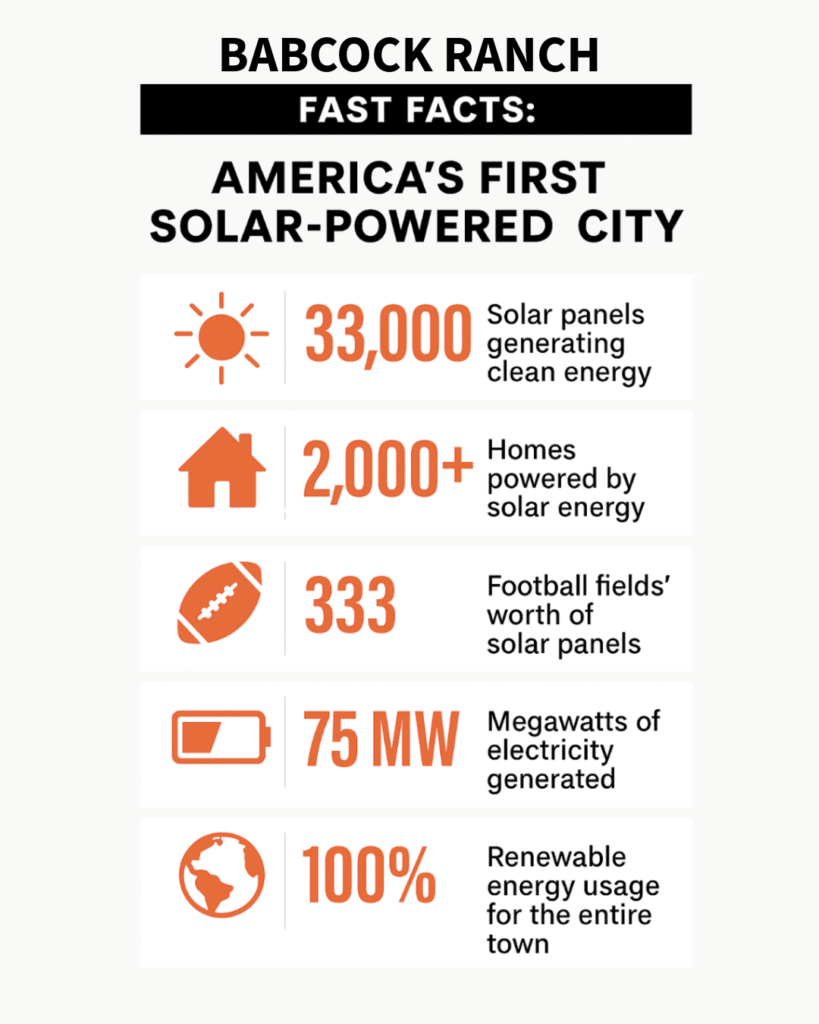
Fast Facts: America’s First Solar-Powered City
Before we explore what makes Babcock Ranch a sustainability success story, here’s a snapshot of how this innovative town is making waves—powered entirely by the sun.
Babcock Ranch: A Sustainable Dream Turned Into Reality
As with most grand plans, the beginning of Babcock Ranch began with a simple vision by its founder, Syd Kitson. According to VOA News, Kitson wanted to build a city that worked hand-in-hand with the environment. In 2015, his dream was realized as they broke ground on its construction, and Babcock Ranch was born.
The town, which spans over 18,000 acres of land, has become a series of distinct neighborhoods, schools, restaurants, nature trails, and more amenities that make it a desirable place to live. But what really sets it apart from other towns is the fact that it runs entirely on
So how does Babcock Ranch power 2,000 (and growing) residences and additional commercial spaces at once? Partnered with Florida Power and Light, Babcock Ranch houses a solar energy center on 440 acres of land.
Not sure what that looks like? Picture this: 333 football fields, filled with approximately 33,000 solar panels soaking up the sun’s energy all day long. Together, those panels generate about 75 megawatts of clean energy. To put this in perspective, one megawatt produces enough electricity to power approximately 200 homes. So, there’s plenty of solar energy to go around—and even some left over to serve customers living outside of Babcock Ranch.
Why Babcock Ranch Survived Hurricane Ian While Other Towns Didn’t
Many of Babcock Ranch’s current residents moved there because of its potential to withstand hurricane damage. But how did its builders ensure the town’s safety ahead of the devastation wrought by Hurricane Ian on neighboring cities?
A few strategies they implemented when developing the town include:
Building it on high ground that could endure storm surges.
Crafting homes that were made to resist hurricane-force winds.
Burying power lines underground, shielding them from heavy winds and bad weather.
Digging retention ponds to protect homes from flooding.
Paving streets that are designed to remove excess water.
Thanks to the careful planning involved in constructing the solar-powered town, Babcock Ranch emerged relatively unharmed from the havoc Hurricane Ian caused in Ft. Myers, Sanibel Island, and other nearby cities. Apart from minor damage like fallen trees, the town maintained power throughout and after the storm, proving that America’s first solar-powered town is, indeed, the place you want to be when a hurricane hits.
Earn an Online Graduate Credential in Energy Business at UTPB
Whether you aspire to become a chief sustainability officer or a climate change policy analyst in emerging sustainable cities, The University of Texas Permian Basin offers several online graduate credentials in energy business, including:
Graduate Certificate in Energy Business During this 100% online, 12-credit program, you’ll gain the accounting, finance, management, marketing, and business law skills needed to join ranks in the energy industry.
MBA with Certificate in Energy Business With a heavy focus on business and the energy industry, this 36- to 45-credit online program provides an array of knowledge and leadership skills, preparing you to work in a diverse range of roles in energy-related fields.
MS in Energy Business Designed for energy industry professionals, the MS in Energy Business is an online 30-credit program that offers an in-depth study of the energy industry and its operations, concentrating on the current and future demands of the field.
All of our programs offer year-round start dates and affordable tuition rates and are AACSB accredited. Whether you’re new to the energy industry or interested in advancing your role, find the program that’s right for you and apply today!
According to the World Health Organization, 99% of the global population breathes polluted air. Yet we’re surrounded by clean, sustainable energy sources. Despite coal and natural gas being the most widely used energy sources, the urgency of climate change and resource depletion is making the shift to clean energy increasingly essential. In 2023, about 23%…
Thanks to “Landman” on Paramount+, everyone’s curious about what a landman really does. Set in modern-day West Texas, the show follows Tommy Norris (played by Billy Bob Thornton), who manages a crew of roughnecks while contending with wildcatters, cartel members, and a disgruntled ex-wife. The real job is dynamic, rewarding, and essential to how the…
Renewable energy has officially left the “alternative” category and entered the mainstream. And the numbers? They back it up. Renewable energy sources now generate 32% of the world’s electricity, up from just 20% in 2011. Solar is leading the charge, and the pressure to decarbonize the grid isn’t letting up, regardless of who’s setting policy….
When financial records don’t add up, forensic accountants are often the ones called in to figure out why.
Forensic accounting is the practice of reviewing financial records to investigate fraud, embezzlement, money laundering, and other financial crimes. These professionals combine accounting knowledge with investigative skills to uncover what really happened.
Fraud examination is closely related to forensic accounting, but it has a narrower focus. While forensic accounting covers a wide range of financial investigations, fraud examination centers specifically on identifying, investigating, and helping prevent fraud. In practice, the two fields often overlap.
What Do Forensic Accountants Do?
Forensic accountants examine financial records for irregularities, inconsistencies, and signs of misconduct. Depending on the case, their work may include:
Analyzing financial statements and transactions
Tracing funds and assets
Identifying suspicious patterns or discrepancies
Interviewing people connected to the case
Preparing reports for legal or regulatory proceedings
Working with attorneys, law enforcement, or compliance teams
Testifying as expert witnesses in court
Some forensic accountants work for accounting firms, corporations, insurance companies, or financial institutions. Others work with government agencies or law enforcement.
What Are Common Types of Financial Crimes?
One reason forensic accounting appeals to many students is that the work can vary so much from case to case. Forensic accountants may investigate crimes such as:
Fraudulent financial reporting – when a company or individual falsifies records to mislead investors, lenders, or regulators
Asset misappropriation – the theft or embezzlement of company funds or resources
Money laundering – disguising where illegally obtained money came from
Insurance fraud – false or exaggerated claims made for financial gain
Other types of financial crimes include:
Tax evasion
Bribery
Securities fraud
Hidden assets
Forensic Accounting and Fraud Examination FAQs
Wondering what it takes to become a forensic accountant or how they help solve financial crimes? We’ve got answers to the most common questions about this field below:
What’s the difference between forensic accounting and fraud examination? While the two are closely related and often overlap, forensic accounting is a broader field that involves the investigation of financial discrepancies and disputes, often for legal purposes. Fraud examination is a more specialized area that focuses on detecting, investigating, and preventing fraud. Many professionals are trained in both areas.
What qualifications do you need to become a forensic accountant?
Many forensic accountants hold a Certified Public Accountant (CPA) license and some also pursue a Certified Fraud Examiner (CFE) credential. A bachelor’s degree in accounting or a related field is typically required, and many forensic accountants pursue a master’s degree in accounting or business to deepen their expertise and advance their careers.
Where do forensic accountants typically work?
Forensic accountants work in a wide range of settings, including public accounting firms, law enforcement agencies, insurance companies, government organizations, and large corporations. Some also work as independent consultants or expert witnesses in court.
What types of crimes do forensic accountants investigate?
They investigate financial crimes such as embezzlement, insurance fraud, money laundering, tax evasion, bribery, securities fraud, and corporate misconduct. Their work often plays a critical role in legal proceedings and regulatory actions.
Advance Your Accounting Career at UTPB
Whether you’re interested in forensic accounting or another accounting path, The University of Texas Permian Basin offers online programs designed to help students build strong accounting knowledge and career-ready skills. Options include:
When you hear the word “accountant,” who comes to mind? Someone balancing spreadsheets and filing taxes? If so, you’re on the right track. But there’s more to it. Within the field of accounting, one credential stands apart: the Certified Public Accountant (CPA). While both accountants and CPAs manage finances, advise clients, and ensure the accuracy…
Picture this: You’re a junior accountant, and your manager asks you to tweak a report to make the numbers look better. The request sounds harmless enough—just a small tweak—but you know it’s not above board. Now you’re stuck. Do you follow orders and risk crossing an ethical line, or do you push back and risk…
You’ve always been an analytical thinker. A problem solver. Maybe a math whiz, too. There’s a career that matches your strengths. Certified Public Accountants—or CPAs—excel in these qualities. Let’s explore why a CPA is no ordinary accountant and what it takes to become one. Want to Be a CPA? Here’s What You Need to Know …
Robots are taking over the world, but not in the way science fiction writers imagined.
Welding robots assemble our cars. ATMs and online banking handle our deposits. And where overworked retail cashiers once asked, “Did you find everything okay?” there now stands self-checkout terminals.
Automation has long promised to revolutionize blue-collar work, which is repetitive and sometimes dangerous. Now, artificial intelligence (AI) is shaking things up for white-collar workers. Jobs like technical writing, web development, and budget analysis—roles once thought safe from automation—could be at risk.
Will AI take over your job? Let’s find out.
An Algorithm for Every Occasion
Generative AI, such as ChatGPT, Google Gemini, DALL-E, and Midjourney, are deep-learning models that mimic human decision-making processes to create new content, including:
Code
Images
Text
Video
Music
Ask ChatGPT to write a children’s book in the style of Dr. Seuss and the large language model (LLM) will generate whimsical rhymes in seconds. Tell DALL-E to paint a picture of Nosferatu in RuPaul’s Drag Race or Darth Vader ice fishing and that’s exactly what you’ll get.
The truth is that no one knows how generative AI will affect jobs, only that it will.
No one can compete with the speed and efficiency of these AI tools, which have come out of (seemingly) nowhere to threaten office jobs. “To be brutally honest, we had a hierarchy of things that technology could do, and we felt comfortable saying things like creative work, professional work, emotional intelligence would be hard for machines to ever do,” said Erik Brynjolfsson, a professor at the Stanford Institute for Human-Centered AI. “Now that’s all been upended.”
How Will AI Affect Jobs?
The truth is that no one knows how generativeAI will affect jobs, only that it will. A 2023 study conducted by OpenAI, ChatGPT’s parent company, looked at 923 occupations and found that:
LLMs could perform some (at least 10%) of the work performed by 80% of American workers.
About 1 in 5 workers could see at least half of their tasks impacted by generative AI.
Only 4% of jobs were unaffected.
So, unless you’re a world-class athlete or a skilled tradesperson, your world is about to change.
“You can replace people, you can augment people, and you can create new opportunities for people. But you do have winners and losers.”
—Mary Daly, CEO of the Federal Reserve Bank of San Francisco
What Does This Mean for Workers?
AI, particularly generative AI, is inherently disruptive. However, technological advancements of this kind have consistently fueled economic and employment growth.
Some jobs may be lost, but most will benefit from integrating AI technologies. No matter how sophisticated generative AI may be, human expertise remains irreplaceable. There will always be work for people; only now, it will be like everyone has an AI-powered assistant, making it easier to perform advanced tasks and closing the gap between entry-level and experienced workers.
Worry About Your Rivals
Chances are AI won’t take over your job: your rivals will. Professionals who are more willing to embrace AI tools will almost certainly gain a competitive edge. “When I think of generative AI—or AI writ large—what I see is an opportunity,” explained Mary Daly, CEO of the Federal Reserve Bank of San Francisco. “You can replace people, you can augment people, and you can create new opportunities for people. But you do have winners and losers.”
Embrace AI Tools
The future of work remains uncertain, but it will be intensely competitive. If you hope to keep up, your best bet is to embrace AI tools like ChatGPT and DALL-E, which will serve as valuable additions to your repertoire of skills. Only by honing your technical and interpersonal abilities can you accomplish things that neither your competitor nor AI can achieve.
Through our online program, you’ll master both traditional and digital marketing, equipping you with the skills you need to leave the competition behind. Not only will you explore the latest marketing trends, you’ll also learn what it takes to thrive in a competitive landscape increasingly reliant on AI.
Our online BBA in marketing courses include:
Principles of Marketing: An introduction to marketing concepts. Throughout this course, you’ll be encouraged to use any AI tools at your disposal to complete course assignments. After all, you’ll be using tools like these in your career.
Digital Marketing Analytics: Gain a deep understanding of consumers’ needs, exploring the effectiveness of various digital marketing strategies while learning about AI topics and analytics tools.
Marketing Strategy: Taking a top-down approach to marketing, this course focuses on how businesses operate across borders. Learn to think like a strategy manager, and in the process, learn how companies can integrate AI to remain competitive.
Join The University of Texas Permian Basin’s online BBA in Marketing program to stay ahead of the curve. Apply today!
Did you know that there are approximately 33.2 million small businesses in America? About 46% of workers in the United States are employed by these tiny but very mighty companies. However, larger businesses employ numerous expensive marketing strategies to increase their visibility, customer base, and revenue, so how are small businesses supposed to keep up?
Enter social media marketing, a digital marketing strategy that has the potential to bring buyers to small businesses in droves. With 5 billion social media users worldwide, small businesses can use social media to reach a significantly higher number of potential customers (along with a slew of other worthwhile benefits).
Interested in learning more about how social media is revolutionizing the small business landscape? Sit back and relax as we discuss five positive impacts social media marketing can have on small businesses.
#1 It Increases Brand Awareness
If your small business isn’t leveraging social media, your ability to introduce yourself to potential customers decreases significantly. However, by incorporating various forms of social media marketing, such as content marketing, influencer marketing, and paid advertising, you can showcase your brand to individuals within your target market locally and globally.
So, how exactly does social media enhance brand awareness? It provides a popular platform to integrate multiple marketing strategies, including:
Sharing content that addresses your customers’ pain points.
Building connections with potential customers.
Communicating your unique selling points.
Encouraging users to share your content with others.
#2 It Drives Traffic to Your Website
Many small businesses use websites as a platform to showcase—and sell—their products or services. And with online shopping bringing in more than $800 billion in annual sales, we can understand why so many companies are joining the bandwagon. But without taking advantage of social media, they’re missing a huge opportunity to bring more traffic (a.k.a. potential customers) to their website.
Let’s imagine you own a crystal company, offering a variety of crystals from rose quartz to labradorite. Despite launching your website, you haven’t seen a significant increase in traffic. However, after a colleague suggests creating a business account on your target audience’s preferred social media platform, you begin to notice a rise in the number of people visiting your site.
As you incorporate customer testimonials, include links to your website in your social media posts, and actively engage with your audience, website traffic continues to grow. This increase ultimately leads to a boost in sales and revenue for your crystal company, proving that social media’s ability to increase traffic also translates to tangible success for your business.
#3 It Promotes Content
Social media provides an excellent opportunity to promote many types of content, including blog posts, videos, infographics, and podcasts.
Let’s say you wrote a brilliant listicle titled “Ten Healing Crystals That Will Change Your Life.” While you might attract some organic clicks via search engines, consider the potential for increased clicks if you promote it on one or more social media accounts. As your following increases, you’ll be creating a larger platform to showcase your content, simultaneously highlighting your industry expertise. It’s a win-win for your marketing strategy and your business.
#4 It Helps You Stay Ahead of Competitors
Once you jump on the social media marketing bandwagon, you’ll realize that you’re not the only crystal connoisseur out there. While you may have found a specific niche of customers to target your efforts towards, other small businesses selling similar products have also identified their own target audience and are implementing their own marketing strategies to attract potential customers to their content and website.
Social media provides valuable insights into your competitors’ activities and keeps you updated on current industry trends. By monitoring your competitors’ marketing strategies, you can identify what’s working for them and what isn’t, enabling you to adapt and refine your own marketing approaches accordingly.
Master Your Business and Marketing Prowess at UTPB
The impact of social media on small businesses can be profound, whether you’re implementing it for your own business or pursuing a marketing role where you offer your expertise to multiple small businesses. And social media is just the tip of the iceberg. There are numerous digital and traditional marketing strategies you can use to help small businesses grow.
The University of Texas Permian Basin offers an online Bachelor of Business Administration in Marketing that prepares you for all of the above, from social media and other digital marketing strategies to more traditional methods, such as print and broadcast advertising.
What’s more, we understand that many of our students are working professionals. That’s why we’ve created an online program that caters to adults with busy professional and personal lives. You can take the courses at a pace that’s convenient to you, earning a bachelor’s degree that will strengthen your marketing prowess and give you the tools to help you build businesses from the ground up.
Browse our course offerings, and when you’re ready, start the next chapter in your career by completing an application.
If you’re considering earning a Master of Business Administration (MBA), you may already be aware that adding an MBA to your resume can be a career-defining accomplishment. But what does that mean in terms of real-world benefits? If you’re earning an MBA from The University of Texas Permian Basin online, we can confirm that there…
Shopping holidays are a time-honored American tradition. Now, however, shoppers can decide whether to line up outside a brick-and-mortar store on Black Friday or fill a virtual shopping cart on Cyber Monday—or do both. We’re here to explore the history behind seven of the biggest shopping days. Looking back, we may glean what makes shoppers…
Every year, new trends and technologies emerge to influence how we develop strategies, deliver content, and connect with audiences, and 2023 looks to be no different. Marketers with their finger on the pulse of culture and society will have a distinct advantage over the competition. As for those who don’t, they probably aren’t going to…
Astute business decisions play a central role in bringing a business back from the brink, whether that predicament is due to bankruptcy or scandal. Here we’ll look at a few celebrated businesses and brands that were once in serious trouble but have come back to thrive. We’ll conclude with a discussion of the skills necessary to lead a company out of a crisis and how you can develop them.
Lessons in Crisis Management
Below are some notable instances of companies confronting dire prospects and then clawing their way back to success. See what they were facing and what they did to change course.
Starbucks
It may be difficult to fathom, but Starbucks—yes, that Starbucks—hit hard times in the early 2000s. The ubiquitous, astonishingly popular coffee chain had grown too quickly and made changes that didn’t resonate with customers. After shutting down 600 stores and reestablishing its focus on coffee, the chain pivoted from an immense drop in stock value in 2007 to record profits by 2010.
Marvel
Known for decades as a comic book and trading card giant, Marvel went bankrupt in 1996 owing to a variety of factors. The company had long been licensing its characters to movie studios, but its decision to go into movie production changed its fortunes significantly. Marvel has had some major successes (and a few disappointments) as a film and TV studio since its comeback, but the enduring power of its parent brand, The Walt Disney Company, is likely to keep it alive for many years to come.
Chipotle
The popular and profitable Tex-Mex restaurant chain took a huge financial and reputational hit in 2020 when the U.S. Justice Department fined Chipotle Mexican Grill $25 million for safety violations—the largest fine to date for a case of its kind. Between 2015 and 2018, more than 1,100 Chipotle customers became ill due to health and safety violations. To avoid criminal charges, the company paid the fine and began a food safety compliance program that included food safety audits and extensive employee training. These efforts must have helped: In 2023 the company saw a 14.3% revenue increase over 2022.
Lego
Though its products are loved by children worldwide, the block toy company was saddled with debt by the early 2000s. To turn the situation around, Lego sold off a majority stake in their pricey theme parks; moved production from Denmark to cheaper locales; created specialized Lego sets aligned with major brands such as “Star Wars” and “Harry Potter”; and branched out into movies, TV, and video games.
Best Buy
Many big-box stores struggled under competition from online retailers, and Best Buy—for years the go-to store for audiovisual equipment, computers, appliances, and physical media—was no exception. By 2012, the company was losing billions. To compete with Amazon, Best Buy introduced a price-match policy, incorporated in-store showrooms for well-known consumer electronics brands, and started an in-home technology consultation service.
What These Companies Have in Common
How did all these companies come back from the brink? In every case, people in leadership positions made strategic and often difficult decisions that helped set a new course for the organization: the very definition of crisis management. Such are the actions of leaders possessing the acumen and vision to reorganize, leverage their organization’s advantages and, when possible, do what the others can’t.
Where Aspiring Leaders Come to Learn
Learn to effectively lead any organization through good times and bad. Crisis management, a core capability of effective business leaders, requires strong strategic-thinking skills complemented with broad business knowledge encompassing marketing, management, finance, and accounting concepts. Earning an MBA is a proven way to build this expertise and put it to use in coveted, high-level leadership positions.
But don’t just choose any MBA program! Here’s why you should consider The University of Texas Permian Basin’s online MBA:
Affordability
UTPB’s tuition rates are some of the most affordable among accredited universities. U.S. News & World Report has even ranked UT Permian Basin one of its Best Value Schools.
AACSB Accreditation
Our College of Business is AACSB-accredited, a distinguished designation awarded to only 5% of business programs worldwide.
Prestige
Our institution is a proud part of the renowned UT System, a distinction highly valued on a resume.
Recognition
Best Online MBA Programs (U.S. News & World Report)
Best Online MBA Programs for Veterans (U.S. News & World Report)
Best Colleges in America (Money)
Convenience
Our program empowers you to complete your studies on your schedule from nearly anywhere in the world.
The women on this list didn’t wait for the playing field to level out. They built something anyway, and in doing so, made the path clearer for everyone who comes after them.
Here are seven highly successful business women blazing the trail for future generations.
1. Taylor Swift
Taylor Swift is a force of nature. Swift’s success comes from her business savvy, eye for marketing, and willingness to invest in herself.
Her “Eras Tour,” which paid homage to the singer-songwriter’s illustrious career, brought joy to hundreds of thousands of attendees and boosted the U.S. economy by nearly $5 billion. We can’t wait to see what she does next (assuming we can get tickets).
2. Zhang Xin
Growing up under a communist regime, Zhang Xin’s life was dull, monotonous, and gray. Gray buildings. Gray uniforms. There were even sandstorms that turned the sky gray. Xin and the company she cofounded, property developer SOHO China, are credited with bringing lights and colors to the city of Beijing.
After becoming “the woman who built Beijing,” Xin went on to found the New York-based film production company Closer Media.
3. Debbie Sterling
As an engineering student, Debbie Sterling was outnumbered by her male counterparts. Asking herself, “why should boys have all the fun?”, Sterling set out to change the status quo.
Sara Blakely was looking for the perfect undergarment to pair with white pants. Armed with only a pair of scissors, she made her own from a pair of pantyhose. From that moment of invention came SPANX.
SPANX now has retail shops around the world, and Blakely can be counted among the world’s youngest self-made female billionaires.
5. Jessica Alba
Jessica Alba was at the top of her acting career when, in 2008, she gave birth to her daughter Honor and decided to take her life in a new direction.
Alba launched The Honest Company in 2012, a wellness brand specializing in eco-friendly products. Alba was willing to pivot in her career and dared to imagine a better life than the one she had.
6. Oprah Winfrey
Winfrey was born poor in rural Mississippi. From her humble beginnings, she built a media and business empire, developing and hosting “The Oprah Winfrey Show,” starring in “The Color Purple,” and creating multimedia production company Harpo Productions. She remains an inspiration and a powerful force across multiple industries.
7. Whitney Wolfe Herd
Whitney Wolfe Herd created not one tech giant but two, cofounding Tinder and later its rival, Bumble.
With Bumble, Wolfe Herd wanted to change the gender dynamics of dating, inspired by the advances women had made in the workforce. She took the dating app public in 2021, making her the youngest female CEO to take a U.S. company public.
Build Your Own Story in Business
The women on this list came from different industries, backgrounds, and starting points. What they shared was a willingness to take what they knew (or what they wanted to know) and build something with it.
A business degree won’t hand you a billion-dollar company, but it gives you the foundation to make smarter decisions, navigate challenges, and lead with confidence. UTPB’s AACSB-accredited College of Business offers fully online programs at both the undergraduate and graduate level—built for people who are ready to get moving without putting their lives on hold.
Are you authoritative? Intuitive? Experienced? A natural-born leader whose direct reports would follow off a cliff? That’s a phenomenal start, but these days, it’s only half the equation. Modern business leaders need a seamless blend of high-level human skills and data analytics skills. In competitive markets, professionals with both are known as dual-threats. Data skills…
According to the World Health Organization, 99% of the global population breathes polluted air. Yet we’re surrounded by clean, sustainable energy sources. Despite coal and natural gas being the most widely used energy sources, the urgency of climate change and resource depletion is making the shift to clean energy increasingly essential. In 2023, about 23%…
Some of the best career growth strategies for BBA graduates are building experience intentionally, developing leadership habits early, and expanding your skills before you need them. That’s the blueprint. But here’s how it usually plays out. Most graduates start in roles like “marketing coordinator” or “financial analyst trainee.” That’s normal (and honestly, a good thing). Those early roles are where you…
Not even a week has passed since you stored away your Christmas decorations, and signs of the next big holiday are already on the rise. Pink and red heart-shaped boxes and a plethora of lovestruck stuffed animals line the shelves in every store.
It’s official: Valentine’s Day is approaching. Thanks to several well-planned marketing strategies, companies far and wide are promoting the upcoming cuddlefest event of the year, hoping to entice you to join the 52% of Americans who, on average, spend $192 on the holiday.
Grab your box of chocolates as we explore five of the top Valentine’s Day marketing ideas used for this sugary, sweetheart-filled holiday and expand on what makes those tactics so successful.
#1 Target the Valentine’s Day Procrastinators
There’s nothing quite like the excitement of organizing an unforgettable Valentine’s Day for your special someone, your family, or even your friends—especially when you wait until the last minute. According to a survey by the NPD Group, that’s exactly what the majority of consumers do, with approximately 78% of people completing their V-Day shopping a week or less before the holiday. Fortunately for them, plenty of businesses cater to these last-minute shoppers and reap the monetary benefits.
There are several ways companies can capitalize on final-hour buyers:
Create a website countdown timer. Timers help create a sense of urgency and can motivate potential buyers to make quicker purchasing decisions.
Offer digital gift certificates. They’re easy to purchase because consumers can purchase them online and send them directly to the recipient. Individuals who are on the fence about purchasing may also be persuaded by gift card discounts.
#2 Create Limited Edition Products
The strategy of developing and presenting limited edition products adds a must-have touch to exclusive products, especially for shoppers with FOMO. This approach is especially impactful for well-established brands, as devoted customers often pursue the exclusivity of being among the select few to snag a seasonal product for their beloved. Whether it’s an intricately designed insulated cup adorned in pink sparkles or a limited-edition floral-scented fragrance from a renowned perfume brand, this tactic caters to the desire for special and distinctive offerings.
#3 Implement User-Generated Marketing on Social Media
Many people love to show off their Valentine’s Day goodies to, well, anyone who’s willing to watch. That makes user-generated content (UGC) a prime Valentine’s Day marketing strategy. Instead of having the brand market itself, UGC highlights content created by customers, including images, videos, testimonials, and reviews of a brand’s products.
There are several ways you can implement UGC for Valentine’s Day, including:
Storytelling Your brand can ask consumers to share their special Valentine’s Day moments related to your brand’s products. Once shared, you can feature the stories on your website or social media platforms.
Collaborative content You can also collaborate with social media influencers to create topical Valentine’s Day content that showcases your brand’s products.
Interactive content Try creating quizzes or challenges that encourage users to engage and share their results on your social media platforms.
#4 Offer Personalization Options
When you think of personalization, you might recall the classic customized coffee mug that explicitly expresses your partner’s love for you. While personalized marketing is not quite the same thing, it is a highly effective marketing tool.
Personalized marketing involves tailoring your marketing based on the data you’ve collected from your target audience, including their age, interests, purchase history, and more. With that data, you can create various forms of tailored marketing that often make consumers feel special and understood, including:
Customized messages
Targeted ads
Personalized gift recommendations
#5 Be Inclusive of Every Relationship Status
Just because it’s Valentine’s Day doesn’t mean every person will have someone to send heartfelt cards and gifts to—and that’s okay. Approximately half of the population identifies as single, and many plan to celebrate the holiday, solo or otherwise.
That’s why it’s essential to tailor your marketing efforts to multiple audiences for the holiday, including couples, people looking to buy a special gift for friends or family members, and individuals who aspire to break the mold and treat themselves the well-deserved gift of self-care.
Amp Up Your Marketing Skills at UTPB
Thanks to effective marketing strategies, American consumers collectively spent $23.9 billion on Valentine’s Day-related shopping in 2022. If you aspire to emulate the success of the marketing professionals behind such significant figures, you’ve come to the right place. The University of Texas Permian Basin provides several entirely online marketing programs, all accredited by the AACSB, that cater to different points in your career and align with your aspirational goals:
Bachelor of Business Administration in Marketing
Our online Bachelor of Business Administration in Marketing equips you with the skills to promote businesses using both digital and traditional strategies. In your core courses, you’ll analyze demographics and consumer behavior to build marketing strategies and explore the challenges that occur during the marketing lifecycle.
Undergraduate Certificate in Digital Marketing
If you’d like to add a few skills in digital marketing to your resume while pursuing an undergraduate degree in a different field, consider our Undergraduate Certificate in Digital Marketing. With this credential, you’ll gain specialized knowledge in social media marketing tactics, learn the fundamentals of Google Analytics, and more.
MBA with Emphasis in Marketing
This online master’s program, ranging from 33 to 42 credits, goes beyond your existing skillset, equipping you with the tools to enhance your leadership capabilities, all with a specialized focus on marketing management.
With three unique paths to choose from, there are plenty of opportunities to bring your career goals to life. When you’re ready, jump-start your journey and apply to the program that’s right for you.
Thinking about earning a master’s degree in finance? You’ve likely come across two popular options: an MS in finance and an MBA with a finance concentration. While both can prepare you for a successful career, each offers a unique path to your goals.
In this article, we’ll break down the differences between these two graduate degrees—including our 100% online programs at The University of Texas Permian Basin—and help you decide which is the best fit.
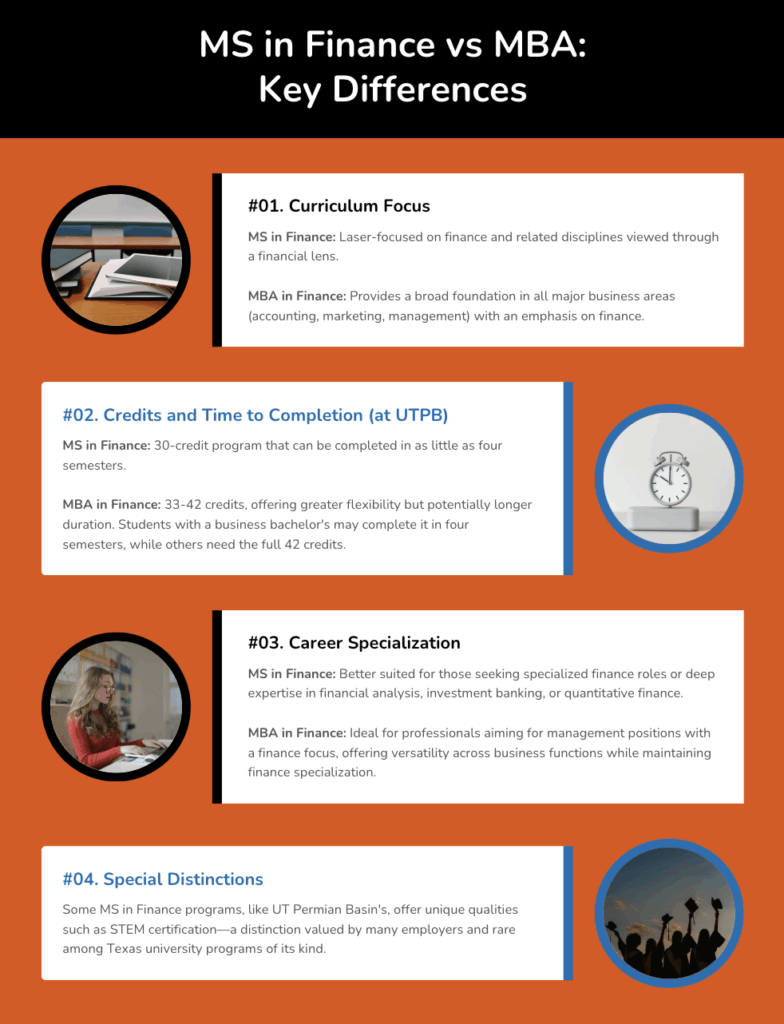
MS in Finance vs. MBA in Finance: Key Differences to Know
While both degrees focus on finance, the MS and MBA each offer unique advantages you’ll want to consider to ensure the best fit for your goals:
Emphasis of Curriculum
An MS in finance is laser-focused on finance. It’ll look at accounting, which is closely connected to finance, as well as management and other business disciplines through a financial lens.
In general, an MBA will provide a broad foundation in all major areas of business, including accounting, finance, marketing, and management. An MBA in finance includes courses in those topics but places an emphasis on finance.
Number of Credits and Time to Completion
Like any master’s degree program, an MS in finance and an MBA in finance can vary in credit requirements and, correspondingly, time to completion. Here’s the breakdown for UT Permian Basin’s online graduate finance programs:
Our MS in finance is a 30-credit program. Many students finish this program in as 12 to 24 months.
Our MBA in finance ranges from 33 to 42 credits, which offers students greater flexibility but a potentially longer duration. Those who enter the program with a bachelor’s degree in business may be able to complete the program in as little as four semesters. Students with another type of bachelor’s degree must complete the full 42 credit hours.
Special Distinctions or Features
Some online finance graduate programs have unique qualities that help them stand out. For example, UT Permian Basin’s MS in finance is among a very small number of Texas university programs of its kind with STEM certification—a quality many employers may value in their candidates’ university credentials.
Frequently Asked Questions About Graduate Finance Degrees
Choosing the right graduate degree is a big decision. Still weighing your options? Here are answers to some of the most common questions we hear:
Is an MS in finance or an MBA in finance better for someone with no business background? An MBA may offer broader exposure to key business principles, making it a good option for those without a business undergraduate degree. However, our MS in finance welcomes applicants from a variety of academic backgrounds and offers a focused path for those ready to specialize.
Which program is more respected by employers? Both degrees are respected, but the “right” one depends on the role. For finance-specific roles (like financial analyst or investment banker), an MS may be ideal. For leadership roles in finance departments, the MBA may offer broader appeal.
What’s the difference in ROI between an MS and an MBA? ROI can vary based on your career goals, prior experience, and the industry you enter. In general, both degrees can lead to strong salaries and job stability in finance and related fields.
Top Benefits of Our Online MBA and MS in Finance Programs
Whether you choose an MS in finance or an MBA in finance, if it’s one of UT Permian Basin’s online programs, you can count on optimal quality and convenience, with:
Self-paced learning
24/7 program access from virtually any location in the world
Dedicated doctoral-level faculty noted for their publications and research
Six start times per year
AACSB accreditation
Career and Earning Potential for a Master’s Degree in Finance
Did you know that most of the best-known Fortune 500 CEOs have a finance background? If that’s not inspiration enough for you, consider that a finance degree prepares you for a variety of rewarding professional roles. What’s more, the U.S. Bureau of Labor Statistics (BLS) reports that master’s degree holders enjoy median earnings 16% higher than individuals with a bachelor’s degree alone and are more likely to be employed than anyone with a lesser degree.
Financial planning for millennials isn’t about hitting milestones on the same timeline our parents did. If that were the standard, a large percentage of us would already feel behind. Instead, it’s about understanding your money, making informed decisions, and building stability in a changing economy. If that already feels refreshing, good. Because many millennials are managing student loans, rising living costs, career…
Ever opened your bank account and thought: “How do I have another bill due already?” You’re not alone. Financial stress affects 61% of adults ages 18 to 35, whether it’s from: Gen Z has been through a lot—from the COVID pandemic’s economic impact to inflation and job uncertainty. That’s why smart financial planning matters more…
Imagine sending money across the world in seconds—without waiting for a bank transfer or filling out piles of forms. That’s the promise of cryptocurrency. Cryptocurrency is digital money that doesn’t require banks. Instead, your funds are secured by encryption and passwords only you control. When Bitcoin launched in 2009, it introduced a new way to…